










A customer asks your support team whether they can change a booking after last week's fare-rule update, and whether they'll get a refund. The policy page has changed, the booking record shows a special fare class, and an older help article still appears in search. Your AI assistant needs more than a plausible answer. It needs to find the applicable evidence, resolve the gaps, and know whether it's allowed to act.
Agentic AI RAG addresses that problem by giving an agent control over retrieval. The useful way to understand it isn't as a smarter chatbot, but as a controlled retrieval loop with an audit trail. That distinction matters when you're responsible for customer outcomes, employee privacy, or changes to business records.
Table of Contents
- What Agentic RAG Means in Plain Terms
- How the Agentic RAG Loop Works, Step by Step
- Building Blocks of an Agentic RAG System
- Enterprise Use Cases Where Agentic RAG Pays Off
- Measuring Agentic RAG Beyond the Final Answer
- Risks When Retrieval Meets Autonomous Action
- Confirm Your First Agentic RAG Use Case
What Agentic RAG Means in Plain Terms
For the booking question, a standalone large language model, or LLM, can explain common refund practices. But without access to your systems, it can't establish what your updated policy says or which fare the customer purchased. Fluent language doesn't establish eligibility.
Retrieval-augmented generation, or RAG, adds external knowledge at answer time. In a simple standard RAG pipeline, the application searches a document collection and passes the returned passages to the model. The model then writes an answer using that context.
That works when the retrieved material contains everything needed. It's less suitable when the first result describes change fees but says nothing about the customer's fare class or the policy's effective date.
From fetching information to investigating a question
Think of standard RAG as a librarian who fetches material from one shelf in response to your request. Agentic RAG is closer to a research assistant who checks several books, follows a reference, and returns to the shelf when something is missing.
The important difference is who controls the next lookup. In an agentic system, a reasoning model can choose another search, inspect a document, or use a permitted tool based on the evidence already collected. It doesn't have to accept the first batch of passages as sufficient.
Standalone LLM, standard RAG and agentic RAG compared
| System | Retrieves at runtime | Plans multiple steps | Chooses tools | Best suited for |
|---|---|---|---|---|
| Standalone LLM | No | No | No | Drafting and general knowledge from training data |
| Standard RAG | Yes, one query | No | No | Answering from a single document set |
| Agentic RAG | Yes, repeated and adaptive | Yes | Yes | Multi-step questions that span policies, records and actions |
These are simplified architectural categories, not limits on every product. A fixed RAG pipeline can include query expansion or reranking without becoming agentic. Likewise, a standalone model can write a plan, but writing one isn't the same as executing a retrieval workflow.
Practical test: Does the system decide what to look up next based on what it has already found?
An agent also doesn't need write access to qualify. A read-only assistant that investigates missing evidence can use agentic RAG without changing a booking or issuing a payment. Adaptive retrieval and permission to act are separate design choices.
How the Agentic RAG Loop Works, Step by Step
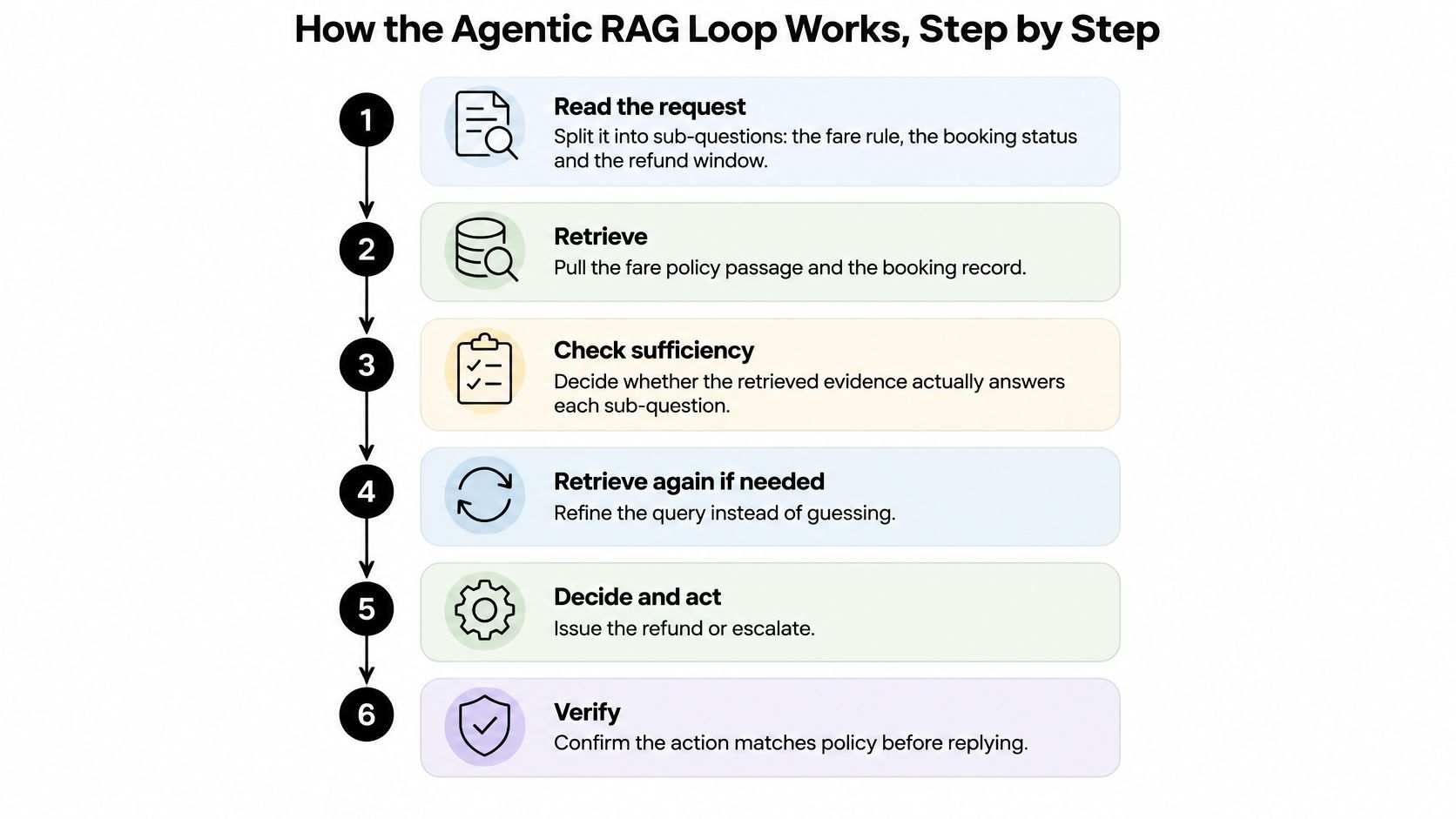
The refund request becomes manageable when the application treats it as an investigation with explicit checkpoints. The AgenticRAG paper describes a reasoning harness with search, find, open, and summarize tools, allowing an agent to inspect evidence iteratively rather than generate from a fixed search result.
This diagram groups the workflow into its main operational stages.
Follow the refund request through the loop
Read the request and separate the questions. Establish whether the customer wants a change, a cancellation, or an explanation of their options. Break the request into evidence needs, including the applicable fare rule, booking status, and refund window.
Choose the appropriate tool. Search the policy index for applicable rules, use a booking lookup for live account details, or open a known policy document. Choosing deliberately avoids using document search to answer a question that requires a transactional record.
Retrieve and inspect candidate evidence. Check the passage's scope, effective date, and surrounding conditions instead of trusting its search position. A highly relevant refund paragraph may still apply to the wrong fare class.
Check whether the evidence is sufficient. Match each sub-question to supporting material and identify unresolved gaps. If the policy refers to an exception schedule, retrieve that schedule rather than guessing what the exception means.
Join the evidence across sources. Connect the booking's fare class and purchase details to the applicable policy conditions. Keep those relationships explicit so a reviewer can see why a rule applies to this customer.
Act only within authorization, then verify. If the customer has confirmed the change and the application permits it, call the rescheduling tool with validated inputs. Inspect the tool result before claiming success, and don't confuse a submitted request with a completed booking change.
Record the evidence trail and answer. Capture queries, source identifiers, relevant excerpts, tool outcomes, and the stop reason throughout execution. Return a concise explanation with citations, clearly separating confirmed facts from unresolved questions.
Give the loop a stopping rule
Set hard limits for search attempts, elapsed time, and spend in the orchestration layer. Each additional retrieval or model call adds work, and a model shouldn't decide for itself that unlimited searching is acceptable.
Useful stop reasons include sufficient evidence, missing authoritative material, unresolved conflict, tool failure, and exhausted budget. An exhausted budget should produce an honest handoff, not a confident answer assembled from incomplete context.
For a complementary walkthrough, watch the following video.
Trace a real customer question through this sequence in your own system. Mark the first checkpoint where the evidence or execution becomes unreliable, rather than judging only the final wording.
Building Blocks of an Agentic RAG System
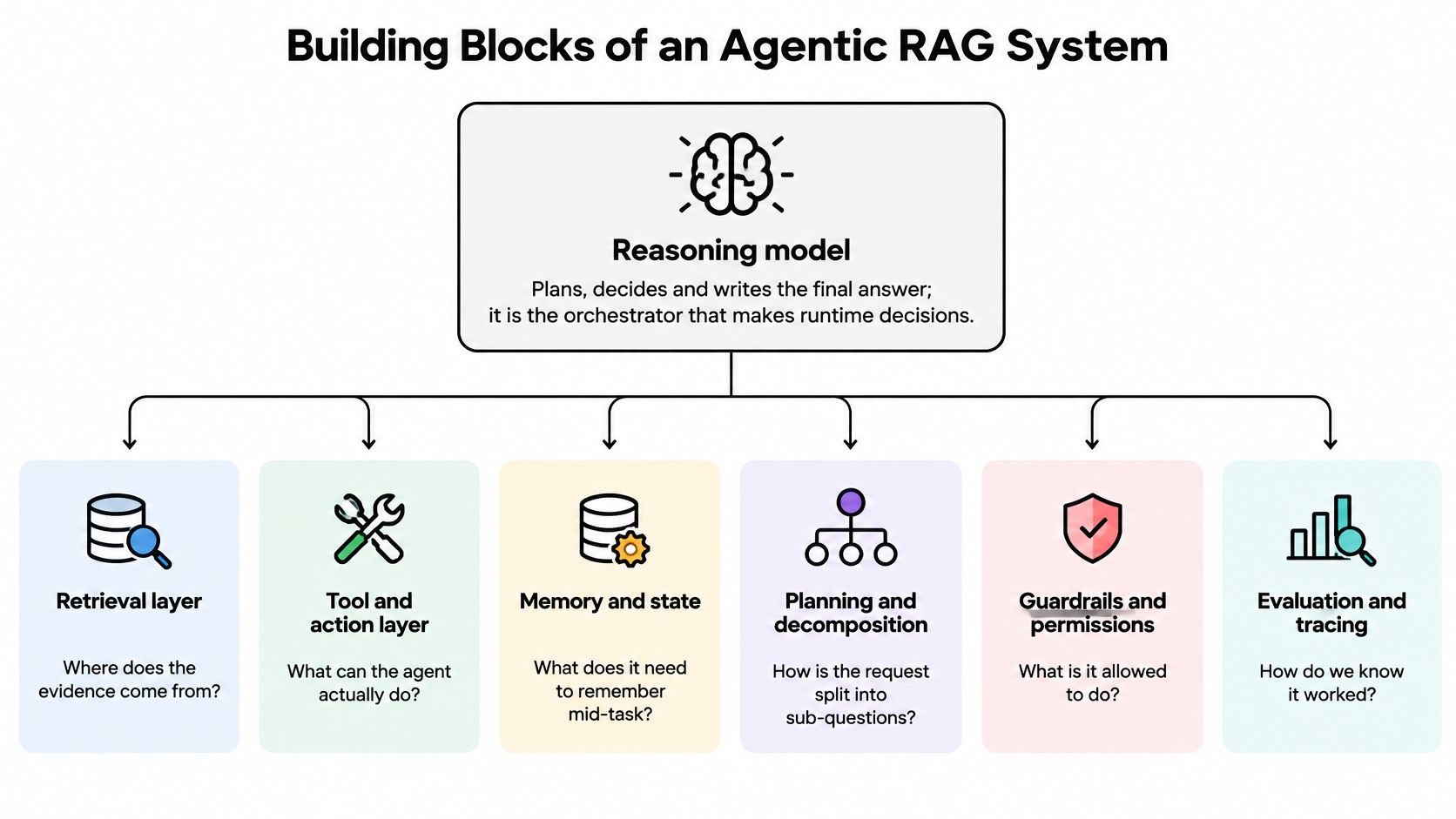
A useful architecture review starts with responsibilities, not framework names. You should be able to identify where the application makes decisions, where it obtains evidence, and where it enforces limits.
The following diagram shows how those responsibilities connect.
Decisions, evidence, and execution
The reasoning model answers, “What should happen next?” It interprets the request, decomposes the task, selects available tools, and drafts the response. The application should validate its proposed operations rather than treating generated text as an executable command.
The retrieval layer answers, “Where does the evidence come from?” It includes keyword, vector, or hybrid indexes, document chunking, and metadata. Dates, document owners, identifiers, and access rights are operationally important because matching words alone won't establish whether a passage applies. A clear retrieval-augmented generation foundation helps distinguish these retrieval responsibilities from agent orchestration.
The tool layer answers, “What can the agent do?” Expose narrow operations such as searching an index, opening a document, or reading a booking. Write operations need defined input schemas, server-side validation, and protection against duplicate execution.
State, traceability, and enforcement
Memory and state answer, “What must remain available during this task?” Track the user's intent, verified facts, unresolved questions, visited sources, and remaining execution budget. Separate retrieved evidence from tentative conclusions so an early assumption doesn't become an accepted fact later.
The evidence and audit layer answers, “Can someone reconstruct what happened?” Store observable execution events and concise decision summaries, not an assumed window into the model's private reasoning. Preserve source versions or approved snapshots where permitted, since a citation to a page that later changes may not explain yesterday's decision.
The guardrail layer answers, “What is allowed?” Enforce identity checks, tool permissions, approval requirements, and escalation rules outside the model. A prompt can describe a restriction, but an authorization service must enforce it.
You don't necessarily need to replace an existing enterprise search stack. First check whether its interfaces expose the metadata, document access, and evidence needed by an orchestration layer.
Use this ownership checklist during a design review:
- Name the owner: Assign a team responsible for each component's operation and changes.
- Test the dependency: Record what happens when search, state storage, or an action tool becomes unavailable.
- Inspect incident readiness: Confirm that an on-call engineer can locate the relevant evidence and execution history without recreating the conversation manually.
Enterprise Use Cases Where Agentic RAG Pays Off
Consider an employee asking whether they can combine annual leave with a particular benefit. The handbook describes general eligibility, a regional HR page adds a local restriction, and the employee portal contains their employment category. A useful answer requires connecting those sources, not merely finding a paragraph about leave.
The assistant can open the relevant handbook section, identify the employee's permitted profile details, and check the regional policy. If the regional page conflicts with the handbook and neither identifies which takes precedence, the assistant should prepare a handoff containing both passages and the unresolved question.
That handoff is a useful outcome. The assistant has reduced the investigation work without inventing an HR determination.
Match the workflow to the evidence
Agentic retrieval is most useful when one lookup reveals what another lookup must establish. Flight rebooking illustrates the pattern: the booking record identifies the fare class, which determines the policy section to inspect, which may introduce an exception requiring another source.
The following risk levels are planning categories, not formal assessments. Actual exposure increases with sensitive information, irreversible actions, and the consequences of an incorrect decision.
Enterprise use cases for agentic RAG
| Use case | Knowledge sources | Agent action | Risk level |
|---|---|---|---|
| Order status and rescheduling | Order system, booking rules | Read order, reschedule booking | Medium |
| Employee benefits and leave questions | Benefits handbook, HR policy pages | Answer with citation, open leave request | Medium |
| IT self-service troubleshooting | Known-error articles, device logs | Run guided fix steps | Low to medium |
| Compliance guidance in banking and healthcare | Regulations, internal policy documents | Answer with clause citation, escalate exceptions | High |
| Internal service requests | Service catalogue, approval policies | Submit request, route for approval | Medium |
For IT support, distinguish a guided restart from a privileged configuration change. For internal service requests, distinguish submitting an access request from granting access. Similar conversational interfaces can conceal very different operational consequences.
Recognize where the approach won't help
The required answer must exist in accessible, authoritative material or an approved operational system. An agent can search around missing evidence, but it can't turn an undocumented exception into an established policy.
For an initial action-taking deployment, prefer a reversible operation with a clear confirmation step. Avoid starting with discretionary compliance decisions, contested employee entitlements, or workflows where correcting an error requires another institution's intervention.
Choose the pilot with the cleanest evidence and the easiest recovery path, not the most impressive demonstration.
If a scoped standard RAG system already answers the question reliably, keep it. Add an adaptive loop where you can identify a concrete failure, such as missing cross-source evidence or the need to inspect a referenced exception.
Measuring Agentic RAG Beyond the Final Answer
On the Heterogeneous Enterprise Retrieval Benchmark, which contains 39,190 enterprise artifacts, a ReAct agent achieved an average score of 32.96, exceeding the hybrid-search baseline by 12.35 points, according to the benchmark paper. The improvement is meaningful, but the modest overall score is a warning against treating an architectural upgrade as proof of production readiness.
A better average can hide the failures your customers care about most. An agent may retrieve the right policy but join it to the wrong account, cite an irrelevant ticket, or answer a question the available documents don't cover.
Diagnose the stage, not just the sentence
Label failures by stage: planning, query decomposition, retrieval, tool use, citation selection, synthesis, memory, or policy enforcement. The same incorrect answer can originate from different defects, and each defect needs a different fix.
Metrics that show where agentic RAG fails
| Metric | What it catches | Example failure it reveals |
|---|---|---|
| Retrieval recall | Whether needed sources were found at all | The agent never opened the current refund policy |
| Answer faithfulness | Claims not supported by retrieved evidence | A fluent refund answer that the source text does not contain |
| Citation correctness | Whether cited sources actually support the claim | A link to an unrelated ticket |
| Abstention accuracy | Whether the agent declines appropriately when evidence is missing | A confident guess on a question the documents do not cover |
| p95 latency | The response-time threshold below which approximately 95% of requests fall | Repeated searches that stall a live chat |
| Cost per resolution | Total model and tool spend per solved case | Repeated searches to resolve a simple order-status question |
Treat p95 latency as a percentile boundary, not the average response time of the slowest requests. Likewise, define resolution before calculating cost: a cheap answer that creates a repeat contact isn't necessarily a cheap resolution.
Build a business-facing scorecard
A research synthesis on agentic RAG evaluation identifies difficulties assigning credit across multi-step trajectories and warns that LLM-based judges can be unstable or biased toward outputs resembling their own. Use automated graders for repeatable checks, but pair them with human review of ambiguous cases, policy exceptions, and consequential actions.
A practical RAG evaluation metrics scorecard should connect technical measurements to resolution rate, escalation quality, and cost per resolved interaction. Evaluate handoffs for usable context, not merely whether a transfer occurred.
Release criterion: A quality improvement should survive checks for evidence support, operational delay, spending, and policy compliance.
Compare changes against the same representative question set. Include missing answers, conflicting documents, and failed tools, not just clean questions with obvious supporting passages.
Risks When Retrieval Meets Autonomous Action

An agent finds a policy that appears to authorize a refund, then calls the payment tool. The policy is outdated, and the refund goes through before anyone notices. Retrieval can ground an answer in documents, but it cannot by itself establish whether a source is current or whether an action is allowed.
A security analysis of retrieval-enabled and agentic systems describes prompt-injection exposure, expanding system state, and runtime policy enforcement as security concerns. Read-only retrieval can still expose confidential information or produce harmful advice. When an agent can act, errors may also change a booking, alter access, or initiate a financial operation.
Treat retrieved content as evidence, not authority
A document might contain instructions to ignore the agent's rules or disclose protected information. That is prompt injection: text to assess, not a legitimate change to system permissions.
Attacks are only one source of failure. An obsolete policy may look authoritative; conflicting documents may lead the agent to choose arbitrarily; and an overbroad search account may return material the requester should not see. In banking, healthcare, utilities, and HR, a plausible but unauthorized response can create privacy, discrimination, financial, or safety risks.
Put controls outside the model
- Source trust tiers: Label approved policies, informal discussions, and external material separately. Set precedence rules so the model does not infer authority from writing style.
- Instruction-data separation: Treat retrieved text as content to evaluate. Do not let it change system rules or tool permissions.
- Permission-aware retrieval: Apply the requester's access rules when searching and opening documents, rather than filtering only the final answer.
- Approval thresholds: Require explicit approval for consequential writes. Reject actions when their prerequisites have not been verified.
- Immutable audit trails: Protect execution records from alteration, and set appropriate retention and access controls.
- Adversarial testing: Try malicious passages, conflicting policies, unauthorized requests, and interrupted operations before release.
- Safe abstention: Give the user a clear refusal or handoff when the system cannot establish an authorized path.
Guidance on preventing unsupported AI answers can help address factual errors, but a factuality check does not establish authorization. A correctly cited policy still cannot grant an agent permission to issue a refund.
Keep the control plane separate from the search index. Retrieval supplies evidence; application services enforce identity, permissions, approvals, and action limits. Record which sources informed a decision, which checks passed, and whether a human approved the action. That audit trail helps teams investigate failures and refine controls without treating a confident final answer as proof that the whole process was safe.
Confirm Your First Agentic RAG Use Case
A Capgemini Research Institute survey of 1,500 executives across 14 countries found that 61% of organizations were exploring agentic AI, 23% were running pilots, 12% had partial-scale deployments, and 2% had deployed agents at scale, as reported in Keyhole Software's enterprise adoption overview.
By comparison, PagerDuty's 2025 survey of 1,000 global IT and business executives found that 51% of companies had deployed AI agents, while another 35% planned to within two years. These aren't interchangeable measures: deployment participation doesn't establish full-scale operational maturity.
Make the pilot a go-or-no-go decision
Use explicit entry conditions rather than a broad ambition to become agentic:
- Owned sources exist. Each authoritative document has a named owner who can resolve omissions and conflicts.
- The initial scope is recoverable. Start read-only or allow only a narrowly defined, reversible action.
- Success is measurable. Establish acceptance criteria for retrieval recall, faithfulness, citation correctness, abstention, latency, and resolution cost.
- Human escalation is ready. Assign a destination and handoff format before enabling writes.
- Access and tracing are active. Test permission enforcement and audit records before exposing the pilot to users.
Start with evidence gathering and explanations. Add actions only when the scorecard passes, and count correct abstention as successful behavior rather than failed automation.
This week, select a workflow with clean sources and collect a representative set of real questions. Trace each through the retrieval loop, label the earliest failure, and assign an owner to fix it before expanding scope.
Our Conversational Knowledge Base uses Agentic RAG to support enterprise knowledge retrieval. Visit Yellow.ai to explore how it could fit a bounded customer or employee service workflow, and bring your source inventory, evaluation questions, and approval requirements to the discussion.