













Agentic RAG is an AI system where autonomous agents can plan, retrieve, validate, and refine information across multiple steps to solve complex problems, not just answer simple questions. In practice, it's the shift from a one-shot retrieve-then-generate pattern to an iterative reasoning loop that can break work into sub-queries, use different tools and sources, and check its own context before responding.
If you're leading AI in a large enterprise, you've probably hit the same wall. Your chatbot handles FAQs well enough, but it falls apart when a customer issue spans order history, policy exceptions, inventory availability, and a backend workflow. The failure usually isn't the language model alone. It's the architecture around it.
That's where Agentic RAG starts to matter. Most writeups stop at the mechanics. Enterprise leaders need a different answer: why use it, when is it worth the extra complexity, and how do you govern it before it starts touching real workflows. Those are the questions that decide whether a pilot creates value or becomes another AI demo that never reaches production.
Table of Contents
- Beyond Answers to Autonomous Actions
- From Retrieval to Reasoning Defining Agentic RAG
- Agentic RAG vs Standard RAG and Agentic AI
- The Architecture of an Agentic RAG System
- Enterprise Use Cases for Customer and Employee Experience
- Implementation and Governance Considerations
- Activating Enterprise-Grade Agentic RAG with Yellow.ai
Beyond Answers to Autonomous Actions
A customer opens a support chat because an urgent shipment hasn't arrived. The bot checks tracking, repeats the latest scan, and offers a generic apology. The customer asks a more useful question: can the company reroute from another warehouse, waive expedited shipping on the replacement, and update the account team because this order supports a live launch?
That's where many assistants stall. A standard bot can fetch one answer from one source. It usually can't coordinate a sequence of decisions across policy documents, order systems, CRM notes, and operational tools. It answers the first question it can recognize, not the actual problem the customer needs solved.
Agentic RAG changes that operating model. Instead of treating retrieval as a single lookup step before generation, it gives an AI agent control over the loop so the system can plan what to check, retrieve from multiple sources, validate what it found, and refine the response over several steps. IBM's overview of agentic RAG describes it as a newer evolution of retrieval-augmented generation built to improve adaptability, multi-source retrieval, and accuracy in more complex workflows.
The real upgrade isn't that the system sounds smarter. It's that the system can pursue the task, not just respond to the prompt.
For enterprise teams, that distinction matters. Customer service doesn't run on isolated facts. HR service doesn't run on one policy PDF. IT support doesn't run on a single knowledge article. The work is cross-system, contextual, and conditional.
That's why agentic RAG is getting attention as the next step beyond simpler AI models. It's not a replacement for every use case. But for processes where the answer depends on planning, retrieval strategy, and validation, it solves a problem traditional chat architectures were never built to handle.
From Retrieval to Reasoning Defining Agentic RAG
A simple way to understand what Agentic RAG is starts with a familiar comparison.
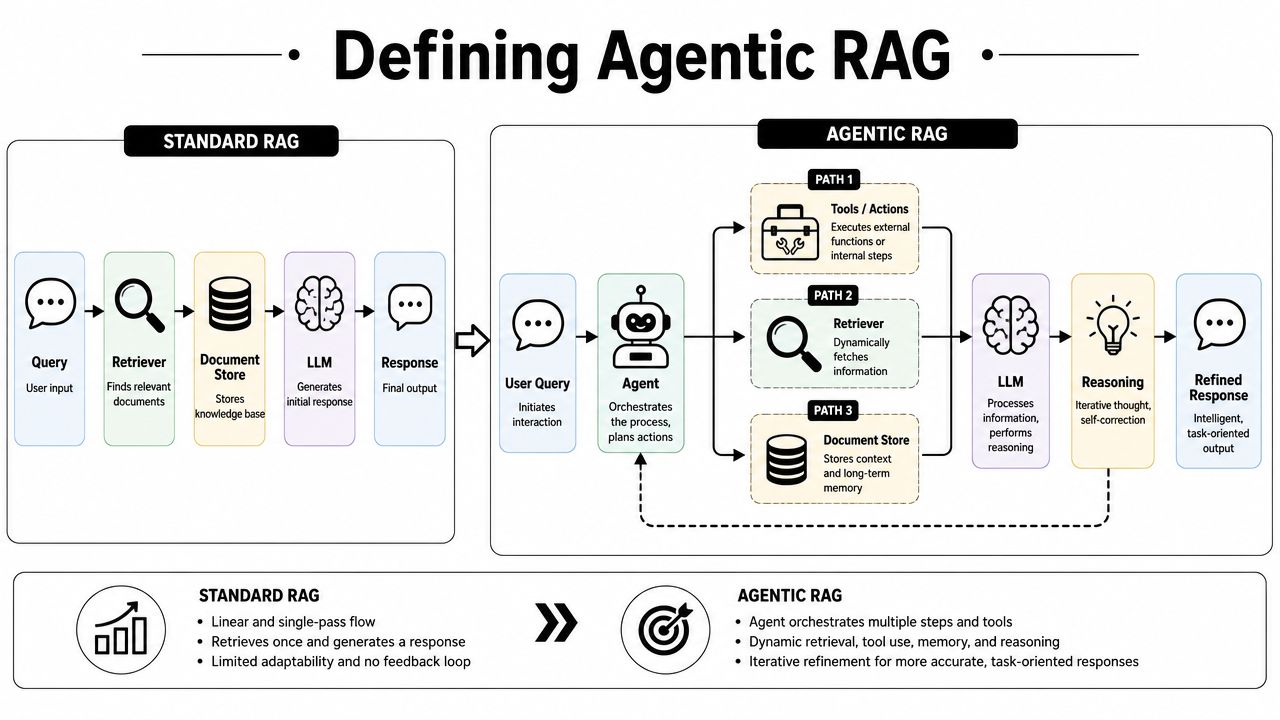
Standard RAG works like a librarian. You ask for something specific, the system searches a knowledge base, retrieves relevant passages, and the model answers based on that material. That pattern is useful, efficient, and often enough for direct factual questions.
Why standard RAG feels limited in enterprise work
The weakness appears when the request is layered. A customer asks for a refund exception based on loyalty status and shipment delay. An employee asks how parental leave interacts with local policy, manager approval, and remaining vacation days. A support engineer asks for the likely root cause of an incident using a mix of runbooks, recent alerts, and change logs.
In those moments, retrieval isn't just lookup. It becomes a problem-solving process.
What changes when an agent controls retrieval
Agentic RAG works more like an experienced research assistant than a librarian. It interprets the goal, breaks the task into sub-questions, decides which sources or tools to use, checks whether the retrieved context is sufficient, and then revises the plan if needed.
Weaviate defines it clearly in its explainer on what agentic RAG is: an AI agent controls the retrieval loop, not just the final generation step; the agent can plan sub-queries, choose among tools or sources, re-retrieve, and validate context before answering, turning retrieval into an iterative reasoning process rather than a one-shot lookup.
That shift produces a different behavior profile:
- Planning before answering means the system can decompose a broad request into smaller steps.
- Dynamic source selection means it can pull from the right place for the right sub-task, instead of treating all knowledge as one flat corpus.
- Validation and re-retrieval mean it can recognize weak context and try again before committing to an answer.
- Tool use means it can do more than summarize text. It can call systems, verify records, and move work forward.
A short walkthrough helps make this concrete.
Practical rule: If the request can be answered with one clean retrieval step, you probably don't need agentic RAG. If the request needs planning, cross-source synthesis, or verification, you probably do.
That's the core definition enterprise teams should use. Agentic RAG is not just “RAG, but better.” It is retrieval governed by an agent that can reason through the task.
Agentic RAG vs Standard RAG and Agentic AI
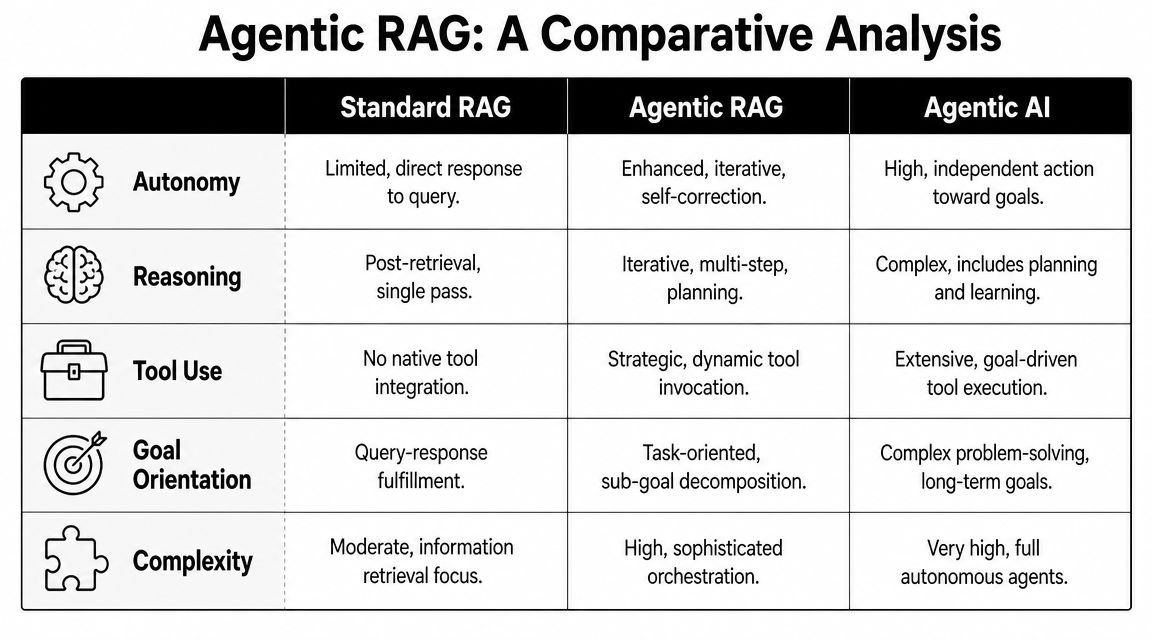
One reason this topic gets muddy is that three categories keep getting blurred together: standard RAG, agentic RAG, and agentic AI. They overlap, but they are not interchangeable.
Three models with different strengths
| Approach | Best fit | Main limitation |
|---|---|---|
| Standard RAG | Direct factual answers grounded in known content | Struggles when the task needs multi-step reasoning |
| Agentic RAG | Complex tasks that require planning, retrieval, and validation | Adds orchestration complexity |
| Agentic AI | Goal-driven workflows with broader autonomy | Can act without enough grounded knowledge if retrieval is weak |
Standard RAG is the simplest of the three. It retrieves supporting context and generates an answer. That makes it strong for knowledge assistants, FAQ automation, and direct support questions where the information already exists in a well-managed corpus.
Standalone agentic AI sits on the other side. It emphasizes autonomy, task execution, planning, and tool use. If you want a useful primer on that broader category, Zenfox.ai's agentic AI guide is a good companion read for business leaders comparing architectures.
Where confusion usually starts
The confusion usually starts when teams assume agentic AI automatically solves knowledge grounding. It doesn't. An autonomous agent that can plan and act still needs reliable access to current enterprise context. Without that, you just get a more confident system making decisions on partial information.
That's why agentic RAG is such an important middle path. It combines the autonomy of agents with the grounding discipline of retrieval. The “brain” can reason, but it still has to consult the “books.”
A second source of confusion is language. Some teams treat agentic RAG as just another chatbot feature. It's better understood as an architectural pattern. Yellow.ai's overview of agentic AI and how it differs from AI agents is useful here because it separates workflow autonomy from narrower agent behavior.
If standard RAG answers questions and agentic AI pursues goals, agentic RAG does both with a retrieval layer that keeps the system tied to enterprise knowledge.
For enterprise leaders, that's the practical takeaway. Choose standard RAG when the job is direct retrieval. Choose broader agentic AI when the system needs wider task autonomy. Choose agentic RAG when autonomy only works if it stays grounded in changing business knowledge.
The Architecture of an Agentic RAG System
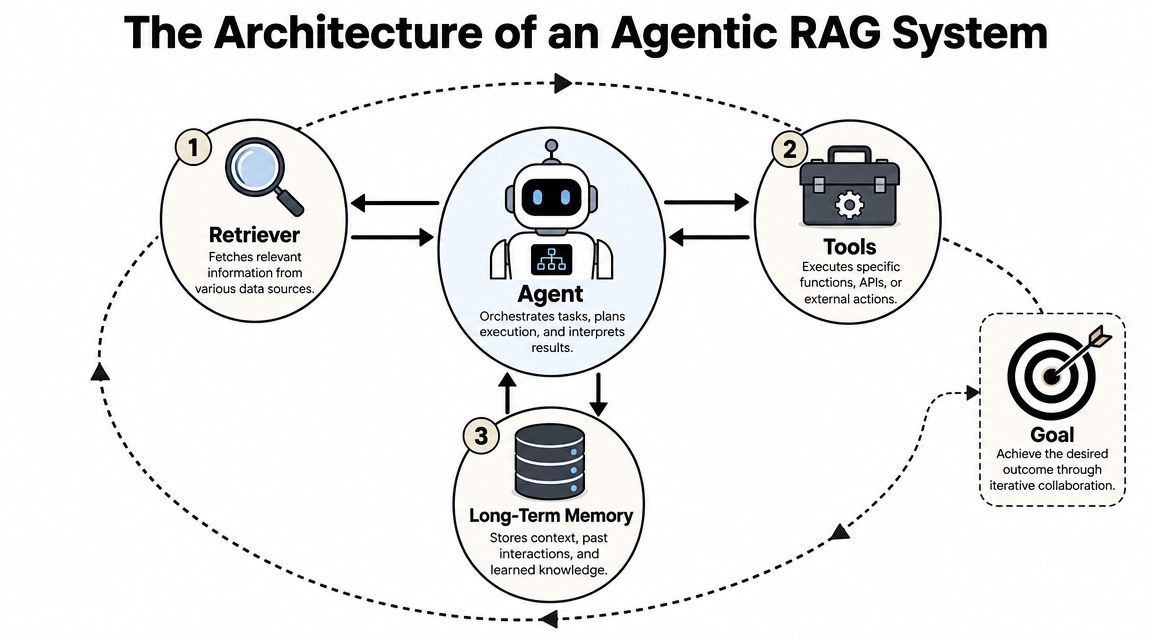
The easiest way to understand the architecture is to stop thinking about a chatbot and start thinking about an operating loop. The user asks for an outcome. The system plans, retrieves, acts, checks, and only then answers.
The components that matter most
At the center is the planner or orchestrator. This is the control layer that decides what the system should do first, what to do next, and when it has enough information to proceed. In an enterprise deployment, orchestration quality often matters more than model quality because it determines whether the system can handle ambiguity without wandering.
A mature orchestration layer usually needs these components:
- Retriever layer that can search across structured and unstructured sources, not just a single vector index.
- Tool library for actions such as API calls, ticket lookups, workflow triggers, or policy checks.
- Memory and context store so the system can preserve conversational state and task history.
- Validation loop that checks relevance, freshness, and consistency before the final output.
If you're evaluating orchestration patterns, Yellow.ai's overview of LLM orchestration is useful because it reflects the actual issue enterprises face: coordinating models, tools, and workflows rather than just calling an LLM once.
How the workflow behaves in production
In practice, the flow looks less like a straight line and more like managed recursion.
A customer asks for an order exception. The planner breaks that into sub-tasks. One sub-task checks account status. Another checks shipping state. A third pulls refund policy. If the policy article conflicts with the CRM record, the validation step triggers another retrieval. If approval is needed, a tool call can route the case.
That's why implementation teams often need strong expertise in AI agent development, especially when systems have to combine retrieval with operational actions across enterprise software. A useful reference point is AI agent development, which highlights the kind of engineering discipline these systems require beyond prompt design.
Here's the architectural test that matters most:
- Can the system decompose the task?
- Can it choose the right source or tool per step?
- Can it detect when the evidence is weak or outdated?
- Can it stop safely when confidence, policy, or workflow rules require escalation?
Good agentic RAG architecture is less about adding more agents and more about making each decision path observable, constrained, and recoverable.
That's what separates an interesting prototype from a production system.
Enterprise Use Cases for Customer and Employee Experience
The strongest use cases for agentic RAG appear where people ask layered questions and the answer lives across systems, not in one repository.
Customer experience scenarios
Take a logistics support flow. A customer asks why a delivery is delayed and whether the order can still arrive before an event. A simple assistant may return a tracking update. An agentic RAG system can work through the actual service problem: check shipment state, review replacement policy, inspect inventory in nearby locations, look at the customer's account history, and prepare the next best action for an agent or an automated workflow.
That pattern matters because enterprise support work is rarely synchronous and self-contained. NVIDIA notes in its discussion of traditional RAG vs agentic RAG that in complex workflows, agentic RAG is designed to improve accuracy, freshness, and reliability by adapting search strategy to the task and data source in real time. It highlights particular value for asynchronous tasks such as research, summarization, and code correction.
In customer operations, that translates well to scenarios like:
- Proactive support recovery where the system gathers evidence from order, policy, and service systems before proposing a remedy.
- Complex returns and exceptions where answers depend on loyalty status, product type, channel, and regional policy.
- Escalation preparation where the system doesn't just route a case, it assembles the full context an agent needs.
Employee experience scenarios
Employee service has the same pattern, but the stakes are often compliance and consistency.
An HR assistant receives a question about parental leave, accrued vacation, local policy differences, and manager approval. No single document answers that. The system has to combine policy content with employee-specific records and then present a response that's both grounded and constrained.
A similar need shows up in IT. An employee reports access loss after a role change. The assistant may need to inspect identity records, role mappings, access policy, and recent tickets before suggesting the next action.
What works well in these environments is not “better chat.” It's workflow-aware knowledge access.
- HR knowledge navigation benefits when policy interpretation requires multiple documents and employee context.
- IT support triage benefits when the issue spans runbooks, prior incidents, and system data.
- Operations research benefits when teams need summaries built from evolving evidence rather than one static source.
Enterprise value comes from reducing dead-end conversations. The system should advance the task, not simply answer the first sentence of the request.
That's the practical reason leaders are evaluating agentic RAG now. It aligns more closely with how service work happens.
Implementation and Governance Considerations
Here, most enterprise projects either become credible or collapse under their own ambition.
The architecture sounds compelling, but agentic RAG introduces real operating costs. More reasoning steps usually mean more model calls, more latency, more orchestration overhead, and more ways for the system to fail in non-obvious ways. That doesn't make it a bad design. It means you should apply it selectively.
When agentic RAG is justified
The first decision is economic and operational, not technical. Machine Learning Mastery's discussion of agentic RAG tradeoffs makes the core point clearly: agentic RAG is slower and costlier than static RAG because it requires multiple LLM calls, which makes static RAG better for single-hop factual queries and agentic RAG better for multi-step reasoning or cross-source synthesis.
That gives leaders a clean starting framework:
| Use case pattern | Better fit |
|---|---|
| One policy lookup | Standard RAG |
| One product answer from one source | Standard RAG |
| Policy plus account plus workflow exception | Agentic RAG |
| Multi-source investigation with validation | Agentic RAG |
Use agentic RAG when the cost of a wrong or incomplete answer is higher than the cost of extra orchestration. Don't use it to answer questions that a direct retrieval pipeline can already resolve.
What governance needs to cover
The second issue is governance. As agentic behavior becomes more dynamic, it also becomes harder to predict.
The recent survey on agentic retrieval-augmented generation frames the category as combining reflection, planning, tool use, and multi-agent collaboration. That flexibility is powerful, but it also raises a practical enterprise question: how do you prove the added autonomy improves outcomes rather than contributing to increased system complexity?
A governance model should cover at least these controls:
- Source policy so the agent knows which repositories are approved for which decisions.
- Freshness checks so outdated content doesn't dominate retrieval.
- Action boundaries so some tasks can be executed automatically while others require human approval.
- Audit trails that record what the system retrieved, what it ignored, and why it responded the way it did.
- Escalation paths when evidence conflicts, confidence drops, or policy scope is unclear.
The mistake isn't giving the system autonomy. The mistake is giving it autonomy without boundaries, observability, and a defined handoff model.
How to evaluate before scaling
Enterprises should evaluate agentic RAG as a workflow system, not only as a language system.
Focus the review on questions like these:
- Did the agent choose the right sources?
- Did it retrieve enough evidence to justify the answer?
- Did it stop and escalate when the case required judgment or approval?
- Can your team inspect the retrieval path afterward?
You should also test failure modes deliberately. Give the system ambiguous prompts. Give it conflicting documents. Give it stale content. Give it partial permissions. These tests reveal more than polished demos ever will.
The best rollout model often proves to be narrow-first. Pick one workflow where cross-source reasoning clearly matters, define the approved tools and knowledge domains, and instrument the system heavily before broad deployment.
Activating Enterprise-Grade Agentic RAG with Yellow.ai
Enterprise teams don't need another abstract AI concept. They need a platform that can connect knowledge, orchestration, testing, and governance in one operating model.
That's where a platform approach becomes useful. Yellow.ai supports agentic RAG through its Conversational Knowledge Base, which works with documents, websites, and internal knowledge sources, and through its AI Agent Builder 2.0, which gives teams a way to design and test multi-step workflows in a low-code environment. For leaders looking at how this applies to service operations, Yellow.ai's overview of agentic AI workflows in customer service shows how retrieval and action can be combined in production-oriented flows.
What matters most is the combination of capabilities:
- Knowledge ingestion across multiple enterprise sources, so responses stay grounded in business context.
- Agent design and orchestration so teams can define multi-step retrieval and action paths instead of relying on one generic prompt.
- Testing and analytics so behavior can be monitored, refined, and constrained.
- Safe AI and enterprise compliance controls so governance is built into deployment rather than added later.
For enterprise leaders, that's the right lens for evaluating any agentic RAG platform. Don't ask whether it can answer a question in a demo. Ask whether it can retrieve from the right systems, reason through a real workflow, and remain governable when the stakes are operational.
If you're evaluating how to bring agentic RAG into customer service, employee support, or enterprise operations, Yellow.ai is worth exploring as a practical platform for orchestrated, governed AI agents. The right next step isn't a broad rollout. It's a focused pilot on a workflow where static RAG already falls short and agentic reasoning can be measured clearly.



