











Most advice on a voice of customer program still starts in the wrong place. It starts with surveys, forms, scorecards, and response rates. That made sense when customer feedback was sparse and expensive to gather. It doesn't fit an enterprise where customers are already telling you what matters in calls, chats, reviews, support tickets, community threads, and product behavior every day.
The problem isn't a lack of input. It's an overproduction of disconnected signals.
A modern voice of customer program has to do more than collect opinions. It has to convert conversational data into decisions, route those decisions into operating teams, and verify that action changed an outcome customers can feel. If your program ends with a dashboard, you don't have a VoC capability. You have a reporting layer.
Table of Contents
- Beyond Surveys Rethinking Your VoC Program for the AI Era
- Establish Your VoC Governance and Strategic Goals
- Unify All Customer Signals from Surveys to Voice AI
- Build an Analytics Engine to Decode Customer Intent
- Operationalize Insights and Close the Loop
- Scale Your Program with AI and Change Management
Beyond Surveys Rethinking Your VoC Program for the AI Era
A survey-heavy program gives leadership a delayed, partial view of customer reality. It captures what a subset of customers chooses to say after an interaction. It rarely captures what happened during the interaction, what the customer tried before reaching support, or what behavior changed afterward.
That gap matters because the original purpose of VoC was operational, not ceremonial. A foundational milestone came after World War II, when formal quality methods pushed organizations to treat customer feedback as an operational input instead of anecdote. Modern programs expanded that approach into multi-channel systems that combine surveys, support transcripts, web analytics, social listening, and other sources to identify themes and prioritize improvements, as described in Sprinklr's overview of voice of the customer.
What legacy VoC misses
Enterprise teams often overvalue solicited feedback because it's structured and easy to chart. But customers are more candid in live conversations than in post-interaction forms. The most useful signal is often buried in what they say unprompted:
- Support calls reveal friction in sequence. You hear where the customer started, what failed, what workaround they tried, and what broke trust.
- Chats expose wording problems fast. Customers repeat the same confusion in their own language, which is exactly what product, knowledge, and automation teams need.
- Behavioral data adds consequence. A complaint matters more when it appears alongside lower usage, repeated logins, or rising support volume.
This is why a modern program has to ingest unstructured data continuously, not wait for survey cycles.
Most VoC teams don't suffer from a listening problem. They suffer from a translation problem.
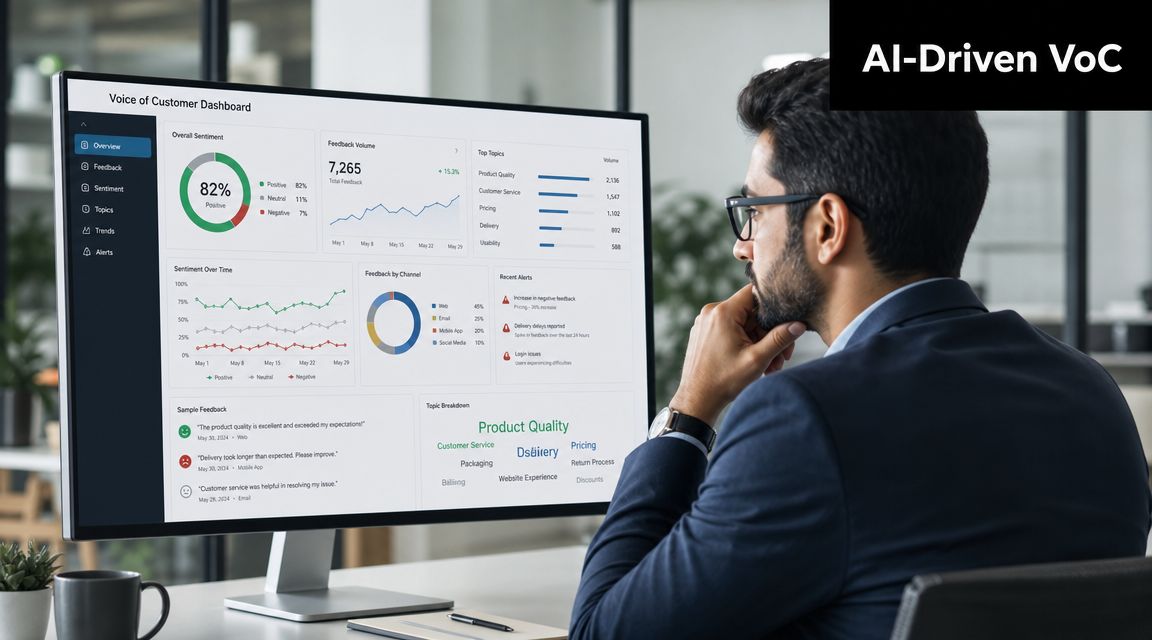
AI changes the economics of translation. Conversation intelligence can cluster themes, detect intent shifts, surface root-cause phrases, and route issues while interactions are still fresh. Teams that want to build AI-powered browser agents for monitoring web journeys, form failures, and customer-facing flows can add another layer of observational signal to the VoC stack, especially when digital experience breaks before customers file a formal complaint.
The new standard is operational listening
The practical question isn't whether to keep surveys. Keep them. The question is whether surveys are the control panel or just one instrument.
If satisfaction is slipping while AI adoption rises, the issue is often fragmentation, poor orchestration, or weak escalation design rather than AI itself. That tension is captured well in Yellow.ai's analysis of declining customer satisfaction despite record AI adoption.
The best voice of customer program in 2026 doesn't ask customers to do extra work so the company can learn. It learns from the work customers already do. Then it turns that learning into product fixes, policy changes, better routing, tighter automation, and more competent human support.
Establish Your VoC Governance and Strategic Goals
Most VoC programs fail long before the first dashboard is built. They fail when nobody defines who owns prioritization, how insights move across functions, and what action counts as success. That's why governance isn't administrative overhead. It's the mechanism that prevents the program from becoming an archive of complaints.
A recurring gap in VoC design is actionability. Leading guidance stresses that VoC has to move from insights to actions, with clear accountability, shared access to findings, and prioritization by impact versus effort. The larger failure mode is organizational, not methodological, as outlined in MCORP's discussion of actionable VoC governance.
Start with operating decisions, not listening channels
If the first planning workshop centers on survey tools, tagging models, or dashboard filters, stop and reset. Start with the business decisions the program should improve.
For an enterprise leadership team, those decisions usually fall into a small set:
Retention decisions
Which signals should trigger intervention from CX, success, or service recovery teams?Product decisions
Which recurring points of friction belong in the roadmap, and which belong in onboarding, documentation, or defect management?Service design decisions
Which contact drivers should be automated, which should be redesigned, and which should remain human-led?Policy decisions
Which rules create preventable customer effort, repeat contacts, or avoidable escalations?
A good governance model ties every major VoC theme to one of those decision domains. That's how you keep feedback from drifting into generic "customer sentiment" reporting.
Design ownership before data volume rises
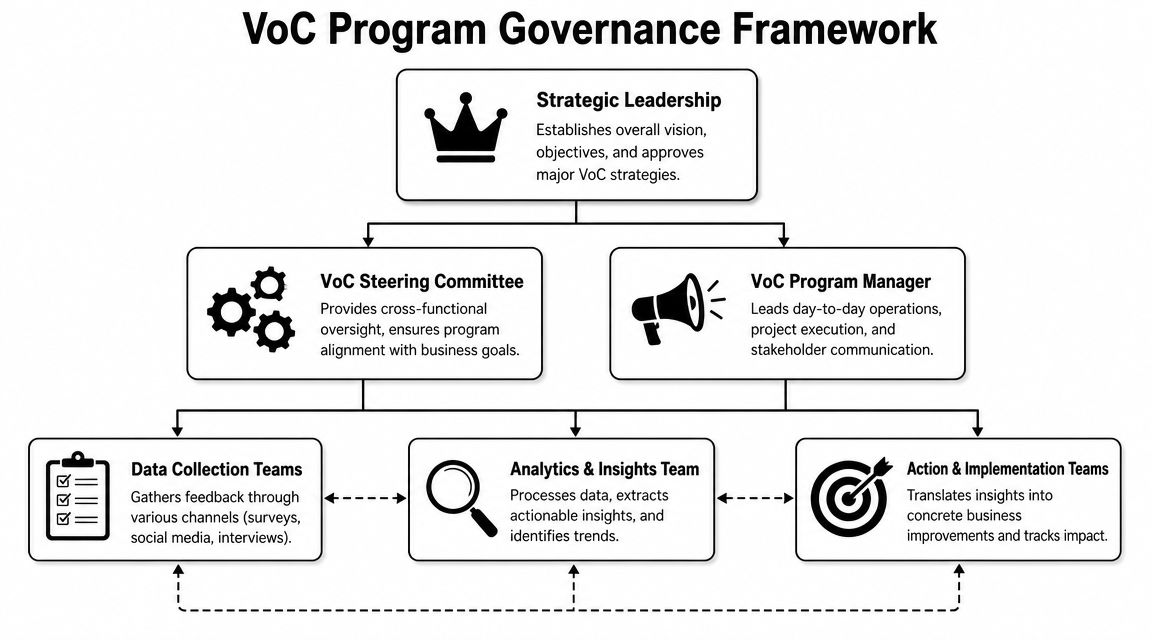
Cross-functional ownership sounds good in theory and collapses in practice unless roles are explicit. The cleanest operating model usually includes a steering group and a program leader, but it shouldn't stop there.
Use a simple ownership map:
- Executive sponsor owns funding, strategic alignment, and escalation when teams block action.
- VoC program manager owns intake standards, review cadence, taxonomy governance, and reporting discipline.
- Analytics lead owns classification quality, trend logic, and confidence thresholds.
- Domain owners in product, digital, contact center, service operations, and compliance own remediation.
- Change leads own rollout, training, and adoption after an insight becomes a process or tooling change.
Practical rule: If a VoC finding can't be assigned to one named operator within one business function, it isn't ready for executive review.
Many enterprises make the same mistake here. They create a steering committee with broad representation, then route every issue through consensus. That slows action and turns the committee into a debate forum. Use the committee for arbitration, budget trade-offs, and quarterly direction. Use domain owners for weekly execution.
Write a charter that survives executive turnover
A durable voice of customer program needs a short charter. Not a slide deck. A working document with operating rules.
At minimum, the charter should define:
| Charter Element | What it should answer |
|---|---|
| Business purpose | Which outcomes the program exists to influence |
| Scope | Which channels, journeys, and geographies are included first |
| Decision rights | Who prioritizes, who approves, who executes |
| Cadence | How often teams review, triage, and escalate themes |
| Evidence standard | What qualifies as a validated issue versus anecdotal noise |
| Closure criteria | How teams prove an action was completed and monitored |
The evidence standard is where mature teams separate themselves. One angry customer shouldn't trigger a roadmap detour. But repeated conversational evidence across support, chat, and digital behavior shouldn't wait for a quarterly survey to validate what operators already know.
Tie goals to enterprise outcomes
Don't define goals as "collect more feedback" or "increase listening coverage." Those are activity targets. They don't tell operating teams what success looks like.
Stronger goal statements sound like this:
- Reduce avoidable contact drivers by identifying the top reasons customers re-enter support after a failed self-service attempt.
- Improve service recovery by routing severe negative interactions to specialized teams before the next renewal, repayment, or purchase event.
- Strengthen product adoption by connecting friction themes with usage patterns and support demand.
- Improve agent effectiveness by feeding recurring issue patterns into coaching, knowledge articles, and workflow design.
When goals are framed this way, technology choices become easier. You're not buying a VoC platform. You're building a decision system.
Unify All Customer Signals from Surveys to Voice AI
An enterprise voice of customer program breaks when each channel tells a different story to a different team. Survey results sit with CX. Call recordings stay in the contact center. Chat transcripts live in a service platform. Product signals sit with digital or data teams. Nobody sees the whole journey.
That fragmentation is expensive because customers don't experience your channels separately. They move through them as one sequence.
Why solicited and unsolicited feedback behave differently
Solicited feedback is useful because it's standardized. Unsolicited feedback is useful because it's honest. You need both, but they shouldn't carry equal weight in every decision.
Solicited inputs include NPS, CSAT, CES, transactional surveys, and structured interviews. Unsolicited inputs include call recordings, chat logs, emails, review sites, social posts, community threads, and agent notes. Behavioral signals sit alongside both. They include product usage, repeated logins, drop-offs, support recontact patterns, and failure loops in self-service.
A practical listening architecture ingests all three categories and maps them to the same customer, journey stage, and issue taxonomy.
Comparison of VoC Data Sources
| Data Source | Type | Key Benefit | Key Limitation |
|---|---|---|---|
| NPS survey | Solicited | Standardized loyalty signal, easy to benchmark internally | Lacks rich context unless paired with verbatim feedback |
| CSAT survey | Solicited | Useful for measuring reaction to a specific interaction | Overweights the final moment rather than the full journey |
| CES survey | Solicited | Good for identifying customer effort in service flows | Narrow by design, often misses upstream root cause |
| Voice calls | Unsolicited conversational | Rich detail, emotion, sequence, and escalation cues | Hard to analyze manually at scale |
| Chat and messaging transcripts | Unsolicited conversational | Clear customer language and fast pattern detection | Context can fragment across sessions and channels |
| Social and review content | Unsolicited public | Reveals candid sentiment and reputation risk | May skew toward extremes and lack identity resolution |
| Product and web behavior | Behavioral | Shows what customers did, not just what they said | Doesn't explain intent without conversational context |
What a unified signal layer looks like
A useful design pattern is to organize sources by customer journey stage rather than by system. For example:
- Pre-purchase or pre-service signals might include search terms, chatbot exits, abandoned forms, and review content.
- Active service signals might include IVR paths, call transcripts, live chat, hold reasons, and transfer patterns.
- Post-resolution signals might include CSAT, repeat contact, portal usage, and complaint escalation.
Voice AI has a special role here because phone calls still contain some of the most nuanced customer feedback. Tone, interruption patterns, hesitation, and repeated rephrasing all reveal effort and intent. Teams evaluating conversational signal capture should understand how Voice AI systems work in enterprise service environments, especially when they want to analyze live and historical call data in one operating loop.
A customer who says "it's fine" after repeating the same issue three times isn't satisfied. They're exhausted.
This is why channel unification can't be a reporting exercise. It has to be an identity and context exercise. When the same customer appears in web logs, a chatbot transcript, a call recording, and a survey response, the program should treat that as one experience, not four datasets.
A unified signal layer also changes prioritization. Ten survey comments about an issue may matter less than three call transcripts tied to failed authentication and repeated support contact. Volume alone is a poor ranking method. Context, friction depth, and operational consequence matter more.
Build an Analytics Engine to Decode Customer Intent
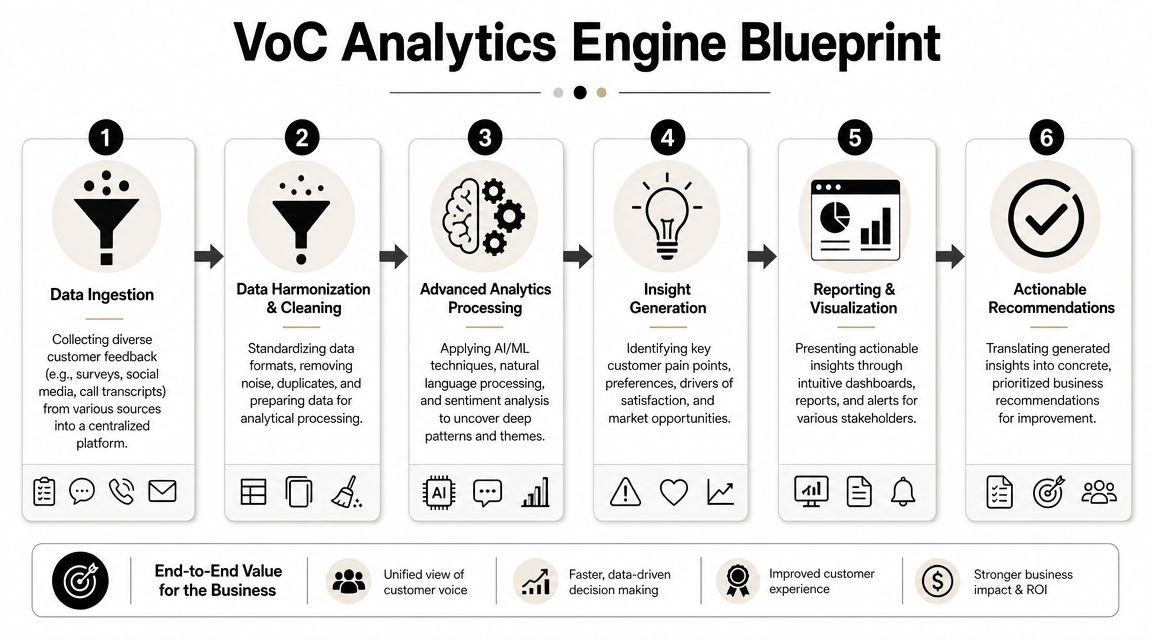
Collecting customer signals without a classification system creates a larger mess faster. The analytics engine is where a voice of customer program becomes operational. It translates messy language into consistent categories, links themes to business context, and surfaces patterns teams can act on.
This doesn't require perfect AI. It requires disciplined structure.
Build a taxonomy your operators can actually use
The best taxonomy isn't the most complex one. It's the one product, operations, service, and digital teams can all understand and apply.
A practical structure usually has several layers:
- Domain such as billing, onboarding, authentication, delivery, claims, returns, account access
- Issue type such as failure, delay, confusion, missing feature, policy friction, agent handoff
- Intent such as cancel, complain, dispute, upgrade, verify, track, reactivate
- Sentiment or effort signal such as positive, neutral, negative, frustrated, confused
- Outcome such as resolved, unresolved, escalated, abandoned, repeat contact likely
Many teams stumble by building a taxonomy around internal departments instead of customer language. Customers don't say "CRM sync issue" or "tier-two exception workflow." They say "I can't log in," "you charged me twice," or "your agent asked me the same questions again."
Move from themes to root cause
Topic detection is only the first layer. Real value comes from asking why the theme exists.
Take a simple example. A cluster labeled "login issues" looks actionable but isn't specific enough. The engine should separate password reset confusion from multi-factor authentication failures, expired links, browser incompatibility, and account lockout after bot detection. Each root cause belongs to a different owner.
Conversational AI and supporting data must meet. Support transcripts tell you what the customer experienced. Behavioral logs tell you what failed. CRM context tells you which segment was affected. Together, they convert a fuzzy complaint into an operational case.
Good analytics doesn't just tell you what customers discussed. It tells you which team can fix it next.
Role-based analytics platforms can help here. For example, Yellow.ai's insights engine is built to analyze conversational patterns, sentiment, and operational signals across customer interactions. In a mature stack, that kind of capability sits beside CRM, data warehouse, contact center, and workflow systems rather than replacing them.
Choose tooling that supports continuous ingestion
Tool selection should follow a few practical tests:
| Decision Area | What to look for |
|---|---|
| Ingestion | Can it absorb calls, chats, surveys, reviews, and behavioral context without heavy manual work? |
| Classification | Can teams tune taxonomy and review false positives without a data science bottleneck? |
| Workflow integration | Can insights trigger tickets, alerts, case routing, or knowledge updates? |
| Explainability | Can operators see why an item was classified a certain way? |
| Governance | Can you enforce access controls, auditability, and versioning of categories? |
Enterprises that want broader external signal coverage often need web-scale ingestion beyond owned channels. For teams doing market monitoring, review capture, public forum analysis, or competitor-adjacent intelligence, tools like the #1 Web Scraping API for LLMs can support the raw data pipeline feeding downstream VoC analysis.
What doesn't work is a one-time text analysis project. Customer language changes. Product terminology changes. Policy language changes. The taxonomy has to evolve with them. Mature teams review ambiguous categories, merge low-value labels, split overloaded themes, and retrain classification logic on a standing cadence.
The analytics engine should get sharper every month. If it doesn't, the program is just warehousing transcripts with better branding.
Operationalize Insights and Close the Loop
Most enterprises don't need more customer insight. They need more customer insight in motion.
A voice of customer program creates value only when it enters operating systems. That means the insight has an owner, a workflow, a deadline, and a visible outcome. Without that chain, analysis becomes a spectator sport.

Route insights by role, not by report
Executives, product managers, contact center leaders, digital owners, and frontline supervisors shouldn't consume the same dashboard. Each group needs a different level of granularity.
A practical model looks like this:
- Executives see trend movement, risk concentration, and the status of major remediation themes.
- Product leaders see issue clusters tied to feature areas, failed tasks, and repeat friction in adoption or usability.
- Service leaders see contact drivers, transfer reasons, escalation patterns, and unresolved sentiment.
- Frontline supervisors see coaching opportunities, failed workflows, and knowledge gaps at the interaction level.
This sounds obvious, but many teams still send one monthly VoC deck to everyone and wonder why nothing changes. Reports don't drive action. Role-specific queues do.
Closed-loop workflows that change operations
The strongest closed-loop designs don't ask humans to notice a trend and then manually create work. They route likely action at the moment the signal appears.
Examples that work well in enterprise environments include:
Service recovery routing
Negative high-friction interactions can create a follow-up task for retention, customer success, or complaint management.Knowledge base updates
When the same clarification appears across chats and calls, the knowledge team gets a content request with example customer language attached.Product defect escalation
Repeated reports of a broken step can open a ticket in the engineering backlog with transcript evidence and journey context.Automation tuning
If customers keep abandoning a bot flow at the same point, the conversation design team gets a review task with the exact node, phrase, or handoff path.
A short example helps. A retail bank might notice a rise in conversations where customers say they can't complete identity verification. The old model would wait for surveys and a quarterly review. The better model detects the pattern in calls and chat transcripts, links it to failed authentication attempts, routes a service alert to digital operations, and updates the voice bot prompt that was causing confusion. That is closed-loop VoC. The customer issue enters operations before it hardens into churn risk or complaint volume.
A good walkthrough of automation in customer interactions can help teams picture what this looks like in practice:
Measure the program with a balanced scorecard
VoC measurement gets distorted when teams rely on one score. A major benchmark in many programs is Net Promoter Score, introduced in 2003, using a single 0 to 10 recommendation question that classifies respondents as promoters, passives, or detractors, as summarized in Gainsight's essential guide to Voice of the Customer. In practice, VoC programs commonly combine NPS, CSAT, and CES, then analyze those scores with behavioral signals such as product usage, login frequency, session length, and support interaction volume.
That combination matters because sentiment without behavior can mislead, and behavior without sentiment can hide frustration.
Use a balanced scorecard with three layers:
| Scorecard Layer | What to include |
|---|---|
| Perception | NPS, CSAT, CES, structured verbatim feedback |
| Behavior | Usage patterns, login frequency, repeat contact, support interaction volume |
| Operational response | Time to route, time to resolve, action completion, workflow adoption |
Leadership test: Ask one question every month. Which customer themes produced a verified operational change, and what happened after that change?
If the answer is vague, the VoC system still isn't operational enough.
Scale Your Program with AI and Change Management
A voice of customer program becomes strategic when it scales without losing signal quality. That doesn't happen from software alone. It happens when AI, governance, workflow design, and management habits mature together.
What maturity looks like in practice
A scaled program doesn't just listen across channels. It acts with increasing autonomy under clear guardrails.
In a BFSI setting, for example, a mature model can ingest calls, chat, branch feedback, and digital journey failures into one system. The analytics layer classifies identity verification issues, billing confusion, and policy friction. Workflow rules then send the right items to fraud operations, servicing teams, content owners, or digital product managers. Supervisors review edge cases. Executives review trend concentration and unresolved themes. The loop keeps running.
In retail, the same design can connect product availability complaints, delivery confusion, chatbot failures, and return-policy friction. The program doesn't merely report that customers are unhappy. It tells merchandising, logistics, digital commerce, and customer care what changed, where, and who should act.
Change management is the real scale constraint
Most organizations can buy tooling. Fewer can change habits.
The main barriers usually look familiar:
- Local optimization where each team protects its own metrics and avoids cross-functional fixes
- Insight fatigue where operators receive too many alerts with unclear action paths
- Low trust in AI tagging when teams can't inspect why the system classified an interaction a certain way
- Weak follow-through when action owners aren't measured on remediation completion
The answer isn't another steering meeting. It's operational design.
Teams adopt VoC when the program reduces work, clarifies ownership, and helps them make better decisions faster. Product managers use it when issue clusters arrive with evidence. Contact center leaders use it when coaching insights connect to real interactions. Digital teams use it when friction themes point to a broken step instead of a vague sentiment trend.
If you want enterprise adoption, don't sell the VoC program as listening. Sell it as decision support.
How to expand without losing trust
Scale in waves, not all at once.
A sensible path is to start with one journey, one service domain, or one business unit where conversational volume is high and operational owners are engaged. Prove that classification quality is good enough, routing is reliable, and closures are visible. Then extend taxonomy coverage, source ingestion, and automation depth.
As the program expands, keep a few disciplines in place:
- Review model drift so customer language changes don't erode classification accuracy.
- Publish action logs so business teams can see what the program changed, not just what it observed.
- Train managers first because they turn insights into staffing, process, and product decisions.
- Protect customer trust with strong controls around access, retention, and acceptable AI usage.
At scale, the endpoint is an AI-powered enterprise that learns continuously from customer interactions and adapts with less manual effort. That's the future of VoC. Not better surveys. Better organizational response.
Yellow.ai fits this category as an enterprise option for teams that want to connect omnichannel conversations, voice and chat automation, analytics, and workflow orchestration in one environment. If you're evaluating how to turn a voice of customer program into an always-on operational system, it's worth exploring Yellow.ai alongside your CRM, contact center, and data platform stack.