








For an enterprise AI platform, total cost of ownership over three years often reaches four to five times the initial license price because integration and operational overhead accumulate quickly. Accurate modeling is essential if you want to avoid painful mid-contract budget surprises.
The familiar scenario starts with an attractive annual subscription that fits neatly inside the current fiscal plan. The CFO approves the investment, procurement negotiates the contract, and the technology team begins implementation. By the second year, the budget conversation has changed. Infrastructure has expanded, integrations need maintenance, adoption requires more enablement, and model refreshes create work nobody included in the original spreadsheet.
That gap isn't a procurement failure alone. It reflects an outdated definition of total cost of ownership analysis, one that treats TCO as a purchase comparison instead of a living financial model. A useful model follows the platform through acquisition, implementation, operation, maintenance, scaling, renewal, and retirement. It also gives finance and technology a shared way to discuss trade-offs before the contract makes those trade-offs expensive.
Table of Contents
- Why Initial Prices Rarely Tell the Whole Story
- Identifying Direct and Indirect Cost Categories
- Building a Multi-Year Financial Model
- Evaluating TCO Modeling Approaches
- Linking TCO to Strategic Business KPIs
- Presenting Findings to Key Stakeholders
Why Initial Prices Rarely Tell the Whole Story
A platform can look inexpensive at signing and still become difficult to fund by the second budget cycle. The initial quote may cover software access, yet the business also pays for integration work, cloud consumption, security reviews, support coverage, data preparation, training, governance, and the operational labor required to keep the service useful. Those costs don't arrive as one dramatic invoice. They appear across technology, operations, customer experience, compliance, and finance.

ISO 15686-5:2017 provides a useful foundation for thinking beyond the sticker price. The standard sets requirements and guidance for life-cycle cost analysis of buildings and constructed assets, and its publication in 2017 reflects the broader evolution of TCO into a structured method for comparing acquisition, operation, maintenance, renewal, and end-of-life costs across an asset's life cycle. Its relevance extends to enterprise technology because the principle is the same: recurring costs and residual value belong in the decision, not just the purchase amount. ISO 15686-5:2017 life-cycle cost context
The budget crisis usually starts with a static model
A static spreadsheet assumes that the operating environment will remain stable. AI platforms rarely behave that way. User adoption changes demand, automated workflows create new transaction volume, integrations encounter exceptions, and model providers revise capabilities or pricing structures. Infrastructure can scale before the finance team has a clear view of why consumption increased.
That creates a predictable conflict. The CFO wants lower committed capital and a clear payback story. The CTO needs operating flexibility because usage, model selection, security controls, and deployment patterns will evolve. A model that hides variable operating costs may satisfy the first conversation while undermining the second.
Practical rule: Treat every assumption about usage, support, integration, and model operations as a variable with an owner, not as a fixed line in a one-time business case.
Hidden costs sit outside the purchase order
Manufacturing provides a helpful warning. A manufacturer-focused analysis identifies quality failures, logistics inefficiency, premium freight, inspection overhead, expediting, extra inventory buffers, supplier lead time, and defect risk as cost drivers that organizations often omit from TCO models, even though they can materially exceed the invoice price. manufacturer-focused analysis of the TCO gap
The same discipline applies to an AI deployment. A failed handoff to a legacy CRM can create manual work. Poor answer quality can increase escalations. Weak adoption can leave the company paying for a platform while agents continue using older tools. Even asset-control details matter. A separate review of compliance fines from unreturned laptops illustrates how obligations that sit outside the core purchase can still become real ownership costs.
Before comparing vendors, define the full operating system around the platform. Pricing pages, including the Yellow.ai pricing information, can help establish the visible commercial layer, but they won't replace an internal model of labor, infrastructure, adoption, risk, and change.
Identifying Direct and Indirect Cost Categories
Start by building a cost map rather than opening a spreadsheet with a single subscription row. A modern enterprise AI platform has direct costs, which can usually be tied to a contract or project, and indirect costs, which arise from the work required to make the platform operate safely and effectively. Both belong in the same analysis because a cheaper license can demand more internal labor, while a higher platform fee can reduce integration and support effort.
Direct costs belong in the first pass
Capture the obvious items first, but don't stop there:
- Subscription or license fees: Record the commercial basis, renewal terms, included capabilities, usage limits, support tier, and any charges that vary with consumption.
- Implementation services: Include configuration, workflow design, data preparation, testing, migration, security assessment, and deployment support.
- Infrastructure: Model hosting, storage, observability, networking, data transfer, and the environments required for development, testing, and production.
- Integration work: Include connectors, APIs, identity access, event handling, error management, and the effort to maintain links to systems such as Salesforce, Zendesk, Genesys, or an internal knowledge base.
- Governance and security: Budget for privacy reviews, access controls, audit evidence, model evaluation, retention policies, and approval workflows.
For AI, separate fixed commitments from usage-sensitive costs. A platform may have a predictable base fee while inference, orchestration, storage, or monitoring expands with demand. If the model doesn't distinguish those components, the CFO sees a false sense of certainty and the CTO loses room to manage change.
Indirect costs reveal operational exposure
Indirect costs usually sit in departmental budgets, which makes them easy to miss. Ask each owner to estimate the work created by the deployment, not only the work performed by the vendor.
Customer experience leaders should account for training, quality assurance, escalation handling, knowledge maintenance, workforce planning, and the time supervisors spend reviewing new automated flows. IT should include release management, incident response, integration ownership, data engineering, and model refresh activities. Legal, risk, and compliance teams may need recurring reviews as use cases expand.
Adoption is another cost category. Employees need guidance, managers need new operating procedures, and teams need a feedback loop for correcting poor outcomes. A platform that isn't adopted doesn't create value, even when the technical implementation is complete.
Turn categories into accountable assumptions
Assign every line item an owner, a source, and a confidence level. Separate known contractual costs from estimates, then identify what would cause each estimate to move.
| Cost question | Owner to consult | Modeling treatment |
|---|---|---|
| What is contractually committed? | Procurement and finance | Fixed cost with renewal assumptions |
| What scales with usage? | Engineering and vendor management | Variable driver with scenario ranges |
| What internal work is required? | IT, CX, security, and operations | Labor capacity and recurring effort |
| What happens when quality falls? | CX operations and risk | Exception, escalation, and remediation cost |
| What must be refreshed? | Product and platform teams | Scheduled or trigger-based operating cost |
This map changes the negotiation. Instead of asking only for a lower license price, you can negotiate usage protections, support boundaries, data portability, integration responsibilities, refresh obligations, and exit assistance. Those terms often matter more to long-term ownership than a small reduction in the opening quote.
Building a Multi-Year Financial Model
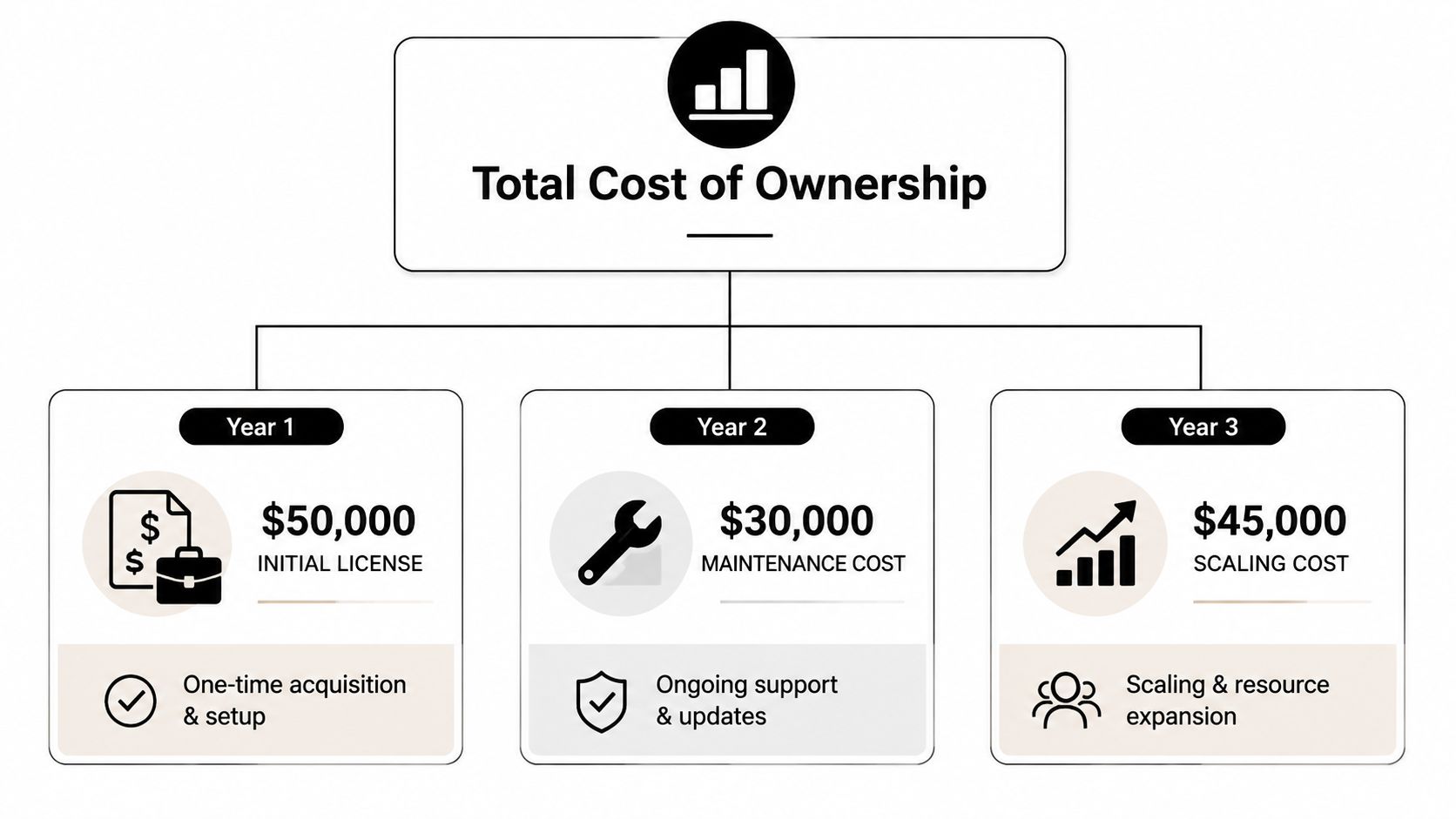
A credible model behaves less like a budget snapshot and more like a controlled simulation. Begin with a baseline year, then model how the platform behaves as users, conversations, workflows, integrations, and model calls change. The model should show both the expected path and the conditions that would make the investment more or less expensive.
Use a simple structure:
TCO = acquisition and setup costs + operating costs + maintenance and change costs + risk and disruption costs – residual value or avoided costs.
The formula is less important than the discipline behind each term. For an AI platform, acquisition may include implementation and migration. Operating costs can include platform access, infrastructure, support, monitoring, and human oversight. Maintenance includes integration updates, knowledge changes, evaluation, model refresh, prompt or workflow revisions, and security work.
Model the drivers, not just the years
A year-by-year column is useful, but it won't explain movement unless each cost is connected to a driver. Track the variables that create operational drift:
- Adoption: Estimate how usage develops across teams, channels, and use cases.
- Volume: Connect API calls, conversations, transactions, or documents to infrastructure and model consumption.
- Complexity: Allow for additional languages, channels, workflows, integrations, and exception paths.
- Quality operations: Include evaluation, human review, escalation, knowledge updates, and remediation.
- Model lifecycle: Treat model refresh, fallback routing, testing, and regression checks as recurring work rather than launch activities.
- Infrastructure scaling: Include capacity changes as demand and system complexity rise.
The need for this dynamic view is visible beyond software. A 2025 fleet outlook reports that TCO rose up to 30% from 2020 to 2025, with maintenance costs rising 29% on average, driven by labor inflation, parts bottlenecks, and increasing vehicle complexity. A separate fleet market recap in the same source reports new-vehicle TCO up about 29% versus 2019 and used-vehicle TCO up about 36%, outpacing overall inflation. Arval's 2025 fleet TCO outlook
Build scenarios that expose hidden drift
Create at least three scenarios, such as expected, constrained adoption, and accelerated scale. Don't alter only the volume assumption. Change the operational conditions that finance and technology worry about, including higher support demand, delayed integration work, stricter compliance requirements, model replacement, or an increase in exception handling.
Review the model at a regular operating cadence. Compare actual usage, infrastructure consumption, support effort, and outcome measures against the assumptions. If the model remains untouched after approval, it has become a document rather than a management tool.
A useful simulation doesn't predict the future perfectly. It shows which assumptions can break the budget and what action the team should take when they do.
You can also use a structured AI ROI calculator as an input to the business case, but validate any output against your own volumes, staffing model, integration estate, and governance requirements.
The manufacturing evidence reinforces why this matters. Quality failures, premium freight, inspection overhead, expediting, and inventory buffers are often excluded from static ownership models, while supplier lead time and defect risk can materially affect the total cost. In AI, the equivalent omissions include rework, escalations, failed automations, monitoring, and the labor required to keep outputs reliable.
Evaluating TCO Modeling Approaches
The right modeling approach depends on the decision's risk, scale, and reversibility. A small experiment doesn't need a complex financial engine. A platform that will sit inside customer support, employee service, or regulated operations deserves more rigor because changing it later can disrupt workflows, integrations, training, and reporting.
The spreadsheet is useful, until it becomes the system
A spreadsheet remains the fastest way to establish a shared vocabulary. It can separate fixed and variable costs, assign owners, compare vendors, and make assumptions visible. It also gives finance a familiar artifact for budget review.
Its weakness is maintenance. A static workbook rarely captures changing usage, delayed benefits, model refreshes, integration incidents, or the difference between planned and actual labor. Multiple versions create governance problems, and teams may debate formulas instead of improving assumptions.
Use a spreadsheet for the first decision gate, then connect it to actual operational data. A model should have a version history, an assumption register, and a review owner.
Activity-based costing adds operational realism
Activity-based costing assigns cost to the activities that create it. For an AI platform, those activities might include handling a conversation, evaluating an answer, reviewing an exception, updating knowledge, releasing an integration, or investigating an incident.
This method is more demanding, but it answers practical questions that subscription math can't. Which workflow consumes the most human review? Which integration generates the greatest maintenance burden? Which channel creates expensive escalations? The answers can change the deployment sequence and the vendor negotiation.
Scenario modeling handles uncertainty better
Scenario modeling is appropriate when adoption and usage are difficult to predict. Build the model around decision triggers rather than false precision. For example, define the point at which a workflow needs additional review, the conditions that require a different model, or the usage level at which infrastructure must be expanded.
Opportunity cost should also appear, but label it clearly. If employees spend time on repetitive service work, the model can estimate the value of reallocating that capacity. Don't present that estimate as guaranteed savings unless the organization has a plan to change staffing, workload, or service capacity.
For build-versus-buy decisions, include engineering ownership, maintenance, security, testing, and time to production. The customer service AI build-versus-buy blueprint can provide a useful framework for structuring that discussion.
Decision standard: Choose the simplest model that can expose the risks your stakeholders are actually trying to manage. More complexity isn't the same as more accuracy.
Linking TCO to Strategic Business KPIs
A TCO model gains executive support when it connects spending to operating outcomes. Finance needs to know what the organization is buying, while CX and technology leaders need to explain how the investment changes service capacity, quality, speed, or risk. A list of platform fees can't answer either question on its own.
Start with the customer journey and work backward to the financial model. If the platform handles a service interaction, identify the cost per contact, transfer rate, first-contact or first-call resolution, escalation volume, average handle time, abandonment, and customer retention signals. If it supports employees, use resolution time, self-service completion, case deflection, onboarding effort, and employee satisfaction.
Build a KPI bridge
The bridge should connect each cost driver to a measurable operational effect:
| Business outcome | KPI to monitor | TCO connection |
|---|---|---|
| Lower service effort | Cost per contact and handle time | Shows whether automation changes operating capacity |
| Better resolution | First-contact resolution and escalation rate | Captures rework and specialist workload |
| Faster adoption | Time to proficiency and workflow completion | Connects enablement effort to realized value |
| Safer automation | Quality scores and exception rate | Prices review, remediation, and risk controls |
| Faster delivery | Time to value and release effort | Reveals the cost of delay and ongoing change |
Don't put every favorable KPI into the business case. Select measures that the operating team can influence and that finance can audit. For example, lower handle time may not produce immediate cash savings if staffing remains fixed, but it can create capacity for service growth, backlog reduction, or higher-value work. State that distinction directly.
Separate savings from capacity
Executives challenge TCO models when they treat capacity as cash. A reduction in manual effort can produce several different outcomes: fewer external service hours, increased throughput, shorter queues, improved coverage, or redeployment of employees. Each outcome has a different financial treatment.
Churn deserves similar care. A better experience may support retention, but attributing a commercial result to one platform requires a defensible measurement design. Use controlled comparisons, operational baselines, and clear attribution rules rather than assigning all improvement to the AI investment.
Make time-to-value visible
A platform that costs less over its life cycle may still be the wrong choice if it delays a critical operational change. Conversely, a faster deployment can create value sooner, but only if the organization can adopt it and maintain quality. Include implementation duration, training readiness, integration dependencies, and the date when each KPI should begin moving.
The leadership conversation should therefore sound like this: the investment has these ownership costs, it depends on these operational conditions, and it will be judged through these specific outcomes. That framing gives the CFO a controllable financial story and gives the CTO an engineering plan instead of a promise.
Presenting Findings to Key Stakeholders
The final presentation should not be a tour of spreadsheet tabs. It should be a decision document that shows the recommended option, the assumptions behind it, the major risks, the conditions for success, and the actions required from each executive.
Start with a one-page view. Show the initial commitment separately from recurring operating cost, variable usage cost, internal labor, and risk reserves. Then show the expected scenario beside a downside scenario. This makes the CFO's concern visible without forcing the CTO to defend every technical assumption in the opening minutes.
Use two narratives for the same model
The CFO typically wants answers to four questions:
- What is committed? Identify contractual obligations and renewal exposure.
- What can move? Separate controllable usage, staffing, integration, and support costs.
- What could surprise us? Name the assumptions most likely to drift.
- What decision is required? Specify the approval, budget treatment, and review gate.
The CTO needs a different level of detail:
- What must scale? Show infrastructure, model routing, data, and integration dependencies.
- What must remain flexible? Identify deployment, vendor, model, and capacity choices.
- Who owns operations? Assign responsibility for quality, security, incidents, and refreshes.
- What happens if the plan changes? Document fallback paths, exit constraints, and migration effort.
A CXO or operations leader will focus on service quality, adoption, workforce impact, and customer outcomes. Use the same assumptions, but translate them into the metrics that person manages.
Make disagreement productive
If finance challenges the operating forecast, don't respond by defending a single number. Show the driver behind it and offer a measurement plan. If technology objects to a cost cap, ask which capability would be constrained and what service or risk consequence would follow.
Presentation principle: Never hide uncertainty inside an average. Put the uncertainty on the page and attach a decision trigger to it.
End with a staged commitment when the evidence is incomplete. Define the initial scope, the success measures, the spending boundary, the review date, and the conditions for expansion. A dynamic TCO model then becomes part of governance, not just an approval hurdle. It helps both sides revisit the investment using actual operating evidence instead of repeating the original assumptions.
Yellow.ai offers enterprise agentic AI capabilities across voice, chat, email, images, and video, with integrations, analytics, automated testing, and multi-LLM architecture that can be evaluated within a broader ownership model. Visit Yellow.ai to assess how its platform could fit your AI cost, integration, and KPI planning.