










The surprising part about smart customer service isn't that AI is getting better. It's that support is no longer organized around agents as the default execution layer. That shift is already visible in the market. Salesforce reports that 79% of service leaders say investment in AI agents is essential to meet business demands, and 30% of service cases were resolved by AI in 2025, with that share projected to reach 50% by 2027 in Salesforce's customer service statistics.
That changes the operating model. Traditional support teams were built to receive tickets, classify them, move them through queues, and close them as efficiently as possible. Smart customer service flips that logic. The system understands intent, selects the right workflow, pulls the right context, takes action where it can, and hands off only when judgment or exception handling is needed.
For enterprise leaders, this is no longer a question of adding another bot to the website. It's a redesign of service as an autonomous capability that spans customer experience, employee support, and back-office execution.
Table of Contents
- What Smart Customer Service Means in 2026
- The Architecture of an Autonomous Service Engine
- Business Benefits and Critical KPIs to Measure
- Smart Service in Action Across the Enterprise
- Your Enterprise Implementation Roadmap
- Choosing a Partner and Avoiding Common Pitfalls
What Smart Customer Service Means in 2026
Smart customer service in 2026 doesn't mean a nicer chatbot, a few better automations, or a cleaner omnichannel dashboard. It means the service layer can increasingly reason, decide, and act across systems with minimal human intervention.
Older digital service programs improved access. They gave customers more channels, more portals, and more scripted self-service. That was progress, but it still depended on customers navigating the company's operating model. If the request crossed channels, products, or internal teams, the experience often fell apart.
From digital access to autonomous resolution
The new model is different. Smart customer service is autonomous, unified, and context-rich. It doesn't just answer. It resolves.
That matters because buyers now expect the service organization to operate at machine speed while still feeling coherent and personal. Support leaders who are rethinking email workflows as part of that shift can learn from practical patterns in building AI email for agents, especially where AI needs to draft, classify, and respond with policy-aware context rather than generic text generation.
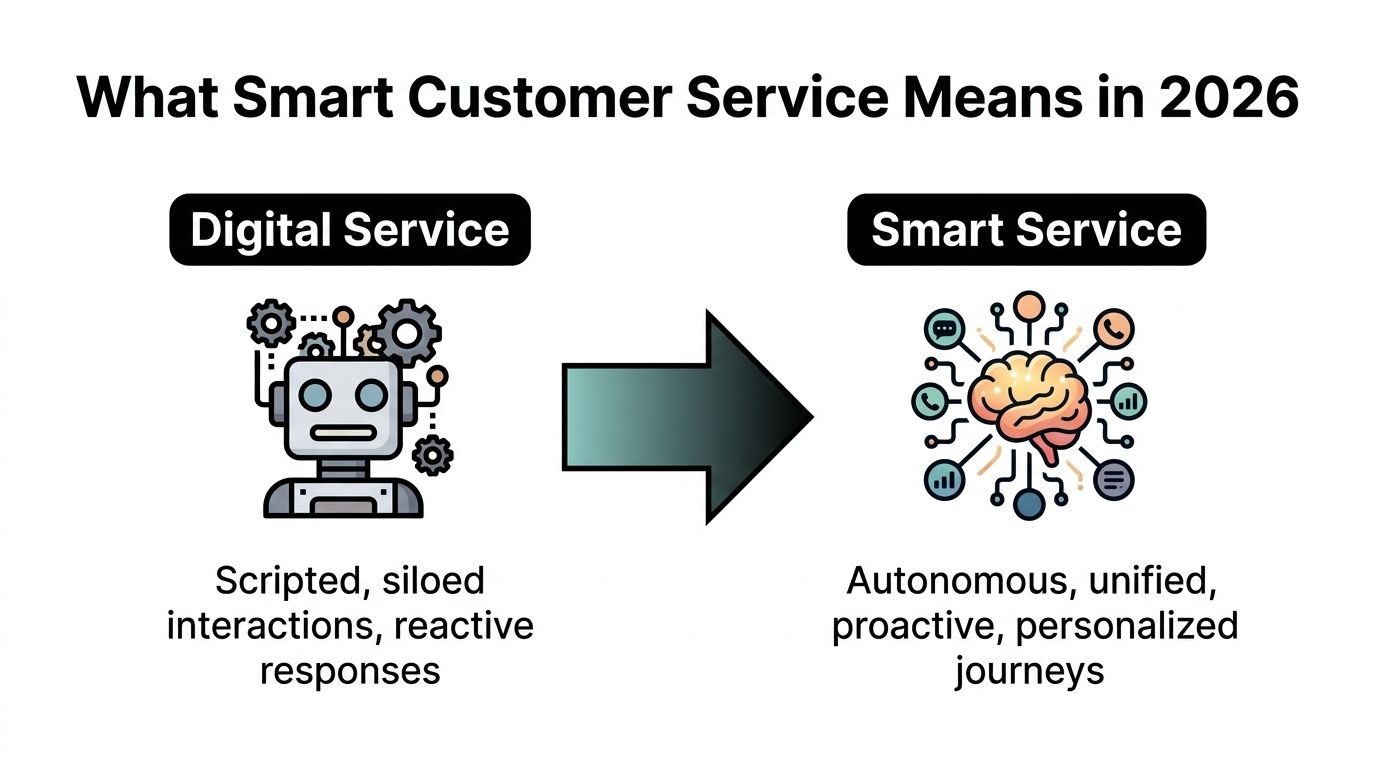
A useful way to define the difference is this:
- Digital service gives customers more ways to submit work.
- Smart service gives the enterprise a system that can complete work.
That's why agentic AI matters. An agentic system doesn't stop at intent detection or answer retrieval. It can break a goal into steps, choose tools, request additional context when needed, and complete multi-stage actions while preserving auditability and guardrails. Teams evaluating that shift should understand the distinction between conventional automation and autonomous execution in this explainer on agentic AI and how it differs from AI agents.
Why the definition has changed
The strongest signal isn't the technology itself. It's the market's willingness to operationalize it. AI in service has moved from pilot curiosity to an execution layer for mainstream support.
Practical rule: If your AI can answer questions but can't safely complete service tasks across systems, you don't yet have smart customer service. You have a faster front door.
In practice, smart customer service has four traits.
- It is proactive: The system spots patterns, predicts likely intent, and surfaces the next best action before an issue expands.
- It is integrated: CRM history, product usage, prior tickets, policy rules, and channel context are available in one flow.
- It is multimodal: Voice, chat, email, and visual interactions belong to the same service fabric.
- It is self-improving: Every interaction becomes training material for better routing, better knowledge, and better automation design.
What doesn't work is bolting AI onto fragmented operations. A scripted bot on top of siloed systems usually just creates a more intricate dead end. The customer still repeats information. The agent still re-keys data. The business still pays for avoidable handoffs.
The organizations getting this right are redesigning service around autonomy itself. They're asking a more useful question: which journeys should the system own from start to finish, and where should people step in?
The Architecture of an Autonomous Service Engine
An autonomous service model only works when the architecture supports it. Most failed programs don't fail because the model is weak. They fail because the AI sits on top of disconnected channels, stale knowledge, and brittle workflows.
A mature smart customer service stack combines ticketing, live chat, knowledge bases, remote-access tooling, and AI chatbots so Tier-1 issues can move to self-service while agents handle exceptions with full context, including CRM records, product-usage data, and prior ticket history during live interactions, as described in this overview of technical customer service architecture.
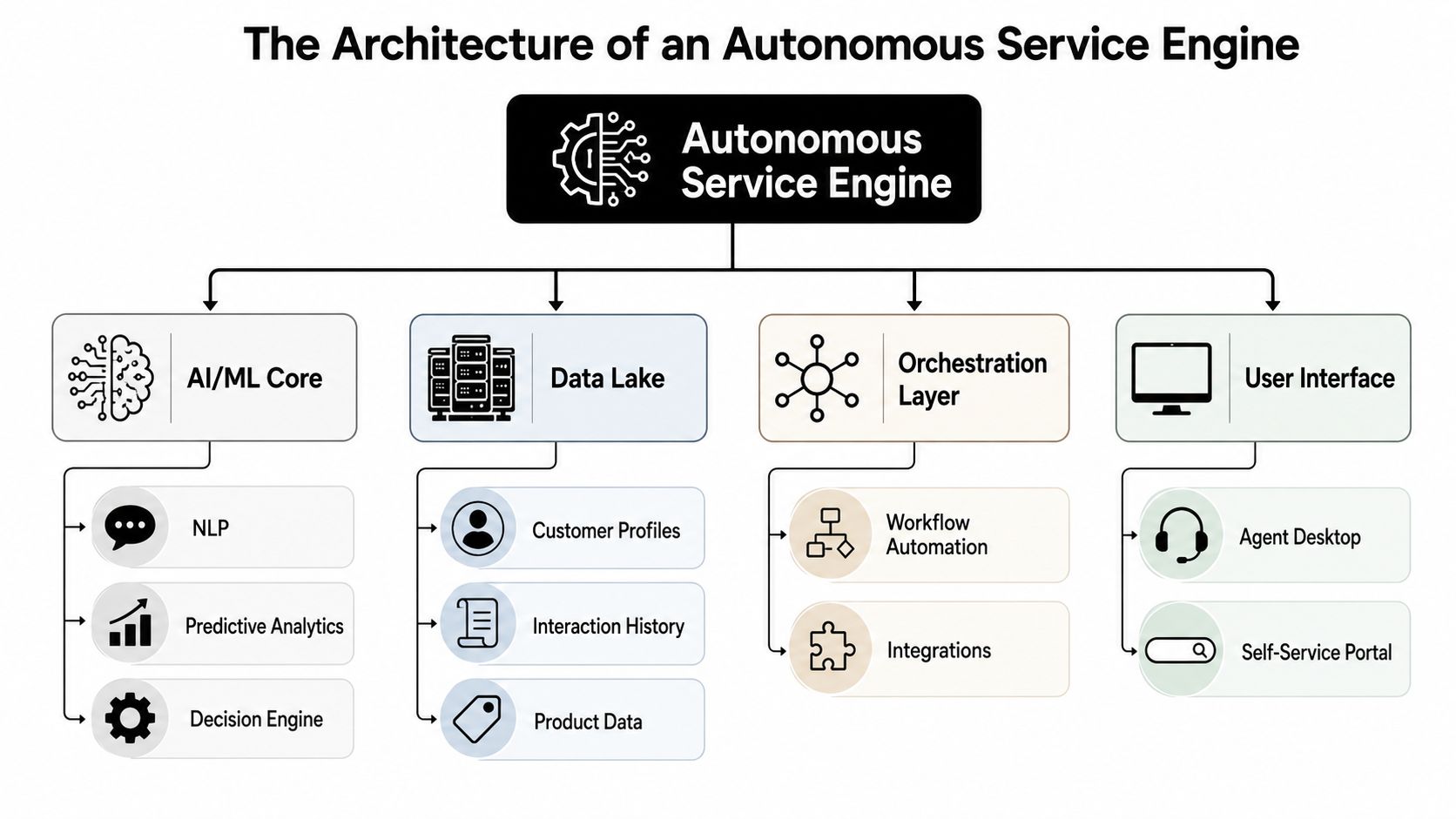
I've found it useful to explain the architecture as four connected layers. Not because enterprises need a metaphor, but because it keeps leaders from buying isolated features instead of a working system.
The brain
The brain is the reasoning and decision layer. Agentic AI, orchestration logic, and model selection reside there.
In practical terms, the brain does five things well:
- It interprets intent beyond keywords.
- It retrieves trusted knowledge from enterprise sources.
- It decides whether the task can be completed autonomously.
- It chooses tools and systems to execute the task.
- It escalates with context when human judgment is needed.
Multi-LLM design is critical. Different models are better at different tasks, such as classification, extraction, summarization, policy grounding, or long-form reasoning. Teams that want business-friendly context on that stack should look at orchestrating multiple models with an enterprise LLM layer.
The interface
The interface is how users experience the system. Text chat is only one part of it.
A modern interface should support voice, email, messaging, and visual interactions without turning each channel into a separate workflow. Low-latency voice matters because people judge service quality quickly in spoken interactions. If the pauses feel mechanical, trust drops. If the system can listen, respond, confirm, and act naturally, the experience starts to feel like service rather than software navigation.
The best interface disappears into the task. Customers shouldn't need to understand your routing logic, your systems, or your org chart to get help.
The nervous system
The nervous system is the omnichannel orchestration layer. It keeps conversations, state, and workflows aligned as requests move across touchpoints.
This is what prevents common failure modes:
- Channel amnesia: The customer starts in chat, moves to voice, and loses all prior context.
- Workflow drift: One channel can trigger actions that another channel cannot.
- Inconsistent policy: Different surfaces produce different answers to the same request.
Sentiment can also play a role here, not as a vanity feature but as an operational signal for routing and escalation. Teams exploring that dimension in more depth may find leveraging AI for sentiment analysis useful, especially when deciding which conversations need priority treatment or agent intervention.
The connective tissue
The connective tissue is what joins the service layer to enterprise reality. This includes CRM, ERP, ITSM, billing, identity, order systems, and knowledge sources.
Without this layer, AI can only talk. With it, AI can work.
That's the difference between an assistant that says, “I can help you with that,” and one that updates an address, verifies an order state, opens a replacement request, schedules follow-up, and logs the action trail for compliance review.
A strong architecture also changes the human role. Agents stop spending their day copying case notes, searching for articles, and manually stitching together partial context. They focus on exceptions, judgment calls, and relationship-sensitive moments where automation shouldn't be the final authority.
Business Benefits and Critical KPIs to Measure
The business case for smart customer service starts with responsiveness. Buyers don't separate service quality from brand quality anymore. SuperOffice reports that 90% of buyers say an immediate response is essential when they have a support question, and that companies leading in customer experience grow revenue 80% faster than competitors in its customer experience statistics roundup.
That's why the value discussion has to move beyond labor deflection. Faster service is useful. Better resolution is more important. What leaders should want is a system that reduces friction for customers while improving operating discipline inside the enterprise.
The value is speed with control
The strongest smart customer service programs usually create value in three places at once.
- Customer experience: Customers get quick answers, cleaner handoffs, and fewer repeated steps.
- Operational performance: Teams reduce backlog pressure, improve routing quality, and spend less time on repetitive work.
- Employee experience: Agents spend more time solving exceptions and less time gathering context.
This changes the economics of service. When AI handles routine interactions and assists on more complex ones, managers can redesign staffing around judgment-heavy work rather than queue management. That tends to improve service consistency because the system carries memory and policy application across channels.
Smart customer service should lower effort for both sides. If customers work less but agents work more to compensate, the design is wrong.
Which metrics matter now
Many teams still over-index on legacy contact center measures. Average handle time has its place, but it can push the wrong behavior when the goal is durable resolution.
A smarter measurement model should include:
- First Contact Resolution: Whether the issue was resolved in the first interaction.
- Customer Effort Score: Whether the process felt easy from the customer's point of view.
- Containment rate: How often the autonomous layer completed the task without unnecessary escalation.
- Automation quality: Whether automated outcomes were correct, policy-compliant, and accepted by customers.
- AI-assisted resolution score: How much the AI improved agent performance on cases it did not fully own.
For teams building that measurement framework, this guide to measuring AI agent performance in an AI-first world is a useful reference because it treats AI as an operating layer, not just a chatbot metric.
What doesn't work is counting automations and declaring victory. High containment with poor outcomes pushes rework downstream. The KPI system needs to detect that. A mature program watches where automation succeeds, where it creates hidden effort, and where humans still add the most value.
Smart Service in Action Across the Enterprise
The easiest way to understand smart customer service is to watch what it does when the request isn't simple.

A customer journey handled end to end
A customer calls about a failed payment tied to a delayed order. In a traditional environment, that issue can bounce between IVR, a support queue, a billing team, and a fulfillment system. Each team sees only part of the problem.
In a smart service model, the voice AI identifies the order, verifies the customer, checks payment state, checks shipment status, and determines whether the failure came from payment authorization, inventory allocation, or a duplicate fraud flag. If the policy allows autonomous action, the system updates the payment method flow, triggers the next fulfillment step, sends a confirmation, and records the case outcome.
If the case crosses a policy boundary, the handoff is cleaner. The human agent receives the transcript, account context, prior actions, system findings, and recommended next step. The conversation starts at resolution, not re-discovery.
That's what enterprise leaders should be aiming for. Not chatbot containment for its own sake. Task completion with confidence.
A short demo is often the fastest way to make this real inside the organization:
The same model for employee service
The same architecture also works for employee experience.
An employee needs access to a finance tool, a laptop replacement, and a policy clarification before joining a new team. In many companies, that means three portals, several forms, and a chain of manual approvals. Smart service can unify that flow. The agent verifies identity, checks role and entitlement rules, initiates the IT request, pulls the HR policy answer from the knowledge layer, and updates the employee on status in one thread.
Internal service is where many enterprises discover the real leverage of autonomy. The same orchestration, knowledge, and action layers can support both customers and employees.
This is one reason the category is expanding beyond the contact center. The platform capabilities are increasingly shared across CX and EX. Once the orchestration layer can understand intent, apply policy, and act through enterprise systems, the difference between a customer request and an employee request becomes less about tooling and more about governance.
That has strategic implications. Enterprises don't need one AI stack for customer support, another for IT helpdesk, and a third for HR service delivery if the underlying architecture already supports multimodal workflows, integrations, and role-based guardrails.
Your Enterprise Implementation Roadmap
Autonomous service programs fail for a predictable reason. Enterprises try to deploy a general-purpose AI experience before they have defined where the system should act, what it can access, and how success will be measured.
The stronger approach is narrower and more ambitious at the same time. Start with a small set of service journeys where an agentic system can understand intent, retrieve grounded knowledge, take action in connected systems, and hand off cleanly when policy or risk requires a human. That is the shift from support automation to an autonomous service model.
Industry guidance frames smart customer service as scalable, multichannel, agile, relevant, and timely, and recommends prioritizing the most-used customer journeys first, then tracking metrics such as First Contact Resolution and Customer Effort Score to see whether automation is reducing friction in eGain's guidance on smart customer service.
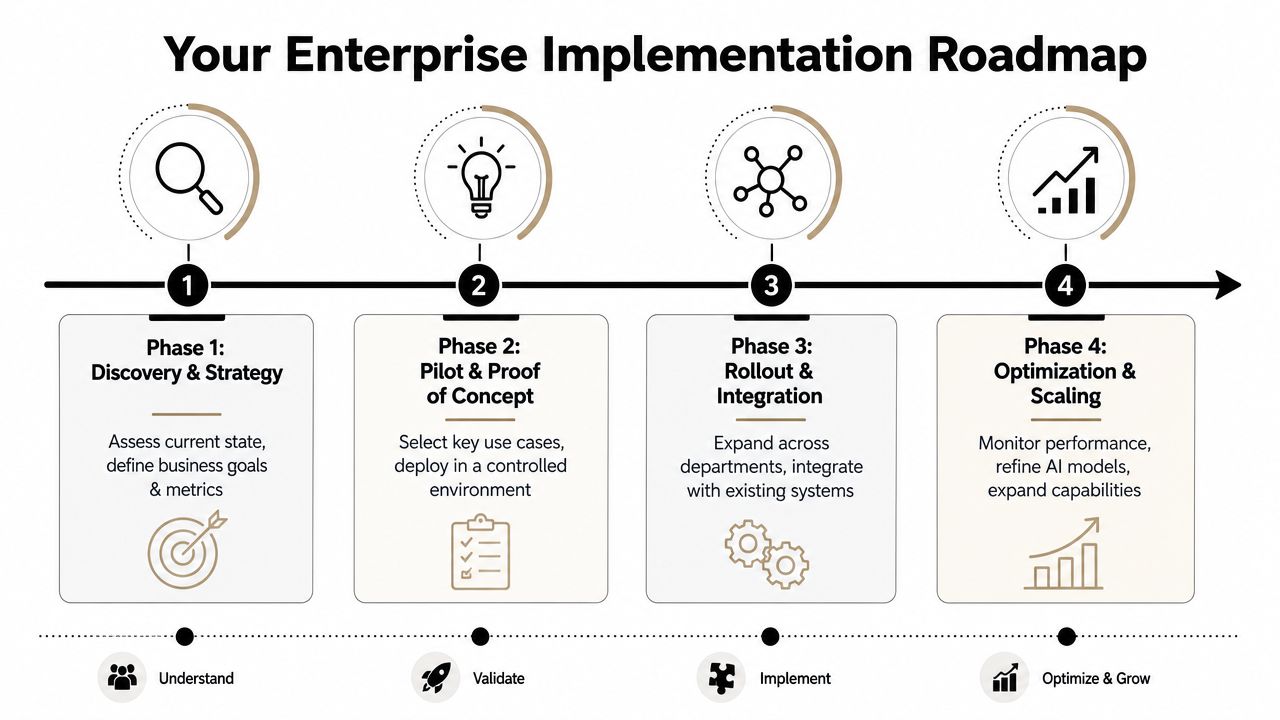
Phase 1 and Phase 2
Phase 1 is discovery and strategy. Choose journeys with high volume, clear policy rules, and measurable operational pain. Good starting points include order status, account changes, appointment rescheduling, claims updates, billing questions, access requests, and other requests that already follow a known path.
The key decision in this phase is architectural, not cosmetic. Define where the agent will read, where it will write, what approvals it needs, and where human intervention remains required.
Four questions usually expose whether a journey is ready:
- Which journey generates avoidable contact volume
- Which systems must the AI access to complete the task
- Which decisions require policy checks or human approval
- Which business outcome will prove the pilot succeeded
Phase 2 is data and integration preparation. In this phase, serious programs separate from slideware. If the knowledge layer is inconsistent, if APIs are unreliable, or if escalation paths are vague, the agent will produce uneven service no matter how strong the model is.
A practical readiness checklist includes:
- Knowledge quality: Remove duplicates, stale articles, and conflicting guidance.
- Workflow clarity: Define what the system may answer, recommend, or execute.
- Integration scope: Connect only the systems needed for the initial journeys.
- Guardrails: Set approval logic, audit trails, and fallback behavior before launch.
Phase 3 and Phase 4
Phase 3 is pilot and test. Keep the first release tight enough to learn from real traffic. In practice, this means testing retrieval quality, prompt behavior, exception handling, permissions, and handoff logic under production conditions, not just in a sandbox.
Tooling choices matter here. Platforms such as Salesforce, Zendesk, ServiceNow, and Yellow.ai can all fit, depending on the existing stack, channel mix, and workflow depth required. The ultimate test is whether the platform can support agentic execution, multimodal interactions, and governed system actions without pushing the enterprise into fragile custom orchestration.
Treat the pilot as an operational proving ground with real policy, real data, and real escalation paths.
Phase 4 is scale and govern. Expand by domain, such as billing, claims, onboarding, or internal service, instead of adding disconnected channels one by one. That creates reusable patterns for knowledge, approvals, integrations, and reporting.
Governance needs to be built into the operating model. Include service operations, IT, security, legal, compliance, and business owners in a regular review cycle. Examine failed automations, weak knowledge sources, escalation drivers, and action-level audit logs. Then decide which journeys are ready for broader autonomy and which still need tighter controls.
Teams that scale well usually do five things consistently:
- Standardize journey design patterns.
- Build a shared library of approved actions and guardrails.
- Review AI outcomes with operations leaders, not only technical teams.
- Keep human override simple and visible.
- Expand after the previous journeys are stable and trusted.
The best roadmap is not the fastest one. It is the one that turns early wins into a governed autonomous service layer the enterprise can keep extending.
Choosing a Partner and Avoiding Common Pitfalls
Choosing a smart customer service platform is less about buying a bot and more about selecting an operating layer that may sit across support, sales, IT, and employee services. That decision has long-term implications for model flexibility, governance, integration cost, and service quality.
A good evaluation process should focus on whether the platform supports autonomous execution safely and at enterprise depth. Many products can generate answers. Fewer can reason across tasks, take action in connected systems, and expose the controls that large organizations need.
What to evaluate before you buy
Here's a practical framework to use in vendor reviews.
| Capability Area | What to Look For | Why It Matters |
|---|---|---|
| Agentic capability | Support for multi-step reasoning, tool use, workflow execution, and controlled handoff | This separates autonomous service from FAQ automation |
| Model strategy | Multi-LLM flexibility, model routing, and the ability to avoid hard dependency on one provider | Reduces lock-in and lets teams optimize for task type |
| Knowledge layer | Retrieval grounded in enterprise content, support for permissions, and clear citation behavior inside workflows | Prevents confident but unusable answers |
| Multimodal support | Native handling for voice, chat, email, and other channels in one architecture | Keeps journeys consistent across touchpoints |
| Integration depth | Pre-built connectors for CRM, ITSM, ERP, ticketing, identity, and workflow tools | Determines how quickly AI can move from answering to acting |
| Governance and security | Audit trails, role-based access, testing controls, and enterprise compliance features | Essential for regulated and high-risk environments |
| Analytics | Visibility into automation outcomes, escalation causes, and workflow bottlenecks | Needed for ongoing improvement, not just launch reporting |
| Human collaboration | Agent assist, approval loops, and strong handoff context | Ensures people can intervene without starting over |
When vendors present roadmaps, ask uncomfortable questions. Can the system complete actions or only recommend them? Can it preserve memory across channels? Can business teams safely update knowledge and workflows without engineering dependency? Can security teams inspect how decisions were made?
If the answers are vague, the implementation risk is high.
Where programs usually fail
The most common failure mode is poor data. Enterprises often expect AI to compensate for fragmented knowledge, conflicting policies, and undocumented exceptions. It won't. It will expose those weaknesses faster.
The second failure is weak change management. Service leaders may understand the transformation, but agents, supervisors, compliance teams, and business owners often receive it as a tooling project. That creates resistance at exactly the point where new operating practices are needed.
A few pitfalls show up repeatedly:
- Starting with the wrong journey: Highly political or highly variable workflows are bad first candidates.
- Automating without authority mapping: If approval boundaries are unclear, the AI either over-escapes or overreaches.
- Ignoring handoff quality: Escalation is not failure. Blind escalation is.
- Buying for demos instead of operations: A polished conversation is not the same as dependable execution.
- Treating governance as a late-stage add-on: Guardrails need to be designed before expansion, not after incidents.
A platform is only as good as its operational fit. If your teams can't govern it, test it, and improve it continuously, adoption will stall.
One more caution matters. Don't confuse channel breadth with service maturity. A vendor may support many channels but still rely on separate logic, separate knowledge, and separate analytics in each one. That creates hidden fragmentation. Ask whether voice, chat, and email are part of one orchestration layer or just bundled interfaces.
The right partner should help your organization move from isolated automations to a managed autonomous service model. That means architecture, governance, deployment support, and operational transparency all need to be part of the decision.
Yellow.ai provides an agentic AI platform for enterprises that want to automate customer and employee conversations across voice, chat, email, and other channels while connecting those interactions to business systems and governance controls. If your team is evaluating how to move from digital support to autonomous service, it's worth assessing whether that kind of platform architecture fits your service model, integration architecture, and compliance needs.