













You've got the green light from stakeholders, the brand team likes the sample voice, and now the heavy lifting starts. The demo sounded clean on a laptop, but the first contact-center pilot exposed codec glare, awkward pauses, and a security team that wanted answers before anyone touched live traffic. That's the gap many teams hit when they learn how to voice clone for production, not for a weekend proof of concept.
A modern clone can be built from shockingly little source material, which is exactly why the risk profile changes so fast. McAfee's 2023 research found that only 3 seconds of audio could be enough to create a voice clone with an 85% match, and 70% of respondents across seven countries said they weren't confident they could tell a cloned voice from a real one (McAfee research summary). That same low threshold is why enterprise voice cloning now sits at the intersection of CX, fraud prevention, compliance, and identity.
Table of Contents
- Why Enterprise Voice Cloning Is Harder Than a Demo
- Consent, Recordings, and the Data You Actually Need
- Preprocessing Recordings for Clean Speaker Embeddings
- Choosing Between Speaker Adaptation and Speaker Encoding
- Evaluating Voice Clones Beyond Surface Similarity
- Deploying Cloned Voices With Low Latency and Omnichannel Reach
- Monitoring, Drift Detection, and Lifecycle Controls in Production
Why Enterprise Voice Cloning Is Harder Than a Demo
A CX director at a regional bank can get a cloned brand voice working in an afternoon. The same director usually spends the next two quarters getting it through security review, telephony integration, legal approval, and a pilot that doesn't break the moment a carrier codec or noisy agent headset enters the path.
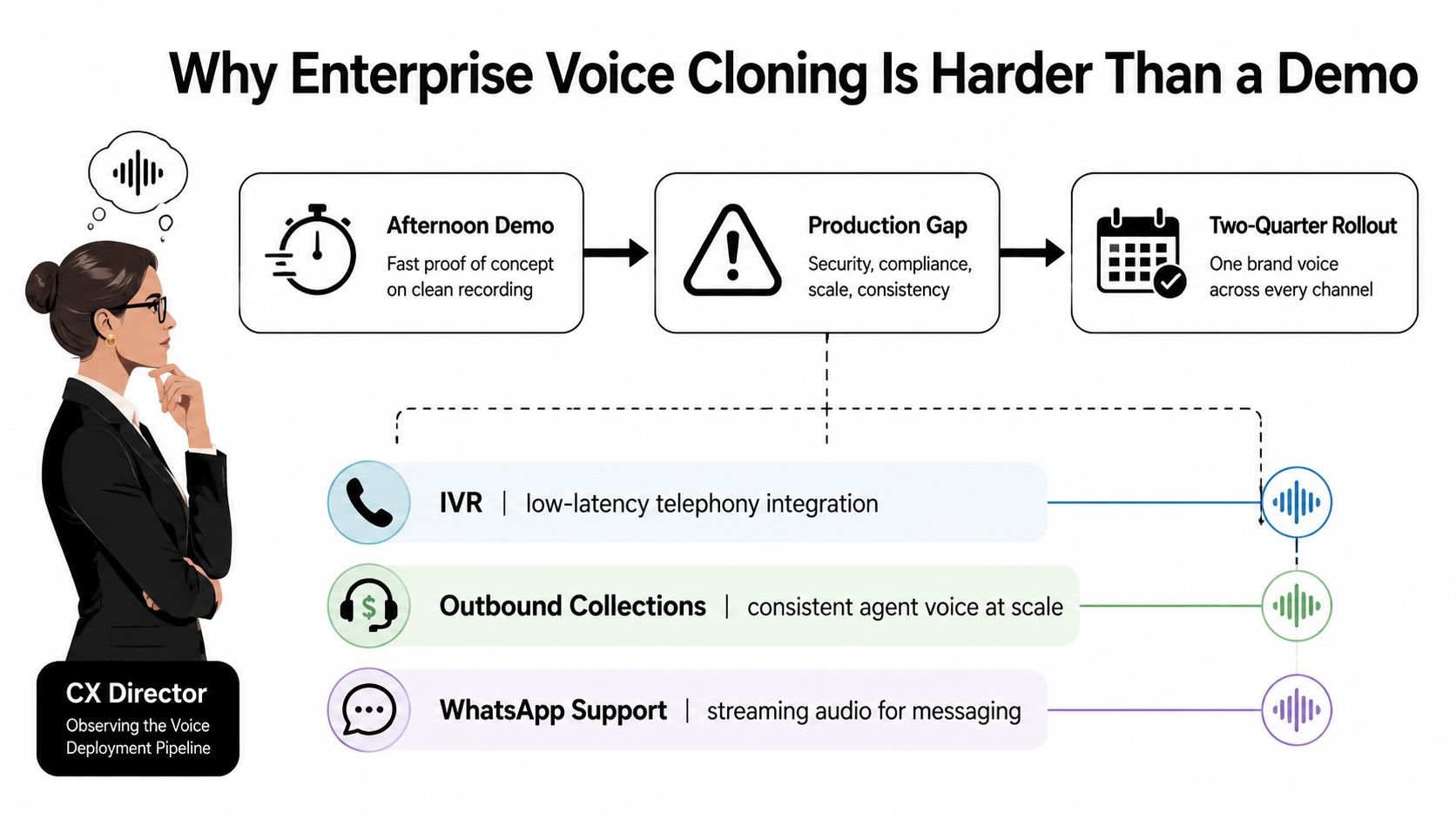
The demo succeeds because everything is clean. The studio sample is quiet, the prompt is short, the network is stable, and nobody is trying to spoof the brand on the other end of the call. Production is different. Telco codecs smear detail, mobile noise leaks into enrollment audio, regional accents push a brand voice away from its intended persona, and low-latency requirements force trade-offs between fidelity and responsiveness.
Treat the clone as a system, not a model
Most tutorials overfocus on the training loop. That's the smallest piece of the job. The primary artifact is the end-to-end voice system, including consent capture, recording governance, preprocessing, serving, fraud controls, and revocation.
If you want a useful mental model, the closest enterprise analogue is not a toy TTS demo. It's closer to behavioral cloning definition, where a system learns from observed patterns and then has to behave predictably under messy real-world inputs. Voice cloning inherits the same problem, the behavior has to remain stable when the environment stops being ideal.
Practical rule: if a cloned voice is going to answer the phone, the security review has to happen before the first pilot call, not after the first complaint.
That's especially true once the voice becomes a brand asset. A cloned voice in IVR, outbound collections, or WhatsApp support can be impersonated just as easily as it can be deployed legitimately. Pindrop's 2024 analysis reported a 1,300% year-over-year increase in deepfake fraud attempts across contact centers, based on more than 1.2 billion customer calls, and described attacks rising from roughly one per month to about seven per day in the same dataset (Pindrop analysis summary). That's the operational reality behind the software.
The enterprise checklist starts with controls
A production rollout needs multi-channel codec normalization, accent coverage, adversarial testing for synthetic-speech detection, written consent, and a revocation path that works when a voice talent leaves or a contract expires. It also needs explicit scope. Internal QA, IVR, outbound calls, and conversational messaging shouldn't all sit behind one blanket release.
For teams evaluating platforms, Yellow.ai's enterprise security documentation is a useful reference point for how vendors think about governance, access control, and deployment boundaries in this category, especially when voice is treated as a regulated workflow rather than a novelty (Yellow.ai enterprise security overview).
Consent, Recordings, and the Data You Actually Need
Voice cloning starts with permission, not software. If the speaker is a real employee, contractor, or brand ambassador, capture consent before the microphone is switched on and document exactly what the voice can be used for. In practice, that means named speaker consent, channel scope, geographic scope, duration of use, and a clear revocation path.
Build consent like an access policy
A single blanket release is brittle. Split consent by channel so future changes are easier to manage, especially if one use case needs to end while another continues. A voice used for internal QA doesn't need the same permission boundary as one used for outbound collections or public-facing IVR.
The documentation should read like something a legal team can audit without guessing. Include the person's identity, the permitted use cases, the retention window, the revocation process, and the person or team responsible for approving changes. Store that record alongside the raw audio and transcripts in an access-logged repository with retention tied to the consent term, not a generic corporate retention schedule.
Record for variety, not just volume
A useful voice dataset isn't just long, it's varied. Capture clean studio audio, then add conversational prompts, numbers, dates, currency, and emotionally distinct phrases like apology, urgency, and reassurance. Also record alternate takes for ambiguous phonemes, plus separate takes for each language or accent the voice needs to cover.
The goal is to give the model enough coverage to preserve identity across different speaking conditions. That matters because a clone that sounds fine on a single scripted paragraph can fall apart on short support prompts, spelling-heavy utterances, or escalated service conversations.
The fastest way to create a weak clone is to record a lot of the wrong thing.
The recording setup matters too. A treated room, a pop-filtered large-diaphragm condenser, and consistent gain staging reduce downstream cleanup work. If the source audio is noisy or inconsistent, every later step has to work harder, and the embedding quality tends to suffer.
| Artifact | Purpose | Channel Coverage |
|---|---|---|
| Signed consent form | Proves the approved use, scope, and revocation terms | IVR, outbound, chat TTS, internal QA |
| Raw audio files | Preserve original signal for preprocessing and rework | All planned channels |
| Transcripts | Support alignment, pronunciation checks, and review | All planned channels |
| Revocation log | Records who can suspend or retire a voice clone | All planned channels |
| Retention policy notice | Ties deletion to consent expiry and contract terms | All planned channels |
Preprocessing Recordings for Clean Speaker Embeddings
A clone can pass a clean demo and still fail in production because preprocessing preserved the wrong signal. In practice, clipping, inconsistent loudness, residual room noise, and mixed speakers surface later as unstable pronunciation or weak identity. RVCBench's results across robustness tasks also show that speaker systems degrade under noise, post-processing, long context, and cross-lingual use, so preprocessing needs to reflect the deployment path, not only the studio recording.
Normalize first, then protect the signal
Normalize loudness and dynamic range across sessions. A practical target is -23 LUFS with -1 dBTP true-peak limiting. This reduces clipping and re-encoding artifacts before the audio enters a telephony path. Large volume swings can also carry into the clone as uneven rhythm.
Apply denoising selectively. An aggressive filter may remove breath, sibilance, and short transitions that help listeners recognize the speaker. Validate a neural denoiser against the noise profile expected in deployment, including room tone and network-processed audio, rather than trusting a polished benchmark sample.
Segment on silence, align on transcript, verify the speaker
Clean segmentation gives the model coherent speech units. Use VAD-based splitting around silences longer than 700 ms, and discard segments shorter than two seconds. Run automatic transcription after segmentation, then have a reviewer check proper nouns and numbers before forced alignment. Misread names and digits can turn into repeatable pronunciation errors in customer-facing flows.
Speaker verification is the final intake gate. It can catch room tone, page beeps, and an accidental second speaker before they contaminate the embedding. If identity is uncertain here, later model tuning will not reliably repair it.
Test the channel before you trust the model
Prepare evaluation copies with Opus, G.711, and AMR-WB codecs, packet-loss simulation, and noisy conditions. The purpose is controlled stress testing, not making the training set arbitrarily dirty. Compare speaker similarity and intelligibility across the audio paths used by IVR, outbound calling, and other channels.
RVCBench benchmark evaluated modern systems across 10 robustness tasks, 225 speakers, 14,370 utterances, and 11 models. It reported deterioration under long-context use, cross-lingual generation, post-processing, passive noise, and active perturbation. A clip that sounds convincing in a clean lab recording can therefore fail once codecs, packet loss, and live call conditions enter the flow.
Choosing Between Speaker Adaptation and Speaker Encoding
The right cloning approach depends on whether you're cloning one brand voice once, or many voices continuously. Teams often pick the wrong architecture by optimizing for demo speed instead of operational cost, update speed, and revocation control.
Three approaches, three very different operating models
Speaker adaptation fine-tunes a base TTS model on target speech. It can deliver strong fidelity when you have enough curated audio, but retraining a voice every time something changes is expensive and slow.
Speaker encoding, by contrast, learns a separate speaker representation that can be reused across voices. That works well when you expect a broader library of voices or need a cleaner separation between the base model and the enrolled identity. It also makes the system easier to manage when voices need to be updated or retired.
Zero-shot and few-shot foundation models are the fastest path to a live demo. They synthesize a target voice from a short reference clip without a full retraining cycle, which is why they're attractive for contact-center pilots, temporary campaigns, and rapid brand experiments. The trade-off is that the voice may be easier to drift, especially when the prompt space gets broad or the audio path gets noisy.
| Approach | Data Required | Latency | Fidelity | Best Fit |
|---|---|---|---|---|
| Speaker adaptation | Minutes to hours of curated speech | Higher during training, lower once deployed | Strong when data is clean and consistent | One stable brand voice with controlled updates |
| Speaker encoding | Modest enrollment set plus reusable embeddings | Moderate | Good balance of reuse and flexibility | Multiple voices, reusable identity infrastructure |
| Zero-shot or few-shot | Short reference clip | Usually lowest setup cost | Fast to launch, more variable in edge cases | Pilots, assistants, quick campaigns |
Pick based on voice count and change rate
If you only need one branded voice and can afford a careful enrollment process, adaptation is often the most controllable route. If you expect many voices, frequent updates, or revocation-heavy operations, speaker encoding usually gives you a saner maintenance model. If you need speed above all else, zero-shot cloning gets you there fastest, but you'll need tighter QA and stronger guardrails.
The original Neural Voice Cloning approach is still a useful reference here because it formalized two production-relevant paths, speaker adaptation and speaker encoding, and showed that good similarity and naturalness don't require huge target datasets when the reference audio is strong (Neural Voice Cloning). That's the important lesson, the architecture should match your operational burden, not your enthusiasm.
Evaluating Voice Clones Beyond Surface Similarity
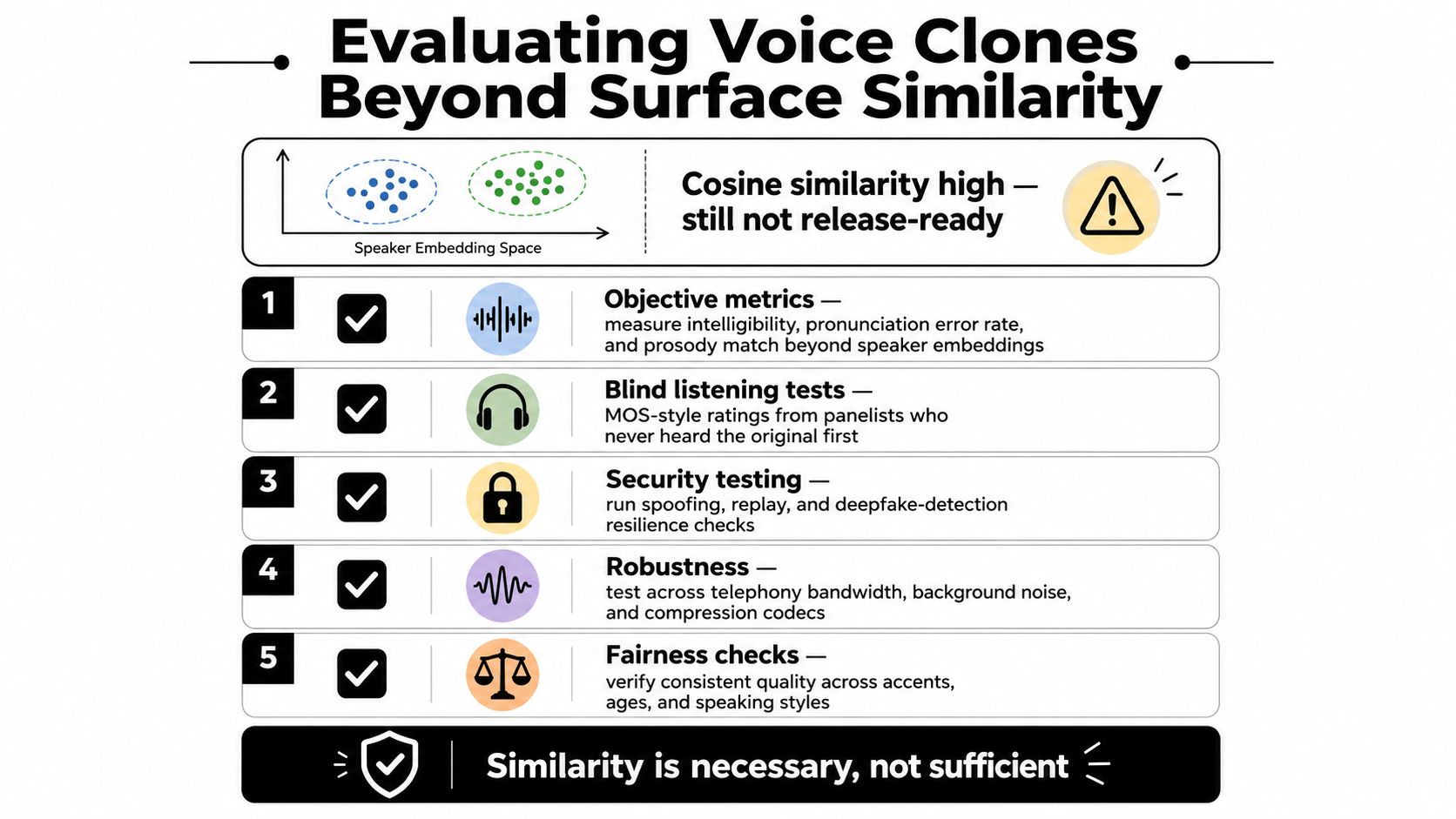
A clone can sound convincing in a clean sample and still fail a release review. Similarity belongs in the decision, but it cannot stand in for intelligibility, naturalness, or safe behavior under real call conditions.
Use a structured harness, not a listening hunch
Begin with objective similarity checks, then assess naturalness, intelligibility, and consistency across longer utterances. Cosine similarity on speaker embeddings helps verify speaker identity, but it cannot show whether speech remains clear after compression or whether intonation collapses in a full response.
Blind listening tests expose failures that metrics miss. Have panelists hear the clone without first hearing the source voice, then rate likeness and naturalness separately. A recognizable voice can still sound robotic, rushed, emotionally flat, or poorly timed.
Evaluate the behaviors that affect customer conversations. Check pronunciation of names, numbers, product terms, interruptions, corrections, and escalation prompts. A voice that passes a short script may still create fraud or support risk if it sounds inconsistent during identity checks or high-stakes disclosures.
Stress the voice the way customers will stress it
Enterprise traffic is not a studio environment. Test telephony codecs, background noise, compressed mobile paths, accented prompts, and long-form utterances. These conditions expose defects in pronunciation, pacing, and prosody that clean recordings conceal.
Release gate rule: do not ship on one clean sample. If a voice only works in ideal conditions, it isn't ready for production.
A practical release gate combines similarity, intelligibility, and naturalness thresholds with checks for call-handling and escalation regressions. If callers repeat themselves more often or agents intervene more frequently, reject the build even when the waveform sounds attractive.
Turn failure cases into training data
QA should produce inputs for the next iteration. Keep problematic prompts, clipped segments, codec-damaged outputs, and pronunciation failures, then use them to improve preprocessing, evaluation sets, or training examples. This approach addresses recurring defects instead of patching isolated samples.
The evaluation must also support a defensible go-no-go decision. ClonEval provides an open protocol, scoring library, and leaderboard for comparing voice-cloning systems more consistently (ClonEval benchmark). Use that framework to standardize the release gate, while keeping your own production failures and channel conditions in the test set.
A shallow evaluation leaves production to discover the flaw.
Deploying Cloned Voices With Low Latency and Omnichannel Reach
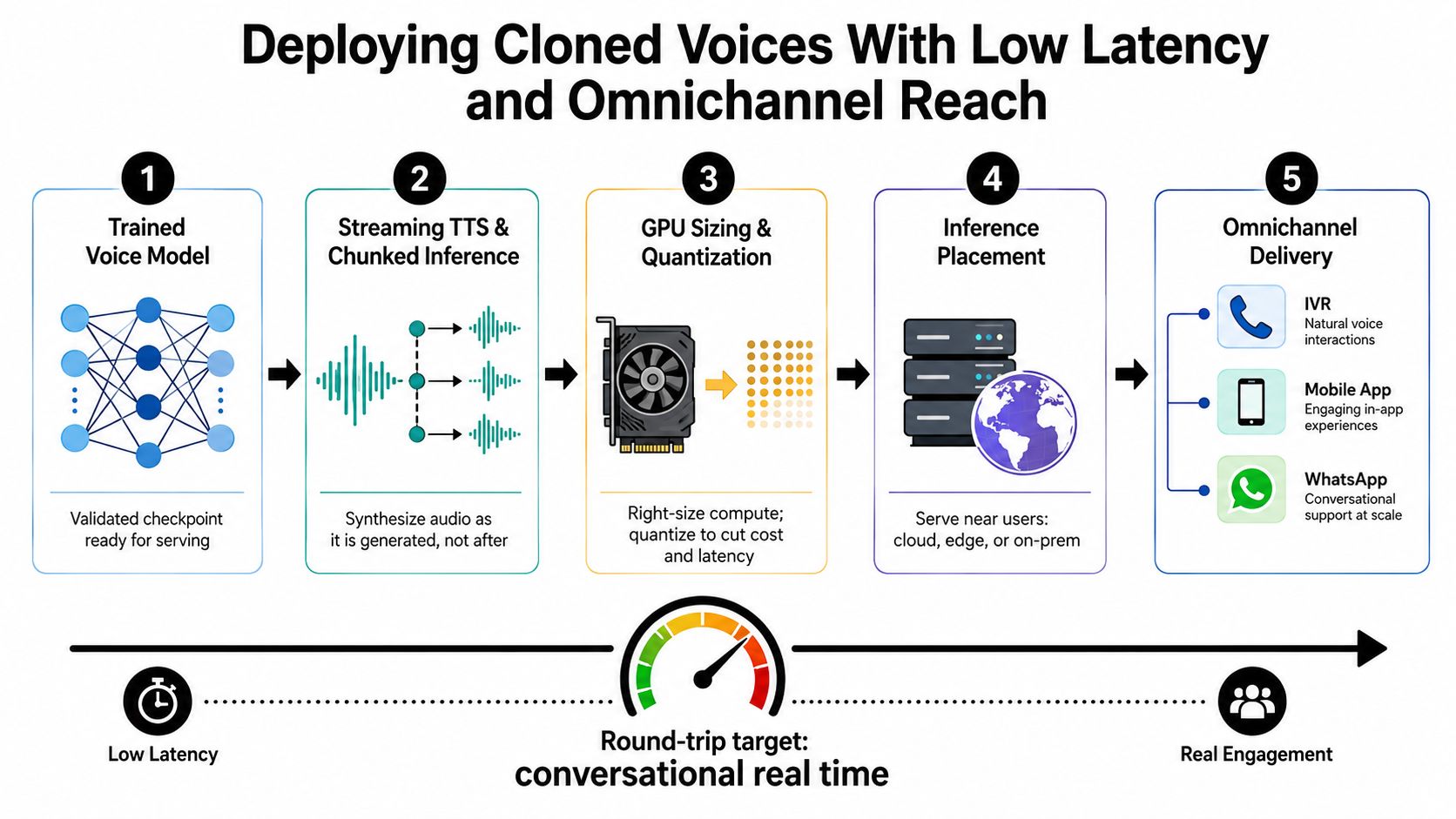
A production voice clone only matters if it can speak on time. If callers hear a laggy response, the system feels broken even when the audio quality is high, and that's a hard trust failure to recover from.
Design for streaming, not batch synthesis
Use streaming TTS and chunked inference so audio begins flowing before the entire sentence is finished. That's the basic move that keeps the experience conversational instead of making the caller wait for a full render. GPU sizing and quantization matter here because they shape both cost and time-to-first-byte.
Where you place inference also matters. Serving close to SIP and WebRTC edges reduces path length and makes low-latency design more realistic in live calls. If the voice has to cross too many hops, the illusion of immediate conversation falls apart fast.
Match the channel to the audio profile
The same cloned voice can serve IVR, in-app assistants, chat, and video avatars, but it shouldn't use the exact same audio profile everywhere. SSML, prosody tags, and channel-specific tuning help keep the brand voice consistent without forcing one waveform to fit every medium. Mobile and messaging channels are especially sensitive to echo, partial packet loss, and truncated utterances.
Integration is usually straightforward with the major contact-center and telephony stacks, but the edge cases aren't. Barge-in behavior, VAD tuning, and codec artifacts tend to show up in production after a few clean demos. That's normal, which is why failover and tenant isolation need to be part of the plan from day one.
Pick a platform that can sit inside enterprise workflows
If you want a reference point for what this looks like in practice, Yellow.ai's voice automation stack is one example of a product surface that ties voice to broader conversational routing instead of treating it like a standalone asset. That matters because cloning a voice is easy compared with orchestrating it across channels, roles, and fallback paths.
The other enterprise requirement is resilience. Regional residency, on-prem options where needed, and strict tenant boundaries are not nice-to-have features. They're what makes a cloned voice acceptable to security and compliance teams that have to approve the rollout.
Monitoring, Drift Detection, and Lifecycle Controls in Production
The hardest mistake to correct is treating launch as the end of the project. In voice cloning, launch is the point where the risk profile becomes real, because the voice is now tied to live traffic, live policy, and live users.
Watch for acoustic, semantic, and consent drift
Three failure modes show up repeatedly. Acoustic drift happens when carriers or codecs change behavior and the voice no longer renders the way it did in testing. Semantic drift happens when prompts, scripts, or model settings change and the output moves away from the approved persona. Consent drift happens when the original speaker's role or contract changes, but the voice stays active because nobody tied it to a revocation system.
The monitoring layer has to catch all three. Track similarity against the consented enrollment embedding, flag quality drops against a rolling baseline, and watch for prompt-injection attempts that try to push the clone into unauthorized scripts. If the voice can be prompted outside its approved use case, you need to know immediately.
Build revocation into the control plane
Time-boxed synthesis tokens are a good first layer, but they're not enough on their own. You also need a revocation pipeline tied to HR systems and consent registries so a voice can be suspended without waiting for a manual ticket chain. Version pinning helps too, because regulated environments often need to replay a specific voice build for audit or forensic review.
A synthetic canary is useful here. Re-synthesize fixed probes on a schedule, then compare the results to the approved baseline. When something changes, the dashboard should show whether the problem is latency, similarity, refusal behavior, or a downstream integration issue. That's much better than discovering the problem when a customer complains.
If your monitoring can't tell you whether the clone failed, drifted, or was revoked, the monitoring isn't finished.
The practical policy is straightforward. Keep a kill switch, keep logs that are tamper-evident, and make compliance events trigger the same response path as technical failures. A cloned voice in production should behave like a regulated asset, not a static media file.
For teams thinking about how to harden these systems, Yellow.ai's work on prism prompt reliability and AI agent drift is a relevant adjacent read, because the same operational idea applies, changes in prompts and behavior need ongoing detection, not one-time testing.
| Metric | What It Catches | Alert Threshold (Example) |
|---|---|---|
| Similarity score | Drift from the consented voice identity | Sudden drop from baseline |
| Latency | Slow responses that break conversation flow | Noticeable jump over normal path |
| Refusal rate | Overblocking or policy misfires | Spike compared with typical traffic |
| Baseline MOS trend | Quality decay in real usage | Sustained downward movement |
| Revocation status | Voices still active after consent ends | Any active token after expiry |
If you're building voice into a real customer journey, Yellow.ai can help you connect cloning, orchestration, testing, and governance in one enterprise workflow. Visit Yellow.ai to see how its voice and agent platform fits into contact-center and CX deployments that need more than a demo.



