









The surprising part of generative AI customer service isn't that models can write fluent answers. It's that the enterprise shift has less to do with chat and more to do with operating model redesign. What used to sit at the edge of support as a bot experiment is turning into a service layer that shapes routing, self-service, agent workflows, and compliance controls.
The market signals are hard to ignore. The AI customer service market was valued at USD 13,012.4 million in 2024 and is projected to reach USD 83,854.9 million by 2033, a projected 23.2% CAGR from 2025 to 2033. The same 2025 forecast says 80% of customer service organizations were expected to use AI solutions, with some estimates suggesting generative AI could handle up to 70% of customer interactions by 2025, according to Upskillist's 2025 customer service AI overview.
That doesn't mean every AI deployment is good. It means the center of gravity has moved. Enterprise leaders now have to decide whether generative AI becomes a controlled, measurable system inside CX, or a patchwork of copilots, point tools, and unmanaged risk.
Table of Contents
- The New Reality of Customer Service
- Redefining Service with Generative AI
- The Business Case for Generative AI in Service
- Core Use Cases From Automation to Agentic AI
- Architecting for Enterprise-Grade Performance
- Your Implementation Roadmap and Safety Guardrails
- Measuring Success and Choosing Your AI Platform
The New Reality of Customer Service
Support organizations used to treat automation as a containment layer in front of human agents. That model is fading. Generative AI customer service changes the sequencing. The system now attempts understanding, retrieval, decision support, and response generation first. Humans step in where judgment, exception handling, negotiation, or empathy matter most.
That shift is already visible in enterprise planning. As noted earlier, adoption and market growth point to AI becoming a core operating layer rather than a sidecar feature. For CX leaders, the strategic risk involves more than missing a chatbot trend. It's locking the business into a service model built for slower routing, heavier manual handling, and fragmented knowledge operations.
The operating model is changing
In practice, the modern support stack is moving toward an AI-first, human-governed structure:
- Front door automation: AI handles initial intent capture, identity steps, and common request resolution.
- Knowledge mediation: The model translates dense policies and documentation into usable answers.
- Agent augmentation: Human teams receive summaries, recommended actions, and drafted responses.
- Escalation by design: Complex, sensitive, or high-risk cases move to people with context preserved.
This is a bigger redesign than many teams expect. If your knowledge base is stale, your policy rules are inconsistent, or your CRM context is fragmented, generative AI won't fix those weaknesses. It will expose them faster.
Practical rule: Treat generative AI as a service architecture decision, not as a channel feature.
Why enterprise leaders feel urgency now
Three pressures are converging. Customers expect fast resolution. Agents need relief from repetitive work. Technology leaders need a path that improves service without creating unmanaged risk.
The enterprises making progress don't start by asking, "Where can we put a bot?" They ask sharper questions. Which journeys are stable enough to automate? Which knowledge sources can be trusted? Which decisions require approval? Which channels need the same policy logic?
Those questions separate pilot theater from durable transformation.
Redefining Service with Generative AI
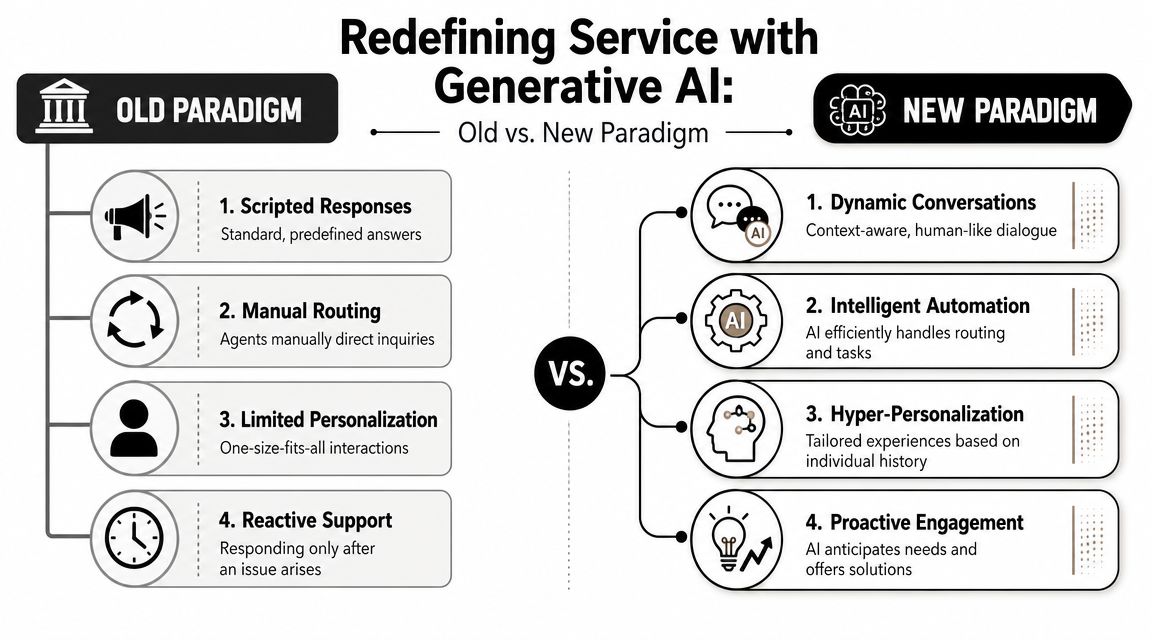
Traditional customer service automation worked like an employee reading from a rigid script. If the customer followed the expected path, the system performed adequately. If the customer used unusual wording, switched channels, mixed multiple issues together, or asked a policy question with nuance, the experience broke down.
Generative AI behaves differently. When it's deployed correctly, it acts more like a trained operator who can understand intent, pull from company knowledge, and respond in natural language without sounding trapped inside a decision tree.
From scripts to adaptive reasoning
The old model was deterministic. Teams wrote flows, button paths, fallback trees, and canned responses. That approach still has value for strict transactions, but it struggles when conversations become messy.
The new approach is probabilistic and context-aware. The model interprets the request, weighs intent and phrasing, references available knowledge, and generates a relevant response. That's why generative systems can feel dramatically more natural than older bots.
A useful way to think about the difference:
| Traditional automation | Generative AI service |
|---|---|
| Fixed flows | Dynamic response generation |
| Keyword matching | Intent and context understanding |
| Narrow FAQ handling | Broader conversational coverage |
| Manual authoring at scale | Knowledge-grounded adaptation |
| Brittle handoffs | Richer escalation context |
That distinction also explains why leaders are paying attention to agentic AI and how it differs from traditional AI agents. Once the model can reason over context and tools, the conversation stops being just a response engine and starts becoming a workflow participant.
Why this changes the service model
The primary value isn't that the AI sounds human. A pleasant sentence is easy. The hard part is generating a useful answer while respecting policy, permissions, and channel context.
Generative AI changes service in four practical ways:
- It absorbs messy language. Customers don't need to phrase requests exactly right.
- It can personalize at runtime. The response can reflect account status, prior history, and journey context.
- It shortens the distance to resolution. The system can combine retrieval, guidance, and action support in one interaction.
- It gives agents better starting points. Instead of searching across tabs, they work from summaries and grounded suggestions.
The strongest deployments don't try to make AI sound clever. They make AI reliably useful.
That distinction matters. Many failed projects optimize tone before they solve grounding, access control, and escalation logic. Enterprises need the reverse order.
The Business Case for Generative AI in Service
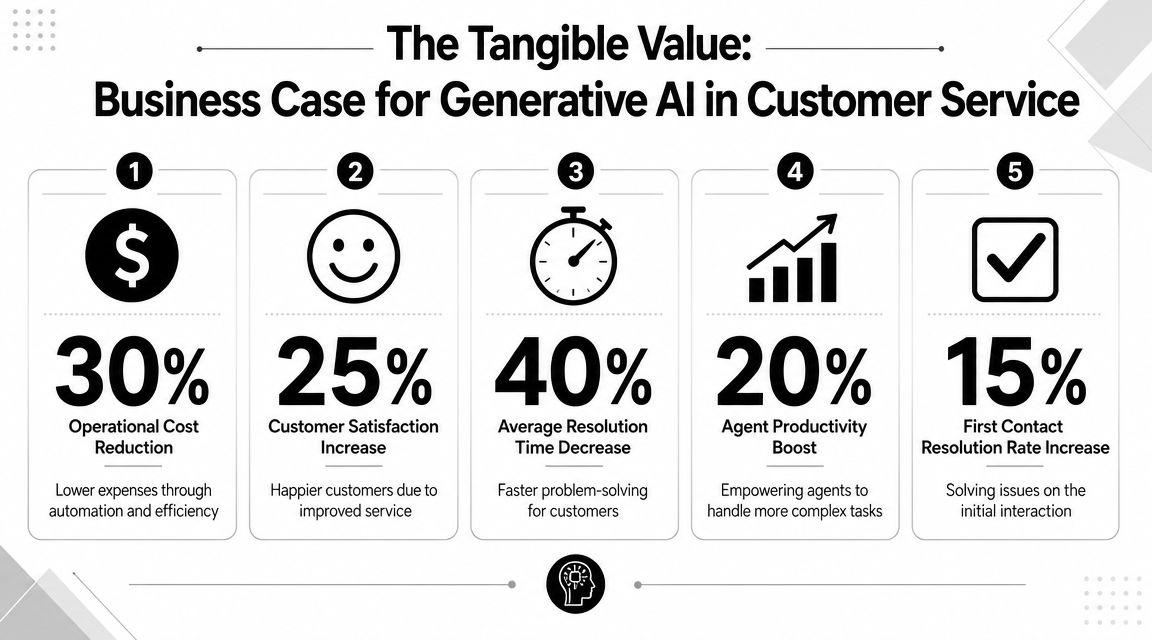
The business case starts with labor and throughput, but it doesn't end there. Generative AI customer service creates value across efficiency, customer experience, and workforce effectiveness. If you only model ticket deflection, you'll underestimate the upside and miss half the implementation requirements.
Efficiency is the entry point
The clearest operational argument is that AI can handle a large share of repetitive inbound demand. According to GetNextPhone's AI customer service statistics roundup, AI tools are projected to resolve 65% of incoming support queries without human help in 2025, and companies deploying generative AI report a 14% average productivity boost for support agents. The same source notes that 69% of consumers prefer AI-powered self-service tools for quick issue resolution.
Those figures matter because they point to a practical pattern. Well-scoped AI reduces manual touches in high-volume queues, then raises agent productivity in the interactions that remain. Cost containment doesn't come only from fewer tickets reaching people. It also comes from faster preparation, better routing, and less after-call work.
A useful external explainer on this distinction is Riff Analytics on chatbot AI vs ChatGPT, which helps frame why generative systems create a different value profile than older scripted bots.
Customer experience and agent leverage
Efficiency alone won't justify enterprise-scale change if customer outcomes get worse. The stronger business case is that generative AI can improve the service experience while taking pressure off teams.
Consider the pattern:
- Faster answers for common issues: Customers get immediate help for routine problems.
- Better use of human capacity: Agents focus on escalations, judgment calls, and emotionally charged interactions.
- More consistent service: The AI can draw from standardized knowledge instead of relying on memory or uneven agent tenure.
This changes what "good support" looks like. For many organizations, the goal isn't a smaller contact center. It's a better-distributed one, where automation handles repeatable work and human specialists spend their time where it adds value.
What works: Build the financial case around queue mix, handle time pressure, and agent workload.
What doesn't: Promise generic transformation without mapping AI to actual service journeys.
There's also a talent argument. Agents generally don't want to spend their day retyping password reset instructions or summarizing conversations into multiple systems. Copilots, summaries, and grounded drafts remove low-value friction. That helps operations and job design at the same time.
Core Use Cases From Automation to Agentic AI
The easiest mistake in generative AI customer service is assuming the only use case is "better chatbot answers." That's the shallow end of the pool. The bigger opportunity spans self-service, agent assist, multimodal interactions, and workflow execution that begins to look agentic.
Self-service that actually resolves issues
The first wave is intelligent self-service. This includes conversational FAQ resolution, account support, policy explanation, and guided troubleshooting across web chat, app messaging, and conversational IVR.
Done well, this doesn't feel like an FAQ page with a chat bubble attached. The system understands the customer's wording, retrieves relevant internal knowledge, and asks clarifying questions when needed. It can also maintain context across turns, which is where many legacy bots failed.
A practical example is messaging-led service. For teams exploring that channel, a hands-on reference like this n8n WhatsApp chatbot guide is useful because it shows how workflow automation and customer messaging can connect in actual scenarios.
What works in self-service:
- Stable high-volume intents: Order status, policy questions, simple troubleshooting, appointment changes.
- Strong identity and permissions controls: The bot shouldn't expose account-specific information without the right checks.
- Clear fallback logic: When confidence drops, escalation should be immediate and context-rich.
What doesn't work is pushing every inquiry into automation. Complex billing disputes, emotionally sensitive complaints, and edge-case policy interpretation usually need human judgment.
Agent assist and copilots
The second wave sits behind the scenes. Agent assist systems listen, summarize, suggest responses, and surface relevant knowledge while the conversation is happening.
Many enterprises see fast internal adoption because the AI helps employees before it fully replaces any front-end workflow. Common applications include:
- Real-time answer suggestion during chat or voice interactions
- Automated summaries after the conversation ends
- Knowledge retrieval based on live issue context
- Tone adjustment and rewriting for customer-facing messages
These use cases often land better politically because they're framed as augmentation, not replacement. They also generate cleaner data for QA and coaching when summaries and resolutions are structured consistently.
Multilingual and voice-first operations
The hardest enterprise problem isn't answering a simple question in English on web chat. It's delivering consistent service quality across voice, messaging, and digital channels when customers speak different languages, use different accents, and expect low latency.
That challenge is frequently under-discussed. As Mindpath's analysis of Gen AI in the customer service landscape notes, low-resource languages are often poorly represented in training data, which creates uneven quality. The same piece highlights the need for low-latency, high-quality service across hundreds of languages, accents, and channels like voice.
For global brands, this changes the vendor and architecture conversation. It's not enough for a demo bot to perform well in one language on one channel. Enterprise systems need to preserve tone, policy adherence, and escalation quality across a far broader service footprint.
If you're a global brand, multilingual performance isn't a feature request. It's a deployment constraint.
The more advanced frontier is agentic behavior. That means systems that don't just answer, but also coordinate tasks, trigger workflows, collect missing information, and manage the next step. At that point, the conversation layer starts interacting with business systems rather than just speaking about them.
Architecting for Enterprise-Grade Performance
Most problems in generative AI customer service aren't model problems. They're architecture problems. Enterprises get weak outcomes when they connect a model directly to a channel and expect intelligence to emerge from prompts alone. That's not a platform. That's an experiment.
The production pattern is layered, controlled, and thoroughly integrated.
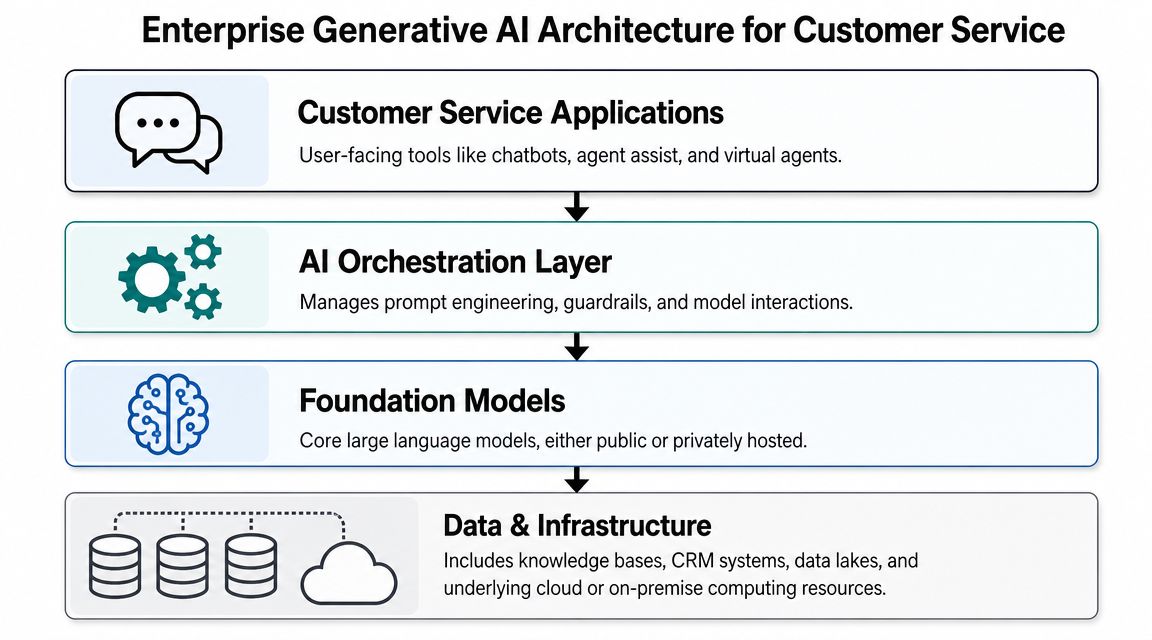
The stack that matters
A reliable enterprise stack usually includes four layers:
- Customer-facing applications such as chat, voice, email assist, and agent desktop tools.
- An orchestration layer that manages prompts, tools, guardrails, routing logic, and conversation state.
- Foundation models selected for specific tasks such as generation, summarization, classification, or speech.
- Data and infrastructure including CRM, ticketing, knowledge sources, access controls, analytics, and observability.
Each layer solves a different problem. Confusing them creates technical debt fast. The model is only one component, and often not the hardest one.
Why RAG is non-negotiable
The most important enterprise pattern is retrieval-augmented generation, or RAG. According to K2view's guide to generative AI use cases in customer service, grounding the model in enterprise knowledge is the industry-standard approach for safe and effective deployment. The same guidance explains that RAG enables answers to be generated from verified internal documents, policy manuals, and ticket history, reducing hallucination risk and keeping responses current.
That grounding matters because support environments change constantly. Policies are updated. Product documentation evolves. Temporary exceptions appear. A model's pretraining doesn't know your refund rule from last Tuesday.
A practical RAG pattern usually requires:
- Unified knowledge access: Product docs, SOPs, policy files, and historical cases need a usable retrieval path.
- Document chunking and indexing: Long content has to be structured for retrieval quality.
- Permission-aware retrieval: The system must respect what each user or agent is allowed to see.
- Answer generation from retrieved context: The output should reflect approved source material, not unsupported model memory.
One useful reference point for orchestration choices is Yellow.ai's LLM orchestration overview, which outlines how orchestration layers can govern model interactions rather than leaving behavior entirely to raw prompting.
Integration and orchestration discipline
Even a well-grounded model will underperform if it can't access the systems where service occurs. Enterprise support depends on CRM records, identity services, order systems, billing tools, telephony, ticket history, and workforce applications.
This is why point solutions often hit a wall. They may demo well in a sandbox, but production service needs:
| Architectural need | Why it matters |
|---|---|
| Channel orchestration | Customers switch between voice, chat, and messaging |
| CRM and ticketing integration | The AI needs context and actionability |
| Observability | Teams need traceability for failures and drift |
| Access controls | Not every role should retrieve every data source |
| Model flexibility | Different tasks often need different models |
A mature platform should also avoid rigid single-model dependence. Enterprises benefit from selecting models by task, latency need, language support, and compliance requirement. That doesn't mean building a research lab internally. It means preserving enough control to adapt as models and regulations change.
Your Implementation Roadmap and Safety Guardrails
Generative AI in service fails when organizations treat deployment like a feature launch. It succeeds when they treat it like a managed transformation program with governance built in from day one.
A practical roadmap should be phased, narrow at the start, and brutally honest about safety requirements.
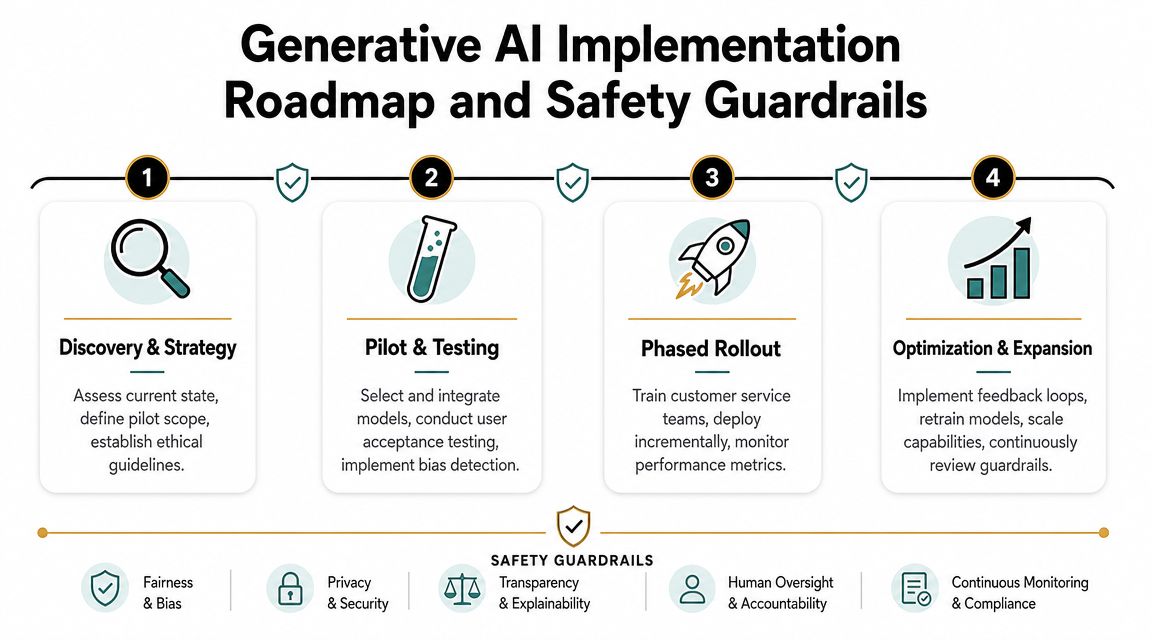
Start with a bounded service problem
The best first deployment is rarely the most ambitious one. Start where three conditions are true: the demand is high-volume, the knowledge is reasonably stable, and the downside of a wrong answer is manageable.
Good candidates include policy FAQs, account support with clear verification, internal help desk scenarios, and agent copilot use cases. Poor candidates include broad "answer anything" bots connected to sensitive customer workflows with weak retrieval quality.
A disciplined roadmap often follows this sequence:
- Discovery and governance setup: Define approved use cases, risk classes, escalation rules, and data boundaries.
- Knowledge preparation: Clean duplicate content, retire outdated documents, and establish source ownership.
- Pilot build: Connect retrieval, channel, and workflow systems for one tightly scoped journey.
- Live testing with humans in the loop: Review outputs, edge cases, and escalation quality before broader rollout.
- Controlled expansion: Add adjacent intents, channels, and automation depth only after performance is stable.
The implementation discussion is easier to understand when teams can see the lifecycle in action. This short video gives that rollout perspective:
Build testing and oversight before scale
Many teams cut corners. They validate happy-path prompts, get a promising demo, then discover in production that the model fails on ambiguity, policy exceptions, and adversarial phrasing.
Testing should cover more than answer quality. It should evaluate:
- Retrieval relevance: Did the system fetch the right source material?
- Policy adherence: Did the answer stay within approved language and business rules?
- Escalation judgment: Did the AI know when not to answer?
- Channel behavior: Did the same logic hold across chat, email, and voice?
- Auditability: Can the team reconstruct what the system saw and why it responded that way?
A pilot without systematic testing isn't a pilot. It's a polished demo.
Human review matters long after launch. Enterprises need structured feedback loops from agents, QA teams, compliance owners, and operations leaders. Those signals are how you improve retrieval quality, tighten prompts, and refine fallback thresholds.
Guardrails that enterprises actually need
Safety guardrails aren't decorative. They're the cost of admission. As Assembled's overview of generative AI customer service risks notes, the U.S. NIST warns that generative AI systems can produce inaccurate, misleading, or fabricated outputs. The same guidance emphasizes human review, continuous monitoring, and clear audit trails, especially in regulated environments like finance and healthcare.
In practice, that means building controls at multiple levels:
- Data guardrails: Define which data can be retrieved, summarized, stored, or exposed to customers.
- Response guardrails: Restrict unsupported claims, disallowed language, and off-policy recommendations.
- Workflow guardrails: Require human approval for refunds, exceptions, regulated disclosures, or high-impact decisions.
- Operational guardrails: Monitor drift, failed retrievals, repeated escalations, and incident patterns.
If you're selecting a platform for this phase, capabilities matter more than marketing language. One example is Yellow.ai, which provides enterprise agent building, multimodal orchestration, automated testing, and compliance-oriented controls across customer and employee workflows. That's the category of capability to look for, whether you're evaluating Yellow.ai, a CCaaS vendor, or a standalone AI platform.
The common failure mode is trying to automate too much before trust and traceability are in place. The better approach is to expand only when governance, testing, and operations teams can explain exactly how the system behaves.
Measuring Success and Choosing Your AI Platform
Once generative AI moves beyond pilot status, leaders need two disciplines. First, measure the program with the right operational and business signals. Second, choose a platform that can scale across channels, governance needs, and future use cases.
Measure outcomes, not demos
Vanity metrics distort AI programs. A fluent answer isn't the same as a successful service interaction. The right KPIs depend on what the system is supposed to improve.
For most enterprise teams, the scorecard should include three layers:
- Operational metrics: containment rate, automation rate, transfer quality, time to resolution, and repeat contact patterns
- Customer metrics: CSAT, customer effort, complaint signals, and escalation sentiment
- Business metrics: cost-to-serve, queue health, agent workload mix, and service consistency across markets
The key is pairing AI metrics with service metrics. If automation rises but escalations become messier, the program isn't winning. If summaries save time but agents still mistrust the suggestions, the copilot isn't creating enough value.
For teams building a stronger measurement model, this guide to measuring AI agent performance in an AI-first world is a useful reference for thinking beyond basic bot dashboards.
Enterprise AI Platform Evaluation Checklist
Vendor selection often gets reduced to model quality in a demo. That's too narrow. Enterprise generative AI customer service depends on security, orchestration, integration, multilingual capability, governance, and operational tooling.
| Capability | What to Ask | Why It Matters |
|---|---|---|
| Multi-model support | Can the platform route tasks across different models or are you locked into one? | Different tasks have different latency, cost, and language requirements |
| RAG architecture | How does retrieval work, and can responses be grounded in approved enterprise content? | Grounding is central to accuracy and trust |
| Permissions and access control | Can retrieval respect user roles, regions, and data entitlements? | Support systems often expose sensitive customer and policy data |
| Channel coverage | Does the same orchestration layer support chat, voice, email, and messaging? | Customers don't stay in one channel |
| Multilingual and voice quality | How does the platform handle low-resource languages, accents, and voice interactions? | Global operations need consistency, not just English-language demos |
| Integrations | Are there pre-built connectors for CRM, CCaaS, ticketing, identity, and knowledge systems? | AI without system access can't resolve much |
| Testing and monitoring | What tools exist for simulation, evaluation, alerts, and audit trails? | Reliability depends on continuous evaluation |
| Governance | Can you define escalation rules, response policies, and human approval points? | High-risk workflows need explicit control |
| Compliance posture | Which enterprise certifications and operational safeguards are supported? | Security review can stop a project before it starts |
| Analytics | Can teams trace outcomes from answer quality to business impact? | AI programs need defensible ROI, not anecdotes |
A final buying note. Ask vendors to show how the system fails, not just how it succeeds. Ask for examples of low-confidence handling, retrieval misses, policy conflicts, and escalation decisions. Mature platforms can explain those moments. Immature ones hide them behind a polished demo path.
The future of service will look more conversational, more proactive, and more autonomous. But the winners won't be the brands that deploy the most AI. They'll be the ones that build the most governable AI.
Yellow.ai is one option for enterprises that need a governed agentic AI platform across CX and EX, with multimodal orchestration, RAG-based knowledge access, pre-built integrations, analytics, and enterprise compliance controls. If you're evaluating how to operationalize generative AI customer service at scale, it's worth exploring Yellow.ai alongside your broader platform shortlist.