











The hardest part of enterprise AI usually isn't model quality. It's coordination. Teams can buy strong models, wire up promising agents, and still fail to produce reliable business outcomes because no one has built the control layer that manages context, routing, policy, retries, integrations, and human oversight.
That's why the growth signal around orchestration matters so much. The AI orchestration market is projected to grow from USD 11.02 billion in 2025 to USD 30.23 billion by 2030, at a 22.3% CAGR, which points to a shift in how enterprises are thinking about AI: not as isolated assistants, but as an operating layer for enterprise-wide automation, according to MarketsandMarkets on the AI orchestration market.
For CX and EX leaders, that changes the conversation. The question is no longer “Which model should we use?” It's “What system will coordinate customer requests, employee tasks, enterprise data, and action-taking workflows without breaking governance?” That system is the orchestration platform.
Table of Contents
- From AI Chaos to Enterprise Autonomy
- What Is an AI Orchestration Platform
- Core Architecture and Key Capabilities
- Enterprise Use Cases in Action
- Integration and Deployment Patterns
- How to Select the Right AI Orchestration Platform
- Your Implementation Roadmap and Measuring ROI
From AI Chaos to Enterprise Autonomy
Most enterprises don't have an AI problem. They have a systems problem.
One team deploys an LLM for customer support. Another adds a workflow bot for HR. A third team builds a retrieval layer for internal knowledge. Soon there are too many prompts, too many connectors, too many model choices, and no common control plane deciding what should happen, in what order, under which policies, and with what fallback behavior.
That's where many AI programs stall. Not because the ideas are weak, but because production operations demand more than intelligence. They demand coordination.
An AI orchestration platform is what turns scattered capabilities into a working enterprise system. It manages the sequence of actions, keeps context intact across steps, decides when to call tools or humans, and applies governance across every handoff. Without that layer, AI remains a collection of demos.
Why autonomy starts with control
The autonomic enterprise isn't a science fiction idea. It's a practical operating model where systems can sense intent, reason over enterprise context, take bounded action, and recover when a task becomes ambiguous or high risk.
That matters most in CX and EX because those functions live in cross-system work. A customer conversation rarely ends in one channel or one application. An employee service request often spans identity, IT, policy, training, payroll, and approvals. AI can participate in those journeys only if something coordinates the full chain.
Practical rule: If your agent can answer questions but can't manage state, trigger workflows, or escalate cleanly, you don't have enterprise automation. You have an interface.
The strongest orchestration strategies treat AI as part of the operating fabric. They connect models, APIs, business rules, event streams, and human checkpoints into one governed runtime.
What changes when orchestration is treated strategically
Once orchestration becomes a board-level platform decision instead of a point-tool choice, priorities get sharper:
- Architects focus on model-agnostic design so teams aren't trapped by one vendor.
- Operations leaders push for workflow reliability, retries, observability, and exception handling.
- Security teams require policy enforcement, auditability, and clear boundaries around data movement.
- CX and EX owners care about outcomes. Resolution, fulfillment, speed, and consistency.
The organizations making real progress have stopped asking whether they need more AI tools. They're asking which platform will coordinate all the tools they already have.
What Is an AI Orchestration Platform
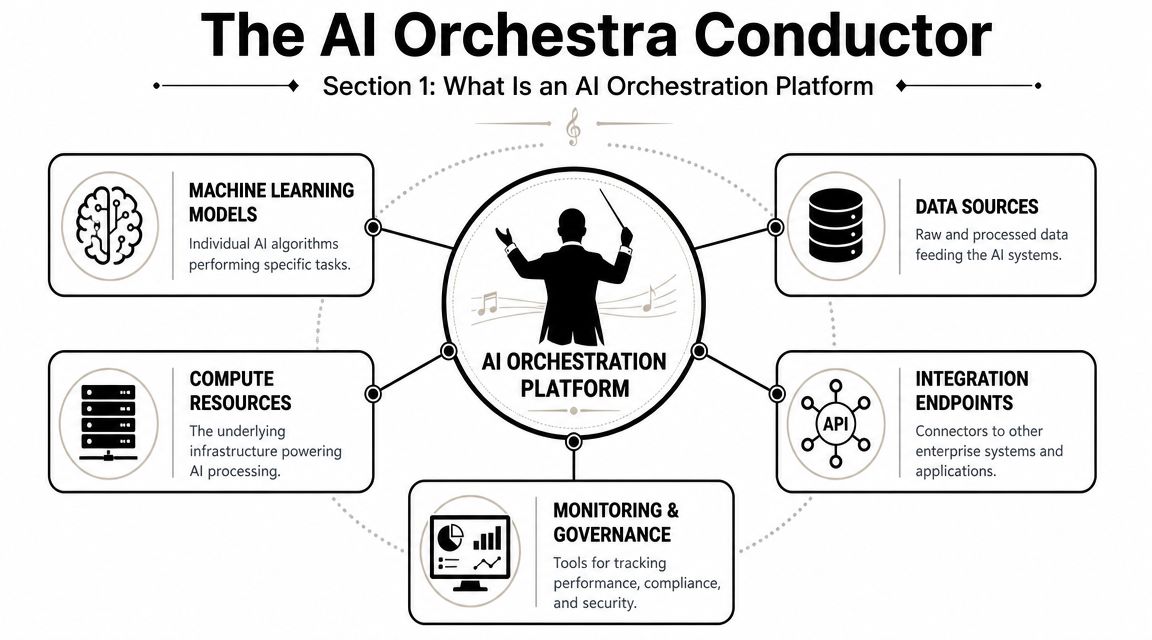
An AI orchestration platform is the conductor of the enterprise AI stack. Models, agents, APIs, databases, and workflow tools may all be capable on their own, but capability without coordination creates noise.
The conductor, not the instrument
The conductor doesn't play every instrument. The conductor decides who comes in, when they act, how long they continue, and what happens if something goes off tempo.
That's the role of orchestration in enterprise AI. It coordinates:
- Models for reasoning, extraction, classification, or generation
- Data sources such as CRM records, policy documents, ticket histories, and knowledge bases
- Tools and endpoints that execute actions in systems like HRIS, ITSM, ERP, and payment platforms
- Governance controls for permissions, approvals, monitoring, and escalation
A customer asks to rebook travel, update a loyalty account, and apply a voucher. A useful system doesn't just generate a response. It identifies the goals, checks eligibility, retrieves booking details, calls the right service APIs in sequence, handles a failed step, and returns a confirmed outcome. That's orchestration.
For teams documenting and tuning multi-step voice or chat workflows, tools such as Voicy app for voice typing can also help capture call transcripts, operational notes, and test observations quickly during rollout and QA.
What orchestration does that other layers do not
People often confuse orchestration with MLOps, workflow automation, or API management. They overlap, but they aren't the same.
| Layer | Main role | What it does not solve on its own |
|---|---|---|
| MLOps | Model lifecycle management | Doesn't coordinate multi-step business actions across tools and humans |
| API gateway | Access and routing for services | Doesn't manage AI context, reasoning chains, or agent handoffs |
| Workflow automation | Rule-based process execution | Struggles when the system must interpret intent and adapt dynamically |
| AI orchestration platform | Runtime control across models, agents, tools, and workflows | Must still be paired with strong governance and domain design |
The distinction matters because enterprise work is rarely linear. Users switch goals. Data arrives incomplete. One action succeeds while another fails. A human may need to approve a sensitive step.
That's why modern platforms increasingly combine orchestration with agentic runtime capabilities. Platforms such as Yellow.ai's agentic AI platform are built around that idea: managing autonomous conversational flows while still grounding them in enterprise systems and controls.
A short walkthrough helps visualize the pattern in practice:
The practical takeaway is simple. If a platform only connects one model to one prompt, it isn't orchestration. If it can coordinate multiple reasoning steps, invoke systems, manage state, and enforce boundaries, it is.
Core Architecture and Key Capabilities
The architecture of modern AI orchestration platforms didn't appear from nowhere. It grew out of data and workflow systems that enterprises were already using to coordinate pipelines and jobs. As noted by Faye Digital on the evolution of AI orchestration platforms, tools such as Apache Airflow started in data pipelines and ML training, which explains why orchestration platforms are now strong at coordinating data sources, models, agents, and deployment versions inside one control plane.
That history matters because the best platforms still inherit a pipeline mindset. They know how to sequence work, manage dependencies, observe runs, and recover from failure. But they extend that discipline into agentic and conversational systems.
Multi-model coordination
A serious orchestration platform can't assume one model is right for every task. Classification, summarization, reasoning, extraction, and voice interactions all place different demands on latency, cost, and accuracy.
The multi-model layer handles that complexity by separating business logic from model choice. Instead of hardcoding one provider into every workflow, the platform lets teams route tasks to the best-fit model and swap providers without rebuilding the whole system.
Model-agnostic design proves beneficial:
- Avoid vendor lock-in when pricing, policy, or performance changes.
- Match models to tasks instead of forcing one general-purpose model to do everything.
- Preserve flexibility as the model environment evolves.
For teams evaluating orchestration depth, this is the first place to look. If routing logic is opaque or tied to one provider, long-term control will be weak. Products such as Yellow.ai Orchestrator LLM reflect one approach to this challenge by managing multi-goal conversational context while fitting into a broader orchestration layer.
Workflow and agent control
The next layer is the execution engine, where good demos become resilient systems.
In enterprise conditions, workflows don't run in straight lines. They branch. They loop. They retry. They pause for human approval. They resume after an external system responds late. They carry state across steps so the system doesn't lose the thread halfway through a request.
Frameworks highlighted in the market often emphasize exactly these requirements: loops, branching, retries, and human-in-the-loop checkpoints. That's also why stateful execution matters so much in agent orchestration.
A brittle agent can produce a fluent answer and still fail the business task. Reliable orchestration cares more about the transaction than the phrasing.
What tends to work in production:
- Explicit state handling so each step knows what has already happened
- Policy-based branching for approvals, exceptions, and risk checks
- Retries with limits instead of silent failures or infinite loops
- Human checkpoints for sensitive changes such as account updates or payment actions
What usually fails:
- Prompt-only chaining with no durable workflow state
- Agents that improvise tools instead of calling approved actions
- No exception model for partial completion or external dependency failure
Enterprise memory through agentic RAG
Orchestration without memory becomes guesswork. Enterprise requests depend on policies, records, historical context, and unstructured knowledge spread across systems.
Agentic RAG gives the orchestrated system access to the enterprise's working memory. Not just by retrieving documents, but by selecting relevant knowledge at the right point in the workflow and combining it with action logic.
In practice, that means the platform should support:
| Capability | Why it matters in operations |
|---|---|
| Contextual retrieval | Pulls the right policy, article, or record for the current task |
| Grounded generation | Reduces unsupported responses in customer and employee interactions |
| Knowledge plus action | Lets agents answer and execute, instead of stopping at information delivery |
| Version awareness | Helps teams manage changing policies, scripts, and model behavior |
RAG on its own isn't enough. Retrieval needs to be tied to task state. If a customer changes the goal mid-conversation, the retrieval target should also change. That's orchestration's job.
Monitoring, governance, and safety rails
The final pillar is control. Every enterprise says governance matters. Far fewer design it into runtime behavior.
A mature orchestration layer should make three things visible: what the system attempted, why it made that choice, and what happened next. That visibility is what lets operators debug failures, audit actions, and improve flows.
Operating principle: Don't trust an AI workflow you can't inspect step by step.
The essentials include:
- Traceability: Each model call, tool invocation, and decision path should be observable.
- Guardrails: Sensitive actions need permission checks, approval paths, or escalation logic.
- Performance monitoring: Teams need to see where workflows stall, fail, or hand off to humans.
- Version control: Prompt, workflow, and connector changes should be managed like production software.
The best platforms don't treat governance as a reporting feature. They treat it as part of execution.
Enterprise Use Cases in Action
The easiest way to understand orchestration is to watch where isolated agents fail.
A single agent can answer a question. An orchestrated system can complete a job that spans systems, policies, and multiple forms of reasoning. That distinction becomes obvious in CX, EX, and contact center operations.
Customer experience across fragmented journeys
A traveler opens a support chat and says, “I need to move my flight to tomorrow, keep the hotel if possible, and use my travel credit.”
That request isn't one intent. It's a bundle of tasks with dependencies. The platform has to identify the goals, pull the booking, check airline change rules, verify hotel policy, inspect voucher eligibility, calculate any difference, and present options in the right order.
An isolated agent usually breaks here. It may answer one part well and ignore the rest. Or it may lose context after the first API call.
An orchestrated setup works differently. One specialist handles itinerary retrieval. Another validates fare rules. Another manages payment or credit logic. The orchestration layer preserves shared state across the entire journey.
According to Coworker.ai on AI agent orchestration platforms, multi-agent orchestration can improve efficiency by 30% compared with isolated-agent deployments, because specialized agents handle sub-tasks while the orchestration layer maintains shared context and state.
That pattern is especially useful in CX because customer requests are often nested. Change one reservation and three downstream actions may also need to change.
Employee experience without ticket ping-pong
Now take a new hire onboarding request.
HR confirms the start date. IT needs to provision identity and access. Facilities may need a badge or desk assignment. Learning systems need to assign mandatory training. The employee also asks where to find leave policy and how benefits enrollment works.
Traditional service models break this into separate tickets. The employee sees delay, duplication, and conflicting updates.
An orchestrated EX flow turns it into one managed lifecycle:
- Identity and access tasks route to IT systems based on role and geography
- Policy questions are grounded in current HR knowledge sources
- Approvals trigger only where role sensitivity requires them
- Status updates stay consistent across every step
The important design choice is that the employee doesn't need to know which backend team owns which action. The orchestration layer absorbs that complexity.
Contact center execution, not just conversation
Voice AI is where weak orchestration becomes obvious fast.
A caller wants to dispute a charge, update a mailing address, and get confirmation that the replacement card is on the way. If the voice bot can only answer FAQs, the call ends in frustration. If it can perform secure verification, access CRM data, trigger the right transaction, and escalate with context when confidence drops, the experience changes completely.
That's the shift from conversational AI to operational AI.
What works in contact centers is usually a combination of three design choices:
- Strong identity and policy checks before any account-changing action.
- Transaction-aware orchestration so the system can execute CRM or backend updates, not just talk about them.
- Clean human handoff with transcript, intent summary, and completed steps attached.
A contact center agent, human or virtual, adds value when it resolves the issue. Conversation quality matters, but completion quality matters more.
This is why orchestration has become central to service transformation. It lets enterprises build systems that don't stop at intent recognition. They move from request to fulfillment.
Integration and Deployment Patterns
Integration is where most ambitious AI programs either accelerate or get delayed for quarters.
The reason is simple. Orchestration platforms don't live in isolation. They sit in the middle of CRM, ticketing, telephony, identity, databases, knowledge systems, analytics, and often a layer of legacy applications that no one wants to replatform right now.
How orchestration fits into the existing stack
A good orchestration platform reduces integration friction by meeting systems where they already are. That usually means a mix of APIs, event streams, connectors, and data-layer access patterns.
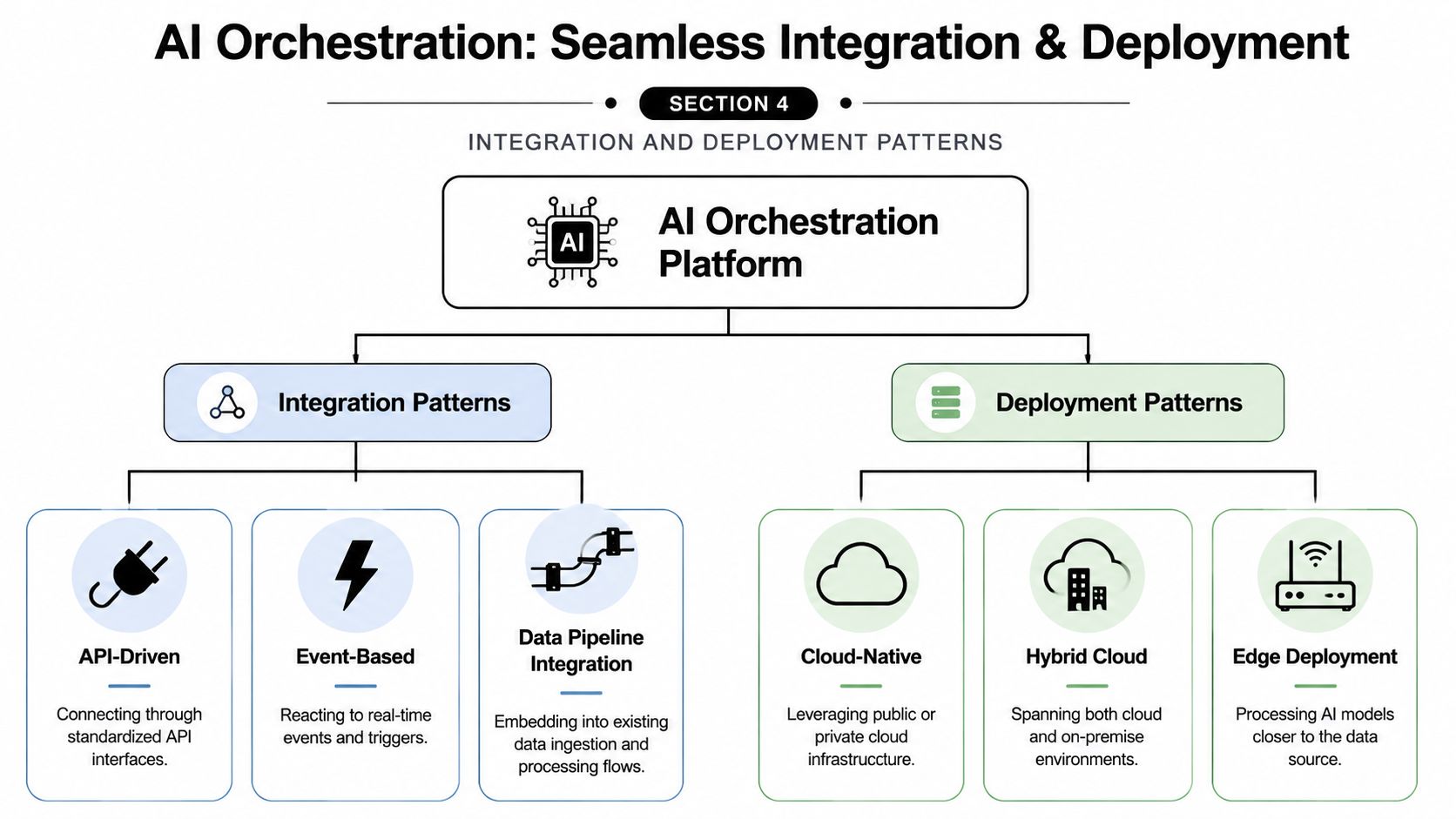
The practical integration patterns tend to fall into three buckets:
- API-driven integration: Best when the external system exposes reliable service interfaces for create, update, validate, or lookup actions.
- Event-based integration: Useful when workflows should react to triggers such as ticket creation, payment status changes, or employee lifecycle events.
- Data pipeline integration: Relevant when orchestration needs access to enterprise knowledge, transaction history, or analytics context already flowing through existing pipelines.
For operations teams, pre-built connectors matter because they reduce custom glue code. A broad catalog such as Yellow.ai platform integrations shows the type of ecosystem support buyers should expect from enterprise vendors, especially around systems like CRM, contact center, help desk, and business applications.
Deployment trade-offs leaders actually face
Deployment isn't a purity test. It's a trade-off between speed, control, residency, and operational complexity.
| Deployment pattern | Best fit | Main trade-off |
|---|---|---|
| SaaS | Fast rollout, lower operational burden | Less direct infrastructure control |
| Virtual private cloud | Stronger isolation with managed scalability | More setup and governance coordination |
| On-premise or tightly controlled private environment | Strict regulatory, residency, or internal control needs | Slower deployment and heavier internal operations |
Most enterprises end up in a hybrid posture. Customer-facing use cases may prefer managed cloud speed, while regulated data paths or internal employee workflows may require stricter hosting boundaries.
The mistake is forcing one deployment model on every use case. The better approach is to align deployment to risk profile, integration constraints, and operating model.
Security requirements that can't be bolted on later
Security controls need to shape the platform decision early, not appear as a procurement checklist at the end.
In practice, enterprise teams usually look for a mix of:
- Identity and access controls that limit who can build, deploy, and approve workflows
- Auditability for model behavior, tool usage, and agent actions
- Compliance alignment for regulated environments, especially in healthcare, finance, and payments
- Data handling boundaries around retention, masking, and movement between systems
The common failure pattern is building a pilot that works functionally but can't pass security review. Then the project stalls while teams retrofit logging, roles, approvals, and architecture constraints.
A better pattern is to treat deployment and security as part of workflow design from day one. The orchestration layer is where those decisions become enforceable.
How to Select the Right AI Orchestration Platform
Vendor decks tend to flatten important differences. Almost every platform claims automation, intelligence, integrations, and governance. A key question is whether the platform can coordinate enterprise AI under operational pressure.
Questions that expose platform depth
The fastest way to separate mature platforms from polished demos is to ask how they behave when work becomes messy.
Ask questions like these:
- How does the platform manage multi-step state? If it relies on brittle prompt chaining, production reliability will suffer.
- Can it orchestrate across multiple models and tools? If every use case funnels through one model and one narrow runtime, flexibility will erode.
- What happens when a workflow partially fails? You want retries, branching, exception handling, and resumability.
- How are human approvals inserted? Sensitive business steps should pause cleanly and resume without losing context.
- What visibility do operators get? Teams need traces, logs, action histories, and diagnostics that are useful to both developers and business operators.
A procurement process improves immediately when teams stop asking “Does it support agents?” and start asking “How does it govern agent behavior at runtime?”
If you're building a budget model alongside technical evaluation, it also helps to evaluate agentic development expenses early so architecture ambition and operating cost stay aligned.
A practical evaluation checklist
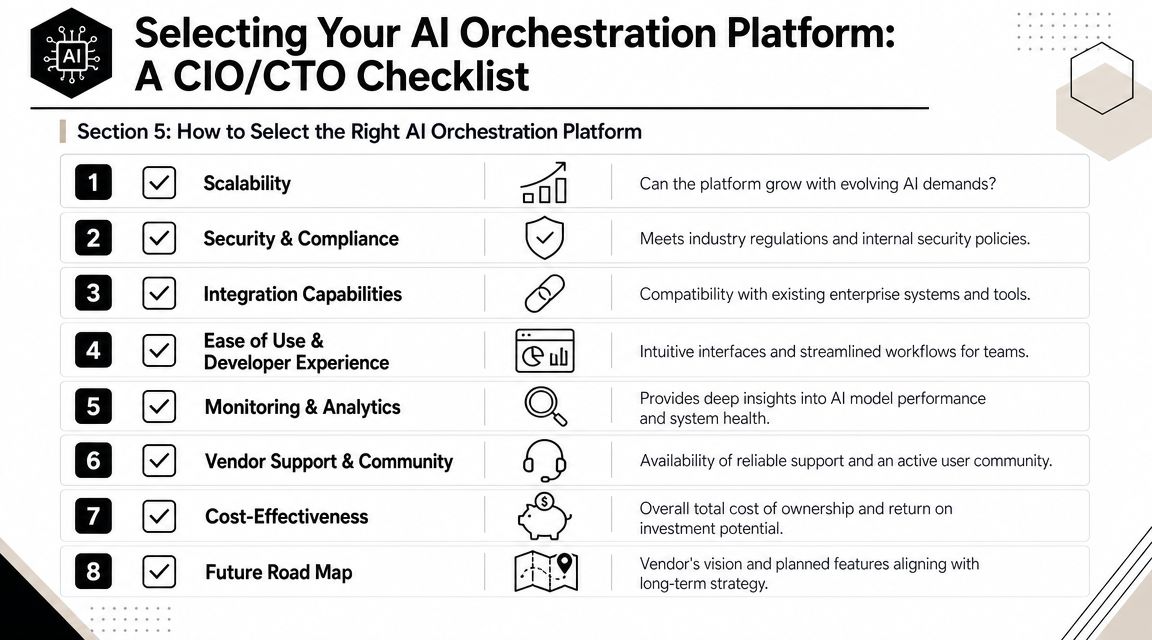
The strongest buying teams use a weighted checklist rather than a feature bingo card.
- Scalability: Can the platform support growing workflow complexity, channel expansion, and more business units without requiring a redesign?
- Security and compliance: Does the vendor provide the control model your risk team needs, including audit and role boundaries?
- Integration capability: How much of your existing stack can connect through supported connectors, APIs, or event patterns?
- Developer and operator experience: Can builders create, test, debug, and maintain flows without heroic effort?
- Monitoring and analytics: Is the platform observable enough to improve quality after launch?
- Support model: Will your teams get implementation guidance, operational help, and product evolution that matches enterprise pace?
- Cost discipline: Are you evaluating the full operating model, including implementation, workflow maintenance, model usage, and support overhead?
- Road map fit: Is the vendor building toward the kind of autonomic operating model you want in CX and EX, or just adding isolated AI features?
Choose the platform that gives you the most control over outcomes, not the one that generates the flashiest demo.
One more selection discipline matters. Run a live scenario that includes a mid-flow change, a failed system response, and a required human approval. If the platform handles that well, you're looking at orchestration. If it falls apart, you're looking at a prototype.
Your Implementation Roadmap and Measuring ROI
The best orchestration programs don't begin with a platform-wide rollout. They begin with one operational problem that is painful enough to matter and contained enough to govern well.
A phased rollout that reduces risk
A practical rollout usually follows four phases.
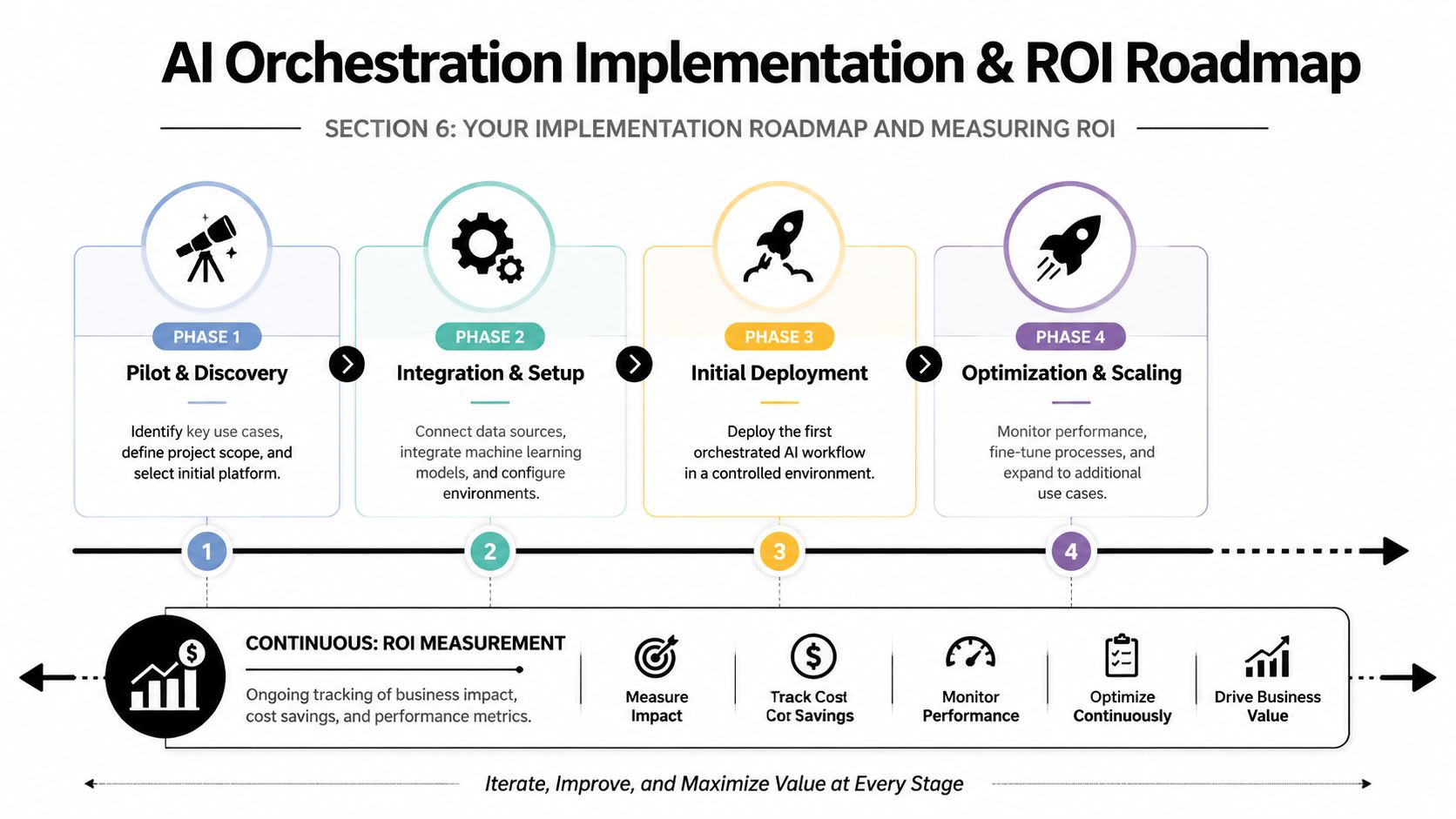
Pilot and discovery
Pick one use case with clear workflow boundaries. Good candidates include a repeatable service request in HR, a bounded support flow in CX, or a transaction-heavy contact center task with known rules.Integration and setup
Connect the minimum systems required for useful execution. Define roles, approvals, knowledge access, testing paths, and monitoring before launch.Initial deployment
Release in a controlled environment. Watch where workflows fail, where users switch goals, and where human review is still required.Optimization and scaling
Standardize patterns that worked. Build reusable connectors, governance templates, prompt policies, and operational playbooks. Then extend to adjacent workflows.
This rollout pattern works because it forces discipline. Teams learn how the platform behaves in real operations before they attempt broad autonomy.
How to measure value in CX and EX
ROI conversations get weak when teams rely only on generic “productivity” language. Orchestration should be measured against business outcomes and operational movement.
For CX, the most useful metrics often include:
- Average Handling Time
- First Contact Resolution
- Containment for well-defined intents
- Escalation quality when handoff is required
- Completion of backend actions, not just conversation success
For EX, measure things such as:
- Service fulfillment time
- Policy answer consistency
- Time to onboard or provision
- Reduction in internal ticket back-and-forth
- Employee satisfaction with request completion
Use both leading and lagging signals. Leading metrics tell you whether workflows are operating cleanly. Lagging metrics tell you whether business outcomes improved.
The deeper point is that orchestration ROI doesn't come from having AI in more places. It comes from having AI complete more of the work, with fewer manual resets and fewer broken handoffs.
Yellow.ai is one option for teams that want to operationalize this model in CX and EX. Its platform combines agentic AI, omnichannel orchestration, enterprise integrations, and governance features in a way that fits customer support, employee service, and contact center use cases. If you're evaluating platforms for an autonomic enterprise roadmap, Yellow.ai is worth including in the shortlist.