









The advice many teams still follow is simple. Get one demo to pass, freeze the prompt, and ship. That advice treats an agent like a function with one input and one output. A support agent is not that function. It plans, picks tools, writes parameters, and sometimes changes its mind on the next identical request. A single green run only proves that one path worked once.
Table of Contents
- Why a Passing Demo Is Not Proof of Reliability
- The Five Parts of a Working Testing Framework
- How One Test Run Moves From Scenario to Verdict
- Debugging a Failed Run to Its Root Cause
- Metrics That Prove Reliability Across Repeated Runs
- Stress Cases Where Happy-Path Tests Fail
- How a Customer Support Agent Gets Tested End to End
- Confirm Deployment Readiness Before You Ship
Why a Passing Demo Is Not Proof of Reliability
Standard suites assert one expected string for one fixture. An agent can reach a correct refund answer by calling the eligibility tool, or by skipping that call and echoing a policy paragraph it already saw. Both runs can look fine in a transcript review if you only read the last message.
Say a refund agent is demoed on a known order. On the first run it authenticates the customer, looks up the order, and calculates eligibility before it replies. On the second run, with the same utterance, it skips the eligibility lookup and answers from the policy text alone. The tool call was probabilistic. The demo still "passed" because nobody scored the path.
That gap is now a shipping problem, not a lab curiosity. Deloitte's 2025 State of Generative AI in the Enterprise survey, covering 2,773 business and technology leaders across 14 countries and conducted in July–September 2024, found that 26% of organizations were exploring autonomous-agent development to a large extent. Many of those teams will put agents in front of customers with a test discipline built for chatbots, not for tool-using systems.
An AI agent testing framework has to make three shifts before any release gate means anything.
Judge the trajectory, not the last sentence. Score tool choice, arguments, order, and the final state in the ticket system.
Judge repeated runs, not one success. A behavior that flips between runs is a defect even when the average looks healthy.
Judge failure conditions, not only the happy path. Missing fields, stale records, and dead tools are the cases that reach production.
By the end of this piece you will have the parts of that framework, the path from scenario to verdict, the failure categories and their fixes, the metrics that separate a fluke from a stable agent, the stress cases happy-path suites miss, a worked refund example, and a go or no-go checklist you can set before the first run.
The Five Parts of a Working Testing Framework
Most agent test efforts fail because one of five parts is missing. Writing more cases does not fix a suite that has no fixed data, no repeated execution, or no place to store the trace. Build the stack first, then add scenarios on top of it.
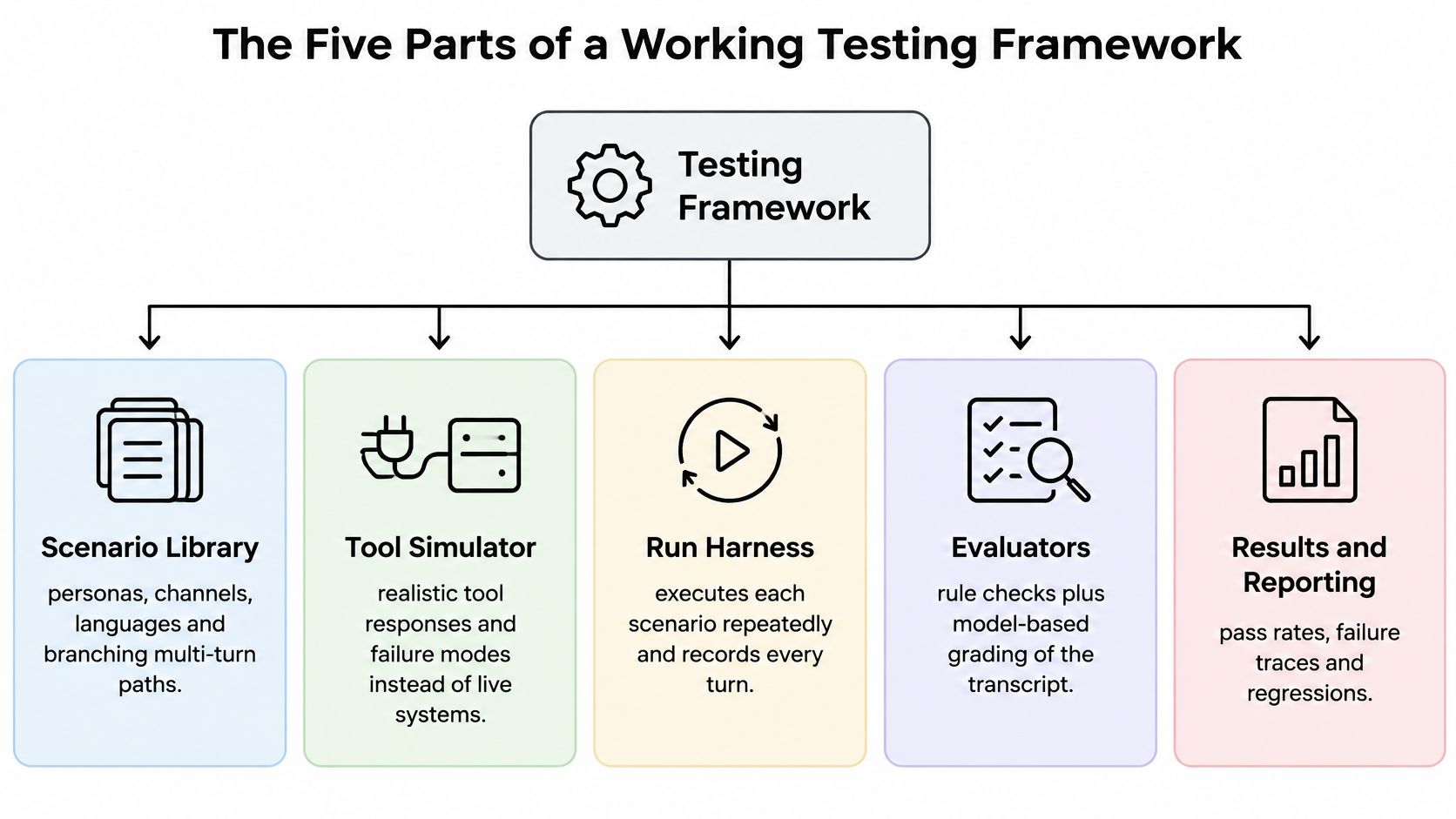
What each layer is for
Scenario library. Personas, channels, languages, and branching multi-turn paths belong here, drawn from real tickets rather than from the flows the team imagined in a workshop. Tag every case with the traffic slice it represents, such as chat refund, voice identity check, or email policy dispute. Untagged cases cannot tell you which slice is uncovered.
Sandboxed tools and fixtures. Stub the CRM, ticketing system, knowledge base, and identity provider with fixed records. Live systems change between Monday and Tuesday, so a failure you cannot replay is not a test. The simulator should also return the failure modes you will inject later, including timeouts and permission errors, without touching production.
Execution harness. Run each scenario more than once while holding the seed, the tool configuration, and the retry policy constant. If you change the retry cap in the same commit as the prompt, you cannot tell which change moved the score. The harness is what separates model behavior from orchestration behavior.
Assertions and judges. Use a deterministic check when the outcome is exact. Did the ticket land in the refund queue with the right order id? That is a boolean. Use a written rubric and a model judge only when wording can vary and still be correct, such as tone or explanation quality. Judges that are not calibrated against a small set of human grades will drift, so spot-check them.
Trace store and regression tracker. Persist every tool call, argument, state change, and model version. A release comparison is a diff of those traces, not a vibe check of two chat windows.
A release gate sits on the stack. It reads thresholds you set before the run and returns go or no-go. It does not invent a new bar after the numbers look awkward.
| Component | What It Checks | Output |
|---|---|---|
| Scenario library | Personas, channels, languages and multi-turn branches | Tagged scenario set mapped to real traffic |
| Sandboxed tools and fixtures | Agent behavior against fixed CRM, ticketing, knowledge-base and identity data | Replayable environment for every run |
| Execution harness | Repeated runs with fixed seeds, tool configuration and retry policy | Logged run results per scenario |
| Assertions and judges | Deterministic checks for exact outcomes, rubric-based model judging for free-form outcomes | Pass or fail with a reason code |
| Trace store and regression tracker | Tool calls, state transitions and results across model and prompt versions | Diff between the current and previous release |
| Release gate | Thresholds set before the run for each core metric | Go or no-go decision |
Practical rule: If a part cannot name its output for the release decision, it is not part of the framework yet. A folder of prompts is not a scenario library.
Trade-off worth making explicit. Fully deterministic fixtures miss some production messiness. Fully live backends make runs unreproducible. Keep fixtures for the regression suite, and reserve a smaller live-shadow set for checks you cannot stub, such as a vendor latency profile. Do not mix the two in one score.
How One Test Run Moves From Scenario to Verdict
A test that only stores the final reply cannot tell you why a run failed. Static question-and-answer sets miss interaction, replanning, and multi-step execution. Recent evaluation research on agent testing organizes the work into four stages: generating scenarios, executing them in an environment, evaluating against explicit criteria, and assessing compliance and safety. A harness that captures task interpretation, planning, tool selection, parameter accuracy, intermediate state, error recovery, policy compliance, latency, and the final outcome is what makes those stages diagnosable.
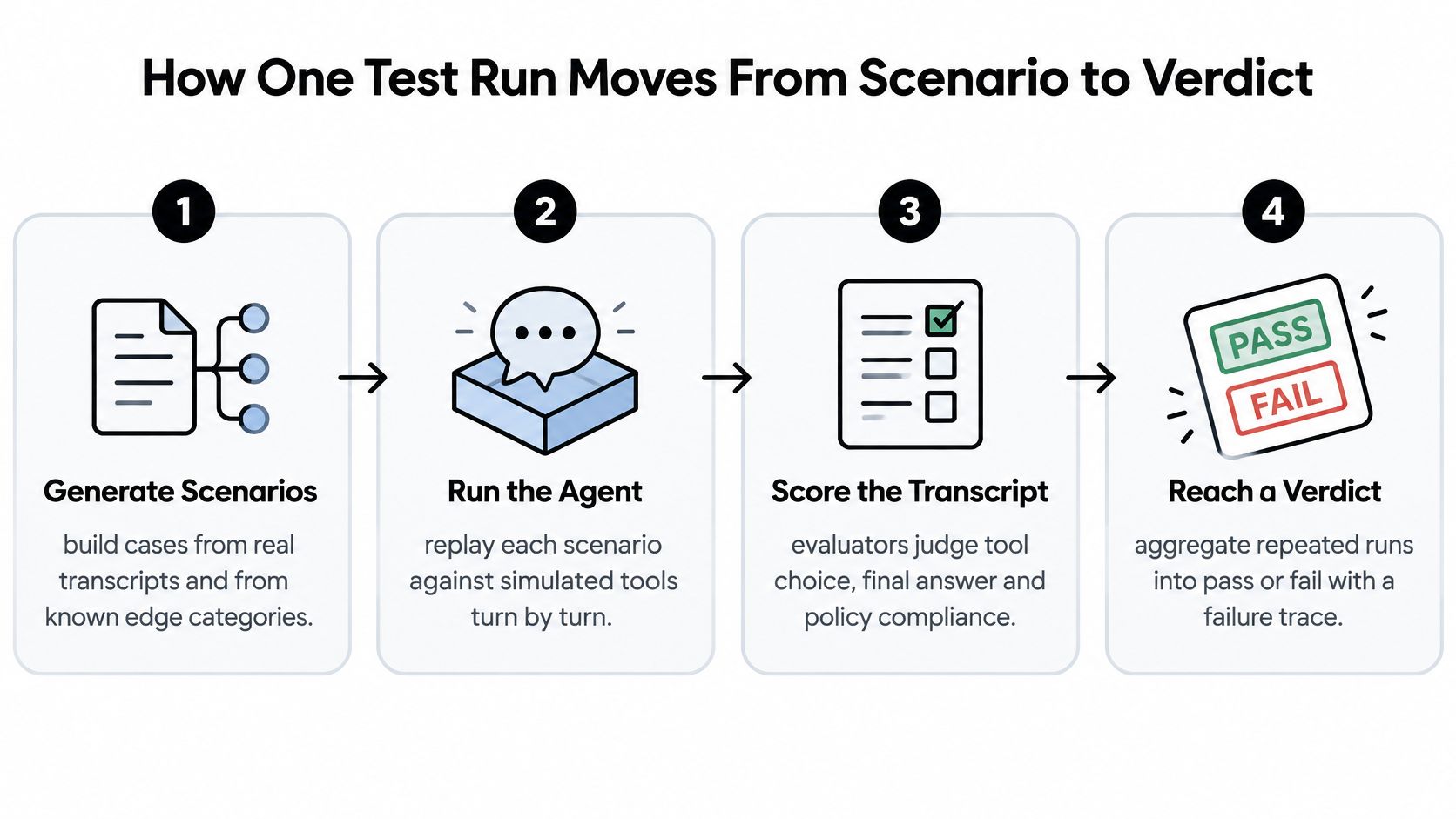
1. Generate scenarios
Pull cases from real transcripts, then add the edge categories you already know will hurt you: ambiguous requests, missing fields, and conflicting tool outputs. Tag each case with channel, persona, and failure family so coverage is a report, not a guess. A scenario without a tag cannot be quarantined later when it flakes.
Why this stage matters: an agent that only sees the prompts its authors wrote will look stronger than the traffic it will meet.
2. Execute in the environment
Replay the case against deterministic fixtures. Record every tool call, every argument, and every state transition. Do not wait until the end of the conversation to start logging. If the identity stub returns a fixed customer id, the next call must carry that same id.
Why this stage matters: two agents can print the same apology and still have done different, and unequally safe, work underneath it.
3. Evaluate against explicit criteria
Where the outcome is exact, assert it in code. Where the wording can vary, score it against a rubric that names what "good" is, such as "the explanation cites the eligibility window and does not invent a dollar amount." Check task interpretation, tool selection, parameter accuracy, and whether the agent recovered after a tool error.
Why this stage matters: a blended score hides the fix. A low success rate from a wrong tool needs a catalog change. A low success rate from bad retrieval needs an index change. A low success rate from invalid API parameters needs schema checks. Those are not the same ticket.
4. Assess compliance and safety
Look for unauthorized actions, broken policy rules, slow responses, and escalations that should have happened and did not. Write the verdict with a failure category, not only pass or fail. Rubrics plus executable checks keep that verdict stable when you swap domains or model versions.
Why this stage matters: an agent that completes the task by calling a tool the customer is not allowed to trigger has failed, even if the customer is happy with the text.
A failed run maps to a stage. No case in the library means generation. No trace means execution. A trace that diverges from the assertion means evaluation. A correct task that breaks a rule means compliance.
Read the trace before you touch the prompt. The first wrong step is usually earlier than the ugly final sentence.
Debugging a Failed Run to Its Root Cause
Start from the trace, not from the aggregate score. A score tells you something broke. The trace tells you which step broke, and that step tells you which fix to apply. AI agent observability is what makes that first wrong step visible instead of inferred.
- Find the first departure. Walk the expected sequence until a tool, a parameter, a skipped check, or a timeout does not match. Everything after that step is contaminated, so do not debug the last message first.
- Name one failure category. Wrong tool, invalid parameters, poor retrieval, ordering violation, failed recovery, or infrastructure fault. If two categories show up in one trace, split the case and rerun each fault alone before you decide which fix comes first.
- Apply the fix for that category only. Then rerun the scenarios tagged with it. A prompt rewrite that also changes the tool catalog gives you a new mystery.
- Rerun the full repeated-run set. Confirm the stable behavior did not drop while you fixed the local bug. Log the category on every verdict so the regression tracker can show which failure type is rising across releases.
| Failure category | Symptom in the trace | Fix to apply |
|---|---|---|
| Wrong tool selected | Correct tool absent from the first call, distractor tool used | Tighten tool descriptions and disambiguate the catalog |
| Invalid parameters | Tool called with a missing, altered or malformed field | Add argument schema validation and worked examples |
| Poor retrieval | Correct tool called, but policy text missing, outdated or off-topic | Fix chunking, index freshness or the retrieval query |
| Ordering violation | A step runs before authentication or the eligibility check | Make the step dependency explicit in orchestration and prompt |
| Failed recovery | Tool error retried without fallback or handoff | Add a fallback path and a retry cap that ends in handoff |
| Infrastructure fault | Timeout or server error from a stubbed service | Set a timeout budget and a graceful handoff path |
Take a refund run that quotes the right policy and still computes eligibility from an older billing date. The trace shows the retrieval call returned current policy text, then a later tool received a stale billing date as a parameter. That is invalid parameters caused by a fixture version, not a weak model. Replacing the model would not have fixed it. Pinning the fixture version and validating the date field would.
Keep one fault per run. Stacked faults feel realistic and make the cause unreadable. Realism belongs in a separate exploratory set, not in the suite you use to choose a fix.
Metrics That Prove Reliability Across Repeated Runs
A single success rate flatters an agent that is merely lucky. Say a task succeeds on any one run with a 90% chance. The chance that three independent runs all succeed is about 73% (0.9 cubed). Customers never see your best run. They see whichever run they happened to hit, so the number that matters is computed across runs, not within one.
The evaluation literature moved from single-answer accuracy toward operational metrics such as task success rate, execution accuracy, pass@k, step count, cost, and reliability. Interactive benchmarks pushed large language models into multi-step environments, and later work widened that to web navigation, software engineering, tool use, and research workflows. For enterprise CX and EX agents the metric that fits is pass^k: the fraction of tasks that succeed on every one of k independent runs. It separates an agent that occasionally succeeds from one that behaves the same way every time. Keep pass@1 as a fast screening read, because tool choice, policy adherence, and escalation can all change on the next run even when the first answer was right.
No single language-model score stands in for the action trajectory and the business outcome. A reliable read combines scenario generation, controlled execution, deterministic assertions where the outcome is exact, model-based judging where wording varies, trace inspection, and regression tracking across versions.
| Metric | What It Shows | When to Track |
|---|---|---|
| Task success rate | Share of tasks completed correctly in a run | Every regression pass |
| pass^k | Share of tasks that succeed on all k independent runs | Before any production launch |
| Correct tool selection rate | Share of tool calls that used the intended tool | After any tool catalog change |
| Argument validation rate | Share of tool calls with valid, unaltered parameters | After any API or schema change |
| Recovery success after tool failure | Share of injected failures the agent recovers from | Before go-live |
| Escalation precision | Share of human handoffs that were actually needed | During a pilot with real handoffs |
| Policy violation rate | Share of runs that break a defined rule | Every release |
| p95 latency | Response time that 95% of runs beat | Load testing before launch |
Each row exists because a different failure can hide behind one aggregate pass rate. Tool selection and argument validation catch action-layer faults. Recovery success and escalation precision catch behavior under stress. Latency and policy violations catch problems users feel before correctness visibly suffers.
Retrieval quality sits beside these numbers. A run can "succeed" while grounding the answer in the wrong chunk, which is why RAG evaluation metrics belong in the same release view as tool selection, not in a separate science project.
Set the bar before you look
Pick one threshold per metric before the run starts. A bar chosen after the results land is a story, not a gate. I would start with a high pass^k on the small set of flows that move money or identity, and a looser bar on explanatory chats, rather than one blended number for the whole agent. A blended score lets a chatty agent look reliable while its refund flow fails.
Track cost next to pass^k. An agent that stays consistent only by retrying five times may clear the reliability bar and still be too expensive for the channel. Step count per successful task is the cheapest early warning: when consistency rises but steps rise faster, the agent is guessing until something works.
Stress Cases Where Happy-Path Tests Fail
A clean demo proves the agent can follow a clean path. It says little about reliability under changed conditions. ReliabilityBench reports that agents achieving a 96.9% pass@1 rate with no task perturbation fell to 88.1% when the perturbation level reached 0.2, a decline of 8.8 percentage points. That is the gap a stress suite has to measure. The question is not whether the agent can answer once. It is whether repeated runs keep the same tool choice, the same grounded answer, and the same safe handoff when inputs shift.
The same benchmark organizes reliability around three production dimensions.
Consistency across repeated executions, so the same request does not fork into different tools.
Resilience when task conditions change, including phrasing, missing fields, and conflicting records.
Fault tolerance when infrastructure or an execution component fails.
Those dimensions matter for enterprise agents that cross channels, APIs, knowledge bases, identity systems, and human handoffs. Real sessions rarely reproduce the fixture used in development. A customer may shorten the request, use a different product name, omit the order id, or ask while a backend service is slow. Each variation maps to a failure category, and each category needs a fix the test can expose.
Build the stress suite as one fault per run.
- Altered or ambiguous input: Rephrase the request, swap a product name for a near synonym, or leave the order id implied.
- Unavailable tool: Remove the refund tool from the catalog for that run and expect a safe handoff, not a guessed refund.
- Delayed service: Make the account lookup exceed the timeout budget.
- Malformed record: Return a billing date in the wrong format.
- Permission failure: Let identity succeed and let the refund API reject the role.
- Stale versus fresh conflict: Return a current policy chunk and an older order status that disagree. Stale grounding is also how confident wrong answers get out, which is the failure preventing AI hallucinations has to catch in test, not only in production copy reviews.
Record cost and latency on every stress run. An agent that recovers by looping is not recovered in any sense that a contact center can afford. A safe handoff after one failed tool call is a useful result. A handoff after repeated retries, stale answers, and contradictory tool outputs is a release risk.
Harness design can dwarf the model. Reported success rates can swing widely with the benchmark harness and orchestration setup, even when the underlying model story sounds similar. The spread is a warning. If you change orchestration, tool configuration, or retry policy in the same release as the model, you have not measured the model. You have measured a bundle. Seed the suite so repeated runs are comparable, then run unseeded trials to see what the seed was hiding. I would keep both views, because a framework that only passes its fixed cases gives you confidence in the fixture, not in the agent.
How a Customer Support Agent Gets Tested End to End
A refund flow is the cleanest way to see the framework under load. The catalog holds two near-duplicate tools, issue_refund and apply_account_credit. Completion alone is a weak check, because either tool can leave the customer with a friendly closing line.

MCPAgent-Bench, built around real-world tool definitions, uses a dynamic sandbox that presents candidate tools containing distractors and scores whether the agent selects and uses the right one. It includes 178 human-curated test cases. The lesson for a support deployment is practical. Keep a versioned tool catalog, and generate cases for semantic ambiguity, overlapping descriptions, missing fields, malformed values, permission failures, stale records, and conflicting tool outputs.
The required sequence
The representative case runs in a fixed order.
- Authenticate the customer before any account data is read.
- Look up the account with the id the identity fixture returned, unchanged.
- Retrieve the refund policy, and require the answer to stay inside that text.
- Calculate eligibility from the order fields, not from a number the model invents.
- Create the ticket only after eligibility passes.
- Hand off when the case falls outside policy, with the trace attached for the human.
At each step the assertions check four things: the intended tool, parameters preserved exactly, order respected, and no action before authentication. The trace has to be auditable without reconstructing it from logs by hand.
The distractor case is the one I would not skip. The customer asks for a credit. Policy allows only a refund. The agent must refuse apply_account_credit, say why, and offer the refund path. A suite that only rewards "the customer got something" will train the agent to pick whichever tool is closest in the description.
Fault cases from the stress list are injected one per run, not all at once. Missing fields, stale records, and permission failures each get their own tagged scenario.
Run the whole suite after every prompt, retrieval, integration, and model change. Compare pass rates and failure categories with confidence intervals so a two-point wobble is not treated as a regression, and a real drop is not waved through as noise. Quarantine tests that fail intermittently. Fix or rewrite them before they count again. A flaky test in the denominator hides the regression you built the suite to catch.
This video walks through how scenario checks and traces fit a support workflow, which is the same shape as the refund sequence above.
What you are measuring is operational reliability and tool discrimination. Final-answer quality alone will not predict the production risk, because the dangerous failures are the ones that still sound helpful.
Confirm Deployment Readiness Before You Ship
A readiness gate is a checklist with thresholds agreed before the first run. Its job is to stop the team from negotiating with the score after the fact. I would hold the release if any line below fails, even when the demo still looks polished.
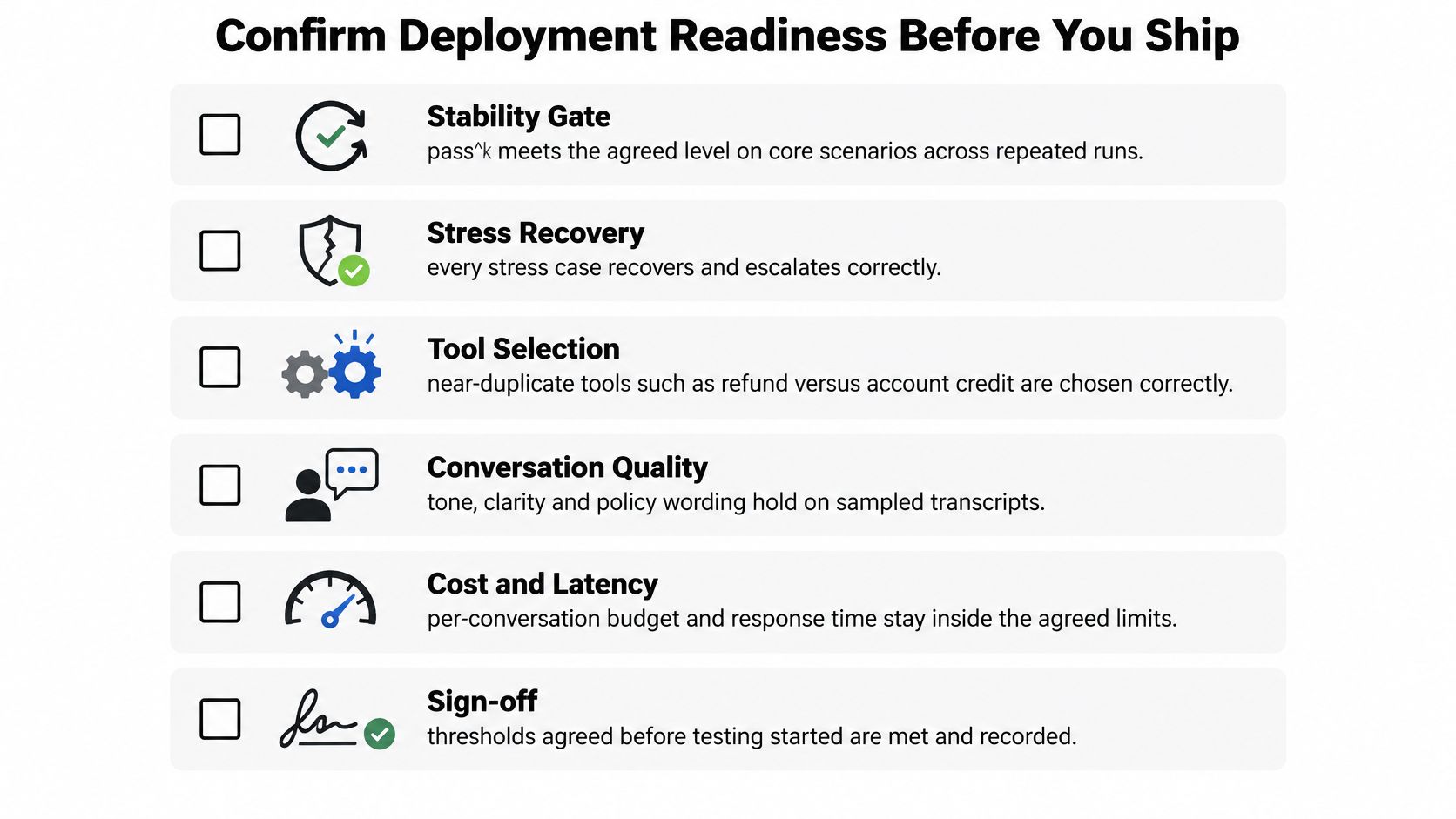
Stability. pass^k on the core scenarios meets the level you wrote down, measured across repeated runs. A single seeded pass proves nothing.
Stress recovery. Every injected fault either recovers inside the timeout budget or fails into a human handoff. A hung retry is a fail.
Critical policy. Zero violations on rules you marked critical, such as acting before authentication or promising a refund the policy forbids.
Latency. p95 fits the channel budget. Chat can tolerate a slower tail than voice, so give each channel its own number instead of sharing one budget across both.
Trace completeness. Every run stores the tool calls, arguments, and state changes a reviewer would need the next morning.
Regression. The suite passes on the current prompt, catalog, and model version, with quarantined tests excluded and listed by name.
Handoff proven. A human receives the case with the conversation history and the escalation reason attached. Run that path end to end against the stubbed inbox before you trust it, because an empty transfer is a silent failure that happy-path testing will never catch.
A gate you can explain in one sentence is a gate the team will enforce.
When a line fails, the failure category already names the fix. Wrong tool means catalog copy. Invalid parameters means schema checks. Ordering means an explicit dependency in the orchestration. Do not open a general "make the agent smarter" ticket.
Teams that want the run, the trace, and the verdict in one place can run these checks with Yellow.ai's Automated Testing for AI agents. AI Copilot lets you preview, debug, and optimize agent performance in that same flow, and agents can be hardened through automated testing within a single interface before deployment. The gate itself does not depend on a vendor. The same seven lines apply on any harness that can repeat a run and store a trace.
The decision is binary. Fix the category the gate points to, rerun the full suite, and approve only when every line passes. Schedule the next regression against the next prompt, tool, or model change rather than a calendar quarter. An agent that cleared the gate in March is a different agent after an untested catalog edit in April.
Yellow.ai's Automated Testing and AI Copilot let CX and EX teams test agents within a single interface and preview, debug, and optimize performance before agents reach customers. See how it fits your support and employee workflows at Yellow.ai.