









In the current digital landscape, the concept of a “fixed” customer persona is obsolete. Modern CX is defined by Fluid Customer States, real-time psychological shifts that require an autonomous, predictive response.
Most traditional customer service systems treat people like they’re one thing.
They’re not.
The old model made sense when people had predictable journeys. Prospect becomes Lead becomes Customer becomes Loyal Advocate. Each stage got one playbook. But that’s not how buying works in 2026.
For instance, one person walks in as a researcher on Monday. Becomes impulsive and buys on Tuesday. Frustrated by Wednesday. By Friday they’re asking for their money back, but are open to buying again if the offer is better.
Your segmentation system sees Sarah once. Labels her. Treats her the same way every time she shows up.
But Sarah isn’t one customer type. She’s ten different versions depending on what day it is, what happened before, and what just triggered her.
This is the real problem with 2026 customer service. Not that you don’t have the data. You do. The problem is your system can’t respond to someone who’s in four different psychological states in the same week.
This blog explores how customer service enterprises in 2026 are transitioning from reactive support to Systemic Intent Modeling, ensuring that every interaction, whether from a loyal advocate or a frustrated first-time buyer, is met with precision, cross-session memory, and autonomous resolution.
Related read: 10 Types of customer service you should know
Introduction: Why Personalization is Now a Structural Requirement
The traditional marketplace analogy has shifted. It is no longer enough to recognize that one shopper is “Need-Based” while another is “Wandering.” In 2026, a single user will often cycle through multiple intent states in one single session. The customer journey brings about different phases. They might start as an Informed Researcher and, through a frictionless experience, transition into an Impulsive Buyer.
Data reveals a critical structural shift: 65% of customers now switch brands based on the relevance of the experience, not just the product. Furthermore, 33% of consumers will abandon a brand after just one high-friction interaction. For B2C leaders, understanding these dynamics is no longer about “delighting” the customer; it is about building a system that can detect emotional states and resolve intent before it leads to churn.
Related must-reads:
- Customer loyalty: Importance & Strategies to increase
- Omnichannel customer service – 2026 Guide [Strategy + Examples]
- Customer onboarding – Process, examples, and mistakes to avoid
- Customer feedback: Types + 8 ways to collect It
Diverse Customer Dynamics: A Systemic Imperative
Navigating customer interactions today is less like steering a ship and more like managing an Autonomous Ecosystem. The core of understanding these dynamics lies in the realization that every customer interaction is like a live data point. When a system recognizes these fluid states, it moves from being a cost center (Support) to a value driver (Retention).
The Evolution of the Service Framework:
- The Traditional Concept: Consisted of humans reacting to static scripts within channel silos.
- 2026 Strategy: TThe current focus is on systems predicting intent and detecting emotional states with Ambient Support, where human intervention is orchestrated only when the system detects a high-complexity or high-emotion state within the current customer journey.
The transition from curiosity to brand advocacy is a layered journey. By segmenting visitors based on real-time behavior rather than broad demographics, businesses can address actual needs. This nuanced approach drives measurable business outcomes: higher Lifetime Value (LTV), lower Customer Acquisition Cost (CAC), and sustainable growth.
Navigating the 10 Primary Customer States in Customer Service
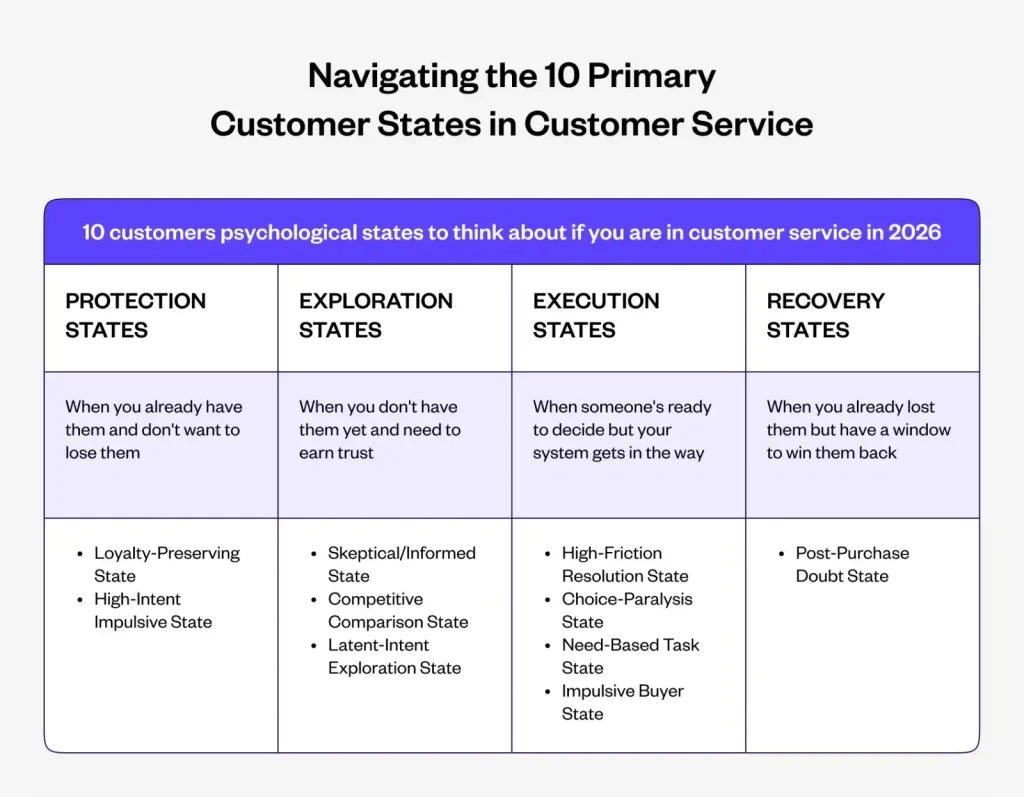
1. The Loyalty-Preserving State
The Challenge: High-value customers represent stable revenue, yet they are often neglected until they face a problem. Traditional support treats them as “just another ticket,” ignoring their history. This creates a “recognition gap” that makes the customer feel like a stranger despite years of tenure.
Why Traditional Systems Break: Most CRM-bot integrations are “thin.” They may know the name, but they don’t know the context of loyalty. They treat a 10-year veteran customer with the same generic greeting as a first-time visitor.
What’s needed in customer service in 2026: Cross-Session Memory. The system must immediately identify the user’s tenure and value. Instead of a generic greeting, the system should acknowledge their history: “Welcome back, Sarah. I see you’ve been a subscriber since 2022; I’ve prioritized your request for immediate resolution.”
2. The High-Intent Impulsive State
The Challenge: Frustration here is rarely caused by the initial product failure; it is exacerbated by the “Repetition Tax”, the exhausting process of explaining a problem to multiple agents or bots.
Why Traditional Systems Break: Reactive systems can only trigger when a customer uses profanity or explicit “agent” requests. By that time, the sentiment is often unsalvageable.
What’s needed in customer service in 2026: Human-in-the-Loop Orchestration. The system detects rising frustration markers and escalates to a senior agent with a full context summary before the customer asks. This ensures the transition is seamless and the context is preserved.
3. The Skeptical/Informed State
The Challenge: Today’s buyers are hyper-informed, often completing 70% of their research before making contact. They have developed an “immunity” to traditional marketing slogans and view generic sales fluff as a sign of technical incompetence.
Why Traditional Systems Break: Most bots are programmed with “Marketing Scripts” rather than “Knowledge Bases.” When an informed buyer asks a technical “Why” or “How,” the bot fails or gives a shallow answer, killing the brand’s credibility and trust.
What’s needed in customer service in 2026: Systems must use RAG (Retrieval-Augmented Generation) to connect the conversation directly to technical documentation and verified data. Providing cited, objective evidence validates their research and builds institutional trust.
4. The High-Friction Resolution State
The Challenge: For an impulsive buyer, intent has a short half-life. They are driven by an emotional spark that fades the moment they encounter a technical hurdle.
Why Traditional Systems Break: Any friction, complex forms, account creation, or external redirects, acts as a “kill switch” for the transaction. Every second of delay is an opportunity for the buyer to regain their logic and abandon the cart.
What’s needed in customer service in 2026: The goal is Zero-Friction Execution. The system must move from query to autonomous checkout within the same interface. By capturing the “buying spark” through in-chat commerce, the system prevents the drop-off typical of multi-step funnels.
5. The Choice-Paralysis State
The Challenge: “Choice overload” leads to decision fatigue. Uncertain customers aren’t looking for more products; they are looking for a reduction in complexity.
Why Traditional Systems Break: Typical search and filter tools rely on the customer to know what they want. If a customer is uncertain, a “Search” bar is useless—it just gives them more of the same overwhelming options.
What’s needed in customer service in 2026: Deploy Autonomous Curation. The system uses a brief diagnostic dialogue to narrow the catalog down to a “Top 3” curated selection based on the user’s specific context, removing the mental load of decision-making.
6. The Competitive Comparison State
The Challenge: A researcher is actively looking for a reason to choose a competitor. If your system is defensive or opaque about its limitations, the researcher interprets this as a weakness and leaves to find answers elsewhere.
Why Traditional Systems Break: Most brands avoid mentioning competitors in their automated flows, hoping the customer hasn’t noticed them. In reality, the customer is already comparing tabs.
What’s needed in customer service in 2026: Predictive Intent Modeling identifies when a user is “feature-hunting” and proactively offers a transparent comparison guide. This keeps the user on-site while allowing the brand to control the narrative of its Unique Selling Points (USPs).
7. The Need-Based Task State
The Challenge: These customers are mission-driven and time-sensitive. Their primary friction point is “interruption”, being forced through irrelevant marketing funnels, newsletters sign-ups, or “warm” introductory chat scripts when they have a singular, urgent task to complete.
Why Traditional Systems Break: Most automated workflows are designed for a linear journey that assumes every customer wants a “relationship.” For a need-based user, a system that tries to “upsell” or “nurture” before solving the immediate problem is perceived as an obstacle, leading to high abandonment rates.
What’s needed in customer service in 2026: Goal-Oriented Orchestration. The system must use NLU (Natural Language Understanding) to identify the specific “job to be done” within the first utterance. It then dynamically collapses the standard funnel, bypassing all non-essential dialogue to provide a direct, high-speed solution path. Success for this state is measured by the shortest possible time-to-resolution.
8. The High-Intent Impulsive State
The Challenge: Impulsive buyers are driven by an immediate emotional “spark.” This state has the shortest half-life of any customer phase; every second of delay—whether due to a slow-loading page, complex authentication, or a lack of instant product clarity, allows logic to override the impulse, leading to immediate abandonment.
Why Traditional Systems Break: Most workflows are built for a linear, multi-step journey (cart > account > shipping > payment). For a user in this state, these steps are friction points. Traditional bots that can’t facilitate a transaction within the chat window effectively kill the conversion opportunity.
2026 System Requirement: Zero-Friction Execution. The system must enable “In-Flow Commerce.” When the system detects high-intent impulsive language, it should surface a secure, one-click checkout or a direct “Add to Cart” action within the conversation. The goal is to move from intent to confirmation in a single, uninterrupted flow.
9. The Latent-Intent Exploration State
The Challenge: These visitors here are in an “open” state; they are gathering vibes and information but lack a specific problem to solve. The challenge is “aggression”, over-eager sales prompts or “Buy Now” pop-ups act as a deterrent, driving away potential leads before their intent has matured.
Why Traditional Systems Break: Traditional “Lead Gen” bots are too binary. They treat every visitor as a prospect to be “closed.” If the visitor doesn’t provide an email or book a demo, the system treats the interaction as a failure and stops providing value.
What’s needed in customer service in 2026: Ambient Engagement. The system must adopt a “low-pressure” posture. Instead of a sales pitch, it offers high-value, educational content, such as industry insights or “how-to” guides, that builds brand equity without forcing a transaction. The goal is to nurture the lead by staying present but unobtrusive, ensuring your brand is the first choice when the customer eventually shifts into a “Need-Based” or “Impulsive” state.
10. The Post-Purchase Doubt State
The Challenge: Immediately following a transaction, many customers enter a state of “buyer’s remorse” or technical uncertainty. This is the most critical window for retention; if the customer feels abandoned or struggles to find value in the product, they shift from a potential loyalist to a high-risk return.
Why Traditional Systems Break: Most support systems are reactive, they wait for the customer to reach out with a problem. By the time a new customer contacts support to ask “How do I start?”, they have already experienced significant frustration, lowering their overall brand sentiment.
2026 System Requirement: Predictive Onboarding. The system must use the transaction data to trigger proactive, ambient support. If a customer purchases a complex product, the system should push a “Quick Start” guide or a 30-second video walkthrough 24 hours post-delivery. By anticipating the “doubt” before it becomes a ticket, the system reinforces the purchase decision and stabilizes the relationship.
While these states represent psychological shifts in the buyer, for the business, they represent critical pivot points for revenue and retention. Solving for these dynamics at scale is where traditional automation fails and where dynamic, intent-aware AI begins to redefine the bottom line.
The Shift Happening in Customer Service in 2026
Old approach:
- Customer has problem → AI tries to deflect → Escalates to humans
New approach:
- AI agent detects state in real-time → AI agent handles what it can → Intelligent escalation when needed → System learns from outcome and doesn’t handoff for the same scenario next time with any customer
Most AI agents are built for deflection, essentially to keep conversations from escalating and needing human hand offs.
But that only works if you’re handling what the customer actually needs. A researcher needs documentation. An impulsive buyer needs friction removed. A VIP needs recognition.
Give them the wrong thing and they escalate, or worse, they leave.
The AI-powered CX operations that are really winning in 2026 aren’t deflecting better. They’re resolving better. These are the ones where the AI agents are handling increasingly complex interactions because they understand what the customer is actually trying to achieve.
That’s the shift. From “how do we keep this off human support” to “how do we handle this as effectively as possible, whether that’s automation or intelligent escalation.”
The Yellow.ai Solution
Identifying these fluid customer states is only the initial step; the true competitive advantage lies in the architectural layer that powers the response. Moving from a reactive posture to a predictive one requires more than a standard chatbot, it demands a sophisticated orchestration layer capable of real-time state switching.
This is where Yellow.ai’s Orchestrator LLM redefines the system design. By moving beyond static, predefined scripts, the platform uses Agentic AI to navigate complex, multi-step scenarios autonomously. Whether it’s detecting a High-Friction State through sentiment analysis and triggering an immediate human handoff with full context, or facilitating a High-Intent Impulsive State via frictionless in-chat commerce, the system adapts instantly.
With features like Cross-Session Memory and Agentic RAG, Yellow.ai ensures that your brand’s “brain” never resets, allowing a customer’s journey to persist seamlessly across 35+ channels.
By treating CX as a dynamic system rather than a series of siloed tickets, businesses can achieve up to 90% automation while significantly elevating CSAT and LTV.
To Decide What Works Best for You, Ask Yourself:
If it is the former, the path is to build. But if it is the latter, if your goal is to reduce churn and maximize lifetime value through superior experience, then the goal is to buy time back.