













Voice cloning is AI reproducing a person's vocal identity from short audio samples. McAfee's 2023 benchmark found that about 3 seconds of audio could produce a convincing clone with an 85% voice match. The benchmark and its consumer research help explain why voice has shifted from a familiar customer-service signal into a serious identity and trust concern.
A customer calls a service line and hears a warm, consistent brand voice explain a billing change, guide them through a return, or confirm the next step. The interaction feels personal, even though the words were generated dynamically. For a CX leader, that sounds like a voice-quality decision. It's two decisions: whose identity the system is reproducing, and whether the organization can prove that the voice is being used with permission.
Table of Contents
- Introduction to What Voice Cloning Really Means
- How Voice Cloning Works Behind the Scenes
- The Technology Stack and Data That Powers Cloning
- Enterprise Use Cases That Bring Voice Cloning to Life
- Benefits and Risks Every CX Leader Should Weigh
- Legal Ethical and Compliance Considerations You Cannot Ignore
- Choosing the Right Voice Cloning Solution for Your Enterprise
Introduction to What Voice Cloning Really Means
Voice cloning uses an AI system to reproduce a real person's speech patterns and vocal identity from recorded audio. After learning how that speaker sounds, the system can generate new speech from text. The result is synthesized audio, not a replayed recording or a generic text-to-speech voice.
That difference changes the enterprise CX decision. Traditional TTS reads a script through a prebuilt synthetic voice. A cloned voice can represent an approved executive, narrator, brand representative, or accessibility voice across new conversations without recording every line manually. Possible applications include IVR, voice agents, notifications, training, and employee services.
Core concept: A cloned voice is a generated representation of a person's vocal identity. Treat it like an identity asset, not just an audio file.
The benchmark cited above shows why source audio deserves governance attention. A short recording can provide enough evidence for a system to approximate a recognizable speaker, even when listeners assume a distinctive voice is difficult to reproduce. The business question is therefore not only whether the output sounds natural. It is whether the organization has permission to create it, defined where it may be used, and retained evidence of that authorization.
A short recording does not guarantee a perfect replica. Audio quality, speech variety, model architecture, language, and delivery affect the result. Those variables also make testing necessary: a voice approved for one language, channel, or message type may not perform or feel appropriate in another.
Voice cloning is best understood as an identity and trust decision, not merely a TTS feature. Clone a voice when authorization, purpose, audience, and review controls are clear. Choose a generic or licensed synthetic voice when consent is uncertain, the speaker could be mistaken for an authority, or the experience would create unnecessary trust risk. Before deployment, leaders need controls for consent, access, approved use cases, monitoring, and retirement.
How Voice Cloning Works Behind the Scenes
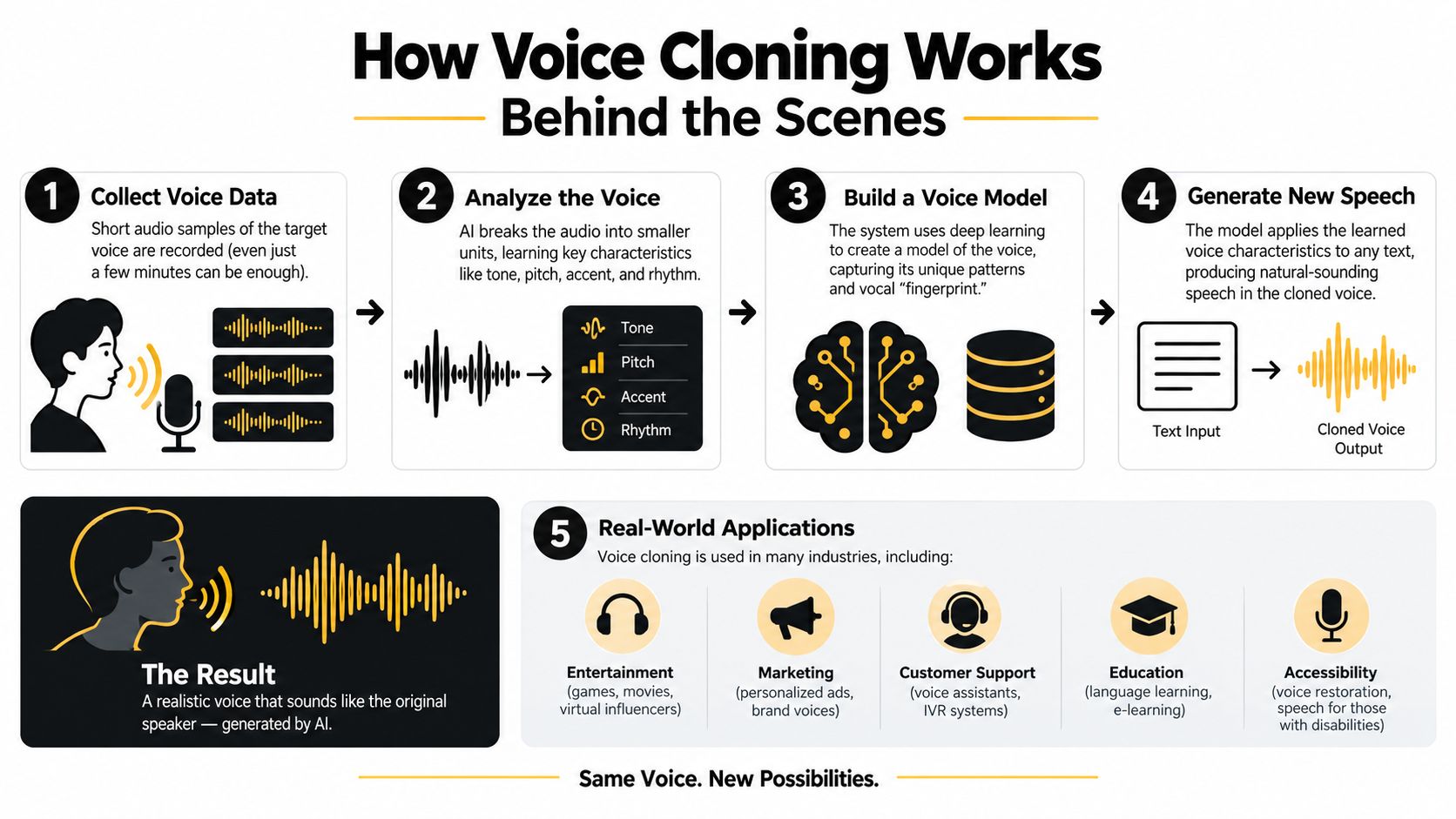
Start with ordinary text to speech. A user supplies written words, and a model generates spoken audio. A generic TTS system uses a voice selected from its library. Voice cloning adds a reference recording so the system can condition that generated speech on the target speaker's vocal characteristics.
A useful analogy is a voice fingerprint, although the technical representation is more complex than a fingerprint. The model tries to represent the elements that make a person recognizable, including timbre, prosody, pitch patterns, pacing, and accent, while preserving clear pronunciation.
From reference audio to speaker identity
A practical pipeline usually follows a sequence like this:
- Reference audio enters the system. The recording contains speech from the target speaker. The model uses that sample as evidence of vocal identity, not as a script to replay.
- The system extracts speaker characteristics. A speaker encoder or speaker-discriminative encoder converts relevant vocal information into an embedding, a learned numerical representation.
- The model separates identity from content. The words being spoken and the person speaking them are treated as related but distinct signals. This allows the system to generate new words while retaining characteristics associated with the reference speaker.
- A synthesis model generates speech. The model combines the requested text with the speaker representation and reconstructs an audio signal.
- A vocoder turns the representation into sound. The final stage produces the waveform that a customer or employee hears.
Technical research on speaker embeddings and zero-shot adaptation describes voice cloning as a specialized TTS pipeline conditioned on a short reference utterance. It explains that speaker embeddings help a single synthesis model generalize across many voices, including voices the model hasn't previously encountered.
Why the audio isn't copied directly
The system doesn't need to store and splice together every possible sentence the person might say. Instead, it reconstructs speech from learned latent representations. This is why a clone can produce a sentence that never appeared in the reference recording.
That flexibility creates both value and responsibility. The output can respond to new customer questions, but it can also express words the original speaker never approved. A deployment therefore needs controls around script authority, content generation, disclosure, and access to the voice model.
Quality depends on whether the embedding captures identity without damaging intelligibility. A model may resemble a speaker in tone but mishandle pronunciation, emotional delivery, or accent. Enterprise testing should evaluate the complete interaction, not just a short demonstration sentence.
The Technology Stack and Data That Powers Cloning
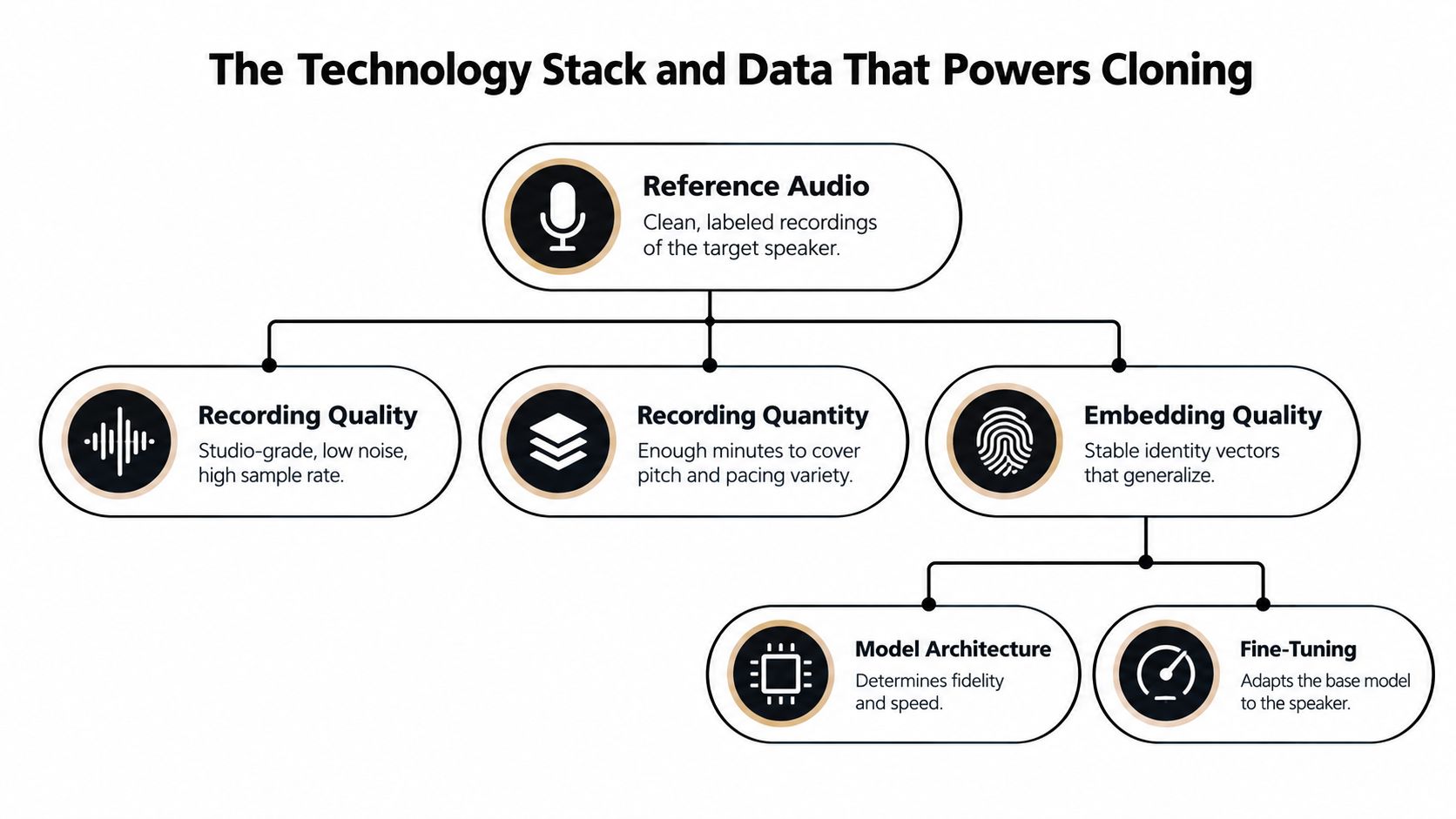
A voice-cloning product may present a simple upload-and-generate screen, but its reliability depends on several connected layers. Reference audio quality determines what the system can learn. Embedding quality determines how consistently it represents the speaker. Model architecture and fine-tuning shape fidelity, response speed, and behavior outside the original recording.
The data layer
Clean, labeled recordings provide a clearer reference. Background noise, overlapping speakers, inconsistent microphones, and inaccurate transcripts can blur the difference between the target speaker's identity and the recording environment.
A longer and more varied dataset can reveal changes in pacing, pronunciation, pitch, and emotional delivery. A short sample may establish identity while leaving the model less prepared for other contexts. Enterprise teams should therefore treat voice data as identity data, not ordinary content. Before collection, they need a documented purpose, speaker permission, retention rules, and a process for withdrawing the voice from future generation.
The embedding connects the reference audio to the synthesis model. If it represents only a narrow slice of the speaker, output may sound credible in one use case and become unstable in another. Vendor evaluations should cover pronunciation, prosody, intelligibility, language handling, and consistency across long scripts. These tests help leaders decide whether cloning is appropriate for a controlled workflow or whether a standard synthetic voice presents less identity risk.
The model and evaluation layer
Some systems use zero-shot adaptation. A pretrained model generates a new speaker's voice from a short reference without full speaker-specific training. Other systems apply fine-tuning to adapt a base model more closely to the target voice. The choice depends on quality requirements, deployment speed, governance controls, and operating cost.
Latency affects live CX interactions. A voice can sound convincing in a recording and still perform poorly if it pauses unpredictably. Testing should include interruptions, corrections, names, numbers, domain-specific vocabulary, and transfers to human agents.
Evaluation needs to be repeatable rather than based on a polished vendor demonstration. ClonEval's benchmark research introduced an architecture-agnostic protocol, an open-source library, and a public leaderboard. The research also reported that cloned speech produced from 20 minutes of real speech per speaker achieved bypass rates ranging from 43.1% to 82.7% against a state-of-the-art speaker verifier, even when that verifier had very low false-acceptance rates for genuine users. The finding separates two decisions: whether a clone sounds acceptable, and whether the cloned identity creates unacceptable authentication risk. Enterprise deployment should require both evaluations, alongside controls for consent, access, approved content, and model withdrawal.
Enterprise Use Cases That Bring Voice Cloning to Life
A contact center manager may begin with a familiar operational problem: customers hear one voice in the IVR, another in a virtual agent, and a third in outbound notifications. Each voice may be acceptable on its own, but the experience feels fragmented. A governed clone of an approved brand voice can create greater continuity, provided the organization clearly discloses the automated interaction where appropriate.

A consistent voice across service journeys
Consider an airline, utility, or retailer updating a large set of service prompts. With a conventional recording process, every wording change can require scheduling, studio work, quality review, and distribution. A controlled voice-generation workflow can let the team revise approved text and regenerate the relevant audio, while language specialists and CX owners validate pronunciation and tone.
The same principle applies to personalized outbound engagement. An agent might explain a renewal, appointment, or delivery update using a familiar voice, but personalization should remain bounded by approved content and customer consent. The system shouldn't improvise sensitive claims merely because the voice sounds reassuring.
For an overview of automated voice interactions, teams can review Yellow.ai's voice bot capabilities alongside other enterprise voice-agent platforms. The evaluation should focus on orchestration, escalation, analytics, access control, and integration with the existing contact-center stack, not on vocal realism alone.
Accessibility and employee experience
Voice cloning can also help organizations preserve an individual's familiar voice for accessibility scenarios, subject to explicit permission and careful handling of sensitive data. The business objective isn't novelty. It may be continuity, allowing a person to communicate through a voice that feels personally meaningful.
In employee experience, a voice agent could guide workers through routine HR or IT requests. A recognizable organizational voice may make the interaction easier to use, but it mustn't become a substitute for authentication. A voice can deliver information and ask questions without serving as the sole proof of who the employee is.
The operational design matters as much as the model. Define which content the agent can deliver, which requests require a human, how the system records consent and disclosure, and what happens when the voice output is uncertain.
A short product demonstration can show how generated speech sounds, but enterprise leaders should also inspect the workflow around it. The following video provides additional context on voice AI and customer interactions.
Benefits and Risks Every CX Leader Should Weigh
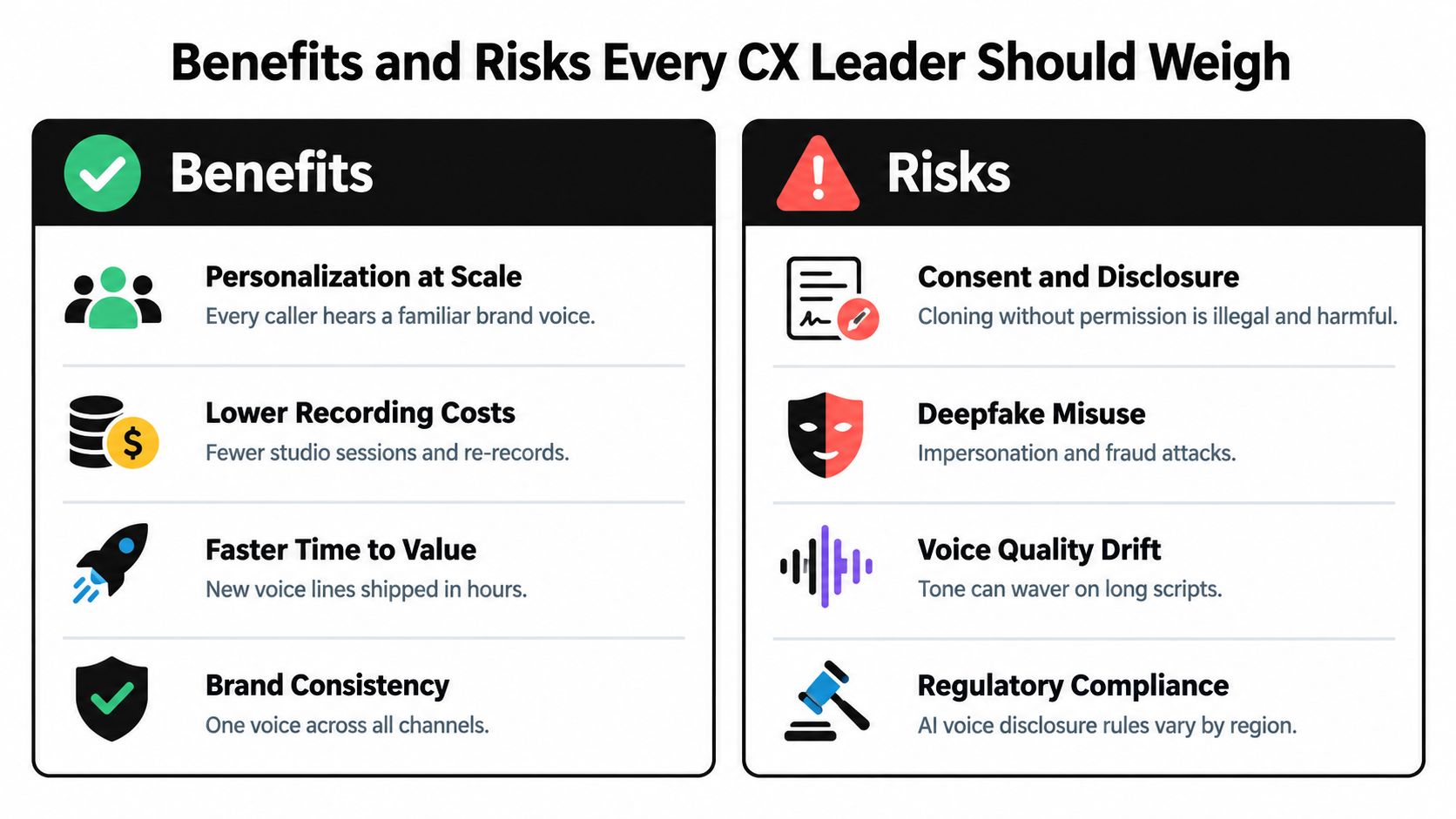
Voice cloning can remove friction from content production and customer interaction. A team may create approved voice lines without arranging a new recording session for every script revision. A brand can use a consistent voice across channels, and an accessibility program can preserve a speaker's vocal identity for an authorized purpose.
Those benefits don't make the capability low risk. The same realism that makes a voice agent feel natural can make an impersonation attempt more persuasive. Pindrop's 2025 Voice Intelligence and Security Report, as summarized in later reporting, identified a 1,300% year-over-year increase in deepfake fraud attempts across industries during 2024, described as growing from about one attempt per month to about seven per day.
| Potential value | Decision risk |
|---|---|
| Personalization at scale, a familiar voice can support many approved interactions. | Impersonation, attackers can use convincing speech to pressure customers or employees. |
| Lower recording effort, teams can update controlled scripts more easily. | Consent failure, a speaker may not understand how broadly the voice will be used. |
| Brand consistency, the same authorized identity can appear across channels. | Disclosure gaps, customers may mistake an automated voice for a human. |
| Accessibility support, authorized voice preservation can support communication. | Authentication weakness, vocal similarity can undermine voice-only verification. |
The correct comparison isn't “AI versus human.” It's governed generation versus uncontrolled generation, and voice as an experience layer versus voice as an identity factor. A CX team can gain speed while security, legal, and privacy teams set boundaries around creation, use, monitoring, and removal.
Yellow.ai's perspective on voice AI for interpersonal customer service can help frame that discussion, but every organization still needs its own risk assessment. The safest pilot usually starts with low-risk informational content, clear disclosure, human escalation, and no voice-based authorization for high-impact actions.
Legal Ethical and Compliance Considerations You Cannot Ignore
Consent isn't a checkbox at the end of a workflow. It should identify the speaker, describe the intended uses, define the duration and distribution of the voice, and explain how the organization will revoke access. If the voice will appear in customer support, marketing, training, or internal services, those purposes should be separated rather than hidden inside a broad approval.
Independent reporting found that most leading voice-cloning products lacked meaningful safeguards against impersonation. A consumer complaint also alleged that some systems could clone a voice from only seconds of audio with little more than a checkbox for consent. Consumer Reports' assessment documented deepfake-related losses of at least $2.19 billion by April 2026 in one incident-based compilation.
Controls for responsible deployment
An enterprise buyer should require more than a realistic sample. The minimum control set should include:
- Explicit consent records: Store who granted permission, for which voice, and for what uses.
- Access restrictions: Limit voice creation, editing, export, and deployment to approved roles.
- Audit trails: Record prompts, generated outputs, users, systems, and production destinations.
- Revocation: Make it possible to disable a clone and prevent further use when permission ends.
- Provenance: Mark or otherwise track generated speech so internal teams can identify its origin.
- Content boundaries: Prevent the voice from making unauthorized financial, legal, medical, employment, or security claims.
- Human escalation: Route uncertain, sensitive, or disputed interactions to trained staff.
Why authentication needs a redesign
Voice may still be useful as a conversational signal, but it shouldn't stand alone as proof of identity in high-risk workflows. Research on voice-based authentication limits argues that vocal cloning is undermining voice authentication in finance and public services.
A safer design combines voice with stronger factors such as a trusted device, behavioral signals, document checks, or an authenticated session. The right combination depends on the transaction, but the principle is consistent: don't let a generated likeness authorize a consequential action.
Security architecture should support that policy. Organizations can review Yellow.ai's enterprise-grade security approach as one reference point while validating the controls, certifications, data handling, and integration requirements that apply to their own environment.
Choosing the Right Voice Cloning Solution for Your Enterprise
The right solution isn't the one that produces the most impressive demo. It's the one that fits your operating model and gives risk owners enough visibility to approve, monitor, and stop its use.
Begin with the business purpose. A controlled IVR voice, a multilingual service agent, an accessibility application, and an executive announcement have different consent, review, and disclosure requirements. If the proposed use requires voice to authenticate a person or authorize a transaction, redesign the workflow before evaluating vendors.
A practical enterprise scorecard
Assess each platform across several dimensions:
- Voice quality: Test pronunciation, pacing, emotional range, interruptions, long scripts, names, numbers, and industry terminology.
- Language coverage: Confirm that the languages and accents required by your customers are supported consistently, not just in a demonstration.
- Conversation performance: Evaluate latency, turn-taking, barge-in handling, error recovery, and transfer to human agents.
- Governance: Look for consent workflows, role-based access, audit logs, revocation, output monitoring, and provenance support.
- Security and compliance: Review protections relevant to your environment, including HIPAA, ISO 27001/27701, SOC 2 Type II, and PCI-DSS where applicable.
- Operational integration: Check whether the platform connects with your CRM, contact center, knowledge systems, analytics, and workforce tools.
- Model flexibility: Understand how the vendor manages model choice, updates, testing, and portability without locking your organization into one approach.
Yellow.ai offers Nexus Vox as a voice AI capability that can clone a voice from a short sample and deploy it within conversational experiences, alongside omnichannel orchestration and enterprise security controls. Treat it as one option to evaluate against your scorecard, not as a replacement for consent, authentication redesign, or human oversight.
Run a limited pilot with low-risk content. Assign owners from CX, security, legal, privacy, and operations. Before expanding, test revocation, audit retrieval, disclosure language, escalation, and failure handling under realistic customer conditions.
Yellow.ai can help enterprises create governed voice experiences through Nexus Vox, connect them with customer and employee workflows, and manage conversations across supported channels. Visit Yellow.ai to evaluate how its voice AI, integrations, analytics, and enterprise security capabilities could support a responsible voice-cloning pilot.



