














Telephony looks like a legacy utility until you examine where modern voice AI runs. The same category that began with Bell's first successful speech transmission in 1876 became a network business almost immediately, and by 1900 Bell's system had nearly 600,000 phones, growing to 5.8 million by 1910, which is a useful reminder that telephony was never just a handset. It was infrastructure from the start (historical telephony timeline from Elon University).
That matters now because the enterprise question has changed. “What is telephony?” no longer means “how do phone calls work?” It means “what voice infrastructure do we need if we want AI to answer, route, authenticate, resolve, escalate, and document conversations in real time?” If your team is deploying voice automation, building a modern contact center, or supporting distributed employees, telephony isn't a side topic. It's the operating layer underneath the experience.
Table of Contents
- Telephony Is More Than Just a Dial Tone
- The Core Technologies Powering Voice Communication
- Choosing Your Architecture On-Premise PBX vs Cloud UCaaS
- Modern Enterprise Use Cases for Telephony
- Implementation and Migration Essentials
- Measuring Success and Future-Proofing Your Strategy
- Conclusion: Telephony Is Your Foundation for Autonomous CX
Telephony Is More Than Just a Dial Tone
Telephony is not a legacy utility sitting at the edge of the business. It is the voice infrastructure that determines whether AI can operate reliably in real customer and employee conversations.
Many enterprise teams still define telephony too narrowly. They picture desk phones, carrier contracts, and a fixed set of calling features. In practice, telephony is the full system that makes voice communication work across networks, devices, and applications. That includes fixed-line calling, mobile networks, IP-based voice, routing logic, identity, handoff rules, and the integrations that connect a conversation to business context.
AI voice runs on top of that foundation. A voice agent still needs a phone number, inbound and outbound connectivity, call control, audio transport, escalation paths, and access to CRM or ticketing data. If those pieces are brittle, the automation layer inherits the same problems.
From invention to infrastructure
Telephony became infrastructure the moment voice communication had to move beyond a single point-to-point connection. The breakthrough was not just transmitting speech. It was building exchanges, switching systems, and operating models that could route conversations across a growing network.
That history matters for one reason. Telephony has always been about connection management at scale.
The same design questions still define modern enterprise voice. How are calls routed? What happens when a user transfers, drops, or needs authentication? Which system owns the customer record? How quickly can teams change call flows without waiting on a carrier or hardware refresh? Those are telephony questions, and they now sit directly inside AI deployment plans.
Telephony is the control layer that lets AI participate in live voice conversations with the reliability enterprises expect.
What counts as telephony now
A current definition has to cover far more than the PSTN. It includes mobile voice, VoIP, softphones, SIP trunks, conferencing, contact center routing, and the systems that connect voice traffic to identity, analytics, and workflow tools.
For CX and EX leaders, that changes how telephony should be evaluated:
- Look past call minutes and seat counts. Check how voice connects to CRM, HR systems, ticketing, analytics, and authentication.
- Treat telephony as part of the application stack. Voice now sits alongside messaging, automation, and orchestration tools, not outside them.
- Assess flexibility early. If routing logic, APIs, or handoff flows are hard to change, AI deployments will slow down fast.
- Plan for channel convergence. The strongest voice environments share context across phone, chat, email, and agent desktop tools.
Teams building AI voice experiences usually see this first in production. The model may perform well in testing, but poor audio quality, weak transfer logic, or fragmented caller context will still break the experience. That is why a modern voice automation platform depends on telephony that is programmable, observable, and tightly connected to enterprise systems.
If your organization is also evaluating connectivity options for distributed sites or hard-to-wire environments, this Essential Starlink phone service overview is a useful reference point.
The Impact on AI Strategy
The strongest AI voice programs usually start by fixing the underlying voice stack. Clean routing, stable audio, reliable handoff to human agents, and access to live business context produce better outcomes than a polished demo sitting on weak infrastructure.
In the AI era, telephony is the enterprise voice layer that decides whether automation feels smooth, contained, and useful, or fragmented and frustrating.
The Core Technologies Powering Voice Communication
The jargon around telephony gets in the way because people often bundle very different technologies into one idea. The cleanest way to understand it is to separate the legacy network, the internet-based model, and the protocols that coordinate each call.
PSTN and VoIP serve different operating models
The PSTN is the traditional circuit-switched phone network. Think of it as reserving a dedicated path for the duration of a call. That model is predictable and familiar, but it's also rigid when you want software-driven routing, fast changes, or deep application integration.
VoIP moves voice over IP networks instead. Instead of tying the call to a fixed circuit, it packetizes audio and sends it across a data network. That shift is what made it practical to combine voice with video, messaging, analytics, and workflow automation on the same foundation.
If your team is comparing connectivity options in remote or hard-to-wire environments, this Essential Starlink phone service overview is a useful primer on how voice service conversations now extend beyond conventional wired assumptions.
SIP handles the setup and RTP carries the media
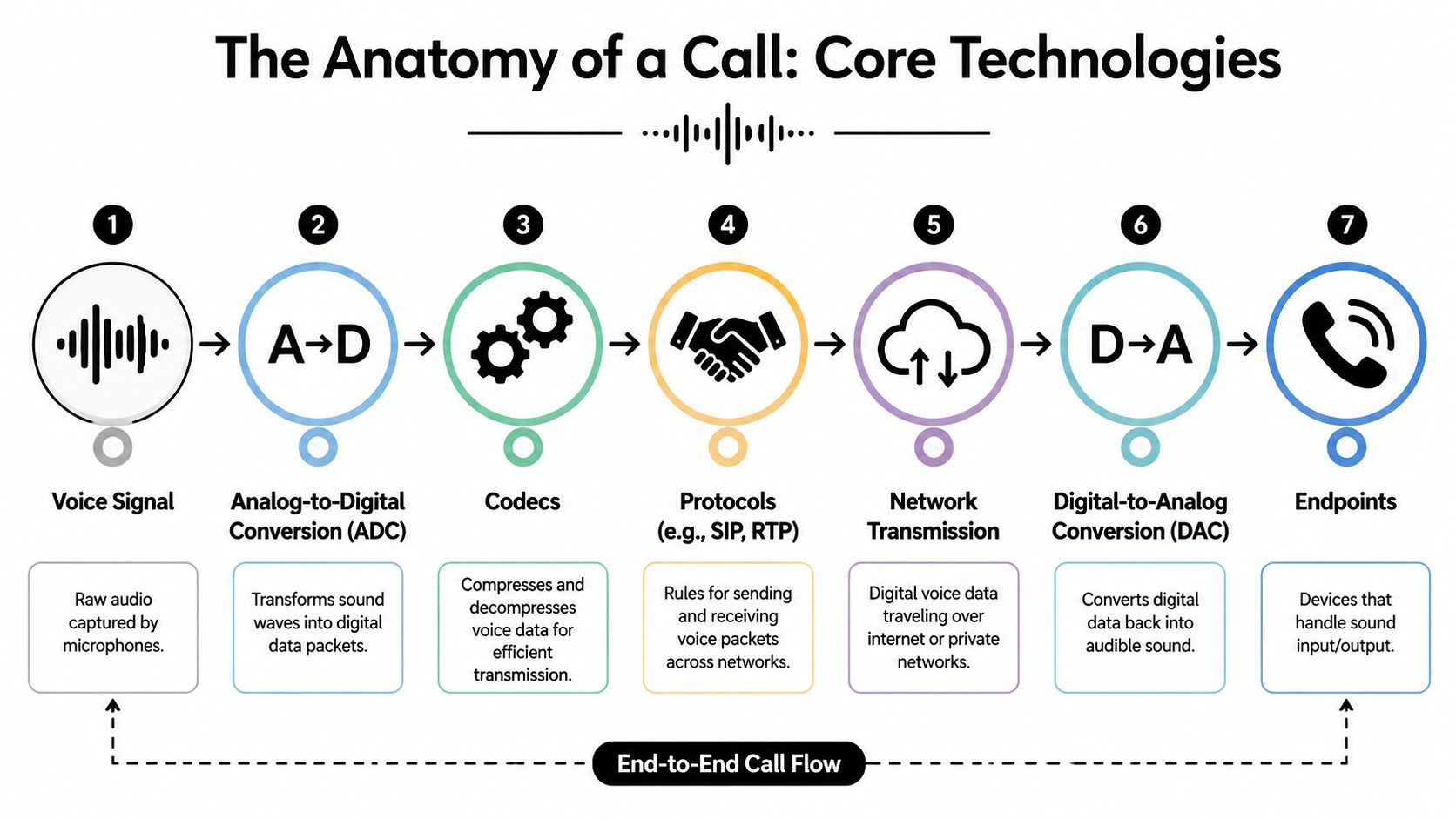
In IP telephony, the most important distinction is between signaling and media. SIP establishes, modifies, and terminates calls, while RTP usually carries the media stream. That separation is one reason IP telephony can support voice, video, and messaging on shared infrastructure (modern IP telephony basics from Salesforce).
A simple mental model helps:
- SIP is the traffic controller. It decides who should talk to whom, when the session starts, and how it changes.
- RTP is the delivery path. It carries the actual audio once the call is active.
- Codecs are the compression layer. They shape how audio is encoded, transmitted, and reconstructed at the other end.
That split has direct business consequences. It's why enterprises can insert recording, transcription, sentiment analysis, conference logic, and AI-based routing into the same flow without rebuilding the entire system.
Endpoints are no longer just desk phones
Endpoints now include mobile devices, browser-based softphones, contact center desktops, embedded communications inside business apps, and voice agents connected through SIP or carrier services. That's why telephony projects increasingly overlap with platform decisions.
For teams exploring automation, it helps to think of voice not as a standalone channel but as part of an orchestration layer. A practical example is how AI systems connect to telephony to manage spoken interactions, qualify intent, and route conversations into workflows such as those supported through voice automation platforms.
Practical rule: If your provider can't clearly explain signaling, media handling, endpoint support, and integration boundaries, you don't yet understand how your voice stack will behave in production.
Choosing Your Architecture On-Premise PBX vs Cloud UCaaS
The architecture decision usually comes down to control versus flexibility. Some organizations still run an on-premise PBX because they want tight oversight, established operational processes, or compatibility with legacy environments. Others move to cloud UCaaS because they need faster deployment, remote support, and easier integration.
The important point is that this isn't just a telephony decision anymore. It's a decision about how voice fits into your communications platform, your support model, and your AI roadmap.
The strategic trade-offs
On-premise PBX environments give IT teams a high degree of direct control over hardware, configuration, and change windows. That can work well in heavily structured environments where change is slow and compliance review is strict. The downside is operational drag. Scaling, maintaining, and integrating these systems often takes more effort than business teams expect.
Cloud UCaaS shifts that burden toward a service model. You gain faster rollout, simpler support for distributed users, and easier connectivity to adjacent tools such as CRM, identity, ticketing, and collaboration systems. You also accept a different operating reality, where vendor capabilities, APIs, and service governance matter as much as traditional telecom engineering.
On-Premise PBX vs. Cloud UCaaS At a Glance
| Factor | On-Premise PBX | Cloud UCaaS (Unified Communications as a Service) |
|---|---|---|
| Cost model | Higher upfront investment, ongoing maintenance burden | Subscription-style operating expense |
| Control | More direct control over infrastructure | More provider-managed operations |
| Scalability | Expansion can be slower and more involved | Capacity changes are typically easier |
| Remote work support | Often requires added design work | Usually better aligned to distributed teams |
| Integration readiness | Can require custom work | Often easier to connect with cloud apps |
| AI fit | Possible, but often more complex | Usually a better base for rapid AI adoption |
As enterprise communications evolve, the line between telephony and broader communications platforms keeps fading. RingCentral notes that the modern enterprise question is often where telephony ends and communications platforms begin, especially as businesses move from PSTN-only systems to cloud, mobile, and omnichannel architectures that support remote work and new business applications (enterprise telephony definition and shift to cloud communications).
What usually works better in practice
For most large organizations, a hybrid period is normal. They keep some legacy elements in place while moving user groups, locations, or functions to cloud services in phases. That approach reduces operational shock and gives teams time to redesign routing, reporting, and escalation logic.
A useful screening question is this: can your voice environment connect cleanly to the rest of your stack? If not, your architecture will slow every future initiative. That includes agent desktop design, workflow automation, reporting, and AI deployment through enterprise integration frameworks.
Buy architecture for the next operating model, not the last procurement cycle.
Modern Enterprise Use Cases for Telephony
Modern telephony shows its value when it disappears into the workflow. Customers don't care whether a call arrived through PSTN, mobile, or VoIP. Employees don't care how signaling and routing are handled. They care that the right conversation happens quickly, with context, and without repetition.
That's why the most useful way to think about telephony now is by the business experiences it enables.

Contact centers that act on context
In a modern contact center, telephony does more than connect calls. It supplies the intake layer for routing, identity checks, queue logic, handoff, recording, and post-call automation. When that layer is connected to CRM and service systems, agents don't start from zero. They begin with account context, prior interaction history, and likely intent.
That same model now supports AI voice agents. A neutral explanation from Decagon makes the key shift explicit: many explainers stop at a broad definition, but the enterprise question has become “what parts of telephony must be modernized for real-time automation?” It also notes that telephony is now treated as the infrastructure layer for AI voice agents (telephony as the infrastructure layer for AI voice agents).
Employee support and internal service delivery
Telephony is just as relevant inside the business. HR helpdesks, IT service desks, workplace services, and field operations all rely on voice during moments when speed matters more than channel preference. Someone locked out of a system, reporting a safety issue, or coordinating a delivery doesn't want to deal with a fragmented stack.
Common internal use cases include:
- IT support intake with authentication, triage, and ticket creation.
- HR service automation for leave policies, payroll questions, and document requests.
- Field operations coordination where staff need immediate voice-based updates.
- After-hours support that can resolve routine needs or escalate urgent ones.
That's where voice AI becomes operationally useful. Teams can use platforms that connect to telephony and business systems to automate routine voice interactions. One example is Yellow.ai, which supports voice AI agents that work across telephony environments including SIP and PSTN while connecting voice flows to enterprise systems.
Voice automation works when handoffs are clean
The fastest way to make voice automation fail is to trap callers in a brittle bot flow. The best deployments do the opposite. They identify intent early, resolve straightforward tasks, and transfer with context when a human should take over.
A short demo helps make that real:
Good voice automation doesn't try to eliminate humans from the system. It decides when automation is appropriate and when a person should step in with full context.
Implementation and Migration Essentials
A telephony migration usually fails for boring reasons, not exotic ones. Number porting gets mishandled. Routing logic is copied without being redesigned. Security review starts too late. Business teams assume the new stack will preserve every legacy behavior, even the ones nobody should keep.
A cleaner approach is to treat migration as an operating model change with technical work attached to it.
Start with your real call flows
Before selecting providers or planning cutover, map how calls move through the business. Identify entry points, routing rules, overflow logic, escalation paths, compliance requirements, recording needs, and the systems that should receive event data.
That step often exposes outdated complexity. Teams discover old hunt groups that no longer make sense, phone trees built around org charts instead of customer intent, and manual handoffs that should have been automated years ago.
Where SIP trunking fits
For many enterprises, SIP trunking is the bridge between legacy telephony and IP-based services. It lets organizations connect existing environments to modern voice infrastructure without replacing everything at once. That can be useful during phased migration, regional transitions, or coexistence periods where some business units move faster than others.
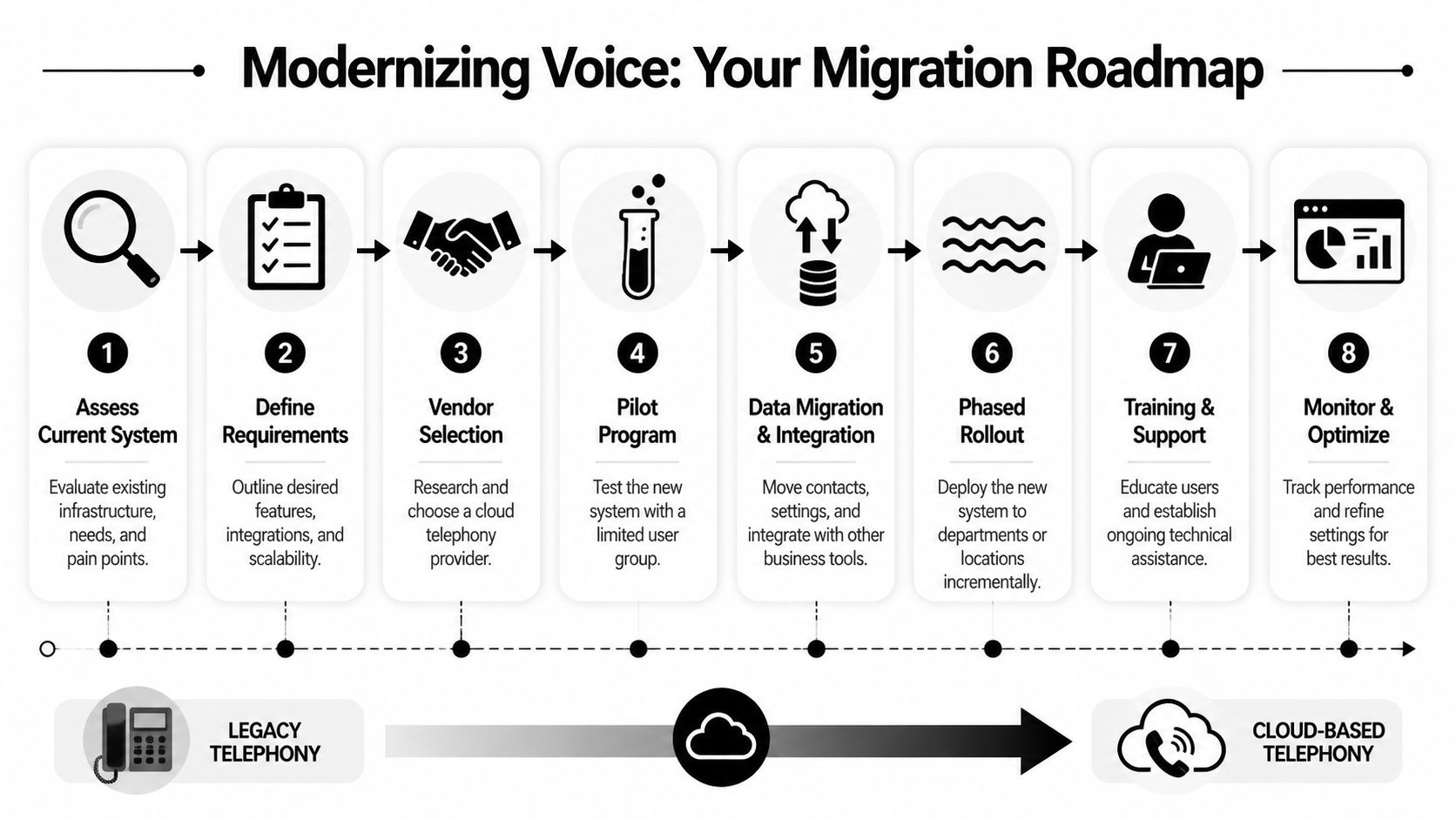
A practical migration checklist should cover:
- Current-state assessment. Document carriers, number inventory, call flows, integrations, and compliance constraints.
- Porting plan. Decide which numbers move first, which stay temporarily, and how rollback will work.
- Carrier and provider review. Evaluate service governance, support responsiveness, geographic fit, and escalation processes.
- Security and compliance alignment. Confirm how voice data, recordings, and transcripts are handled.
- Pilot design. Start with a contained user group that surfaces issues without disrupting the whole business.
Choose partners that can support change, not just traffic
A provider may offer voice connectivity and still be a poor fit for enterprise transformation. What matters is whether they can support integration, migration sequencing, testing discipline, and operational accountability.
That same principle applies when adding automation. If you're planning conversational voice flows, treat telephony and AI as one implementation program. The voice layer should support number management, routing, escalation, and transcript or event handoff into the automation layer, such as systems used to deploy an enterprise voice bot.
Migration gets easier when teams stop asking, “How do we preserve the old phone system?” and start asking, “Which voice behaviors are still worth keeping?”
Measuring Success and Future-Proofing Your Strategy
Most telephony dashboards overemphasize volume and underemphasize experience quality. You need both. A voice environment can connect calls reliably and still create poor customer outcomes if latency, routing, handoff, or audio quality break the conversation.
Measure quality, reliability, and user friction
At the operational level, telephony leaders usually track indicators such as MOS for perceived call quality, ASR for call completion reliability, and PDD for the delay between initiating and connecting a call. Those metrics matter because callers feel them immediately, even when they can't name them.
You should also look at conversation-level signals:
- Transfer patterns that show where automation or routing is failing
- Repeat-contact themes that expose poor resolution design
- Escalation quality that reveals whether context survives handoff
- Silence and interruption patterns that often point to latency or flow issues
Here is a visual summary of common business-facing metrics teams often monitor in telephony environments:
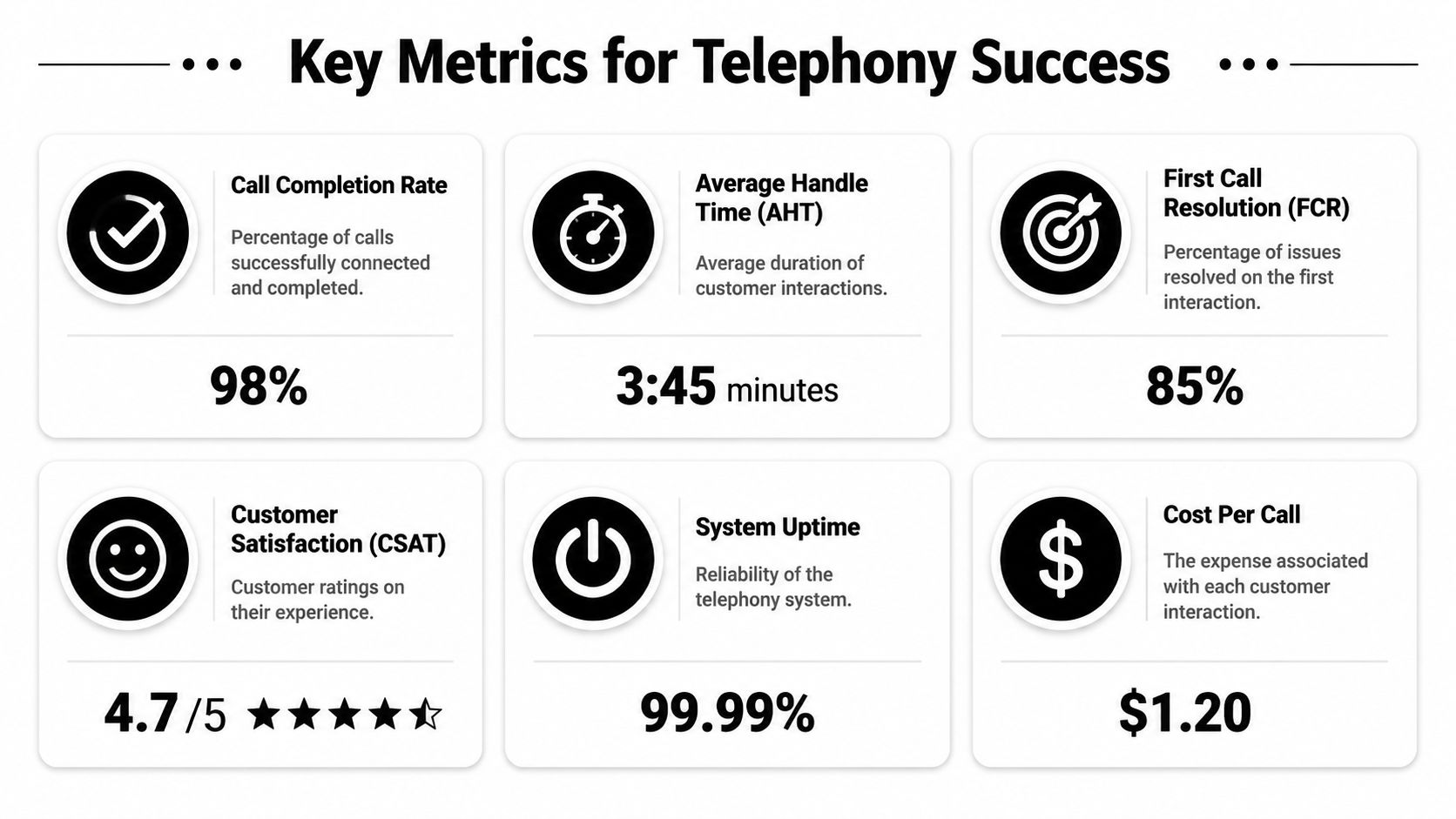
The specific values shown in a generic infographic won't tell you whether your system is healthy. Your own baseline, by channel, geography, carrier path, and use case, is what matters.
Future-proofing means designing for mobility and AI
Telephony strategy also has to reflect where enterprise voice now lives. The International Telecommunication Union's historical framing shows how central telecommunications statistics have been to infrastructure planning over time, and its timeline notes that in 2016 the number of mobile connections surpassed the world population. It also notes that in 2019 the first commercial 5G network launched, marking another shift in voice and data transport beyond fixed-line calling (ITU telecommunication history and milestones).
That matters for AI because voice experiences are no longer built for a fixed endpoint in a fixed location. They're built for mobile users, distributed teams, and software-defined interactions that may begin in one channel and continue in another.
The strategic test
A future-ready telephony stack should let you do three things well:
- Adapt channels and endpoints without redesigning the business process every time
- Insert automation cleanly into routing, service, and handoff logic
- Learn from conversations through analytics, transcripts, and workflow data
If your stack can't support those moves, it may still place calls, but it won't support the next generation of autonomous customer and employee experiences.
Conclusion: Telephony Is Your Foundation for Autonomous CX
Telephony started as a way to transmit voice. In the enterprise, it has become much more than that. It's the system that determines how spoken interactions enter the business, how they're routed, how context is attached, how automation participates, and how humans take over when needed.
That's why the question “what is telephony” deserves a strategic answer, not a dictionary definition. For AI initiatives, telephony is the infrastructure layer that decides whether voice automation will be dependable, scalable, and useful in real operations. Weak architecture creates brittle bots, poor handoffs, and fragmented experiences. Strong architecture creates continuity across channels, agents, workflows, and data.
The practical takeaway is straightforward. Treat telephony as part of your AI platform strategy, not as a disconnected utility. Evaluate it based on integration readiness, mobility, routing flexibility, operational visibility, and how well it supports real-time automation. That's the shift from maintaining phone systems to designing autonomous CX and EX.
If your organization is investing in contact center modernization, employee service automation, or AI-led voice experiences, this is not optional. Voice will remain one of the highest-stakes channels in the business. The teams that modernize the telephony layer first will have a much easier path to deploying automation that works.
If you're planning to modernize voice for customer or employee experience, explore Yellow.ai to see how telephony-connected AI agents can fit into a broader enterprise automation strategy.



