













You're probably dealing with one of two situations right now. Either your team is paying too much to run separate environments for customers who mostly need the same product, or you're evaluating an AI platform and realizing that “shared infrastructure” means very different things depending on how security and isolation are implemented.
That's where multi-tenant architecture stops being an abstract engineering term and becomes a board-level decision. It shapes cost, release speed, compliance posture, customization limits, and how far an AI platform can scale before operations become brittle. In CX and EX systems especially, the architecture underneath the product determines whether you can onboard many business units and brands cleanly, or whether every new deployment becomes another special case to maintain.
Table of Contents
- The Unseen Engine of Modern Enterprise Software
- What Is Multi-Tenant Architecture at Its Core
- Understanding Tenancy Models and Isolation Levels
- Single-Tenant vs Multi-Tenant Architecture Compared
- Key Design Implications for Modern AI Platforms
- Multi-Tenancy in Action for CX and EX
- Best Practices and Migration Checklist
- Frequently Asked Questions for Enterprise Leaders
The Unseen Engine of Modern Enterprise Software
Most enterprise buyers don't ask for multi-tenancy by name. They ask for lower operating cost, faster rollout, simpler upgrades, and a platform that won't collapse under growth. Multi-tenant architecture is what makes those outcomes possible.
It has become the default delivery model behind modern SaaS. The global SaaS market generated about $274 billion in 2023 and is projected to reach $345 billion by 2025, while over 85% of enterprise software deployments now use SaaS models that rely on multi-tenancy for cost efficiency, according to McKinsey Digital insights. That isn't a niche design pattern. It's the operating model of enterprise software.
What changed is simple. Enterprises stopped wanting to fund duplicated infrastructure for every customer deployment when a shared platform could deliver the same core capability with tighter operational control. Vendors realized they could patch once, deploy once, and improve one codebase instead of managing a growing fleet of near-identical environments.
Practical rule: If your business model depends on serving many customers with similar product behavior, multi-tenancy is usually the economic baseline, not an advanced option.
That doesn't mean every workload belongs in a heavily shared system. It means the first question is no longer “should we share anything?” It's “what should we share, and where do we need stronger isolation?”
For CX, EX, and AI platforms, that question matters even more. Shared infrastructure can make global scale possible. Poor isolation design can turn that same efficiency into a security and compliance problem.
What Is Multi-Tenant Architecture at Its Core
In multi-tenant architecture, one software platform serves multiple customers, while keeping each customer's data, configuration, and user experience logically separate. Tenants share underlying resources, but they shouldn't see or affect one another's business data.
The simplest mental model
The easiest way to understand what is multi-tenant architecture is to compare it with housing.
A single-tenant system is like a single-family home. One customer gets the whole property. They have maximum control and strong separation, but they also carry the full cost of the land, plumbing, wiring, and maintenance.
A multi-tenant system is like an apartment building. Many residents share the foundation, elevators, security desk, and utilities infrastructure. Each apartment is still private. The value comes from sharing what doesn't need to be duplicated.
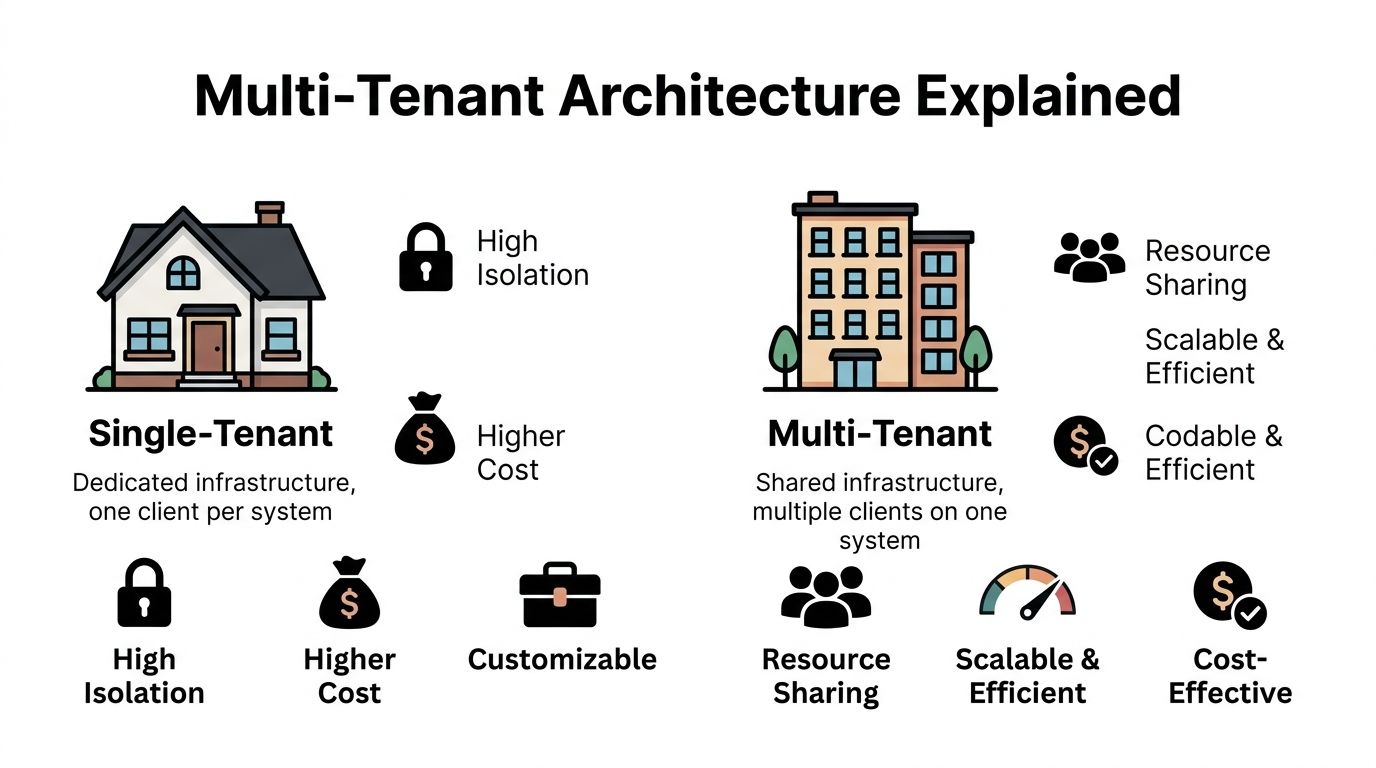
That analogy holds up better than most definitions because it explains the economics and the engineering at the same time. The platform owner centralizes operations. The tenant gets service, separation, and configuration without funding a full duplicate stack.
What actually gets shared
In a real SaaS product, teams may share several layers:
- Application codebase: Everyone runs on the same core product version.
- Compute infrastructure: Containers, virtual machines, and orchestration layers are pooled.
- Databases or schemas: Depending on the isolation model, tenants may share a database engine, schema, or both.
- Operational workflows: Monitoring, patching, releases, and incident response are centralized.
What usually remains tenant-specific is equally important:
- Business data
- Identity and access policies
- Branding and workflow settings
- Integrations and entitlement rules
If you want a useful adjacent read on governance and isolation decisions in collaboration systems, Ollo's architect's guide for SharePoint multi-tenant security is worth reviewing because it frames shared-platform security as an architectural discipline, not a checkbox.
A quick explainer helps if you're briefing non-technical stakeholders:
The mistake I see most often is treating multi-tenancy as “everyone shares everything.” Good platforms don't work that way. They share the expensive common layers and isolate the risky or customer-specific ones.
Understanding Tenancy Models and Isolation Levels
Not all multi-tenant systems isolate customers in the same way. The key design question is where separation happens: infrastructure, application, database, schema, or row level.
Isolation is a spectrum
AWS guidance describes three common models: Silo, Bridge, and Pool. In the Silo model, each tenant gets a dedicated application stack and database instance. In Bridge, tenants share the application stack and database, but use schema-per-tenant separation. In Pool, tenants share the stack and database and rely on row-level security. AWS also notes that the Silo model provides maximum isolation but can carry up to 300% higher infrastructure costs, as outlined in this AWS architecture guidance on partitioning multitenant SaaS data.
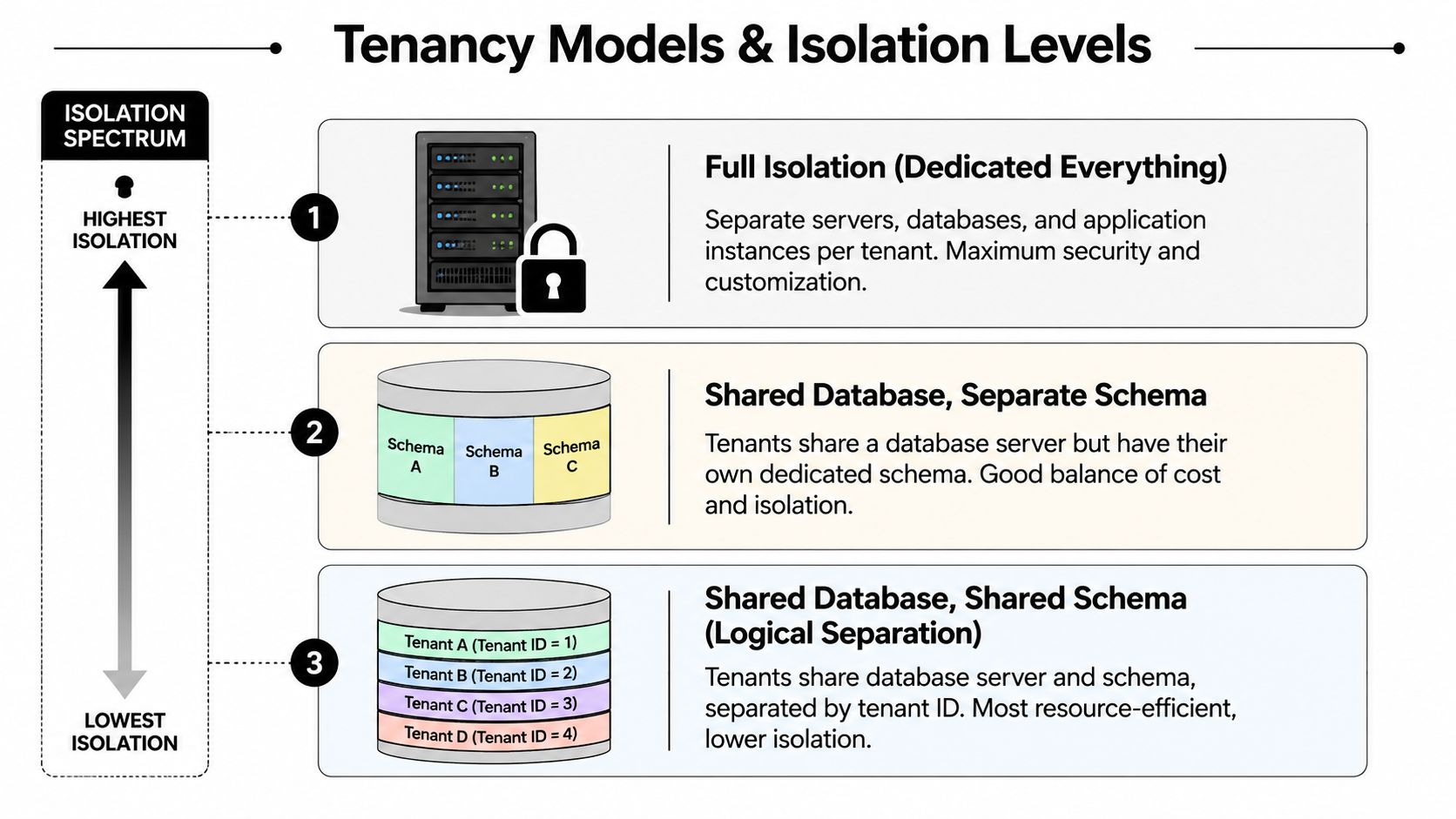
Here's the practical view:
| Model | Best for | Main advantage | Main trade-off |
|---|---|---|---|
| Silo | Highly regulated tenants | Strongest isolation | Highest cost and operational duplication |
| Bridge | Enterprises needing balance | Cleaner separation with shared efficiency | Schema management gets harder over time |
| Pool | Large-scale SaaS platforms | Best unit economics and scale | Isolation depends heavily on application discipline |
This is why the phrase “multi-tenant architecture” on its own doesn't tell you enough. Two vendors can both be multi-tenant and still operate with completely different security profiles.
How teams choose in practice
Most enterprise platforms don't stay pure to one model forever.
A bank, insurer, or hospital may require stronger tenant boundaries because compliance teams want tighter control over data placement, auditability, and change management. A retail or logistics customer may care more about rollout speed, lower cost, and flexible integration patterns. Mature platforms often support both by placing premium or regulated tenants into stronger isolation tiers while keeping standard workloads in shared pools.
Multi-tenancy works best when isolation is treated as a product capability. Not just a database trick.
That also changes how procurement should work. Instead of asking, “Are you multi-tenant or single-tenant?” ask where tenancy boundaries are enforced, how identity maps to tenant context, and what happens when one tenant's workload spikes or a policy is misconfigured.
For a broader conceptual explanation, Kogifi's article on what is multi-tenant architecture is a useful companion, especially for teams aligning product, engineering, and procurement language before vendor evaluation.
Single-Tenant vs Multi-Tenant Architecture Compared
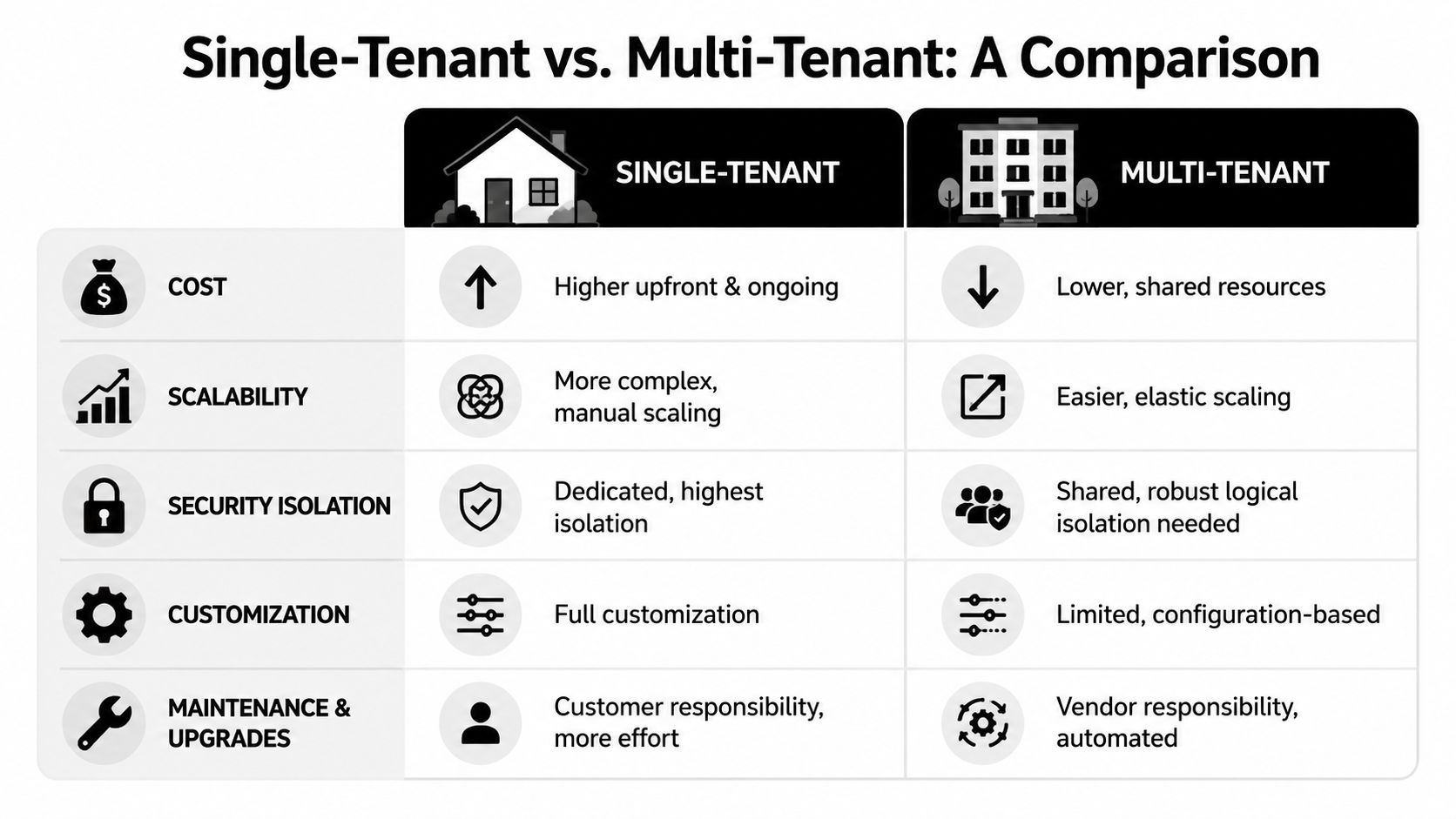
The decision between single-tenant and multi-tenant architecture isn't ideological. It's a trade-off between control and efficiency.
Where multi-tenancy wins
Multi-tenancy usually wins on operational efficiency. When one codebase serves many customers, the vendor patches once, upgrades once, and monitors one shared platform instead of a spread of bespoke environments.
Benchmark data from Microsoft Azure indicates that multi-tenant architectures reduce licensing and maintenance costs by about 40% to 50% compared with single-tenant deployments because updates and security patches are applied once across the shared codebase, as described in Azure's multitenant SaaS architecture guidance.
That advantage shows up in day-to-day operations:
- Release management gets simpler: Product teams don't wait for customer-by-customer upgrade cycles.
- Capacity is easier to pool: Idle resources from one tenant can support another tenant's peak.
- Security operations are more consistent: Centralized patching reduces version drift.
- Feature rollout is cleaner: Entitlements and configuration flags replace environment forks.
Where single-tenancy still makes sense
Single-tenancy still earns its place when isolation requirements override cost efficiency. That usually happens when an organization needs dedicated infrastructure, unusual change-control processes, or deep custom code that would distort a shared platform.
A simple side-by-side view helps:
| Decision area | Single-tenant | Multi-tenant |
|---|---|---|
| Cost profile | Higher ongoing spend | Lower through shared resources |
| Customization | Broad environment-level control | Better for configuration-led variation |
| Scalability | Expansion is heavier operationally | Expansion is built into the platform model |
| Upgrades | Per-customer effort | Centralized and repeatable |
| Isolation | Strong physical or instance separation | Strong logical separation when designed well |
There's also a performance nuance. Multi-tenant systems have to manage noisy-neighbor risks. Single-tenant systems avoid that class of contention more naturally, but they give up the elasticity and common control plane that make modern SaaS efficient.
Choose single-tenancy when dedicated isolation is a hard requirement. Choose multi-tenancy when repeatability, speed, and platform economics matter more than full environmental exclusivity.
Key Design Implications for Modern AI Platforms
Classic multi-tenancy discussions stop at the database. That's no longer enough for AI platforms.
Database isolation is no longer enough
In an agentic AI system, the risk surface extends beyond tables and schemas. Tenant data can also leak through prompts, memory layers, retrieved documents, session state, tool calls, and shared inference workflows. A platform may have perfect row-level separation in storage and still create cross-tenant exposure at runtime.
Recent studies on agentic AI reported that 42% of multi-tenant failures came not from static database breaches, but from runtime context injection where one tenant's prompt data influenced another tenant's model output during shared inference cycles. The same research found that 78% of enterprises now deploy multi-tenant AI agents, yet 63% lack a clear runtime segregation strategy beyond database partitioning, according to Yellow.ai's analysis on its enterprise AI and platform security blog.
That shifts the architecture conversation. Isolation now has to exist at three layers:
- Data isolation: Tenant records, files, and metadata must remain separated in storage.
- Application isolation: Sessions, APIs, permissions, and integration scopes must stay tenant-aware.
- Inference isolation: Prompt assembly, retrieval context, memory, and model outputs must never carry residue from another tenant.
What to ask AI vendors now
Many evaluations often fall apart. Buyers ask whether the vendor supports SSO, encryption, or data partitioning. They don't ask how the platform handles prompt-scoped memory, vector retrieval boundaries, shared tool execution, or model-side caching behaviors.
A stronger review process includes questions like these:
- How is tenant context enforced during prompt construction?
- What prevents retrieval from crossing tenant boundaries in shared knowledge systems?
- Are memory, transcripts, and tool outputs isolated per tenant and per environment?
- What controls exist for testing cross-tenant leakage during AI release cycles?
For teams evaluating enterprise AI safeguards in more depth, review Yellow.ai's enterprise-grade security approach as an example of the kinds of controls an enterprise platform should be able to explain clearly.
The other issue is cost. Shared AI looks efficient until customization grows. Voice cloning, multilingual support, model routing, and tenant-specific knowledge bases all add runtime complexity. If the architecture doesn't separate common AI services from tenant-specific inference overhead, unit economics deteriorate quickly.
Multi-Tenancy in Action for CX and EX
A good way to judge multi-tenancy is to look at environments where many organizations use the same platform for very different outcomes. CX and EX are ideal examples.

One platform serving very different organizations
Consider a shared contact center platform used by a retailer, a bank, and a hospital. All three may run on the same core application, orchestration layer, and AI services. Yet each tenant needs its own identity setup, workflows, compliance rules, tone of voice, integrations, and reporting views.
The retailer might prioritize order tracking, returns, and campaign-driven support spikes. The bank may need stricter approval flows, masked data handling, and carefully controlled authentication steps. The hospital may require stronger auditability and guarded access to sensitive interactions.
The platform succeeds when none of those tenants need a forked product.
Why CX and EX teams prefer this model
Shared architecture is attractive in service operations because CX and EX teams rarely want to manage infrastructure themselves. They want speed, consistency, and the ability to launch new automations without opening a major IT program every time.
In practice, strong multi-tenancy supports:
- Brand-level variation: Different business units can maintain their own bot flows, language, branding, and escalation logic.
- Central governance: The enterprise can still enforce identity, security, and release controls.
- Faster rollout across channels: Voice, chat, email, and messaging can be added through the same platform model.
- Operational learning at scale: Platform teams improve one system and every tenant benefits.
If you want to see how this model shows up in service automation, this overview of conversational AI for customer service is a useful reference point for how shared platforms support customer-facing operations across channels.
The key is that customization stays mostly declarative. Once each tenant starts demanding unique infrastructure behavior, the benefits of multi-tenancy erode fast.
Best Practices and Migration Checklist
Teams get into trouble when they migrate to multi-tenancy as if it were just a hosting change. It isn't. It's an operating model change.
Questions to answer before you migrate
Start with business and risk boundaries, not tooling.
- Which tenants need stronger isolation: Separate your regulated or high-risk customers from standard commercial tenants early.
- What must be configurable versus customizable: Configuration scales. Bespoke code paths usually don't.
- Where will tenant identity live: Authentication, authorization, and tenant context must line up across apps, APIs, and analytics.
- How will you audit data access: Logging must prove who accessed what, under which tenant, and through which workflow.
The cleanest migrations happen when teams define isolation policy before they define infrastructure policy.
For buyers building an evaluation framework, Yellow.ai's buyer's guide to evaluating conversational AI solutions is a practical checklist for comparing enterprise-readiness, governance, and platform fit.
What works better than a lift-and-shift
A direct port of single-tenant assumptions into a shared platform usually creates technical debt.
Better patterns include:
- Start with tenancy-aware domain models: Tenant ID should be part of the design, not bolted on later.
- Design for pooled operations: Monitoring, deployment, and support should assume shared services from day one.
- Limit per-tenant exceptions: Every exception multiplies test complexity.
- Create an isolation escalation path: Some customers will eventually need stronger boundaries. Plan that route before the sales team asks for it.
Migration succeeds when architecture, compliance, and commercial packaging are aligned. If those three move separately, the platform becomes hard to govern.
Frequently Asked Questions for Enterprise Leaders
Is multi-tenant architecture secure enough for regulated industries
Yes, if the platform enforces isolation deliberately across identity, data, application logic, and audit controls. The weak version of multi-tenancy is risky. The disciplined version can support heavily regulated environments when boundaries are designed and tested properly.
Does multi-tenancy always create performance problems
No. The real issue is whether the platform can contain noisy-neighbor effects. Good designs use workload isolation, throttling, queuing, and scaling controls so one tenant's spike doesn't degrade everyone else.
Can enterprises still get customization in a shared platform
Yes, but the safest customization is configuration-led. Branding, workflows, integrations, routing logic, and permissions can vary widely without fragmenting the core platform. Deep code-level divergence is where platforms lose efficiency.
Are AI platforms changing the cost equation
Yes, many buyers often underestimate the trade-off. Industry reporting found that multi-tenant SaaS can reduce initial infrastructure costs by 35%, but AI-specific multi-tenant deployments can incur 50% higher per-tenant operational expenses due to auto-scaling inefficiencies when agents support 500+ languages and 15+ LLM models simultaneously. That customization overhead can erode 30% to 40% of projected cost benefits. The right interpretation isn't that multi-tenancy fails. It's that AI customization has to be designed as a capacity and isolation problem, not just a feature problem.
When should a company avoid multi-tenancy
Avoid it when a customer requires dedicated infrastructure, extreme environment-level customization, or governance rules that don't fit a shared operating model. In those cases, forcing multi-tenancy often creates more friction than value.
Multi-tenant architecture isn't just a way to host software more cheaply. It's the design choice that determines whether an enterprise AI platform can scale securely, adapt across teams, and stay economically viable as customization grows. If you're evaluating platforms for CX or EX automation, Yellow.ai is worth a closer look for teams that need enterprise-grade agentic AI with strong security, multilingual scale, and support for complex service operations.



