













You're already living with the problem voice synthesis solves. The contact center is overloaded, employees are waiting too long for answers, and every new market adds another language, accent, or compliance wrinkle you can't ignore. A common mistake is treating voice as a shiny feature instead of a platform decision with real trade-offs.
Table of Contents
- Why Voice Synthesis Matters to the Enterprise in 2026
- The Core Technologies Behind Modern Voice Synthesis
- Latency, Naturalness, and Language Coverage Trade-offs
- Enterprise Use Cases Across CX and EX
- Implementation Playbook for Enterprise Rollouts
- Evaluation Metrics and Agentic Testing
- Compliance, Safety, and the Edits Most Buyers Underestimate
- Vendor Selection Checklist and Quick Answers
Why Voice Synthesis Matters to the Enterprise in 2026
A CX leader doesn't wake up wanting a “voice synthesis strategy.” They wake up to rising call volumes, multilingual customers, a tired operations team, and a compliance group that won't sign off on anything that sounds risky. The pressure is practical. You need to modernize IVR, keep the brand voice consistent, and avoid building another brittle system that annoys callers and frustrates agents.
Voice synthesis is software that turns text into spoken audio, and in modern systems it can also clone, edit, and govern voices for enterprise use. That makes it less of a research topic and more of a procurement category. The buyer isn't just asking, “Can it speak?” The buyer is asking, “Can it speak fast enough, in the right language, with the right controls, across the stack we already use?”
What changed from old TTS to enterprise voice stacks
The field has been around for a long time. Historical milestones include the VODER at the 1939 New York World's Fair, the first full electrical synthesis device in 1922, and even the UK Telephone Company's speaking clock in 1936 (Aalto history of speech synthesis). The point isn't nostalgia. The point is that the category is mature enough to buy, but still evolving fast enough that architecture choices matter.
By the late 2010s, neural TTS changed buyer expectations. Models like WaveNet and Tacotron 2 pushed naturalness much closer to human speech, and that moved voice from “acceptable automation” to something customers can tolerate in production (speech synthesis overview). That shift is why enterprises now evaluate voice the way they evaluate core infrastructure, with attention to latency, reliability, language depth, and governance.
Practical rule: Don't compare vendors on demo polish alone. Compare them on the real conditions you'll run, live traffic, multiple languages, and brand-sensitive interactions.
The rest of the procurement discussion comes down to one question. Do you want a voice layer, or do you want a controllable voice system that can sit inside CX, EX, and compliance workflows without creating new risk?
The Core Technologies Behind Modern Voice Synthesis
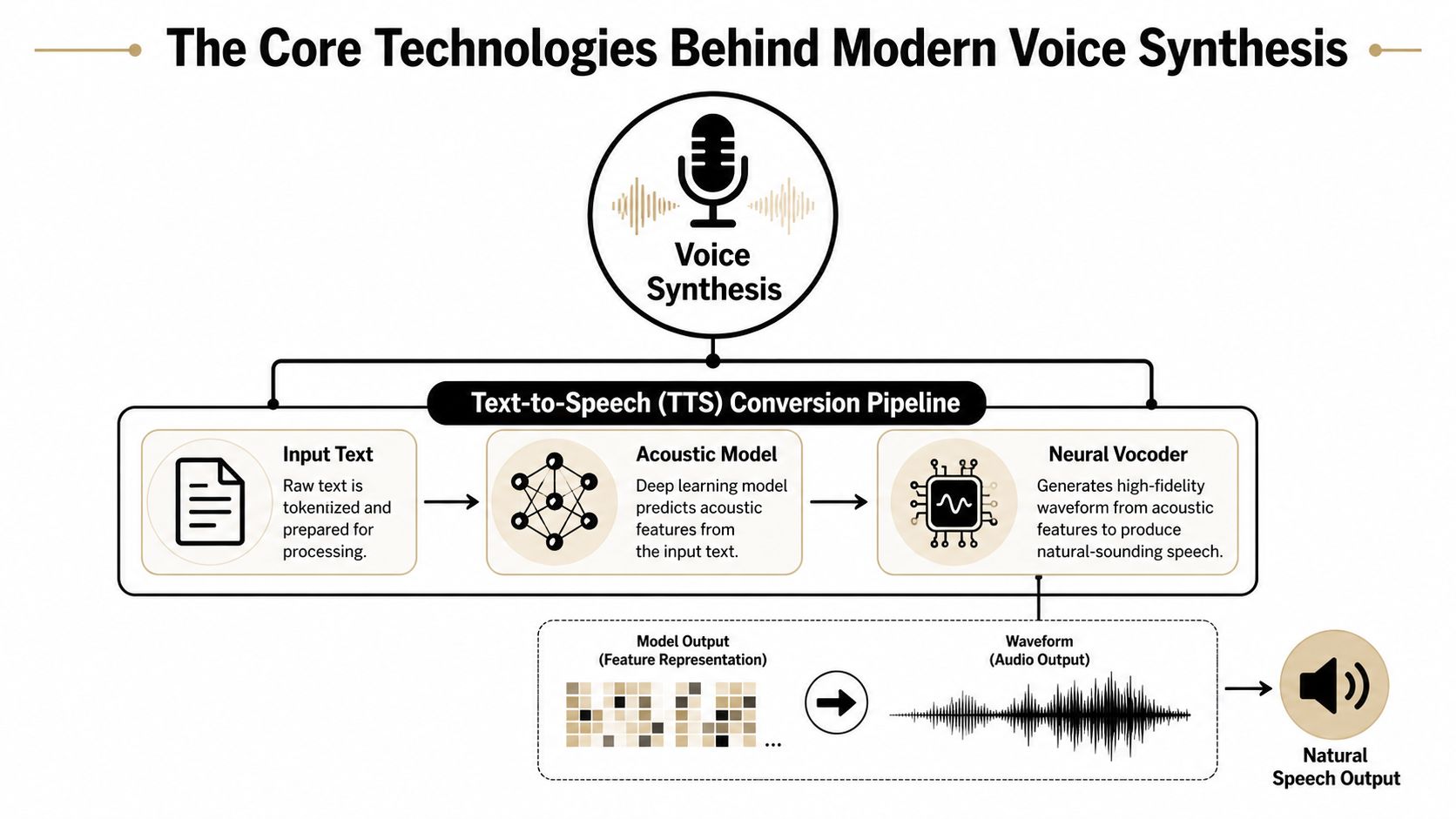
A buyer looking at voice synthesis needs to separate the pipeline from the pitch. Text enters one side, speech leaves the other. In enterprise deployments, that pipeline has two distinct layers, and vendors often blur the boundary because it makes the product sound more capable than it is.
Front end and back end are not the same thing
The front end handles text normalization, pronunciation, phoneme conversion, and prosody prediction. The back end generates the waveform through an acoustic model and a vocoder, which turns model output into audible speech (text-to-speech guide). If the front end is weak, proper names break, pauses land in the wrong place, and the delivery feels flat. If the back end is weak, the speech may be intelligible but still sound synthetic.
The front end shapes how speech is interpreted. The back end shapes how it sounds. If either side is undercooked, the final voice sounds off.
What is commodity and what still differentiates
Basic TTS is table stakes. Serious buyers should assume any vendor can turn text into speech. The differentiators are voice cloning quality, streaming latency, language coverage, and how well the system handles prosody and editing when users want more than one fixed voice.
That is where procurement gets messy. A vendor can claim “multilingual” and still fail on regional pronunciation or code-switching. A vendor can claim “voice cloning” and still give you no practical control over style, consent, or revocation. A vendor can claim “real-time” and still add delays that break a live conversation.
If you are mapping the stack, use the public architecture of a voice assistant like Yellow.ai Nexus Vox as a reference point for how voice, orchestration, and enterprise controls are being packaged together. For language-heavy deployment contexts, the guide for Irish language educators is a useful reminder that pronunciation quality and language-specific nuance matter more than raw language count.
Latency, Naturalness, and Language Coverage Trade-offs
Enterprise buyers keep asking for three outcomes at once, and the platform team has to make the trade-offs explicit. You want the voice to sound natural. You want it to respond immediately. You want it to work across many languages and accents. Those goals pull against each other, so procurement has to score the platform by use case, not by vendor slogan.
The trade-off matrix buyers should actually use
| Trade-off | What It Means in Practice | What to Ask the Vendor |
|---|---|---|
| Latency vs. naturalness | Faster streaming makes conversations feel responsive, but higher-fidelity output may need more processing. | What is the turn-taking latency under live load, not just in a demo? |
| Language breadth vs. language depth | A vendor may claim broad coverage, but some languages or accents may sound weak in production. | Which languages are genuinely production-ready, and which are only supported on paper? |
| Cloud vs. on-device inference | Cloud gives easier scaling and updates. On-device can reduce dependency and sometimes tighten control. | Where does inference run, and what changes when traffic spikes? |
| Cloning fidelity vs. governance overhead | Better cloning raises consent, abuse, and audit requirements. | How do you capture consent, control edits, and revoke a voice if needed? |
For production-grade use, technical targets commonly include sub-1 second latency, real-time synthesis, and audio at or above 16 kHz, 16-bit. Newer voice models also advertise much lower streaming latency, such as <200 ms with adjustable 16–48 kHz output (enterprise voice RFC). Those numbers matter because latency changes how a customer perceives the system. In a live CX flow, delay breaks turn-taking. In content generation, delay matters less than quality.
How to choose based on use case
Live service needs turn-taking, interruption handling, and predictable streaming. Content, training, and branded narration need offline quality, expressive control, and voice consistency. Most buyers mix those requirements and then pick the wrong default profile.
Decision rule: Score CX systems on conversational responsiveness first. Score content systems on output quality first. Do not let one vendor force the same baseline for both.
Language coverage deserves the same skepticism. A platform can look global and still struggle with regional accents, code-switching, or locally preferred pronunciation. The operational test is simple, compare it on the conditions you'll run under, live traffic, multiple languages, and brand-sensitive interactions. A vendor that sounds acceptable in a controlled demo can still miss badly once you put it in front of customers.
Enterprise Use Cases Across CX and EX
The best enterprise voice projects don't start with technology. They start with a broken interaction. A caller gets trapped in an IVR tree. An employee can't get a policy answer without opening three portals. A customer with a screen-reading need gets stuck because the interface assumes visual navigation. Voice synthesis earns its place when it removes a specific failure mode.
Contact center modernization
Rigid IVR trees are still one of the easiest ways to create abandonment and resentment. A natural voice layer lets you replace menu-heavy flows with conversational prompts, then hand off to a human with context already attached. That matters because the agent shouldn't have to re-collect the same details the bot already heard.
This is also where teams often bring in broader AI service tooling to reduce the amount of manual work in claims, billing, or account support. A useful companion reference is Nolana AI's article on how teams can streamline claims with AI, especially if you're mapping voice into a larger service workflow instead of isolating it as a one-off front end.
Employee experience and accessibility
In EX, voice is usually about speed and access. An employee who can ask HR a question by voice gets an answer faster than someone navigating a dense intranet. The same applies to IT self-service, password resets, onboarding help, and multilingual internal support. If you operate across regions, voice reduces friction for teams that don't share the same first language.
Accessibility is the third use case buyers underweight. Voice helps users who can't easily read screens or who prefer spoken interaction. That isn't a niche feature. It's a design constraint if you care about inclusive operations.
Practical rule: If the use case doesn't remove an existing bottleneck, don't call it a business case. Call it a demo.
The right enterprise voice layer doesn't just sound good. It reduces repetition, shortens escalations, and keeps brand tone stable across channels. That's why procurement should tie every use case to a failure mode, not to a generic innovation story.
Implementation Playbook for Enterprise Rollouts
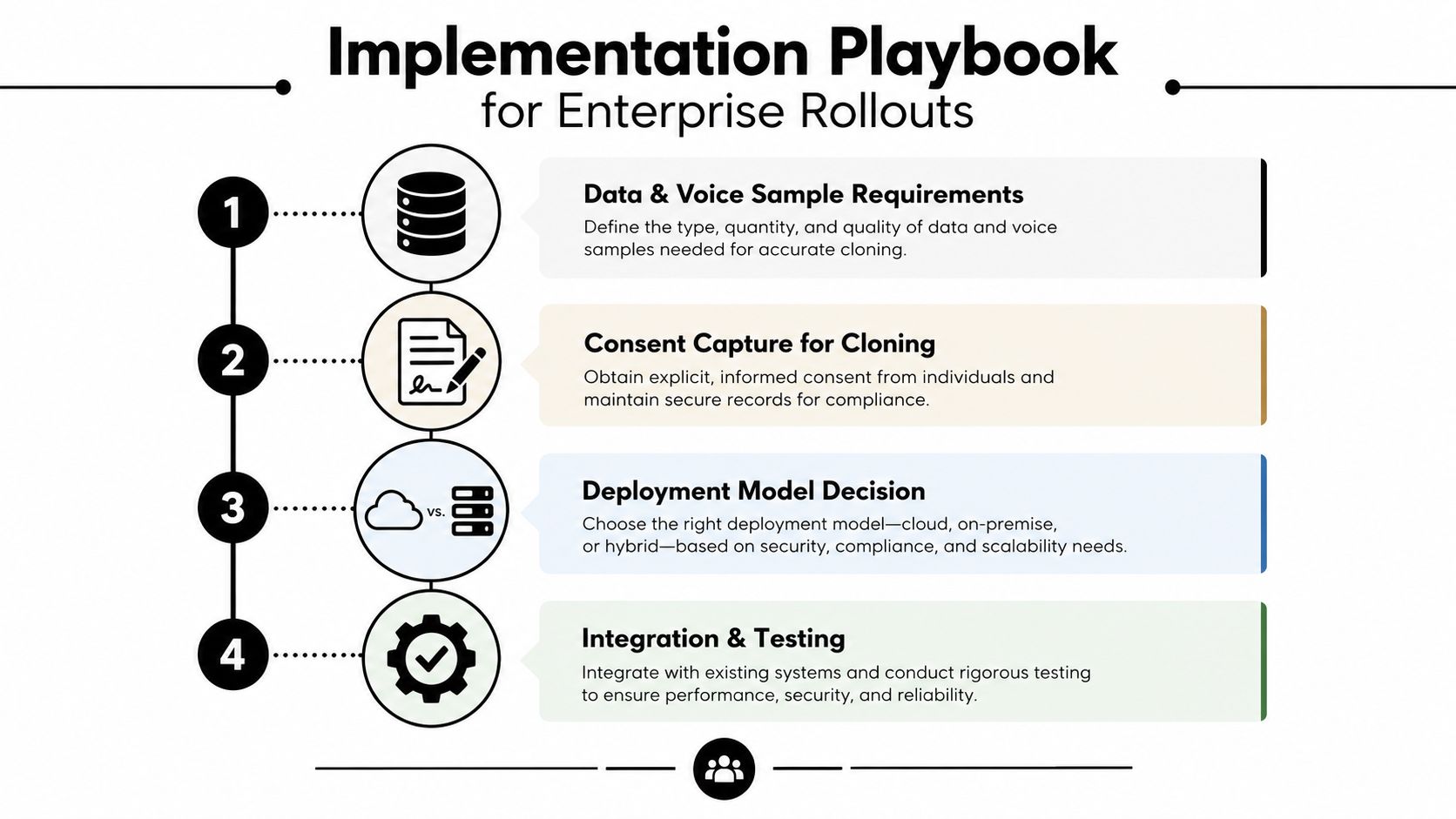
The first 90 days decide whether voice synthesis becomes an operational asset or an abandoned pilot. Teams lose time when they rush into a pilot before they settle the basics, data, consent, deployment, and integration. That sequence is what matters.
Start with data and voice rights, not tooling
Start by defining what voice material you can use. If you want cloning, you need clean sample data, clear ownership, and a consent process that legal will accept. If the speaker is an employee, contractor, or brand ambassador, you need to know who can approve usage and who can revoke it later.
Then choose the deployment model. Cloud is easiest for speed and scale. Private or hybrid deployment may be the right answer when the workload is sensitive, regulated, or tightly coupled to internal systems. Do not accept a default architecture just because it is the vendor's favorite setup.
Integrate the voice layer into the stack you already run
Voice does not live alone. It has to connect with your contact center, CRM, analytics, and knowledge layers. If your team already runs Salesforce, Zendesk, Genesys, Freshdesk, HubSpot, or NICE, ask how the voice stack plugs in before you sign anything. A clean integration path matters more than a polished demo.
The newer orchestration question is multi-LLM routing. That matters because you may want different models for different languages, domains, or tasks. It also helps reduce lock-in. If one model underperforms, you should be able to route around it without rebuilding the whole system.
Treat omnichannel as consistency, not just distribution
Omnichannel is not putting the bot on voice, chat, and email. Omnichannel means the same intent, context, and brand voice follow the user across those channels. If a customer starts on voice and finishes in chat, the handoff should feel like one conversation, not three disconnected systems.
Yellow.ai is one example of a platform that combines voice with omnichannel orchestration and multi-LLM routing in the same stack, which is the right direction for enterprises that want fewer handoff gaps and less vendor sprawl. The reason I mention it here is simple, voice projects fail when they are isolated from the rest of the journey.
The internal test should be straightforward. Can a user move from voice to chat to email without repeating themselves, while the system preserves context and brand tone? If the answer is no, the rollout is not ready.
The trade-off matrix buyers should use is simple, but too many teams avoid it because it forces hard calls.
| Decision point | What to ask |
|---|---|
| Voice quality versus speed | Does the model sound natural enough for your brand, or does lower latency matter more for live service? |
| Turn-taking under load | What is the turn-taking latency under live load, not just in a demo? |
| Language coverage | Which languages are production-ready, and which are only supported on paper? |
| Consent and rights management | Can the platform prove who approved the voice asset and where it can be used? |
| Routing and resilience | Can you switch models or routes without breaking the conversation flow? |
| Compliance boundaries | Can the deployment meet your security, retention, and data residency rules? |
Here is the sequence I would enforce in week one:
- Lock the voice data policy. Decide what can be recorded, stored, cloned, and deleted.
- Document consent capture. Build the approval path before anyone records a sample.
- Choose the deployment boundary. Cloud, private, or hybrid, with security review attached.
- Run integration tests early. Do not wait for pilot week to discover your CRM handoff is broken.
Use a testing workflow before anything touches production, and tie it to a platform such as Yellow.ai automated testing so QA can push through scenario coverage without turning the process into manual busywork.
Evaluation Metrics and Agentic Testing
A vendor demo can sound polished and still fail in production. Buyers should score voice synthesis on how people experience it in real workflows, not on how it behaves in a controlled lab.
What the common metrics really tell you
Mean Opinion Score, or MOS, measures perceived naturalness. It is useful for benchmarking, but it only answers one narrow question. Published comparisons in the speech synthesis overview report WaveNet at 4.21, concatenative systems at 3.86, Tacotron 2 at 4.53, and human speech at 4.58. Those figures show that naturalness can be measured, but they do not prove the system will hold up in your contact center, your language mix, or your compliance environment.
Word Error Rate, or WER, shows how faithfully the system preserves content. Intelligibility testing shows whether people understand the output without effort. Latency tells you whether the interaction still feels conversational or starts to drag.
Procurement teams should treat those as separate checks. A platform can score well on MOS and still mispronounce names, stumble on acronyms, or lag badly under load. That is why buyers need a scorecard that reflects the full service experience, not just the audio sample.
Why scripted QA misses too much
Scripted tests only cover the paths you already planned for. Real users interrupt, switch languages midstream, ask off-script questions, and move between channels. That is why agentic testing matters. It runs scenarios, personas, languages, and failure states before the system goes live, so you see the weak points before customers do.
Practical rule: Test the strange cases on purpose. If a model breaks on a dialect or a turn-taking edge case, catch it in QA, not after launch.
The testing layer should also let your team inspect flows before launch, not after a failed pilot. If a platform gives you AI-assisted testing, use it to review routing, prompts, model selection, and failover behavior. A workflow like Yellow.ai automated testing shows how teams can push scenario coverage without turning QA into manual busywork.
What to put in an RFP
- MOS target: Ask how the vendor measures naturalness and under what conditions.
- WER and intelligibility: Ask how accuracy is checked across your supported languages.
- Latency in context: Ask for live-turn measurements, not demo timing.
- Dialect failover: Ask what happens when a specific accent or language underperforms.
If a vendor cannot explain how they test branching conversations across channels, they are not ready for enterprise deployment.
Compliance, Safety, and the Edits Most Buyers Underestimate
A high MOS score can still hide a dangerous deployment. That's the part the market keeps downplaying. A voice that sounds great in a demo can still be unusable if you can't prove consent, audit usage, or control what happens after the voice is generated.
Governance is now part of the product
Synthetic voice governance should include consent records, audit trails, and the ability to edit or revoke a cloned voice. That matters because voice synthesis is no longer just generation, it's lifecycle management. If the platform can't tell you who approved the voice, when it was used, and how it can be removed, it's not enterprise-ready.
Research on user-driven voice editing also points to a bigger gap. Buyers increasingly want granular control over speaker identity, style, and attributes, but many workflows still expose only coarse controls or black-box generation (voice editing and governance research). That is a real procurement issue, not a theoretical one.
Global coverage is not the same as usable coverage
The low-resource language problem is still widely discussed because many languages spoken by millions remain poorly served by mainstream TTS. Data scarcity, weak phonetic tooling, and language-specific pronunciation issues keep output unnatural in many cases (low-resource language review). So when a vendor says “we support many languages,” ask what that means in practice for accents, code-switching, and regional pronunciation.
That's the trap. Breadth looks impressive in a slide deck. Depth is what your users feel.
Compliance requirements are not optional extras
If your environment touches healthcare, payments, or regulated employee data, the usual controls still apply. Ask how the vendor maps voice workflows to HIPAA, ISO 27001, ISO 27701, SOC 2, and PCI-DSS expectations. Yellow.ai's enterprise-grade security is one example of how product teams are packaging those controls into the platform layer rather than treating them as afterthoughts.
Bottom line: Do not buy voice on naturalness alone. Buy the controls that let you use it safely, revoke it cleanly, and audit it later.
Vendor Selection Checklist and Quick Answers
Use this checklist before you sign a pilot or a production contract.
- Consent and revocation: Can the vendor prove voice ownership, approval, and revocation workflows?
- Language depth: Does the system sound good in your target languages, accents, and code-switching patterns?
- Latency under load: Has the vendor tested real conversational response times, not just benchmark clips?
- Multi-LLM routing: Can you route tasks and languages across models without replatforming?
- Omnichannel orchestration: Does context survive a move from voice to chat or email?
- Integrations: Does it connect cleanly with Salesforce, Zendesk, Genesys, Freshdesk, HubSpot, NICE, and your CRM or contact center stack?
- Agentic testing: Can you simulate conversations, not just run static QA scripts?
- Security and compliance: Are the required certifications, controls, and audit trails in place?
A few quick answers come up in every buyer review. Real-time means the system can respond fast enough that the user still feels like the conversation is continuous. Cloning data requirements depend on the voice rights, the target fidelity, and the vendor's workflow, so don't accept a one-size-fits-all answer. And no, you don't always need separate TTS vendors if your platform can handle orchestration, testing, and governance in one stack.
If you're buying voice synthesis for CX or EX, treat it like platform infrastructure, not a novelty feature. Yellow.ai brings voice, omnichannel orchestration, testing, and enterprise controls into one operating model, which is the kind of setup serious teams should evaluate. Visit Yellow.ai if you want to see how an enterprise agentic platform approaches voice, governance, and deployment in the same system.



