














Your support organization has a recognizable voice, but the operating model behind it is fragmented. The licensed voice actor can't record every new script, regional teams are commissioning separate text-to-speech voices, and customers hear a different brand personality depending on the language or channel. A voice cloning API looks like the obvious fix, but choosing one by demo quality alone creates a new production problem.
The right question isn't which model sounds most impressive in a controlled recording. It's whether the entire pipeline can enroll a voice lawfully, deliver the first audio quickly, preserve quality across languages, survive network and telephony constraints, and remove the voice when the business no longer has permission to use it. Treat voice cloning as a platform decision, not a model-shopping exercise.
Table of Contents
- Why Enterprise Teams Are Evaluating Voice Cloning APIs in 2026
- How a Voice Cloning API Pipeline Actually Works
- Latency, Streaming, and the Conversation-Budget Framework
- Sample Length, Fidelity, and Multi-Language Support Tradeoffs
- Consent, Provenance, and Enterprise Compliance Controls
- Integration Patterns for Voice Agents and Contact Centers
- A Vendor Scorecard for Choosing the Right API
- A Two-Week Pilot Plan Before You Commit
Why Enterprise Teams Are Evaluating Voice Cloning APIs in 2026
A voice cloning API accepts reference audio and returns synthesized speech that carries the speaker's vocal characteristics. In enterprise products, it usually sits beside text-to-speech, automatic speech recognition, dialogue orchestration, analytics, and contact-center integrations. The API may expose a simple synthesis call, but the production system still has to manage enrollment, identity, streaming, storage, routing, monitoring, and governance.
That distinction matters because the market has moved beyond novelty use cases. Industry forecasts place the voice cloning market at USD 1.5 billion in 2022 and USD 16.2 billion by 2032, while another estimate places it at USD 1.45 billion in 2022 and USD 9.75 billion by 2030. A separate forecast puts the market at USD 3.02 billion in 2026 and USD 9.53 billion by 2031. These projections differ, but they point in the same direction: voice cloning is being absorbed into conversational AI, localization, accessibility, and synthetic-media workflows. See the voice cloning market forecasts for the underlying estimates.
The enterprise trigger is operational, not cosmetic
A global support organization doesn't need a cloned voice because executives want a clever demo. It needs one because recording every policy update with the same actor is slow, multilingual delivery is inconsistent, and regional teams keep creating uncoordinated alternatives. The business problem is continuity at scale.
Teams are also evaluating voice cloning for branded contact-center agents, employee-service assistants, guided applications, and localized customer journeys. A cloned voice can become a reusable asset, but only if the platform treats it as a governed identity rather than an audio file.
Voice automation for enterprise conversations is one example of the broader category in which cloned voices are deployed alongside conversational workflows. The procurement decision should therefore include the surrounding orchestration layer, not just the synthesis engine.
Architectural rule: Buy the pipeline you can operate. A beautiful voice with weak streaming, deletion, or integration controls is not production-ready.
How a Voice Cloning API Pipeline Actually Works
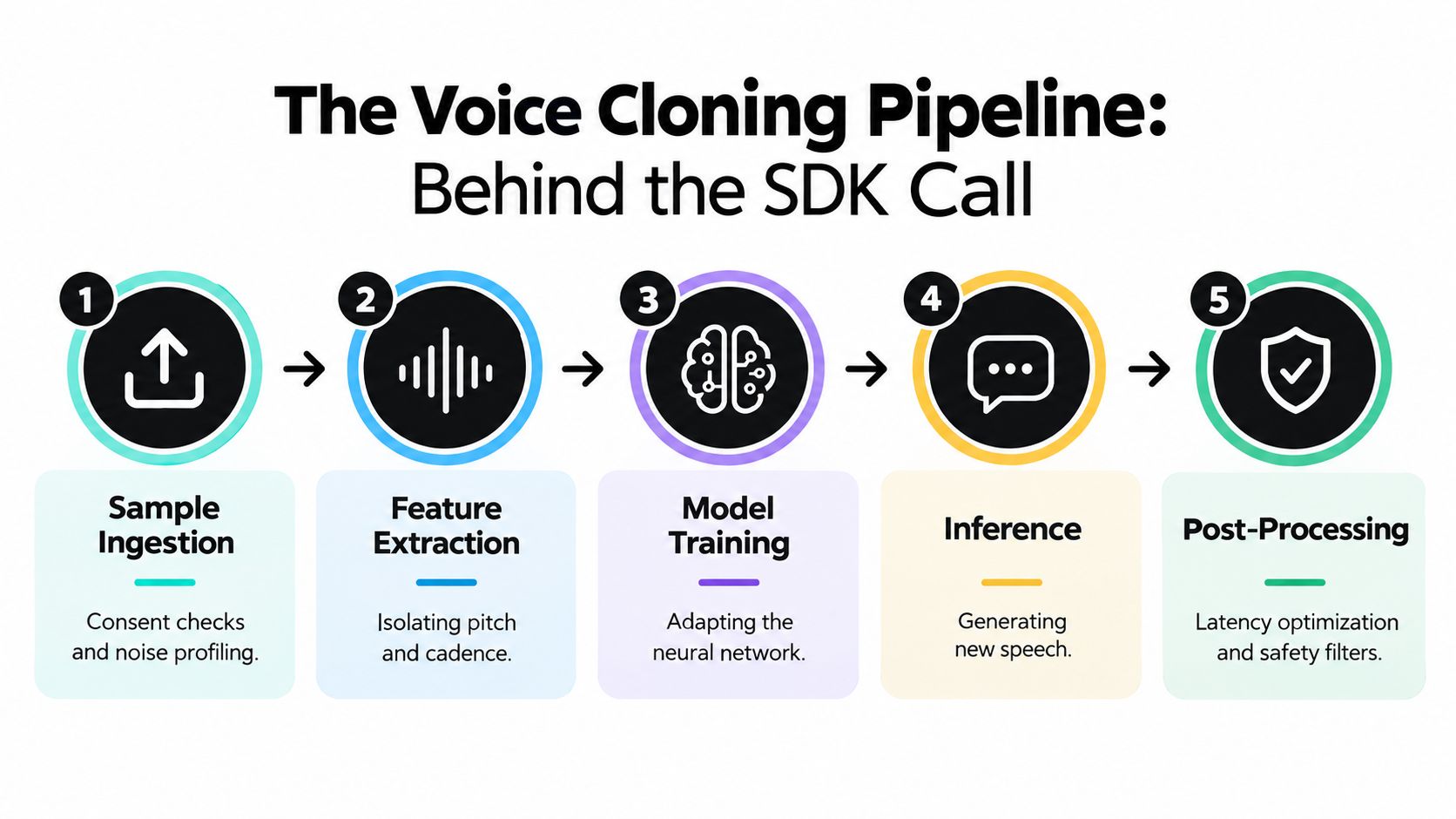
A support agent can sound perfect in a vendor demo and still fail in production because the API hides several separate operations. Evaluate the pipeline, not just the model name. That distinction exposes where enrollment delays, unusable recordings, retention gaps, and conversational pauses originate.
1. Ingest and validate the reference audio
The API receives a recording, checks its format, profiles noise, identifies channel and sampling characteristics, and runs consent checks. It then extracts speaker features, commonly an embedding that represents elements of timbre, pitch, and cadence.
Ask whether the service rejects poor recordings or produces a weak clone. Confirm where the original audio, derived embedding, and consent record are stored. These assets have different sensitivity levels, so each needs explicit retention, deletion, and access policies. A vendor that cannot answer these questions creates an audit problem before synthesis begins.
2. Create a reusable voice representation
Some services cache a speaker embedding for repeated synthesis. Others adapt a model or create a discrete voice profile. That implementation affects enrollment time, storage, portability, and request economics.
Require precise answers about reuse. Is clone creation a one-time operation? Can the resulting voice serve multiple agents? Does deleting the profile remove every derived representation? Clone creation latency belongs to enrollment. It should not be presented as part of the recurring response-time promise for every conversation turn.
3. Generate and stream speech
The synthesis stage normalizes text, predicts prosody, conditions the model on the voice representation, and decodes acoustic output. A production API may return a complete file, sentence chunks, or incremental frames. The choice determines whether an agent can start speaking while the rest of its response is still being generated.
Persistent channels such as WebSocket or gRPC support progressive delivery. Batch HTTP suits recordings, dubbing, and asynchronous content, but a caller may hear the wait as agent hesitation. Treat transport and playback behavior as part of the voice cloning API pipeline, not as integration detail.
4. Apply delivery and safety processing
Post-processing can include loudness normalization, sample-rate conversion, codec handling, profanity or policy filters, and watermark injection. Audio may then pass through a WebRTC bridge, SIP gateway, contact-center connector, or application playback layer. Each handoff can alter timing or sound quality.
One technical benchmark reports that OpenVoice can generate approximately one second of speech in 85 milliseconds. That measures raw inference speed, not complete user-visible latency. Network round-trip time, streaming startup, buffering, and application overhead still determine when the caller hears the first chunk. The OpenVoice technical benchmark helps separate model throughput from conversational performance.
The video below shows the pipeline visually. Review it alongside the stages above, then ask where each stage runs, which data it retains, and which timing the provider measures.
Latency, Streaming, and the Conversation-Budget Framework
A live voice agent fails when callers wait through silence, even if a benchmark reports fast rendering. Time-to-first-audio measures the delay before the first playable audio arrives. Incremental chunk latency measures the gap between successive streamed chunks. End-of-utterance latency measures how long the system takes to finish the response.
These metrics expose different failure modes. A contact-center agent needs an early audio signal to acknowledge the caller while the answer continues generating. An IVR prompt or dubbing workflow may prioritize complete file generation instead. A vendor quoting “sub-second synthesis” without naming the measured stage is avoiding the decision that affects your users.
Score the transport, not just the decoder
WebSocket or gRPC streaming can deliver audio progressively. A synchronous HTTP endpoint usually waits for the complete response, which suits batch content but can create conspicuous pauses in conversation. WebRTC adds playback and network variables. PSTN adds telephony encoding and gateway behavior that can change what callers hear.
Clone creation latency is a separate measurement from conversational latency. Enrollment may occur once, before a voice enters the production library. Synthesis runs on every turn. Combining both figures in one vendor headline turns a one-time onboarding cost into a misleading estimate of recurring response time.
| Metric | What It Measures | Typical Enterprise Target |
|---|---|---|
| Time-to-first-audio | Delay before the first playable audio chunk | Set a target that preserves natural turn-taking in your channel |
| Incremental chunk latency | Delay between streamed audio chunks | Keep delivery continuous during longer answers |
| End-of-utterance latency | Time to finish the complete response | Optimize for IVR, recordings, and batch workflows |
| Clone creation time | Time to enroll and prepare a reusable voice | Treat as an onboarding or content-operations metric |
| End-to-end conversational delay | Combined ASR, orchestration, synthesis, transport, and playback delay | Measure on the telephony or WebRTC path |
Require vendors to report each stage independently. Otherwise, a fast clone-building demo can conceal slow synthesis, delayed transport, or buffering that breaks turn-taking. Test the full pipeline with your ASR, orchestration layer, codec, network, and playback path.
The technical review of voice cloning API evaluation criteria identifies audio quality, minimum sample audio, latency, and language support as core evaluation dimensions. Use those dimensions, then weight latency according to the failure your channel can tolerate.
Sample Length, Fidelity, and Multi-Language Support Tradeoffs
Reference audio is not a magic input. The recording's length, cleanliness, emotional range, and linguistic content all affect the result. A short, clean sample may produce a usable brand voice for scripted prompts, while a richer sample can better represent variation in cadence and expression. More audio doesn't automatically solve poor recording conditions.
Test the voice with the material your agent will speak. Include interruptions, product names, account identifiers, dates, addresses, acronyms, and emotionally difficult conversations. A clone that sounds convincing on a polished greeting can still fail on names, code-switching, or stressed delivery.
Evaluate languages as separate capabilities
A vendor's language list isn't proof of uniform quality. Ask for native-language evaluation, accent behavior, pronunciation controls, and the ability to preserve speaker identity without forcing an unnatural accent into the target language.
For global support, separate these requirements:
- Cross-lingual identity: Does the same speaker profile retain recognizable vocal characteristics in another language?
- Native pronunciation: Does the output sound appropriate to local listeners rather than like a translated script read with transferred pronunciation?
- Locale control: Can the system handle regional numbers, names, currencies, dates, and speech conventions?
- Code-switching: Does the voice remain stable when a caller or agent changes language within a turn?
- Prosody range: Can the system sound calm, urgent, empathetic, or instructional without losing speaker similarity?
The enterprise choice usually sits between lightweight enrollment and controlled studio-grade capture. The right tier depends on whether the voice is used for fixed prompts, dynamic support, or high-stakes customer interactions.
| Dimension | Lightweight Tier | Enterprise Tier | Failure Mode to Watch |
|---|---|---|---|
| Reference audio | Short, clean sample | Curated sample set covering speech variation | Weak identity or unstable prosody |
| Fidelity | Suitable for scripted prompts | Tested on held-out operational phrases | Impressive demo, poor production output |
| Language coverage | Limited or uneven | Locale-specific validation | A listed language sounds unnatural |
| Emotional range | Narrow delivery style | Controlled expression and pronunciation testing | Empathy disappears under stress |
| Noise robustness | Assumes clean enrollment | Preprocessing and rejection rules | Background noise becomes part of the voice |
Don't approve a voice because one executive likes the sample. Approve a profile after listeners from the target markets evaluate representative prompts and the engineering team confirms reproducible behavior.
Consent, Provenance, and Enterprise Compliance Controls
A checkbox does not establish an auditable consent system. Enterprise voice cloning requires a documented chain linking the speaker, reference recording, permitted uses, generated audio, and deletion request. If legal or security teams cannot reconstruct that chain, the voice should not enter production.
Enrollment should verify consent, not merely accept an assertion. A challenge phrase recorded by the speaker can serve as evidence of authorization. Consent attestation, watermarking, and deletion workflows strengthen that record, provided the provider can show how each control operates and how quickly it takes effect. Treat governance guidance as a checklist, not as proof that a vendor meets your requirements.
Compare governance maturity directly
| Control | Lightweight | Enterprise-Grade | Buyer Question |
|---|---|---|---|
| Consent capture | Checkbox or uploaded declaration | Verified challenge recording tied to a voice identity | What evidence proves permission? |
| Provenance | Internal metadata only | Traceable record for each generated asset | Can investigators identify how audio was created? |
| Watermarking | Optional or unavailable | Applied to generated output with detection support | Can the organization distinguish synthetic output? |
| Deletion | Removes the visible profile | Removes source audio, embeddings, model artifacts, and cached copies | What exactly disappears, and when? |
| Audit logging | Request logs | Immutable records for enrollment, synthesis, access, and deletion | Can compliance retrieve a complete history? |
| Tenant isolation | Shared account controls | Per-tenant storage, keys, roles, and data boundaries | Could one customer access another's voice assets? |
These controls address privacy obligations, contractual restrictions, internal brand rules, and requirements concerning synthetic media. A provider's general security certification does not answer voice-specific questions. Require clear answers on retention, subprocessors, export rights, regional storage, incident handling, and deletion verification.
Review enterprise-grade security capabilities alongside the voice provider's enrollment and provenance design. Platform security and voice governance solve different problems. Your application still needs authorization, policy enforcement, and audit handling around every synthesis request.
Compliance test: If a speaker withdraws permission, your team should identify the records to delete, caches to invalidate, agents to disable, and evidence needed to prove completion.
Integration Patterns for Voice Agents and Contact Centers
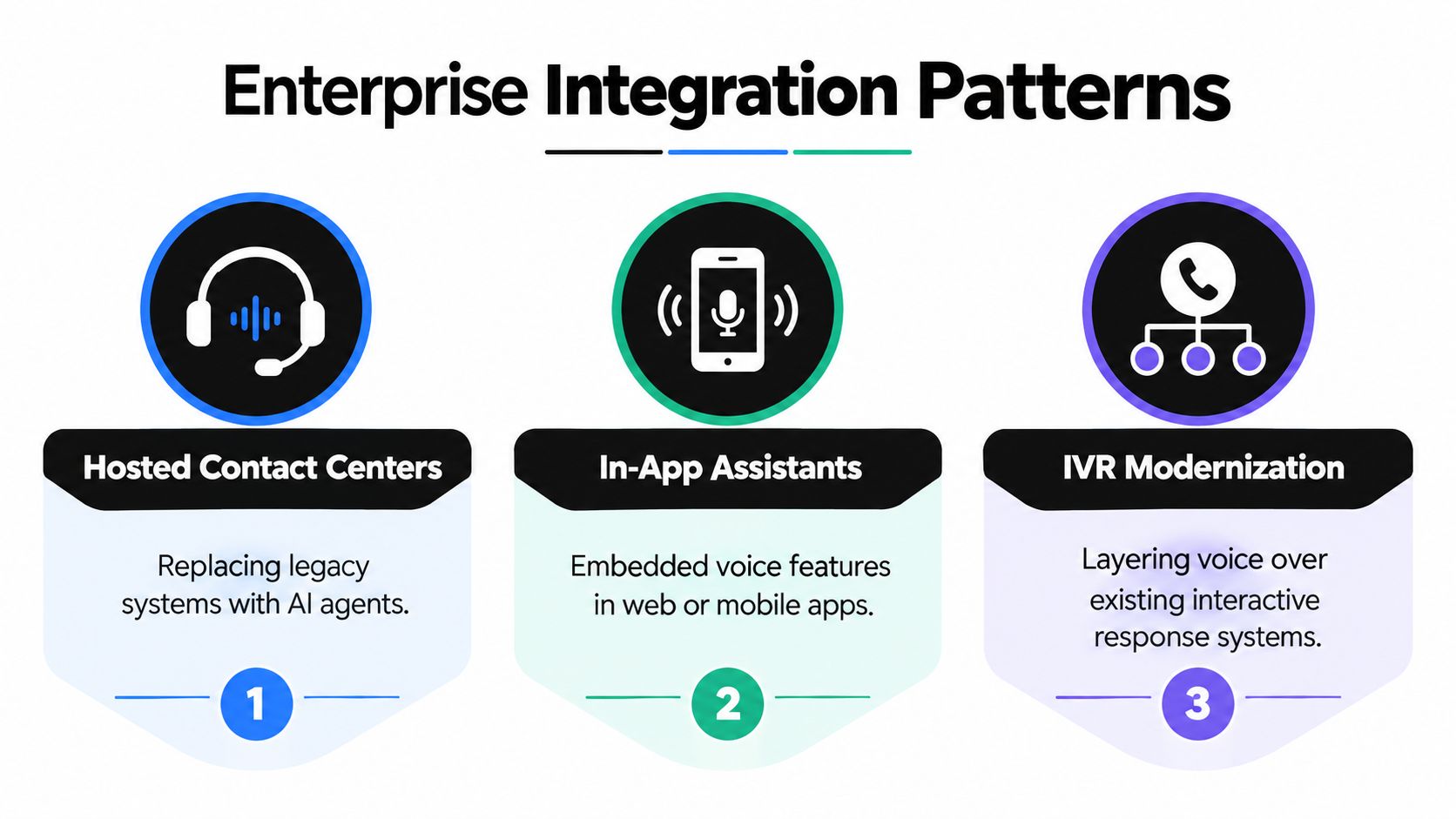
The integration shape determines which failures appear first. A voice cloning API doesn't replace your telephony edge, dialogue manager, recording policy, or agent-routing system. It supplies the speech layer inside that system.
Hosted contact centers
A hosted contact-center deployment usually connects telephony, SIP, ASR, orchestration, business systems, and cloned-voice synthesis. The voice profile should map to an agent identity, skill, locale, or campaign rather than being hard-coded into a prompt.
Test barge-in early. The system must stop playback when the caller starts speaking, cancel pending synthesis, and avoid playing stale audio after the dialogue state changes. Call recording redaction also needs explicit treatment because a generated response may contain personal information even when the voice itself is approved.
In-app assistants
Web and mobile assistants can use WebRTC or an application audio layer. They offer more control over playback, permissions, fallback messaging, and user experience than PSTN, but they still need interruption handling and degraded-mode behavior.
Keep voice profiles separate from UI identities. A user may change locale, accessibility preference, or assistant role without receiving an unauthorized voice. Store the profile mapping in the orchestration layer, with policy checks before synthesis.
IVR modernization
Modernized IVR systems often preserve existing telephony and DTMF paths while adding natural-language interaction. That makes fallback essential. If speech recognition fails, the caller should still reach menu options, an agent, or a safe retry path.
Use enterprise integrations for voice and conversational systems to assess available connectors, but validate the exact path in your environment. Vendor documentation can't reveal how your SIP edge, call recording, routing rules, and carrier behavior will interact.
A production checklist should include:
- DTMF fallback: Confirm callers can complete critical tasks without speech.
- Barge-in cancellation: Stop audio and cancel pending generation when the caller interrupts.
- Recording controls: Redact sensitive content and label generated speech correctly.
- Voice-to-agent mapping: Tie cloned voices to skills, locales, campaigns, and permissions.
- Failure routing: Send the call to a human or alternate voice when the API degrades.
A Vendor Scorecard for Choosing the Right API
Use a weighted scorecard, not a feature checklist. “Supports streaming” tells you almost nothing until you know the transport, chunk behavior, cancellation semantics, and performance under realistic network conditions.
Score every vendor against a held-out prompt set. Include text the vendor hasn't seen, because a polished demo script can hide pronunciation and prosody failures. Measure speaker similarity and naturalness, but don't let quality dominate the decision if the vendor can't provide deletion guarantees or stable first-audio delivery.
| Dimension | What to Measure | Why It Matters | Recommended Weight |
|---|---|---|---|
| Clone quality | Naturalness, speaker similarity, pronunciation, emotional control | Prevents brand damage and caller distrust | High |
| Streaming latency | Time-to-first-audio, chunk intervals, cancellation, jitter behavior | Prevents awkward pauses and stale playback | Very high |
| Language and accent coverage | Native listener review, locale behavior, code-switching | Prevents uneven global service quality | High |
| Governance maturity | Consent evidence, audit logs, watermarking, deletion, isolation | Reduces impersonation and compliance exposure | Very high |
| Total cost of ownership | Enrollment, synthesis, storage, egress, integration, support, and operational labor | Prevents a low API price from hiding platform costs | Medium to high |
Give failure modes more weight than demo polish
The scorecard should reflect where an enterprise rollout can fail. A slightly less expressive voice may be acceptable if it streams reliably, supports the required languages, and gives legal teams verifiable deletion. A beautiful clone that stalls during handoffs or can't be removed creates operational and reputational exposure.
Don't use unsupported assumptions about caller behavior as your latency threshold. Measure abandonment and interruption behavior in your own channel, then set acceptance criteria from those observations. The same applies to cost. Request the full pricing model, including per-clone enrollment fees, per-minute or per-character synthesis, storage, egress, support, concurrency, and premium language charges.
Run the same script through every vendor under identical conditions. Include packet loss, network jitter, long responses, short acknowledgements, proper nouns, multilingual turns, and an interruption halfway through a sentence. Procurement should reject any provider that refuses to define what deletion means or reports only a blended latency number.
Decision principle: The best vendor is the one with no unacceptable failure mode, not the one with the most convincing showcase voice.
Yellow.ai can be included as one platform option when the requirement is a broader enterprise conversational system with voice capabilities, agent orchestration, and integrations rather than an isolated synthesis endpoint. Evaluate its voice cloning and surrounding controls using the same scorecard as every other candidate.
A Two-Week Pilot Plan Before You Commit
A short pilot should produce evidence, not another round of subjective demos. Use your real voice profiles, real channels, representative languages, and failure handling.
Week one, enrollment and static quality
Enroll three voices representing different accents and recording conditions. The pilot should verify the enrollment path, consent evidence, voice-profile reuse, and deletion behavior before anyone spends time tuning prompts.
Build a held-out prompt set containing greetings, names, account references, policy language, emotional responses, and locale-specific content. Have native or highly fluent listeners assess naturalness, speaker similarity, pronunciation, and prosody. Record which failures occur rather than reducing the result to a single favorite sample.
Confirm the following:
- Voice lifecycle: Enrollment, reuse, suspension, deletion, and audit retrieval all work through documented interfaces.
- Language coverage: Each target locale passes a separate listening review.
- Output controls: Audio format, loudness, watermarking, and recording behavior meet application requirements.
- Data handling: Source audio, derived voice assets, logs, and cached outputs follow the intended retention policy.
Week two, conversational performance
Connect the candidate to the actual SIP, PSTN, WebRTC, or application path. Measure time-to-first-audio from the caller's perspective, not from the synthesis service's internal timestamp. Track incremental chunk delivery, interruption cancellation, end-of-utterance completion, and fallback behavior.
Stress the system with network degradation, concurrent sessions, long responses, and API errors. The pilot must show what happens when synthesis times out, a stream disconnects, a voice profile is unavailable, or the orchestrator changes the response after audio generation begins.
The go/no-go decision should answer five questions:
- Does the voice meet quality requirements on unseen operational text?
- Does the complete path preserve acceptable turn-taking?
- Does every target locale perform adequately?
- Can the organization prove consent, provenance, isolation, and deletion?
- Can finance calculate total cost from actual usage and integration assumptions?
If any answer is unclear, don't sign a production contract. Extend the pilot or remove the vendor from consideration. A voice cloning API is ready when the pipeline is measurable, recoverable, and governable, not when the demo sounds human.
Yellow.ai combines enterprise voice capabilities with conversational orchestration, agent tooling, analytics, and prebuilt integrations for customer and employee workflows. If you're evaluating a voice cloning API for a production agent, review the platform and test the complete experience through Yellow.ai.



