













A customer calls about a billing problem. The voice agent recognizes the request, but the response arrives after an uncomfortable pause. The caller repeats themselves, interrupts the answer, and eventually asks for a human. The transfer reaches an agent without the right context, so the customer has to start over.
That experience captures the central enterprise challenge. Voice AI platforms aren't automation tools. They're operational infrastructure connecting telephony, speech models, business systems, policies, analytics, and human teams. A polished demo can hide weak endpointing, poor recognition on noisy calls, brittle integrations, and handoffs that damage trust.
The right buying question isn't whether voice AI can sound natural. It's whether the platform can perform reliably inside your operating model, at the speed your customers expect, with the controls your IT and compliance teams require.
Table of Contents
- Why Voice AI Platforms Matter Right Now
- What Voice AI Platforms Actually Do
- Core Capabilities That Define Enterprise Readiness
- How to Evaluate Voice AI Platforms for CX and EX
- Deploying and Operating Voice AI at Scale
- How Yellow.ai Fits Enterprise Voice AI Needs
- Choosing Your Voice AI Path Forward
Why Voice AI Platforms Matter Right Now
A voice AI deployment can begin as a call-handling project and quickly become part of the operating model. One independent market report values the global voice AI platform market at $5.2 billion in 2025 and projects $48.6 billion by 2034, implying a 28.6% CAGR from 2026 to 2034. Its analysis connects demand with contact centers, workflow automation, multilingual service, and integrated enterprise operations. In those settings, response speed, real-world speech accuracy, and deployment quality matter alongside a natural-sounding voice. MarketIntelo's voice AI platform market report
Enterprise teams are already shaping a larger share of that demand. The report estimates the enterprise voice AI platform segment at $3.3 billion in 2025, projecting $18.9 billion by 2034, with a 21.4% CAGR. These figures reflect a shift in the buying question. Leaders are deciding where voice belongs in customer service, employee support, sales workflows, and contact-center modernization, then defining the controls required to run it.
Strategic importance and operational dissatisfaction
Adoption does not establish production quality. Deepgram's State of Voice AI report found that 67% of organizations consider voice AI core to strategy, while only 21% are very satisfied with traditional voice agent systems, and 80% still use those legacy systems. The gap creates a governance problem as well as a technology problem: organizations must improve service without removing human oversight from exceptions, escalations, and sensitive interactions. Deepgram's State of Voice AI report
Latency makes the issue visible to customers. A short delay can cause interruptions or repeated requests, while inaccurate transcription can send the workflow down the wrong path. A platform therefore needs a practical latency budget, dependable recognition across real call conditions, clear failure handling, and a controlled route to a human.
Weak infrastructure creates work instead of removing it. Customers repeat information, supervisors review failed calls, agents repair incomplete CRM records, and IT teams maintain fragile connections between telephony and business applications. The platform must also show what happened during each interaction so teams can improve models, workflows, and handoff rules.
Practical rule: Treat every voice AI deployment as a service operation with model dependencies, failure handling, observability, and human ownership.
The stakes extend beyond customer experience. For employee experience teams, an unreliable assistant can frustrate staff seeking help with payroll, benefits, or access requests. For CIOs and contact-center leaders, the choice affects integration architecture, data governance, workforce design, and the credibility of the broader AI program.
What Voice AI Platforms Actually Do
A voice AI platform turns a live phone conversation into a controlled software workflow. It doesn't just convert speech to text. It listens, interprets meaning, decides what should happen, retrieves information, performs actions, and produces a spoken response.
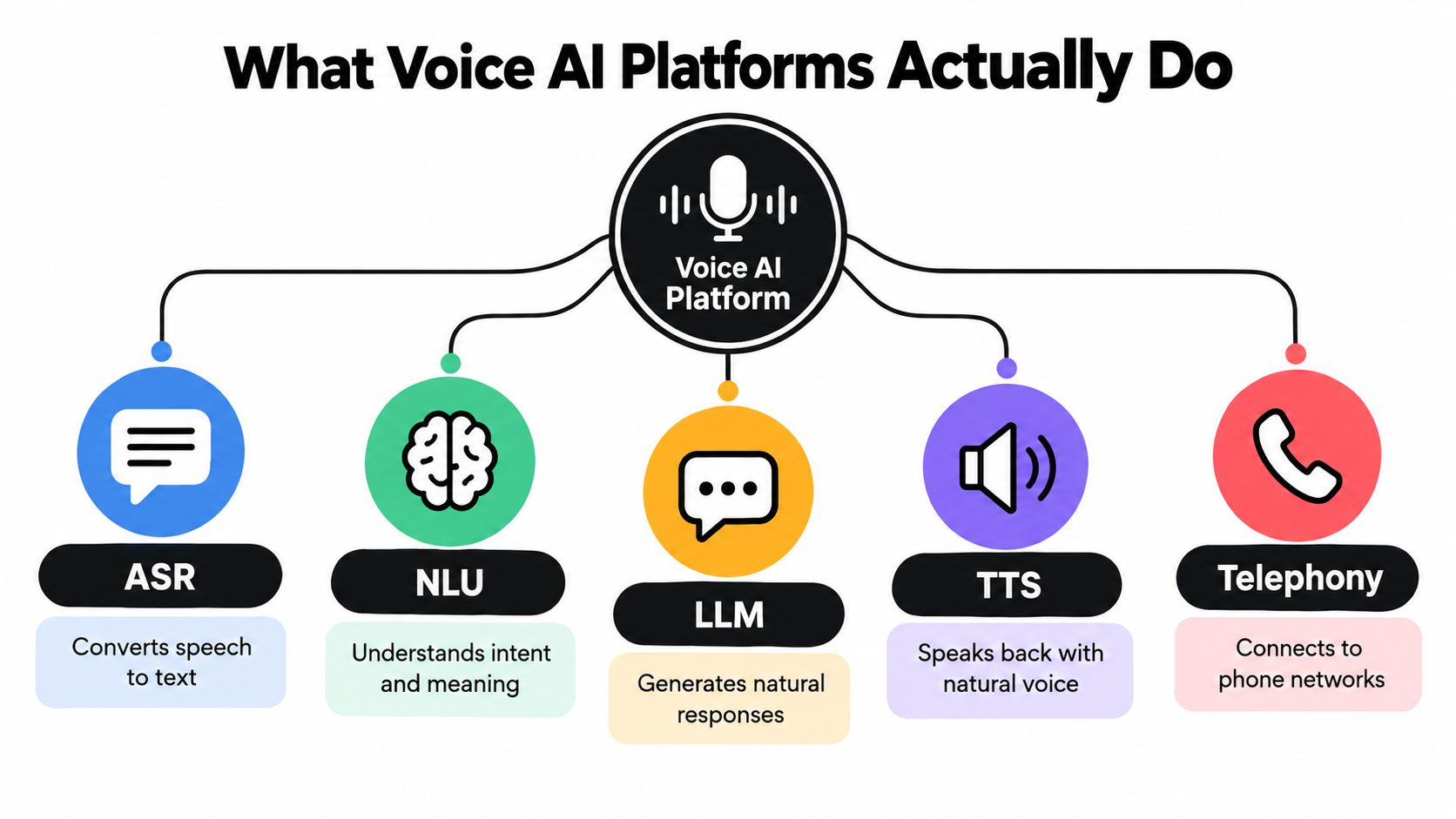
Think of the platform as a live interpreter and operations coordinator working together. Each layer has a distinct responsibility:
Speech enters through telephony
Telephony connects the customer to the system through phone networks, contact-center infrastructure, SIP connections, or carrier services. It manages call routing, caller identity, recording behavior, transfers, and the audio stream.
The platform then uses automatic speech recognition, or ASR, to turn the caller's voice into text. A streaming ASR system doesn't wait for the entire call turn to finish. It processes partial audio as the person speaks, which helps the platform detect intent and prepare a response sooner.
Meaning becomes a decision
Natural language understanding, or NLU, identifies intent, entities, sentiment signals, and conversational context. For example, “I was charged twice for my subscription” contains an issue type, a billing topic, and a possible duplicate-payment event.
An LLM can then generate a response or reason through the next step. In an enterprise setting, it shouldn't operate without boundaries. The platform may restrict available actions, ground answers in approved knowledge, require authentication before exposing records, and route sensitive cases to people.
The response returns as speech
Text-to-speech, or TTS, converts the approved response into audio. Quality depends on more than pronunciation. The system must handle pacing, interruptions, emphasis, and turn-taking so the caller doesn't feel trapped in a recorded menu.
A full platform coordinates all five layers in real time. It also connects the conversation to CRM records, ticketing tools, workforce processes, knowledge sources, and analytics. A standalone speech-to-text API may transcribe a call well, but it won't necessarily authenticate a customer, update a case, trigger a refund workflow, or transfer the interaction with context.
For a broader look at how enterprise voice automation is assembled, Yellow.ai's voice automation overview provides a platform-level reference. The key distinction is orchestration. A voice AI platform manages the sequence from audio input to business action, not just one model endpoint.
Core Capabilities That Define Enterprise Readiness
Production readiness appears when a caller interrupts, background noise distorts recognition, or a downstream system responds slowly. A polished synthetic voice cannot compensate if the platform pauses too long, mishears the request, or transfers the caller without conversation history. Enterprise buyers should assess voice AI as operational infrastructure, with measurable limits and controls.
Latency is a conversation design constraint
Independent benchmarks report median end-to-end voice AI response times around 1.4 to 1.7 seconds, compared with about 239 milliseconds for human turn-taking. Under load, tail latency can reach 3.3 to 3.8 seconds at P90 and 8 to 15 seconds at P99. The enterprise voice AI latency budget report traces these delays to endpointing, model inference, and network hops, and describes caller abandonment when response time exceeds roughly 1.5 seconds.
Latency works like a conversation budget. Every stage spends part of it, from detecting that the caller has finished speaking to generating audio and sending it through the telephony network. Buyers should request measured P50, P95, and P99 latency, including interruption recovery, rather than relying on a best-case demonstration.
Recognition quality determines downstream behavior
Call-center audio carries difficult conditions: narrowband codecs, accents, overlapping speech, microphone variation, and background noise. Benchmarks using 8 kHz call-center audio place leading systems in the mid-to-high 80% accuracy range, including published results of 87.67% for one top model and 86.17% for another configuration. Voicegain's 8 kHz call-center speech benchmark also describes WER below 10% as excellent and 10 to 15% as acceptable guidance for live call environments.
A recognition mistake can travel through the whole workflow. The platform may infer the wrong intent, retrieve the wrong account, apply an unsuitable policy, or transfer a call that could have been resolved automatically. Test performance on representative recordings, including domain terms and imperfect speech, rather than judging accuracy from clean audio.
Voice identity and multilingual reach
Voice cloning can create a consistent brand identity, while adding governance requirements. Verify consent, permitted use, abuse prevention, approval workflows, and the retirement process for a cloned voice.
Multilingual coverage requires more than a language selector. Test accents, code-switching, names, product terminology, regional policies, and human handoff quality. Broad language support with uneven performance can produce uneven customer service.
Security belongs in the architecture
Ask where recordings, transcripts, prompts, and retrieved knowledge are processed. Confirm retention controls, role-based access, audit logs, deletion procedures, data residency options, and the platform's policy for using customer data to improve models. Human escalation should also have clear permissions and auditability, because governance covers both the automated response and the action taken afterward.
A secure voice system protects the conversation, the action taken from it, and the record created afterward.
How to Evaluate Voice AI Platforms for CX and EX
A platform can sound impressive in a scripted demo and still fail during a live customer call. Evaluate it against the conversations, systems, policies, and escalation rules your teams use. Give each vendor the same representative audio and workflow, then compare measurable results rather than feature counts.
Build a test set with clear and difficult calls. Include interruptions, silence, accents, background noise, authentication failures, ambiguous requests, policy exceptions, and direct requests for a person. Listen to the recordings yourself. A dashboard may show that a transfer occurred, but the recording or transcript shows whether the caller was understood and whether the handoff preserved context.
A practical comparison matrix
| Evaluation Criteria | What to Measure | Why It Matters |
|---|---|---|
| Telephony latency | P50, P95, and P99 response time, endpointing delay, interruption recovery | Slow responses make conversation feel unnatural and can increase abandonment |
| Speech understanding | Recognition quality on your audio, domain terms, accents, partial transcripts | Recognition errors can affect intent detection and workflow actions |
| Integration depth | CRM, helpdesk, CCaaS, identity, knowledge, and API connectivity | The agent must operate inside existing processes |
| Human handoff | Context transfer, transcript delivery, routing rules, warm transfer behavior | Customers should not need to repeat the conversation |
| Governance | Approval controls, audit trails, permissions, escalation policies | Hybrid operations require clear ownership |
| Analytics | Call outcomes, transfer reasons, failure categories, latency, transcripts | Teams need evidence for improvement |
| Security and compliance | Data location, retention, deletion, access, certifications, controls | Calls may contain sensitive customer and employee information |
| Change management | Prompt editing, workflow versioning, testing, rollback | Teams need to improve behavior without unsafe releases |
Integration should be tested as an operational dependency, not treated as a checkbox. Businesses identified integration with existing systems as their biggest implementation hurdle, while 85% had adopted a hybrid model instead of replacing humans entirely. Thoughtly's 2025 voice AI survey supports evaluating how well each platform fits shared work between AI and human agents.
Test the failure path, not only the happy path
Ask the vendor to demonstrate what happens when the knowledge base has no answer, authentication fails, the caller changes topics, an API times out, or a request crosses a policy boundary. Observe whether the agent states its limitation clearly, retains the relevant context, and routes the call to the right person.
The pilot should measure behavior under pressure. Track response latency, recognition on representative audio, incorrect actions, transfer quality, and the reasons people intervene. Review those results with CX, operations, security, and IT stakeholders. For a human-centered perspective on voice service, this voice AI whitepaper on interpersonal customer service can support that discussion. A platform earns approval when its AI behavior, human controls, and operating evidence align.
Deploying and Operating Voice AI at Scale
Implementation starts before the first prompt is written. Identify the call types, business owners, systems of record, escalation policies, data classifications, and decisions the agent is allowed to make. A narrow, repeatable workflow gives the team a safer place to learn than a broad “answer everything” launch.
Connect the operating systems
Integration is often the hardest part because the agent must work across systems that were designed independently. Map the data flow for caller identity, authentication, customer records, case creation, disposition codes, recordings, transcripts, and transfer context.
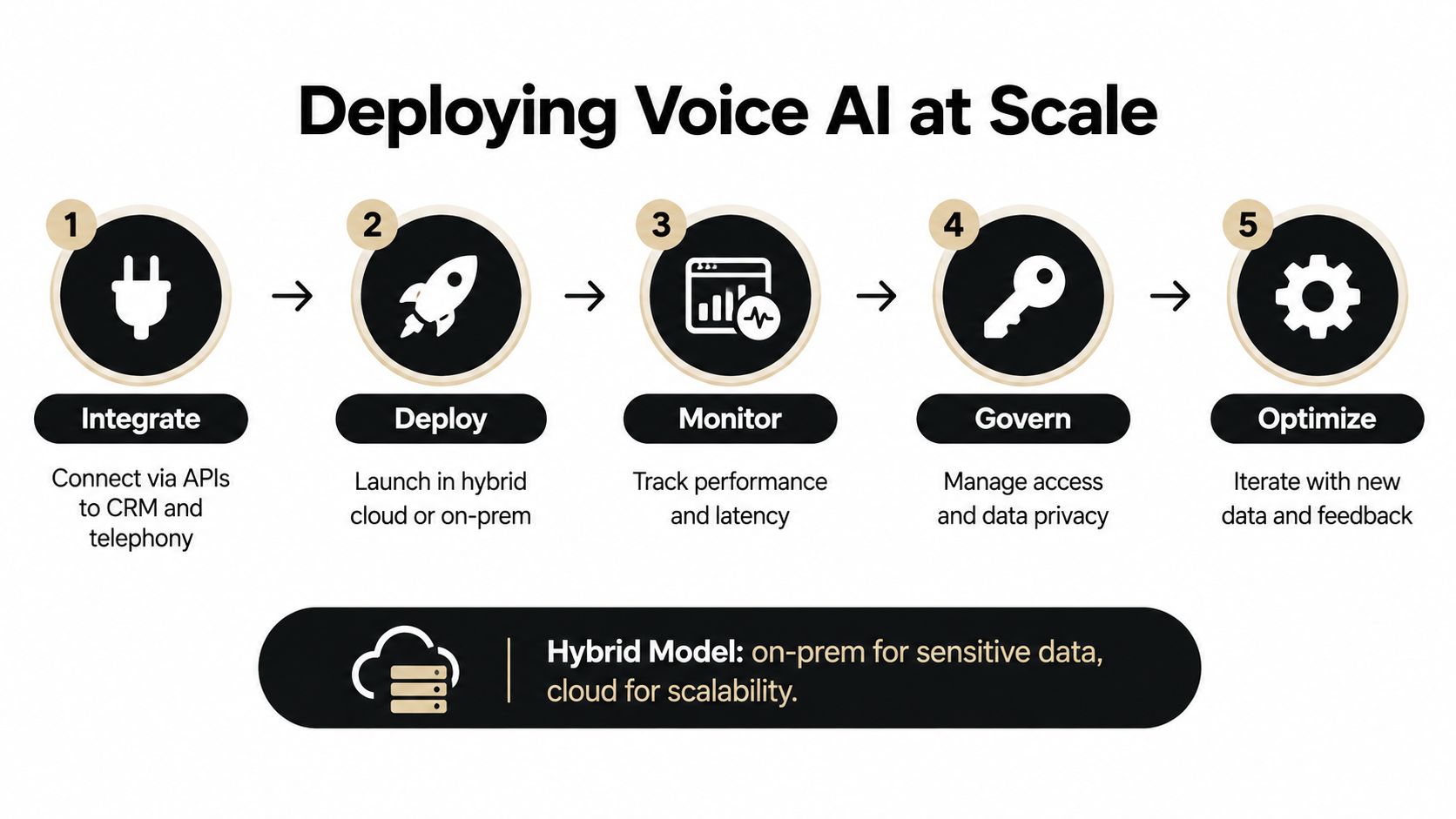
A useful deployment sequence looks like this:
- Define the workflow. Select a bounded use case, list allowed actions, and document conditions that require a person.
- Connect the stack. Link telephony, CRM, helpdesk, knowledge sources, identity services, and analytics through supported interfaces.
- Test realistic conversations. Replay difficult calls, inspect partial transcripts, and test API failures and interruptions.
- Release in controlled stages. Use a hybrid model with clear routing thresholds and human review for sensitive outcomes.
- Optimize continuously. Group failures by root cause, update knowledge and workflows, retest, and version every meaningful change.
Govern the hybrid model
Human+AI governance isn't just a fallback button. Supervisors need ownership of escalation rules, quality review, exception handling, and policy updates. Agents need the context required to continue the conversation, including the reason for transfer and actions already taken.
Track operational signals such as containment, resolution, transfer quality, repeat-contact patterns, latency, recognition failures, and customer feedback. Pair those metrics with regular call review. A rising transfer rate might indicate a difficult use case, weak authentication, poor knowledge grounding, or a routing defect. The number alone won't identify the cause.
Plan for change
Voice workflows change when products, policies, prices, and compliance requirements change. Keep prompts, knowledge sources, tools, and routing logic versioned. Establish a release process that includes testing, approval, rollback, and post-release monitoring.
The production owner isn't finished when the agent goes live. That's when measurement, governance, and improvement begin.
How Yellow.ai Fits Enterprise Voice AI Needs
Yellow.ai can be evaluated against the same architecture and operating criteria rather than as a separate category. Its Nexus Vox capability supports voice cloning in seconds and deployment across 500+ languages, while the platform combines voice orchestration with enterprise agent-building and knowledge capabilities. Nexus Vox by Yellow.ai describes that voice-focused approach.

For CX and EX teams, the relevant question is how those capabilities map to deployment work. AI Agent Builder 2.0 supports agent design, testing, and deployment. A Conversational Knowledge Base with agentic RAG can connect responses to enterprise information, while the multi-LLM architecture uses 15+ models to support model choice and reduce dependence on one provider. These capabilities address the practical need to change workflows, ground answers, and manage model behavior over time.
The platform also supports omnichannel orchestration and 150+ pre-built integrations, including connections across CRM, helpdesk, and contact-center environments. That matters when a voice interaction begins in a phone channel but must create a case, update a customer record, or continue through chat or email.
The architecture is relevant to regulated and operationally complex sectors such as BFSI, healthcare, retail, utilities, logistics, and employee services. Safe AI controls and enterprise compliance capabilities, including HIPAA, ISO 27001/27701, SOC 2 Type II, and PCI-DSS, provide controls for teams that need more than conversational fluency.
The following video offers a product view of how enterprise voice interactions can fit into broader agentic workflows.
The important comparison remains operational. Buyers should validate latency on their telephony paths, recognition on their own audio, handoff quality, integration behavior, governance controls, and the effort required to maintain agents after launch.
Choosing Your Voice AI Path Forward
Voice AI platform selection becomes clearer when leaders separate three questions:
- Can it understand the caller? Test real telephony audio, accents, interruptions, domain language, and ambiguous requests.
- Can it respond quickly enough? Review percentile latency, endpointing, turn-taking, and recovery after interruption.
- Can it operate safely? Verify authentication, tool permissions, escalation rules, auditability, data handling, and human ownership.
- Can it fit the existing stack? Test CRM updates, case creation, knowledge retrieval, transfers, transcripts, and analytics.
- Can the team improve it? Confirm versioning, automated testing, release controls, rollback, and access for operations staff.
Start with one workflow where the customer value is clear and the boundaries are enforceable. Involve CX, IT, security, compliance, operations, and frontline agents before the pilot begins. Then judge the platform on real conversations and failure recovery, not only on how convincing the synthetic voice sounds.
The strongest path forward treats voice as a governed layer of the operating model. Automation handles appropriate work, people handle exceptions and sensitive interactions, and both sides share the context required to serve the customer well.
Yellow.ai provides an enterprise agentic AI platform for human-like CX and EX conversations, with voice orchestration, multilingual deployment, integrations, knowledge grounding, testing, analytics, and governance capabilities. Visit Yellow.ai to evaluate how its voice AI approach could fit your contact-center or employee-service pilot.



