














Voice AI customer service is moving from experiment to infrastructure. The market was valued at $2.4 billion in 2024 and is projected to reach $47.5 billion by 2034, a 34.8% compound annual growth rate, while 80% of businesses plan to integrate AI-driven voice technology into customer service by 2026, according to industry market and adoption data. The important question for CX leaders isn't whether voice AI sounds impressive. It's which calls should be automated, what a contained interaction costs, and what fails once the system meets real customers, legacy software, and human escalation queues.
Table of Contents
- What Voice AI Customer Service Means in 2026
- How Voice AI Systems Actually Work
- Business Benefits and ROI of Voice AI Customer Service
- Integration Patterns for Contact Centers and CRMs
- Latency, Accuracy, and the Containment Equation
- Security, Compliance, and Safe AI Requirements
- Implementation Roadmap From Pilot to Scale
- Where Voice AI Wins, Where It Still Fails, and How to Choose
What Voice AI Customer Service Means in 2026
Voice AI for customer service is a real-time software stack that receives spoken language over telephony, interprets the caller's intent, retrieves or changes information in business systems, and responds with synthesized speech. It is not just a chatbot reading answers aloud. A production system combines automatic speech recognition, an orchestration layer connected to a large language model, business rules and tools, and neural text-to-speech.
That distinction matters because the phone channel adds constraints that text chat doesn't face. The system must detect when a caller has finished speaking, handle interruptions, recognize accents and background noise, maintain context, and respond quickly enough to avoid awkward silence. It must also decide when it lacks confidence and transfer the call without making the customer repeat the entire issue.
The commercial case comes from containment economics. A contained call is one that stays with the AI instead of reaching a human queue. A resolved call goes further, the customer's problem is completed. Teams that measure only deflection can report attractive results while customers call back later or reach an agent through another channel.
From menus to intent-driven conversations
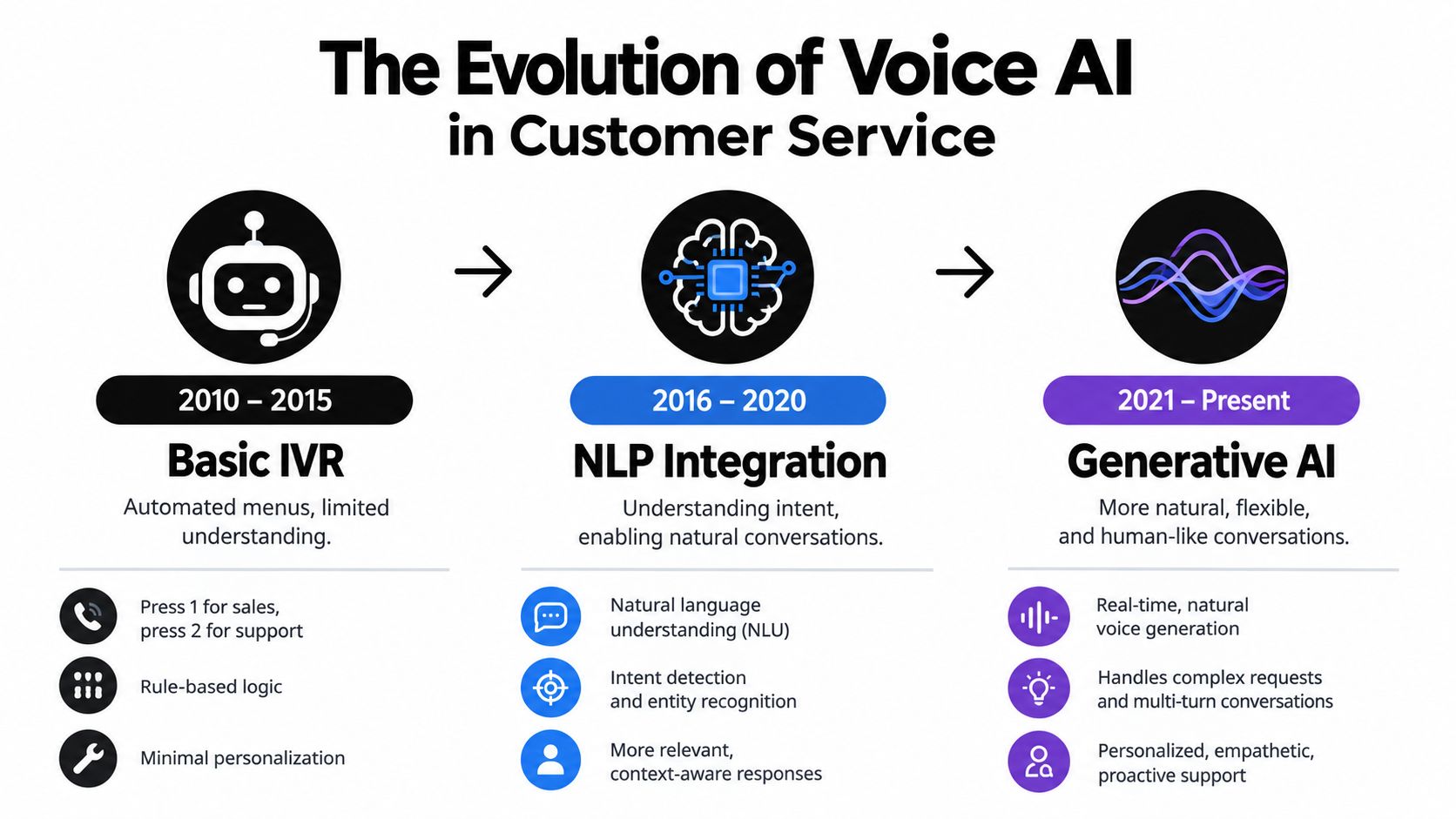
Traditional interactive voice response systems route callers through rigid menus. Voice AI lets callers describe an objective in ordinary language, such as checking an order, changing an appointment, or asking about account information. The agent can then use function calls to query a CRM, order platform, scheduling system, or knowledge base.
The strongest deployment scope is selective. Routine, structured requests are easier to ground in verified data and complete through deterministic workflows. Calls involving disputes, distress, complex judgment, or multiple unresolved system dependencies should usually retain a human path.
The new production standard
The market's growth is pushing enterprises beyond demos. A credible deployment now needs production-grade latency, CRM connectivity, audit trails, regional data controls, and a designed handoff experience. The voice may sound natural, but fluency alone doesn't create business value. If the agent can't access current customer data or complete the requested task, a convincing voice only makes the failure more frustrating.
The rest of the decision should therefore be framed around cost per resolved interaction, containment by intent, service availability, accuracy, and escalation quality, not a full-replacement story.
How Voice AI Systems Actually Work
A voice agent has four operational layers. Each one can introduce delay or failure, and the caller experiences the combined result rather than the performance of any single vendor component.
1. Telephony carries the conversation
A SIP connection or cloud contact-center API receives the call and streams audio into the AI service. This layer determines whether audio arrives consistently, whether caller metadata is available, and how easily the system can transfer the interaction to an existing queue.
2. Speech recognition creates usable input
The automatic speech recognition layer converts the audio stream into partial and final transcripts. Services such as Whisper, Deepgram, Google Speech-to-Text, and Azure Speech can be used here, but the model name matters less than performance on the organization's actual audio, accents, terminology, and concurrent load.
3. Orchestration controls the agent
The orchestration layer manages turn-taking, endpointing, conversation state, prompts, safety rules, and tool calls. It decides whether the caller has finished speaking, whether a response needs a CRM lookup, and whether a low-confidence result should trigger clarification or escalation.
Practical rule: Treat endpointing and interruption handling as first-class product requirements. A powerful language model can't repair a system that cuts callers off or waits too long before responding.
4. Text-to-speech makes the answer audible
Neural text-to-speech converts the approved response into audio. ElevenLabs, Amazon Polly, and Azure Neural voices are examples of this layer. Voice quality affects trust, but a pleasant voice doesn't compensate for incorrect account data or a slow backend request.
Latency is a budget, not a single metric
Industry benchmarking places median voice-AI response times around 1,400 to 1,700 milliseconds, compared with an approximately 200-millisecond human turn-taking gap, according to speech latency benchmarking. Well-configured cascading systems can reach a median full-pipeline delay near 1,115 milliseconds, while optimized deployments target below 500 milliseconds.
That delay is distributed across audio transport, speech recognition, orchestration, LLM inference, tool calls, and speech synthesis. Teams should measure P50, P95, and P99 latency, because average performance can hide queue spikes and cold starts. Cascading models, partial transcripts, streaming TTS, voice activity detection, and barge-in support often produce more practical gains than replacing one LLM with another.
Business Benefits and ROI of Voice AI Customer Service
The financial case for voice AI depends on the share of calls it completes, not the number it answers. One 2026 benchmark places voice AI at roughly $0.40 per call versus $7 to $12 for a human agent, according to call-center cost benchmarks. A separate benchmark reports $0.62 for an AI resolution, $1.18 for a voice-AI resolution, and $7.40 for a human resolution, with the figures summarized in the same call-center cost benchmarks. These are directional benchmarks. A business still needs its own fully loaded labor, platform, telephony, and support costs.
The basic model is:
Avoided cost = eligible call volume × contained share × (human cost per call minus AI cost per call).
“Contained” must mean that the customer's task was completed. A call that avoids transfer but triggers a repeat contact has not produced the expected saving. This distinction separates real resolution economics from queue deflection.
Where the return comes from
Voice AI can create value through several operating levers:
- Routine resolution: Status checks, scheduling, authentication, and straightforward account requests can run through defined workflows.
- After-hours availability: Customers can receive service outside staffed queues, without adding an overnight human team.
- Agent preparation: Escalated calls can arrive with identity verification, intent, transcript, and relevant customer context already collected.
- Peak capacity: An AI layer can absorb predictable demand spikes without the hiring and training cycle required for equivalent human capacity.
- Repetitive-work reduction: Agents can focus on judgment-heavy cases instead of repeating scripted information.
The cost gap supports adoption, while intent mix and integration depth determine the actual payback. A contact center handling complex disputes will have a lower automation ceiling than one dominated by repeatable requests. An agent that cannot access current order, billing, or scheduling data may answer questions but still fail to complete the underlying task.
Use call recordings, transfer rates, handle times, platform fees, and telephony costs to build the forecast. Before selecting a model, compare AI receptionist pricing. A voice AI ROI calculator can organize the estimate, but measured containment and resolution should replace vendor assumptions before approval. Pilot results should also include repeat contacts and escalations, since a low transfer rate can conceal unresolved demand.
| Metric | Human baseline | Voice AI (contained call) | Typical lift |
|---|---|---|---|
| Cost per interaction | $7 to $12 | Roughly $0.40 | Lower unit cost |
| Resolution cost | $7.40 | $1.18 for voice AI | Lower resolution cost |
| Service availability | Staffed operating hours | Continuous automated availability | Broader coverage |
Integration Patterns for Contact Centers and CRMs
Voice AI rarely replaces the contact-center stack. It usually sits beside telephony, routing, CRM, knowledge, recording, and reporting systems. That architecture determines whether the agent can complete a task or merely collect information before transferring the call.
IVR replacement
The fastest pattern places a conversational agent in front of the existing queue. Telephony routes the caller to the AI, which identifies intent and either completes a narrow workflow or sends the call to the appropriate team. This approach works well for menu replacement and basic routing, but it can remain shallow if the agent can't retrieve live customer context.
Embedded contact-center integration
A native or platform-level connector can preserve existing routing, recording, agent status, analytics, and queue logic. Genesys, NICE CXone, Zendesk Talk, and Salesforce Service Cloud Voice each represent environments where the integration must account for the platform's APIs, identity model, transfer controls, and release schedule.
The benefit is operational continuity. The trade-off is dependence on the platform's supported extension points. A feature that looks simple in a demo may require coordination between the AI vendor, the CCaaS administrator, security, and the CRM team.
CRM and knowledge sidecars
A sidecar API gives the voice agent direct access to selected CRM records, order data, policies, and knowledge articles. It offers flexibility and can support custom workflows, but every lookup adds another dependency, timeout risk, access-control decision, and maintenance obligation. Teams evaluating prebuilt options can review enterprise integration capabilities alongside their existing architecture.
| Platform | Native Connector | Integration Pattern | Best Fit |
|---|---|---|---|
| Genesys Cloud | Platform APIs and connector options | Embedded routing plus CRM tools | Enterprise teams preserving CCaaS workflows |
| NICE CXone | Contact-center integration layer | Embedded automation and escalation | Large service operations with established routing |
| Zendesk Talk | Help-desk and telephony connections | CRM and ticket sidecar | Support teams centered on ticket history |
| Salesforce Service Cloud Voice | CRM-native context and workflows | Embedded CRM automation | Organizations where customer records live in Salesforce |
Architecture test: Ask what the AI can read and write during a live call, then measure the added round-trip delay. A connector that preserves context but responds slowly can reduce containment just as surely as a missing integration.
Latency, Accuracy, and the Containment Equation
Containment is the operational metric that decides whether voice AI earns its place in the service stack. It isn't produced by the language model alone. It emerges from a chain that starts with understandable audio, continues through correct intent recognition and reliable tool execution, and ends with a response the caller accepts as complete.
The relationship with latency is direct. Guidance for contact-center automation places natural-feeling dialogue at roughly 300 milliseconds or less, with friction becoming noticeable beyond 800 milliseconds, while production systems commonly target below 500 milliseconds for total response time, according to voice-AI latency guidance for contact centers. Broader benchmarking reports current median response times of 1,400 to 1,700 milliseconds, so teams should treat sub-500-millisecond performance as an optimization target that must be proven under real load, not assumed from a demo.
Accuracy compounds with delay
A recognition error gives the orchestration layer a bad premise. The agent may then retrieve the wrong record, ask an unnecessary question, or give an answer that prompts escalation. A delayed correction forces the caller to repeat themselves. These failures reinforce each other, which is why speech accuracy and turn-taking need joint monitoring.
Teams should track:
- Containment by intent, not only a blended account-wide figure.
- Transfer reasons, including recognition failure, missing data, policy restrictions, and caller preference.
- Latency percentiles, especially during concurrency and backend lookups.
- Recognition quality, including performance on accents, terminology, and noisy audio.
- Repeat contact signals, because a contained call isn't necessarily a resolved one.
A low transfer rate with poor post-call outcomes is a false win. The correct optimization target is a completed customer task at an acceptable cost and experience level, supported by traceable telemetry from audio input through escalation.
Security, Compliance, and Safe AI Requirements
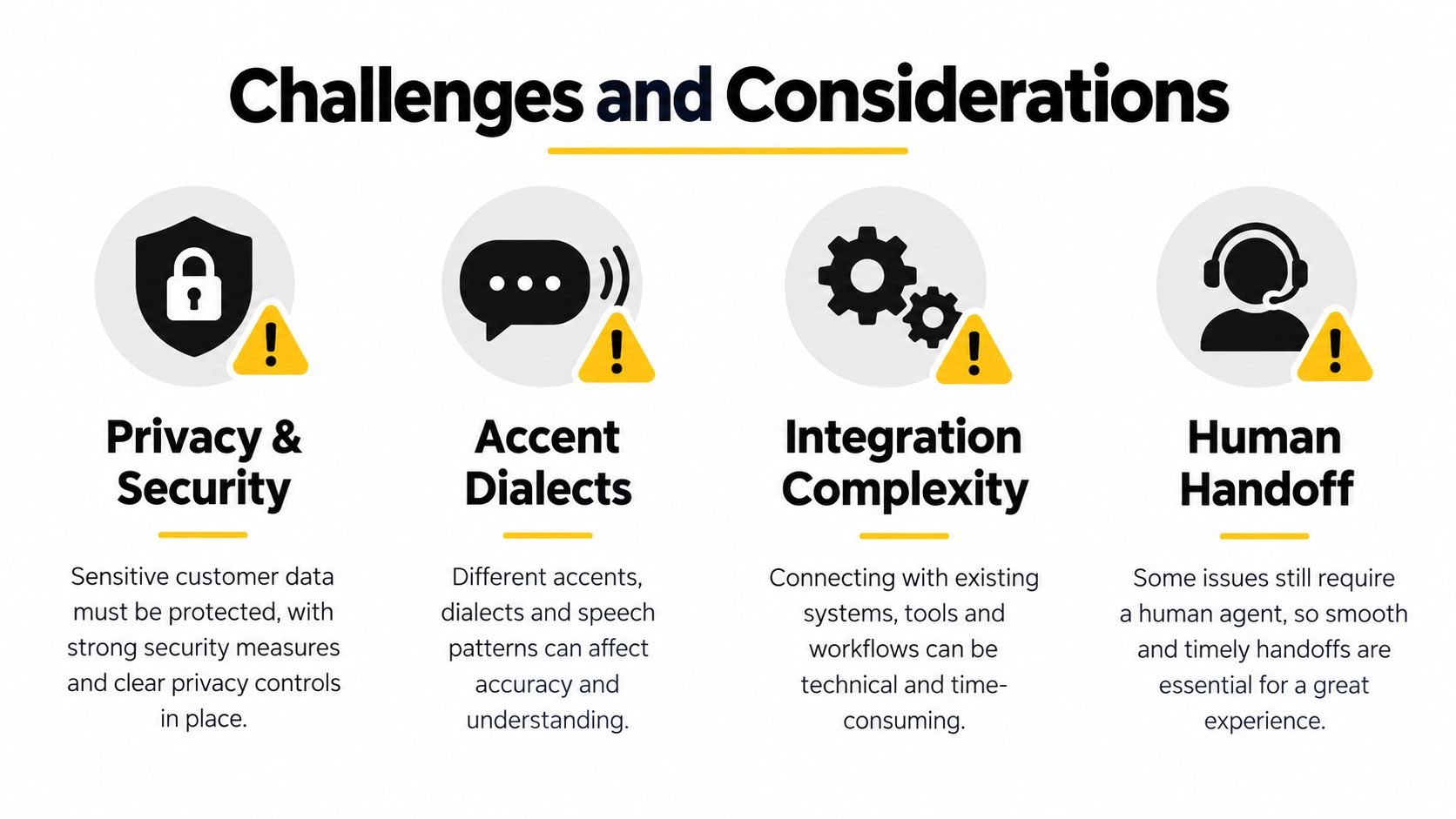
Voice creates a durable record of a customer interaction, often containing identity, payment, health, or account information. Compliance can't be treated as a later procurement checkbox. It should shape the architecture, retention policy, vendor contract, and escalation design before the first pilot call.
Enterprises in regulated sectors should evaluate HIPAA, ISO 27001, ISO 27701, SOC 2 Type II, and PCI-DSS as gating requirements where applicable. A vendor's certification doesn't automatically make a deployment compliant. The customer still has to configure access, retention, consent, data flows, and business processes correctly.
Controls to verify before testing
- Consent capture: The system should deliver the required recording or processing notice at the beginning of the interaction and retain evidence that the notice was presented.
- PII redaction: Transcripts and recordings should support automatic masking of sensitive information before broad access or downstream analysis.
- Encryption: Ask how audio, transcripts, credentials, and tool responses are protected in transit and at rest.
- Access control: Conversation logs should use role-based permissions, with audit trails for viewing, exporting, and deletion.
- Data residency: Confirm where recordings, transcripts, model requests, and backups are processed, especially for EU or Saudi Arabian operations.
- Vendor governance: Review subprocessors, incident response, model-training opt-outs, retention controls, and deletion workflows.
The evaluation should include enterprise-grade security controls alongside functional testing. Security teams need architecture diagrams and evidence, not broad assurances that the platform is “secure.”
Procurement standard: If a vendor can't explain what data is stored, who can access it, how long it remains available, and how it is deleted, the pilot isn't ready for legal review.
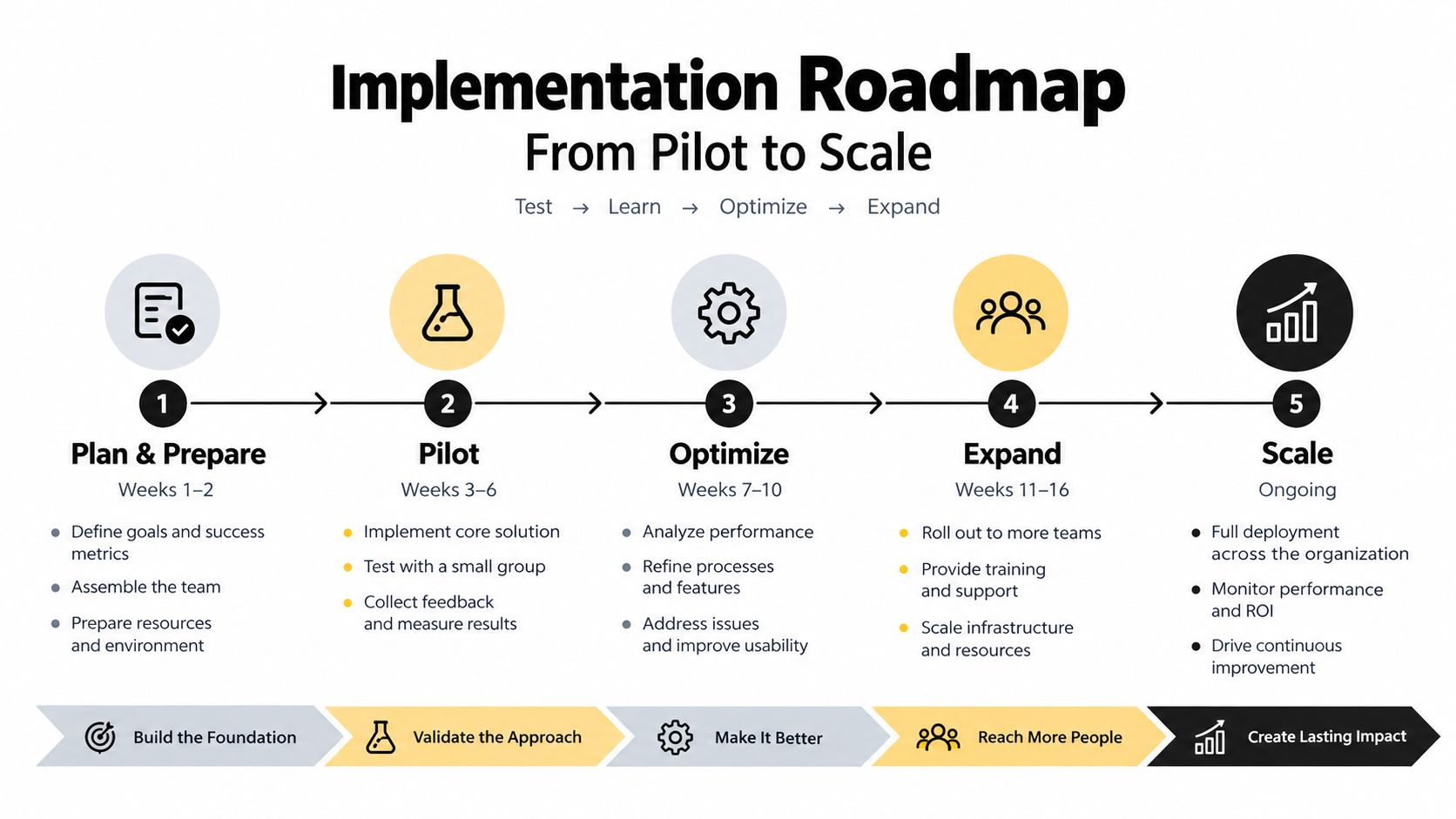
Implementation Roadmap From Pilot to Scale
A successful voice-AI program begins with call selection, not platform selection. Start by examining recordings, transcripts, transfer reasons, repeat contacts, and existing routing categories. The purpose is to find requests with clear resolution paths, stable policy rules, sufficient volume, and systems that can provide current data.
Phase one, discover the automation boundary
Group calls by customer objective rather than by department. Separate status checks from disputes, authentication from advisory conversations, and simple scheduling from cases requiring judgment. Mark intents that carry safety, legal, financial, clinical, or emotional risk for immediate human routing.
Define the baseline before configuring the agent. Capture current cost per call, handle time, transfer behavior, customer satisfaction, and the proportion of calls that are eligible for the proposed workflow. Without that baseline, a lower queue volume can look like savings even if repeat contacts rise.
Phase two, pilot one narrow workflow
Choose a use case such as order status or appointment scheduling. A focused pilot can expose the actual constraints without mixing unrelated policies, data sources, and caller expectations. Test normal calls, interruptions, silence, background noise, ambiguous requests, authentication failures, and system timeouts.
The pilot should measure more than whether the call reached a person:
- Did the caller's intent get classified correctly?
- Did the AI access authoritative data?
- Did it complete the requested action?
- Did the customer accept the outcome?
- If transferred, did the human receive useful context?
- Did the interaction create a repeat contact?
Phase three, engineer the handoff
A warm transfer should pass the transcript, verified identity, intent, actions already taken, unresolved question, and any relevant customer data to the receiving agent. The human should be able to begin solving the issue rather than restarting discovery.
Create explicit fallback rules for low-confidence speech, unavailable systems, prohibited actions, repeated misunderstanding, and caller requests for a human. Escalation isn't an admission that the AI failed. It is part of the product's safety and experience design.
Phase four, scale with observability
Post-pilot degradation often comes from dependencies that weren't visible in a controlled test. CRM lookups add latency, product changes make prompts stale, and new call variants expose gaps in intent coverage. Coverage and accuracy can decline even when the voice model itself hasn't changed.
Assign ownership to a conversation designer, an integration engineer, a CX operations lead, and a compliance owner. Review transcripts, containment, transfer reasons, latency, and customer outcomes weekly during the first quarter after launch. Keep a change log for prompts, policies, integrations, and model settings so teams can connect performance shifts to operational changes.
Where Voice AI Wins, Where It Still Fails, and How to Choose
Voice AI performs best when the customer asks for one clear action and the enterprise can verify the answer through a reliable system. Authentication, balance inquiries, status checks, simple troubleshooting, appointment changes, and outbound notifications fit that pattern. The AI can ask for required information, call a business function, confirm the result, and close the interaction.
The difficult cases are different. Emotionally charged complaints, disputed claims, ambiguous requests, multi-system troubleshooting, and conversations requiring judgment remain poor candidates for unsupervised automation. Voice systems also face interruption handling, background noise, patchy connectivity, and language-specific grammar challenges, as described in guidance on voice-AI limitations in call centers.
Measure the outcome, not the performance theater
A vendor may emphasize containment while the customer experiences an unresolved call. CX leaders should pair operational and experience metrics:
- Containment rate by intent: Did the call avoid a human?
- Resolution rate: Was the customer's actual task completed?
- Transfer rate and reason: Why did automation stop?
- Average handle time: Did escalation become more efficient?
- CSAT by outcome: How did resolved, transferred, and repeat-contact calls compare?
- Cost per resolved interaction: What did the completed task cost after platform, telephony, and human-transfer expenses?
Vendor questions that expose weak deployments
| Evaluation Criterion | Why It Matters | What to Ask Vendors |
|---|---|---|
| Latency under load | A demo may hide queue and concurrency delays | Can you show P50, P95, and P99 results from comparable traffic? |
| Speech accuracy | Misrecognition drives wrong answers and transfers | How does the system perform on our accents, jargon, and noisy recordings? |
| Integration depth | Tools determine whether the AI can complete tasks | Which systems can it read from and write to during a call? |
| Handoff context | Cold transfers create repetition and frustration | What transcript, identity, summary, and action state reach the agent? |
| Observability | Teams need to diagnose post-pilot degradation | Can we inspect traces, tool failures, transfer reasons, and policy violations? |
| Compliance controls | Voice data can create legal and operational exposure | Do you support required certifications, regional processing, retention, deletion, and model-training controls? |
| Deployment options | Sensitive workloads may need architectural isolation | Are private cloud, VPC, or other controlled deployment models available? |
| Comparable references | Performance depends on workflow and call mix | Can you provide references with similar complexity, regulation, and volume? |
The decision matrix is selective by design. A high-volume business with structured calls can start with autonomous resolution. A lower-volume organization with complex cases may get more value from routing, agent assist, and context collection. A regulated enterprise should begin with low-risk workflows and require security approval before expanding. A multilingual operation should test each target language in real audio conditions rather than accepting a language-count claim.
Yellow.ai offers voice AI agents, omnichannel orchestration, enterprise integrations, agentic retrieval, analytics, and enterprise security controls for organizations evaluating this model. Those capabilities are relevant when the business needs to connect voice workflows with CRM, knowledge, contact-center, and human-handoff processes.
If you're assessing voice AI customer service, map your highest-volume intents, establish cost and resolution baselines, and test one workflow against real call conditions. Visit Yellow.ai to evaluate how its voice AI and omnichannel platform could fit your contact-center architecture, integration requirements, and selective-automation plan.



