













At 7:42 p.m., a customer calls a regional utility about a disputed bill. The voice AI agent interrupts her twice, mishears the account number, and then drops the call after a long silence. The demo had sounded smooth. The production system failed because its parts weren't designed to behave as one real-time conversation.
That distinction matters to every CIO evaluating a voice AI agent in 2026. Speech recognition, language understanding, dialogue management, and text-to-speech are only the visible layers. Latency, interruption control, telephony, security, compliance, observability, and human handoffs determine whether callers get answers or abandon the interaction.
Table of Contents
- Why Voice AI Agents Break in Production
- The Core Architecture of a Voice AI Agent
- Latency, Barge-In, and the Production Performance Budget
- Deployment Patterns for Enterprise Voice AI
- Telephony, Omnichannel, and CRM Integration
- Security, Compliance, and Metrics That Matter
- Enterprise Use Cases and How Nexus Vox Delivers Them
Why Voice AI Agents Break in Production
A caller asks for help, corrects an account number, and speaks again before the agent finishes responding. The failure may begin with one misunderstood phrase, but production breakdowns usually come from how the system handles that phrase across its full call path.
A streaming automatic speech recognition system can produce partial hypotheses, yet the language layer may wait for the caller to finish. The dialogue manager may retain turn state without a dedicated interruption channel. Text-to-speech may begin a complete response and fail to stop cleanly when the caller corrects it. Each component can perform acceptably by itself while the combined system struggles with natural turn-taking.
Practical rule: A voice agent must be tested as a live audio loop, with conversational behavior exercised across full call paths rather than isolated text prompts and model benchmarks.
The demo hides the seams
A controlled demonstration usually has a quiet microphone, a cooperative speaker, a short request, and a preselected success path. Production callers pause while searching for an account number, change direction mid-sentence, speak over background noise, or ask for a human after the agent has started responding.
The system must preserve context through each event. It must distinguish hesitation from the end of a turn, stop playback when the caller starts speaking, retain a corrected entity, and continue from the correct dialogue state. Automated testing can expose these paths, and Yellow.ai's automated testing platform provides a testing surface for exercising conversational behavior before release.
Failure is usually operational
The useful distinction is between conversational-layer failures and execution-layer failures. A conversational failure includes incorrect intent resolution or a weak response. An execution failure occurs when the agent understands the request but cannot retrieve the account, complete a transfer, redact payment data, or recover from a degraded region. Kore.ai's discussion of voice AI challenges examines related voice AI problems, including issues that text-only evaluation can miss, such as latency, misrecognition, interruptions, noise, and turn-taking.
Vendor evaluation should therefore address the operational execution layer:
- Can the agent process partial speech while the caller is still talking?
- Can it stop playback immediately and preserve corrected context?
- Can it authenticate, call enterprise systems, and transfer with context?
- Can operators see why a call failed, rather than only that it ended?
- Can compliance teams control recording, retention, consent, and deletion?
Platforms such as Nexus Vox need to address these behaviors as one production system, rather than leave teams to stitch together separate tools. A model-accuracy score describes one component. Enterprise buyers need evidence that the entire call path can handle live conditions.
The Core Architecture of a Voice AI Agent
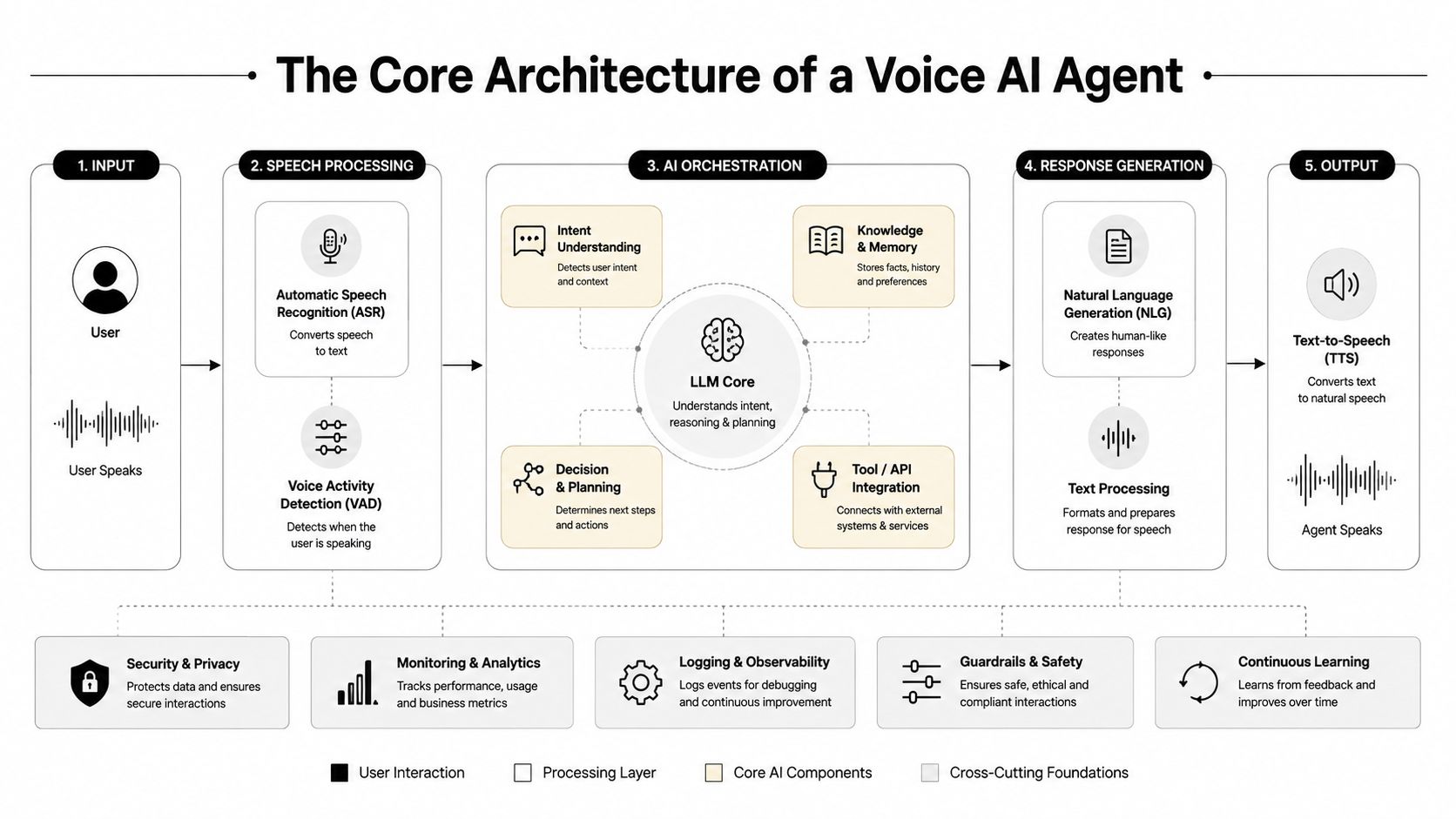
A production voice AI agent starts with audio, but it shouldn't wait for a complete sentence before doing useful work. Consider the caller saying, “My router stopped working after the firmware update last Tuesday.”
From sound to meaning
Automatic speech recognition, or ASR, converts the audio stream into text. A streaming engine might first produce partial phrases such as “my router stopped working,” then add “after the firmware update,” and finally identify “last Tuesday.” Those partial results can begin downstream processing before the caller finishes.
Natural language understanding, or NLU, interprets the sentence. In a traditional IVR, a classifier might map it to a fixed intent such as technical_support. A modern system can use an LLM-driven understanding layer to identify the likely intent, extract entities such as the device and update timing, and determine whether the request needs a diagnostic workflow, an account lookup, or an escalation.
The dialogue manager then evaluates the current state. It checks whether the caller is authenticated, whether the device is known, which troubleshooting steps have already been attempted, and what action is safe to take next. It may ask a clarifying question, call a diagnostic API, or transfer the call while carrying the conversation summary.
From decision to spoken response
The response goes to neural text-to-speech, which synthesizes audio with timing, pronunciation, and prosody suited to the situation. A production system should stream the response rather than wait for every word to be generated. It also needs cancellation controls, because the caller may interrupt before the sentence ends.
These layers aren't independent boxes. ASR feeds incremental text to NLU, NLU updates dialogue state, the policy layer selects an action, and TTS begins speaking as soon as a safe response fragment is available. Some newer speech-to-speech models fuse parts of this process, while cascading architectures remain attractive when teams need inspectable transcripts, explicit tool calls, and replaceable components.
Teams comparing conversational builders can review Yellow.ai's AI Agent Builder alongside other orchestration approaches. For a lighter, consumer-oriented way to experience spoken character interaction, readers can also try on-demand character audio.
A useful mental model is not “four services connected by APIs.” It's one streaming state machine with audio, language, tools, policy, and recovery operating under a shared clock. Nexus Vox is positioned around that unified orchestration model, rather than requiring teams to stitch together separate voice utilities and then own every timing seam.
The following video provides another visual introduction to the interaction model.
Latency, Barge-In, and the Production Performance Budget
Callers don't experience ASR speed or LLM speed separately. They experience the time between finishing a thought and hearing a useful response.
A widely cited realtime benchmark uses a mouth-to-ear gap of about 1,115 milliseconds, with an upper limit near 1,400 milliseconds. Its component targets include roughly 350 milliseconds for speech-to-text, 375 milliseconds for LLM time to first token, and 100 milliseconds for text-to-speech time to first byte. These figures come from a realtime voice-agent latency benchmark discussion, and they illustrate the central point: end-to-end timing matters more than an isolated model claim.
A budget callers can feel
| Pipeline Stage | Target Latency (ms) | Failure Mode if Exceeded |
|---|---|---|
| ASR partial output | 350 | The agent reacts late or transcribes the wrong conversational turn |
| Endpointing | Within the overall turn budget | The agent talks over pauses or waits through awkward silence |
| NLU and entity extraction | Part of the remaining budget | Intent and account details arrive too late for a natural reply |
| Dialogue policy lookup | Part of the remaining budget | Tool calls and next actions create visible hesitation |
| LLM time to first token | 375 | The agent appears unresponsive after the caller stops |
| TTS first byte | 100 | The response can't begin streaming promptly |
| Network round trips | As low as the deployment permits | Regional routing adds silence even when models are fast |
Endpointing deserves special attention. A model can return tokens quickly, but an overly cautious silence detector may still wait before deciding that the caller has finished. Conversely, an aggressive detector can cut off a caller who pauses while reading a confirmation code.
Barge-in turns this into a control problem. The system needs voice activity detection, an interruption event, audio playback cancellation, dialogue-state preservation, and a new input path that doesn't wait for the old response to finish. Guidance from AssemblyAI on realtime speech recognition recommends tracking interrupt detection, false stops, and pipeline latency under concurrent load. Smaller audio chunks can bring end-to-end interruption handling into the 200 to 300 millisecond range, according to the same guidance.
Measure the interruption path separately. A system that responds quickly on clean turns can still feel broken if it takes too long to stop speaking.
Teams should monitor time to first audio, complete response latency, silence duration, interruption success, and performance under concurrent calls. A platform such as Nexus Vox addresses streaming ASR, incremental understanding, interruption control, and voice output as one budget instead of leaving each vendor to optimize its own slice. Analytics should expose those timings by intent, region, channel, and model, not hide them inside an average. A unified analytics surface, such as Yellow.ai's AI analytics platform, can support that operational view.
Deployment Patterns for Enterprise Voice AI
Deployment isn't a procurement detail. It determines where audio travels, which team controls the runtime, how quickly the agent responds, and what happens when a dependency becomes unavailable.
| Pattern | Latency | Control & Residency | Cost Model | Best Fit |
|---|---|---|---|---|
| On-premises or private VPC | Predictable inside the enterprise boundary, subject to local capacity | Strong control over audio, models, and storage | Higher infrastructure and operations burden | Regulated financial services, government, and sensitive internal workflows |
| Public cloud | Elastic, but affected by region and network routing | Vendor-region and tenancy questions require review | Consumption-based infrastructure and service costs | Fast experimentation, variable demand, and broad geographic coverage |
| Hybrid | Can keep media close while using cloud services selectively | Splits control across environments | Two operating models and integration overhead | Enterprises balancing residency with access to specialized models |
| Edge or regional micro-data center | Best for local interaction where round trips are costly | Local processing can reduce exposure | Distributed deployment and lifecycle complexity | Vehicles, kiosks, industrial devices, and IoT |
On-premises and private environments
A containerized stack inside a private data center or enterprise VPC gives security and infrastructure teams direct control over media paths, logs, secrets, and model access. That control comes with responsibility. The organization must manage upgrades, capacity planning, failover, model evaluation, patching, and on-call coverage.
Private deployment can also introduce latency if the speech service, policy engine, CRM, and telephony gateway sit in different network zones. Keeping everything “inside” doesn't automatically make the call fast.
Public cloud and hybrid designs
Public cloud platforms simplify scaling and allow vendors to release model improvements without an internal replatforming project. They also create questions about where audio is decrypted, where transcripts are retained, how tenant isolation works, and whether a service region satisfies the organization's residency obligations under frameworks such as GDPR, DPDPA, HIPAA, or PCI-DSS.
Hybrid architecture can keep call control and sensitive media processing within the enterprise boundary while sending selected language tasks or voice synthesis to cloud services. That can satisfy some governance requirements, but every boundary adds a network hop, a failure mode, and a contract question.
Edge processing
Edge deployments suit interactions where a remote round trip is unacceptable, such as an in-vehicle assistant or a kiosk. They require smaller models or locally available services, regional lifecycle management, and a plan for synchronizing policies and knowledge. The edge should also have a graceful fallback when connectivity returns or when the local model can't complete a protected action.
Before signing, ask vendors:
- Where is audio decrypted and temporarily stored?
- How are models and vector indexes isolated between tenants?
- Can the system fail over across regions without losing dialogue state?
- Which services continue operating during a cloud or network outage?
- How do deployment choices change logging, pricing, and integration ownership?
Telephony, Omnichannel, and CRM Integration
The agent doesn't begin with the language model. It begins at the telephony edge, where the organization receives an audio stream and attempts to attach identity and history to it.
A SIP trunk or PSTN gateway may provide telephony audio in a format such as mu-law or G.711. A browser-based WebRTC session may use Opus. The voice pipeline has to normalize those streams before ASR can interpret them consistently. If the audio conversion introduces distortion, the language layer inherits the problem.
The call's context path
Contact center platforms such as Genesys, Avaya, Five9, and NICE inContact may route a call to the agent through a session identifier or SIP REFER. That identifier should become the join key for the rest of the interaction. The agent can use it to retrieve contact-center history, caller-ID enrichment, authentication state, and the latest CRM record.
The CRM then supplies business context. Salesforce, Microsoft Dynamics, ServiceNow, and Zendesk may contain cases, account status, entitlements, previous transcripts, or unresolved tasks. After the call, the agent should write the outcome, disposition, summary, and follow-up actions back through APIs or webhooks.
A reliable integration doesn't assume that every write succeeds. It uses idempotent operations, retries safely, records an event for later reconciliation, and prevents a duplicate callback or stale case note.
Where context disappears
Common seams include a caller ID that fails to enrich the session, a transfer that sends audio without the conversation summary, and an asynchronous CRM write that times out after the caller has disconnected. Browser calls add their own concerns, including STUN and TURN negotiation, microphone permissions, and reconnect behavior. DTMF capture remains important for legacy IVR fallback and secure numeric entry.
Payment flows need another control. Recording pause and resume must work across the telephony platform and the agent so that sensitive payment audio doesn't enter recordings or transcripts unnecessarily.
A transfer isn't complete when a human answers. It's complete when the human receives the caller's identity, intent, authentication status, collected entities, attempted actions, and reason for escalation.
Vendor review should cover codec support, SIP and WebRTC behavior, DTMF handling, transfer-with-context, recording controls, webhook retries, idempotent CRM writes, and the exact failure behavior when the CRM or contact-center platform is unavailable. Ask for a live demonstration using a deliberately failed API call, not only a successful routing path.
Security, Compliance, and Metrics That Matter
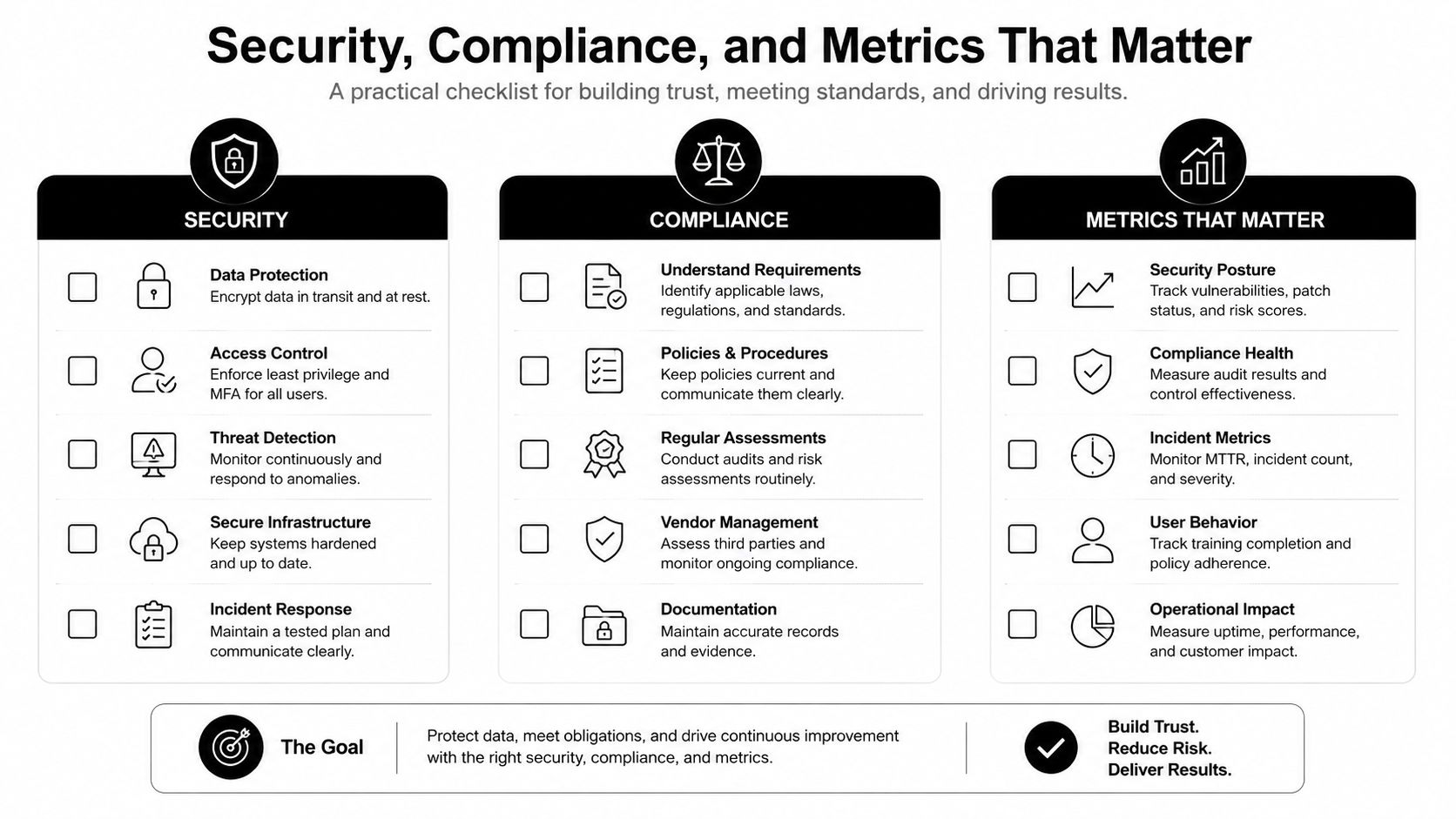
Security, compliance, and performance meet in the same place: the production call. A system that answers quickly but exposes payment data is unacceptable. A secure system that leaves callers in silence will still fail operationally.
Protect the media and the control plane
Media should use encrypted transport such as TLS 1.3 for signaling and SRTP for audio where supported. Internal services need authenticated service-to-service communication, commonly through mutual TLS. Secrets shouldn't live in prompts, source files, or ordinary environment variables. Store them in an HSM-backed or vault-backed key-management system with rotation and access auditing.
Tenant isolation needs more than a tenant ID in an application table. Review dedicated vector stores where appropriate, per-tenant model quotas, separate encryption boundaries, and controls that stop one customer's knowledge or conversation context from entering another customer's response. NLU and retrieval layers also need prompt-injection defenses, especially when callers or retrieved documents can influence tool execution.
Turn obligations into controls
GDPR, CCPA, DPDPA, HIPAA, PCI-DSS, SOC 2 Type II, and ISO 27001 represent different obligations, but each becomes a concrete engineering decision. The agent may need recording consent, transcript deletion for a right-to-erasure request, a BAA for healthcare processing, or audio redaction to reduce payment-data exposure.
A privacy impact assessment should map every copy of the audio and transcript, including temporary buffers, vendor logs, analytics stores, backups, and human review queues. Compliance can't stop at the vendor's certificate. The buyer must verify retention settings, deletion workflows, subprocessors, access roles, audit exports, and regional processing.
Measure the caller's experience
Monitor metrics that connect system behavior to outcomes:
- Time to first audio and full response latency: Show when callers hear the first useful response and when the turn finishes.
- Barge-in accuracy and false stops: Separate successful interruption handling from accidental playback cancellation.
- Intent and slot quality: Track intent-recognition F1 and slot-filling precision by workflow, language, accent, and channel.
- Completion and containment: Distinguish a completed task from a call that ended without a human transfer.
- CSAT and escalation: Compare post-call satisfaction with transfer reasons and unresolved outcomes.
- ASR word error rate: Segment results by accent, device, background noise, and telephony path.
A useful operational target is p95 latency under 800 milliseconds for natural turn-taking, with containment above 60 percent for Tier-1 intents, but these are example SLOs rather than universal guarantees. Teams should set their own thresholds based on risk, workflow complexity, and caller expectations.
The market's satisfaction gap makes this measurement discipline especially important. Coverage from Deepgram's State of Voice AI 2025 reports that 80% of surveyed organizations used some form of voice agent, while only 21% were very satisfied. Adoption alone doesn't prove that callers receive better service.
Red-team tests, transcript review, drift alerts, and DPIAs should continue after launch. A voice AI agent changes as prompts, policies, models, integrations, accents, and call conditions change.
Enterprise Use Cases and How Nexus Vox Delivers Them
Enterprise voice automation works best when leaders define a job, a system of record, a permitted action, and a human fallback. “Build a voice assistant” is too broad. “Resolve first-line router failures using account status and diagnostic APIs, then transfer with context” is testable.
Customer experience jobs
For tier-one inbound support, the agent needs telephony access, caller authentication, knowledge retrieval, account APIs, and a dialogue policy that knows when troubleshooting has failed. Accented speech and noisy channels make ASR tuning part of the workflow, not a post-launch enhancement.
Outbound collections and renewal reminders require a different posture. The system needs campaign rules, consent controls, identity verification, business-safe TTS, and intent handling for promises to pay, disputes, callbacks, or opt-outs. A renewal voice persona may sound polished, but the workflow still needs to stop when the customer disputes the underlying charge.
Post-call summarization is less visible to the caller but valuable to operations. The agent or an agent-assist layer can extract disposition, commitments, unresolved issues, and next actions, then write a structured record to the CRM. The summary must remain traceable to the transcript and should not invent a resolution that the call didn't establish.
Employee experience jobs
An IT helpdesk agent may reset a password, regain access to an account, or check service status. Those actions require identity verification, identity-provider APIs, policy checks, and a clear refusal path when the caller can't satisfy authentication.
An HR tier-one agent may answer leave-balance questions or explain a policy. It needs access to the approved knowledge base and, for personalized answers, the relevant HR system. It should distinguish general guidance from an authoritative employee record and route exceptions to HR.
| Enterprise Job | Channel | Primary Component(s) | System Outcome |
|---|---|---|---|
| Tier-one inbound support | PSTN, SIP, or WebRTC | Voice gateway, ASR tuning, NLU, dialogue flows, knowledge retrieval | Resolve routine issues or transfer with context |
| Collections and renewal reminders | Outbound voice | Campaign controls, intent classification, compliance policy, TTS persona | Handle responses, record commitments, respect opt-outs |
| Post-call summarization | Voice plus CRM | Transcription, agent assist, structured extraction, CRM connector | Create an auditable interaction record |
| IT password reset | Employee voice channel | Authentication, policy engine, identity APIs, dialogue manager | Complete approved resets or escalate securely |
| HR FAQ and leave balance | Employee voice channel | Knowledge base, HR connectors, NLU, analytics | Answer policy questions and retrieve authorized balances |
The architectural value of a unified platform is consistency. Voice routing, dialog flows, ASR tuning, TTS, agent assist, integrations, and analytics should share policy and observability rather than becoming separate projects for every channel. Nexus Vox addresses that model by composing these capabilities as one voice system, while Yellow.ai's platform components provide the associated building, testing, integration, and analytics surfaces.
The business case should be evaluated job by job. Start with a workflow where the data source is reliable, the permitted actions are clear, and escalation is safe. Then test real accents, interruptions, silence, failed APIs, ambiguous requests, and compliance events before expanding to higher-risk interactions.
Yellow.ai offers enterprise voice AI capabilities through its broader agentic platform, including voice orchestration, AI Agent Builder, integrations, testing, and analytics for CX and EX workflows. Visit Yellow.ai to evaluate how a unified voice AI agent architecture could fit your telephony, CRM, compliance, and operational requirements.



