







Adding agents and channels won't fix utilities customer service if customers still have to repeat the same story to billing, metering, outage operations, and complaints teams. The constraint is cross-system resolution. A customer may begin with an outage question, discover a disputed estimated bill, and then face separate authentication and ownership rules at every handoff.
Regulator data makes the problem visible. Ofgem reported overall customer service satisfaction of 77% in January 2026, up from 76% in its previous July-to-August 2025 survey, while complaint-handling satisfaction was only 44% in January 2025. Ofgem's customer service data shows a service experience that customers can rate reasonably well overall while still finding formal resolution frustrating.
The prescription is clear. Put outage, billing, meter, payment, and case information behind one controlled interface, give agents the authority and tools to resolve connected issues, and measure whether customers leave with an answer rather than whether an interaction ended quickly.
Table of Contents
- Why Utilities Customer Service Programs Optimize the Wrong Queue
- What Utilities Customer Service Actually Covers
- The Four Operational Pain Points That Drive Complaints
- KPIs That Matter in a Regulated Utility Contact Center
- From IVR to Agentic Voice AI and RAG Knowledge Bases
- How an Agentic AI Platform Handles an Outage End-to-End
- Governance, Compliance, and a Realistic Implementation Roadmap
- Your 30 60 90 Day Plan for Utilities Customer Service
Why Utilities Customer Service Programs Optimize the Wrong Queue
Utilities customer service programs often begin with a staffing question: “How many more agents do we need?” That matters during a storm, but it does not explain dissatisfaction during routine billing disputes, meter corrections, or complaint escalations. More agents can move calls between departments faster. They cannot remove the transfer loop or give an agent the missing account context.
The sharper diagnostic is the difference between general service satisfaction and complaint-handling satisfaction. Ofgem recorded 77% overall customer service satisfaction in January 2026, while its January 2025 data showed 44% satisfaction with complaint handling. These figures come from different reporting periods, so they are not a contemporaneous performance gap. They still expose a design failure: customers may accept routine service while rejecting the utility's response when something goes wrong.
Pennsylvania reporting supports the same conclusion. In 2015, 85% of customers reported being satisfied and 68% reported being very satisfied with service. By 2022, the industry average remained 85% satisfied, while 62% were very satisfied. The state's 2023 Utility Consumer Activities Report recorded 142,866 consumer contacts, including 60,606 matters requiring further investigation. The Pennsylvania utility customer experience figures reinforce why answer speed is an incomplete contact-center measure.
| Regulator / source | Overall satisfaction | Complaint-handling satisfaction | Gap |
|---|---|---|---|
| Ofgem, January 2026 overall and January 2025 complaint-handling data | 77% | 44% | 33 points (non-contemporaneous periods) |
The operational causes are consistent across utility environments:
- Disconnected records: Agents cannot view outage operations, customer information, advanced meter data, and complaint history in one controlled workflow.
- Repeated authentication: Customers verify the same account again after a transfer.
- Unclear ownership: Billing teams cannot explain field activity, while outage teams cannot address payment arrangements.
- Weak complaint closure: A case is marked transferred or referred, yet the customer still lacks a resolution, explanation, or documented next step.
Set the primary target at end-to-end resolution. Track FCR and CSAT by journey, then examine transfers, repeat contacts, authentication repetitions, and complaint reopenings. A short call that creates another call is not efficiency.
Headcount provides capacity. Unified context drives resolution. Unify outage, billing, meter, payment, and case data behind one agent-facing interface, with permissions and audit trails suited to regulated operations. That removes transfer friction where it matters, instead of merely processing the same unresolved issue through a larger queue.
What Utilities Customer Service Actually Covers
Utilities customer service includes every interaction a utility manages with a customer across electricity, gas, and water. It starts before service begins with move-in and service-transfer requests, continues through billing and payment support, and extends into outage response, meter assistance, field coordination, complaints, and regulated escalation.
A useful operating taxonomy separates four interaction types:
- Transactional interactions cover payments, service starts and stops, address changes, account transfers, payment arrangements, and appointment scheduling. These are often suitable for structured self-service, provided the system can validate the account and complete the transaction.
- Informational interactions explain tariffs, consumption, outage status, meter readings, service rules, and efficiency programs. The answer must come from current utility data, not a static script.
- Restorative interactions address complaints, disputed bills, rebates, estimated usage, meter problems, and service failures. These require evidence, clear ownership, and a documented resolution path.
- Emergency interactions include outage reporting, gas or electrical safety triage, vulnerable-customer protocols, and urgent field coordination. Safety rules must override convenience and automation targets.
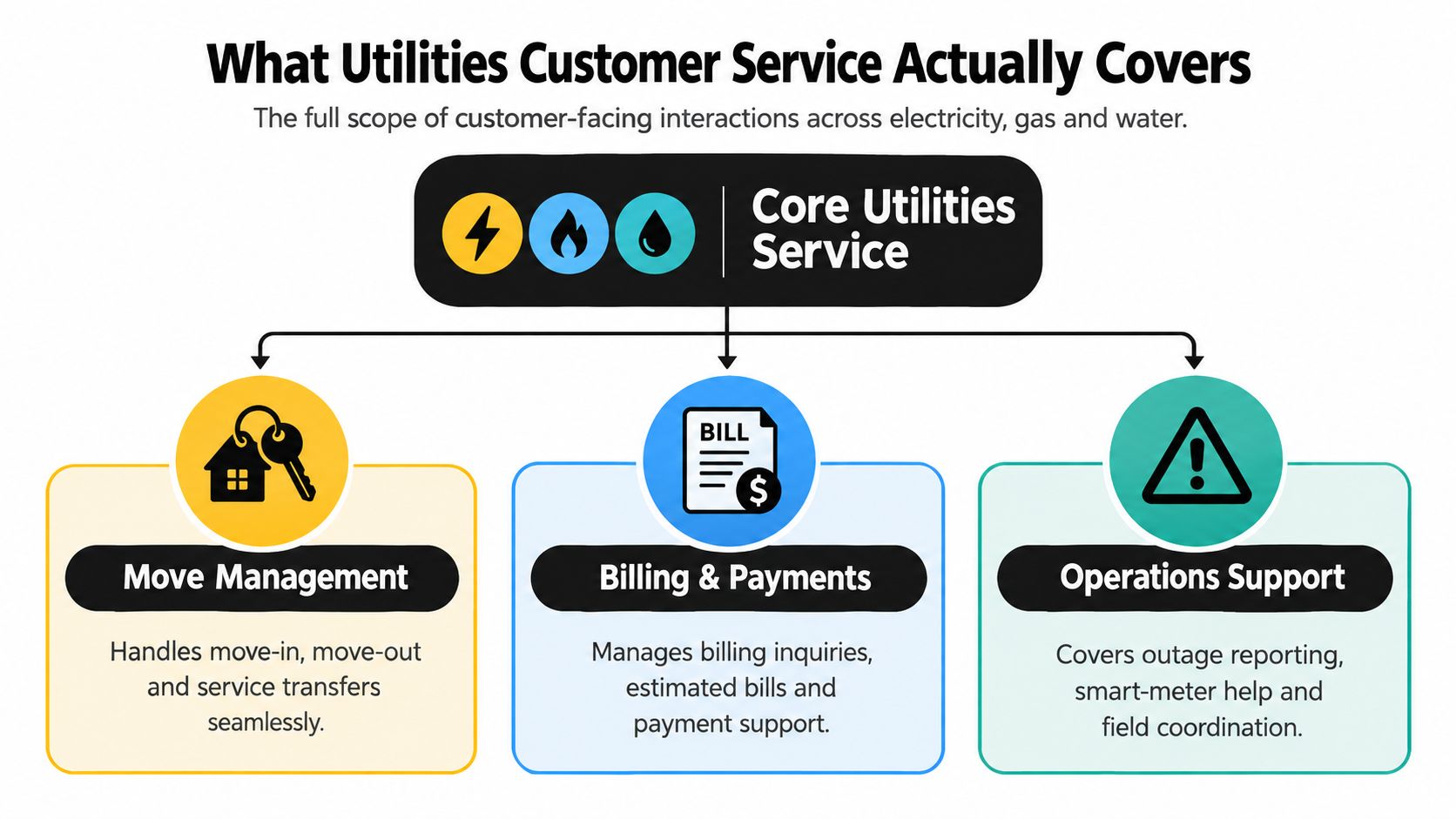
Different accounts create different service designs
Residential customers typically need clear bills, payment flexibility, outage information, meter help, and reliable move management. Commercial customers add demand charges, capacity considerations, multiple premises, delegated users, account-manager interactions, and more complex service orders. Industrial customers may require coordinated field access, operational contacts, contractual service terms, and escalation paths that differ from residential support.
Those differences should shape routing and knowledge access. A single generic bot that treats a household account and a multi-site commercial account as the same customer will create avoidable transfers.
Metering also changes the customer journey. Teams responsible for utility career AMR impact should understand how automatic meter reading affects field operations, data availability, and the explanations agents give customers. For a broader view of how utilities can structure digital and voice support, see Yellow.ai's utilities customer service solution.
Match channels to the job
Voice remains valuable for complex disputes, safety issues, accessibility needs, and emotionally charged incidents. Chat and authenticated apps work well for bill explanations, payment actions, appointment updates, and outage notifications. Field teams own physical service work, but the contact center must expose field status instead of forcing customers to call back for updates.
The channel is secondary to continuity. A customer should be able to move from an outage SMS to authenticated chat or voice without losing the incident context.
The Four Operational Pain Points That Drive Complaints
Utility complaints are rarely caused by agent staffing alone. They usually expose a broken path across outage, billing, meter, customer, and field systems. The operational priority is to remove transfer friction so one interaction can produce a complete, documented answer.
Outage demand arrives in bursts
Storms and equipment failures create demand that ordinary staffing models cannot absorb. Maryland's utility communications standard requires utilities to answer within 30 seconds for at least 75% of applicable calls annually, as described in the Maryland utility communications requirement. That annual requirement does not prepare a queue for a sudden event spike. Utilities still need queue design, proactive messages, accurate outage maps, and self-service that contains routine contacts.
A long IVR maze shifts the burden to the customer. The contact flow should identify the affected premise, confirm the known incident, provide approved restoration information, collect safety details, and route judgment-dependent cases to an agent. The agent should see the outage record before asking the customer to explain it again.
Billing and meter disputes consume trust
Ofgem's complaint-category data attributes roughly 60% of complaints to billing and meter reading combined, and its January 2025 survey records low satisfaction with complaint handling. Ofgem's January 2025 energy consumer satisfaction survey supports the need to treat explanation quality and complaint ownership as operational controls. Customers do not experience a “billing system issue.” They experience a bill that appears wrong, an explanation they cannot verify, and a handoff that forces them to repeat the evidence.
Nigeria's 2025 electricity-sector figures provide a separate comparison. Outrageous billing represented 34.35% of NERC complaints, metering represented 29.62%, and 46.24% of complaints were resolved. These figures are supplied benchmark data, not evidence from the UK survey and not proof that every market has the same complaint profile. The useful lesson is consistent across markets: billing and meter records must be available together, with the calculation, reading history, and prior contacts visible to the person handling the case.
Regulatory obligations turn delay into exposure
Service levels, complaint deadlines, safety procedures, accessibility duties, compensation arrangements, and regulator reporting create consequences beyond a poor interaction. Closing a case without preserving the evidence, decision path, and customer communication can create a compliance problem even when the original issue was routine.
Set controls around intents that require mandatory disclosures, specialist review, vulnerability handling, or documented escalation. Supervisors should be able to audit what the customer reported, which data the agent used, what decision was made, and what follow-up was promised.
Transfers expose the architecture
The most expensive failure often occurs between the customer information system, outage management system, advanced metering infrastructure, and CRM. Every transfer can add authentication, explanation, queue time, and manual notes. It raises handle time while leaving first-contact resolution unchanged.
A supplied utility contact-center benchmark places infrastructure and utilities teams at about 80% first-contact resolution with an average handle time of 7.5 minutes, based on the cited utility contact-center benchmark. Do not force every interaction below that handle time. Complex service orders, outage context, billing explanations, safety triage, and dispatch coordination require complete context. Give the agent the relevant data before asking the customer to repeat the problem.
| Complaint category | Ofgem share | Pennsylvania PUC share | Typical resolution time |
|---|---|---|---|
| Billing and meter reading | About 60% combined | Not specified in the verified data | Varies by evidence and system ownership |
| Consumer matters requiring investigation | Not specified | 60,606 matters in the 2023 report | Requires documented investigation |
| Total consumer contacts | Not specified | 142,866 in the 2023 report | Depends on contact type |
Rank these pain points by repeat contact, transfer rate, complaint escalation, and unresolved case age, not call volume alone. A billing issue that generates several contacts can damage trust more than an outage call that ends with an accurate update and clear ownership.
KPIs That Matter in a Regulated Utility Contact Center
A regulated utility contact center needs a scorecard that connects access, resolution, customer effort, complaints, and compliance. Service level protects access, but first-contact resolution and complaint outcomes show whether the utility solved the underlying problem. Average handle time supports capacity planning. It becomes harmful when supervisors treat speed as the main quality target.
Track the interaction and the outcome
Service level measures how quickly calls are answered against the utility's defined threshold. Maryland's standard sets a 30-second answer target for at least 75% of applicable calls annually, making answer performance a compliance concern as well as a workforce metric. The Maryland standard should be read alongside event-specific operational requirements.
First-contact resolution measures whether the customer receives a complete answer or resolution without repeat contact or an avoidable transfer. Operations leaders should own it because FCR depends on more than agent behavior. It reflects system integration, permissions, knowledge quality, and whether the agent sees outage, billing, and meter context in one view.
Average handle time includes the interaction and relevant after-call work. Use it to plan capacity and identify process friction. Do not reward a short call if the customer must call again because the agent lacked the data or authority to finish the case.
CSAT captures immediate satisfaction. Customer effort score captures how difficult the resolution felt. Complaint rate per 100,000 customer accounts gives executives and regulators a normalized view of service pressure. Track the direction of that rate over time, and separate supplier results from large-supplier results rather than presenting one blended figure. The Ofgem customer service data portal provides the regulatory context for this comparison.
Regulatory compliance rate should cover required disclosures, response deadlines, safety handling, vulnerability procedures, and audit completeness. Compliance and legal teams own the control framework. The complaint lead owns escalation risk, while the CIO owns the data needed to prove that controls were followed.
| KPI | Definition | Primary owner | Benchmark | Regulatory exposure |
|---|---|---|---|---|
| Service level | Calls answered within the defined threshold | Workforce and operations | Maryland uses 30 seconds for at least 75% of applicable calls annually | Direct where a standard applies |
| First-contact resolution | Issue resolved without avoidable repeat contact | Operations and CX | Use the supplied utility benchmark as a baseline | Indirect, through complaints and service quality |
| Average handle time | Interaction and after-call work duration | Operations | Use the supplied benchmark for capacity planning | Indirect |
| CSAT | Customer rating of the interaction | CX | Use the utility's approved baseline | Through customer-service reporting |
| Customer effort | Perceived difficulty of resolution | CX and product | Use a journey-level baseline | Indirect |
| Complaint rate | Complaints per 100,000 accounts | Regulatory and CX | Compare year-over-year trend and supplier groups | Direct reporting relevance |
| Compliance rate | Completion of mandatory controls | Compliance and legal | Set by obligation and jurisdiction | Direct |
A dashboard such as Yellow.ai AI Analytics can unify conversation, intent, transfer, and outcome data. The utility must still define each metric, validate data quality, and determine how the result maps to regulatory obligations.
Review the scorecard weekly for operational movement and monthly for complaint and compliance trends. Set targets by journey, not only by channel. Billing, outage, meter, and safety contacts have different resolution paths, so a single blended KPI can conceal transfer friction and repeat work.
CIO test: If AHT falls while repeat authentication and repeat contact rise, the program is not improving customer service. It is moving work outside the measured interaction.
From IVR to Agentic Voice AI and RAG Knowledge Bases
Technology modernization should follow the resolution problem, not the vendor category. Each layer solves a different constraint, and no layer compensates for missing utility data.
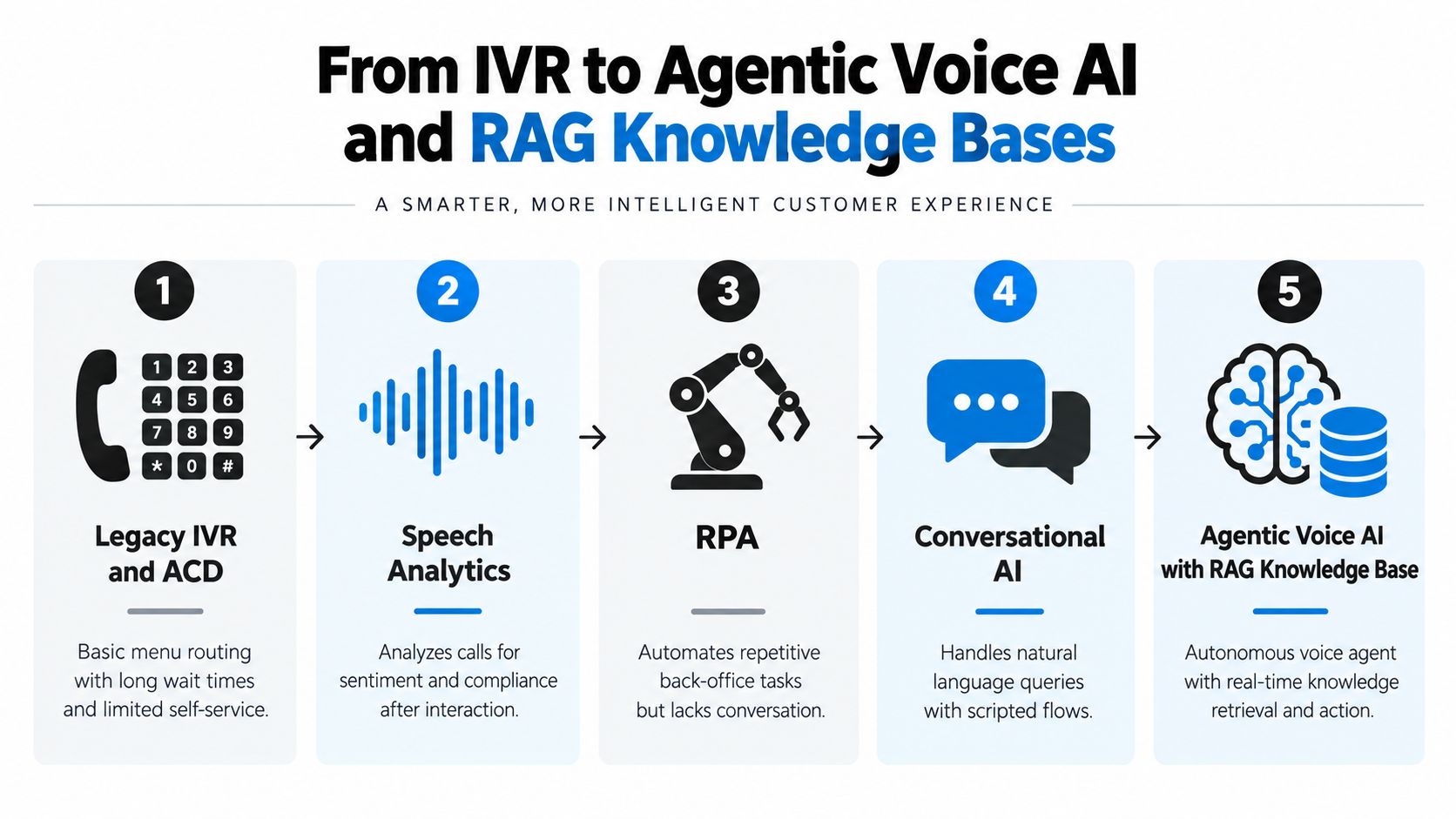
What each layer can and can't do
Legacy IVR and ACD route calls using keypad or basic speech menus. They remain useful for emergency prompts, queue protection, language selection, and deterministic routing. They break when customers describe a combined problem in natural language or need an answer that depends on live account and outage data.
Speech analytics identifies themes, sentiment, compliance phrases, and repeat failure patterns after or during interactions. It helps leaders find transfer loops, but it doesn't resolve the underlying request.
Robotic process automation can copy information between systems, create service orders, and update records. It handles repetitive back-office actions, but it struggles when the customer changes intent mid-conversation or when a transaction needs judgment.
Conversational AI handles natural-language questions through scripted or bounded flows. It works well for stable intents, yet a scripted flow can become brittle when tariff rules, meter states, outage incidents, or customer vulnerability require different treatment.
Agentic voice AI with retrieval-augmented generation adds reasoning, tool use, and access to approved knowledge. In Yellow.ai's agentic AI platform, the relevant design principle is not “let the model talk.” The agent needs permissioned tools for identity, outage lookup, account history, meter data, payment options, case creation, and escalation.
Use deterministic controls around flexible conversation
A regulated utility shouldn't allow an unconstrained model to invent an outage ETA, interpret a tariff without the current approved source, or promise a credit it can't authorize. A RAG-backed knowledge layer should retrieve from controlled content and live APIs, then preserve the source and action in the audit trail.
A practical conversational knowledge base architecture has four parts:
- Live operational connectors for outage, customer, meter, payment, and field systems.
- Governed documents for tariffs, safety scripts, complaint procedures, and compensation rules.
- Policy controls that restrict actions, disclosures, and escalation.
- Human handoff context that passes the transcript, verified identity, retrieved evidence, and attempted actions to the agent.
Build when the utility has distinctive workflows, strong engineering capacity, and a reason to own the full orchestration layer. Buy when speed, integrations, testing, multilingual support, and governance controls matter more than bespoke infrastructure. In either case, test on real failure modes, not only happy-path questions.
How an Agentic AI Platform Handles an Outage End-to-End
Consider a metropolitan storm that triggers a known outage while customers in the affected area are also calling about estimated bills. The experience begins with an outbound notification that identifies the incident and offers a secure path to confirm whether the customer's premise is affected. The customer then moves to voice without starting the story again.
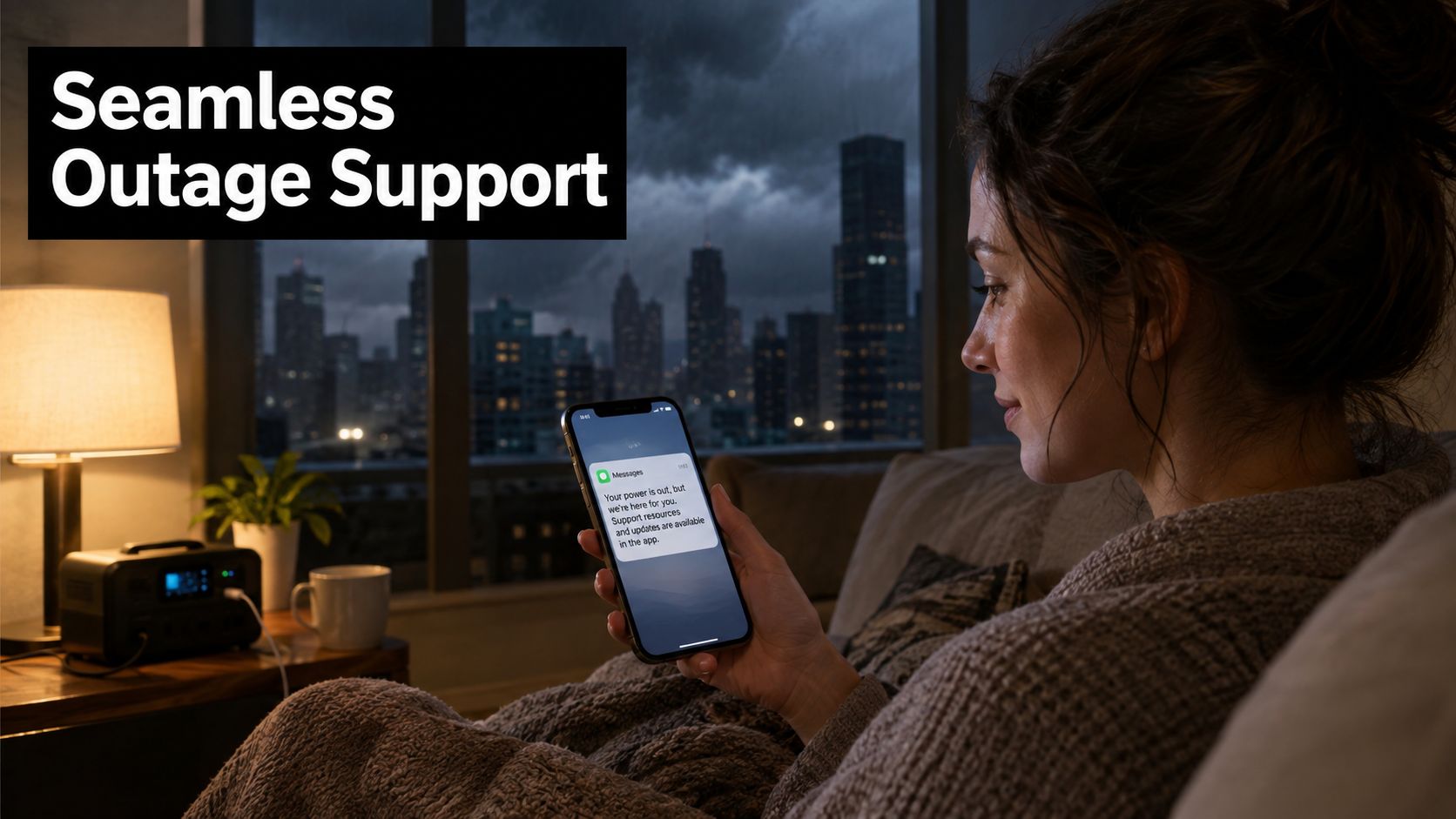
The voice agent authenticates through the approved account process and retrieves the premise's outage ticket, current operational message, service history, and available meter information. It confirms the outage, records the customer's acknowledgment, checks for safety risk, and gives only the restoration information authorized by the outage system. It doesn't guess when the crew will finish.
The caller then says the latest bill also looks wrong. A traditional IVR would likely route the customer to billing and discard much of the outage context. An agentic workflow keeps the verified identity and conversation state, retrieves the bill composition and meter-read status, distinguishes an estimated reading from an actual reading, and explains what the customer can verify.
Resolution depends on action permissions
The platform can offer an approved payment arrangement when the account qualifies, create a billing investigation when the evidence requires review, and rebook a field appointment when the scheduling system permits it. If the customer reports a safety issue, vulnerability, or dispute requiring specialist judgment, the agent escalates with the relevant regulatory notes and all prior steps attached.
The important outcome isn't a fictional performance lift. It is the removal of avoidable repetition:
- The customer authenticates once within the permitted session.
- The outage status comes from the operational system.
- Meter and bill information comes from the account and metering systems.
- The payment or appointment action is completed through an authorized tool.
- The human agent receives a complete case record if escalation is necessary.
The utility should measure this journey by transfer rate, repeat authentication, repeat contact, verified resolution, complaint reopening, and customer effort. It should also review whether the agent made unsupported promises, exposed protected data, or issued an incorrect action.
The human copilot view should surface the retrieved evidence, policy guidance, conversation summary, and unresolved decision. That design lets the human focus on judgment rather than asking the customer to reconstruct the incident.
The visual demonstration should sit later in the journey, after the customer has received the operational answer and the billing path has been established.
Governance, Compliance, and a Realistic Implementation Roadmap
Agentic automation in utilities needs a control layer before it needs a larger language model. Account and payment data require strict access policies, encryption, retention rules, and jurisdiction-specific data residency decisions. Regulators may require an audit trail showing what the customer asked, what data the system retrieved, what action it took, and when a human approved an exception.
Put sign-off into every release gate
A practical roadmap has four governance phases:
- Data residency: Security and legal confirm where conversational, account, payment, and operational data may be processed and stored.
- PII handling: Privacy and security define identity verification, masking, access control, retention, and payment boundaries.
- Audit trails: Compliance and the complaint lead specify regulator-ready logs for AI retrievals, tool calls, human interventions, disclosures, and escalations.
- Phased rollout: Operations validates the journey, compliance approves the controls, security approves the architecture, and the regulator-facing complaint lead reviews outcomes.
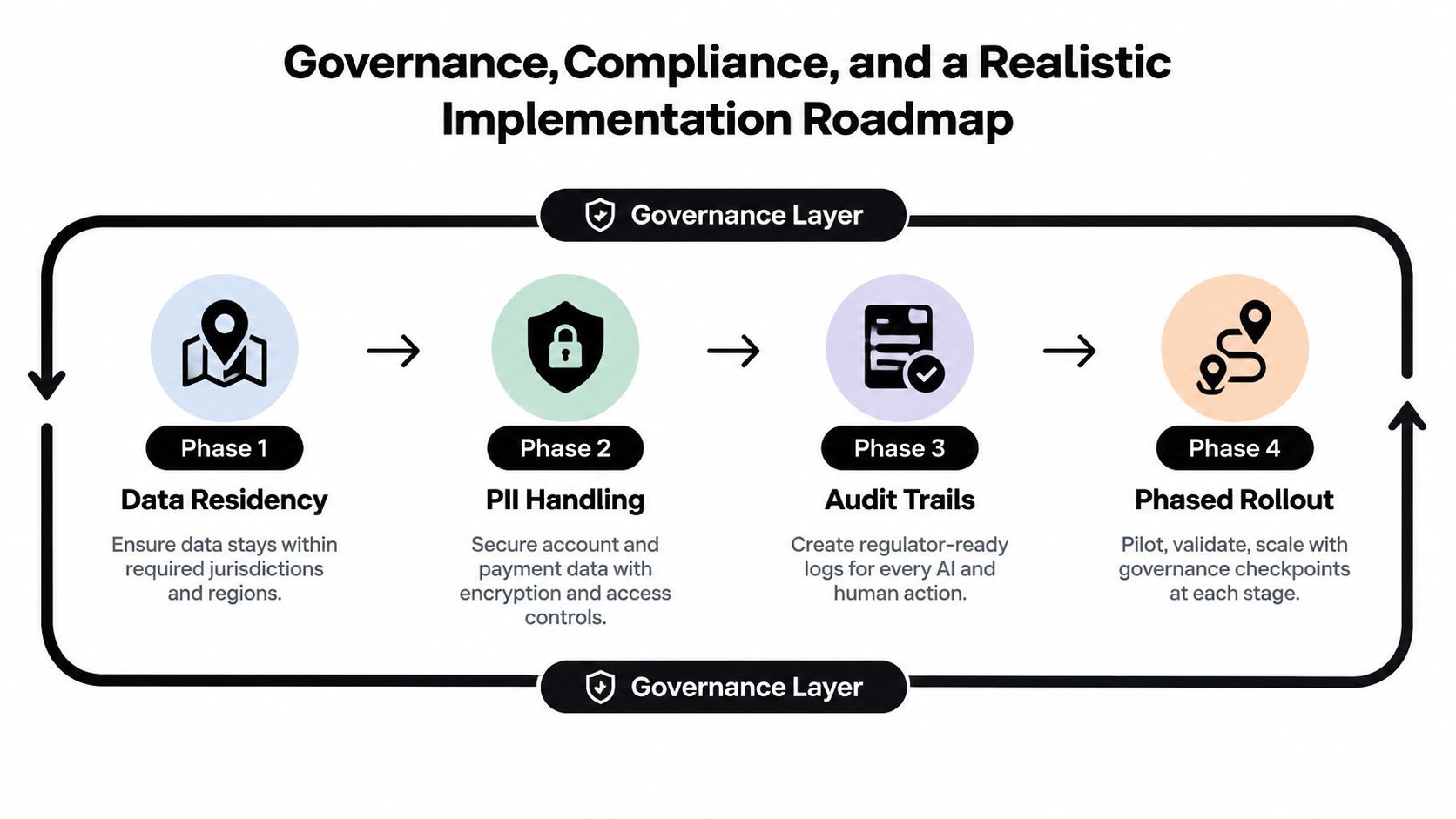
At the 30-day checkpoint, approve the journey map, baseline definitions, data inventory, and escalation rules. At 60 days, review pilot transcripts, retrieval accuracy, transfer behavior, accessibility, and complaint handling. At 90 days, decide whether the use case can expand, requires redesign, or should stop.
Executives will debate build versus buy, single-vendor versus best-of-breed, and whether to retire old IVR menus. Don't retire a menu until the replacement handles accessibility, emergency routing, service-level obligations, and failure recovery. Keep deterministic fallback paths while the agentic layer proves it can resolve the selected intents safely.
Governance isn't a launch document. It's the operating system for every automated decision.
Your 30 60 90 Day Plan for Utilities Customer Service
Days 1 to 30: Establish the baseline. Measure FCR, AHT, CSAT, complaint rate, transfer rate, repeat authentication, and repeat contact by intent. Instrument call drivers and select two narrow automation candidates, usually outage status and bill explanation.
Days 31 to 60: Connect a governed RAG knowledge layer to the customer information system, outage management system, and meter data. Start on digital channels with a visible human fallback, test representative billing and outage journeys, and train specialists on the escalation packet.
Days 61 to 90: Launch voice automation for the validated intents. Give operations a weekly dashboard, run a regulator-style complaint review, sample transcripts for unsupported claims, and decide whether the evidence supports enterprise expansion.
Watch for three failure signals every week:
- Transfer rate rising: The agent is identifying intent but not completing the workflow.
- Repeat authentication recurring: Identity context isn't passing safely between systems.
- Unsupported outage ETAs appearing: Retrieval, permissions, or response guardrails aren't working.
Don't retire IVR prematurely, ignore accessibility, or skip data residency review. A controlled pilot that proves complete resolution is more valuable than a broad launch that merely deflects calls.
Yellow.ai can help utilities orchestrate voice and digital agents, connect approved knowledge with enterprise systems, and route complex cases to human teams with conversation context. Visit Yellow.ai to evaluate an agentic customer-service approach built around outage, billing, meter, and complaint resolution.