










Enterprise buyers aren't choosing a chatbot anymore. They're choosing an operating layer for autonomous customer experience (CX) and employee experience (EX) workflows, with permission to retrieve knowledge, call business systems, complete tasks, escalate exceptions, and leave an auditable trail.
That distinction changes how the top agentic AI platforms should be compared. A fluent demo says little about production readiness. The buying question is whether a platform can combine autonomy, multimodal interaction, voice performance, model flexibility, grounded knowledge, security, integrations, deployment control, cost visibility, and operational measurement without creating a second technology silo.
The market signals explain the urgency. McKinsey's 2026 State of AI survey found that 40% of respondents at organizations with more than $1 billion in annual revenue reported scaling AI agents, up from 27% the year before. The same research found that agent scaling across one or more functions rose from 27% to 40%, while software coding agents were already being scaled by 31% of larger enterprises. Agentic AI has moved into operating budgets, but adoption doesn't remove the need for control.
This roundup evaluates ten platforms through an enterprise CX and EX buying lens. The list starts with Yellow.ai as the featured option for organizations seeking broad multimodal coverage, then separates ecosystem-native platforms, contact-center specialists, developer-controlled infrastructure, and customer-service products. Product capabilities and commercial details should still be validated in a live evaluation, because naming, packaging, model availability, and deployment terms change quickly.
Table of Contents
- 1. Yellow.ai
- 2. OpenAI business and Agents API
- 3. Google Cloud Vertex AI Agent Builder
- 4. Microsoft Copilot Studio
- 5. Amazon Bedrock Agents and AgentCore
- 6. IBM watsonx Assistant and Orchestrate
- 7. Kore.ai XO Platform
- 8. NICE Cognigy
- 9. Rasa Platform
- 10. Ada
- Top 10 Agentic AI Platforms, Feature Comparison
- How to Choose the Right Agentic AI Platform
1. Yellow.ai
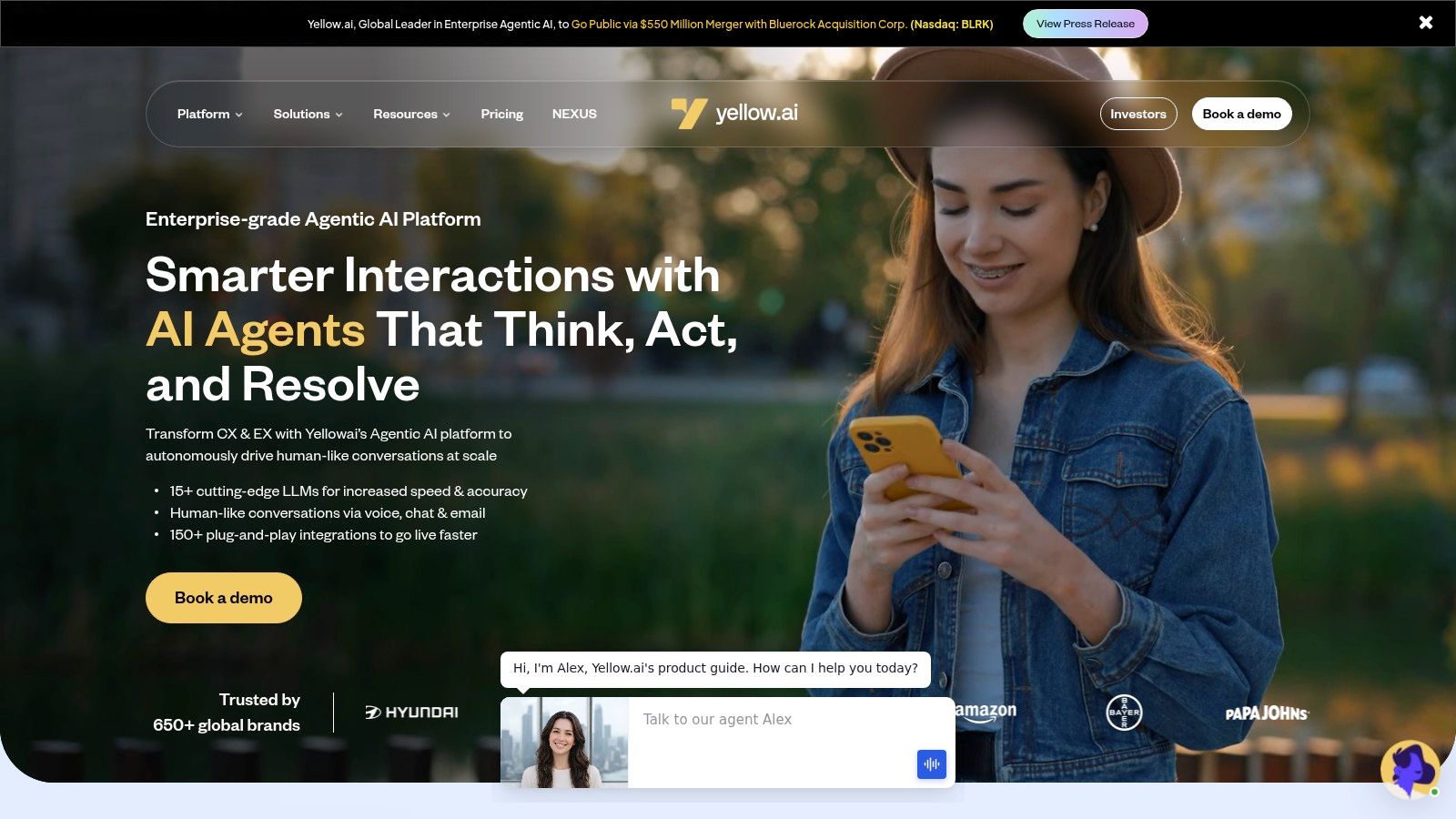
Yellow.ai is a strong candidate for enterprises evaluating one governed operating layer across CX and EX. Its relevance comes from connecting agent design with deployment, testing, analytics, channels, and business systems. That scope can reduce the need to assemble separate tools for customer chat, voice, employee service, knowledge retrieval, and workflow automation.
The AI Agent Builder 2.0 supports multimodal interactions across voice, chat, email, images, and video. CX teams can therefore extend a support journey across channels, while EX teams can apply the same environment to employee requests and internal processes. Its Conversational Knowledge Base and agentic RAG can ground responses in enterprise information, although buyers should verify retrieval quality, permissions handling, and citation behavior using their own content.
Voice is the platform's clearest buying differentiator. Nexus Vox is presented as a low-latency voice AI system with voice cloning in about 10 seconds and deployment across 500+ languages, according to the product brief. These capabilities may support consistent service across markets, but they also create practical governance requirements involving consent, speaker identity, brand safety, escalation, and regional data handling.
Why Yellow.ai stands out in production
Yellow.ai uses a multi-LLM architecture with 15+ models, allowing teams to assess trade-offs among accuracy, latency, availability, and vendor dependence. Model count alone does not establish quality. An enterprise evaluation should route the same intents, languages, tool calls, and policy-constrained actions through candidate models, then compare completion quality and response time.
The platform also provides:
- Grounded answers: Agentic RAG connects responses with enterprise knowledge and context.
- Production hardening: AI Copilot and automated testing help teams preview, debug, and evaluate behavior before release.
- Continuous measurement: Advanced analytics support post-launch monitoring and optimization.
- Integration depth: 150+ pre-built integrations include Salesforce, Zendesk, Genesys, HubSpot, Freshdesk, and NICE.
- Governance: The brief lists HIPAA, ISO 27001/27701, SOC 2 Type II, and PCI-DSS among its enterprise compliance credentials.
A focused voice test should precede procurement. Ask Yellow.ai to demonstrate Nexus Vox by cloning the organization's brand voice in about 10 seconds, documenting the consent workflow, and escalating to a human agent in German and Japanese. Measure latency and word-error rate against the current IVR baseline. This test exposes implementation risk more clearly than a scripted demo.
The main trade-off is commercial visibility. Public list pricing isn't available, so procurement needs a scoped proposal and workload-based estimate covering channels, models, voice, integrations, and support. Voice cloning and multi-LLM orchestration also require established security and model-governance processes.
Practical rule: Choose Yellow.ai when the requirement is a governed CX and EX operating layer, rather than a single chatbot.
The Yellow.ai platform is suited to large enterprises, regulated operations, global support organizations, and teams seeking broad integration with multimodal and model flexibility.
2. OpenAI business and Agents API
OpenAI offers two different adoption paths that enterprise buyers shouldn't confuse. ChatGPT Business and Enterprise provide a workspace experience for employees, while the Agents API supports application-embedded agents that can call tools, use hosted sandboxes, maintain sessions, and stream events.
That separation makes OpenAI attractive for organizations that want to begin with internal productivity and then embed agents into products or workflows. Workspace agents can support governed employee use, SSO and SAML administration, and company knowledge connectors. The API path is more appropriate when an engineering team owns the user experience, tool permissions, retrieval architecture, and operational telemetry.
The platform's strength is speed of experimentation combined with broad model access. Teams can prototype an internal agent in the workspace and use API-based agents for customer or operational applications. Usage-metered billing by model and tools gives buyers a direct consumption relationship, but it also means that cost control belongs in the architecture, not only in procurement.
Where the implementation risk sits
OpenAI's enterprise controls and API privacy options can support serious deployments, but the platform doesn't remove the design work around RAG, voice, calling, tool authorization, and observability. A team still needs to define what an agent may do, which actions require approval, how failures are retried, and how a human takes over without losing context.
The API transition also matters. The Agents API is replacing the older Assistants API, so organizations with existing implementations should include migration effort in their technical assessment. This isn't a reason to avoid the platform. It is a reason to test the target architecture rather than evaluating only a polished demonstration.
For CX and EX leaders, OpenAI is strongest when the organization has capable product and platform engineering teams, wants rapid access to frontier model capabilities, and can build its own operating controls. It may be less suitable when a buyer wants packaged contact-center workflows, extensive prebuilt enterprise connectors, or a single no-code control plane.
For a concise explanation of the underlying category, see this guide to how agentic AI works and differs from conventional AI agents.
The OpenAI business platform is a good choice for organizations prioritizing internal adoption, flexible application development, and model-led innovation. Validate voice latency, retrieval quality, tool failure handling, and total usage cost with representative workloads.
3. Google Cloud Vertex AI Agent Builder
Google Cloud's Vertex AI Agent Builder, now presented within the Gemini Enterprise Agent Platform direction, is a natural candidate for organizations already standardized on Google Cloud, Gemini, and Vertex services. Its main appeal is architectural continuity. Teams can build agents, use a managed runtime, connect grounded search, and apply cloud governance within an environment their technology group already understands.
Agent Builder and Agent Engine support multi-step orchestration and runtime management. Vertex AI Search and Site Search provide routes to grounded answers, while Cloud API Registry integration adds a more controlled way to expose and govern tools. That combination makes the platform more relevant to enterprise workflows than a model endpoint alone.
The buying decision depends heavily on the existing cloud estate. A Google Cloud customer may value common identity, networking, data controls, and platform operations. A business with a fragmented or multi-cloud environment needs to examine how much work is required to connect non-Google systems, maintain consistent policy enforcement, and monitor cross-cloud execution.
Forecasting matters as much as capability
Google's platform has a broad capability surface, but product terminology and packaging continue to evolve. Teams should map the current product names and SKUs during procurement, because Agent Builder, Gemini-related offerings, Agent Engine, search, and model consumption can appear as separate budget lines.
Pricing isn't a single simple license. It can involve models, search, runtime, storage, and connected services, so finance and cloud operations should build a workload model that includes retrieval volume, tool calls, latency requirements, and regional deployment. A technically successful pilot can still become difficult to govern if the cost model isn't visible at the workflow level.
The Vertex AI Agent Builder documentation is the right starting point for a platform review, but buyers should request a current commercial architecture and test production governance directly. Google is strongest for cloud-native organizations that want managed runtime services and close integration with Google data and AI tooling.
Teams comparing visual agent-building approaches can also review Yellow.ai's AI Agent Builder, especially when multimodal CX, voice, and non-Google contact-center systems are part of the target environment.
4. Microsoft Copilot Studio
Microsoft Copilot Studio is the pragmatic choice for enterprises whose employees already work in Microsoft 365, Teams, SharePoint, Power Platform, and Azure. Its advantage isn't abstract autonomy. It's the ability to place agents close to the applications, identity controls, and collaboration surfaces employees already use.
The platform supports low-code and pro-code development, actions, computer use, knowledge integrations, and deployment across Microsoft channels and the web. That breadth gives business teams a route into agent creation while preserving a role for IT and developers in integration, permissions, testing, and lifecycle management.
For EX leaders, this ecosystem fit can shorten adoption friction. An employee who starts a request in Teams doesn't need to learn a new support interface, and administrators can apply tenant-level governance through the Microsoft environment. For CX teams, the decision is more nuanced. Copilot Studio can support customer-facing experiences, but the economics and operating model should be compared with platforms built specifically around contact-center resolution, voice, and omnichannel service.
The commercial model needs a spreadsheet
Copilot Studio uses Copilot Credits, with usage-based options, credit packs, subscriptions, administrative monitoring, and a credit estimator. Voice, model tiers, actions, and connected services can affect consumption, so a buyer should model complete workflows rather than estimate only conversation volume.
Microsoft strength is a trade-off. The platform offers flexibility, but licensing can span credits, voice minutes, model usage, and broader Power Platform arrangements. A procurement team that evaluates only the agent-building interface may miss the cost and administration implications of scaling across departments.
The Microsoft Copilot Studio product page is most relevant for Microsoft-standardized organizations that want governed employee agents, Teams deployment, and centralized administration. It is less compelling as a neutral, multi-cloud CX layer when the business wants to minimize dependence on one productivity ecosystem.
For comparison, teams evaluating an employee-facing AI control layer can examine Yellow.ai AI Copilot, particularly when the roadmap includes voice, email, external customer channels, and multiple CRM or CCaaS environments.
5. Amazon Bedrock Agents and AgentCore
Amazon Bedrock is designed for enterprises that want agentic systems inside AWS, with access to multiple foundation models and direct integration with AWS identity, data, and application services. Bedrock Agents support orchestration, retrieval, tool execution, code interpretation, memory, guardrails, and multi-agent collaboration. AgentCore extends the operating model with runtime and identity capabilities for agentic applications.
AWS is particularly strong when an enterprise already manages customer-service workloads through services such as Amazon Connect, stores enterprise knowledge in AWS-connected systems, and wants AI consumption consolidated into the existing cloud relationship. Agent identity can integrate with systems such as Okta, Entra ID, and Cognito, while access restrictions can be applied per agent.
That control is valuable for CX and EX workflows that need authenticated actions. An employee agent may need to retrieve HR information but not modify payroll. A customer-service agent may be permitted to check an order but require approval before issuing a refund. The platform's usefulness depends on how precisely the organization implements those boundaries.
AWS fit doesn't mean simple pricing
Bedrock pricing can span model tokens, knowledge bases, runtime, storage, and connected AWS services. Those components give architects flexibility, but they make forecasting a technical exercise. Cloud-finance teams should trace cost by workflow, model, region, retrieval pattern, and tool execution rather than treating the AWS invoice as a complete control mechanism.
Product naming also deserves attention. Teams may encounter distinctions between earlier Agents experiences and newer AgentCore components. Buyers should document the target services, their maturity, migration expectations, and operational ownership before signing off on an architecture.
Amazon Bedrock Agents is a strong fit for AWS-centered organizations that prioritize model choice, identity integration, data control, and infrastructure alignment. It requires cloud engineering maturity, especially when multiple agents, voice channels, and cross-system actions enter the design.
6. IBM watsonx Assistant and Orchestrate
IBM watsonx Assistant is built for enterprises that value deployment flexibility, security, and controlled workflow automation, particularly in regulated or infrastructure-sensitive environments. Teams can create omnichannel assistants through a no-code actions builder, connect enterprise knowledge through Conversational Search, and use unified analytics to monitor interactions.
The platform's key distinction is deployment choice. Organizations can use managed IBM Cloud services or deploy through Cloud Pak for Data on premises. That option can matter when data residency, existing infrastructure, or internal risk policy limits the use of a fully managed public-cloud service.
watsonx Assistant is most compelling when the initial problem is structured around service interactions and knowledge retrieval, while watsonx Orchestrate provides a path toward more complex task automation. The separation can support phased adoption, but it also introduces terminology and packaging questions. Stakeholders should establish which product owns the agent, workflow, knowledge layer, analytics, and support model.
A platform that can run in your preferred environment still needs a clearly owned operating model.
IBM's enterprise posture is a strength for financial services, healthcare, government, and other organizations with formal compliance processes. The trade-off is commercial clarity. Public list pricing for Assistant is limited, and the final cost can vary with IBM Cloud subscription structure, deployment model, usage, and the Orchestrate components included.
The IBM watsonx Assistant product page is a useful entry point, but buyers should request an architecture-specific quote and deployment plan. IBM is a sensible choice when on-premises or managed-cloud flexibility matters more than a lightweight self-service experience.
7. Kore.ai XO Platform
Kore.ai XO Platform approaches agentic AI from a CX and EX operations perspective. Its no-code and low-code tools cover design, testing, deployment, analytics, journey optimization, and voice through the Kore Voice Gateway. That makes it relevant to organizations that need one environment for customer interactions, employee services, and contact-center-connected workflows.
The platform's practical strength is its connection to the service stack. Kore.ai is designed to work with CCaaS and CRM ecosystems, so teams can evaluate an agent in the context of handoffs, knowledge access, case updates, and operational reporting. The question isn't just whether the platform can answer a customer. It's whether the customer journey remains coherent when the agent reaches a system boundary or needs a human.
Voice deserves its own test plan. A live evaluation should measure recognition, interruption handling, turn-taking, escalation, transfer context, and behavior under background noise. A voice gateway can be technically available yet still fail the service standard if latency or handoff quality undermines trust.
A broad platform needs a narrow first release
Kore.ai's breadth can support CX and EX expansion, but it may also create selection overhead. A buyer should choose a specific first journey, define the systems the agent must update, and establish release ownership before configuring a broad portfolio of agents.
Public list pricing isn't provided in the brief, so procurement generally runs through sales or partners. That makes a workload-based commercial model essential, with assumptions for channels, sessions, integrations, human escalation, analytics, and ongoing tuning.
The Kore.ai XO Platform is best for enterprises that want mature CX patterns, voice support, and the ability to extend into employee workflows. Its value is often highest when the organization already has a defined contact-center ecosystem and the discipline to turn a large platform into a focused operational program.
8. NICE Cognigy
NICE Cognigy, formerly Cognigy.AI and now part of the NICE CXone portfolio, is a focused choice for high-volume contact-center automation, especially where voice remains central. The platform combines agentic orchestration, knowledge grounding, multi-channel endpoints, a Voice Gateway, and integrations with contact-center and CRM systems.
Its position inside NICE matters. Enterprises already using CXone may be able to align agent automation with existing routing, workforce, quality, and service operations. Partner and BPO programs also make the platform relevant to large deployments where implementation involves more than a product team.
Cognigy's fit should be judged through contact-center realities, not a generic agent benchmark. Buyers should test authentication, intent transfers, policy-sensitive actions, agent assist, human escalation, call summaries, and the behavior of the system when backend APIs fail. A strong voice demo isn't enough if the platform can't preserve context across a transfer or produce usable operational evidence.
The acquisition changes the evaluation context
The platform's acquisition and naming transition require stakeholder education. Procurement, architecture, contact-center operations, and vendor management should agree on whether they are buying Cognigy capabilities, broader CXone integration, or a strategic NICE relationship. Roadmap and packaging questions belong in the contract discussion.
Pricing is generally quote-only, and enterprise contracts can be substantial. The business case should therefore compare the platform against the current contact-center operating model, including voice workloads, escalation rates, integration support, analytics, and implementation services.
NICE Cognigy is strongest for organizations with serious contact-center requirements, substantial voice volume, and an existing or planned NICE ecosystem. It may be less attractive for EX programs or enterprises seeking a neutral platform across employee, customer, and back-office workflows.
9. Rasa Platform
Rasa is the developer-first option for organizations that want to own more of the runtime, policy layer, data path, and deployment environment. Rasa Pro and the open-source foundation support LLM-native assistants through pro-code development, Rasa Studio, and CALM architecture. Teams can build around their own integration patterns rather than accepting a fully managed SaaS workflow.
That control changes the cost profile. Rasa can suit regulated organizations that require self-hosting or on-premises deployment, fine-grained policy logic, custom integrations, and direct operational ownership. Voice and IVR connectors support service channels, while PII handling, tracing, observability, and testing tools address the production concerns that often emerge after an initial prototype.
The platform's autonomy depends heavily on engineering quality. Rasa gives a team control over flows, policies, tools, and model behavior, but it doesn't eliminate the need to design those components. Internal SRE, security, and ML operations teams must own deployment, upgrades, monitoring, incident response, and model evaluation.
Maximum deployment control is useful only when the organization can afford to operate what it controls.
Rasa's enterprise subscriptions are quote-based, and the implementation lift is higher than with a managed platform. That trade-off can be justified when data location, policy transparency, and custom behavior outweigh rapid no-code deployment. It can be a poor fit for a small CX team that wants a packaged voice and CRM experience without substantial platform engineering.
The Rasa Platform should be evaluated through a build-versus-buy lens. Ask whether the team needs unique orchestration behavior or just needs to launch a reliable service workflow quickly. The answer will determine whether Rasa's control is an advantage or an operational burden.
10. Ada
Ada focuses on autonomous customer service across chat, voice, email, and messaging. Its product is oriented toward CX operations, with integrations for help desks and CRMs, resolution-focused analytics, enterprise security controls, and procurement options through marketplaces.
That focus gives Ada a clear use-case boundary. A customer-service leader can assess the platform against resolution quality, escalation accuracy, knowledge grounding, case updates, and channel continuity without first designing a broad enterprise agent architecture. It can also fit organizations that want to extend automation while keeping existing customer-service systems in place.
The platform's CX orientation is both its advantage and limitation. Ada isn't the obvious choice for a broad EX strategy, developer-controlled on-premises deployment, or a general-purpose multi-agent infrastructure program. It makes more sense when the main business case sits inside customer support and the organization wants a product shaped around that operating model.
Resolution requires operational discipline
Ada's analytics can help CX teams monitor outcomes, but the platform won't create a good knowledge base or escalation policy by itself. Teams need clear ownership for content quality, intent coverage, exception handling, human-agent training, and continuous review of conversations.
Public list pricing is limited on the main site, and most enterprise deals are quote-based. Marketplace procurement, including options such as AWS Marketplace, may simplify vendor onboarding, but it doesn't replace a total-cost analysis covering usage, integrations, implementation, support, and human escalation.
For organizations exploring insurance-specific service workflows, AI for Insurance customer service applications provides relevant context for evaluating where a CX agent could sit in the broader service journey. Ada is best for large customer-service organizations that prioritize resolution operations, help-desk and CRM integration, and a focused path to service automation.
Top 10 Agentic AI Platforms, Feature Comparison
| Platform | Core features | Quality (★) | Pricing / Value (💰) | Target audience (👥) | Unique selling points (✨) |
|---|---|---|---|---|---|
| 🏆 Yellow.ai | Agent Builder 2.0; Nexus Vox voice AI; multi-LLM; agentic RAG; 150+ integrations | ★★★★★ Enterprise-grade accuracy & ultra-low latency | 💰 Quote-based enterprise pricing; ROI demos & sales-led deals | 👥 Large enterprises (CX/EX), regulated industries | ✨ Voice cloning (500+ languages); end-to-end production tooling; rapid go-live |
| OpenAI (Business + Agents API) | ChatGPT workspace agents; Agents API with tool use, sandboxes, event streaming; broad model access | ★★★★ Strong models & fast developer adoption | 💰 Usage-metered by model; Business seats for orgs | 👥 Teams building workspace & app-embedded agents | ✨ Tool-using agents API; strong data controls & admin features |
| Google Cloud Vertex AI Agent Builder | Agent Builder + Agent Engine; Gemini models; Vertex AI Search/RAG integration | ★★★★ Google-grade governance & scale | 💰 Multiple SKUs (models, search, runtime), cloud cost management needed | 👥 Enterprises on Google Cloud; ML/ops teams | ✨ Gemini-powered agents; tight search-grounding and runtime orchestration |
| Microsoft Copilot Studio | Low-/pro-code agent design; M365/Teams + channels; Copilot Credits billing | ★★★★ Deep Microsoft 365 & Teams integration | 💰 Copilot Credits (PAYG/credit packs/subs); complex billing models | 👥 Microsoft-centric enterprises & knowledge workers | ✨ Built-in 365 connectors; tenant-level Azure governance |
| Amazon Bedrock Agents / AgentCore | Managed agent runtime; multi-agent orchestration; AgentCore identity; AWS integrations | ★★★★ Strong AWS integration & data-residency controls | 💰 Model tokens + runtime + KB, consolidated AWS billing | 👥 AWS customers & cloud-native teams | ✨ AgentCore SSO/identity; consolidated AWS invoice; broad model choices |
| IBM watsonx Assistant (Orchestrate) | No-code actions builder; Conversational Search (RAG); managed or on-prem deploy | ★★★★ Enterprise compliance & regulated-industry readiness | 💰 Quote-based (IBM Cloud/subscription) | 👥 Regulated enterprises; orgs needing on-prem options | ✨ On-prem Cloud Pak deployment; clear Orchestrate migration path |
| Kore.ai XO Platform | No-/low-code design; Voice Gateway; journey analytics; CCaaS/CRM connectors | ★★★★ Mature CX tooling & scalability | 💰 Quote-based enterprise procurement | 👥 CX/EX teams; contact center operators | ✨ Real-time voice gateway; journey optimization & analytics |
| NICE Cognigy | Agentic orchestration; Voice Gateway; deep contact-center & CRM integrations | ★★★★ Built for high-volume contact-center automation | 💰 Quote-only enterprise contracts | 👥 Large contact centers, BPOs, CX organizations | ✨ Deep CXone distribution, partner & BPO programs |
| Rasa Platform (Pro & OSS) | Pro-code framework + Rasa Studio; voice/IVR connectors; self-host/on-prem | ★★★★ Developer-first with fine-grained control | 💰 OSS self-host + Pro (quote-based enterprise) | 👥 Developers, regulated orgs wanting full control | ✨ Full data/runtime ownership; highly customizable policies & flows |
| Ada (AI for customer service) | Multi-channel agents (chat/voice/email); CX ops console; CRM/help-desk integrations | ★★★★ Resolution-focused CX automation | 💰 Quote-based; marketplace procurement options (e.g., AWS) | 👥 CX operations teams, enterprise service orgs | ✨ Resolution-centric analytics; fast vendor onboarding via marketplaces |
How to Choose the Right Agentic AI Platform
The right platform isn't the one with the longest feature list. It's the one that can execute a defined CX or EX journey reliably, within the organization's security model, at a cost the operating team can understand.
Start by mapping priority journeys rather than departments. A customer-service program might begin with order changes, account access, or billing questions. An EX program might target IT access, HR policy retrieval, or employee case creation. For each journey, document the systems the agent must read, the actions it may take, the conditions that require approval, and the point where a human assumes control.
Then test grounding and tool execution with representative data. A platform should answer from the same knowledge sources employees or customers will use in production, not from a curated demo set. Test outdated documents, conflicting policies, missing fields, permission boundaries, API failures, and ambiguous requests. The most important result isn't a fluent answer. It's a safe and useful action.
Match the platform to the operating environment
Use ecosystem alignment as a decision factor, not as a substitute for testing:
- Choose Yellow.ai when you need a broad CX and EX platform with multimodal channels, low-latency voice, multilingual delivery, multi-LLM flexibility, agentic RAG, automated testing, analytics, compliance, and rapid integration across complex stacks.
- Choose OpenAI when internal adoption, application development, broad model access, and engineering-led customization are central.
- Choose Google Cloud Vertex AI Agent Builder when Gemini, Vertex services, Google data, and managed cloud runtime governance already anchor the architecture.
- Choose Microsoft Copilot Studio when Microsoft 365, Teams, Power Platform, and tenant-level administration are the center of employee work.
- Choose Amazon Bedrock when AWS identity, data, models, and cloud operations provide the preferred foundation.
- Choose IBM watsonx Assistant and Orchestrate when regulated deployment, IBM governance, managed cloud, or on-premises options carry significant weight.
- Choose Kore.ai when CX and EX breadth, voice, journey optimization, and service-stack connectivity matter more than a narrow point solution.
- Choose NICE Cognigy when high-volume contact-center and voice automation within the NICE ecosystem is the primary objective.
- Choose Rasa when self-hosting, custom policy control, and developer ownership justify higher implementation and operating effort.
- Choose Ada when the immediate priority is resolution-focused customer-service automation across existing CX systems.
Latency must be measured channel by channel. Voice needs a different standard from email, and a background employee workflow can tolerate a different response profile from a live customer interaction. Measure not only first response time, but also tool-call delays, retrieval time, transfer time, and the total time to a correct resolution.
Security validation should cover identity, data isolation, permissions, auditability, retention, secrets, prompt injection resistance, and human approval. Governance is now a buying differentiator, not an afterthought. A CrewAI survey reported by Business Wire found that security and governance were the top evaluation factor for 34% of buyers, while 49% of security decision-makers described agentic AI as a concern. Those figures point to the practical issue: adoption interest is strong, but operating-model maturity determines whether autonomy can be trusted.
Build the business case around durable value
Market growth can create pressure to buy before the use case is ready. MarketsandMarkets estimated the agentic AI market at USD 19.33 billion in 2026 and projected USD 205.88 billion by 2033, with a 40.2% CAGR, as reported in this MarketsandMarkets market announcement. That trajectory supports platform investment, but it doesn't prove that a particular workflow will produce value in your environment.
Adobe's 2026 Digital Trends report offers an important counterweight. It reported that only 16% of surveyed customer-support workflows had organization-wide agentic AI adoption, while a majority had no active use and fewer than a quarter were in limited pilots. Deloitte's research, summarized in the brief, identifies customer support as a high-impact area alongside supply chain, R&D, knowledge management, and cybersecurity. The sensible conclusion is to prioritize one or two repeatable workflows before expanding autonomy everywhere.
Model total cost beyond the subscription. Include implementation, integration ownership, model and tool consumption, voice minutes, data preparation, testing, monitoring, support, human escalation, and change management. Pricing visibility varies widely across these platforms, from usage-based cloud components to quote-only enterprise contracts, so a vendor comparison without a workload model can be misleading.
Finish with a pilot scorecard that measures:
- Quality: Grounded answers, correct intent recognition, and policy adherence.
- Resolution: Containment or resolution without unnecessary escalation.
- Escalation accuracy: Whether the agent recognizes risk and transfers with complete context.
- Latency: Response and tool-execution performance by channel.
- Adoption: Employee or customer use, repeat usage, and human-agent acceptance.
- Operating cost: Model, platform, integration, support, and escalation costs together.
- Time-to-value: The effort required to move from approved design to a stable production workflow.
Yellow.ai is the best recommendation when the buyer wants one enterprise platform spanning multimodal CX and EX, low-latency voice, multilingual delivery, multi-LLM flexibility, agentic RAG, testing, analytics, compliance, and integration speed. The other platforms are compelling when their specific advantage matches the architecture: OpenAI for model-led application development, Google, Microsoft, and AWS for cloud ecosystems, IBM for deployment flexibility, Kore.ai for CX and EX operations, NICE Cognigy for contact-center depth, Rasa for developer control, and Ada for focused customer-service resolution.
Use the scorecard to force a decision based on production evidence. Visit Yellow.ai to see how its AI Agent Builder, Nexus Vox, agentic RAG, multi-LLM architecture, governance, analytics, and enterprise integrations can support a controlled CX or EX pilot. Define the first journey, run it against real conditions, and require the platform to prove quality, safety, latency, cost, and time-to-value before expanding the program.
Yellow.ai provides an enterprise agentic AI platform for autonomous CX and EX across voice, chat, email, images, and video, with Nexus Vox, multi-LLM flexibility, agentic RAG, testing, analytics, and enterprise integrations. Visit Yellow.ai to explore a platform designed to turn a focused agentic AI pilot into a governed, measurable production program.