









You're probably dealing with this already. A large prospect is deep in procurement, your product team has answered the feature questions, legal has redlined the paper, and then the buyer's security team asks for your SOC 2 report. If your response depends on screenshots, spreadsheets, and a scramble across IT, security, HR, and engineering, the issue isn't just audit readiness. It's operating model maturity.
That problem gets sharper for AI-driven CX and EX platforms. Systems change constantly. Access changes constantly. Third-party tools appear mid-quarter. New agents, new integrations, and new data paths can make last month's evidence stale. In that environment, SOC 2 compliance software matters less as an audit convenience and more as infrastructure for proving that your control environment still works while the platform keeps moving.
For CIOs, that's a significant shift. The question is no longer whether you can collect evidence before an auditor arrives. It's whether your organization can maintain a defensible security posture in a cloud and SaaS estate that changes every week.
Table of Contents
- Beyond the Audit Why SOC 2 Is a Strategic Imperative
- Mapping Software Features to Trust Services Criteria
- The ROI of Compliance Automation for CX and EX Platforms
- The CIOs Evaluation Checklist for SOC 2 Software
- Your Implementation Roadmap From Scoping to Audit
- Common Pitfalls and What Compliance Software Cannot Do
Beyond the Audit Why SOC 2 Is a Strategic Imperative
Enterprise teams rarely ask for SOC 2 because they love compliance paperwork. They ask because they need confidence that your controls are documented, repeatable, and sustained. If your platform handles customer conversations, employee workflows, authentication flows, or regulated data, buyers want proof that security isn't dependent on tribal knowledge.

That's why SOC 2 compliance software has moved into the CIO's core tooling stack. SOC 2 is a voluntary attestation report developed by the AICPA, not a legal mandate, and it is built around five Trust Services Criteria: security, availability, processing integrity, confidentiality, and privacy. In practice, that means the software centralizes policies, evidence, access reviews, monitoring, and audit reporting so the organization can demonstrate control coverage across those areas throughout the year rather than only at audit time, as described in this A-LIGN guide to SOC 2.
Why the business issue is bigger than the audit
When leaders treat SOC 2 as a once-a-year event, they usually create two kinds of risk. First, deal risk. Security questionnaires slow down, exceptions pile up, and buyer confidence drops. Second, operational risk. Teams discover control failures late because they weren't watching continuously.
For AI platforms, that gap gets expensive fast. Models may be stable while the surrounding environment is not. Identity systems, CRM integrations, support tooling, ticketing flows, and cloud assets all change. A static checklist doesn't keep up.
Practical rule: If evidence collection starts only when the auditor asks for it, your control environment is already behind your production environment.
What strategic teams use the software for
The most effective teams don't buy SOC 2 software just to generate a cleaner audit folder. They use it to create one operating view across security, IT, compliance, and business stakeholders.
That usually means:
- Centralized control ownership so each policy, review, and remediation task has a named accountable team.
- Connected evidence collection from identity providers, cloud systems, HR systems, ticketing tools, and endpoint tooling.
- Visible exceptions so leaders can see where controls drifted before an auditor or customer notices.
- Cleaner customer assurance through organized reporting, audit trails, and a better trust posture.
For organizations evaluating enterprise AI vendors, this is also why security posture has become part of product due diligence. A platform such as Yellow.ai's enterprise-grade security environment is relevant not because of branding, but because CIOs increasingly need vendors whose controls can stand up to procurement, risk review, and ongoing oversight.
Mapping Software Features to Trust Services Criteria
The best way to evaluate SOC 2 compliance software is to stop thinking in terms of feature catalogs and start thinking in terms of control outcomes. The software is most valuable when it turns the AICPA's five Trust Services Criteria into continuous control monitoring workflows, because it can map controls, collect evidence, and surface exceptions in near real time instead of only at audit time, as explained in Venn's overview of SOC 2 compliance.
What the criteria mean in operational terms
CIOs usually don't struggle with the meaning of security. They struggle with translating abstract criteria into daily operations. That translation matters because auditors review evidence, but customers feel the operational outcome.
| Trust Service Criterion | What It Means for Your Business | Key Software Features |
|---|---|---|
| Security | Only the right people and systems should have access to critical systems and data | Access reviews, MFA checks, identity integrations, audit trails, alerting on control exceptions |
| Availability | Core services should remain usable and resilient when the business needs them | Uptime monitoring inputs, incident tracking, disaster recovery evidence, change management records |
| Processing Integrity | Workflows and automations should run accurately, completely, and as intended | Change control evidence, workflow approvals, system logs, exception tracking |
| Confidentiality | Sensitive business data should be handled according to policy and contractual commitments | Data handling policies, access restrictions, evidence of encryption-related controls, vendor reviews |
| Privacy | Personal information should be collected, used, retained, and handled according to stated practices | Policy management, consent and handling procedures, access governance, data lifecycle documentation |
How software supports each criterion
Security is usually where automation proves its value first. A mature platform should pull user and role data from identity systems, trigger periodic access reviews, and flag accounts that don't align with policy. If teams are exporting screenshots by hand, they haven't automated the hardest part.
Availability often gets under-modeled in compliance discussions. For a CX or EX platform, uptime isn't abstract. If an employee self-service bot fails during a benefits window or a customer service agent cannot escalate correctly, the issue becomes both operational and contractual. Software helps by linking monitoring records, incident workflows, and recovery evidence back to the control set.
Availability controls are where technology leadership and customer trust meet. If your systems fail, your compliance story fails with them.
Processing integrity matters a lot for AI-assisted environments. Leaders need to show that workflow logic, approvals, and output handling are governed, not improvised. Good software helps tie change records and operational evidence back to the documented control.
Then come the two criteria that many teams under-prepare for.
- Confidentiality requires proving that restricted information is handled according to policy, not merely labeled as sensitive.
- Privacy requires discipline around how personal information is managed across systems, vendors, retention practices, and internal responsibilities.
The practical takeaway is simple. If a vendor shows you polished dashboards but can't explain how those dashboards map to a criterion, the product may be an evidence repository, not a real control monitoring platform.
The ROI of Compliance Automation for CX and EX Platforms
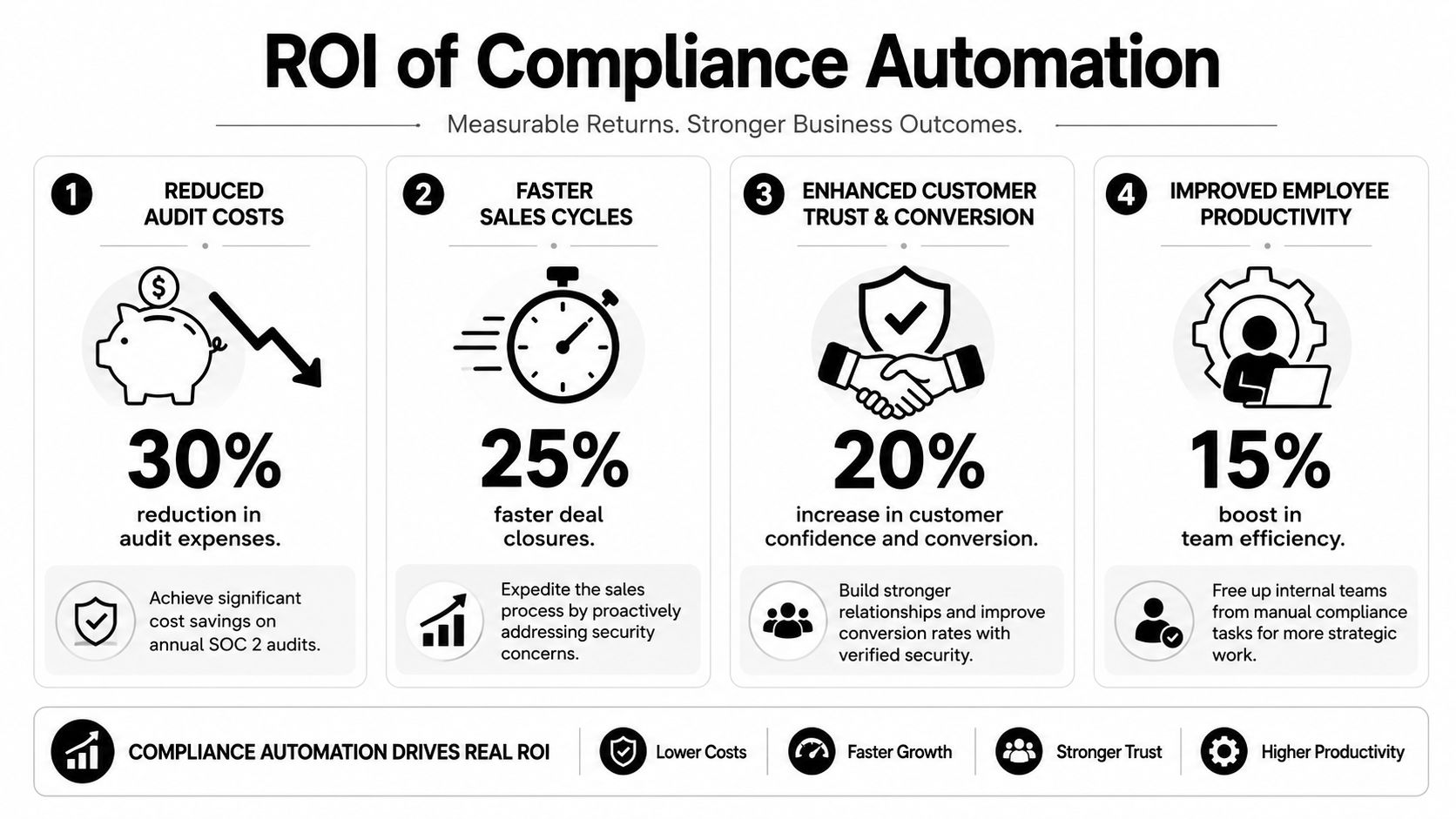
CIOs don't need another argument for buying software that only helps once a year. They need proof that the platform reduces recurring friction across revenue, operations, and risk. That's where SOC 2 compliance automation earns its budget.
A strong SOC 2 platform should automate evidence collection from connected systems and pair that with access reviews, MFA checks, vendor risk tracking, and audit trails, because manual evidence handling increases human error while automated monitoring improves traceability, reduces control drift, and shortens the time needed to prepare for an independent SOC 2 audit, according to this Scytale analysis of SOC 2 software capabilities.
Where the return actually shows up
The first return is usually speed. Security reviews move faster when the organization can produce current control evidence instead of launching a cross-functional document hunt. That doesn't just help compliance. It helps sales, legal, procurement, and customer success.
The second return is labor efficiency. Manual evidence collection is deceptively expensive because it drags in senior people who should be doing other work. Security engineers end up collecting screenshots. IT admins dig through access records. HR confirms onboarding evidence. Compliance teams become project managers for everyone else.
A practical way to frame the investment is to look at the operational drag your current process creates, then compare it against tools that reduce repetitive effort. For teams building a business case, a compliance and automation ROI calculator can help quantify where that time is going today.
Why AI platforms feel the pain first
CX and EX platforms sit on top of fast-changing systems. They touch identity, support tooling, knowledge systems, CRM, workforce applications, telephony, analytics, and vendor ecosystems. Add AI agents, voice workflows, and multilingual interactions, and the number of control-relevant changes rises quickly.
That changes the economics of compliance. A static audit model can't keep pace with a dynamic service model. Continuous monitoring can.
If your platform changes weekly, your evidence model has to keep up weekly too.
For AI-driven operations, the ROI isn't just cleaner audits. It's lower coordination overhead, better visibility into control drift, and fewer late-stage surprises when a buyer or auditor asks for proof.
The CIOs Evaluation Checklist for SOC 2 Software
Most vendor demos look strong for the first fifteen minutes. Dashboards are polished. Framework libraries are extensive. The problem shows up later, when your team discovers that “automation” still means uploading documents manually or reconciling assets in separate systems.
For global enterprises, the harder control challenge is less about writing policies and more about keeping them current as infrastructure and employee tool usage change continuously. The stronger SOC 2 tools now discover and categorize cloud and SaaS assets and automate access reviews to address that operational problem, as discussed in this independent YouTube coverage on modern compliance tooling.
Questions that expose real automation
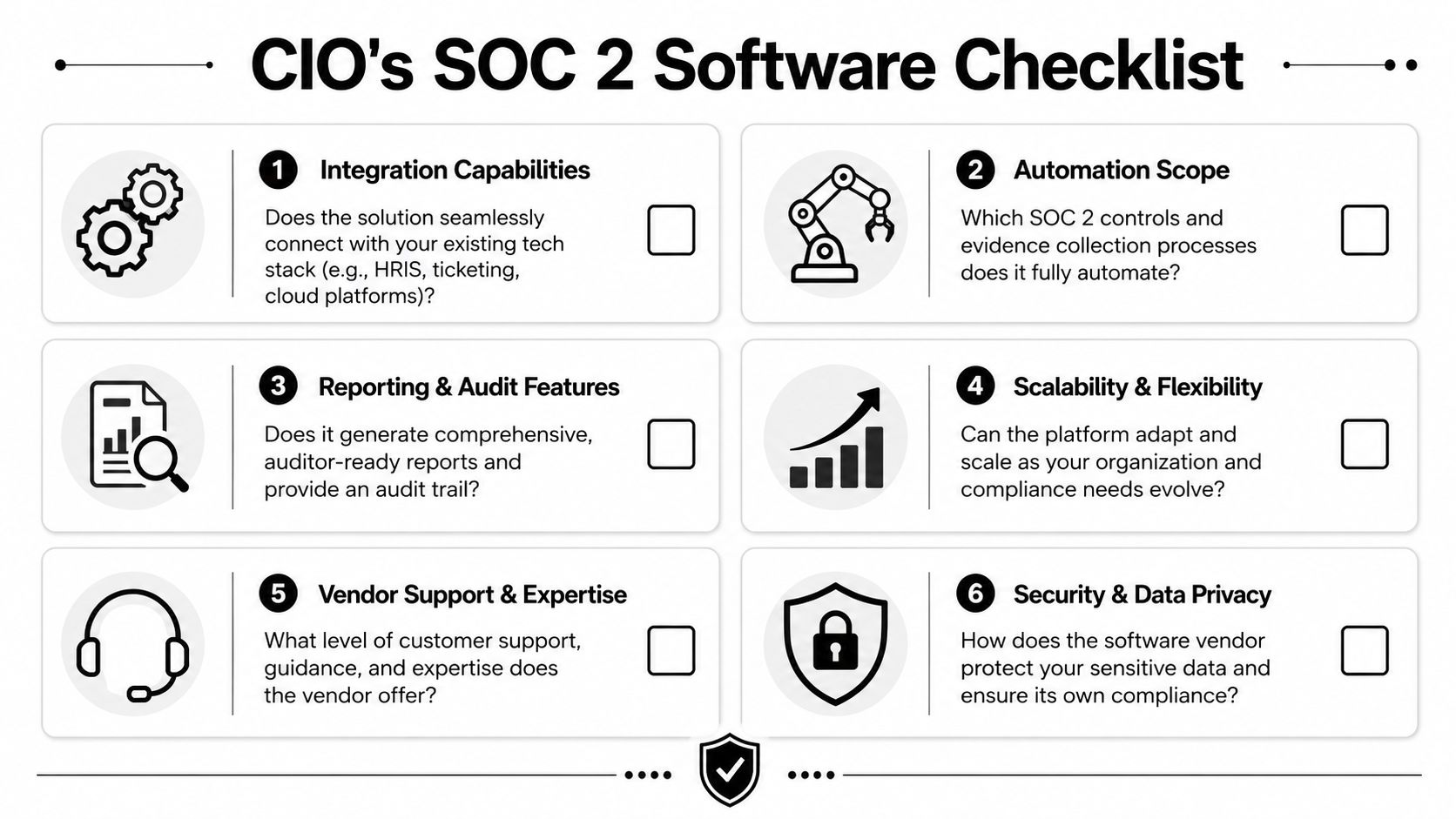
Start with the integration model. If the platform can't connect robustly to the systems that produce your evidence, it will create more administrative work than it removes.
Ask these questions in detail:
- Which integrations are production-grade: Identity providers, cloud platforms, HRIS, ticketing tools, endpoint systems, and collaboration tools should all connect in ways that support recurring evidence collection.
- What is actually automated: Ask the vendor to separate automated evidence collection from manual attestation, reminders, and workflow tracking.
- How exceptions are surfaced: A dashboard without actionable exception handling is just a reporting layer.
- Whether access governance is continuous: Access reviews and MFA checks shouldn't depend on quarterly cleanup efforts.
- How vendor risk is tracked: Third-party reviews should connect to your broader control program, not live in a side module no one maintains.
Signals that a platform will hold up in enterprise environments
The next layer is operational fit. CIOs should care less about template volume and more about whether the platform works in a complex environment with shared ownership.
A strong evaluation usually includes:
- Control ownership clarity. Can each control map to a real internal owner, due date, dependency, and remediation workflow?
- Policy flexibility. Templates are useful, but enterprise teams need room to adapt them to their actual operating model.
- Audit usability. The tool should support clean exports, auditor collaboration, and a traceable history of evidence and approvals.
- Asset awareness. Shadow IT and SaaS sprawl can't be managed if the system only tracks what admins already know about.
- Scalability across teams. Security, IT, legal, HR, and engineering all need usable views, not just the compliance team.
- Vendor maturity. Support quality matters because implementation failures usually come from process design, not screen layout.
If you're evaluating software in parallel with broader AI platform due diligence, a structured buyers guide for evaluating conversational AI solutions can help separate control questions from product capability questions. That keeps the procurement process cleaner on both sides.
Your Implementation Roadmap From Scoping to Audit
SOC 2 programs go off track early, not late. Teams either scope too broadly, automate before controls are defined, or treat the auditor as the person who will tell them what to fix. A disciplined rollout avoids that.
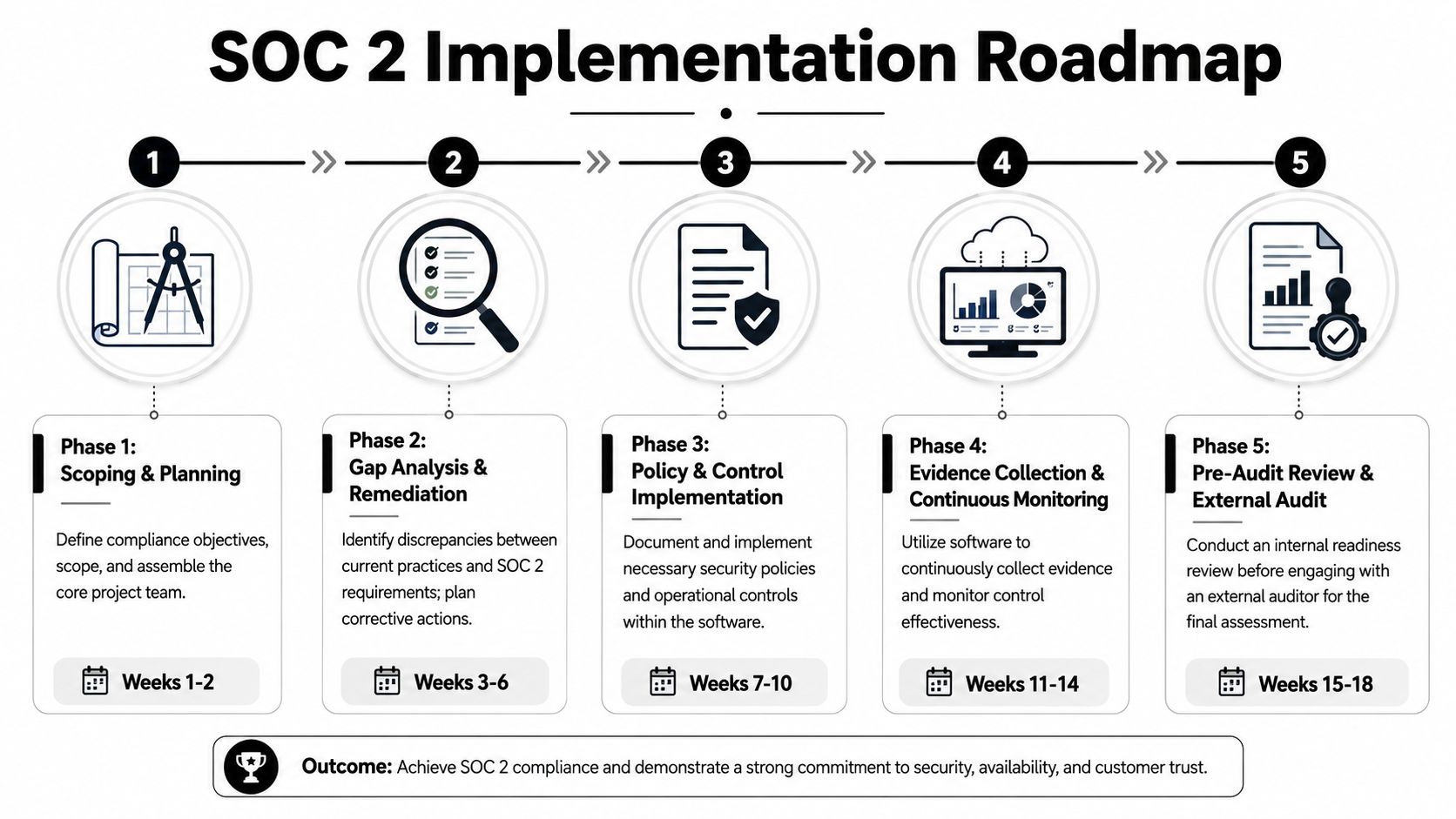
A useful starting view is this roadmap.
Phase one and two getting the foundation right
First, define scope. That means identifying the systems, teams, vendors, and data flows that matter to the service being attested. Don't let the tool decide this for you. Leadership has to decide what environment the report will cover and which trust criteria apply.
Second, run a readiness and gap review. At this stage, the software should help map existing controls, identify missing evidence sources, and assign remediation work. This is also where asset handling details matter more than many teams expect. When hardware is retired or transferred, maintaining a clear chain of custody supports both operational hygiene and defensible records. This overview of documenting IT asset disposition trail is a useful reference for teams tightening asset-related processes.
Here's a short explainer that many leadership teams use to align on the audit journey:
Phase three and four operationalizing the program
Once scope and gaps are clear, move into control implementation. In control implementation, policy management, task workflows, and system integrations should start working together. The key is sequencing. Configure the controls, assign owners, and then turn on automated evidence collection. Don't reverse that order.
After that, use the platform as the operational source of truth:
- Enable integrations carefully so evidence comes from the right systems and owners trust the output.
- Review exception queues regularly instead of saving issues for a pre-audit sprint.
- Use the platform during internal reviews so business owners get used to audit-grade documentation before the auditor arrives.
- Prepare the auditor workspace early to avoid last-minute export chaos.
A strong implementation doesn't end when the auditor starts fieldwork. It continues through the observation period and beyond, because the primary value of the software is maintaining control discipline after the report is issued.
Common Pitfalls and What Compliance Software Cannot Do
The most expensive mistake is believing the tool makes the company compliant. It doesn't. It makes compliance operations more manageable when leadership has already made the hard decisions.
That distinction matters because a major blind spot in the market is what SOC 2 compliance software does not automate. The tools can speed up evidence collection and checklist management, but they do not replace the need to define scope, choose Trust Services Criteria, or remediate control gaps. They mainly help operationalize those steps, and that still requires significant internal coordination, as noted in Secureframe's discussion of SOC 2 Type II readiness.
Where teams overestimate the tool
The first failure pattern is weak ownership. If nobody owns user access reviews, incident response records, vendor reassessments, or policy updates, the platform becomes a nicer-looking backlog.
The second is poor integration quality. Some teams buy a platform that appears to cover a wide range of needs, then discover their important systems still require manual uploads. That creates a false sense of automation and often increases work because people now maintain both a tool and their old spreadsheet process.
The third is treating policy acceptance as proof of control effectiveness. A signed document helps. It doesn't prove the organization followed it consistently.
Software can collect evidence of a process. It cannot create the process discipline by itself.
What disciplined teams do differently
Teams that get durable value from SOC 2 software usually do a few things well.
- They assign named owners across security, IT, legal, HR, and engineering, with deadlines and escalation paths.
- They separate control design from evidence plumbing so they don't automate broken processes.
- They review drift routinely instead of waiting for the audit window.
- They choose tools that match internal maturity. Some organizations need a point solution. Others need consulting support or a broader GRC operating model.
The final practical point is cultural. SOC 2 software can improve traceability, reduce manual coordination, and help maintain a provable control state. It cannot substitute for management judgment, cross-functional cooperation, or a security-first operating culture. For AI-driven platforms, those human decisions matter even more because the environment changes faster than any static checklist can keep up with.
If you're assessing how AI platform strategy, enterprise security, and compliance readiness fit together, Yellow.ai is one example of an enterprise AI platform that presents SOC 2 Type II as part of its broader security and compliance posture. For CIOs, that kind of visibility is useful when vendor evaluation goes beyond features and into control maturity, governance, and buyer assurance.