













Smishing is no longer a side issue in enterprise messaging. It has risen 328% since 2020 and now makes up 39% of all mobile threats globally, while reported SMS fraud losses climbed by over 1,500%, from about $12 million to more than $180 million, according to Allure Security's smishing statistics roundup. For any CTO still treating SMS as a low-risk utility channel, those numbers should force a reset.
Short message service security is now a board-level architecture question. SMS still matters because customers read it, employees respond to it, and operational teams rely on it for alerts, reminders, and authentication. But the old assumption that SMS is “good enough” for sensitive workflows doesn't hold anymore. The right approach isn't to ban it blindly. It's to classify where SMS fits, where it doesn't, and what controls must surround it inside a modern CX and EX stack.
Table of Contents
- Why SMS Security Is a Critical Enterprise Concern in 2026
- Mapping the Modern SMS Threat Landscape
- The Core Vulnerability Protocols and Protections
- Enterprise Best Practices for Secure SMS Workflows
- Integrating SMS Securely into Conversational AI Platforms
- Compliance and Operational Playbooks for CX and EX Leaders
- Conclusion Building a Resilient SMS Communication Strategy
Why SMS Security Is a Critical Enterprise Concern in 2026
The enterprise risk around SMS starts with a basic mistake. Teams confuse high deliverability with high trustworthiness. Those are not the same thing.
Customers still open texts quickly. Employees still act on them fast. Attackers know that, and they exploit the speed of the channel. When a text arrives, users usually have less context, less visible sender information, and less patience for inspection than they do in email or inside a secure app. That makes SMS effective for legitimate engagement, but it also makes it a strong carrier for fraud.
Short message service security deserves executive attention because SMS often sits inside business-critical flows. It's used for login challenges, appointment reminders, shift notifications, payment prompts, delivery updates, and support escalations. If that channel is compromised, the result isn't limited to one bad message. It can lead to account takeover, credential theft, payment fraud, support abuse, and direct brand impersonation.
Why business leaders should treat SMS differently now
A modern SMS risk review has to include more than phishing awareness.
- Customer trust risk: Attackers routinely mimic legitimate brands in text-based flows. When users can't tell your messages from fake ones, your brand carries the reputational cost.
- Operational risk: Support teams, fraud teams, and contact centers absorb the fallout from malicious or spoofed text interactions.
- Identity risk: If SMS is part of authentication or recovery, attackers only need one weak link in the flow.
- Compliance risk: Regulated sectors often keep using SMS for convenience, even when the underlying data handling model is weak.
Practical rule: If a workflow would create material harm when intercepted, spoofed, or socially engineered, SMS should not be the primary trust anchor.
The issue isn't that SMS has no place in enterprise communications. It does. The issue is that many organizations still deploy it as if it were a secure channel by default. It isn't. In 2026, secure use of SMS means narrowing its role, reducing what it carries, and surrounding it with stronger controls than most legacy deployments ever had.
Mapping the Modern SMS Threat Landscape
Attackers don't need to break every layer of your environment. They look for whichever SMS-related weakness gives them the fastest path to identity, money, or access.
What attackers target first
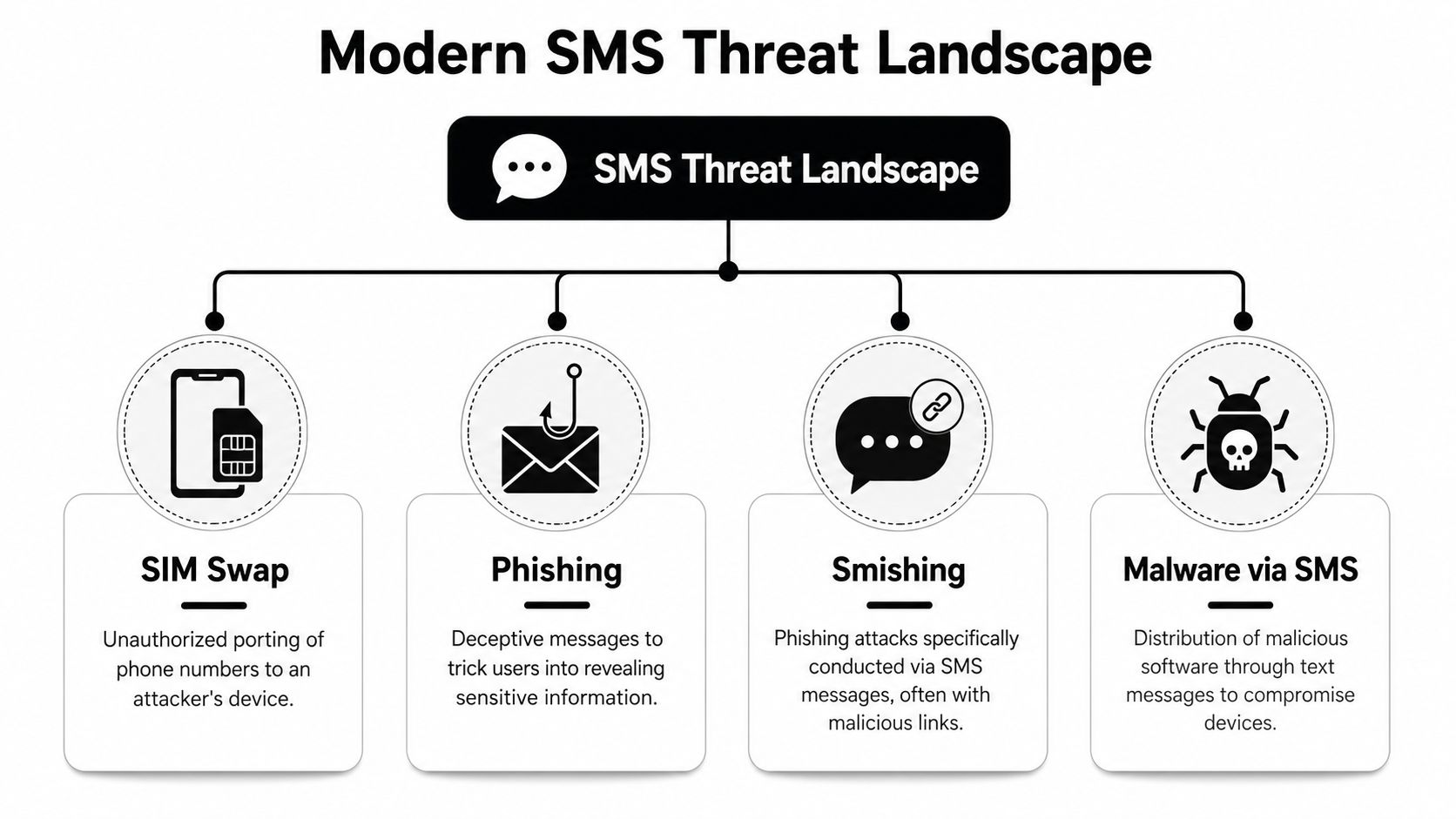
Four patterns show up repeatedly in enterprise environments.
- Smishing: The classic text-based phishing play. The attacker sends a message that creates urgency, impersonates a trusted brand, and pushes the user to click, reply, or call.
- Message spoofing: The user sees what looks like your sender identity, but the message originated elsewhere. This is especially damaging for banks, healthcare providers, logistics firms, and HR teams.
- SIM swapping: The attacker convinces a mobile carrier to move the victim's number to a device they control. Once that happens, texts and one-time codes can route to the attacker.
- Mobile malware via SMS: A malicious link or app install turns the phone itself into the point of compromise, which can expose messages, credentials, and session data.
Each of these paths attacks trust from a different angle. Smishing exploits human response. Spoofing attacks brand identity. SIM swapping undermines number ownership. Malware compromises the endpoint.
Why SS7 still matters to enterprise risk
Many leaders assume SMS insecurity is mainly a user behavior problem. It isn't. The channel has protocol-level weakness underneath it.
The SS7 network, which carriers use to route SMS globally, lacks mandatory authentication for inter-carrier message requests, which means an attacker with SS7 access can redirect, read, or modify messages in real time, as described in the University of Malaya review of mobile short message service security issues. The simplest way to explain that to a board is this: it resembles a global postal routing system where some forwarding instructions aren't strongly authenticated.
That matters because SMS often gets treated like proof of possession. In reality, it is often only proof that a message reached a phone number under current conditions. Those are not equivalent.
If your security model assumes the phone number is the user, your model is already too weak.
For enterprise planning, the practical takeaway is straightforward. Don't rank all SMS threats equally. Brand spoofing and smishing matter most for CX harm. SIM swapping matters most for identity and account recovery. SS7-related exposure matters most for anyone who still assumes SMS transport is trustworthy.
The Core Vulnerability Protocols and Protections
The simplest mental model for short message service security is this: SMS behaves like a postcard. Anyone with the right level of network access or infrastructure position can potentially read or interfere with what's in transit. End-to-end encrypted messengers behave more like sealed envelopes. That difference should shape every architecture decision.
SMS is a postcard, not a sealed envelope
SMS messages are transmitted in clear text rather than end-to-end encrypted form. Research on the SMS ecosystem found that SMS-based 2FA services also often rely on low-entropy one-use codes, including simple 4-digit numbers with about 10,000 combinations, creating room for brute-force abuse in poorly designed implementations, according to the University of Florida analysis of SMS one-time passwords and gateways.
This is why endpoint controls alone don't solve the problem. A managed mobile device, mobile threat defense tool, or hardened app can reduce some risks on the handset, but none of those protections convert SMS transport into a confidential channel. They help at the edges. They do not repair the medium itself.
What protections help and what they cannot fix
A sensible control strategy separates what SMS can do well from what it should never do.
Use SMS for notifications, prompts to enter a secure portal, low-sensitivity reminders, and fallback communications. Don't use it to carry secrets, sensitive records, or trust-defining decisions by itself. If a business process requires higher assurance, move the user into a controlled environment such as a secure app, authenticated web session, or encrypted messaging channel.
For AI-powered CX and EX systems, this principle becomes architectural. The messaging layer should never be treated as the system of trust. The trust layer must live elsewhere, in verified identity, session controls, secure APIs, and platform governance. That's the standard behind an enterprise-grade security model for conversational platforms.
A useful design test is simple:
- Can this message be intercepted without creating material harm? SMS may be acceptable.
- Would this message expose regulated data, credentials, or account control? SMS is the wrong transport.
- Is this message only a pointer to a secure destination? That's usually the safer pattern.
Enterprise Best Practices for Secure SMS Workflows
Most SMS programs don't fail because teams ignored security entirely. They fail because teams applied generic controls to a channel that needs very specific design discipline.
Design rules that reduce exposure
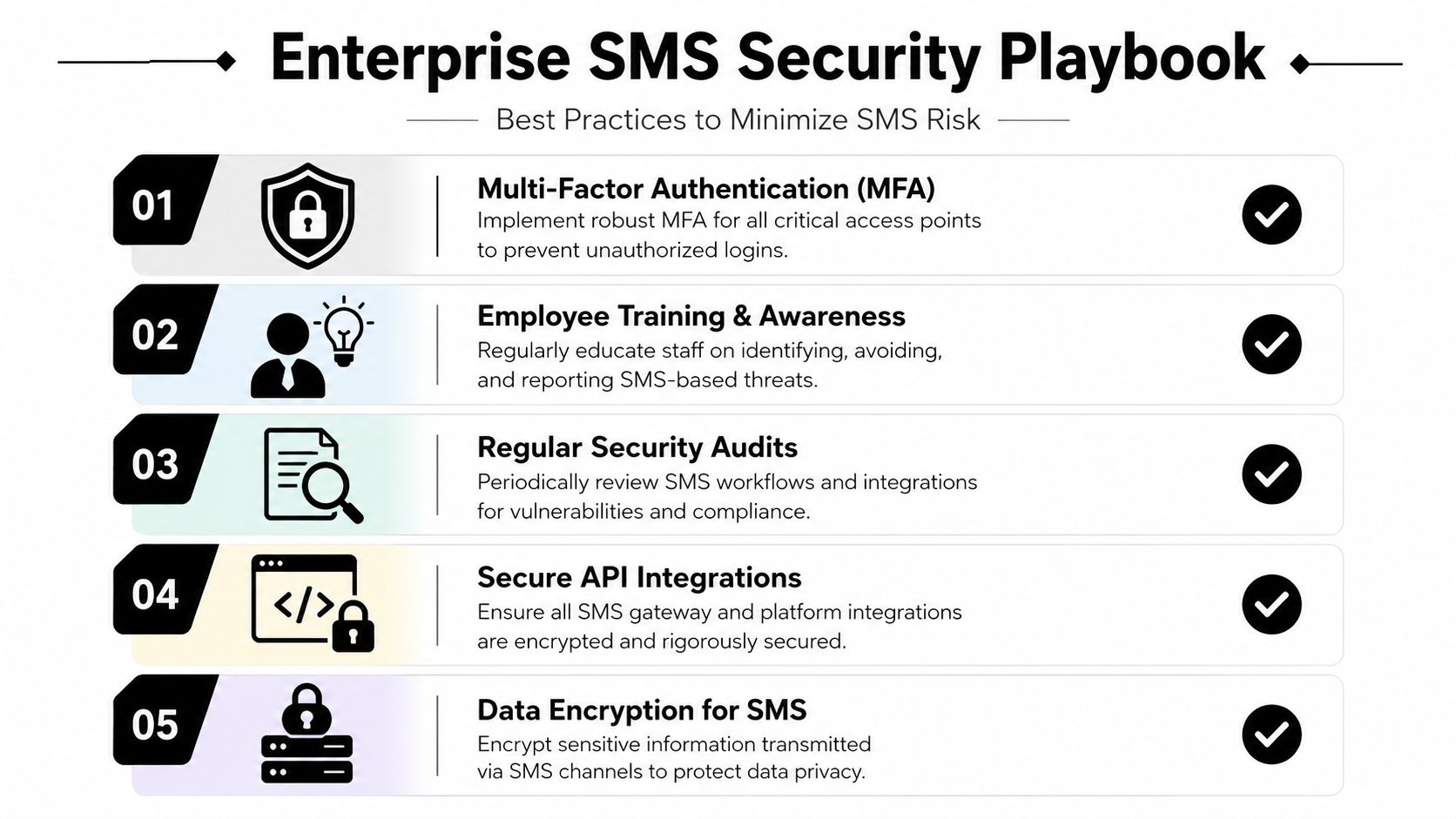
Start with the message itself. The safest SMS is short, boring, and incomplete by design.
- Never include sensitive data: Don't place account numbers, health details, card data, passwords, full personal identifiers, or internal employee details in the text body.
- Avoid full trust decisions in SMS: A one-time code sent over SMS shouldn't be the only proof required for high-risk actions like account recovery, payout changes, or privileged access.
- Keep links controlled: If you must include a link, send users to a secure portal with strong session and fraud checks. Don't use SMS as the place where identity is proven.
- Write recognizable copy: Standardize tone, sender naming, and message patterns so users can learn what legitimate communications look like.
The same principle applies to one-time passwords. If a team still uses SMS OTP, don't pair it with weak recovery logic, easy replay conditions, or broad access rights after successful entry. Treat SMS OTP as a low-assurance factor, not a high-assurance one.
A short walkthrough can help teams pressure-test their design choices:
SMS Security Best Practices Checklist
| Area of Focus | Best Practice | Rationale |
|---|---|---|
| Message content | Exclude sensitive data from SMS bodies | Intercepted or misdirected texts should not expose regulated or high-value information |
| Authentication | Use SMS only as a lower-assurance factor or fallback | Text delivery to a number is weaker than proof of user identity |
| Link handling | Route users into secure portals or apps | Sensitive actions belong in authenticated environments |
| Vendor management | Review SMS gateway controls, logging, and abuse handling | The provider becomes part of your security boundary |
| Monitoring | Track anomalous delivery, response, and recovery patterns | Abuse often appears first as behavioral irregularity |
| Recovery flows | Remove SMS-only account recovery for high-risk users | Recovery paths are frequent takeover targets |
| User education | Teach users what your legitimate SMS messages look like | Consistent messaging lowers impersonation success |
Operational controls that catch abuse early
Message design is only half the job. The rest is operational.
- Harden provider oversight: Review SMS gateway vendors for logging depth, sender management, incident handling, and API authentication practices.
- Instrument the flow: Monitor unusual spikes in OTP requests, repeated failed verifications, unusual geography shifts, and sudden changes in recovery behavior.
- Create fraud handoffs: Your messaging, security, support, and identity teams need a shared escalation path. SMS abuse often lands in support before it lands in security.
- Train employees on workflow abuse: Internal users are common targets for HR, payroll, and IT-themed smishing.
Operator mindset: Design every SMS workflow as if an attacker can read the text, imitate the sender, and pressure the recipient at the same time.
What works is controlled scope, layered verification, and visible monitoring. What doesn't work is assuming that a text message becomes safe because it came from your system.
Integrating SMS Securely into Conversational AI Platforms
Conversational AI changes the SMS risk equation because it increases automation, speed, and scale. That can improve CX and EX. It also means a weak SMS design can create a faster path to abuse.
Where conversational systems add risk
In a simple legacy setup, SMS might only send a reminder or a code. In an AI platform, SMS can trigger workflows, gather intent, pull account data, update records, escalate to voice, and hand off to agents. That makes the channel more useful, but it also creates more attack surfaces.
One emerging problem is the hybrid threat between channels. According to Broadcom's discussion of hidden dangers in SMS OTP, SMS-to-Voice AI spoofing attacks grew 340% in 2025. In these attacks, an AI agent intercepts or captures the SMS code and then impersonates the user by voice to complete the takeover. That's exactly the sort of cross-channel abuse many enterprise designs still miss.
This matters for automated support, employee self-service, and contact center verification. A system that treats SMS and voice as separate trust events can be manipulated if an attacker controls both moments in sequence.
How to architect the channel safely
The answer isn't to remove SMS from conversational systems. It's to isolate its role.
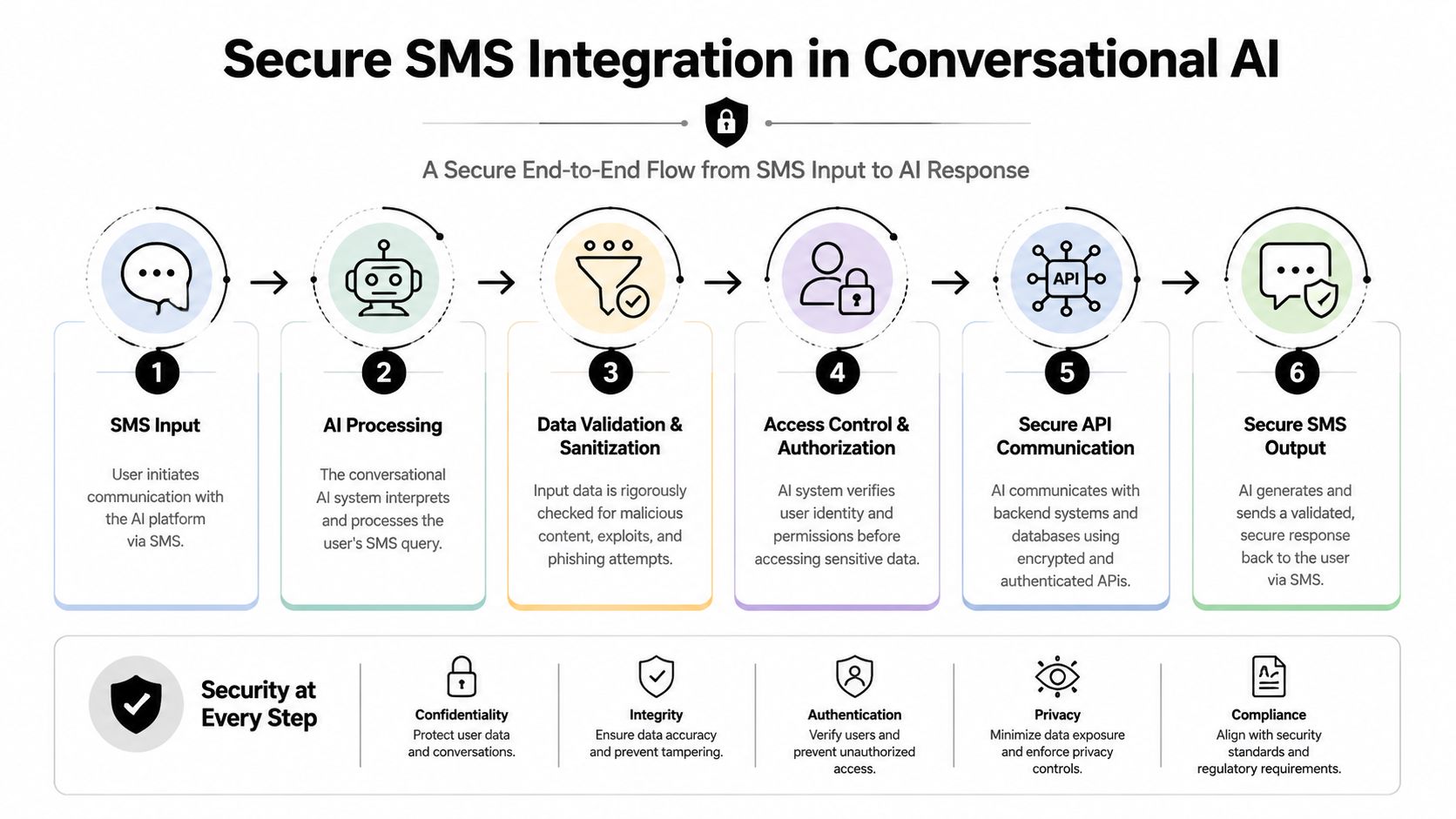
Use SMS as a transport and notification layer, not as the place where core trust is established. Keep the SMS gateway segmented from core systems. Require authenticated, encrypted API calls between orchestration layers and backend services. Sanitize inbound text, restrict what the bot can reveal before stronger verification, and gate sensitive actions behind higher-assurance controls.
For practical deployment, I'd set these rules:
- Separate channel from authority: SMS can initiate or continue a conversation, but it shouldn't approve high-risk actions on its own.
- Limit data exposure in bot responses: The bot should reveal only minimum necessary context until the user moves into a stronger verification step.
- Treat cross-channel escalation as high risk: If SMS hands off to voice, chat, or agent assist, preserve fraud signals and identity context across the transition.
- Constrain automation: Don't let a bot reset credentials, change payout instructions, or disclose regulated records from SMS alone.
Teams building AI messaging workflows should also evaluate how text automation architecture handles identity, backend access, and abuse monitoring. The secure pattern is composable orchestration with strict trust boundaries, not free movement between channels.
Compliance and Operational Playbooks for CX and EX Leaders
The most common compliance mistake with SMS is asking the wrong question. Leaders ask, “Can we use SMS in healthcare or financial services?” The better question is, “What exactly are we sending, and what control system surrounds it?”

A workable rule for regulated teams
The gap in most guidance is obvious. Despite HIPAA risks, 68% of US healthcare providers still use SMS for patient reminders, yet no practical compliance-backed framework exists in 2026 beyond “don't use SMS,” as noted in the PubMed Central discussion of healthcare texting practices.
That reality doesn't mean regulated teams are reckless. It means operations need the channel. Patients miss portal messages. Employees ignore email. Customers respond to texts. The operational demand is real. The answer is disciplined scope control.
A practical compliance playbook looks like this:
- Use SMS for notification, not disclosure: Send reminders, alerts, and prompts without including protected or regulated content.
- Move detail into secure destinations: Link to authenticated portals or apps where the actual sensitive data lives.
- Define approved message templates: Legal, compliance, and security teams should pre-approve what each business function may send.
- Separate consent from convenience: Document user consent for SMS communications and keep channel preferences current.
- Retain auditability: Keep records of template use, sender identities, delivery events, and policy exceptions.
For regulated environments, the safest SMS is usually the one that says just enough to drive action, and nothing more.
Operational policy that survives audit review
Auditors usually care less about whether SMS exists and more about whether leadership can show control over its use.
That means writing policy at the workflow level, not at the channel level. HR, support, collections, clinical operations, and fraud teams should not all inherit the same SMS permissions. Each function needs allowed-use definitions, prohibited content rules, escalation standards, retention handling, and exception review.
I'd also require three governance habits:
- Template governance: No ad hoc texting for regulated processes.
- Periodic review: Revalidate templates, routing logic, and vendor dependencies as systems change.
- Disclosure path testing: Confirm that secure links, login prompts, and handoffs don't accidentally reveal sensitive context.
If you publish vulnerability handling expectations for your software and partners, align SMS workflows to the same standard of reporting and remediation rigor reflected in a vulnerability disclosure program. Compliance teams need more than channel bans. They need repeatable controls that match how the business operates.
Conclusion Building a Resilient SMS Communication Strategy
The market has moved past the idea that SMS is harmless by default. In December 2024, the FBI and CISA urged smartphone users to stop using standard text messaging for sensitive communications and to abandon SMS-based MFA, effectively classifying the medium as insecure for protecting digital identity, as covered in this summary of the federal advisory and the Salt Typhoon context.
That doesn't mean enterprises should abandon SMS entirely. It means they should stop treating it as a trusted container. SMS still works well for reach, reminders, and lightweight engagement. It works poorly as a carrier for secrets, a proof of identity, or a stand-alone control for high-risk actions.
A resilient short message service security strategy is built on narrower scope, stronger surrounding controls, clean workflow design, and governance that stands up under audit. For CTOs leading AI-powered CX and EX platforms, this marks a significant evolution. SMS is no longer a simple feature. It's a managed risk surface inside a larger omnichannel trust architecture.
If you're evaluating how to deliver secure, enterprise-ready conversations across SMS, voice, chat, and other channels, explore Yellow.ai to see how an agentic AI platform can support stronger CX and EX orchestration without treating insecure channels as trust anchors.



