













Most advice on RAG vs LLM gets one thing wrong. It treats the decision like a model bake-off.
That's too narrow for enterprise AI. The real question isn't whether retrieval reduces hallucinations or whether a base model sounds more fluent. The real question is which architecture gives your business the right balance of accuracy, control, speed, security, and operational resilience when customers and employees depend on the answer.
For a support leader, that affects whether an AI agent gives a policy-compliant response or invents one. For HR, it affects whether an employee gets the latest benefits guidance or an outdated summary. For IT, it determines whether proprietary knowledge stays governed or leaks through a weak retrieval layer. That's why choosing between a standalone LLM and a RAG system belongs in the same conversation as platform governance, knowledge management, and risk management. Teams using AI as an enterprise capability, not a demo, need a sharper evaluation lens than “which one is smarter.”
A practical buying process helps. Yellow.ai's buyer's guide to evaluating conversational AI solutions is useful because it pushes the discussion toward deployment readiness, governance, and business outcomes rather than model hype.
Table of Contents
- The Strategic Choice Beyond the Hype
- Foundational Concepts What Is an LLM and What Is RAG
- RAG vs LLM A Detailed Architectural Comparison
- Performance Cost and Scalability Tradeoffs
- Key Enterprise Use Cases for CX and EX
- How to Implement and Evaluate RAG in Your Enterprise
- Making the Right Choice and The Future of Agentic AI
The Strategic Choice Beyond the Hype
Enterprises don't buy AI to admire model outputs. They buy it to run service, automate decisions, and make knowledge usable at scale.
That changes how the RAG vs LLM decision should be framed. A standalone LLM may be enough when the task is broad, language-heavy, and tolerant of approximation. A RAG system becomes more attractive when the answer must reflect live policies, internal content, product updates, or regulated knowledge. The architecture you choose shapes trust far more than the model name does.
What leaders often underestimate
The common assumption is simple: pick RAG if you want accuracy, pick an LLM if you want creativity. That's directionally useful, but operationally incomplete.
What usually gets missed is that enterprise performance depends on the whole chain. Retrieval quality, content permissions, chunking strategy, prompt design, and fallback behavior often matter as much as model capability. Teams that ignore those layers tend to discover the problem late, after rollout, when users start asking questions the demo never covered.
Practical rule: If your AI agent answers questions tied to internal truth, the knowledge system is part of the product, not a background integration.
Why this is a business architecture decision
For CX teams, this choice affects consistency and policy alignment. For EX teams, it affects whether employees trust self-service enough to use it. For CIOs and platform owners, it affects how fast knowledge can change without requiring model retraining.
A strong enterprise strategy usually starts with three questions:
- How often does the knowledge change? If content shifts frequently, a static model-only approach becomes harder to govern.
- How costly is a wrong answer? Some use cases can tolerate soft errors. Others can't.
- What must be explainable? In many workflows, teams need to inspect the source behind the answer, not just the answer itself.
That's why the debate is no longer academic. It sits at the center of building an autonomous enterprise that can act intelligently without losing control.
Foundational Concepts What Is an LLM and What Is RAG
A large language model, or LLM, is the reasoning and generation engine commonly associated with modern AI. It learns patterns from large text datasets and uses those patterns to generate responses, summarize content, classify text, and carry out language-heavy tasks.
In enterprise terms, an LLM is often best understood as a highly capable closed-book system. It answers from what it absorbed during training and from the prompt it receives at runtime. That makes it powerful, fast to experiment with, and flexible across many tasks. It also means it doesn't automatically know your latest return policy, pricing rule, compliance update, or benefits handbook revision.
The closed-book versus open-book difference
Retrieval-augmented generation, or RAG, is not a separate replacement for an LLM. It's an architectural pattern that adds retrieval before generation. IBM notes that RAG was formally introduced in a 2020 paper to give large language models access to information beyond their training data, and describes the difference: a standalone LLM is a closed-book model, while RAG is an open-book workflow that can cite its sources in enterprise use cases (IBM Research on retrieval-augmented generation).
That open-book framing matters because it changes how answers are produced. Instead of relying only on model memory, the system first searches a knowledge source, retrieves relevant documents or passages, and then passes that context into the model so the response is grounded in current material.
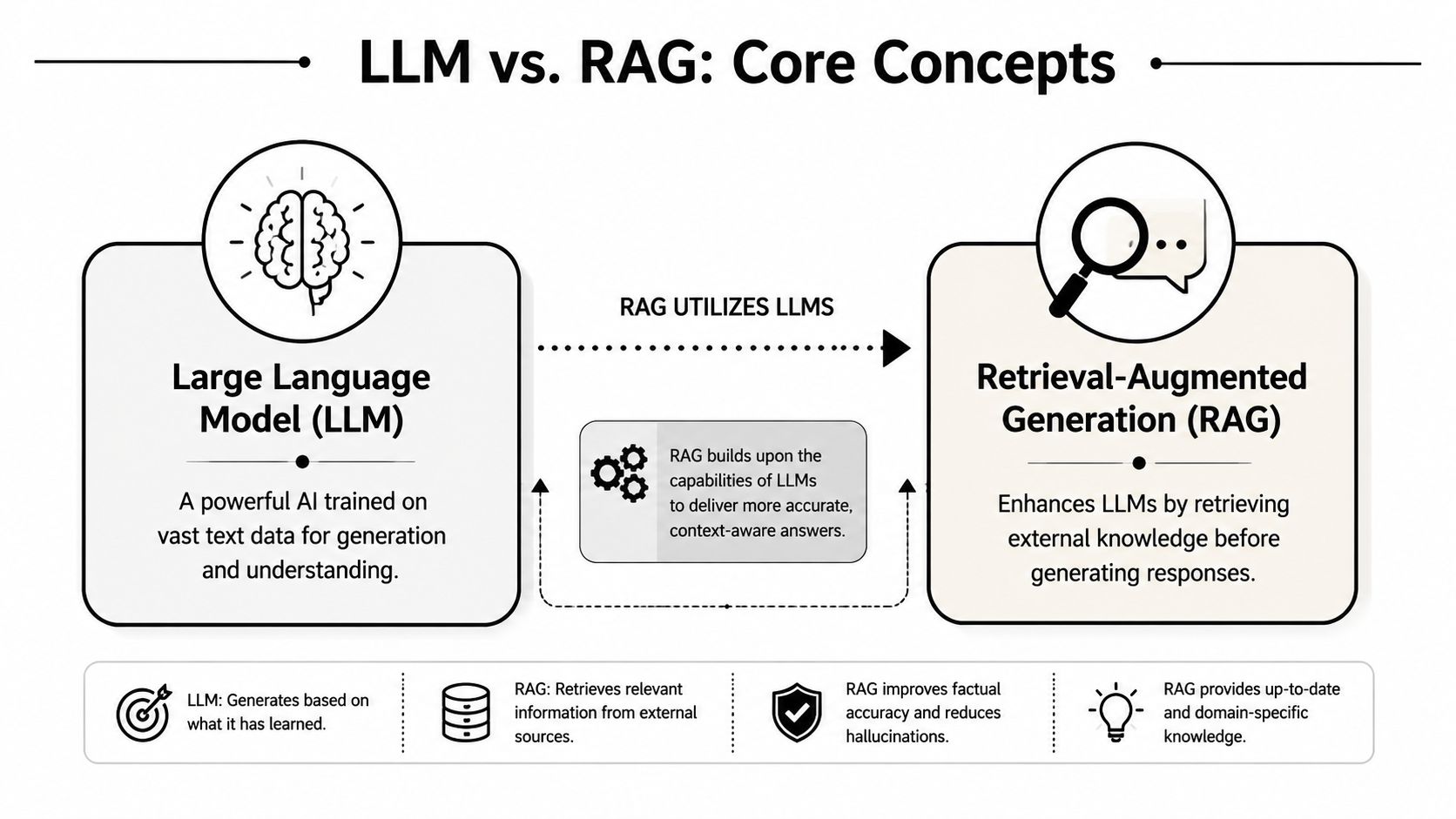
A useful analogy is this. A standalone LLM is like a brilliant employee taking a closed-book exam. A RAG system is like the same employee taking an open-book exam with access to the company handbook, product catalog, and policy repository.
Why that distinction matters in enterprise AI
The benefit isn't just better recall. It's operational agility.
When your organization changes product information, support scripts, compliance language, or internal process docs, RAG lets you update the knowledge source instead of changing model weights. That's one reason it has become a practical foundation for enterprise AI deployments. It aligns better with how businesses operate, where the knowledge changes faster than the core language capability.
This is also where RAG starts to connect with more autonomous systems. Yellow.ai's guide to agentic AI and how it differs from AI agents is useful for understanding the next step: systems that don't just answer, but decide when to retrieve, when to reason, and when to act.
A model can sound intelligent without being current. Enterprise AI needs both.
RAG vs LLM A Detailed Architectural Comparison
The most useful RAG vs LLM comparison isn't about which one “wins.” It's about what each one assumes about knowledge, control, and risk.
Below is the practical comparison most enterprise teams need early in evaluation.
Core differences that matter in production
| Criterion | Standalone LLM | RAG System |
|---|---|---|
| Knowledge source | Internal model parameters plus user prompt | Retrieved external knowledge plus model reasoning |
| Freshness | Limited by training cutoff and prompt content | Can reflect newly updated documents if retrieval is configured well |
| Verifiability | Harder to trace exactly why an answer was produced | Can point to supporting documents used in the answer |
| Hallucination profile | More likely to fill gaps from learned patterns when facts are missing | Usually better grounded when retrieval returns relevant evidence |
| Maintenance model | May require prompt work or retraining for domain adaptation | Requires ongoing content ingestion, indexing, and retrieval tuning |
| Failure mode | Confident but unsupported answers | Wrong, stale, or unsafe answers caused by poor retrieval or unsafe documents |
| Security exposure | Risks center on prompt handling, output control, and model behavior | Adds retrieval-layer risks such as document hygiene and prompt injection via content |
This is why a conversational knowledge layer matters as much as the model layer. Platforms such as Yellow.ai's conversational knowledge base are built around that reality, where retrieval, governance, and grounding need to be managed as first-class parts of the system.
Where RAG can go wrong
RAG is often presented as the safe enterprise answer because it grounds the model in real documents. That's only half true.
Glean's analysis makes the overlooked point clearly: while RAG is framed as an accuracy booster, it can also weaken safety by bypassing built-in model guardrails. Retrieval quality, document hygiene, and prompt-injection defenses determine whether RAG improves outcomes or creates a new attack surface (Glean on RAG versus LLM safety tradeoffs).
That changes how teams should evaluate enterprise readiness.
- Weak retrieval breaks good models. If the retriever pulls the wrong passages, the model may generate a polished but incorrect answer grounded in the wrong evidence.
- Messy source content contaminates outputs. Duplicates, outdated docs, conflicting policies, and poorly permissioned content create confusion before the model even starts generating.
- Unsafe documents can manipulate prompts. If retrieved text contains malicious or misleading instructions, the system may treat them as context unless you actively defend against that behavior.
- Source visibility can cut both ways. Citability improves trust, but it also exposes how critical it is to control what the system is allowed to see.
More grounded doesn't automatically mean more secure.
A standalone LLM has its own weaknesses, especially on current knowledge. But its risk surface is narrower. RAG expands capability by expanding the system boundary. That's valuable, but it means architecture discipline matters more.
Performance Cost and Scalability Tradeoffs
Once teams move past the demo, operational reality shows up quickly. Retrieval improves many enterprise workflows, but it also adds moving parts.
A standalone LLM has a simpler request path. The user sends a prompt, the model generates a response, and the system returns it. A RAG system adds ingestion pipelines, embeddings, indexing, retrieval, reranking in some stacks, prompt assembly, and then generation. That added chain affects latency, observability, and cost attribution.
What drives operational load
The cost profile is different for each approach.
For a standalone LLM, the main drivers are model selection, token volume, prompt length, and concurrency. For RAG, the model still matters, but the retrieval stack becomes part of the bill and part of the reliability story. Teams need to budget for content preparation, embedding workflows, storage, retrieval calls, and monitoring of retrieval quality over time.
In practice, that means RAG often asks more from platform engineering than from prompt engineering alone.
- Ingestion discipline matters. Documents need cleaning, deduplication, access controls, and sensible chunking before retrieval can work reliably.
- Latency has more components. Search, filtering, and context assembly add extra steps before generation begins.
- Failure diagnosis gets harder. When an answer is poor, teams must determine whether the issue came from retrieval, ranking, prompt construction, or generation.
Why retrieval can still scale well
The extra complexity doesn't mean RAG stalls at scale. Research summarized by Pinecone reports that adding more retrievable data improved results even when the corpus expanded to 1 billion documents, and that retrieval-augmented systems outperformed GPT-4 without retrieval on knowledge-heavy tasks (Pinecone on scaling retrieval in RAG systems).
That result matters for enterprise planning because it points to a practical truth: growing the knowledge base doesn't automatically degrade usefulness if the retrieval layer is designed well.
Retrieval systems don't fail because they have too much knowledge. They fail because the stack can't surface the right knowledge fast enough and safely enough.
For leaders building AI for service operations, the implication is straightforward. Don't evaluate cost in model terms only. Evaluate the full serving architecture, including what it takes to keep knowledge current, permissioned, searchable, and observable in production.
Key Enterprise Use Cases for CX and EX
The fastest way to make sense of RAG vs LLM is to map each approach to the work itself.

In customer and employee operations, the difference becomes obvious. Some tasks reward creativity and broad language ability. Others demand precise answers tied to enterprise truth. Treating those as the same category creates poor architecture decisions.
When a standalone LLM is enough
A standalone LLM can be the right choice when the task is generative, synthetic, or low-risk.
Think about a marketing team drafting campaign variations, an operations team summarizing meeting notes, or a support manager rewriting macros for tone and clarity. These use cases benefit from language fluency, pattern recognition, and fast iteration. They don't always require citation to a live internal source.
It's also useful for early copilots that help agents write better responses rather than answer customer questions directly. In that mode, the model supports human work instead of acting as the final authority.
Good fits often include:
- Creative drafting: Email copy, campaign concepts, response rewrites, and tone adjustments.
- Summarization work: Meeting recaps, ticket summaries, and call-note condensation.
- Language transformation: Translation, simplification, paraphrasing, and formatting help.
When RAG becomes non-negotiable
RAG becomes much harder to avoid when the answer needs to reflect current enterprise knowledge.
Galileo's comparison notes that grounding generation through retrieval can deliver up to a 13% accuracy gain over models relying only on internal parameters, making RAG stronger for enterprise QA where factual precision and freshness matter (Galileo on comparing RAG and traditional LLMs).
That aligns with the patterns seen in production:
- Customer support agents need current refund rules, plan entitlements, troubleshooting flows, and policy exceptions.
- HR and EX assistants need benefits content, leave policies, payroll guidance, and onboarding procedures that change over time.
- Regulated workflows need answers grounded in approved documentation, not inferred from generic web-scale training.
A healthcare support assistant, for example, may need to answer administrative questions using the latest internal scripts and approved documents. A banking service bot may need to explain a process using current policy language while respecting access boundaries. An employee helpdesk assistant may need to answer software access questions based on internal IT documentation that changes frequently.
A short explainer on the operational difference helps frame the choice:
The practical rule is simple. If the system is expected to act like your company's memory, it needs retrieval. If it's expected to act like a language assistant, a standalone LLM may be enough.
How to Implement and Evaluate RAG in Your Enterprise
Many RAG projects don't fail because the model is weak. They fail because teams rush to prompts before they fix the knowledge layer.
A durable implementation starts with disciplined content operations. That means deciding what content belongs in the knowledge base, who owns it, how it's permissioned, how often it changes, and how conflicts are resolved. Only then does prompt design become meaningful.
Build the knowledge layer before the prompt layer
Start with document quality. Remove outdated files, collapse duplicates, separate policy from commentary, and preserve metadata that helps ranking and access control. Most retrieval problems begin here.
Then build the retrieval workflow around how people naturally ask questions. Support users don't speak like document authors. Employees don't use the exact wording in the handbook. Your indexing and chunking strategy should reflect that mismatch.
A practical implementation checklist looks like this:
- Audit the source corpus. Decide which systems hold the approved truth and which content should stay out.
- Define access boundaries. Retrieval should respect role-based permissions before content reaches the prompt.
- Chunk for meaning, not just length. Break documents where ideas stay coherent.
- Design prompts to use evidence. Tell the model how to answer when evidence is weak, conflicting, or missing.
- Create fallback behavior. Sometimes the right answer is to ask a clarifying question or escalate.
Measure retrieval and answers separately
Many enterprise teams still use the wrong scorecard. RAG evaluation isn't one metric.
Evidently AI notes that RAG evaluation is decomposed into retrieval quality and generation quality, and highlights benchmarks such as RAGTruth, which targets hallucination detection with 18,000 generated responses, and RULER, which tests long-context retrieval and related tasks. The practical takeaway is that enterprise teams need both information-retrieval metrics and answer-grounded metrics for a complete picture (Evidently AI on RAG benchmarks and evaluation).
That leads to a stronger enterprise review process:
- Check retrieval first. Did the system fetch the right evidence?
- Check answer grounding next. Did the response stay faithful to that evidence?
- Inspect abstention behavior. Did the agent avoid guessing when support was weak?
- Test adversarial inputs. Can prompt-like content inside documents manipulate the answer?
If you only evaluate final answers, you'll miss the root cause of failure.
This is the stage where platform tooling matters. Teams usually need retrieval diagnostics, test harnesses, observability, and workflow controls in one place. Yellow.ai is one example of a platform that combines agent building with a conversational knowledge base, testing workflows, and multi-LLM orchestration for enterprise deployments.
Making the Right Choice and The Future of Agentic AI
The strongest enterprise decision framework starts with business conditions, not AI fashion.
Choose a standalone LLM when the task is language-heavy, low-risk, and doesn't depend on fast-changing internal truth. Choose RAG when users need current, governed, explainable answers tied to enterprise knowledge. Consider hybrid patterns when the workflow needs both strong reasoning and live retrieval.
That's also why the future of this debate isn't really RAG vs LLM. It's RAG and LLM, orchestrated intelligently.
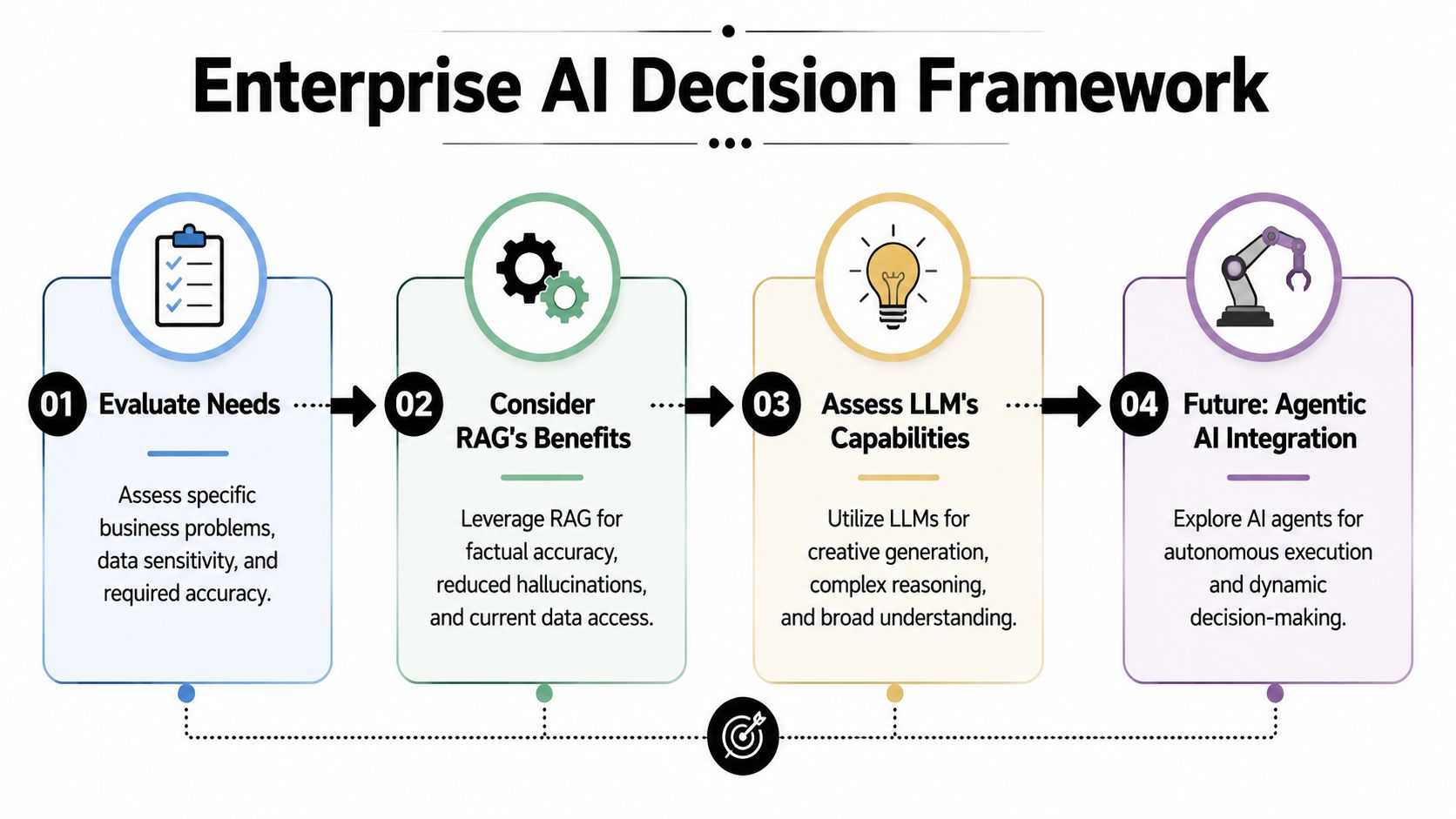
The next generation of enterprise systems won't treat retrieval as a fixed step for every query. They'll decide when retrieval is necessary, when internal reasoning is enough, when a question needs a clarifying follow-up, and when another tool should be invoked. That's the core shift toward agentic AI. The system doesn't just produce text. It chooses the right mode of intelligence for the job.
For enterprise leaders, that means the architecture decision you make now should support that evolution. The right stack should let you mix models, govern knowledge, evaluate groundedness, and harden security controls without rebuilding from scratch later.
The winning design is rarely the purest one. It's the one that makes the organization more autonomous without making it less trustworthy.
If you're evaluating how to operationalize RAG, LLMs, or hybrid agentic workflows across CX and EX, Yellow.ai offers an enterprise AI platform for building, testing, governing, and deploying AI agents with conversational knowledge management, multi-LLM orchestration, and enterprise control layers.



