














A CX leader opens the weekly dashboard and sees a reassuring pattern: post-chat CSAT is healthy, support ratings are stable, and the conversational AI is resolving routine requests. Yet the relationship survey is moving in the opposite direction. NPS is falling, renewal conversations feel harder, and account teams hear customers questioning whether the company still understands their needs.
That situation isn't unusual. CSAT and NPS can both be accurate while telling different stories. One captures how a customer felt about a particular interaction. The other reflects broader willingness to recommend the company after many experiences have accumulated.
The distinction matters in enterprise CX, where a smooth password reset can coexist with product frustration, pricing concerns, unresolved trust issues, or exhausting handoffs between AI and human agents. A green interaction score doesn't automatically mean the relationship is healthy.
This guide explains NPS and CSAT from first principles, then connects each metric to practical contact center and conversational AI workflows. You'll learn how to choose survey moments, manage timing and sampling, interpret divergence, and pair feedback with operational signals rather than treating a score as unquestionable truth.
Table of Contents
- Understanding NPS and CSAT Without the Jargon
- How NPS and CSAT Compare on Purpose Strengths and Limits
- When and How to Use Each Metric in Real Workflows
- Interpreting Results and Connecting the Two Signals
- Benchmarks Pitfalls and What Can Mislead You
- Putting Both Metrics to Work in AI Powered CX
Understanding NPS and CSAT Without the Jargon
A customer finishes a support chat after an agent fixes a failed payment. They may give that interaction a high rating because the response was quick and the problem was resolved. Later, the same customer may hesitate when asked whether they would recommend the company, remembering earlier product failures or repeated service problems.
That difference explains Customer Satisfaction Score, or CSAT, and Net Promoter Score, or NPS. CSAT evaluates a defined experience. NPS reflects the customer's broader relationship and willingness to recommend the company.
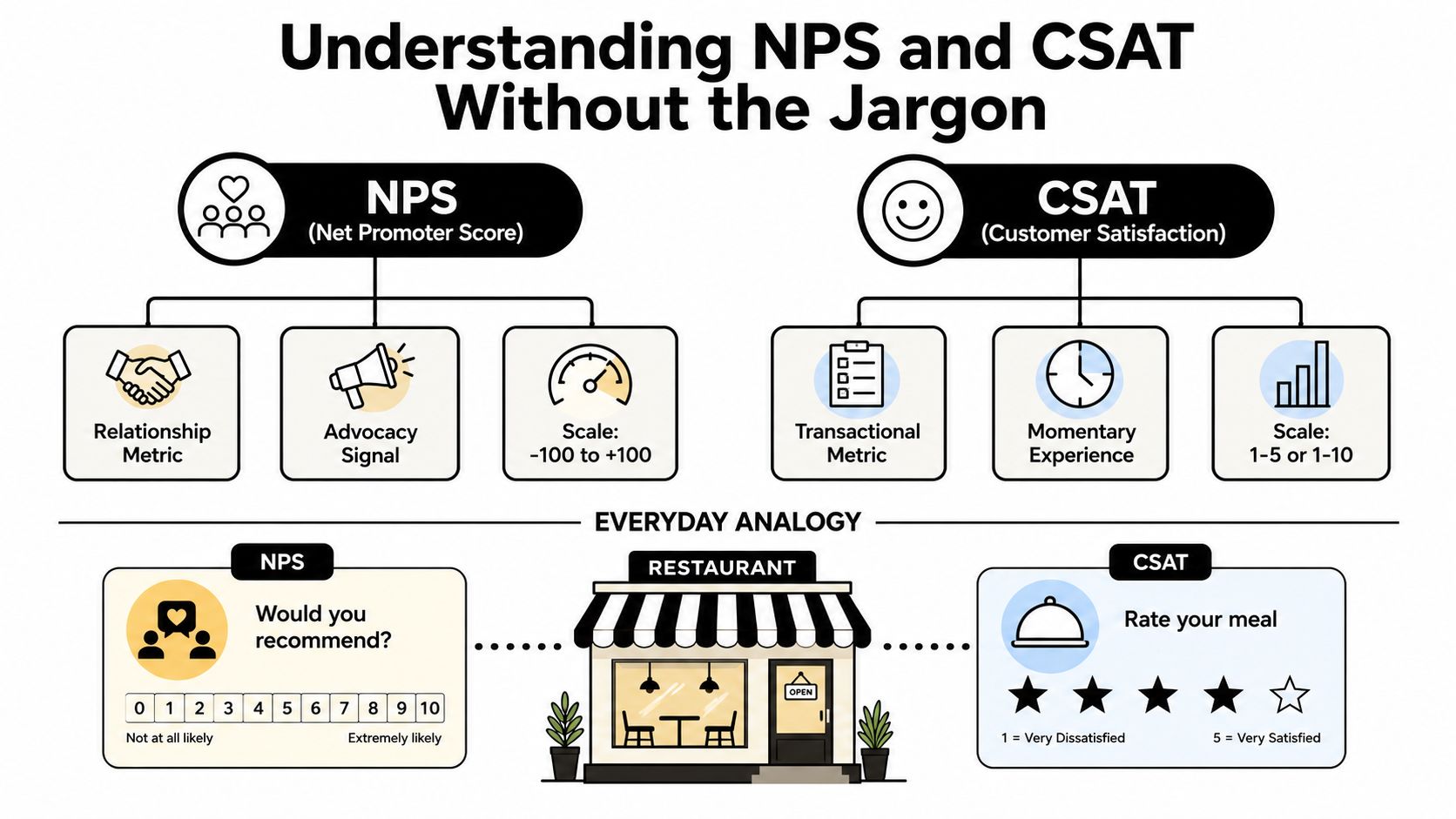
NPS asks about the relationship
A standard NPS question is:
How likely are you to recommend this company, product, or service to a friend or colleague?
Customers answer on a 0-to-10 scale. Their responses form three groups:
- Promoters: Scores of 9 or 10, showing strong recommendation intent.
- Passives: Scores of 7 or 8. They may be satisfied, but they are not showing strong advocacy.
- Detractors: Scores from 0 through 6, indicating weak recommendation intent.
To calculate NPS, subtract the percentage of detractors from the percentage of promoters. The result ranges from -100 to +100. Passives stay in the response base, although they do not directly increase either group's percentage. The metric originated in a 2003 Harvard Business Review article and is widely used to assess loyalty, as explained in IBM's explanation of NPS.
NPS gives leadership a relationship-level signal. It can indicate whether accumulated experiences are producing advocacy, indifference, or resistance. A score alone cannot identify the interaction or issue that shaped the response.
CSAT zooms in on a moment
A typical CSAT question is:
How satisfied are you with this support interaction?
The question should identify the experience being judged. Examples include a billing conversation, onboarding session, checkout process, or AI-assisted service request. Customers often respond on a five-point scale, though organizations may use other scales.
Many teams report CSAT as the percentage of positive responses, commonly the top two ratings, such as 4 or 5 on a five-point scale. The formula is:
Positive responses ÷ total responses × 100 = CSAT percentage
CSAT is therefore transactional. It captures immediate sentiment after a specific touchpoint and reacts to resolution quality, speed, and friction during an AI-to-human handoff. CustomerGauge's guidance on customer feedback benchmarks also illustrates why teams need context when comparing feedback results.
Survey timing and sampling affect both signals. Ask CSAT immediately after the relevant workflow, such as a completed chatbot resolution, while using NPS at a deliberate relationship checkpoint rather than after every routine request. Sampling only easy, completed interactions can produce strong CSAT while missing customers who abandon the journey or face repeated failures.
Core distinction: NPS asks, “How strong is my relationship with this company?” CSAT asks, “How did this particular experience feel?”
A customer can praise a fast payment fix yet remain reluctant to recommend the company. The two answers describe different layers of experience, so neither cancels out the other.
How NPS and CSAT Compare on Purpose Strengths and Limits
A customer can leave a support chat satisfied and still be unlikely to recommend the company later. That split is why NPS and CSAT should not be treated as interchangeable.
NPS works at the relationship level. It is useful for executive reviews, account health checks, and periodic reads on advocacy. CSAT works at the interaction level. It helps a service manager see whether a specific workflow, agent exchange, or automated resolution met expectations.
| Dimension | NPS | CSAT |
|---|---|---|
| Primary purpose | Measures relationship health and recommendation intent | Measures satisfaction with a specific interaction |
| Time horizon | Cumulative and relationship-oriented | Immediate and transactional |
| Typical question | “How likely are you to recommend us?” | “How satisfied are you with this interaction?” |
| Response format | 0 to 10 | Commonly 1 to 5 |
| Best operational use | Track advocacy and broader loyalty risk | Diagnose touchpoint defects |
| Main limitation | Does not explain the root cause and is not a precise support KPI | Does not reliably represent overall loyalty |
Where NPS helps
NPS gives leaders a compact signal on whether customers feel confident enough to recommend the company. When the score falls, the question is usually broader than one ticket or one chatbot reply. It can point to product reliability, pricing pressure, trust issues, account management gaps, or the accumulated effect of repeated service friction.
The more useful reading is trend and segment movement, not a fixed benchmark number. A healthy-looking score can still hide churn risk if it is being held up by a few loyal accounts, while a modest score may improve after a fix even if daily service ratings were already strong.
That is why NPS works well in quarterly business reviews, account planning, and leadership dashboards. It is the right signal when the decision is about retention risk, advocacy, or the health of the relationship as a whole. It is not a clean support score for judging one frontline team on one contact.
Where CSAT helps
CSAT answers a narrower question, did this moment work. A contact center can compare ratings for voice support, live chat, self-service, or AI handoffs. Product teams can test an onboarding step. Operations leaders can see whether a resolution flow leaves customers satisfied right after completion.
The strength of CSAT is precision. The boundary is just as important. A high score on a resolved ticket does not prove the customer will renew, expand, or recommend the brand. It only says the specific interaction felt acceptable.
That makes CSAT useful for daily QA of the password-reset bot, post-chat checks after a billing fix, or review of an AI-to-human handoff. Give the workflow owner the CSAT signal, set a local threshold for follow-up, and keep the question tied to the exact moment being measured. Keep NPS with the account team or leadership group that owns the broader relationship.
When and How to Use Each Metric in Real Workflows
A customer completes a chatbot flow, gives it a high rating, then reduces usage months later. Another customer rates a billing interaction poorly but remains a strong advocate. These outcomes are not inconsistent. They reflect two different measurement moments, so survey placement should follow the customer journey rather than the reporting calendar.
Place CSAT beside the resolution moment
CSAT asks whether a specific interaction worked. Send it immediately after the event being evaluated:
- Voice resolution: Ask after the caller confirms the issue is resolved or the call ends.
- Chat completion: Ask after the bot or agent closes the conversation.
- Human handoff: Ask about the completed interaction, while recording that the customer moved from AI to a person.
- In-app automation: Ask after a task, such as changing an address or checking an order status, reaches a clear completion state.
Timing affects what the response represents. A delayed survey may capture memory, later frustration, or a different experience instead of the interaction itself. Guidance on CSAT collection recommends sending the survey within minutes of the experience, as explained in Kustomer's CSAT glossary.
Keep the question concrete: “How satisfied are you with your support interaction today?” gives an operations leader more useful feedback than “How do you feel about our brand?” Add one optional reason field so customers can explain the rating without turning a completion survey into a lengthy questionnaire.
For conversational AI, store the rating with channel, intent, automation path, handoff status, and resolution state. That context separates an incorrect answer from a long queue after escalation. Teams assessing customer service automation can apply the same structure across voice, chat, and in-app workflows.
Use NPS as a relationship pulse
NPS belongs in a recurring relationship survey, not automatically after every ticket closes. Send it to a defined customer population at a consistent cadence, then compare similar groups. It can accompany account reviews, lifecycle milestones, or broader customer research. Sending it directly after a frustrating support event may pull the immediate incident into the relationship score, unless that effect is intentional.
Sampling needs control. Avoid inviting the same customers to every survey. Rotate samples where appropriate, suppress customers who recently responded, and record response volume and composition. Without those safeguards, highly engaged or highly frustrated customers can dominate the results and create a vocal-minority effect.
Practical rule: Every survey needs an owner, a decision, and a follow-up path. If nobody will investigate or respond, do not collect the score.
A bot can request CSAT after a completed task, but it should not interrupt a high-stakes conversation before the customer confirms resolution. Keep NPS separate from immediate bot performance unless the organization intentionally uses a transactional recommendation question and labels it accordingly.
Interpreting Results and Connecting the Two Signals
The useful question isn't whether NPS or CSAT is “right.” It's whether the two signals agree, and if they don't, what layer of the experience explains the gap.
Start with four patterns:
| CSAT trend | NPS trend | Likely reading | First investigation |
|---|---|---|---|
| Rising | Rising | Local interactions and broader relationship may be improving together | Confirm whether gains appear across segments |
| Falling | Falling | Customers are encountering immediate problems and broader advocacy risk | Identify shared operational or product causes |
| Rising | Falling | Service moments may be improving while trust or product sentiment weakens | Review product, pricing, reliability, and account experience |
| Falling | Stable or rising | A contained workflow may be failing without yet changing the wider relationship | Isolate the affected journey stage and cohort |
The third pattern deserves special attention. High CSAT with falling NPS is not a contradiction. It can mean the support team is recovering individual incidents effectively while customers remain concerned about the underlying product, policy, or relationship.
Segment before you escalate
An aggregate score can hide the source of a change. Break results down by journey stage, channel, customer cohort, issue type, automation path, and handoff outcome. Compare customers who completed a self-service flow with those who needed an agent. Separate onboarding feedback from renewal feedback. Look for deterioration concentrated in one product area rather than assuming the whole operation has shifted.
Then pair survey results with operational signals:
- Resolution rate: Did the system complete the requested outcome?
- Repeat contact: Did the customer return for the same issue?
- Handoff frequency: How often did automation transfer the conversation?
- Time to resolution: Did customers wait or repeat information?
- Retention behavior: Did renewal, expansion, or cancellation activity change?
An analytics layer such as Yellow.ai's AI analytics capabilities can help teams join conversational events with feedback and inspect performance by workflow rather than only by channel average.
Turn movement into action
Use CSAT to prioritize interaction defects. If chat CSAT falls after a knowledge-base change, review answers, containment, and escalation behavior. If voice CSAT falls only after human handoff, inspect queue time and context transfer.
Use NPS to prioritize cumulative experience risk. If NPS falls across customers who rate support positively, investigate factors outside the support conversation. Ask whether customers are losing confidence in reliability, value, transparency, or strategic fit.
Before acting on a single movement, check survey timing, sample composition, question wording, channel mix, and operational changes. A score is a signal to investigate, not a diagnosis.
Benchmarks Pitfalls and What Can Mislead You
A dashboard can show a healthy CSAT score while customer loyalty is weakening. Benchmarks provide orientation, but they do not confirm that a measure fits your audience, channel, sampling method, or business decision.
Reference ranges are useful only as starting points. NPS is often described as strong around 30 or higher and excellent above 50. CSAT is commonly viewed as strong around 75% to 85%. Those figures describe general expectations, not universal targets. Scale design, question wording, customer mix, and survey placement can change the result before sentiment has meaningfully shifted.
A score also depends on where the question appears in the conversational workflow. CSAT asked immediately after an AI assistant resolves a password reset measures that interaction. It should not stand in for relationship sentiment. NPS belongs in a periodic relationship survey, sent to a consistent customer population rather than triggered after every support exchange.
Divergence can reveal hidden loyalty risk
A banking benchmark reported Banking and Credit Unions fell from NPS 41 in Q1 2025 to 19 in Q1 2026, while CSAT moved from 82% to 72% over the same period, as described in GreenBook's analysis of CX metric divergence.
The pattern matters because satisfaction and advocacy operate at different distances from the interaction. A customer may receive acceptable help from a conversational AI workflow and still become less willing to recommend the institution because of fees, trust concerns, product limits, or repeated friction. Strong task-level CSAT can therefore mask weaker loyalty until NPS exposes the broader problem.
Audit the measurement before trusting the dashboard
Review the survey mechanics before comparing results:
- Intent isn't behavior: NPS measures willingness to recommend, not an observed referral, renewal, or purchase.
- A moment isn't the relationship: CSAT reflects a specific experience and may rise after a successful recovery, even when broader confidence remains low.
- Delayed feedback weakens memory: A late CSAT request can capture recollection rather than the service event.
- Channel context shapes sentiment: High ratings in simple in-app or live-chat interactions may say little about overall brand health.
- Survey fatigue changes participation: Repeated requests can reduce response quality and overrepresent customers with strong opinions.
SuperStaff's discussion of NPS and CSAT measurement emphasizes that timing, sampling, and context affect both measures. Record who was invited, who responded, when the question appeared, which channel handled the interaction, and what customer event preceded it. Compare like with like, then investigate divergence instead of averaging it away.
Putting Both Metrics to Work in AI Powered CX
A customer can rate an AI chat highly after a quick password reset, then hesitate to recommend the company after repeated billing friction. That divergence is useful. CSAT evaluates a completed interaction, while NPS samples the broader relationship. Strong task satisfaction can therefore hide weaker loyalty.
Set up each measure for the decision it supports:
- Ask CSAT after confirmed resolution. Trigger the question when an AI or agent workflow reaches its resolution state. Store the channel, handoff, issue type, and outcome with the response.
- Ask NPS as a relationship pulse. Use a consistent audience and cadence, and suppress requests after recent interaction surveys so frequent contacts do not dominate responses.
- Connect scores to workflow results. Compare feedback with resolution, repeat contact, escalation, retention, and account outcomes. Review divergence by journey, customer segment, and channel.
- Give each signal an owner. Support operations should address interaction defects. CX, product, and account leaders should examine broader loyalty movement.
- Close the loop. Assign negative feedback to a human owner and send recurring themes to product and automation teams.
Yellow.ai supports conversational workflows across voice, chat, email, and other channels, with analytics and automated testing for reviewing interaction outcomes. Teams assessing delivery options can also consult customer support outsourcing companies to define which measurement work stays internal.
Use Yellow.ai's CX guidance to turn the framework into an implementation plan. Visit Yellow.ai to examine its conversational AI and analytics capabilities.



