













Most enterprise teams get natural language understanding wrong in the same way. They treat it like a smarter search bar when it's closer to a decision layer for language. That distinction matters because keyword systems retrieve words, while NLU tries to resolve intent, context, and sentiment well enough for a machine to take the next action safely.
The market signal is hard to ignore. The global NLU market is projected to reach USD 215.91 billion by 2034, growing at a 27.24% CAGR according to Fortune Business Insights' natural language understanding market forecast. That isn't just a technology trend. It reflects a broader enterprise shift away from rigid automation and toward systems that can interpret meaning inside customer and employee conversations.
For CX and EX leaders, the practical question isn't whether natural language understanding matters. It's whether your organization is deploying it as a narrow feature or as infrastructure for service, support, routing, knowledge access, and agentic workflows.
Table of Contents
- Beyond Words What Natural Language Understanding Truly Is
- How NLU Deciphers Human Language Step by Step
- The Evolution of NLU Models and Techniques
- NLU in Action Transforming CX and EX
- Enterprise NLU Implementation A Practical Blueprint
- Navigating the Hurdles Common NLU Challenges
- The Next Wave The Future of NLU
Beyond Words What Natural Language Understanding Truly Is
Natural language understanding is often described as software that “understands language.” That's too shallow to be useful in enterprise settings. A more accurate view is this: NLU converts messy human expression into structured meaning that a business system can act on.
A basic search engine matches terms. A capable NLU system distinguishes between the user's exact words and what they're trying to accomplish. In a contact center, that difference separates a bot that surfaces an FAQ from one that routes billing urgency, detects frustration, preserves context from earlier turns, and decides whether automation is still safe.
Meaning is the real unit of automation
In practice, natural language understanding sits between conversation and workflow. It identifies intent, extracts entities, interprets sentiment, and uses context to reduce ambiguity. That's why it matters so much for customer support, employee service, virtual assistants, and knowledge systems.
The business payoff comes from precision. When a system understands whether “I need to stop my policy” means cancellation, temporary suspension, or a request for retention support, the enterprise reduces avoidable transfers and improves resolution quality.
NLU isn't a dictionary with more data. It's the layer that determines whether automation feels helpful or careless.
Why this is now a board-level capability
The market growth behind NLU reflects a strategic reclassification. Enterprises no longer view language understanding as a chatbot feature. They're treating it as a foundational capability for service delivery, operational efficiency, and experience design.
A senior leader should read that shift clearly. The conversation is no longer about whether AI can answer simple questions. It's about whether your systems can interpret language reliably enough to trigger workflows, assist agents, govern risk, and support multi-step experiences across channels.
That's why natural language understanding belongs in platform strategy, not just channel strategy.
How NLU Deciphers Human Language Step by Step
Natural language understanding looks magical from the outside. Inside, it's a pipeline. The output only works when the stages before it are disciplined.
From raw input to structured meaning
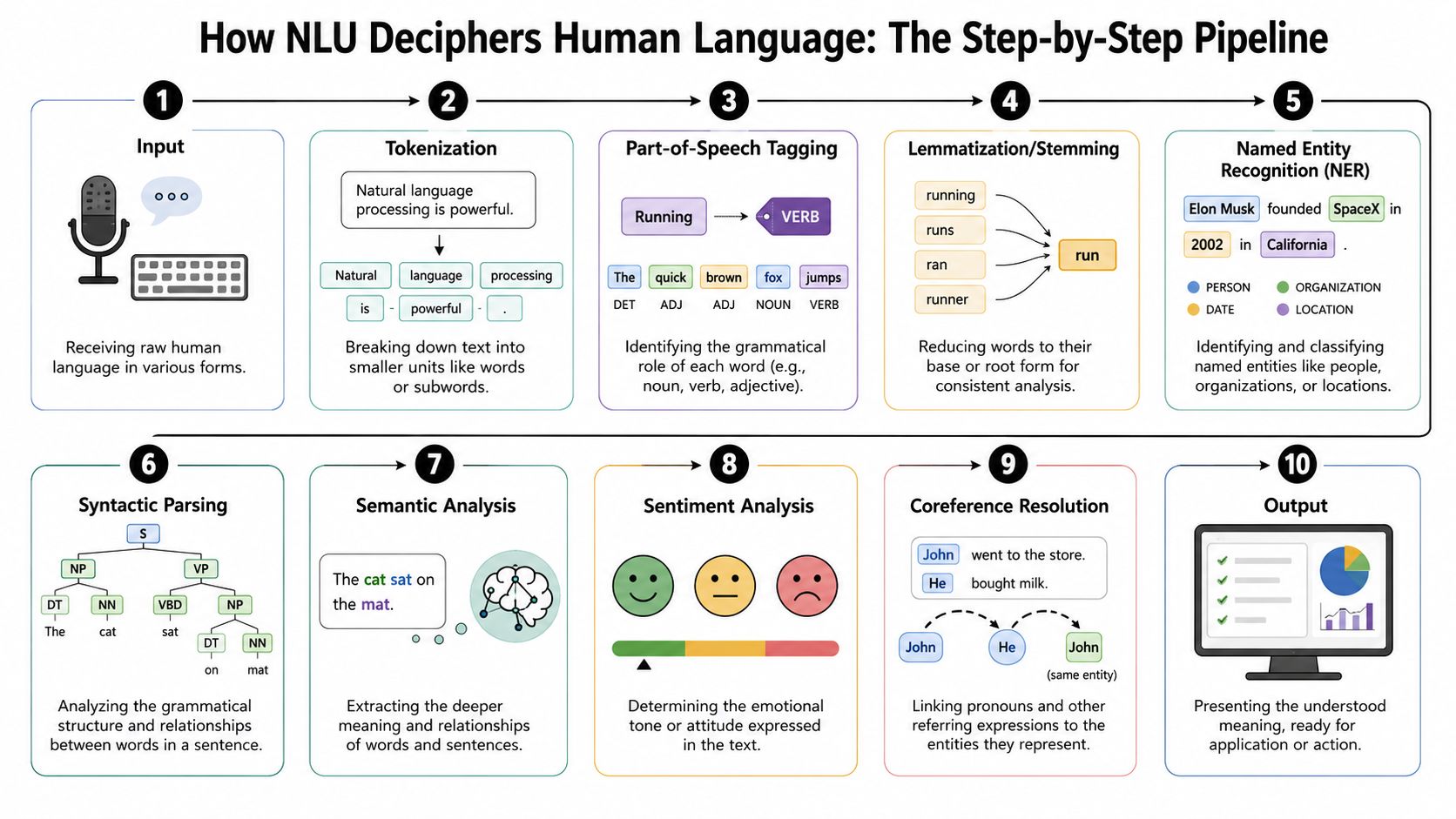
Start with the incoming utterance. It may come from chat, voice transcription, email, or an internal help request. The system first breaks that input into units through tokenization. Those units can be words, subwords, or symbols, depending on the model design.
Next comes lexical analysis, often through part-of-speech tagging. The system then starts labeling how words function. It matters because language is full of terms that shift role depending on context. “Book” can be a noun or an action. “Charge” can describe payment, accusation, or battery level.
Then comes syntactic analysis. This stage maps how words relate to each other in the sentence. It's one of the most underappreciated parts of enterprise NLU. Benchmark data indicates that omitting syntactic analysis reduces intent accuracy by 15 to 20 percent in complex utterances containing multiple clauses, especially when the model misreads subject, verb, and object relationships.
A familiar failure case is negation. “I want to book a flight but not cancel my hotel” contains two service concepts and one negation scope. If the system doesn't parse structure correctly, it may take the wrong action.
For enterprise teams building knowledge assistants, support bots, or guided flows, the practical lesson is simple. Don't confuse fluent responses with reliable understanding. A polished interface still needs a strong interpretation layer, especially when it connects to downstream systems. That's also why teams investing in a conversational knowledge base need retrieval and intent handling to work together, not as separate projects.
Later in the pipeline, semantic analysis, sentiment detection, named entity recognition, and coreference handling refine the result. At that point, the system can map language into a form that routing engines, CRM tools, HR systems, or automation workflows can use.
A useful visual helps make that flow tangible:
NLU versus NLP versus NLG
These terms are often collapsed into one bucket. That leads to poor vendor evaluation and unrealistic implementation plans.
| Concept | Primary Goal | Analogy |
|---|---|---|
| NLP | Process human language broadly | The full kitchen, tools, and methods for working with ingredients |
| NLU | Interpret meaning, intent, and context | The chef understanding what the customer actually wants |
| NLG | Generate natural language responses | The waiter presenting the finished dish in a clear, human way |
Practical rule: If a vendor shows beautiful generated answers but can't explain how intent resolution, entity extraction, and ambiguity handling work, you're looking at language output before language understanding.
The Evolution of NLU Models and Techniques
Enterprise NLU didn't become valuable overnight. It became valuable when model design finally caught up with the complexity of real conversations.
Why rule-based systems hit a ceiling
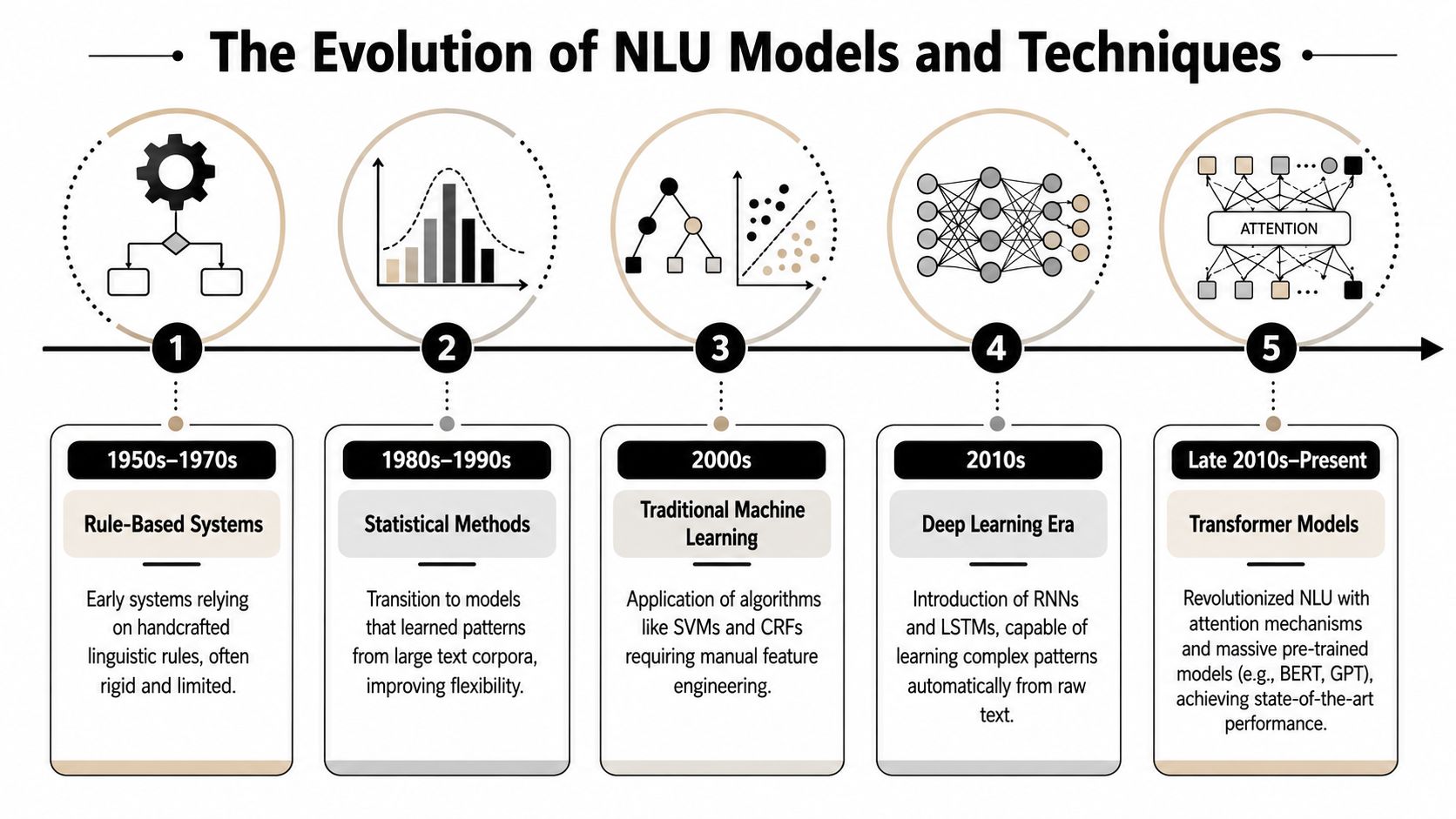
Early enterprise language systems depended on handcrafted rules. Teams defined intents manually, wrote phrase variations, added exceptions, and spent endless cycles patching edge cases. These systems could work in narrow environments, but they were brittle.
The core problem wasn't just maintenance cost. It was linguistic reality. People don't ask for help in clean, repeatable patterns. They hedge, abbreviate, switch topics mid-sentence, refer to prior context, and use internal jargon that changes over time.
Statistical NLU improved that picture by learning from data rather than relying only on predetermined logic. According to Proxet's overview of statistical natural language processing, statistical NLU grew at 20.1% annually from 2021 to 2027, with market size projected to rise from $1 billion in 2020 to $3.7 billion by 2027. That growth reflects the business value of moving from hardcoded pattern matching to probabilistic interpretation.
Why transformers changed enterprise expectations
Statistical methods were an important step, but they still struggled with nuance. They often required heavy feature engineering and could miss the deeper structure of language. Modern transformer-based models changed that by improving contextual understanding at scale.
Transformers don't just inspect nearby words. They weigh relationships across the input, which makes them far better at handling context, ambiguity, and long-range dependencies. For enterprises, that means better performance in conversations where users refer back to earlier details, use indirect phrasing, or express intent through implication rather than explicit commands.
The strategic impact is bigger than model accuracy. It changes the kinds of systems enterprises can build.
- Rule-based systems fit scripted flows and tightly bounded tasks.
- Statistical models made intent classification and entity extraction more adaptable.
- Transformer architectures made multi-turn support, semantic search, advanced routing, and more natural automation operationally realistic.
That's also why multi-model design is becoming more relevant. A single model rarely performs best across every language, channel, and use case. In practice, enterprises need architectures that can combine deterministic guardrails, task-specific models, retrieval components, and large language models without turning the stack into an MLOps burden.
Mature NLU programs don't ask, “Which model is best?” They ask, “Which model mix gives us reliable understanding, governance, and speed for this workflow?”
The history matters because it clarifies a current mistake. Some teams still buy NLU as if it were an isolated chatbot feature. The better approach is to treat it as a layered capability that has evolved from rules, to probabilities, to contextual reasoning infrastructure.
NLU in Action Transforming CX and EX
The easiest way to understand NLU's value is to watch where it removes friction. The strongest deployments don't just answer questions. They route work, preserve context, and reduce the cost of getting to the right outcome.
Where CX teams get value first
Customer support is usually the clearest starting point because language volume is high and failure patterns are visible. In a standard contact center, customers don't arrive with neatly labeled intents. They describe symptoms, emotion, urgency, and background all at once.
A strong NLU layer helps the system separate those signals.
- Intent-aware routing: A customer writes, “My card was charged twice and I'm traveling tomorrow.” Keyword logic may focus on “charged.” NLU can recognize a billing issue with urgency and route it accordingly.
- Context-preserving self-service: A customer starts with a delivery question, then asks for a refund after learning the item is delayed. Good NLU tracks the conversation shift instead of trapping the user in the original flow.
- Sentiment-informed escalation: When the system detects rising frustration, it can hand off with context instead of forcing the customer to repeat the issue.
Customer service platforms benefit from language understanding, moving beyond scripted intent trees. Teams evaluating conversational AI for customer service should focus on how the system handles transitions, ambiguity, and handoff quality, not just answer fluency.
Some sectors make the trade-off even sharper. In public procurement, for example, teams often need to interpret messy requirement language, agency terminology, and high-stakes qualification details. Resources like AI for Government Contracts are useful because they show how much enterprise value depends on turning complex language into structured action, not just document retrieval.
How EX teams reduce service friction
Employee service is where NLU often becomes underestimated. Internal requests are full of abbreviations, policy nuance, and company-specific language that generic assistants rarely understand well out of the box.
Consider a few common patterns:
| EX scenario | Before NLU | After NLU |
|---|---|---|
| HR policy questions | Employees search PDFs and ask HR partners repetitive questions | The assistant interprets intent and returns policy guidance in context |
| IT service requests | Users submit vague tickets that require triage | The assistant classifies the issue, gathers missing details, and routes correctly |
| Onboarding support | New hires don't know internal terms or systems | The assistant translates plain-language questions into system-specific guidance |
The operational gain is consistency. Instead of relying on every employee to know the right form name, portal path, or internal acronym, NLU allows them to ask in everyday language.
That changes employee behavior. People stop learning the quirks of internal systems and start expressing what they need directly. For service teams, that usually means fewer misrouted requests, better triage quality, and less repetitive manual clarification.
Enterprise NLU Implementation A Practical Blueprint
The hardest part of natural language understanding isn't getting a demo to work. It's making the system reliable across real traffic, real policy constraints, and real business variation.
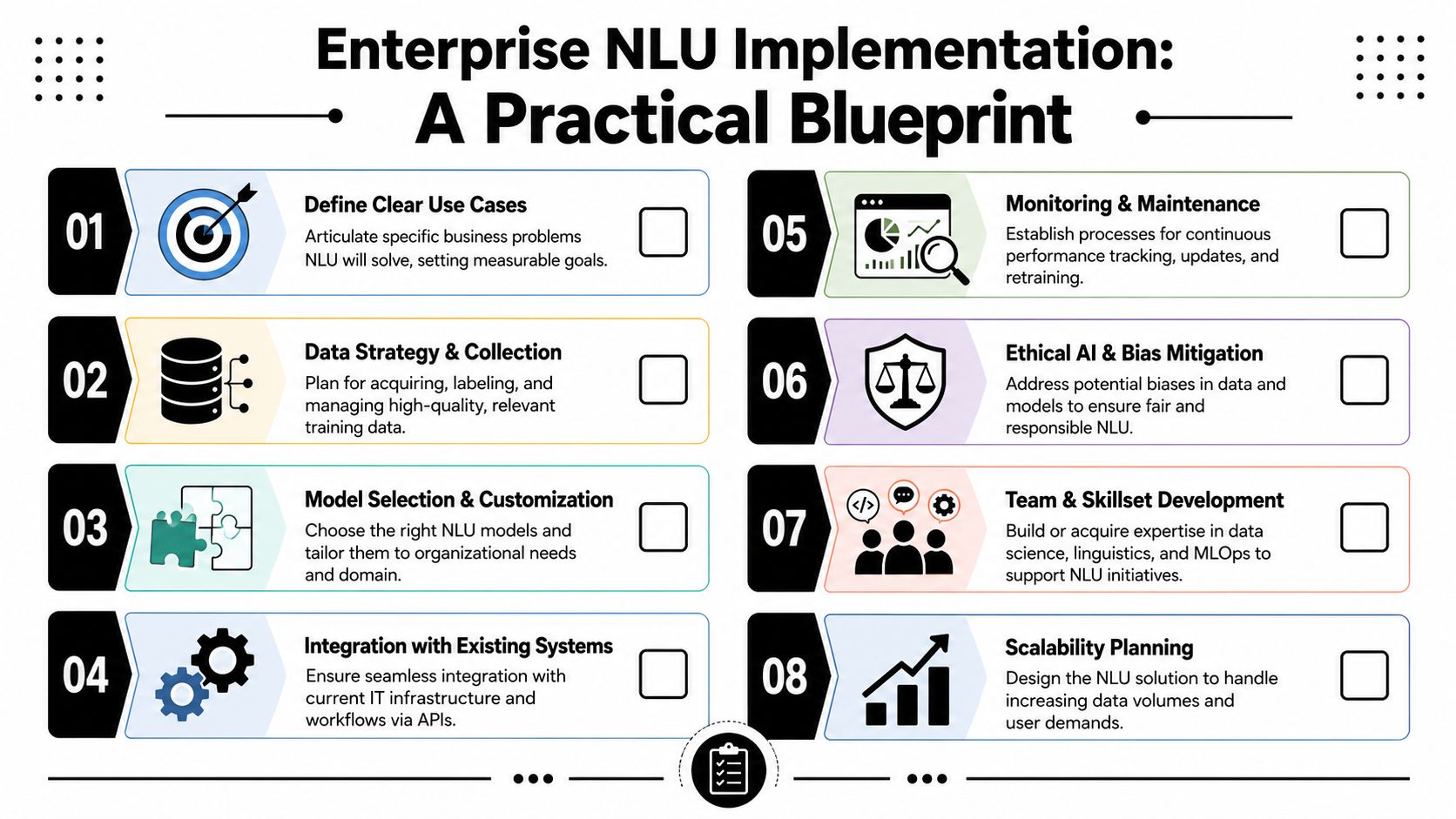
Start with the operating model not the model demo
Many programs fail because teams start with model selection before they've defined workflow boundaries, escalation logic, or data ownership. That sequence creates elegant pilots that break in production.
The first requirement is training data discipline. To achieve 95%+ accuracy in intent classification, an NLU dataset must be balanced with at least 1,000 examples per intent category, and models trained with 50,000+ diverse utterances achieve a false positive rate below 2%. Those thresholds should change how leaders think about readiness. NLU quality isn't something you add later with prompt edits. It's built into the dataset and labeling process from the start.
That means teams need to decide early:
- Which intents matter most: Don't begin with every possible use case. Start where language volume and workflow value are both high.
- Who owns annotation quality: Labels need consistency around entities, edge cases, and negation.
- What “safe automation” means: Some intents can be fully automated. Others require review, confirmation, or agent escalation.
Good NLU programs are run like service operations. They have taxonomy owners, review cycles, escalation policies, and clear accountability.
What to evaluate before rollout
Implementation quality usually depends on a few critical factors.
Integration depth
NLU only creates business value when it connects to systems of record and systems of action. CRM, ticketing, HRIS, identity, and knowledge platforms all need clean handoffs.Compliance design
Privacy and governance can't be retrofitted. Regulated environments need clear controls for retention, redaction, authentication, and access boundaries.Monitoring and retraining
Language drifts. Product names change. Internal jargon evolves. New policies introduce fresh utterance patterns. If there's no review loop, model performance decays.Channel realism
Voice, chat, and email produce different kinds of language data. A system that works in typed chat may struggle with spoken interruptions, transcription noise, or longer narratives.
For organizations comparing platforms, a structured evaluation framework helps avoid shiny-object buying. A useful starting point is a buyer's guide to evaluating conversational AI solutions. And if you're assessing vendors, include platform questions about observability, multilingual tuning, guardrails, integration coverage, and ownership of continuous model improvement. Yellow.ai is one example of an enterprise platform that combines NLU with multi-LLM orchestration, omnichannel deployment, and pre-built integrations, which matters when the goal is production rollout rather than isolated experimentation.
Navigating the Hurdles Common NLU Challenges
Vendor messaging often implies that once a model is large enough, language understanding becomes straightforward. It doesn't. Natural language understanding still contains problems that are difficult in principle, not just in implementation.
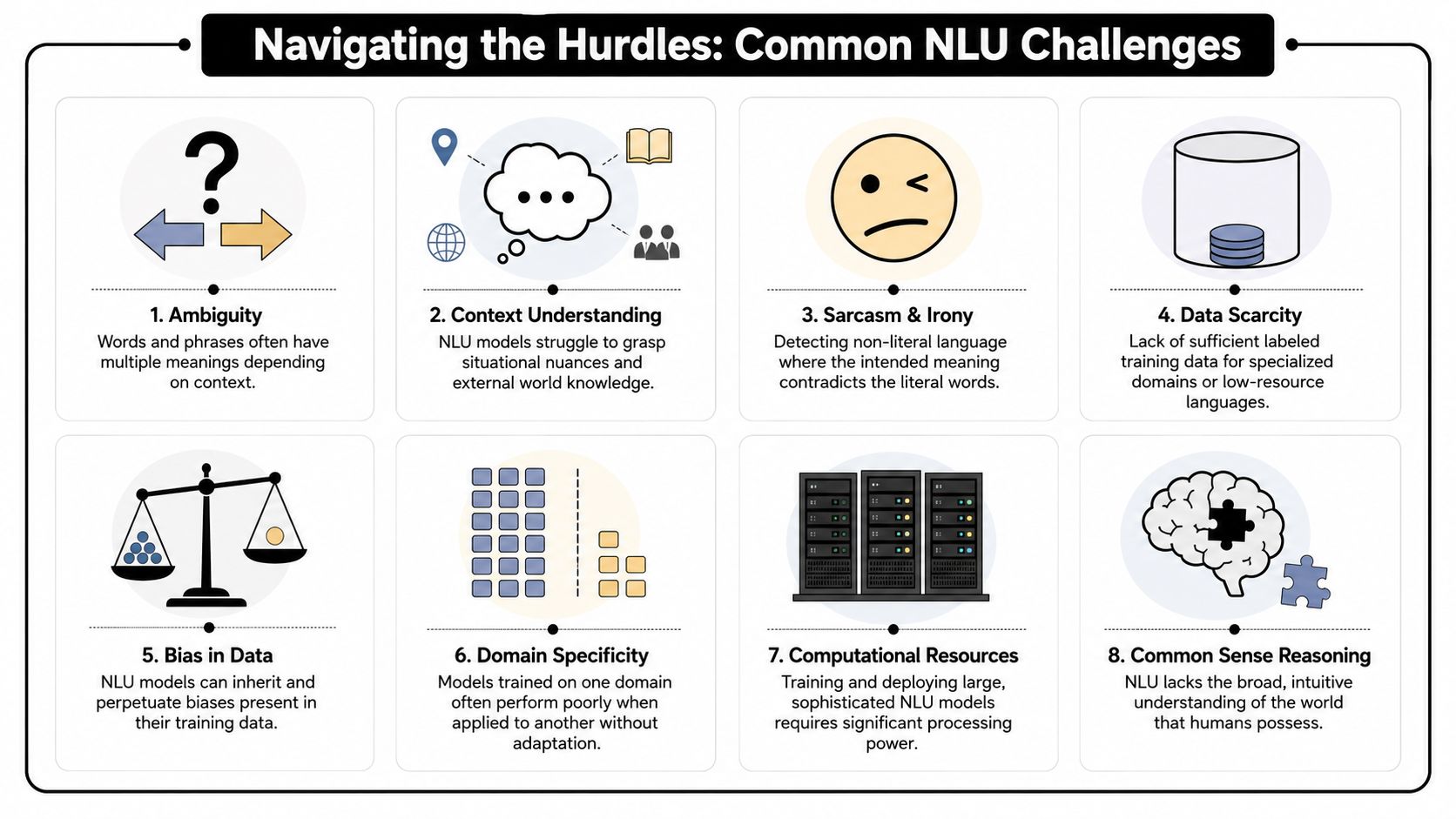
The AI-hard gap is real
One of the least discussed limitations is implicit meaning. Current systems can model language patterns impressively well, but they still struggle to fully infer what humans leave unsaid. That matters because people constantly rely on assumption, context, social cues, and world knowledge when they speak.
A customer saying “That's fine, I'll handle it myself” may be signaling frustration, not closure. An employee asking “Do I need to worry about this payroll issue before Friday?” may be seeking urgency assessment, not just policy text.
The hard truth is this: current models can't effectively uncover unspoken assumptions in natural language with human reliability. In high-stakes domains, that limitation should directly shape automation policy.
- Use human-in-the-loop controls for sensitive intents.
- Require confirmation before high-impact actions.
- Design graceful escalation when confidence drops or ambiguity rises.
The safest enterprise posture isn't “automate everything possible.” It's “automate what can be understood reliably, and escalate the rest with context.”
Global language support is still uneven
The second major hurdle is the language gap. Many enterprise systems look multilingual in product sheets but are still strongest in English-centric scenarios. That creates trouble for global operations, where local phrasing, dialect, formality norms, and domain terminology differ sharply.
The challenge is bigger than translation. Real NLU performance depends on training data, annotation quality, and domain coverage in each language. Teams operating across regions often discover that a model understands generic intent categories but fails on local nuance, especially in healthcare, financial services, and internal support contexts.
Another challenge is domain transfer. A model tuned for customer support language may degrade when deployed for internal HR or IT requests if it hasn't been adapted to that domain's vocabulary and intent structure.
Common failure patterns include:
| Challenge | What it looks like in production |
|---|---|
| Ambiguity | The same phrase triggers different intents depending on user context |
| Sarcasm or indirect speech | The model reads literal words and misses actual sentiment |
| Domain shift | A model trained on one service area misclassifies another |
| Data scarcity | Low-volume intents never become reliable enough for safe automation |
The answer isn't to lower expectations. It's to set mature ones. Enterprises need staged rollout plans, strong fallback design, localized training strategies, and governance that treats NLU as an evolving capability rather than a finished feature.
The Next Wave The Future of NLU
The next chapter of natural language understanding won't be defined by better chat alone. It will be defined by systems that understand language well enough to complete work across channels, tools, and business functions.
From understanding requests to completing work
Today, many assistants still stop at interpretation and response. The future is agentic. That means NLU becomes the front-end reasoning layer for systems that don't just answer questions, but take approved actions on a user's behalf.
In customer experience, that could mean resolving a subscription issue, updating an address, rebooking a service, or coordinating next-best actions across support history. In employee experience, it could mean initiating access requests, guiding policy exceptions, or orchestrating onboarding steps across HR, IT, and facilities.
That shift raises the bar. Understanding intent is no longer enough. Systems must also manage permission boundaries, confirmation logic, risk thresholds, and traceable workflows.
What mature enterprises should prepare for
The future also points toward multi-modal understanding. Enterprises increasingly need one AI layer that can interpret voice, text, images, and video in a unified workflow. A customer may start in voice, upload a document, continue in chat, and expect the system to preserve context across all of it.
The strongest NLU strategies will also become more personalized. Not in a superficial marketing sense, but in an operational sense. Systems will adapt responses based on customer history, employee role, prior interactions, and channel context while still respecting governance boundaries.
That's where NLU starts to look less like a feature and more like a control system for the autonomic enterprise. When language understanding is paired with orchestration, retrieval, analytics, and policy enforcement, software can move from reacting to requests toward proactively supporting work.
The enterprises that benefit most won't be the ones that chase the flashiest demos. They'll be the ones that build language understanding into service design, platform architecture, and operational governance from the beginning.
If your team is evaluating how to operationalize natural language understanding across customer and employee journeys, Yellow.ai is one platform to review. It combines enterprise NLU, agentic workflows, omnichannel deployment, and governance features that matter when you're moving from pilot automation to production-scale CX and EX.



