














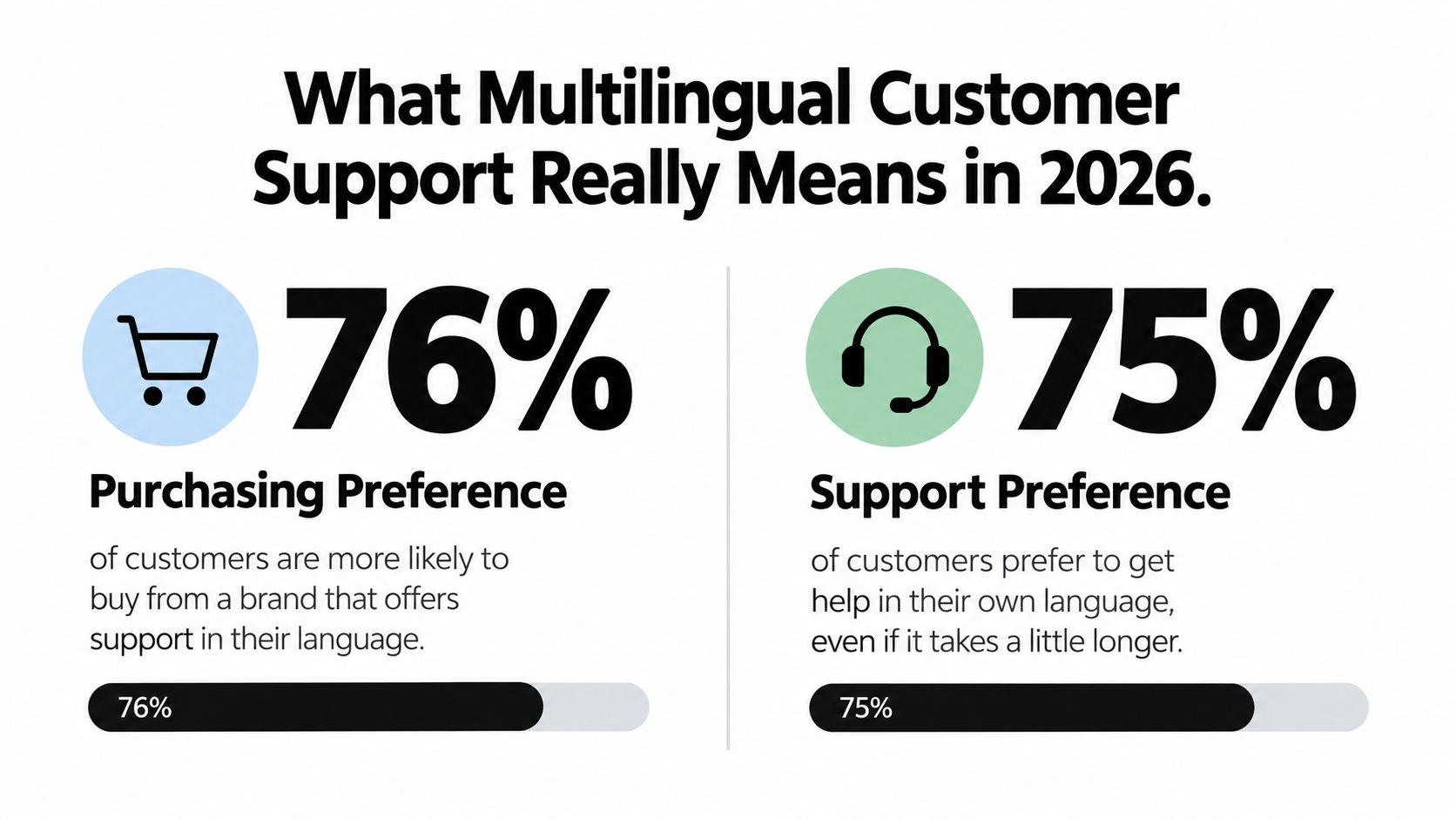
A CSA Research survey of 8,709 consumers across 29 countries found that 76% of online shoppers prefer to buy when product information is available in their own language, while 75% are more likely to buy again when customer care is available in their preferred language. The findings and their commercial implications point to a practical conclusion: multilingual customer support isn't a translation feature. It's a language-access, service-continuity, and risk-management system.
A customer may begin with a voice call, switch to chat, receive an email, and later need a human specialist. The language, intent, account context, consent state, and escalation rights must survive every transition. The programs that hold up in production measure whether that happens, rather than celebrating the number of languages listed on a product page.
Table of Contents
- What Multilingual Customer Support Really Means in 2026
- The Enabling Technology Stack Explained
- Business Benefits and the ROI of Speaking Every Customer's Language
- An Implementation Roadmap From Pilot to Enterprise Scale
- KPIs, Quality Measurement, and Risk-Adaptive Governance
- The Hidden Risks Most Multilingual Programs Miss
- Enterprise Use Cases and How Yellow.ai Fits In
- A 90-Day Plan and Frequently Asked Questions
What Multilingual Customer Support Really Means in 2026
Multilingual customer support means a business can detect a customer's language, understand the request, route it correctly, resolve it safely, and preserve context across channels. Translation is one component. It doesn't decide whether a customer is asking for a refund, reporting a medical symptom, disputing a financial transaction, or seeking urgent assistance.
The difference matters because customer demand and formal service coverage often diverge. A multilingual customer-support report found that 86% of surveyed contact centers served customers who weren't native English speakers, but only 65.5% formally offered support in another language. That 20.5 percentage-point gap is an operating exposure, not merely a localization backlog. The same report found that 76% of respondents believed native-language support improves the overall customer experience, with only 3.2% saying its absence would have no impact. The contact-center research report.pdf) makes the staffing and governance problem visible.
Four operating models
- Human-only support: Native-speaking agents handle the interaction directly. This offers the strongest cultural judgment, but coverage, hiring, scheduling, and consistency become difficult as languages and channels multiply.
- Translation-layered human support: An English-speaking agent works through machine translation. It can extend coverage quickly, but the agent may miss dialect, politeness, code-switching, or a translated legal qualifier.
- AI-first with human fallback: Automation handles routine intents and transfers exceptions. This works well when the routing model recognizes uncertainty instead of pretending every answer is safe.
- Hybrid orchestration: AI identifies language and intent, retrieves approved knowledge, completes low-risk tasks, and gives a trained human the full interaction history when risk or ambiguity rises. This is usually the most defensible model for regulated operations.
A practical program also needs employee workflows, localized knowledge, language-aware quality assurance, and a published fallback policy. Teams building a human talent pipeline can use a resource on bilingual customer service job search to understand the skills required beyond conversational fluency.
The platform layer should connect detection, intent handling, knowledge retrieval, and handoff rather than treating each channel as a separate translation project. Yellow.ai's conversational AI customer service approach is one example of how those components can be brought into a single service workflow. The business case should then be judged through containment, first-contact resolution, customer satisfaction, retention signals, and compliance exceptions.
The Enabling Technology Stack Explained
A production architecture is built from the customer interaction outward. Vendors often begin with a language count. Architects should begin with the failure path.
Build the language path in order
Language identification comes first. The system should recognize the customer's language, dialect where possible, and whether the message is code-mixed. The guardrail is a confidence score with an explicit fallback. If the system can't distinguish between closely related variants, it should ask a short language preference question or route to a capable queue.
Speech-to-text and diarization convert voice into usable turns. Errors in names, account references, medication terms, and amounts can corrupt every downstream layer. Production controls include domain vocabulary, confirmation of critical entities, and separate handling for overlapping speakers.
Neural machine translation should use approved terminology and domain-specific examples. BLEU can provide a reproducible n-gram-overlap signal, while BERTScore evaluates semantic similarity and may align more closely with human judgment in many settings. Neither metric proves that a translated answer preserves a negation, eligibility condition, currency, dosage, or contractual qualifier. The multilingual support KPI guidance recommends combining automatic metrics with human assessment, terminology checks, and post-editing time.
Locale-specific natural language understanding is where many demos fail. An intent model trained on one Spanish variety may mishandle another, while a model trained on formal written language may perform poorly on voice transcripts. Measure intent correctness and entity extraction by locale, then create a human route for unsupported or low-confidence intents.
Response generation needs a policy-aware router. A smaller model may handle a routine status request, while a stronger or privately deployed model may be appropriate for regulated workflows, low-resource languages, or code-mixed conversations. The router should select models by risk, latency, privacy, and cost, not by one global accuracy score.
Voice synthesis must match the locale and the service context. Pronunciation dictionaries, interruption handling, speaking rate, and confirmation prompts matter more than a convincing demo voice. A synthetic voice shouldn't deliver sensitive or irreversible information without clear verification.
Omnichannel orchestration carries identity, consent, language preference, unresolved intent, and transcript context between chat, email, voice, and in-app support. The human agent should receive the decision history, not just a translated transcript. Yellow.ai's AI Agent Builder represents this orchestration layer as a design and deployment environment, but any platform still needs independent evaluation against the organization's own conversations.
Production rule: Set a release gate for semantic fidelity, intent correctness, terminology compliance, and safe escalation. A fluent answer isn't a reliable answer.
Business Benefits and the ROI of Speaking Every Customer's Language
The business case is credible only when each claimed benefit connects to an operational signal. Multilingual support is a language-access capability and a risk-control measure, not a universal conversion multiplier. Results vary by channel, language, intent mix, staffing model, and market maturity.
Cost-to-serve falls when automation resolves routine requests without creating rework. Track containment by language, transfer rate, repeat contact, average handling time, and post-edit minutes. A low transfer rate can conceal failure if customers reopen cases because the first response was inaccurate or incomplete.
Customer satisfaction needs comparison at the journey level. Measure localized journeys against a comparable human-served control, then segment results by language, channel, intent, and escalation outcome. A single global CSAT score can hide poor service for a smaller language community. Review comments and recontact behavior alongside the score.
Retention is the clearest loyalty lever in the available research. The CSA Research findings report that 75% of consumers are more likely to buy again when customer care is available in their preferred language. The source describes this as a reported preference and intention, not a guaranteed revenue effect. Finance teams should connect language availability with repeat purchase, renewal, complaint recurrence, and churn signals before assigning revenue impact.
Expansion occurs when service coverage removes friction in a market that already shows demand. Examine abandoned contacts, unresolved cases, language-related complaints, and sales opportunities that stall after purchase. Support does not create demand on its own, yet English-only service can stop existing demand from becoming a durable customer relationship.
Risk avoidance belongs in the financial case. Customers who cannot understand a compliant disclosure, collections explanation, eligibility condition, or safety instruction may receive the wrong outcome or act on unsafe information. Track the absence of unreviewed high-impact errors, along with escalation records, audit trails, and policy exceptions. Automation volume matters less than whether the right cases reach a qualified person.
| ROI Lever | Typical Magnitude | Proving Metric |
|---|---|---|
| Cost-to-serve | Depends on containment and rework | Containment, transfer rate, handling time, post-edit minutes |
| Customer satisfaction | Varies by journey and language | Localized CSAT, resolution quality, repeat contact |
| Retention | Linked to continuity of preferred-language care | Renewal, repeat purchase, churn and complaint signals |
| Market expansion | Depends on unmet demand and service readiness | Language-related abandonment, pipeline progression, regional retention |
| Risk avoidance | Determined by severity and control quality | Escalation compliance, audit exceptions, policy deviations |
Start with self-service for stable FAQs in the highest-demand languages. Add transactional chat after the knowledge base and escalation rules show reliable results. Voice automation and complex regulated journeys should follow only after testing shows that the language layer preserves meaning under pressure. A structured ROI calculator can support scenario planning, but observed service data should replace its assumptions before approval.
An Implementation Roadmap From Pilot to Enterprise Scale
A multilingual program should expand by risk and evidence, not by a promise to support every language at launch. The initial language list should reflect revenue exposure, contact volume, regulatory obligations, and the availability of human escalation. Set a ceiling for the first release so the team can maintain quality instead of creating shallow coverage everywhere.
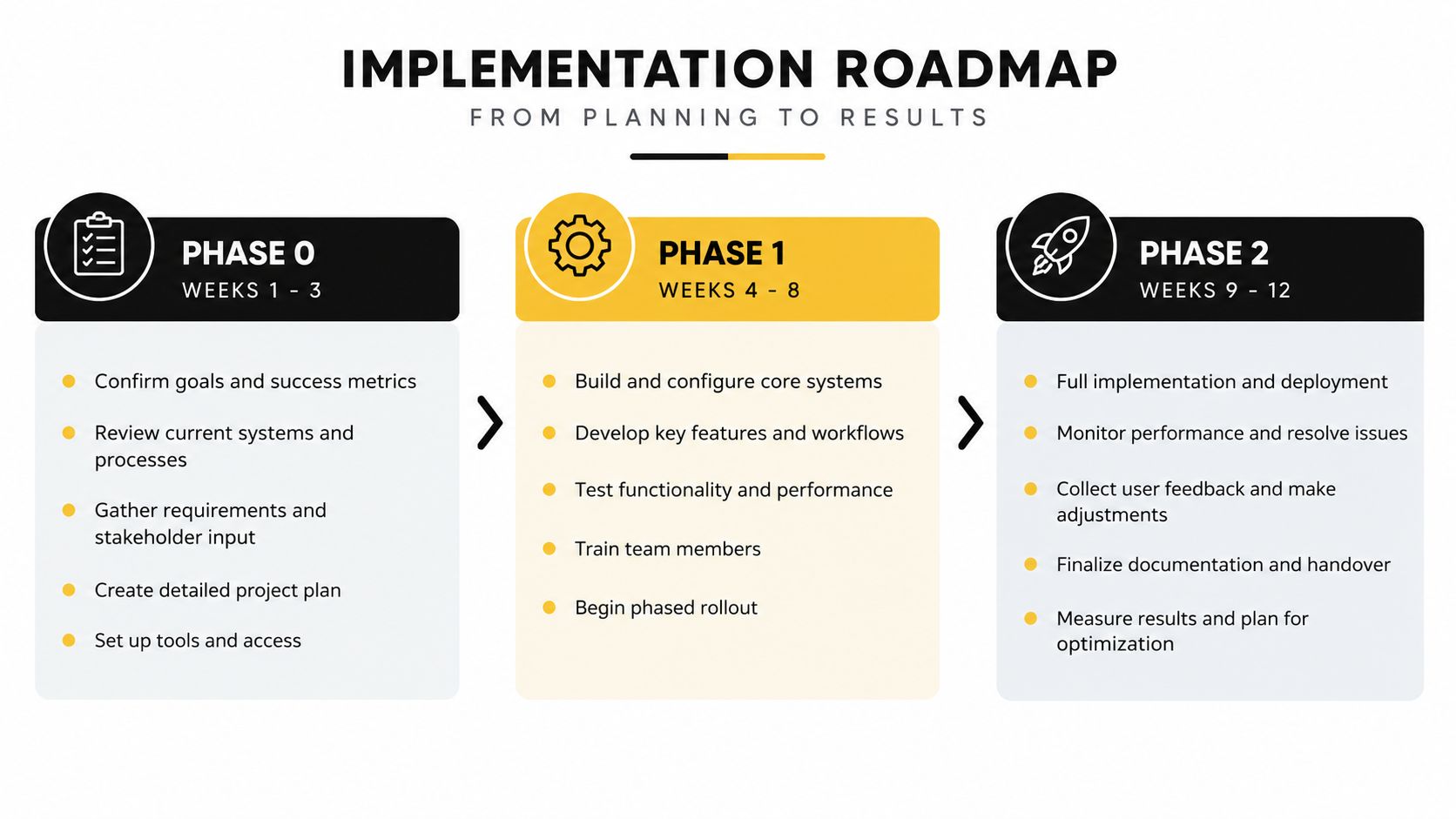
Phase 0 establishes the decision record
Create a language inventory from CRM, contact-center, web, and employee-service data. Map each language to channels, intents, knowledge sources, staffing options, and regulatory requirements. Classify intents into low-risk, operationally sensitive, and high-impact categories before selecting a model.
The governance gate is a signed scope document. It should state which languages and intents are supported, which are translated only for human agents, and what happens when detection confidence is low.
Phase 1 proves one narrow journey
Select a small set of languages and one channel, such as order status, password assistance, appointment preparation, or billing explanations. Capture a human-only baseline for containment, customer satisfaction, resolution, transfer, and recontact. A pilot without a control group can show activity, but it can't show whether the new workflow improved service.
Human reviewers should examine samples for terminology, tone, omissions, entity accuracy, and policy compliance. Use approved source content rather than letting the model invent localized policy.
Phase 2 adds voice and local operating control
Voice introduces transcription errors, interruptions, accents, and confirmation risk. Tune locale-specific intents, establish escalation service levels, and create a localization review board with customer operations, compliance, legal, product, and native-language reviewers.
For European deployments, complete the required data-protection impact assessment before expanding sensitive processing. For clinical Spanish or Portuguese workflows, define the healthcare privacy scope before connecting patient data. For Arabic, test right-to-left rendering, copied identifiers, and data-loss-prevention rules across every agent interface.
Phase 3 and enterprise scale
Cross-channel orchestration should come after the team can preserve context in the initial channel. Then add risk-adaptive routing, human review for low-confidence intents, PII redaction, audit trails, regional data residency, and model-routing policies.
Enterprise scale isn't the point at which governance stops. It is when governance becomes repeatable. Each added language needs an owner, glossary, evaluation set, fallback queue, and retirement process for outdated policy content.
KPIs, Quality Measurement, and Risk-Adaptive Governance
Multilingual quality is auditable only when business, language, and risk measures appear in the same operating review. A high containment rate can conceal mistranslation. A strong automatic score can conceal a wrong eligibility decision. A good global CSAT score can hide poor access for a smaller language group.
Use three layers:
- Business outcomes: Track CSAT, retention signals, cost-to-serve, containment, first-contact resolution, and expansion indicators by locale.
- Language quality: Combine BLEU, BERTScore, human direct assessment, terminology compliance, omission rate, and post-editing time. Review samples by language, channel, intent, and risk tier.
- Risk controls: Monitor PII leakage, unsafe completion, escalation adherence, unsupported intents, policy deviations, and audit exceptions.
Define a locale-level quality index only after stakeholders agree on its components and weights. Semantic fidelity, intent correctness, tone, formality, latency, and policy compliance shouldn't be collapsed into one score until the organization understands which failures are unacceptable. A regulated workflow may tolerate latency more readily than a wrong disclosure.
Route by confidence and consequence
Low-confidence outputs and high-impact intents should go to a trained human. Medium-confidence interactions can use AI with a confirmation prompt when the action is reversible and the customer can correct the record. High-confidence, low-risk requests may be fully automated after they pass semantic and policy checks.
Sampled human evaluation needs adjudication. Reviewers should resolve disagreements, record the failure category, and feed corrections into the glossary, retrieval source, intent set, or routing policy. Model drift and policy changes should trigger re-evaluation rather than waiting for complaints.
| KPI Category | Metric Examples | Target Threshold | Measurement Method | Governance Owner |
|---|---|---|---|---|
| Business | CSAT, containment, resolution, retention signal | Approved by journey and locale | Dashboard segmented by language and channel | CX operations |
| Translation | BLEU, BERTScore, omissions, terminology violations | Locale-specific release gate | Automated scoring plus human review | Localization lead |
| Intent | Intent accuracy, entity correctness, unsupported-intent rate | Risk-tier threshold | Gold-set testing and sampled conversations | Conversation design |
| Service | Transfer rate, resolution time, recontact | Baseline comparison | Contact-center and CRM analysis | Support operations |
| Risk | PII exposure, policy deviation, unsafe answer, escalation adherence | Zero tolerance where applicable | Audit sampling and event monitoring | Compliance and security |
What isn't measured in the customer's language isn't fully served.
The Hidden Risks Most Multilingual Programs Miss
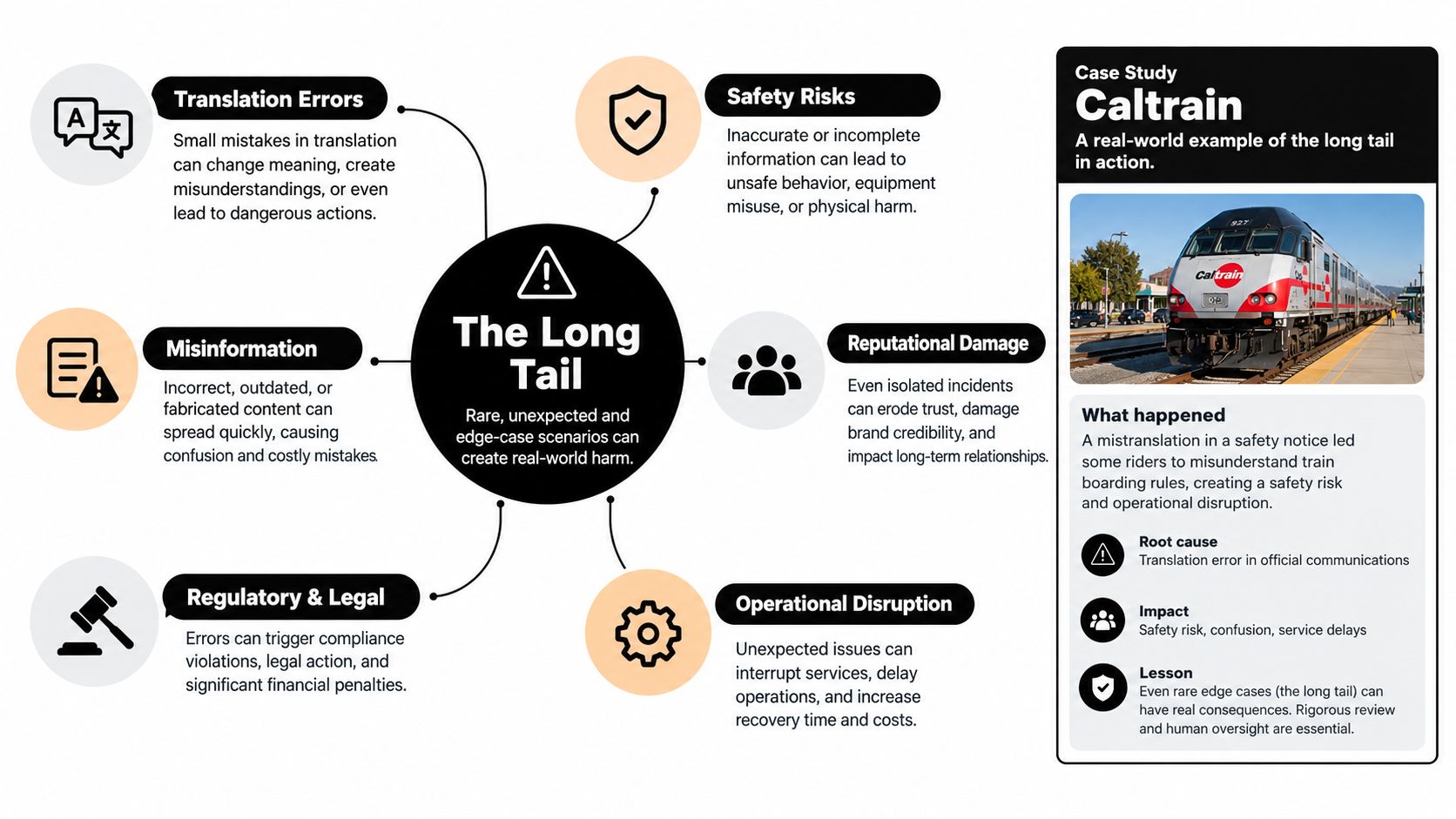
The long tail is where language-access programs reveal their limits. A public-service survey by Caltrain found that nine potential respondents couldn't participate because they spoke a language other than English, Spanish, or Chinese, the languages available in the survey. The Caltrain evidence shows why a supported-language list can look inclusive while excluding real customers.
That problem extends beyond language labels. Dialect, literacy, code-switching, speech impairment, and mixed-language messages can all reduce access. Latin American and Iberian Spanish aren't interchangeable in every service context. Gulf and Levantine Arabic can differ in vocabulary and expectations. Japanese and Korean require careful control of formality. Indian and African markets often produce code-mixed interactions that standard language identification handles poorly.
Meaning loss creates risk
The difficult failure isn't a visibly bad translation. It's a fluent sentence that changes the customer's rights or obligations. Industry coverage has cited research reporting that conventional machine translation can lose up to 47% of contextual meaning, especially where cultural and historical nuance matters. The discussion of language challenges in business operations also reports that a 2025 survey of 1,000 US business decision-makers found 69% had seen language challenges compromise daily operations, 39% reported customer-service impact, and 61% said language issues had delayed or limited international expansion.
Those figures should be treated as reported survey findings, not a universal forecast. The operational lesson is still clear: machine translation can't be the final authority for medical triage, claims, collections, safety instructions, or contractual decisions.
- Detection failure: The system assigns the wrong language or dialect. Ask for confirmation or route to a language-capable queue.
- Context failure: The system preserves words but loses intent, politeness, or risk meaning. Use human review and approved terminology.
- Coverage failure: No suitable language route exists. Offer a transparent fallback without forcing the customer to restart.
- Workflow failure: The translation is accurate, but the handoff loses identity or history. Transfer the full context and audit event.
The contrarian advantage is risk-adaptive routing. Score severity, confidence, language coverage, and regulatory exposure, then choose automation, review, or human ownership per use case. Universal automation is less mature than selective automation with clear refusal behavior.
Enterprise Use Cases and How Yellow.ai Fits In
Different industries expose different weaknesses in a multilingual design. A lender needs accurate amounts, eligibility language, and authentication. A healthcare network needs careful triage boundaries, privacy controls, and qualified escalation. A retailer needs continuity across voice, chat, order systems, and returns.
Consider a BFSI operation serving borrowers who use Hindi, Tamil, or Tagalog. Dynamic AI Agents can identify intent, retrieve approved lending content, and route account-sensitive requests. The critical integration is identity and authorization. A translated answer mustn't create access to information the customer hasn't been authenticated to receive.
A healthcare network handling Spanish, Mandarin, and Vietnamese interactions needs a conservative voice and chat workflow. Automation Knowledge should retrieve localized policy documents, while Agent Assist can help a human continue the conversation after escalation. HIPAA scope, redaction, clinical escalation, and audit retention must be designed before the model connects to patient workflows.
Retail operations across European markets need consistent order, delivery, refund, and returns handling. Utilities face a harder access problem when outage communications reach rural dialect communities or low-bandwidth phone users. BPOs need tenant isolation, contract-specific policies, and observability that proves one client's glossary or data never leaks into another's workflow.
| Vertical | Multilingual Pressure | Yellow.ai Capabilities | Critical Integration and Governance Decision |
|---|---|---|---|
| BFSI | Financial terminology, authentication, eligibility | Dynamic AI Agents, Agent Assist, localized knowledge retrieval | Identity, consent, disclosure approval, audit trail |
| Healthcare | Triage, privacy, sensitive language | Voice AI, Automation Knowledge, human escalation | HIPAA scope, redaction, clinical ownership |
| Retail | Returns, delivery, commerce continuity | Omnichannel agents, knowledge retrieval, voice and chat | CRM, order management, refund authorization |
| Utilities | Urgency, dialect variation, low-bandwidth voice | Voice AI, routing, agent handoff | Outage data, emergency escalation, availability messaging |
| BPO | Multiple clients, policies, queues, and languages | Multi-tenant orchestration, Agent Assist, analytics | Tenant isolation, contract controls, shared observability |
Integration choices determine whether the deployment can be audited. Connectors to CCaaS, CRM, identity, knowledge, and observability systems should preserve language metadata, model decisions, transfer reasons, and policy versions. Leaders comparing service automation approaches can also browse top virtual assistant services to assess how different providers handle orchestration and human support.
A 90-Day Plan and Frequently Asked Questions
Use the first thirty days to establish facts. Audit contacts, languages, channels, knowledge gaps, current staffing, and risk tiers. Choose the initial journeys, record baseline containment and resolution measures, and identify where customers currently abandon or repeat themselves.
During the next thirty days, pilot two carefully selected languages on one channel. Connect language identification, NLU, translation, retrieval, and escalation. Define the confidence thresholds that trigger confirmation or human review, then create a governance group with named owners from CX, compliance, security, and localization.
In the final thirty days, expand only where the evidence supports it. Tune containment, review sampled conversations, score semantic and intent quality, and report ROI alongside failure categories. The result should be a decision on what to scale, what to redesign, and what not to automate.
How do we justify the investment?
Tie the case to observed demand and service cost. Show which contacts are unresolved, transferred, repeated, or delayed because language coverage is weak. Include retention and risk signals, but label them as indicators rather than guaranteed financial outcomes.
Which languages should launch first?
Prioritize languages using contact volume, revenue exposure, regulatory need, unresolved demand, and available human escalation. A smaller list with reliable coverage is safer than a broad list with no fallback.
What human staffing is still required?
Native or highly proficient reviewers remain necessary for high-impact intents, glossary ownership, quality adjudication, escalations, and culturally sensitive conversations. Automation reduces repetitive handling, but it doesn't remove accountability.
How do we satisfy regulators?
Maintain approved source content, language-specific evaluation records, consent and identity controls, redaction, audit trails, escalation evidence, and documented model changes. Re-localize policy content whenever the underlying rule changes.
Multilingual customer support is a continuous operating discipline. Refresh language data quarterly, monitor drift, review unsupported and mixed-language contacts, and re-test whenever policies or models change. Start with a structured pilot that produces evidence a finance, compliance, and operations leader can defend.
Yellow.ai offers AI agents for multilingual customer conversations across voice, chat, apps, and other service channels, with orchestration, knowledge retrieval, human handoff, and analytics in the same operating model. Visit Yellow.ai to evaluate a risk-adaptive pilot around your highest-volume languages and most valuable support journeys.



