














A customer experience leader can buy a polished demo, play it for executives, and still end up with callers saying the voice sounds off. The usual failure isn't the model's accent or vocabulary, it's the gap between studio-quality playback and production-ready realism. That gap is where the most realistic AI voice is decided, because a voice that sounds convincing for ten seconds can still fail under live interruption, noisy lines, and complex workflows.
| Vendor | Fidelity Score | Latency | Prosody Range | Multilingual | Compliance |
|---|---|---|---|---|---|
| ElevenLabs | 95% human parity in audio spectrum tests for breathing and emotional range, source | Not provided in verified data | Strong emotional realism | Not provided in verified data | Not provided in verified data |
| Cartesia Sonic 3.5 Turbo | Not provided in verified data | Approximately 40ms time-to-first-byte, source | Built for interruption-resilient conversation | Not provided in verified data | Not provided in verified data |
| Inworld realtime voice | Not provided in verified data | Sub-250ms end-to-end latency, source | Conversation flow oriented | Not provided in verified data | Not provided in verified data |
| Deepgram Voice Agent API | Not provided in verified data | Sub-250ms end-to-end latency, source | Live speech handling | Not provided in verified data | Not provided in verified data |
| Yellow.ai Nexus Vox | Not provided in verified data | Built for ultra-low latency in enterprise voice deployments, source | Voice cloning and conversational delivery | 500+ languages, source | Enterprise-grade compliance, source |
Table of Contents
- Introduction to Realistic AI Voice
- Understanding AI Voice Realism
- Evaluation Criteria and Testing Methodology
- Comparing AI Voice Vendor Capabilities
- Enterprise Deployment and Compliance Checklist
- Use Cases and Test Scenarios
- Recommendations for Selecting Realistic AI Voices
Introduction to Realistic AI Voice
A CX director can launch a voice bot with correct intents, clean scripts, and acceptable demo audio, then see the pilot fail once callers start interrupting, showing frustration, or changing topics mid-call. The pauses feel mechanical, the tone stays flat, and the system stops sounding credible. That gap separates a clever prototype from the most realistic AI voice.
The standard is higher because voice realism is no longer judged by whether audio sounds “good enough.” Current systems can reproduce specific characteristics of a source voice with 97% accuracy, and blind listening tests show professional-grade clones reaching 94% human-indistinguishable quality in some settings, which makes realism a measurable engineering target rather than a branding claim, source. In contact centers, employee support, premium service, and fraud-sensitive workflows, a single awkward reply can make the system feel unreliable.
Buying voice AI means separating polished audio from production trust. Evaluators need to listen for emotional nuance, check latency under load, and test whether the voice holds up in noisy environments and multi-intent conversations. A useful starting point is Yellow.ai's Nexus Vox overview, which treats voice as an enterprise system rather than a standalone demo, source.
Studio-grade audio helps, but it does not solve the production problem by itself. Buyers who want repeatable quality should also review the studio secrets for professional sound, because mic treatment, mixing discipline, and playback consistency shape how realism is perceived in live use, studio secrets for professional sound.
The practical question is straightforward. Which vendors can deliver a voice that feels human in real workflows, not only in a controlled sample? The answer depends on how realism is defined, how it is tested, and which failure modes the business cannot absorb.
Understanding AI Voice Realism
The six pillars that actually matter
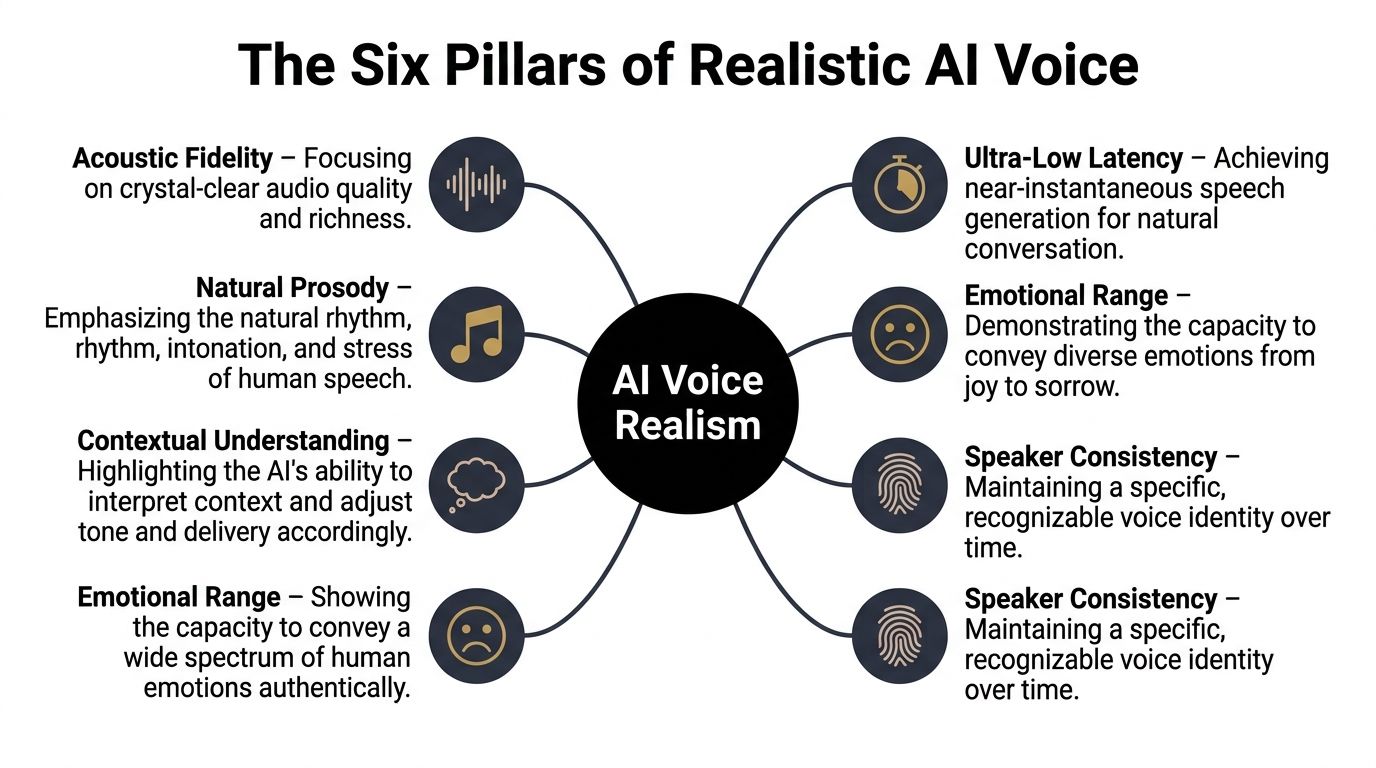
Realism in AI voice breaks into six pillars. Acoustic fidelity covers how clean and rich the signal sounds, but fidelity alone does not guarantee believability. Natural prosody matters just as much, because rhythm, stress, and intonation shape whether speech feels conversational or machine-made.
Contextual understanding determines whether the voice responds appropriately to what the user just said. A support bot that keeps the same tone after a complaint feels scripted, even if the waveform is clean. Ultra-low latency is the fourth pillar, and teams usually notice it only after the first live call stalls. Enterprise analysis points to prosody, emotional range, and contextual adaptability as core parts of realism, and it also shows that predictable sub-250ms latency helps avoid user-perceived unnaturalness, source.
The last two pillars are multilingual support and enterprise security and compliance. Multilingual support matters because accents, language switching, and pronunciation drift show up quickly in global deployments. Security and compliance matter because a realistic voice often handles personal or regulated data, and the enterprise buyer needs consent, governance, and auditability. Teams that want a tighter production sound profile can also review studio secrets for professional sound to understand how mic treatment, mixing discipline, and playback consistency affect perceived realism in live use.
Why clones and generic voices are not the same product
One of the most important distinctions in this market is between a generic AI voice and a voice clone. Generic voices can sound pleasant, but research shows they are consistently rated as less human than real recordings. State-of-the-art clones are now statistically indistinguishable from authentic speech in a meaningful share of judgments, with listeners misidentifying them as human 58% of the time, which is effectively chance-level behavior for many use cases, source.
That distinction changes procurement logic. A brand voice for marketing narration does not need the same believability threshold as a premium support line or fraud-sensitive authentication flow. In those settings, the question is not whether the voice sounds pleasant. It is whether a listener can tell it is synthetic when that distinction matters operationally.
Practical rule: If the use case depends on trust, identity, or interruption handling, evaluate a clone and a generic voice separately. Treating them as one category hides the operational risk.
The most realistic systems combine source-voice authenticity with conversational behavior that stays natural when the user interrupts, pauses, or changes intent. That is why fidelity metrics and live interaction metrics have to be evaluated together, not in isolation. A voice that is beautiful on a benchmark and brittle in production is not enterprise-ready.
A realistic voice has to survive scale
Benchmark numbers can mislead teams if they ignore deployment conditions. Voice AI failures appear only at scale in real rooms, over real networks, and across mixed devices. Production testing has to account for noise profiles, room acoustics, microphone variability, and compression artifacts, because those are the conditions that reveal whether realism holds or collapses.
Yellow.ai's automated testing approach is useful here because it points evaluation toward repeatable checks instead of one-off demos. The same discipline should apply across short prompts, long-form narration, and multi-turn conversations, since each format exposes different weaknesses. Short clips reveal obvious artifacts. Long-form narration shows fatigue, pacing drift, and pronunciation inconsistency. Multi-intent conversations show whether the voice can stay coherent when the user changes direction midstream.
The right mental model is simple. A voice is not realistic because it sounds human once. It is realistic because it keeps sounding human when a customer interrupts, when an employee speaks with an accent, and when the system has to move quickly from one intent to the next. That is the level where enterprise value shows up.
Evaluation Criteria and Testing Methodology
Start with a test plan, not a demo
Teams often begin with vendor demos and end up judging performance under the easiest possible conditions. That misses the point. A serious testing plan should define the target user, the audio environment, the interaction pattern, and the failure threshold before anyone compares voices. If the deployment is for customer support, test with interruptions and unresolved intents. If it is for employee service, include internal jargon, names, and policy language.
The first layer of evaluation should measure acoustic clarity, pitch variance, response time, and emotion accuracy. Then add controlled listening tests with humans who do not know which model they are hearing. Blind testing matters because it removes brand bias and forces the team to judge the actual output. It also catches voices that sound fine in isolation but flatten out over longer exchanges.
Testing standard: Do not approve a voice until it works in noisy audio, across multiple accents, and under concurrent load. Studio playback alone does not predict production behavior.
Evaluation also needs test assets separated by format. Short prompts expose obvious artifacts. Long-form narration reveals fatigue, pacing drift, and pronunciation inconsistency. Multi-turn conversations show whether the voice can remain stable when the dialog changes direction and the user shifts intent midstream.
Validate real-world latency, not just rendered audio
Latency is one of the strongest predictors of perceived realism because users feel delay before they consciously judge timbre. Production validation should therefore measure the full interaction path, not just synthesis speed. That means looking at the handoff between input capture, inference, voice rendering, and playback under live conditions.
A practical framework looks like this:
- Define success criteria for the business scenario.
- Build a varied test set with accents, noisy backgrounds, and multi-intent prompts.
- Run blind listening tests with human raters.
- Measure response timing, not just output quality.
- Simulate production load and live concurrency.
- Re-test after tuning prompts, routing, or orchestration.
The environment should be harder than a vendor demo. If the voice still feels smooth when the interaction is interrupted or the network jitters, the system is closer to production-ready realism. If the voice breaks under those conditions, polished audio files are not a useful indicator.
Use tools that expose conversational failures
Automated speech analytics can help, but they should not replace human judgment. Human raters catch emotional mismatch, while tooling catches timing, pronunciation drift, and consistency problems across sessions. In enterprise deployments, the strongest test plans combine both perspectives instead of treating them as substitutes.
A platform like Yellow.ai's automated testing workflow fits that model because production validation needs repeatability as well as qualitative review. A good test harness should replay the same scripts across different channels, log response timing, and surface failures that appear only under load. The goal is not to find a voice that performs well once. It is to find one that keeps working after routing, scaling, and stress enter the picture.
Clean studio tests are useful, but they do not show how a voice behaves when the room gets noisy, the user interrupts, or multiple intents appear in one session. Realistic voice AI has to hold up in those conditions because that is where customers experience it.
Comparing AI Voice Vendor Capabilities
Reading the numbers the right way
Vendor comparisons only help when they separate emotional realism, speech reasoning, and live interaction behavior. The clearest split appears across those three layers. ElevenLabs is the benchmark for emotional realism because it has been reported at a 95% human parity score in audio spectrum tests for breathing patterns and emotional range, source. That result matters because it reflects the subtle artifacts listeners pick up first, not just whether the voice sounds clean.
Latency changes the picture fast. Cartesia Sonic 3.5 Turbo is notable for an approximately 40ms time-to-first-byte result, source. In a live conversation, that kind of response time can reduce awkward pauses, overlap, and the feeling that the system is lagging behind the user. A voice with lower delay can feel more responsive even if another product sounds better in isolated audio tests.
Speech-to-speech systems add a separate test dimension. Qwen3.5 Omni Plus reached a 98.7% reasoning score on benchmark audio datasets, which points to a shift from pure synthesis quality toward better conversational handling, source. That matters in sessions where the system has to infer intent, hold context, or answer under conversational pressure rather than just read text aloud.
Vendor table with what each product is good at
| Vendor | Fidelity Score | Latency | Prosody Range | Multilingual | Compliance |
|---|---|---|---|---|---|
| ElevenLabs | 95% human parity in audio spectrum tests for breathing and emotional range, source | Not provided in verified data | Strong emotional realism across dramatic, documentary, and narration formats | Not provided in verified data | Not provided in verified data |
| Cartesia Sonic 3.5 Turbo | Not provided in verified data | Approximately 40ms time-to-first-byte, source | Optimized for interruption-resilient conversation | Not provided in verified data | Not provided in verified data |
| Inworld realtime voice generator | Not provided in verified data | Sub-250ms end-to-end latency, source | Built for multi-turn flow | Not provided in verified data | Not provided in verified data |
| Deepgram Voice Agent API | Not provided in verified data | Sub-250ms end-to-end latency, source | Strong live speech handling | Not provided in verified data | Not provided in verified data |
| Yellow.ai Nexus Vox | Not provided in verified data | Ultra-low-latency enterprise voice delivery, source | Voice cloning and conversational delivery | 500+ languages, source | Enterprise-grade compliance, source |
How to interpret the trade-offs
The table makes one point clear. Realism is not a single score. ElevenLabs stands out when emotional authenticity is the main target, while Cartesia is the stronger signal when delay is the biggest risk. Inworld and Deepgram fit use cases where rapid back-and-forth matters more than studio-style polish. Yellow.ai belongs in the enterprise discussion because it combines multilingual scale, voice cloning, and compliance controls inside a broader agent stack.
The practical takeaway is narrower than vendor marketing usually suggests. A support workflow that needs emotional steadiness, speech understanding, and low-latency turn-taking should not be judged with the same rubric as a one-way training narration use case. Multi-intent sessions, interruptions, and turn changes expose failures that polished demo clips hide. The better choice is the vendor that matches the interaction pattern and the operating constraints, not the one with the strongest isolated audio sample.
Enterprise Deployment and Compliance Checklist
Deployment risks surface after procurement
The biggest mistake enterprise teams make is treating voice selection as a media choice instead of a systems choice. Once a voice goes live, it affects identity checks, data handling, escalation routing, and user trust. Deployment checklists need to cover security, consent, failover, and auditability from day one.
A serious rollout starts with confirming what data the voice model sees, stores, and reuses. It also needs operational safeguards for API failure, backup routing, and version control. In regulated workflows, the contract language matters too, especially around usage rights and whether the model is a generic voice or a clone tied to a specific source.
The legal distinction is not academic. State-of-the-art clones are indistinguishable from human speech 58% of the time, and that makes speaker identity a live business issue for fraud detection and premium support, source. If a team mislabels a clone as a generic model, consent, disclosure, and customer expectations can all be affected.
The checklist for production-ready deployment
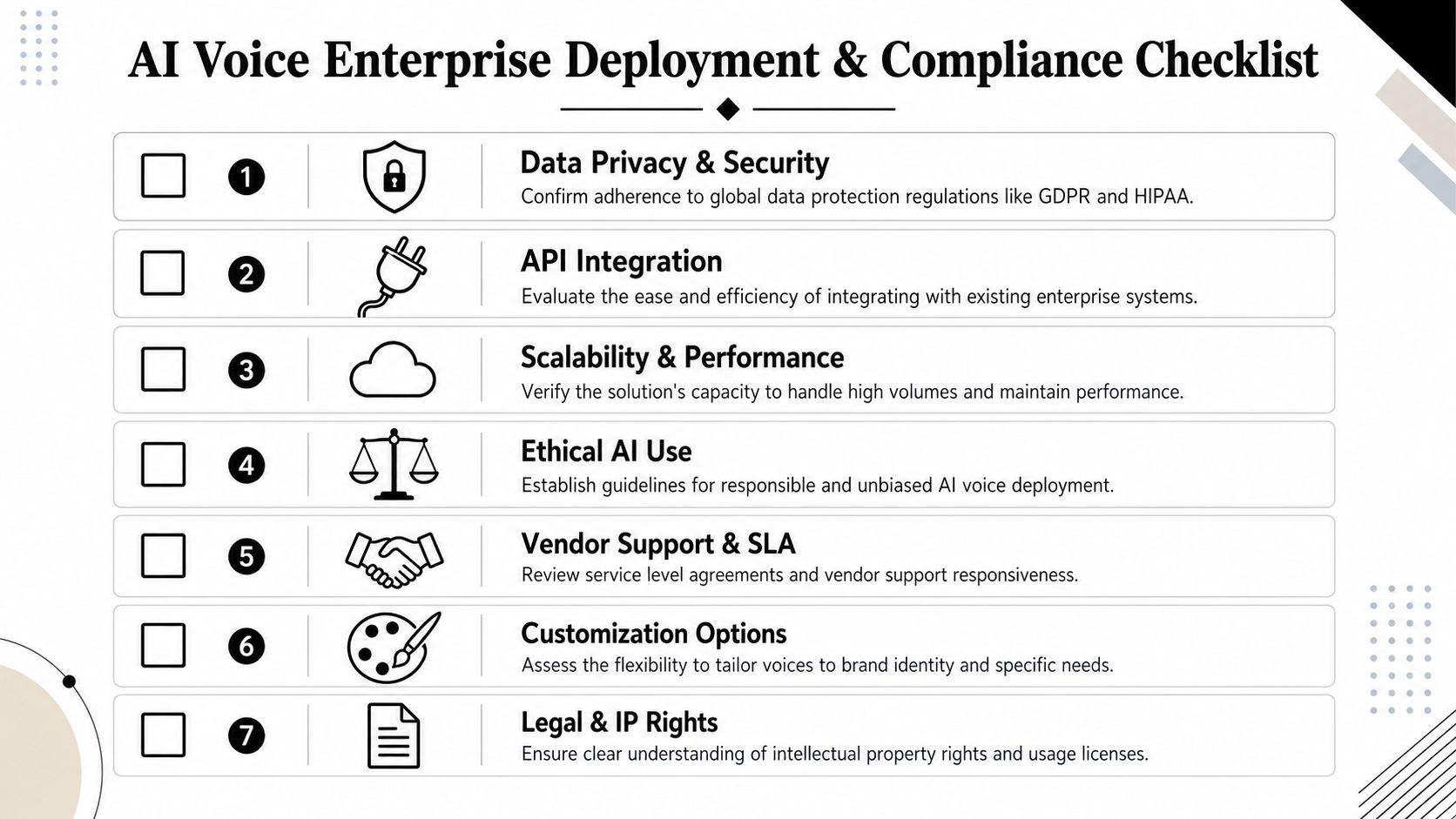
- Data Privacy and Security: Confirm how the vendor handles regulated data, retention, and consent, and review whether enterprise controls align with internal policy. Security review should also cover access boundaries, logging, and how cloned or branded voices are protected in transit and at rest.
- API Integration: Validate that the voice pipeline connects cleanly to orchestration, CRM, and routing systems without fragile custom glue. Test failure paths as part of integration, since a clean demo can still break under retries, timeouts, or handoff errors.
- Scalability and Performance: Test the voice under peak concurrency, not just during sandbox demos. The evaluation should include latency under load, recovery after spikes, and whether response quality changes when multiple intents arrive in the same session.
- Ethical AI Use: Set disclosure rules for when synthetic speech is used, especially in customer-facing environments. Teams should also decide when a synthetic voice is acceptable for support, when it should be flagged as machine-generated, and when a human handoff is required.
- Vendor Support and SLA: Confirm incident response, escalation ownership, and maintenance windows. A vendor that cannot explain support boundaries clearly usually creates more operational risk after rollout than during procurement.
- Customization Options: Check whether pronunciation, speaking style, and brand tone can be tuned without breaking stability. Customization is only useful if it still holds up across accents, fast turn-taking, and multi-intent prompts.
- Legal and IP Rights: Review usage rights carefully, especially for cloned voices and source audio. The review should cover consent, permitted use cases, and who owns the outputs once the voice is deployed in production.
A useful internal reference here is Yellow.ai's enterprise security material, which situates voice inside a broader compliance posture. That matters because voice AI failures are rarely just model problems. They are often governance problems that appear after the first successful pilot.
The cleanest deployment strategy is to pilot with one workflow, one owner, and one rollback plan. If the voice can pass compliance review, survive load testing, and remain understandable in real calls, it is ready for expansion. If any of those pieces fail, the rollout is not ready, no matter how good the demo sounded.
Use Cases and Test Scenarios
Customer support needs a different test than narration
A voice that performs well in a training module can break down in a live support queue. Customer support callers interrupt, repeat details, and change topics mid-sentence. A realistic enterprise voice has to be tested inside a live dialog, not as isolated speech output.
One useful test scenario is multilingual support with code-switching. Put the system in front of callers who mix languages or speak with strong regional accents, then check whether the voice stays stable and easy to understand. Another is billing or fraud support, where the caller is stressed and the system still needs to sound calm and trustworthy without becoming detached.
Cartesia Sonic 3.5 Turbo is relevant here because its approximately 40ms time-to-first-byte supports interruption-resilient exchanges and keeps turn-taking tight, as noted earlier. That kind of speed matters when a caller cuts in before the bot finishes, because the voice has to recover naturally instead of sounding delayed or clipped.
A good support benchmark should also include escalation language. The system should be able to move from routine answers to a handoff without changing tone too sharply or losing context.
Employee and operations bots need emotional control
Internal service bots face a different problem. They need to sound helpful, but not overly cheerful when the user is dealing with a policy issue or benefits problem. The test set should include long-form employee FAQ dialogs, policy explanations, and escalation handoffs. Add messy inputs, because real employees rarely use clean phrasing.
A good production test here is a 10-turn conversation with interruptions and a topic change near the end. If the system keeps context without sounding repetitive, it is much closer to practical realism. Test failure recovery as well. When the model misses a question, the recovery voice should still sound human, not defensive or flat.
The best signal is whether the voice keeps the same emotional register across multiple intents. A benefits question, a policy clarification, and a handoff to a human agent should not sound like three separate systems stitched together.
Live transaction routing demands fast recovery
In high-stakes workflows, the goal is not to impress the listener. It is to keep the interaction moving. Transaction routing, identity checks, and issue triage all benefit from a voice that responds quickly and preserves context across turns. Once delay becomes noticeable, trust starts to drop.
These scenarios should be measured against two separate questions. First, does the voice stay intelligible under pressure. Second, does it recover cleanly after interruptions, corrections, or a failed intent match. Studio-grade audio can mask weak conversational behavior in demos, but production calls expose it quickly.
The takeaway is that use case design should determine test design. A support bot, an HR assistant, and a branded narrator all need different realism thresholds. The strongest voice platforms are the ones that pass multiple scenarios without manual rework every time the dialog changes.
Recommendations for Selecting Realistic AI Voices
Match the model to the job
If your use case is premium support, fraud-sensitive workflows, or branded assistant interactions, prioritize voice clones and test them under production load. If your use case is training, narration, or product walkthroughs, a high-quality generic TTS model may be enough, provided the pacing and pronunciation stay stable over longer scripts. The wrong choice is to assume these are interchangeable.
For BFSI and healthcare, put compliance and identity governance ahead of expressive range. For retail and CX centers, prioritize interruption handling, latency, and multi-turn resilience. For HR and EX bots, focus on calm tone, consistency, and multilingual coverage across internal audiences.
A platform like Yellow.ai can make sense when you need voice cloning inside a broader enterprise agent stack, especially if the deployment also needs multilingual scale and operational testing, but it should still be scored against the same evidence-based criteria as standalone vendors. The buyer should ask one question first. Can this system stay human-sounding when the call gets messy?
Decision rule: Choose realism by workflow, not by slogan. The most realistic AI voice for a narration studio is rarely the same product that wins in a live contact center.
For pilots, keep the scope narrow and measurable. Use one critical workflow, one control group, and one success threshold for latency and comprehension. If the voice survives those conditions, expand carefully. If it doesn't, the issue is usually not the script, it's the mismatch between the model's strengths and the actual job.
If you're evaluating the most realistic AI voice for an enterprise rollout, start by mapping the workflow, then test the voice against real interruptions, real accents, and real load. Explore Yellow.ai to see how an enterprise voice stack can be assessed alongside your CX, EX, and compliance requirements.



