









A regional bank can run a customer-facing generative AI assistant without replacing the 1990s mainframe that still holds its core account records. The assistant may answer balance questions, explain transactions, or start a service request, while the mainframe continues processing the authoritative data underneath. In some organizations, that core workload is not shrinking. Kyndryl found that 56% of respondents saw mainframe usage increase during the past year, and 54% expected further growth over the following 12 months (Kyndryl findings summarized by Saritasa).
That reality changes the architecture question. Legacy system integration isn't merely a migration bridge. It's a coexistence discipline for organizations that need modern AI experiences while preserving systems that still perform valuable operational work. The projects that ship tend to define clear seams, ownership boundaries, data contracts, security controls, and rollback paths before anyone celebrates a successful demo.
Table of Contents
- Why Legacy System Integration Is Now a Coexistence Strategy
- Mapping the Legacy Estate Before You Touch It
- Choosing the Right Integration Pattern
- Building the Middleware, API, and Data Mapping Layer
- Designing Security, Compliance, and Observability In
- Testing and Rolling Out Without Breaking the Business
- Making Integration Sustainable Beyond Go-Live
Why Legacy System Integration Is Now a Coexistence Strategy
The common assumption is that modernization ends with decommissioning. Enterprise architecture rarely works that cleanly. A core banking platform may contain decades of business rules, regulatory controls, and operational knowledge that a replacement program can't reproduce safely in a single release. Meanwhile, conversational AI creates pressure at the customer and employee interface, not necessarily inside the transaction engine.
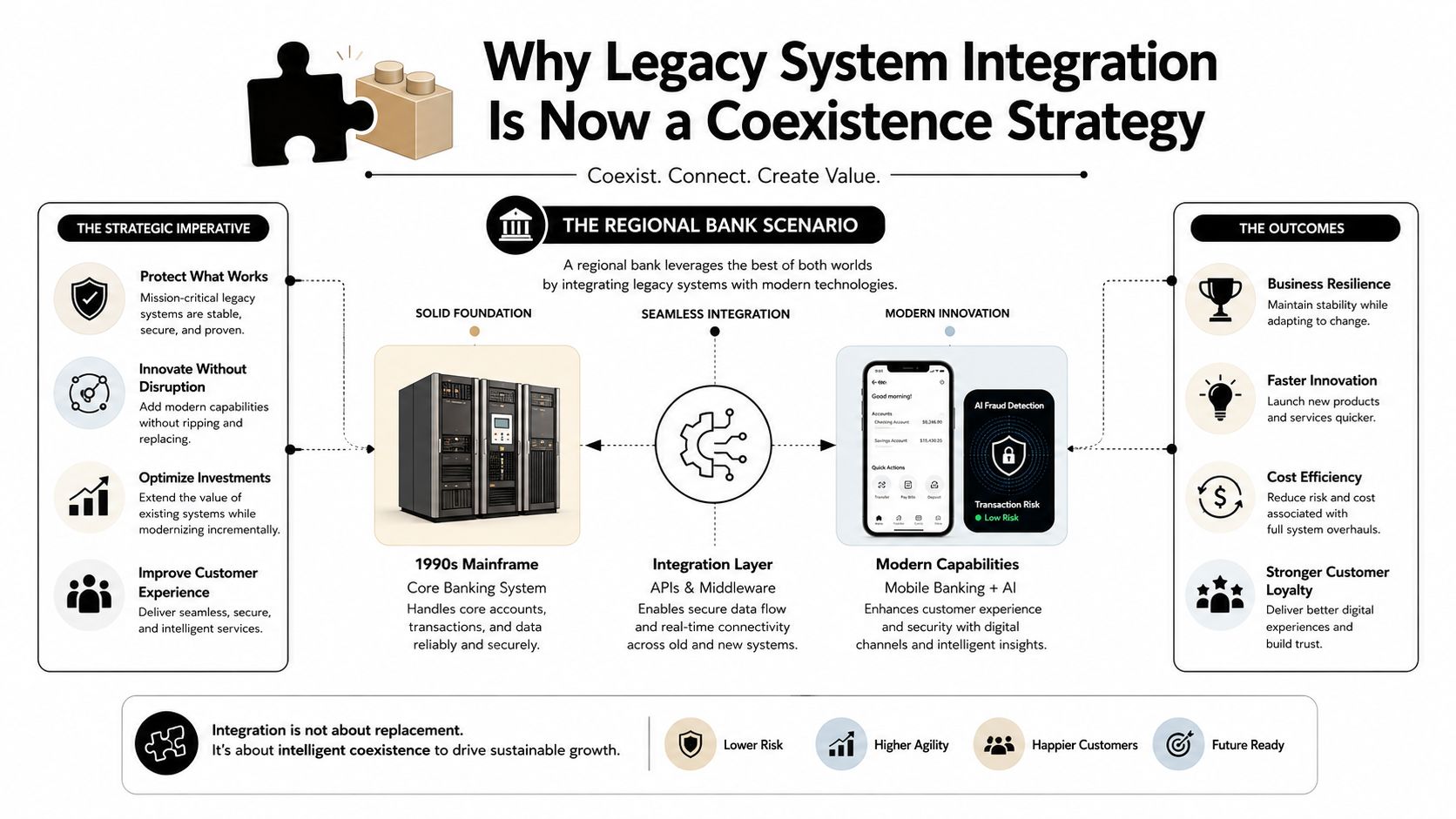
The mainframe may be the neighbor, not the endpoint
Three forces make coexistence a practical default.
First, a big-bang replacement exposes the business to concentrated operational risk. It can disrupt payment processing, customer servicing, reporting, and compliance workflows at the same time. The safer choice is often to isolate valuable capabilities behind controlled interfaces while modern applications assume responsibility for new experiences.
Second, long-running COBOL and RPG workloads frequently encode rules that aren't visible in contemporary documentation. Operators may understand which batch jobs, terminal screens, files, and exception paths keep the business moving. Removing the platform before extracting that knowledge turns modernization into reverse engineering under pressure.
Third, AI adoption moves faster at the interface than at the core. A bank can introduce a conversational assistant, but the assistant still needs governed access to account data and transaction functions. The demand is for a reliable front door, not automatically for a new ledger.
Practical rule: Treat the legacy estate as a production product with consumers, service levels, owners, and a roadmap. Don't treat it as a temporary obstacle that nobody needs to manage.
The scale of the maintenance problem supports this reframe. A 2024 global survey reported that 96% of organizations relied on legacy technology to at least some extent, while 65% spent more than $2 million maintaining or upgrading legacy systems (survey reference). Integration therefore becomes a strategic capability. It connects old and new systems without pretending that every core workload must disappear immediately.
Mapping the Legacy Estate Before You Touch It
Most integration failures begin before the first adapter is built. Teams select an API style or middleware product while they still don't know which system owns the truth, which batch process changes the record later, or which operator depends on an undocumented file transfer.
Start with an inventory that follows business transactions, not application names. For a customer-service assistant, trace the request from the conversational platform to identity services, API gateway, adapter, mainframe program, database, batch update, and downstream notification. Record terminal screens, scheduled jobs, fixed-width files, SOAP endpoints, database views, and manual workarounds. A long-tenured operator should be treated as a discovery source, not as an unofficial integration layer.
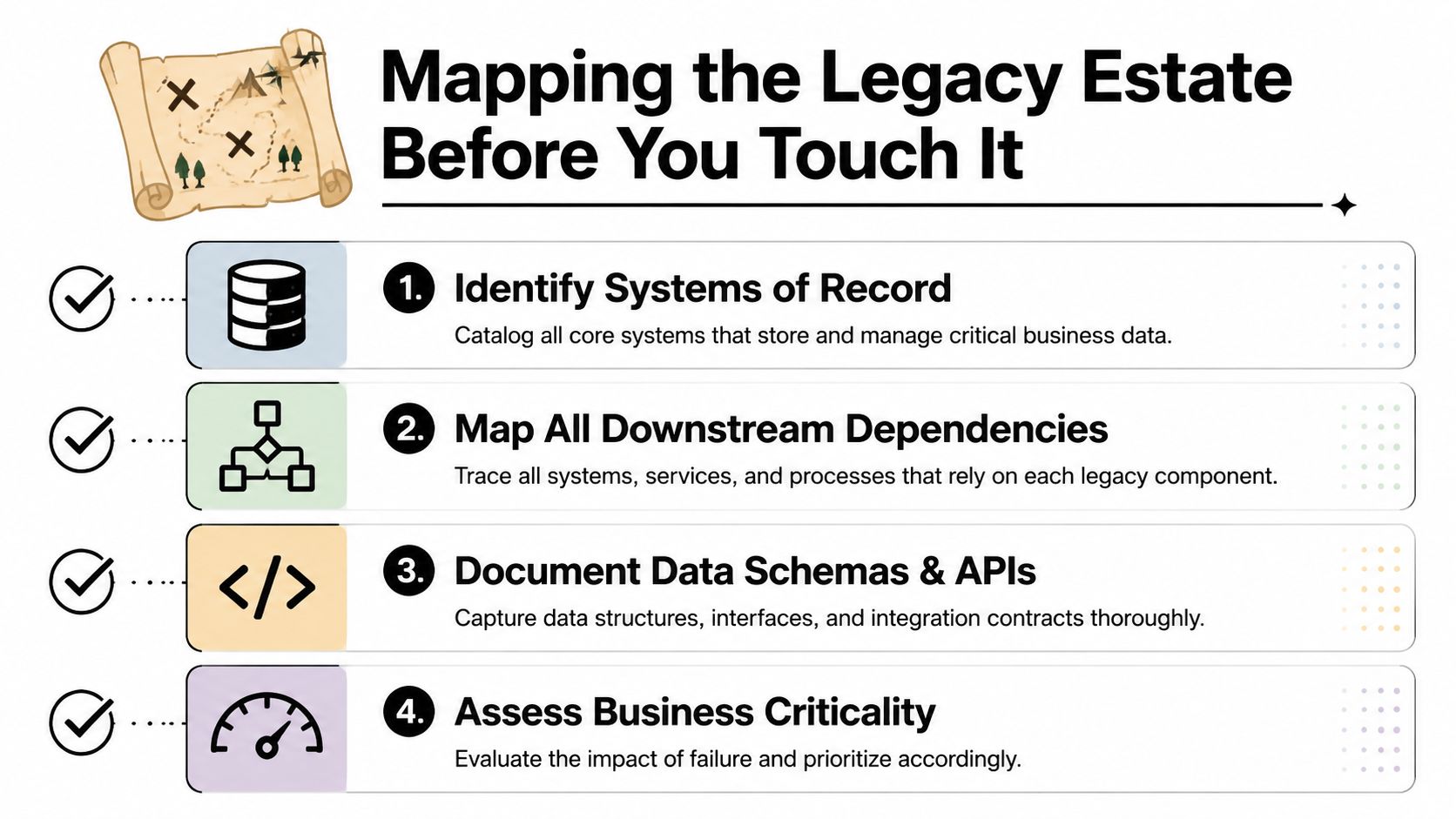
Build the map around business outcomes
A dependency map tells you what is connected. It doesn't tell you what deserves funding. Each proposed integration needs a business outcome that the product owner can inspect, such as lower average handle time, higher first-contact resolution, or more straight-through processing.
Define the baseline before implementation, then distinguish between three measures:
- Customer outcome: Can the customer complete the intended task without an avoidable handoff?
- Operational outcome: Does the workflow reduce rekeying, investigation, or manual lookup?
- Control outcome: Can the organization prove who accessed or changed the data?
This prevents the team from integrating systems just because an interface is technically available.
Use a readiness gate
Before selecting a pattern, confirm:
- System authority: Identify the source of truth for every field and action.
- Dependency visibility: List synchronous calls, batch jobs, files, queues, reports, and shadow integrations.
- Data condition: Check completeness, duplicate records, code meanings, stale fields, and legacy encodings.
- Identity path: Show how a user or service identity travels from the AI channel to the protected operation.
- Latency tolerance: Decide which requests can wait and which need a response within the interaction.
- Endpoint ownership: Name the team that approves changes, handles incidents, and accepts ongoing cost.
A 2024 ISG-LzLabs study found that 40% of organizations had started but not completed modernization projects, while only 21% had successfully completed them (study summary). Mapping doesn't eliminate delivery risk, but it exposes the dependencies that make an apparently small connector expand into an enterprise program.
Choosing the Right Integration Pattern
No single pattern is correct for every legacy workload. A read-only account lookup has different risk characteristics from a funds transfer, and a conversational answer has different timing needs from an overnight reconciliation process.
Screen scraping or robotic process automation can be the fastest route when a terminal has no usable interface. It works for narrow, stable flows where the business accepts brittleness and the automation has strong monitoring. It doesn't create a durable service contract. A screen layout change, new prompt, or timing variation can break the flow without the clean failure semantics of an API.
Controlled database access is more suitable for read-heavy reference data, provided the abstraction layer prevents applications from coupling directly to internal tables. Direct writes are dangerous because they can bypass validation, transaction logic, audit behavior, and downstream events embedded in the application.
Encapsulation through REST or event APIs provides a stronger boundary. Tools such as IBM HostBridge or Micro Focus can help expose mainframe capabilities, but the wrapper still needs ownership, versioning, authentication, capacity controls, and meaningful error responses. The vendor can accelerate enablement, while the enterprise remains responsible for the contract.
Message-driven integration with Kafka or Solace fits asynchronous workflows, notifications, and state changes that don't need an immediate conversational response. It introduces eventual consistency, replay management, schema governance, and more complicated troubleshooting. That trade-off is worthwhile when decoupling matters more than instant confirmation.
For banking-specific planning, an execution guide for bank system integration can help teams frame interfaces around core banking workflows rather than generic connectivity. Teams evaluating conversational use cases should also review the Yellow.ai integrations platform as one example of an AI platform integration surface.
Compare the patterns before choosing
| Pattern | Best Fit | Speed to Value | Maintainability | Key Risk |
|---|---|---|---|---|
| Screen scraping or RPA | Terminal-only workflows with limited alternatives | Fast for a narrow pilot | Low to moderate | Brittle behavior and weak failure visibility |
| Controlled database abstraction | Read-heavy reference data | Moderate | Moderate | Bypassed business rules and stale data |
| REST or event API encapsulation | Reusable business capabilities | Moderate | High when governed well | Wrapper ownership and contract drift |
| Message or event driven | Asynchronous updates and decoupled workflows | Moderate | High with mature platform practices | Eventual consistency and replay complexity |
Use business criticality, latency, and sensitivity as the decision aid. Low-criticality internal lookup may tolerate RPA. High-sensitivity writes should favor an owned service boundary with explicit authorization and transaction handling. If the AI experience requires an immediate answer but the source only updates in batches, expose that limitation to the conversation rather than disguising stale data as certainty.
Building the Middleware, API, and Data Mapping Layer
The plumbing decisions form a chain. Middleware determines how traffic is governed, the API contract determines how capabilities are consumed, and data mapping determines whether the answer or action means what the business thinks it means.
Start with the middleware tier. An API gateway plus lightweight adapters suits a focused estate with strong platform engineering skills and a need for low overhead. A full enterprise service bus makes more sense when transaction orchestration, routing, transformation, and protocol mediation already require centralized controls. A managed iPaaS can shorten delivery when the team lacks specialist integration capacity, but it may constrain runtime behavior, increase dependency on vendor connectors, or complicate high-volume and low-latency workloads.
Let the interaction shape the contract
REST is usually straightforward for request and response operations. GraphQL can help when a user-facing experience needs carefully composed read data, but it requires disciplined authorization at field level. gRPC is useful for controlled internal service-to-service calls where performance and typed contracts matter. Event streams fit notifications and state changes, not a question that requires a confirmed balance at the moment of response.
The contract should describe business capabilities, not expose legacy tables. “Retrieve customer account summary” is a more stable boundary than “select rows from account table.” For writes, require idempotency keys, explicit validation results, correlation identifiers, and clear distinctions between accepted, completed, rejected, and unknown outcomes.
Make mappings inspectable
Legacy data often arrives through EBCDIC, packed decimals, fixed-width files, positional codes, or overloaded status fields. Create a canonical schema only where it reduces repeated translation. Document field-level lineage, transformation rules, allowed values, null behavior, rounding, timestamps, and ownership. Every mapping needs a named business and technical owner, because a technically valid conversion can still change the meaning of a financial or compliance field.
| Layer | Common Options | Best Fit | Key Trade-off |
|---|---|---|---|
| Middleware | API gateway, adapter tier, ESB, managed iPaaS | Depends on orchestration and team capability | Control and flexibility versus delivery speed |
| API contract | REST, GraphQL, gRPC, event stream | Match interaction and consistency needs | Simplicity versus composition or decoupling |
| Data mapping | Canonical schema, direct transformation, batch mapping | Match reuse and source complexity | Standardization effort versus local speed |
A conversational platform should never be allowed to infer undocumented transformations. Put validation before model response generation, return provenance or freshness metadata where appropriate, and design the integration so an unavailable source produces a safe escalation instead of a plausible hallucination.
Designing Security, Compliance, and Observability In
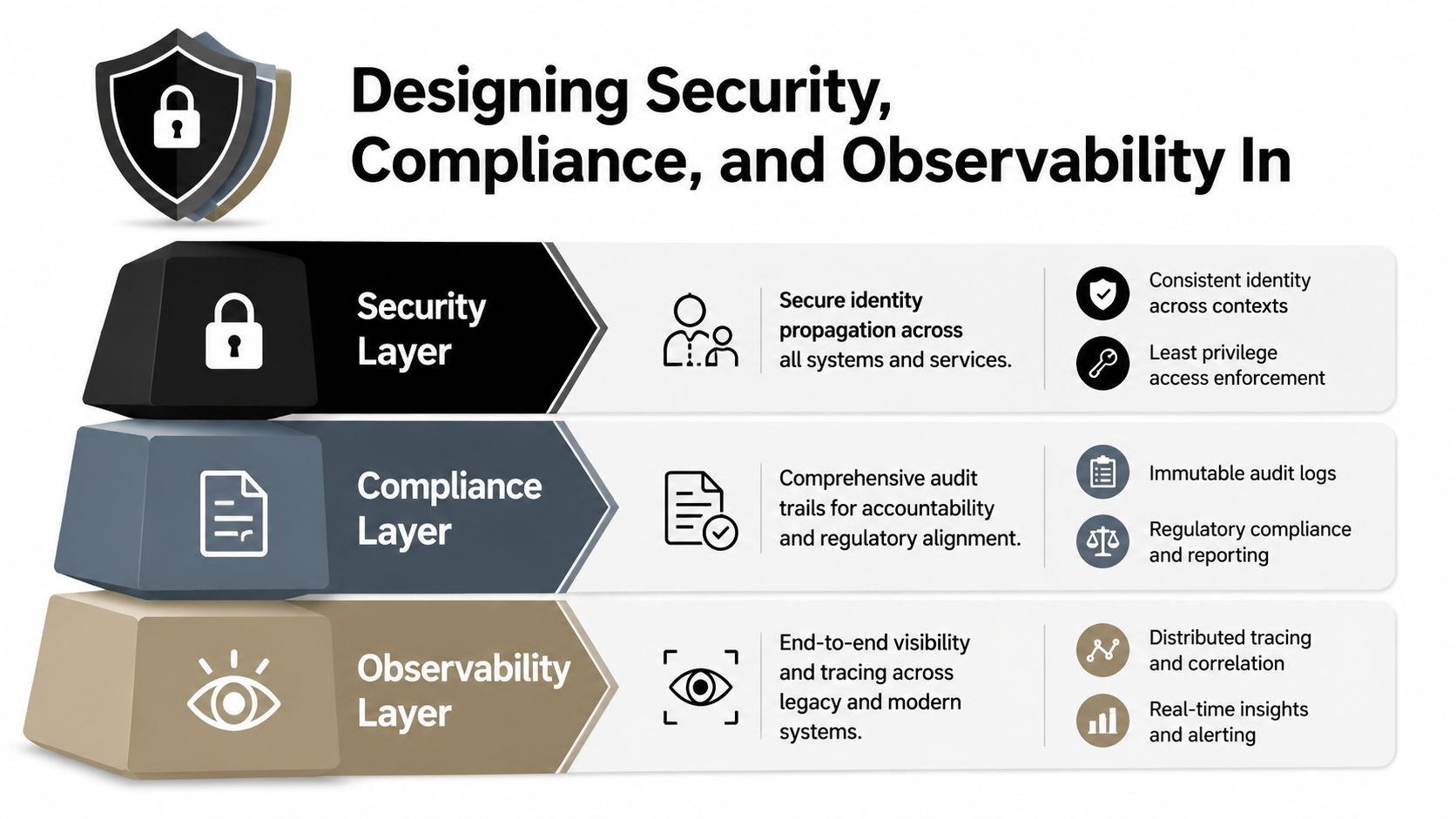
Security can't stop at the AI platform's front door. The integration must preserve authorization as a request crosses the conversational channel, middleware, adapter, and legacy application. That usually means deciding where user identity is retained, where a service identity is introduced, and which system makes the final authorization decision.
SSO bridging can provide continuity for authenticated users, while scoped service accounts may be appropriate for tightly bounded machine actions. Credential vaulting is mandatory for secrets, and shared credentials should be treated as an exception requiring compensating controls. The adapter should pass correlation and authorization context without exposing unnecessary personal data to the model or logs.
Put controls at the conversation boundary
Redact or tokenize PII before it enters prompts, traces, and support tooling. Encrypt data in transit and at rest, but don't assume encryption replaces access control. For obligations under SOX, HIPAA, or GDPR, define retention, access review, deletion handling, audit scope, and evidence ownership with the compliance team.
The Yellow.ai enterprise-grade security overview describes the kind of control surface teams should evaluate when an AI platform touches enterprise workflows. The platform choice doesn't remove the need to secure the adapter, gateway, legacy endpoint, and operational dashboards.
Make silent failures visible
A legacy call that times out can produce more than an error. It can lead an AI agent to answer from stale context, repeat a request, or offer an action that never completed. Observability must therefore follow the transaction across every hop.
Use distributed tracing with correlation IDs, synthetic transactions for critical journeys, and alerts for changes in mapped fields. Track source freshness, validation failures, queue lag, timeout rates, authorization denials, and fallback frequency. Set service objectives that reflect the legacy component's actual reliability instead of promising modern cloud behavior that the source can't support.
A response isn't trustworthy merely because the model generated it confidently. The integration must show whether the underlying system answered, when it answered, and whether the requested action completed.
Testing and Rolling Out Without Breaking the Business
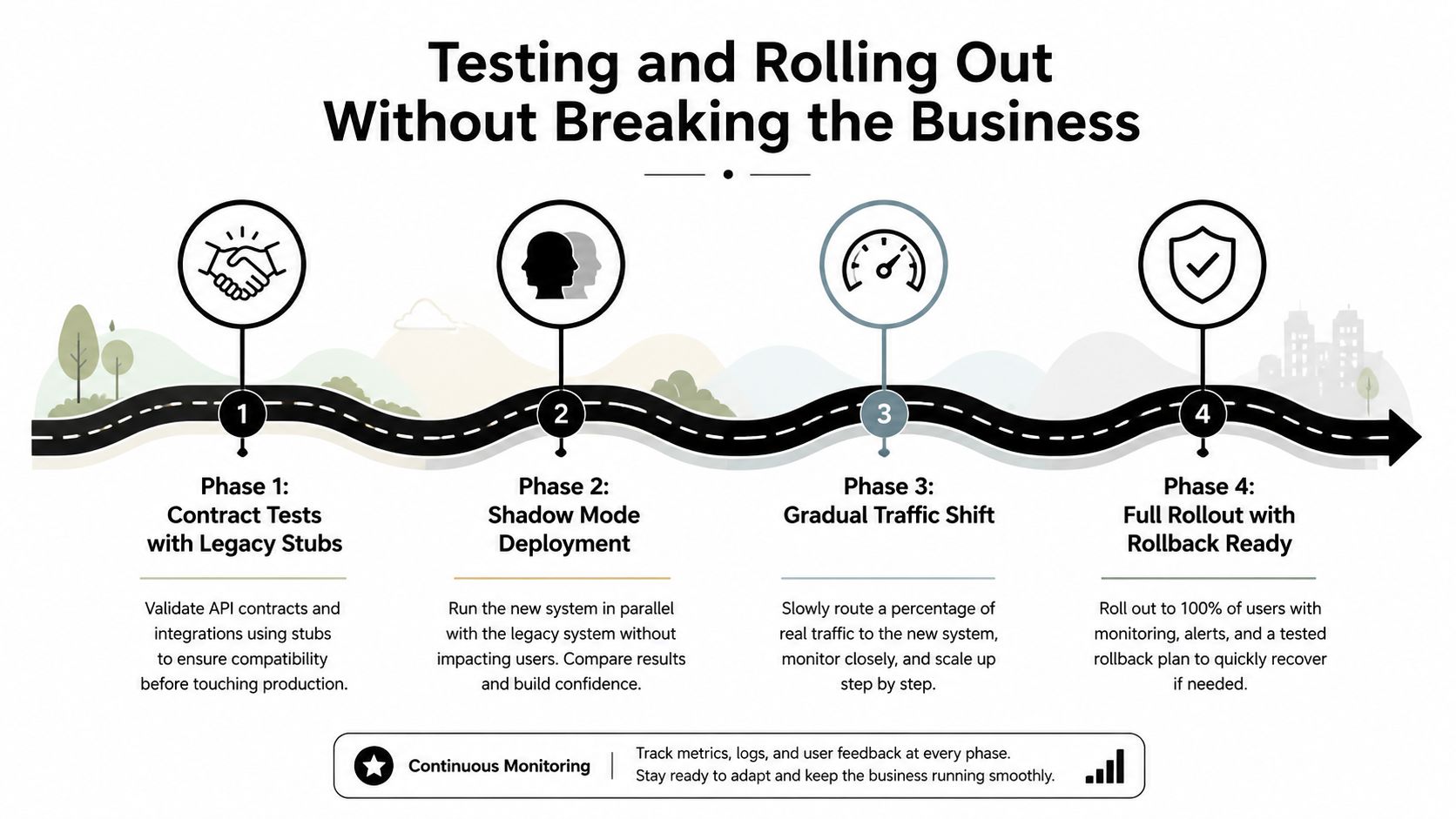
A safe rollout makes reversibility a deliverable. The first useful test isn't a live customer conversation. It's a contract test that proves the adapter handles expected, malformed, delayed, duplicated, and unavailable responses from a representative legacy stub.
Progress through controlled exposure
In shadow mode, the AI platform reads from production legacy systems but doesn't write or trigger consequential actions. It logs intended operations, response timing, mapping outcomes, and discrepancies against the existing path. Teams discover that a field labeled “active” means something different in a downstream report, or that a supposedly real-time value updates only after a batch process.
A controlled pilot should use a small, explicitly selected user cohort, feature flags, and a kill switch that routes traffic back to the established experience. Don't expand because the demo feels smooth. Expand after owners review error behavior, data integrity, user feedback, support volume, and business outcomes.
The cutover sequence for a write-capable workflow needs more discipline:
- Contract tests: Validate schemas, error handling, authorization, and idempotency against stubs and controlled test environments.
- Shadow mode: Compare reads and intended actions without changing production state.
- Dual writes: Where safe and necessary, write through both paths and reconcile results before relying on the new path.
- Parallel run: Operate both routes for a defined period, with a named owner for every discrepancy.
- Staged migration: Shift traffic in deliberate cohorts while retaining the old route.
- Rollback: Reverse routing when predefined thresholds for errors, data integrity, or business KPIs are breached.
The Yellow.ai automated testing capability is one option teams can assess for testing conversational flows, but it can't replace end-to-end validation of the legacy transaction and reconciliation process.
Rollback rule: If the team can't explain how to stop writes, restore routing, and reconcile in-flight work, the integration isn't ready for production.
Incident response should be rehearsed. Name the incident commander, legacy SME, AI product owner, security contact, and communications lead. Legacy systems often fail through partial completion, delayed files, or unclear status, so the runbook must cover unknown outcomes rather than only clean errors.
Making Integration Sustainable Beyond Go-Live
Go-live transfers responsibility from a project to a product. A named team needs budget, backlog authority, on-call duties, connector ownership, and the ability to decline unsafe changes. Without that shift, the first integration becomes an orphaned dependency that only its original developers can repair.
A practical team combines a legacy-systems engineer, an API platform engineer, an AI integration lead, and a security liaison. Pair rotations with mainframe SMEs help modern engineers learn business rules while giving legacy specialists visibility into API contracts, tracing, and agent behavior. Documentation should capture decisions and failure modes, not just endpoint descriptions.
Establish a working governance rhythm
Quarterly architecture reviews should examine coupling, capacity, data contracts, and retirement assumptions. Monthly failure-mode reviews should inspect incidents, near misses, mapping defects, and changes in source behavior. A change advisory board should classify legacy connectors as production-critical assets, not low-risk glue code.
Track three dashboards:
- Business outcome attainment: The agreed customer, employee, or operational result.
- Integration reliability: Availability, latency, reconciliation, fallback, and unresolved failure behavior.
- Technical debt burn-down: Undocumented dependencies, brittle automations, unsupported runtimes, and mappings without owners.
The operating model matters because the challenge is broader than technology. Ensono reported that 49% of IT leaders said actual legacy maintenance costs exceeded plan, and nine in ten reported at least one talent gap slowing modernization (2025 State of IT Modernization report). An integration program needs decision rights and skills depth alongside adapters and APIs.
| Pillar | Day-1 Starting Point | 90-Day Target | Owners |
|---|---|---|---|
| Ownership | Named product and technical owners | Published service boundaries and on-call rota | Product lead, platform lead |
| Skills | Legacy SME paired with integration engineers | Rotation plan and documented runbooks | Engineering manager |
| Governance | Basic change approval and incident process | Recurring architecture and failure-mode reviews | Architecture and risk leads |
Sustainability also requires an exit condition. When the underlying system is retired, decommission its connector, revoke credentials, archive required evidence, and record the lessons. Coexistence is a permanent architecture choice for some workloads, but every connector should still have a reason to exist and a responsible path to sunset.
If you're connecting legacy applications to conversational workflows, Yellow.ai can provide API-based and custom integration paths for enterprise systems, alongside agent design, testing, and omnichannel orchestration. Review how Yellow.ai could fit your integration boundary, then bring your system map, outcome definition, and rollback plan into the evaluation.