














The most popular advice in contact-center transformation is also the least useful: replace IVR with IVA. That recommendation treats every customer journey as if it has the same risk, variability, and operational purpose. It doesn't.
Interactive Voice Response, or IVR, remains effective when a business needs fast, deterministic routing or a tightly controlled self-service transaction. Intelligent Virtual Agents, or IVAs, are valuable when callers need to describe an issue naturally, move through several related intents, or trigger actions across business systems. The practical decision is therefore not which technology is newer. It's where each technology belongs.
That distinction matters in enterprise environments. IVR is a mature telephony automation layer, while IVA adds conversational understanding, context, and system-driven resolution. The strongest architecture often keeps both, assigning predictable, high-throughput flows to IVR and reserving conversational automation for journeys where rigid menus create friction.
Table of Contents
- Rethinking the IVR vs IVA Debate
- Architectural Differences and Core Capabilities
- Evaluating Operational Metrics and Success Criteria
- Real-World Use Cases and Hybrid Deployments
- Implementation, Security, and Seamless Handoffs
- Cost Analysis and ROI Expectations
- Strategic Recommendations for CX Leaders
Rethinking the IVR vs IVA Debate
IVR isn't automatically obsolete, and IVA isn't automatically the right answer. A voice interface that sounds more natural can still create operational problems if it authenticates callers poorly, exposes sensitive data, misunderstands a regulated request, or hands an incomplete interaction to an agent.
The core question is how much uncertainty a flow can tolerate. A simple routing request has a narrow set of valid outcomes. A customer explaining a disputed transaction, changing an order, or troubleshooting a service interruption may use unexpected language, introduce new context, and require several back-end actions. Those flows need different automation patterns.
IVR uses predefined prompts, keypad inputs, or restricted voice commands to move callers through known paths. IVA uses speech recognition, natural-language understanding, dialogue management, business rules, and integrations to interpret what the caller means. The distinction is not merely conversational style. It changes how the system is tested, monitored, secured, and handed over to people.
Practical rule: Use deterministic automation where the correct path is known in advance. Use conversational automation where understanding the caller is part of the work.
The market context also argues against a wholesale replacement narrative. One independent estimate places the IVR market at USD 5.50 billion in 2025, with a projection of USD 9.01 billion by 2034 at a 5.64% CAGR. The estimate is documented in Aberdeen's research on intelligent virtual assistants and customer experience programs. The exact market estimates vary, but the broader implication is consistent: enterprises continue to invest in telephony automation while adding newer AI interfaces.
That makes hybrid design more realistic than “rip and replace.” IVR can act as a controlled entry point, a fallback during uncertainty, or a routing layer for queues with strict service policies. IVA can take ownership of intents where natural language, contextual memory, and system actions produce a better outcome.
Architectural Differences and Core Capabilities
Traditional IVR is a deterministic state machine. The organization defines the prompts, acceptable inputs, branches, validations, and destinations. DTMF remains useful because it provides clean, predictable input. If the caller selects billing, enters an account identifier, and requests a balance, the system follows a known route with limited interpretive risk.
IVA introduces a probabilistic interpretation layer. Speech recognition converts audio into text or structured signals. Natural-language understanding identifies intent and entities. Dialogue orchestration maintains context, retrieves approved knowledge, invokes business APIs, and decides whether to continue, clarify, complete, or escalate. The system must manage uncertainty rather than just advance to the next node.
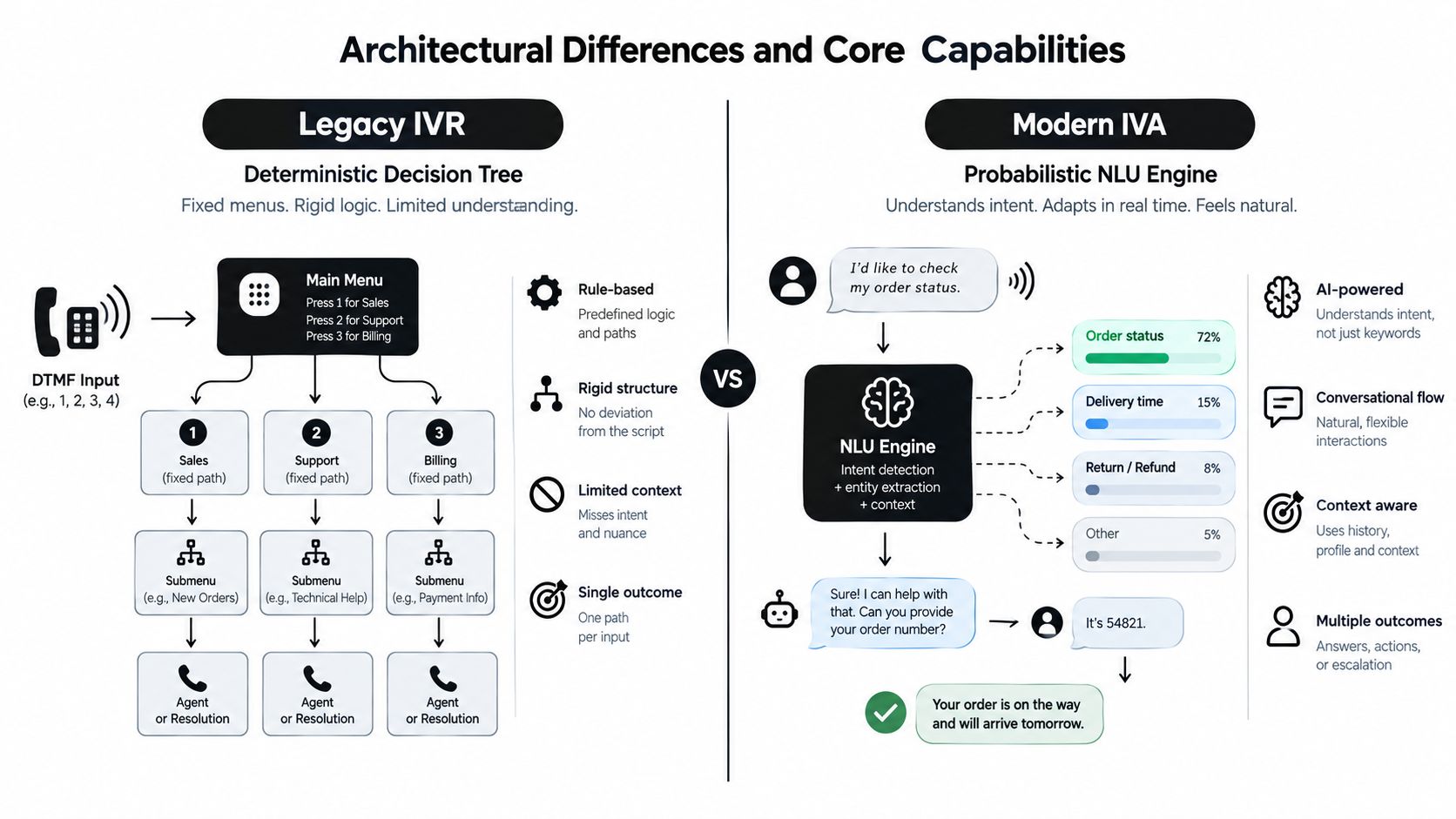
Deterministic paths versus conversational orchestration
An IVR flow is usually designed around the organization's internal taxonomy. “Press 1 for sales” reflects the company's departments, not necessarily the customer's mental model. That structure is easy to audit and often easy to change, but it can force callers to translate their problem into a menu category.
An IVA starts with the caller's language. It can ask an open question, identify an intent, collect missing information, and change direction when the caller adds context. That flexibility requires more than a language model. It requires guardrails, confidence thresholds, approved knowledge, integration permissions, transcript monitoring, and explicit escalation rules.
A multi-LLM architecture can provide model choice and fallback, but it also increases governance responsibilities. Teams need to know which model handled a request, which knowledge source informed the response, and which action the agent attempted. Low latency matters too. A conversational system that pauses unpredictably will feel broken even when its answer is technically correct.
Where each architecture is strongest
IVR is strong at:
- High-throughput routing: It can direct callers quickly when intent categories are stable.
- Controlled input: Keypad responses and constrained speech reduce ambiguity.
- Repeatable compliance: Prompts and disclosures can be reviewed line by line.
- Operational predictability: Capacity planning and failure analysis are straightforward.
IVA is strong at:
- Natural intake: Callers can explain problems without learning a menu tree.
- Context retention: The system can carry details across several turns.
- Dynamic resolution: It can retrieve information and invoke permitted actions.
- Intent discovery: It can identify what the customer needs before choosing a queue or workflow.
The continued relevance of IVR is reflected in the same market estimate cited above, which describes the category as a foundational infrastructure layer rather than a niche legacy product. For enterprises evaluating a conversational upgrade, Yellow.ai's voice bot capabilities illustrate the type of voice interface that sits above telephony routing and connects conversation with business processes.
Evaluating Operational Metrics and Success Criteria
A contact center can make either technology look successful by choosing the wrong metric. An IVR that routes every caller to an agent may report low abandonment, yet deliver little self-service. An IVA that completes a complex request may take longer than a menu interaction, but still create a better outcome by avoiding transfers and repeated explanations.
IVR is commonly evaluated through containment rate and zero-out rate. Containment asks whether the caller completed the journey without reaching a human. Zero-out tracks callers who bypass the system to request an agent. These measures are useful for deterministic flows, but they don't explain whether the customer's underlying problem was solved.
IVA requires a wider measurement model. Conversational completion asks whether the agent achieved the intended outcome. Task resolution examines whether the system completed the transaction, updated the account, answered the question with approved information, or transferred the caller with useful context. The difference is a shift from menu deflection to problem solving, as outlined in NICE's comparison of IVA and IVR.
| Metric Category | Traditional IVR Focus | Modern IVA Focus |
|---|---|---|
| Journey completion | Containment without agent involvement | Successful completion of the customer's intended task |
| Agent bypass | Zero-out rate and requests for a representative | Escalation appropriateness and the quality of the handoff |
| Input quality | Correct menu selection and valid keypad entry | Intent recognition, entity capture, and clarification rate |
| Operational outcome | Routing accuracy and queue placement | Resolution, action completion, and avoided rework |
| Customer effort | Prompt count and menu navigation | Turns, interruptions, repetition, and abandonment after uncertainty |
| Risk control | Script adherence and input validation | Confidence thresholds, policy adherence, authentication, and auditability |
Measure the flow, not just the channel
Leaders should define one primary business outcome for each automated journey. For an appointment confirmation, completion may be enough. For a billing dispute, the system may need to authenticate the caller, classify the request, create a case, provide a reference, and transfer the interaction if policy requires human review.
That means the dashboard must connect voice events to downstream records. A transcript without a completed CRM action is not resolution. A transfer that arrives without captured intent, authentication state, and relevant account context is not a clean handoff.
A low zero-out rate isn't proof of success if callers are abandoning before they reach the right path.
Compare cohorts by intent and risk level rather than blending every call into one score. Review failed recognitions, repeated prompts, silent calls, authentication failures, invalid actions, and transfers after long conversations. For IVA, also sample successful interactions. A system can produce a technically valid response while creating unnecessary effort or communicating information too confidently.
Real-World Use Cases and Hybrid Deployments
The best architecture usually begins with an intent catalog, not a vendor demo. Map the reasons customers call, then classify each intent by volume, language variability, transaction complexity, data sensitivity, exception frequency, and tolerance for failure.
IVR remains a sensible choice for predictable, low-risk flows. A caller confirming an appointment, selecting a language, checking a known status, or choosing a department doesn't necessarily need open-ended conversation. A short menu may be faster, cheaper to operate, and easier to govern than an AI agent that interprets an uncomplicated request.
IVA earns its place when the caller's words carry meaningful context. Dynamic FAQs, detailed order changes, multi-step troubleshooting, service explanations, and requests that cross several systems are stronger candidates. The agent can gather information in the caller's own terms, clarify ambiguity, and execute actions within defined permissions.
A practical hybrid call path
A mature design might work like this:
- Telephony entry: IVR identifies the number, language preference, service category, or urgent routing condition.
- Conversational intake: IVA asks the caller to describe the issue and collects the relevant details.
- System action: The agent checks approved records, retrieves information, or initiates a permitted transaction.
- Controlled escalation: A human receives the transcript, intent, authentication status, and actions already attempted.
- Fallback handling: The call returns to deterministic routing when confidence, policy, or system availability falls below the required threshold.
This arrangement preserves the reliability of IVR while allowing IVA to handle the parts of the journey that benefit from natural language. It also makes migration easier because the enterprise can modernize selected intents rather than redesigning every call path simultaneously.
A voice automation approach from Yellow.ai represents this broader pattern, connecting voice interactions with conversational workflows rather than treating the phone line as an isolated menu system.
Voice remains central to IVA strategy. One market projection estimates that voice-based systems will represent 56.94% of IVA interface share in 2025, while multimodal voice-visual systems are projected to grow at a 32.86% CAGR through 2031, according to the Deepgram State of Voice AI report. Those projections support a layered approach: improve the voice journey first, then add visual or digital continuity where it helps customers complete more complex work.
Implementation, Security, and Seamless Handoffs
Conversational automation fails in production when teams focus on dialogue quality and treat identity, permissions, and escalation as later tasks. Regulated and sensitive flows need a security design before the first prompt is written.
Start by separating recognition from authorization. An IVA may recognize the caller's intent, but that doesn't mean it should disclose account information or execute a transaction. Authentication should use approved factors, expose only the minimum necessary data, and record the verification state that downstream systems need.
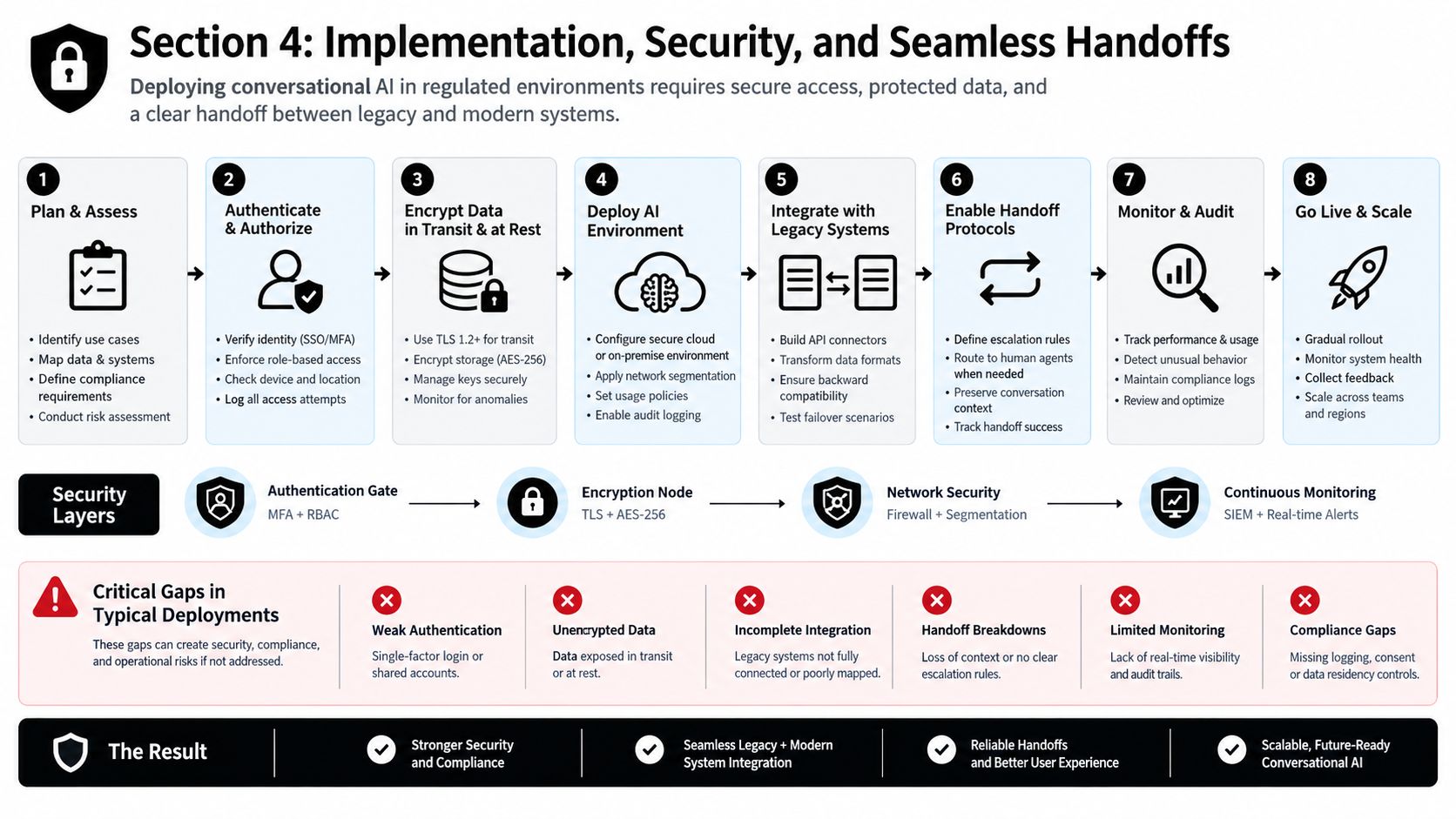
Build the control points first
A production design should define:
- Authentication gates: Specify what the caller must prove before the agent can reveal, change, or create information.
- Data boundaries: Limit what the model can receive, retain, summarize, or repeat.
- Tool permissions: Give the agent access only to APIs and actions required for the approved intent.
- Disclosure controls: Keep mandatory language and consent handling explicit, reviewable, and versioned.
- Escalation triggers: Transfer on low confidence, repeated failure, emotional distress, policy exceptions, or system unavailability.
- Handoff payloads: Send the agent the reason for contact, captured entities, verification state, transcript summary, and attempted actions.
The handoff must feel like continuation, not a restart. If a caller has explained a problem to an IVA and then must repeat it to a human, the automation has shifted effort rather than removed it. Test the handoff under interruptions, incomplete authentication, failed API calls, language changes, and conflicting customer statements.
Enterprise IVA adoption was already moving beyond experimentation around 2019, when Aberdeen research reported that 18% of companies were using an IVA for customer experience management and another 23% planned adoption within 2019 and early 2020, putting 41% in either category. That historical transition is documented in the referenced adoption data. It also explains why contracts, service levels, data processing terms, audit rights, and exit provisions deserve the same scrutiny as model performance. Teams reviewing commercial terms can use this call centre contracts guide as a practical reference when defining vendor responsibilities.
Cost Analysis and ROI Expectations
IVR and IVA create different cost profiles, so comparing license prices alone produces a weak business case. IVR tends to offer predictable infrastructure and maintenance economics. IVA introduces variable usage, model orchestration, speech processing, knowledge management, integration work, monitoring, and continuous tuning.
The right comparison is cost per completed outcome, not cost per minute or cost per call. A cheap IVR interaction that transfers to an agent may cost more overall than an IVA interaction that completes the task. Conversely, using an IVA for a simple routing decision can add unnecessary complexity and expense.
Build the financial model around the selected intent catalog:
- Baseline effort: Measure current agent work, transfers, repeat contacts, after-call work, and manual authentication steps.
- Automation scope: Identify which tasks the system will route, answer, or complete. Don't assume every conversation should be autonomous.
- Integration cost: Include CRM, billing, order management, identity, knowledge, telephony, analytics, and fallback connections.
- Quality operations: Budget for conversation review, prompt and policy changes, test data, regression testing, and incident response.
- Failure cost: Model incorrect answers, failed transactions, avoidable transfers, abandonment, and compliance remediation.
- Outcome value: Tie savings to completed resolutions, released agent capacity, faster service, or improved availability.
A convincing ROI model counts the work automation removes, the work it creates, and the risk it introduces.
Use a controlled pilot with a narrow set of intents and compare it with the existing IVR path. A practical IVA ROI calculator can help structure assumptions, but finance and operations teams should validate every input against internal call data and service policies. The model should show when the investment breaks even under conservative, expected, and failure scenarios.
Strategic Recommendations for CX Leaders
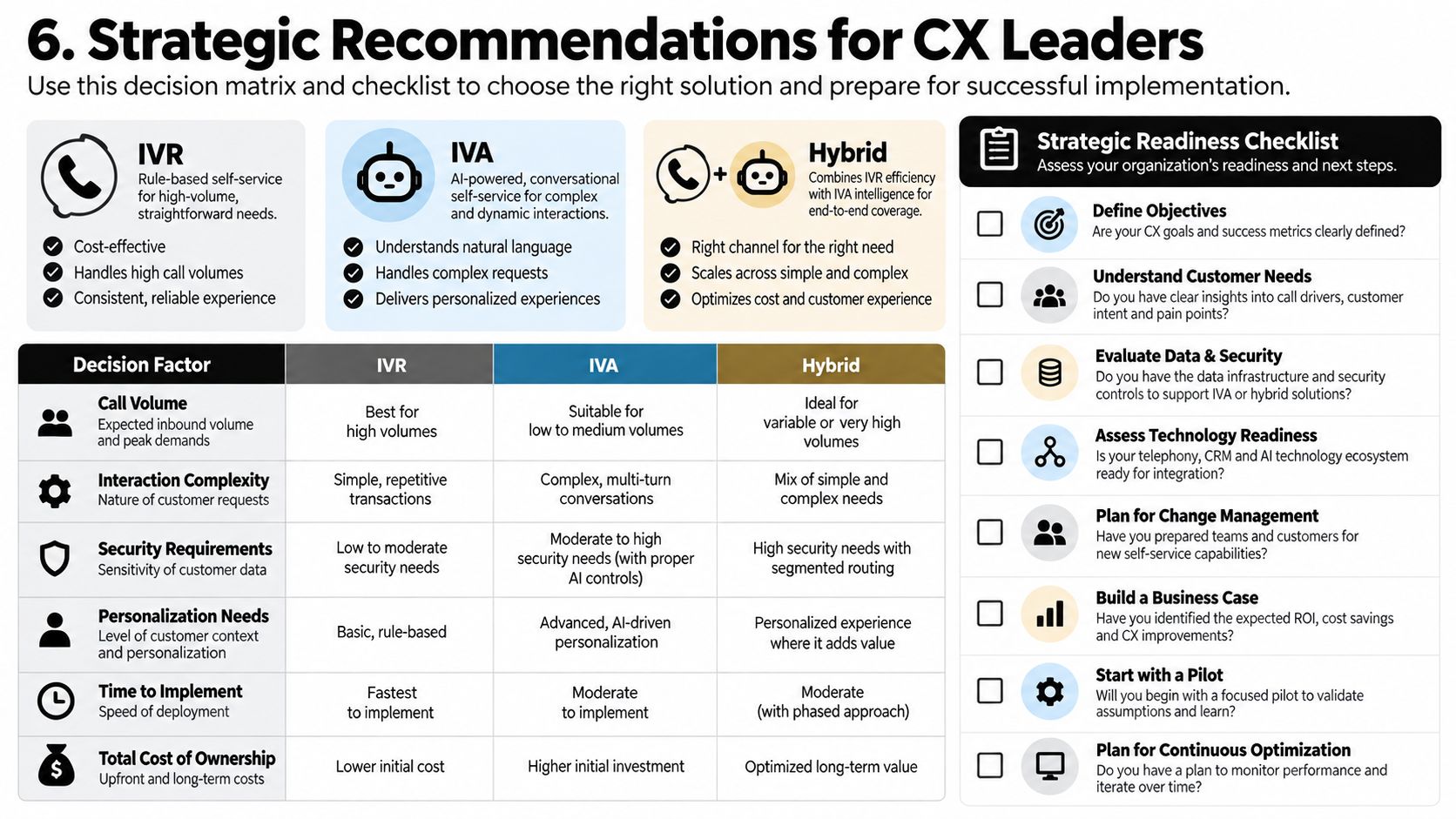
Don't begin with a platform decision. Begin with a risk-weighted migration map. A flow is a strong IVA candidate when callers express it in varied language, agents spend time gathering context, the required actions are well defined, and the organization can provide reliable knowledge and system access.
Keep an IVR path when the interaction is stable, the desired input is narrow, the volume is high, and governance benefits from deterministic behavior. Use a hybrid path when the opening needs controlled routing but the actual problem requires conversational intake or system action.
A decision matrix for modernization
| Flow condition | Recommended pattern | Reason |
|---|---|---|
| Stable intent and narrow input | IVR | Predictable navigation and controlled behavior |
| Simple self-service with clear validation | IVR or hybrid | Automation can remain efficient without unnecessary interpretation |
| Variable language and several related intents | IVA | Natural intake reduces forced categorization |
| Sensitive transaction with strict authorization | Hybrid or controlled IVA | Conversational intake needs explicit security gates |
| Frequent exceptions or emotional escalation | IVA with human handoff | The system can gather context while preserving human judgment |
| Unclear data ownership or weak integrations | IVR first | Fix operational foundations before granting AI system access |
Roll out one intent family at a time. Establish a baseline, define success and failure conditions, create adversarial test cases, and require human review before expanding permissions. Automated testing should cover paraphrases, interruptions, silence, ambiguity, unsupported requests, policy conflicts, and back-end failures.
An AI copilot can help teams inspect transcripts, identify broken paths, and harden conversations before wider deployment. Multi-LLM designs and omnichannel orchestration may support broader service strategies, but they also demand model governance, consistent policy enforcement, and clear ownership between CX, IT, security, and operations.
The conclusion is practical: don't modernize voice by replacing every menu with an AI agent. Preserve IVR where it delivers reliable control, introduce IVA where understanding and resolution matter, and connect both through a handoff architecture that protects customers and agents.
Yellow.ai provides enterprise voice AI agents, conversational workflows, integrations, automated testing, analytics, and omnichannel orchestration for organizations evaluating the move from static IVR to governed IVA and hybrid service flows. Visit Yellow.ai to assess which contact-center journeys should remain deterministic and which are ready for conversational automation.



