










Intent recognition identifies the overall meaning or user goal behind an utterance. On a user-intent recognition task, GPT-3.5 reached 75.28% accuracy and GPT-4 reached 89.64%, but enterprise success depends on more than a benchmark score.
A customer tells a bank's virtual agent, “The payment failed again, and now I'm worried you'll charge me twice.” The sentence contains a transaction problem, a possible billing concern, and frustration about the app. A system that hears only “complaint” may send the customer to a generic queue. A system that separates the immediate operational intent from the supporting context can verify the transaction, explain the charge status, and escalate only if the account requires human review.
That difference captures the practical challenge. Intent recognition is the routing layer between natural language and business action. It decides whether an utterance should trigger a workflow, retrieve knowledge, ask a clarifying question, or be treated as outside the system's scope. Academic benchmarks help compare models, but production systems must also manage ambiguity, shifting intent, multilingual input, latency, privacy, and requests the model has never seen.
Table of Contents
- Why Intent Recognition Matters in Enterprise AI
- How Intent Recognition Works Under the Hood
- From Classification to Retrieval-Augmented Generation
- Measuring What Matters in Intent Evaluation
- Enterprise Implementation Constraints and Considerations
- Hidden Complexity in Multimodal and Context-Aware Recognition
- Building Intent Systems with Yellow.ai Platform
Why Intent Recognition Matters in Enterprise AI
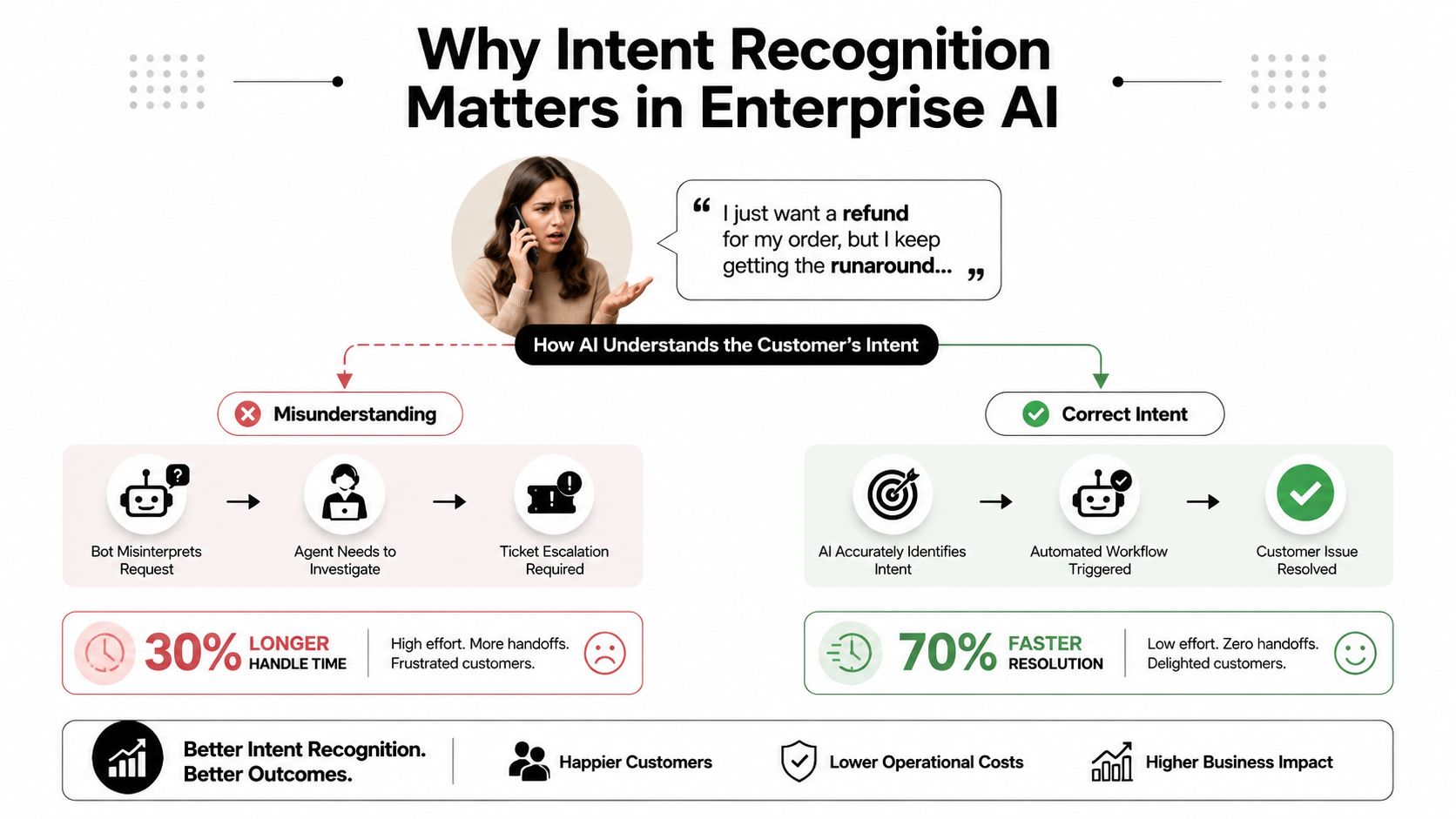
The cost of a wrong intent usually appears downstream. A misclassified request can launch the wrong workflow, expose irrelevant help content, repeat questions the customer has already answered, or transfer a conversation that automation could have resolved. The customer experiences this as friction, while operations teams see avoidable handling, failed containment, and poor routing quality.
Consider a banking interaction where the customer begins with a failed transfer and then asks whether a fee will apply. Those statements may belong to related but distinct intents. Treating the entire conversation as a single broad complaint loses the action the customer needs first. Treating every sentence as an isolated request creates a different problem, because the agent may answer the fee question without resolving the failed transfer.
Intent is an architectural decision
Intent labels determine what an AI agent is allowed to do. A label such as PAY_BILL, PLACE_ORDER, BOOK_FLIGHT, or GET_INFO is useful only when it maps reliably to a workflow, API, knowledge source, or escalation policy. IBM describes intent recognition as telling an NLU algorithm what a user wants to do, while Nuance documents these kinds of production-oriented intent names in its NLU examples. You can review the IBM explanation of natural language understanding for the broader relationship between intent and semantic understanding.
That mapping makes intent recognition more than a feature in a chatbot builder. It becomes a control point for authentication, fulfillment, compliance, and customer experience. In a service environment, a wrong label can be more damaging than a delayed answer because it creates confident misrouting.
What strong systems do differently
Reliable systems account for more than the first apparent topic. They preserve conversation state, recognize when the user changes direction, distinguish similar intents, and refuse to guess when the request falls outside the trained domain.
Practical rule: Optimize for the next safe business action, not merely the most plausible label.
Organizations evaluating customer service automation should connect intent quality to routing accuracy, successful completion, clarification frequency, escalation reasons, and customer correction signals. A platform such as Yellow.ai customer service automation can sit within that broader operating model, but the architecture still needs clear intent boundaries and fallback behavior.
How Intent Recognition Works Under the Hood
Intent recognition converts an utterance into a structured interpretation. The system asks, “What is the user trying to accomplish?” It may then extract the details required to complete that action, such as a destination, date, account, product, or transaction identifier.
This work belongs to natural language understanding, or NLU. Earlier systems often relied heavily on keywords and manually designed patterns. Semantic approaches instead represent meaning so that “I need to settle my invoice” and “How can I pay this bill?” can be treated as related even when they share few exact words. IBM's overview describes the shift from keyword matching toward semantic understanding and reports the GPT-3.5 and GPT-4 intent-recognition results cited above.
Intent classification and slot filling
NLU commonly separates two related tasks:
- Intent detection identifies the speaker's goal, such as booking a flight.
- Slot filling labels the important values inside the utterance, such as destination and travel date.
- Joint intent-slot modeling learns both tasks together, using the relationship between the goal and its parameters.
The progression matters because an utterance can be correctly classified but still unusable. “I want to fly to London next Tuesday” requires both the BOOK_FLIGHT intent and values for destination and date. A routing layer without those slots knows what the user wants, but not enough to execute it.
A 2021 survey describes these as major milestones in joint intent detection and slot filling. It also explains that the tasks were traditionally handled separately, while joint models later exploited their relationship to achieve state-of-the-art results. The survey of joint intent detection and slot-filling models provides the research background.
The production pipeline
A practical enterprise pipeline usually includes speech or text normalization, semantic representation, intent scoring, slot extraction, policy checks, and action selection. The final step should not blindly trust the highest score. It should consider confidence, ambiguity, user history, business rules, and whether the request belongs to a known operating domain.
Latency and language coverage shape model selection. A large generative model may interpret unusual phrasing well, but a smaller classifier or retrieval model may be easier to control and faster for high-volume, repetitive flows. Teams often combine them, using deterministic logic for high-risk actions and more flexible models for understanding, clarification, or knowledge retrieval.
Tools such as Yellow.ai AI Agent Builder are relevant when teams need to design, test, and deploy agents across these layers rather than maintaining separate prototypes for each channel.
From Classification to Retrieval-Augmented Generation
When a customer says, “my payment failed,” the system must decide whether to reroute the request, retrieve documentation, ask a clarifying question, or escalate. A label alone does not make that decision. Classification works well when the domain is stable, the intent taxonomy is explicit, and each label maps cleanly to a workflow. Defined account, payment, delivery, and authentication flows can therefore benefit from fast predictions and controlled behavior.
Production traffic quickly exceeds those neat categories. Users ask for explanations, combine several needs, refer to documents, or introduce requests absent from the original taxonomy. Retrieval-Augmented Generation, or RAG, combines intent signals with retrieval from approved knowledge sources, allowing the system to ground responses in current enterprise content.
Classification and RAG serve different jobs
Classification is strongest when the system must select a known action. RAG is stronger when it must find relevant information and compose an answer from that material. They solve related problems, but they should not be treated as interchangeable.
| Requirement | Classification | Retrieval-Augmented Generation |
|---|---|---|
| Known workflow | Direct routing works well | May add unnecessary complexity |
| Open-ended question | Can force an incorrect label | Can retrieve relevant content |
| Business action | Offers clear policy control | Needs strict action safeguards |
| Unknown request | Requires explicit fallback | Still needs out-of-scope detection |
| Response generation | Usually template-based | Can compose contextual answers |
Intent recognition remains part of a RAG architecture, with a broader responsibility. It can distinguish a policy explanation from a transaction update, comparison, or requested action. Retrieval supplies relevant content, while policy logic determines whether the agent may answer, must request authentication, or should hand off.
Out-of-scope detection is not optional
A benchmark may show strong performance on recognized intents while exposing weak handling of requests outside the taxonomy. The cited multimodal intent recognition benchmark reported 59.30% text-only in-scope accuracy, 51.60 F1, and 30.40 F1 for out-of-scope recognition under its multimodal conditions.
Operationally, a confident wrong route can be more damaging than a clarification request. Track unknown requests separately, inspect confusion pairs, and preserve conversation context when falling back. Do not force every input into a supported class.
A conversational knowledge base with agentic RAG can connect intent understanding with dynamic enterprise retrieval. Deployment still requires source governance, permissions, citation behavior, and clear action boundaries.
Measuring What Matters in Intent Evaluation
A model can score well on a public dataset and still perform poorly in a contact center. The difference usually comes from coverage. Benchmarks tend to provide defined labels and relatively clean examples, while production traffic contains shorthand, incomplete requests, speech recognition errors, domain terminology, mixed languages, and users who change their minds halfway through a conversation.
The standard evaluation set includes accuracy, precision, recall, and F1. Accuracy remains dominant in task-oriented NLU because production systems often care about whether the top intent is correct for each utterance. Public ATIS and SNIPS benchmarks can exceed 95% intent accuracy, with one reviewed model reaching 97.50% on ATIS, as reported in the task-oriented NLU evaluation research.
Compare models against operating outcomes
A useful evaluation program has two layers. The first measures model behavior against labeled examples. The second measures whether that behavior produces the correct business result.
| Evaluation layer | Questions to answer |
|---|---|
| Label quality | Do annotators agree on the intended class? |
| Top-intent accuracy | Did the first prediction select the correct route? |
| Confusion analysis | Which neighboring intents are mixed up? |
| Coverage | Does the test set represent real language and channels? |
| Business outcome | Did the workflow complete safely? |
| Recovery | Did the agent clarify or escalate when uncertain? |
A confusion matrix is often more valuable than a single headline score. If “refund status” and “refund request” are repeatedly confused, the fix may involve clearer label definitions, better examples, additional slots, or a decision step after classification. More training data won't solve an ambiguous taxonomy by itself.
Test agentic systems differently
Agentic systems introduce tool selection, retrieval, memory, and multi-step decisions. Their evaluation must therefore include latency, tool-call correctness, groundedness, policy compliance, and recovery from failed calls. A classifier can be fast and stable but narrow. An agent can handle broader language but may require stricter guardrails and more extensive regression testing.
Build test sets from real utterances, include negative and out-of-scope examples, and replay anonymized conversations after taxonomy changes. Measure first-route correctness and safe fallback behavior separately. Those indicators show whether intent recognition improves operations, rather than merely improving a model report.
Enterprise Implementation Constraints and Considerations
Enterprise deployment fails when teams optimize the model before defining the operating constraints. Voice interactions need responsive turn-taking. Multilingual services need language-specific testing. Regulated workflows need data controls. Contact center integrations need dependable synchronization with customer and case context.
Start with a constraint register, then test architecture choices against it.
Latency and channel behavior
Voice creates a different user expectation from asynchronous chat. Every stage contributes delay, including speech recognition, intent inference, retrieval, tool execution, and response generation. Keep the fast path narrow for common requests, and reserve heavier reasoning for cases that need it.
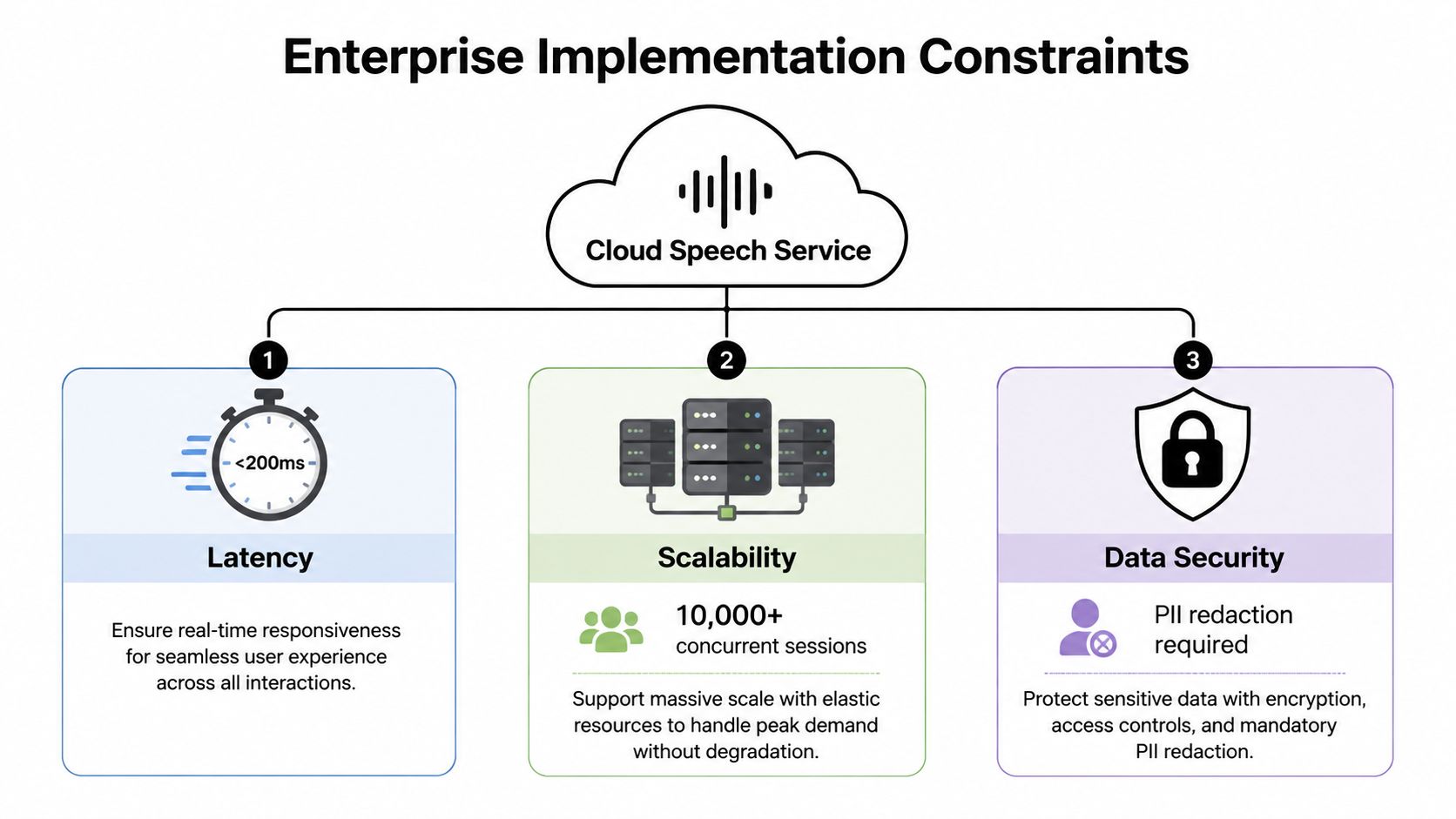
The assigned enterprise visual references a less-than-200ms latency target, 10,000+ concurrent sessions, and PII redaction. Those figures belong to the infographic specification rather than the verified research evidence, so treat them as design prompts, not measured performance claims.
Build for uncertainty
Multimodal testing shows why out-of-scope handling deserves its own KPI. In the cited benchmark, in-scope multimodal performance reached 59.30% accuracy and 51.60 F1, while out-of-scope recognition reached only 30.40 F1 under the reported conditions. Use the benchmark findings on multimodal and open-set intent recognition to frame test design, not as a promise about every production system.
Track the following operational signals:
- Top-intent correctness: Whether the first route matches the required business action.
- Clarification rate: How often the system asks for missing or ambiguous information.
- Out-of-scope precision: Whether the system avoids rejecting requests it can handle.
- Escalation quality: Whether handoffs include the right intent, slots, transcript, and context.
- Latency by stage: Where voice and agent interactions spend time.
- Language and channel variance: Whether performance changes across supported input types.
Security and integration
Intent data can reveal financial, health, employment, or identity information. Apply least-privilege access, redact sensitive content where appropriate, separate training data from live records, and retain audit trails for high-impact actions. Connect the intent layer to CRM context and business rules through explicit contracts, not hidden prompt assumptions.
Multilingual rollout should begin with representative traffic and native review. Translation alone may preserve words while losing politeness, ambiguity, or local phrasing. Validate each language against its own confusion pairs and escalation patterns.
Hidden Complexity in Multimodal and Context-Aware Recognition
A customer may speak while sharing a screen, attach a product photo, refer to an earlier message, and shift from asking for information to requesting an action. A text-only classifier sees fragments. An operational system must reconcile them.
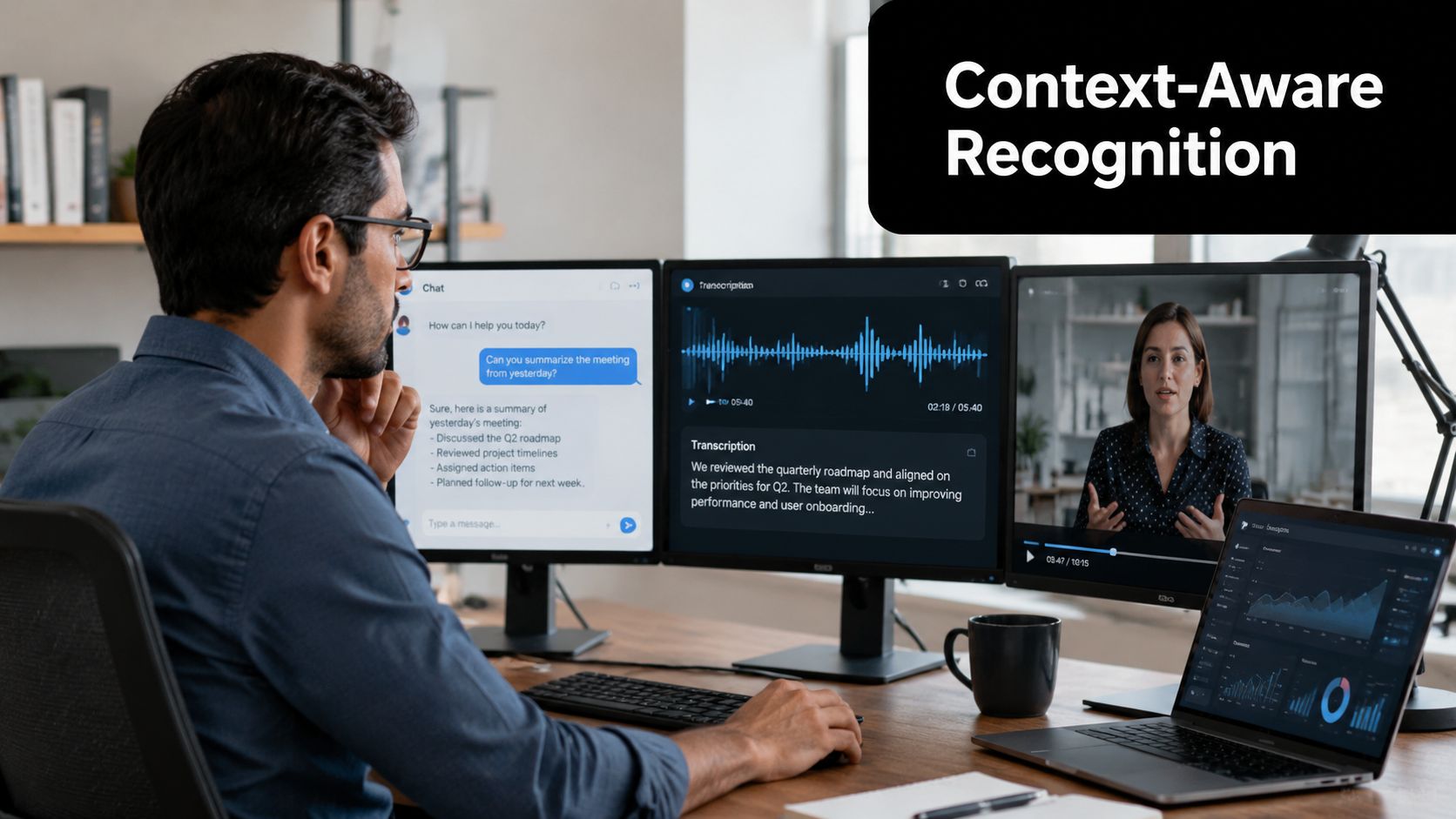
The MIntRec2.0 benchmark highlights gaps in datasets for dynamic, covert, and multimodal interactions. Its coverage includes 15,040 multimodal dialogue samples and more than 5,700 out-of-scope samples. The production lesson is direct: strong benchmark performance on known intents does not prove that a system can reject unfamiliar requests or combine conflicting signals safely.
Context changes the meaning
“The charge is wrong” could refer to a disputed card transaction, an unexpected subscription renewal, or a pending authorization. The correct route depends on account history, prior turns, channel, authentication state, and the task the user is trying to complete.
Conflicting modalities require policy-based resolution. A photo may show a damaged product while the user asks for a refund, replacement, or troubleshooting. Visual evidence supports the decision, but it does not define the intent. The system should confirm the requested outcome, check eligibility rules, and escalate when the evidence and policy disagree. As noted in the multimodal benchmark cited earlier, out-of-scope recognition remains a persistent weakness.
Personalized context creates a separate failure mode. The research on personalized core intent identification describes difficulty identifying a user's core intent from account history as question complexity increases. Broader findings cited there report only 18% success in recognizing user-specific context. A practical example is a customer with a cancelled card, a pending replacement, and an older subscription. “Why was I charged again?” may map to several account states. Routing it from the latest message alone can produce the wrong workflow.
Design for evolving conversations
Treat state as an explicit input, while retaining only facts needed for the current workflow. Mark confirmed details, preserve alternatives, and let users correct the interpretation. A useful state model distinguishes:
- Current goal: What the user wants now.
- Previous goal: What the conversation addressed before a shift.
- Evidence: Words, audio, visual elements, or records supporting the interpretation.
- Confidence and alternatives: What remains uncertain.
- Permissions: Actions the user is authorized to request.
Test missing modalities, contradictory signals, and out-of-scope requests. The fallback should clarify or hand off, not force a confident label.
Building Intent Systems with Yellow.ai Platform
Enterprise teams don't have to assemble every NLU, orchestration, testing, and channel component independently. Yellow.ai combines intent-based agent design with multimodal orchestration, retrieval, testing, and integrations in one enterprise platform.
Its Nexus Vox voice system is described as a unified voice AI that supports voice cloning, deployment across 500+ languages, and low-latency conversational interactions. The platform's AI Agent Builder 2.0 supports the design, testing, and deployment of multimodal agents, with AI Copilot and automated testing for previewing and debugging agent behavior.
The architecture also addresses the classification-to-retrieval transition. Yellow.ai's Conversational Knowledge Base with agentic RAG combines intent understanding with dynamic knowledge retrieval, while its multi-LLM architecture uses 15+ models to give teams model choice rather than forcing a single provider. Omnichannel orchestration covers voice, chat, email, images, and video, with 150+ pre-built integrations for systems including Salesforce, Zendesk, Genesys, and HubSpot.
Where the platform fits
For an enterprise intent program, the useful question isn't whether a platform eliminates complexity. It's whether the platform makes that complexity visible and governable. Teams still need a clean taxonomy, representative utterances, out-of-scope examples, confidence policies, human escalation rules, and regression tests.
Yellow.ai's platform also includes Safe AI controls and enterprise compliance references covering HIPAA, ISO 27001/27701, SOC 2 Type II, and PCI-DSS. Those capabilities can support governance discussions, but each organization should validate configuration, data flows, retention, and control ownership against its own requirements.
The strongest implementation pattern is hybrid: deterministic handling for sensitive actions, semantic recognition for varied language, retrieval for changing knowledge, and explicit fallback for uncertainty. That combination aligns intent recognition with the operational reality that benchmarks rarely capture.
Yellow.ai offers an enterprise agentic AI platform for building intent-aware experiences across voice, chat, email, images, and video, with retrieval, testing, orchestration, and integrations in the same environment. Visit Yellow.ai to evaluate how its agent builder and conversational knowledge capabilities can help you design safer out-of-scope handling and more context-aware automation.