














Your routing probably isn't failing because your team lacks effort. It's failing because the system still assumes every caller can be sorted by a short menu, a fixed queue, or a narrow skills matrix. Customers say one thing, mean another, arrive frustrated, and expect the person who answers to already be equipped to help.
That gap is where most contact center pain starts. Transfers pile up. Agents inherit calls they shouldn't own. Supervisors keep tuning rules that looked sensible on a whiteboard but break under real traffic. Intelligent call routing matters because it changes the job of routing from moving calls into queues to getting each interaction onto the fastest path to resolution.
The strategic shift is bigger than adding AI to telephony. Strong routing systems understand intent early, use context selectively, and stay stable when call patterns change. The teams that get this right don't just modernize the front door. They redesign how service capacity, agent skills, automation, and human judgment work together.
Table of Contents
- Why Your Call Routing Fails and How Intelligence Fixes It
- The Spectrum of Call Routing Approaches
- The Architecture of an Intelligent Routing System
- An Enterprise Checklist for Implementing Intelligent Routing
- KPIs That Matter for Measuring Routing Performance
- Advanced Strategies and Security Best Practices
- Intelligent Routing in Action Use Cases and Outcomes
Why Your Call Routing Fails and How Intelligence Fixes It
A customer calls with a billing issue that's really a service dispute. The IVR sends them to payments. Payments sends them to support. Support realizes the account needs retention approval. By the time the right person joins, the customer has repeated the story three times and the agent starts the conversation from a trust deficit.
That's what broken routing looks like in practice. It's rarely one dramatic failure. It's a chain of small misses caused by systems that classify calls too late, too narrowly, or with too little context.
The old failure pattern
Traditional routing behaves like a paper map. It shows the main roads, but it doesn't know traffic, roadblocks, or where the driver is trying to go. Menu choices and fixed rules can sort obvious demand, but they struggle with ambiguity, mixed intents, and real-world exceptions.
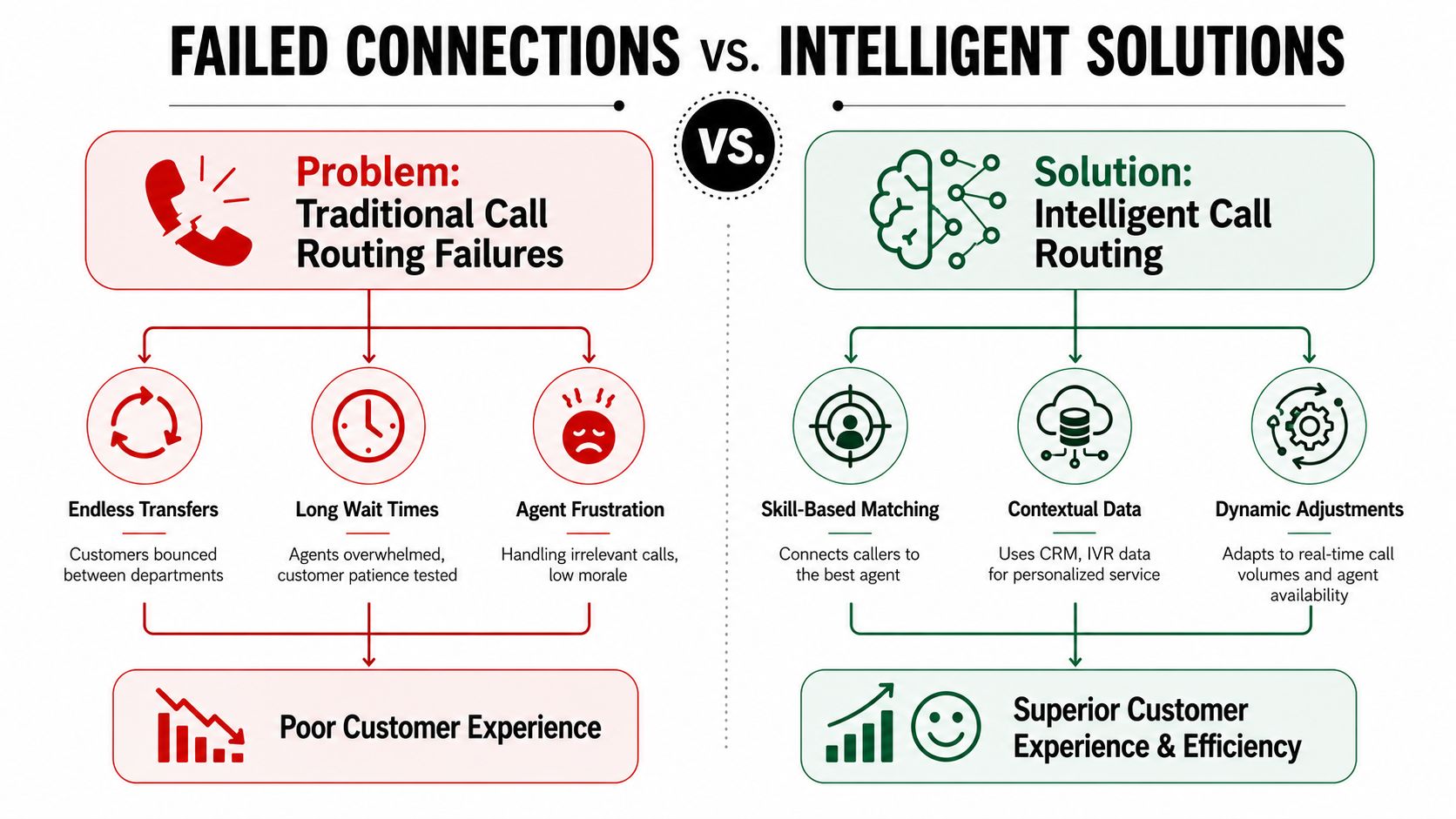
That creates familiar symptoms:
- Endless transfers: Calls move between teams because the first assignment was based on a rough label, not actual intent.
- Long wait times: Queues fill unevenly because demand isn't distributed by likely resolution path.
- Agent frustration: Agents spend time triaging instead of solving.
Why intelligence changes the outcome
Intelligent call routing acts more like a modern GPS. It listens to what the caller says, weighs live conditions, and chooses the best available path now, not the path that looked right when someone designed the queue structure months ago.
The strongest systems don't just route by department. They interpret intent from natural language, combine that with relevant context, and match the call to the agent or workflow most likely to resolve it. According to CSG's overview of intelligent routing, AI-driven routing can achieve up to 98% intent accuracy by using models trained on real call recordings and business-specific vocabulary, and that matters because 83% of customers expect immediate engagement with a qualified representative while 58% of consumers are willing to sever a business relationship due to poor service.
Practical rule: If your routing logic depends on customers choosing the “correct” menu option, you're asking them to do work your system should be doing.
In real operations, that changes the economics of service. Better intent capture reduces avoidable transfers. Smarter assignment lowers the chances that a high-value or high-emotion interaction lands with the wrong queue. Agents receive calls that fit their strengths instead of inheriting random demand.
A good routing strategy also respects a basic truth. Not every call needs maximum complexity. The goal isn't to prove the system is smart. The goal is to get the caller to resolution with as little friction as possible.
The Spectrum of Call Routing Approaches
Most enterprises don't move from manual routing to fully intelligent routing in one jump. They evolve through stages. Each stage solves a real problem from the one before it, but each also creates its own operational ceiling.
Manual era
This model sits closest to traditional ACD logic. Calls land in broad queues and are distributed largely by availability. It's easy to administer and stable under simple demand patterns.
Its weakness is obvious once call types diversify. The system doesn't know much about intent, customer history, or whether the answering agent is the right person to resolve the issue.
Rules-based era
Skills-based routing improved on that model by giving operations leaders more control. Calls could be tagged to language, product line, geography, or specialized teams. For many contact centers, this was a major step forward.
But rules-based systems age badly when exceptions pile up. Every new product, escalation path, or service tier adds another branch. Teams then spend more time maintaining routing logic than improving customer outcomes.
Rules-based routing works well when demand is predictable. It struggles when intent is messy, caller language is natural, and staffing changes by the hour.
Agentic era
Modern intelligent call routing adds machine learning, intent recognition, real-time decisioning, and feedback loops. Instead of asking, “Which queue matches this menu choice?” the system asks, “What is this caller trying to achieve, who can resolve it fastest, and what route is most likely to succeed right now?”
That shift matters because the routing decision becomes adaptive. It can account for agent availability, interaction type, and the practical reality that some callers need a specialist while others need a fast transactional path.
Here's the operating difference in a compact view.
| Routing Model | Core Logic | Primary Limitation | Business Impact |
|---|---|---|---|
| Manual | Availability and broad queue distribution | Low understanding of caller need | High transfer risk and inconsistent experiences |
| Rules-based | Predefined conditions such as skill, language, or team | Becomes hard to maintain as complexity grows | Better control, but brittle when exceptions increase |
| Agentic | Intent recognition plus dynamic matching using live inputs | Requires stronger governance and continuous tuning | Better alignment between demand, expertise, and resolution path |
A useful way to assess your current state is to ask one question. When routing fails, does your team fix it by editing static rules, or does the system improve because it learns from outcomes? If the answer is always “we add another rule,” you're still operating in the previous era.
That doesn't mean every enterprise needs a fully autonomous model everywhere. Some workflows should remain tightly controlled. The strategic move is to use adaptive routing where variability is high and preserve simpler logic where demand is stable.
The Architecture of an Intelligent Routing System
Intelligent routing isn't one feature. It's a stack. When leaders struggle with implementation, it's usually because they treat routing as a single model problem instead of an orchestration problem.
The front end that captures intent
The first layer is the voice interface. Through it, the system hears the customer, turns speech into structured signals, and identifies why the interaction started. If this layer is weak, the rest of the stack only optimizes a bad guess.
In practice, this front end needs low-latency speech handling, strong intent capture, and clean handoff into the orchestration layer. Platforms built for voice AI, such as Yellow.ai voice automation, are designed to handle that intake layer across conversational flows rather than relying only on rigid keypad trees.
The important design choice isn't whether you use voice AI. It's whether the voice layer captures enough meaning to make the next routing decision smarter than a menu.
The decision layer that turns signals into action
Once the system captures intent, the next layers enrich and execute.
A practical architecture usually includes:
- NLU and intent models: These classify what the caller wants, including messy or indirect requests.
- Context connectors: CRM, ticketing, identity, and knowledge systems add relevant signals like account status or open cases.
- Routing logic and orchestration: This layer evaluates those inputs and chooses the best destination, whether that's an agent, a queue, a self-service flow, or escalation path.
- Feedback loops: Outcomes such as resolution, transfer, or repeat contact inform future tuning.
Not every signal deserves equal weight. That's where mature architecture differs from ambitious architecture. Teams often plug in every available data source because they can. Then latency rises, edge cases multiply, and routing becomes harder to trust.
The cleanest routing stacks separate decision-critical context from nice-to-have context. If a signal doesn't change the path to resolution, it probably doesn't belong in the decision loop.
A strong omnichannel design also matters. Customers don't experience voice, chat, and email as separate operating systems. They experience one brand. If the routing layer can't share context across channels, the customer pays for that fragmentation.
The best architecture is rarely the most complex. It's the one that can understand intent quickly, act with confidence, and fail safely when confidence is low.
An Enterprise Checklist for Implementing Intelligent Routing
The implementation failure I see most often is simple. Teams buy routing technology before they decide what operating problem they're solving. The result is an advanced system with no disciplined rollout model.
Start with operating goals not vendor demos
Set the business objective first. Be precise about the failure mode you want to remove. That could mean reducing avoidable transfers, improving first-contact resolution for a narrow call type, or making specialist capacity easier to access during spikes.
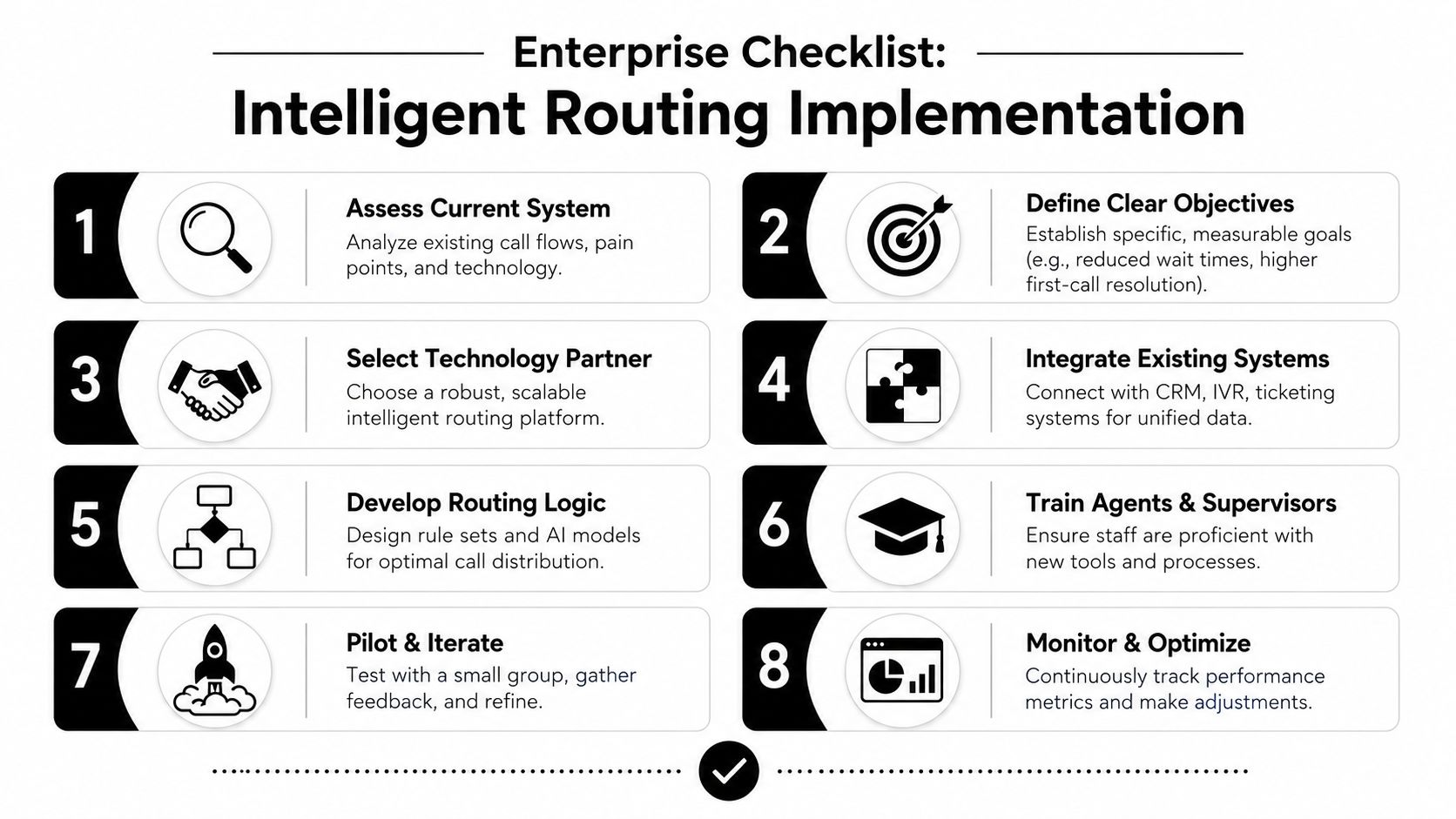
A practical enterprise checklist looks like this:
- Audit current call flows. Trace where customers get misrouted, where agents re-triage, and where queues become dead ends.
- Define success in operational terms. Tie the rollout to metrics your service and operations teams already manage.
- Map only the data that changes routing decisions. CRM and ticketing context often help. Not every profile attribute does.
- Design fallback logic early. Every route needs a safe next step when confidence is low or capacity disappears.
- Align workforce operations. Routing logic fails if agent states, skills, or availability data aren't maintained well.
- Train supervisors and agents. They need to know how the system decides, when to override, and how to flag bad outcomes.
- Pilot on a contained journey. Start where call reasons are common enough to learn from but narrow enough to manage.
- Review outcomes weekly. Tune based on real interactions, not workshop assumptions.
A short explainer helps when aligning stakeholders:
Roll out in controlled layers
A phased approach usually works better than a big-bang deployment.
- Phase one: Target a limited set of high-volume intents with simple routing logic and explicit fallback.
- Phase two: Add selective context such as account type or open-case status where it clearly improves assignment.
- Phase three: Introduce more dynamic optimization only after the base system proves stable.
This is also the right place to evaluate technology partners. Look for practical capabilities. Native voice AI, flexible workflow design, analytics, and integration depth matter more than long feature lists. Enterprises often compare stacks that include telephony providers, CCaaS platforms, and conversational AI layers. One option in that mix is Yellow.ai, which supports intelligent call routing inside a broader enterprise AI and contact center workflow environment.
Don't overlook governance. Someone must own routing policy, model updates, fallback standards, and exception handling. Without that ownership, every missed call path becomes a local fix, and the system slowly turns back into a patchwork.
KPIs That Matter for Measuring Routing Performance
If you can't measure routing quality, you can't operationalize it. Many contact centers install AI, show that it's live, and then evaluate success only through anecdotal feedback. That's how adoption outpaces value.
Read operational metrics as connected signals
According to CMSWire's contact center analysis, 88% of contact centers are adopting AI, but only 25% have fully operationalized it. The same analysis points to a core set of metrics for proving whether AI is working in day-to-day workflows: AHT, FCR, transfer rates, and CSAT.
Those metrics matter because they describe different parts of the same system:
- First-call resolution: This tells you whether routing is getting customers to someone who can solve the issue.
- Average handle time: This shows whether the agent started with the right context and skill match.
- Transfer rate: This is the clearest signal of routing failure, especially when clustered around specific intents.
- CSAT and NPS: These reflect whether the customer experienced the route as smooth and competent.
- Queue times and abandon rates: These reveal whether your routing strategy is distributing demand in a way operations can sustain.
A common mistake is treating each metric in isolation. Lower handle time isn't necessarily good if first-call resolution drops. Higher first-call resolution isn't enough if queue times spike because your matching criteria are too restrictive.
Use measurement to close the operationalization gap
The right review motion is diagnostic, not ceremonial. Look at patterns by intent, queue, and escalation path.
For example:
| KPI | What it reveals about routing | What to investigate when it worsens |
|---|---|---|
| FCR | Quality of initial match | Intent model gaps, missing specialist paths |
| AHT | Fit between issue and assigned agent | Poor context delivery, weak agent preparation |
| Transfer rate | Routing precision | Overbroad intents, broken fallback logic |
| CSAT | Customer perception of the journey | Delays, repetition, unresolved emotional friction |
| Queue time | Capacity alignment | Overly strict rules, staffing imbalance |
Teams that close the adoption-to-operation gap tend to build shared visibility between CX, operations, and analytics. That often means giving supervisors access to tools like AI analytics dashboards that make routing outcomes visible at the interaction and trend level.
If your metrics only tell you that service performance changed, you're late. The useful dashboard shows which routing decisions caused the change.
Measure tightly, but don't overreact to single-day swings. Routing quality improves when teams spot recurring failure patterns and then tune logic, data inputs, or staffing assumptions with discipline.
Advanced Strategies and Security Best Practices
The most overrated idea in intelligent routing is that more inputs automatically produce better decisions. They don't. Past a certain point, more signals produce slower routing, harder debugging, and more unexpected failure paths.
Avoid the over-optimization trap
Recent industry analysis warns that “overcomplication increases system errors” and that systems evaluating agents across 20 to 75 skills can become brittle if teams don't prioritize resilience and controlled fallbacks, as outlined in Whippy's discussion of intelligent call routing complexity.

That warning matches what operations teams discover the hard way. Intent-led routing sounds powerful until every exception gets encoded. Then peak traffic hits, confidence scores wobble, and the system sends calls into narrow queues with no graceful escape.
The fix isn't to retreat to primitive routing. It's to design for resilience:
- Use selective intelligence: Add data signals only when they change outcomes in a measurable way.
- Version your fallback paths: Every advanced route should degrade into a simpler, reliable path.
- Protect for surge conditions: Test what happens when specialist queues fill, not only when they're healthy.
- Separate critical from experimental logic: Don't mix core service journeys with unproven routing ideas.
Keep the primary path smart and the failure path simple. That's what keeps service stable when conditions change.
Secure routing for an AI-mediated service environment
Security now belongs inside routing design, not next to it. As customers use AI tools to prepare for service interactions and synthetic voice threats become more realistic, identity assumptions that worked in older contact centers become weaker.
A resilient routing program should include:
- Stronger verification gates: Don't rely on a single passive signal before exposing account actions.
- Channel-aware trust policies: Voice, chat, and assisted automation should share identity posture, not separate rules.
- Human-in-the-loop handling: Keep sensitive, emotional, or high-risk interactions eligible for human review.
- Compliance by workflow design: Healthcare, financial services, and utilities need routing paths that respect data handling constraints from the start.
Security teams, CX leaders, and operations managers need one shared model of acceptable risk. Otherwise, routing gets optimized for speed while compliance teams later add controls that break the experience.
The strongest systems don't chase maximum automation. They automate the routable parts confidently and hand off the rest with full context.
Intelligent Routing in Action Use Cases and Outcomes
Retail support
A retail enterprise usually sees routing strain after purchase. Calls arrive about refunds, delivery changes, damaged items, loyalty issues, and store policies, but customers rarely describe those categories cleanly. An intelligent routing model can identify the likely resolution path from the caller's language, then send routine issues to the right service pool while escalating edge cases to retention or specialist teams.
The practical outcome is lower post-purchase friction. Customers repeat themselves less, agents spend less time triaging, and supervisors gain a clearer view of where specialist demand is needed.
Internal IT and employee services
Employee helpdesks face a different problem. Workers don't care which internal tower owns identity access, devices, payroll systems, or collaboration tools. They just want the issue solved without bouncing across functions.
Intelligent routing leads to an improved employee experience. A voice or conversational front end can capture the problem in plain language, identify likely ownership, and attach context before the employee reaches a technician. A useful reference point is this employee support transformation example from Yellow.ai, which shows how voice AI can structure support interactions more effectively.
BPO operations
BPOs deal with mixed client requirements, shared agent pools, and strict service commitments. Routing needs to respect client-specific handling rules without fragmenting the workforce into rigid silos.
Intelligent routing helps by evaluating the interaction against SLA needs, language requirements, and specialist availability, then assigning the best-fit agent or queue. The operational payoff is a more flexible staffing model. Leaders can use one workforce more efficiently while still protecting service quality for different clients.
In all three settings, the pattern is the same. The value doesn't come from adding intelligence for its own sake. It comes from turning a call into the right next action faster and more consistently.
If you're rethinking how calls move through your enterprise, Yellow.ai is one platform to evaluate for voice AI, orchestration, analytics, and intelligent routing across CX and EX workflows. The practical test is simple: can it improve routing accuracy, preserve resilience under real operating conditions, and give your teams the controls to keep optimizing after go-live.



