










Insurance claims automation is no longer a paper-sorting upgrade. In the most practical benchmark used across the industry, straight-through processing for simple claims can move from a legacy baseline of about 7% to 70–90% with advanced automation, and McKinsey has projected 90%+ STP for simple claims by 2030 (industry benchmark summary). That shift changes the job, not just the workflow, because the carrier is no longer asking every claim to wait in the same manual queue.
The key question is whether the organization can define which claims should flow automatically, which should be partially assisted, and which should stay in human hands. That boundary is where most programs win or fail. If you treat automation as a blanket replacement for adjusters, you usually get brittle exception handling, frustrated customers, and rework that eats the savings back up.
Table of Contents
- Why Insurance Claims Automation Changes the Operating Model
- Core Technologies Powering Modern Claims Automation
- Measuring ROI and Business Impact
- Data Readiness and Governance Requirements
- Where Automation Should Stop
- Implementation Roadmap and Best Practices
- Emerging Technologies and Future Directions
- Success Metrics and Continuous Improvement
Why Insurance Claims Automation Changes the Operating Model
A claims operation built around 7% STP behaves like a manual service center with a few digital shortcuts. One running at 70–90% STP for simple claims behaves like a rules-driven production system, where people are concentrated on judgment-heavy exceptions instead of rekeying, chasing documents, and moving files from queue to queue (industry benchmark summary). That's the operating-model change most leadership teams underestimate.
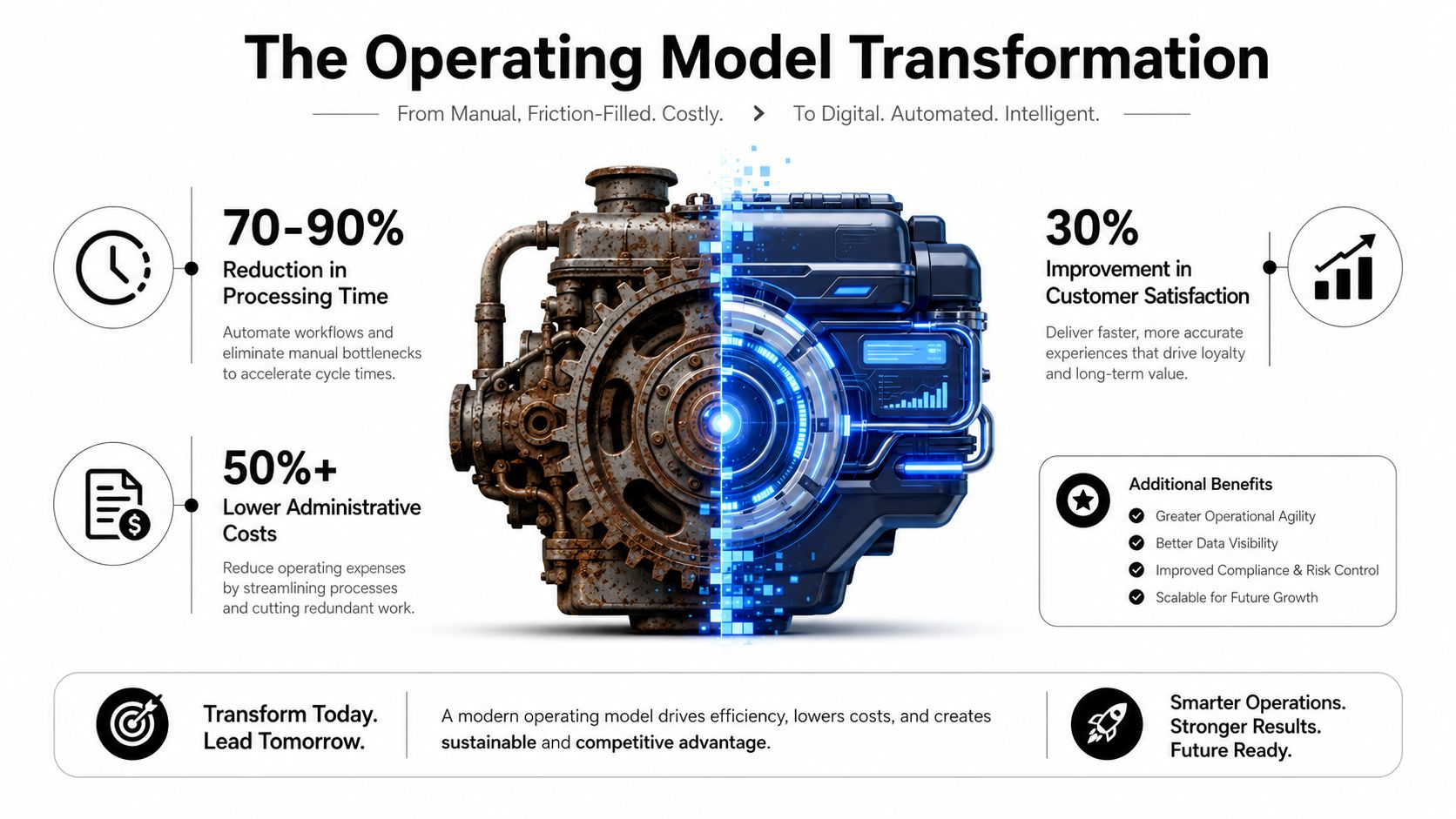
The practical implication is simple. Once routine claims can move through with minimal touch, supervisors stop managing volume by adding headcount, and they start managing segmentation, exception quality, and decision rules. Claims leaders who ignore that shift often automate intake but leave the downstream process untouched, which just creates faster chaos.
What the new model actually changes
The cycle-time story matters, but only because it reflects a deeper redesign. Industry research reports claims cycle time falling by 60–75%, from an average of roughly 30 days to under 8 days for many claim types, with routine low-complexity claims often handled in 24–48 hours (industry benchmark summary). That kind of throughput changes customer expectations, supervisor staffing, and settlement discipline.
A useful way to think about the shift is by decision ownership. In a manual model, people own nearly every step. In an automated model, the system owns the routine path, while people own the edge cases, complaints, ambiguous evidence, and disputes. That's why the operating model has to be redesigned around claim severity, confidence, and escalation logic, not just around software deployment.
Practical rule: if a claim can be decided from clean data, stable rules, and repeatable evidence, it belongs in the automated lane. If any of those three are weak, human review should stay in place.
For insurers still running a mostly manual workflow, the McKinsey projection of 90%+ STP for simple claims by 2030 is less a prediction to admire than a competitive warning (industry benchmark summary). The carriers that will look fastest in the market are the ones redesigning the claims organization now, not the ones treating automation as a back-office tool.
Core Technologies Powering Modern Claims Automation
Claims automation works when the stack handles three realities at once. Claims arrive as documents, claims need judgment, and claims systems still need structured outputs. The best architectures don't try to skip any of those realities, they move them through different layers.
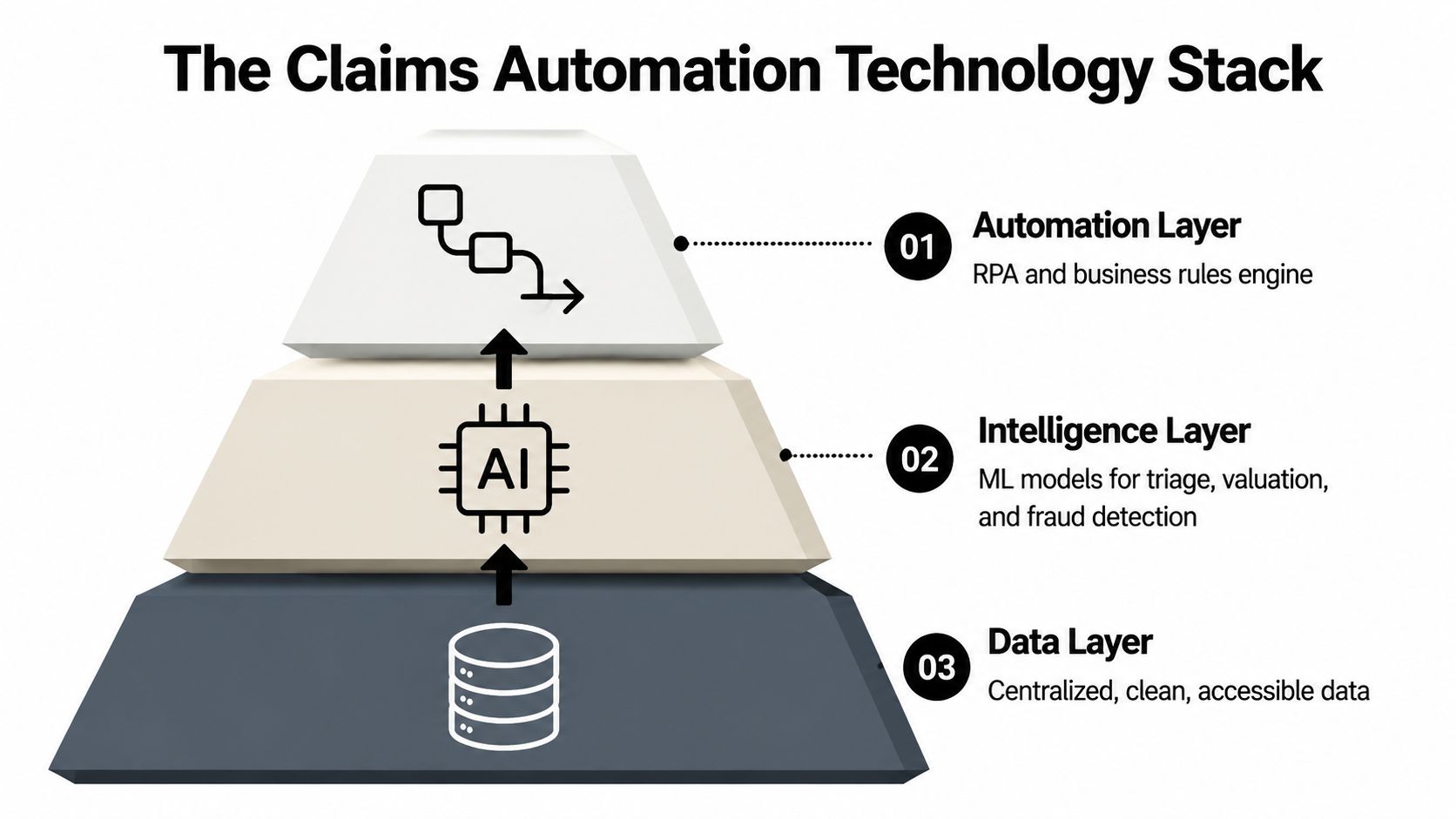
The base is intelligent document processing, or IDP. OCR converts scanned or photographed claim materials into machine-readable text. NLP and LLMs interpret the unstructured parts, including adjuster notes and policy language, while process mining spots where files slow down so the automation effort lands on the highest-friction steps (ABBYY claims processing guide). In claims intake, that matters because a file may include a form, an email, a photo, and a free-text note in the same case.
How the stack behaves in a live claim
The middle layer is intelligence. Machine learning can route a claim, flag suspicious patterns, or push a file toward review when the data doesn't line up. Computer vision can read damage photos, while rules engines can check eligibility and payout conditions. That split is useful because it keeps routine decisions repeatable and pushes uncertainty to people who can interpret nuance.
The top layer is automation, usually a combination of RPA and workflow orchestration. RPA is still useful for repetitive movement between systems, but it's not enough by itself. The claims file has to flow across intake, validation, routing, and payout without forcing staff to copy the same data into multiple screens.
A more realistic way to describe the full stack is this. IDP turns messy inputs into usable data, intelligence scores and classifies the case, and automation executes the routine path while escalating exceptions. That is why claims leaders should ask vendors how their system handles the messy middle, not just how quickly it can ingest a PDF.
When the stack works, the adjuster sees fewer duplicate tasks and more complete files. When it doesn't, the automation layer merely hides broken upstream data quality.
For teams evaluating workflows, a concise overview of insurance customer service and claims orchestration can help frame how claims intake connects to broader service design, including the way Yellow.ai supports BFSI workflows.
Measuring ROI and Business Impact
Business cases for claims automation get weak when they stay abstract. Executives don't fund “digital transformation,” they fund measurable improvement in throughput, cost, control, and service quality. The benchmark numbers are strong enough to build a serious case, but they need to be translated into your portfolio, not copied into a slide deck without context.
Industry research reports 20–40% cost-per-claim reductions, with generative AI alone estimated to deliver nearly 40% savings in claims management (industry benchmark summary). In the same body of research, cycle time falls by 60–75% and STP for simple claims rises sharply. That combination is why claims automation sits near the top of operating-cost agendas, especially in lines with high claim volume and repetitive document handling.
The metrics that actually matter
A finance leader will care about dollars and capacity. An operations leader should also care about consistency, exception rates, and the quality of escalations. If automation is pushing too many files into review, the savings can disappear inside the exception queue.
| Claims Automation ROI Benchmarks | Legacy Baseline | With Automation | Improvement |
|---|---|---|---|
| Straight-through processing for simple claims | About 7% | 70–90% | Material increase in automation coverage |
| Claims cycle time | Roughly 30 days | Under 8 days for many claim types | 60–75% lower cycle time (industry benchmark summary) |
| Routine low-complexity claims | Multi-day manual handling | Often 24–48 hours | Faster resolution for simple cases |
| Cost per claim | Manual baseline | 20–40% lower | Operating-cost reduction (industry benchmark summary) |
| GenAI impact in claims management | Conventional process | Nearly 40% savings | Incremental efficiency from AI (industry benchmark summary) |
If you're building a business case, anchor it to actual claim mix. A simple, high-volume auto portfolio behaves differently from a complex commercial line. That's also why a practical ROI exercise should compare current staffing, current cycle times, and current exception volumes against the target claim types rather than using an enterprise-average fantasy.
For a quick planning exercise, the Yellow.ai ROI calculator can help teams structure the questions that finance will ask before a pilot gets approved. The useful test is not whether automation sounds efficient, it's whether the organization can prove where the savings come from and where the human effort moves instead.
Data Readiness and Governance Requirements
Most automation programs do not fail because the models are weak. They fail because claims data is messy, systems do not integrate cleanly, or governance gets involved only after the pilot has already introduced risk. Claims automation is a data-quality and operating-model program first, software selection second.
A better starting point is a data audit. Decerto's guidance is direct, assess how much historical claims data is clean enough to train or validate models, and put the compliance framework in place with legal and risk teams before deployment (Decerto on AI in claims processing). That may sound basic, but many carriers skip it and then expect the system to automate around broken taxonomy, inconsistent reserve data, or incomplete notes.
The three readiness questions
Before buying or expanding a platform, ask three things.
- Data foundations: Are claim documents digitized, consistently labeled, and available across the main claim types?
- Technical readiness: Can the claims platform exchange data with policy administration, document management, and communication systems without manual re-entry?
- Governance framework: Have legal, risk, and operations agreed on model oversight, escalation paths, and audit requirements?
Those questions matter even more when generative AI enters intake, triage, or customer communication. The carrier needs to know what the model is allowed to say, what it must never decide alone, and how humans intervene when the output is incomplete or off-policy.
External data can strengthen claim assessment when it is governed properly. A useful example is vehicle provenance and risk intelligence, which shows how richer inputs can improve assessment if the organization knows how to validate them and combine them with internal claims evidence.
Decision rule: do not automate a process you cannot describe clearly on paper. If the workflow is inconsistent in the manual world, automation will scale the inconsistency.
TCS has also pointed to a future shaped by composite AI, geospatial data, wearables, and digital twins, which raises the bar on integration and control. That reinforces the core issue here. Readiness is not just whether a vendor can connect to a system, it is whether the business can trust the resulting decision path.
Where Automation Should Stop
The best automation programs know where to stop. That's the part most vendor decks gloss over, because “fully autonomous” sounds cleaner than admitting that some claims need a person who can weigh context, fairness, and customer impact. In practice, the smartest insurers use a hybrid system, not a total replacement for live claims professionals, which aligns with Deloitte's view that digital tools should enhance fact-based claims management rather than force all claimants into virtual channels (Deloitte on claims transformation).
The boundary is easiest to define by claim type and consequence. A low-complexity claim with clean evidence can stay in straight-through processing. A claim with conflicting narratives, potential fraud, legal exposure, or customer vulnerability should surface to a human before the process hardens into an automated decision.
A practical boundary map
| Claim situation | Best handling mode | Why |
|---|---|---|
| Simple, well-documented claim | Straight-through processing | Stable evidence and repeatable rules |
| Claim with photos and moderate ambiguity | AI-assisted review | Automation can classify, humans can confirm |
| Multi-party or high-severity claim | Human-led | Context, negotiation, and judgment matter |
| Suspected fraud | Human decision | Elevated risk and potential dispute |
That boundary also protects trust. Customers generally tolerate automation when the process is fast, fair, and explainable. They push back when they feel trapped in a digital flow that can't hear their context, especially after a serious loss.
Deloitte's mention of sensors and wearables capturing accident data is important because richer evidence can reduce ambiguity, but it doesn't remove the need for judgment in every case (Deloitte on claims transformation). The point is not to eliminate people. The point is to reserve people for the cases where fairness, reputation, and regulatory scrutiny matter most.
For teams evaluating customer-facing automation, a useful benchmark is whether the claimant still has a clear path to a live professional when the case gets complicated. If that path is missing, the design is too rigid.
Implementation Roadmap and Best Practices
A claims automation rollout should start before the technology demo. The first job is to map the actual claims journey, not the idealized version in a process manual. From there, the carrier can identify where files stall, where rekeying happens, and which decisions are routine enough to automate safely.
A phased rollout that holds up in production
Start with process mining and a data audit. Process mining shows where claims spend time in the workflow, while the audit tells you whether the underlying data is clean enough to support automation. That pairing prevents the classic mistake of automating a bad process because it is visible, not because it is ready.
Then pilot low-complexity claim types. Do not begin with the hardest files. Start where the rules are stable, the documents are consistent, and the business can absorb a few misses without damaging customer trust. The first goal is reliable exception handling, not maximum coverage.
After that, connect the platform to the legacy systems that run the business. Claims automation fails when it creates a new island of efficiency around a broken core. The workflow has to move cleanly through policy administration, document management, payments, and customer communication.
Train adjusters on why a file was routed, not just what the system decided. If people don't trust the logic, they'll create shadow workarounds.
Change management matters as much as configuration. Supervisors need escalation rules. Adjusters need to know which cases to review and which to leave alone. Customers need communication that feels clear, not robotic.
Yellow.ai is one option in the market for conversational insurance workflows, including claims inquiries and FNOL support, so it fits naturally where customer messaging and intake sit in the broader process. If you evaluate tools, keep the focus on how well the platform supports exception handling and legacy integration, not on how many features it lists.
Emerging Technologies and Future Directions
A claim used to begin with a phone call or a scanned form. Increasingly, it begins with evidence already captured by devices. That changes the whole front end of the process, because the insurer receives more context before an adjuster ever opens the file.
Deloitte's discussion of sensors and wearables points toward a claims environment where accident data can arrive as richer evidence, not just written description (Deloitte on claims transformation). In auto claims, that could mean cleaner triage when image-based evidence is available. In other lines, it could mean faster validation when the event leaves a digital trace.
What the next wave looks like in practice
Computer vision is already important where damage is visual. The system can inspect images, sort likely severity, and route the file accordingly. That doesn't replace a field estimate in every case, but it can reduce how long a file sits untouched before the right person sees it.
Composite AI combined with geospatial data adds another layer of context. TCS has pointed to that direction, and the governance burden rises with it because more inputs means more validation work. If the external signal is wrong or misaligned, the model can become confident for the wrong reasons.
For customer communication, conversational AI can handle status questions, document requests, and basic guidance while the core claim is in motion. For teams watching the broader market, the Yellow.ai webinar on agentic AI in insurance is a useful lens on how conversational layers are being positioned around service and workflow automation.
The practical distinction is this. Near-term value comes from better intake, triage, and evidence handling. Longer-term value comes from blending those signals into a governed decision path. The carriers that treat every new data source as a chance to bypass controls will create more risk than value.
Success Metrics and Continuous Improvement
Mature automation programs do not brag about the pilot. They watch the operating system. Cycle time still matters, but it cannot stand alone, because a fast process can still be wrong, opaque, or hard on customers.
A useful scorecard includes exception rates, dispute rates, customer confidence, and adjuster satisfaction, along with throughput and cost. Those measures show whether automation is really absorbing routine work or just pushing complexity into another queue. They also show whether the human handoff is smooth enough to preserve trust.
One operational boundary matters more than vendors usually admit. Straight-through processing should handle clear, rules-based claims, while anything ambiguous, disputed, or high-impact should move into human-in-the-loop review before the file is closed.
What to watch after go-live
- Exception quality: Are exceptions difficult cases, or is the system over-escalating routine claims?
- Dispute pattern: Are claimants pushing back on decisions because the process feels opaque?
- Adjuster load: Are people spending their time on judgment, or on cleanup and re-entry?
- Model drift: Are decisions staying aligned with current claim patterns and policy rules?
A good feedback loop ties every adjusted claim back to the model or rule that handled it. That creates a learning system, not just a one-time deployment. It also gives governance teams evidence when they need to revise a threshold or tighten a review rule.
If you want to compare your automation maturity with what other teams are discussing in the field, the Leverage Auto Appraisals tag is a useful place to scan how appraisal, triage, and claims content are evolving across the auto space. Use that kind of external reading to pressure-test your own metrics, not to copy someone else's operating model.
The primary goal is stable scale. When automation is working, leaders see fewer surprises, supervisors see cleaner queues, and customers see faster resolutions with less friction.
Yellow.ai helps enterprises automate customer and employee conversations across chat, voice, email, and other channels, which makes it relevant where claims intake, status updates, and FNOL support sit in the workflow. If you are evaluating insurance claims automation, visit Yellow.ai to see how its platform connects conversational entry points to the broader claims journey.