









Priya's first week at a new company should be simple. She needs to update her direct deposit, find the parental leave policy, and report a payroll error. Instead, she searches three systems, starts two email threads, and waits through a case backlog before anyone can tell her who owns the problem.
That experience is the test of HR service delivery. Employees don't experience HR as an organization chart. They experience it as a sequence of questions, forms, approvals, messages, and handoffs. A modern model must make that sequence easier to work through, while giving HR teams the controls, context, and accountability needed to resolve sensitive issues correctly.
Table of Contents
- What HR Service Delivery Actually Means
- How the Operating Model Works
- KPIs That Show Whether It Is Working
- The Front Door Problem Most Teams Miss
- Where Conversational AI Changes the Model
- Real Use Cases Worth Piloting First
- Implementation Considerations That Decide Success
- Where to Start This Quarter
What HR Service Delivery Actually Means
HR service delivery is the discipline of designing, operating, and improving every way employees and managers get HR support. It includes self-service, conversational assistants, live agents, managers, HR business partners, case workflows, knowledge content, and the systems working behind the scenes.
That definition matters because employee self-service is only one part of the service model. A portal can answer a policy question, but it may not handle a payroll correction. A chatbot can collect information, but a specialist may still need to review a leave exception. A manager may know the local context, while an HR partner owns the judgment required for a sensitive employee-relations case.
Practical rule: Treat every employee request as a journey with an owner, not as a ticket that happens to enter a queue.
Three job-to-be-done categories help clarify the difference.
- Transactional questions: Employees need information or a routine action, such as checking a payslip, changing an address, or understanding a benefits enrollment step.
- Life events and changes: The request involves a transition, such as onboarding, parental leave, relocation, a promotion, or an employment change. These cases often cross several systems and approval points.
- Sensitive escalations: The employee needs discretion, judgment, or protection, such as reporting harassment, challenging a payroll outcome, or raising a workplace concern.
A useful conversational AI for employee experience approach can bring these paths into one interaction, but technology doesn't define the operating model by itself. HR leaders still need to decide which requests employees can complete independently, which require an agent, and which must move directly to a specialist.
HR shared services fits inside this picture. It's a delivery structure that centralizes selected HR activities, while HR service delivery covers the complete experience across channels and teams. The employee should not have to understand that distinction. If Priya is sent from a portal to an inbox, then from the inbox to payroll, the organization has optimized departments rather than delivered a service.
The strongest model owns the experience end to end. It makes the front door clear, routes the request by intent, preserves context during handoffs, and measures whether the employee received the right outcome.
How the Operating Model Works
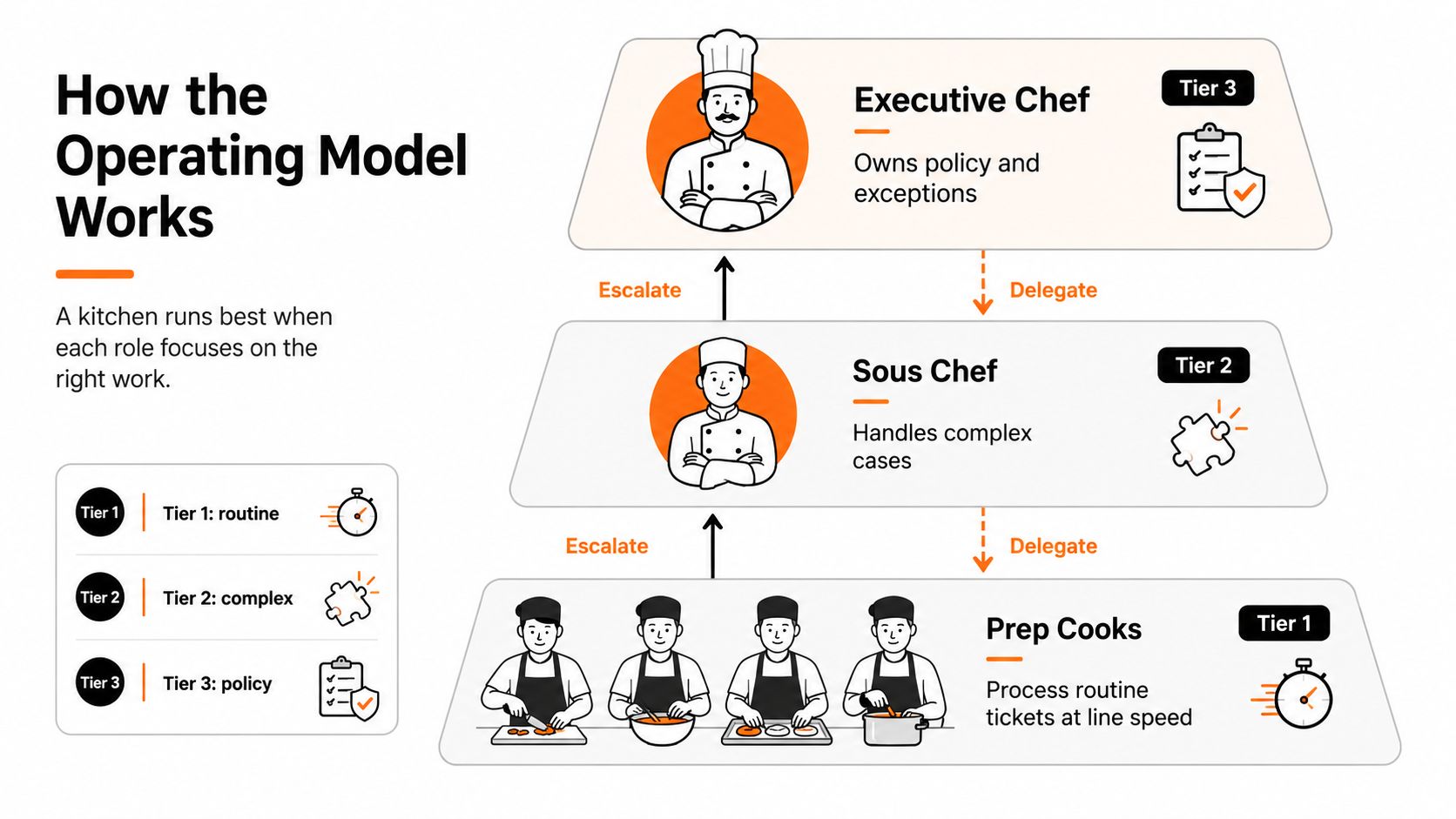
A restaurant kitchen offers a practical way to understand HR service delivery. Prep cooks handle repeatable work at line speed. Sous chefs take on dishes that need more judgment or specialized knowledge. The executive chef decides on standards, exceptions, and changes to the menu.
HR uses a similar tiered structure:
- Tier 0: Self-service answers, search, virtual agents, and automated workflows for routine needs.
- Tier 1: Shared services agents who resolve standard transactions, clarify information, and manage cases.
- Tier 2: Specialists who handle complex, legally sensitive, region-specific, or policy-heavy matters.
- Tier 3: Senior HR leadership or policy owners who decide exceptions, interpret enterprise standards, or resolve serious escalations.
The tiers don't operate in a single channel. Employees may use an HR portal, send an email, ask a Slack or Teams bot, approach a manager, or contact an HR business partner. Without shared case records and routing rules, the same request can appear as an email, a portal case, and a manager escalation. Agents then spend time reconciling duplicate work instead of resolving the underlying issue.
Assign ownership before adding automation
Four ownership questions prevent most operating-model confusion:
- Who owns the knowledge? A named team must review policy content, archive outdated guidance, and approve updates.
- Who owns the case? One person or queue must remain accountable through resolution, even when specialists contribute.
- Who owns the metric? Someone must explain changes in resolution, satisfaction, backlog, and repeat contacts.
- Who owns the policy? The policy owner must make the final call when an answer involves interpretation or an exception.
Organizations comparing centralized, hybrid, and distributed approaches can also compare PEO service models to understand how responsibilities may be divided across internal and external providers.
A tiered model isn't effective merely because it has queues called Tier 1 and Tier 2. Each tier needs clear entry criteria, exit criteria, permissions, escalation triggers, and service expectations. The kitchen works because everyone knows when a prep cook can finish the order, when the sous chef must intervene, and when the executive chef must decide.
KPIs That Show Whether It Is Working
A busy service operation can still leave employees without a reliable answer. Portal visits, bot sessions, and closed tickets show activity. They do not show whether the employee reached the right resolution with reasonable effort.
A useful KPI set connects speed, quality, experience, and cost. Start with a dependable baseline from actual cases, then compare results with established benchmarks where they fit.
| KPI | Formula | Healthy Benchmark |
|---|---|---|
| First contact resolution | Cases resolved on the first interaction ÷ total cases | A mature Tier 1 operation commonly targets 65% to 80%, according to ServiceNow's HR service delivery SLA guidance |
| Self-solved rate | Self-solved virtual-agent cases + knowledge resolutions + automated resolutions ÷ total applicable resolutions | Track by resolution type, using the ServiceNow self-solved KPI definition |
| Average handle time | Talk time plus wrap time ÷ number of cases | Compare separately by tier and case type |
| Employee satisfaction | Post-closure survey score | Use a consistent one-tap survey and segment by channel and issue |
| Employee effort score | Employee-reported effort required to complete the request | Pair with satisfaction to expose frustrating journeys |
| Service level | Cases answered within the defined target ÷ total applicable cases | Set targets by channel, priority, and workforce coverage |
| Cost per case | Total HR service delivery cost ÷ annual case volume | Compare over time and by request category |
Benchmark context helps leaders interpret the numbers. A mature Tier 0 model can absorb 40% to 75% of requests before they reach an HR agent, while portal-only implementations generally fall around 30% to 50%, according to the guidance linked in the first contact resolution row. These ranges are comparison points, not targets to copy blindly. They prompt a more useful question: has the organization designed genuine resolution, or only published information?
Self-service also needs a clear definition. A request counts as self-solved only when the employee reaches a usable answer or completed outcome without agent intervention. Measuring virtual-agent sessions alone can reward conversations that end in a handoff.
First contact resolution requires the same care. A low result may indicate weak training, poor knowledge content, unclear scope, or incorrect routing. A high containment result paired with poor satisfaction can signal that the system is stopping contacts without solving the underlying need. Review the KPI with repeat contacts, escalations, and survey comments.
For a broader framework for selecting and interpreting people metrics, the HR metrics guide provides useful context. The operating test is straightforward: measure whether the employee's need was resolved, how much effort it required, and whether the front door produced a clean handoff when automation could not finish the work.
The Front Door Problem Most Teams Miss
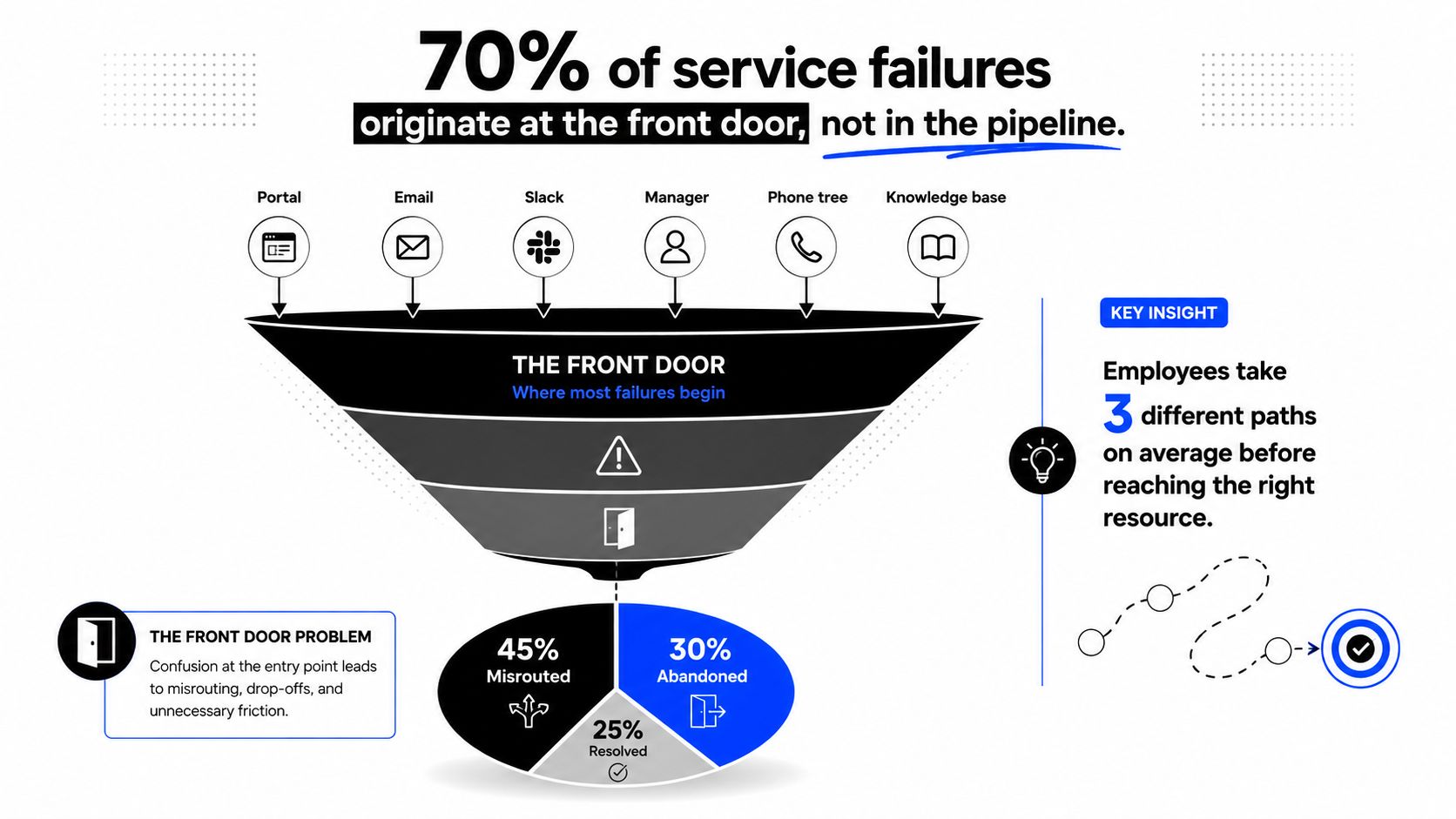
Many HR service delivery failures begin before a case reaches the right team. The employee may start in a portal, switch to email, ask a manager, search a knowledge base, and then call HR. Each channel can produce a different answer, a different case number, and a different expectation.
A recent HR shared services report found that 73% of organizations lack an enterprise-wide front door for employee queries, while 38% plan to expand digital systems and AI, according to Lace Partners' HR shared services trends report. The contrast exposes a common mistake. Organizations often buy more automation before making it easy for employees to find the correct starting point.
Design for intent, not the org chart
An employee shouldn't need to know whether payroll, benefits, HRIS, mobility, or a local HR team owns a request. They should be able to say, “My paycheck is wrong,” and receive a guided path that identifies the issue, requests the relevant details, and routes it with context.
The front door should therefore answer four practical questions:
- Where do I start? Provide one obvious entry point across web, collaboration tools, mobile, and live support.
- Will the system recognize my situation? Authenticate the employee and use relevant context without exposing information they aren't authorized to see.
- What happens next? Show status, ownership, expected action, and any missing information.
- Can I change channels without starting over? Preserve the conversation and case history when a human agent takes over.
McKinsey's 2026 HR Monitor, as summarized in the same report, says nearly all organizations offer at least one HR self-service solution, yet only about 40% of processes are offered as self-service on average. The limitation isn't always a lack of software. Some processes are too complex, sensitive, or locally variable for complete self-service, while others remain fragmented because nobody owns the journey.
A practical audit starts with one question: How many tools must an employee touch before reaching the right resource? If the answer is more than one for a routine request, consolidate the entry experience before optimizing downstream automation. A faster pipeline can't compensate for a confusing entrance.
A conversational knowledge layer can help unify policy discovery and guided answers through a conversational knowledge base, but the content and routing behind it still need accountable owners.
Where Conversational AI Changes the Model
Conversational AI changes HR service delivery when it performs work across the journey, not when it places a chat window over an existing FAQ library. The useful sequence is straightforward: authenticate the employee, interpret the intent, retrieve trusted information, complete an action when authorized, or hand off the case with its context intact.
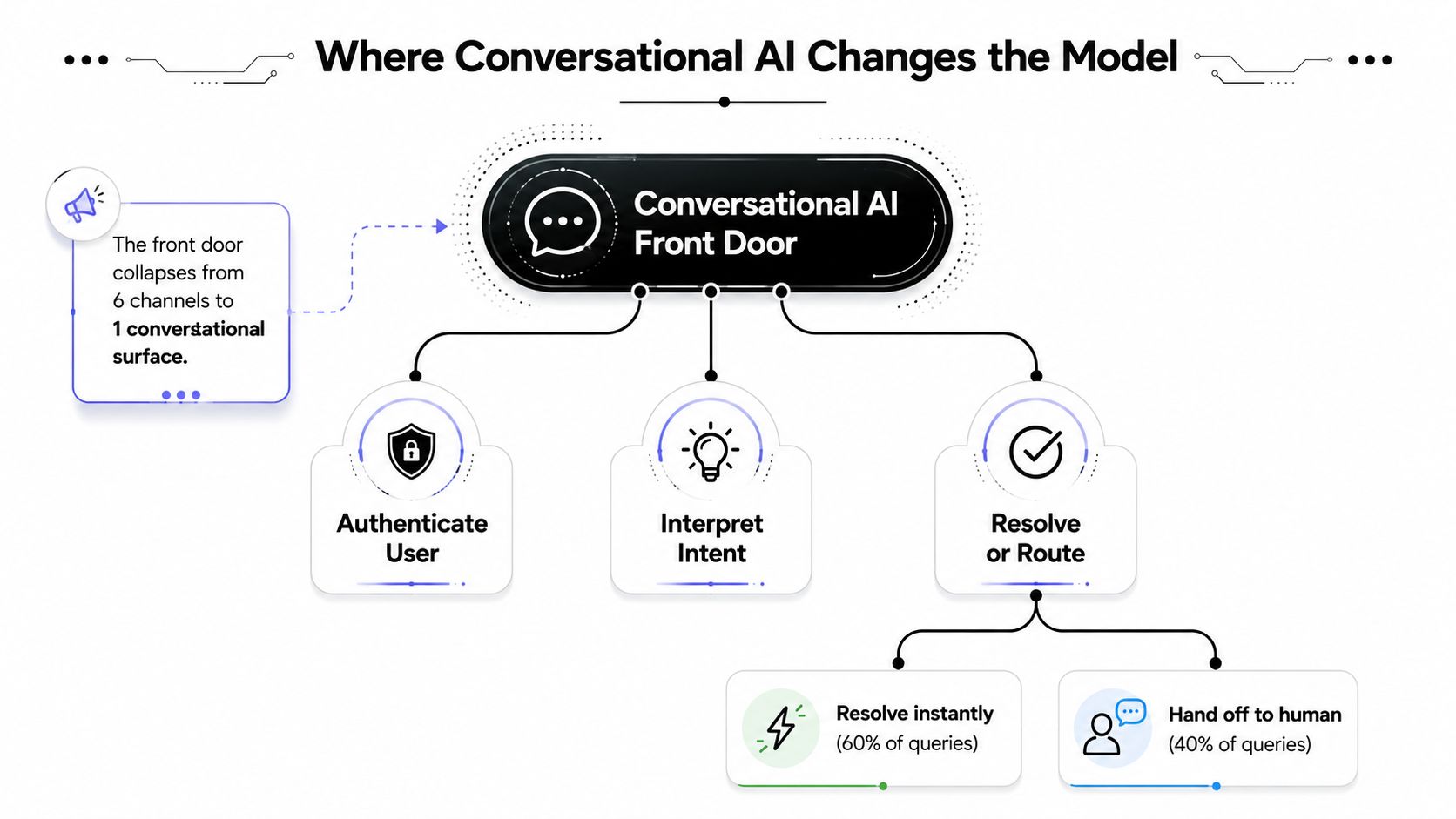
Three operating-model changes
Tier 0 becomes transactional. A static article tells an employee where to look. A connected assistant can check an employee's relevant record, explain the next step, and initiate an authorized workflow. That distinction matters for requests such as leave balances, address changes, or payslip access, where information alone may not complete the job.
Tier 1 handles fewer routine contacts. Agents can spend less time repeating standard policy explanations and collecting details that an assistant could capture. Their role shifts toward judgment, exception handling, quality review, and conversations where empathy or discretion matters.
Knowledge becomes a feedback system. Unanswered questions, low-confidence responses, repeated contacts, and agent corrections reveal where the knowledge base is incomplete. HR operations can use those signals to update content, clarify policy language, and improve routing. A knowledge base becomes useful when it changes in response to real demand.
The transformation has limits. AI still needs authoritative source data, permission controls, clear escalation rules, and human ownership for edge cases. It shouldn't invent a policy interpretation, expose another employee's information, or make a sensitive decision without the required review.
The independent 2026 HR shared services research cited by Lace Partners estimates that 60% to 80% of HR requests could be automated through AI-driven workflows, while also noting that self-service remains concentrated in transactional work. That tension is important. Automation can reduce repetitive demand, but it won't redesign a broken approval chain unless the organization changes the process itself.
AI reorganizes work. It doesn't remove accountability.
Real Use Cases Worth Piloting First
The strongest first pilots share three characteristics: high demand, limited judgment, and low political risk. They also produce an obvious comparison between the old employee journey and the new one.
| Use Case | Legacy Workflow | AI-Assisted Workflow | Expected Outcome |
|---|---|---|---|
| Onboarding | New hires search across messages, forms, and documents for instructions | A guided conversation collects documents, presents relevant acknowledgments, and directs benefits steps based on role and location | Fewer missed tasks and a clearer first-day experience |
| Leave management | Employees email HR, wait for clarification, and separately notify a manager | The assistant checks available information, starts the approved HRIS workflow, and communicates the next action | Faster intake, better status visibility, and fewer duplicate contacts |
| Policy questions | Employees search multiple documents or ask an agent to interpret routine guidance | The assistant answers from the official policy library and cites the applicable source, then escalates uncertainty | More consistent responses and a stronger content feedback loop |
Start with onboarding
Onboarding is a good candidate because the journey has recognizable milestones. The assistant can ask for missing information, identify the relevant location or employment type, and guide the new hire through required steps. It should not decide an exception or approve a document outside its authority. Those actions remain with the designated HR or compliance owner.
Make leave status visible
Leave requests combine information retrieval and workflow initiation. A useful assistant doesn't merely display a policy link. It explains what the employee needs to provide, records the request in the approved system, and makes the status visible without requiring a fresh email.
Ground policy answers in approved content
Policy questions look simple but often expose knowledge weaknesses. The assistant should distinguish between retrieving an official rule and offering an interpretation. When the content is ambiguous, outdated, or jurisdiction-specific, the correct outcome is a transparent escalation rather than a confident guess.
Pilot design should include a baseline, a defined audience, a clear escalation path, and quality review. Don't select a use case because it demos well. Select one where employees repeatedly perform the same work and where HR can verify the result.
Implementation Considerations That Decide Success
AI pilots stall for operational reasons more often than technical ones. The assistant may work as designed, yet employees still abandon it because the policy content is contradictory, the system can't complete the requested action, or the handoff loses the conversation.
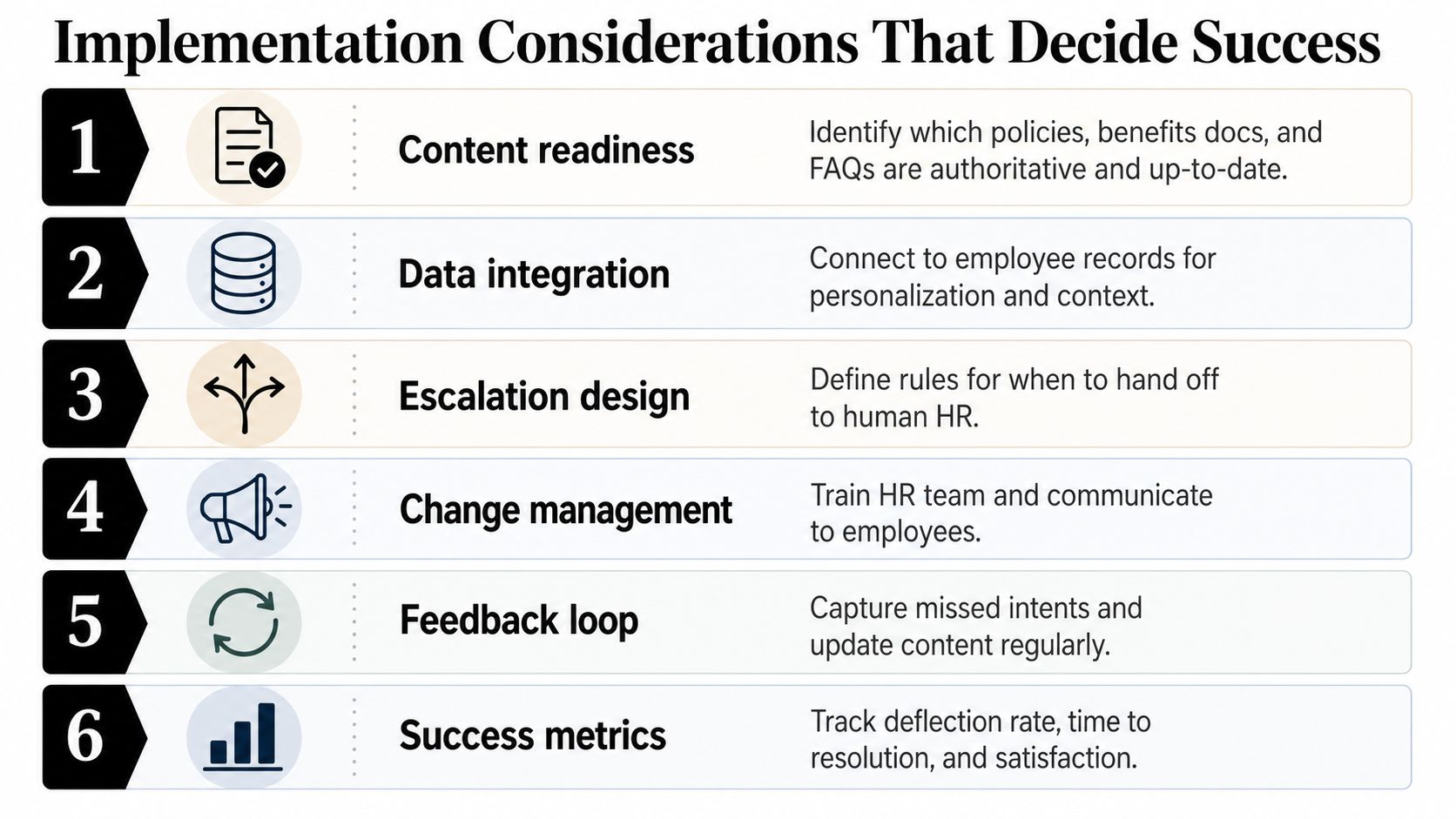
Content readiness comes first
Create a source-of-truth inventory for policies, benefits documents, FAQs, forms, and local guidance. Mark each item as authoritative, outdated, duplicated, or awaiting review. Conversational AI can retrieve and summarize content, but it can't resolve two conflicting policies unless a human decides which one governs.
Integration depth determines usefulness
Ask whether the assistant can read the relevant HRIS, case system, identity layer, and knowledge repository in the required context. A bot that only points employees toward PDFs may improve search, but it won't deliver end-to-end service. For a leave request, the difference is whether the employee can initiate and track the workflow, not whether the assistant can describe it.
Guardrails should feel natural
Define which topics require authentication, which actions need confirmation, and which signals trigger human escalation. Sensitive employee-relations matters, uncertain policy interpretation, threats to safety, and repeated failed attempts should move to trained staff with a complete transcript and collected details.
An agent-assist capability can support this handoff by giving HR staff relevant context while preserving human control. For example, teams evaluating an agent assist platform should examine how it surfaces approved knowledge, summarizes conversations, and records corrections.
Watch the operating signals
Three patterns deserve immediate investigation:
- Containment rises while satisfaction falls: The assistant may be ending conversations without solving the problem.
- Tier 2 volume rises: Routing, content, or permissions may be pushing ordinary requests to specialists.
- Knowledge articles remain untouched: Employees may not trust the content, may not find it, or may be using another front door.
Adoption that plateaus after launch isn't automatically an employee attitude problem. It may indicate that the organization has added a bot without removing the old pathways. Change management should explain where employees start, what the assistant can do, when a person joins, and how the organization protects sensitive information.
Where to Start This Quarter
A CHRO can make meaningful progress without launching an enterprise-wide transformation. The first requirement is an honest view of current demand.
Instrument the present state. Pull 30 days of ticket data by category, channel, ownership, resolution time, repeat contact, and escalation. The data should show where employees begin and where cases end, not just which queue closed them.
Choose one pilot. Select a high-volume, low-complexity request, such as a policy question or leave-balance inquiry. Set the containment definition and the satisfaction measure before launch, so the team can't redefine success after seeing the results.
Map the front door. Document the paths through the portal, email, collaboration tools, managers, phone support, and HR partners. Decide which entry point should become the default and how every other channel will connect to it.
Name an operations owner. Give one HR operations lead authority to resolve content and routing gaps with HR, IT, payroll, benefits, and finance. Without cross-functional ownership, the pilot will expose problems that nobody can fix.
Set a 90-day review gate. Decide in advance what would justify scaling, refining, or stopping the pilot. Review resolution quality, repeat contacts, employee effort, escalation patterns, and knowledge gaps alongside ticket volume.
The major 2023 ISG HR technology survey found that mobile-enabled employee and manager self-service had become the top HR technology trend, with 61% of organizations using it at the time of the survey, as reported in the ISG HR technology survey. The lesson for this quarter isn't to add another channel. It's to decide how employees should get help, who owns the outcome, and whether AI makes that operating model clearer.
Modernization is an operating-model decision before it's a vendor decision.
Yellow.ai can help organizations build a unified employee front door across conversational channels, connect answers to enterprise knowledge, and automate HR journeys such as policy questions, leave requests, and onboarding tasks. Visit Yellow.ai to evaluate how an enterprise conversational AI platform could fit your HR service delivery pilot.