














An angry customer rarely arrives as a clean, isolated ticket. It usually lands in the middle of a busy queue, a product issue, a staffing gap, and a team already trying to move fast without sounding rushed. One email is sharp. One call starts with shouting. One social post tags your brand publicly and invites an audience into the problem.
That's the moment organizations either stabilize the relationship or make it worse.
Knowing how to deal with angry customers isn't about memorizing a few empathy lines. It's about building a repeatable operating model. Agents need a reliable de-escalation sequence. Managers need escalation paths that reflect business impact, not just ticket severity. Leaders need AI and automation that reduce friction for both customers and frontline teams, instead of trapping people in rigid workflows that trigger more anger.
Table of Contents
- The Hidden Cost of Customer Anger
- The De-escalation Playbook From First Contact to Calm
- Mastering Active Listening and Empathy
- Designing Smart Resolution and Escalation Workflows
- Augmenting Your Team with AI and Automation
- Closing the Loop Recovery Follow-up and Measurement
The Hidden Cost of Customer Anger
The angry customer you can see is usually not the biggest risk. The bigger risk is the customer who had a bad experience, decided your company wouldn't help, and left quietly.
According to Help Scout's customer service statistics roundup, only 1 in 26 customers will tell a business about a negative experience. Everyone else often leaves without giving the company a chance to recover the relationship. For support leaders, that changes the frame completely. A complaint is not just a support event. It is a visible retention warning.
That's why the first response matters so much. When a customer reaches out angry, they're still in the conversation. They haven't fully written you off yet. They're giving your team one more chance to prove that the company listens, owns problems, and can move with urgency.
Angry customers are useful signals
The loud customer is often speaking for a much larger group of frustrated customers who never contacted support. If an issue keeps surfacing in cancellations, review sites, escalations, and repeated contacts, the support organization shouldn't treat those as separate incidents. They are one operational signal coming through different channels.
Practical rule: Treat anger as diagnostic data. The emotion is the delivery mechanism. The underlying problem is what needs to be fixed.
This is one reason I don't like teams measuring success only by speed. Fast responses help, but speed without judgment creates scripted interactions that feel dismissive. Customers can tell when an agent is trying to close the case faster than they are trying to understand the problem.
Retention strategy, not ticket handling
A mature CX team sees complaint handling as part of customer retention strategy. That means staffing for difficult conversations, giving agents enough authority to act, and reviewing complaints for patterns that affect churn, renewals, and reputation.
It also means giving leaders a way to connect service recovery to business outcomes. If you're trying to estimate the value of stronger retention and better service automation, a customer service ROI calculator can help frame the operational trade-offs before you redesign workflows.
The main shift is simple. Don't ask, “How do we close angry tickets faster?” Ask, “How do we keep preventable anger from becoming preventable churn?”
The De-escalation Playbook From First Contact to Calm
When customers are upset, many agents make the same mistake. They rush to explain, defend, or solve. That usually backfires.
A more reliable sequence is to let the customer speak without interruption, acknowledge the emotion, apologize specifically, restate the problem to confirm understanding, then move to a concrete resolution, as described in this de-escalation guidance from GigaBPO. The order matters because customers rarely accept a solution before they feel heard.
Start with containment, not correction
Use this visual as the baseline process for coaching and QA.
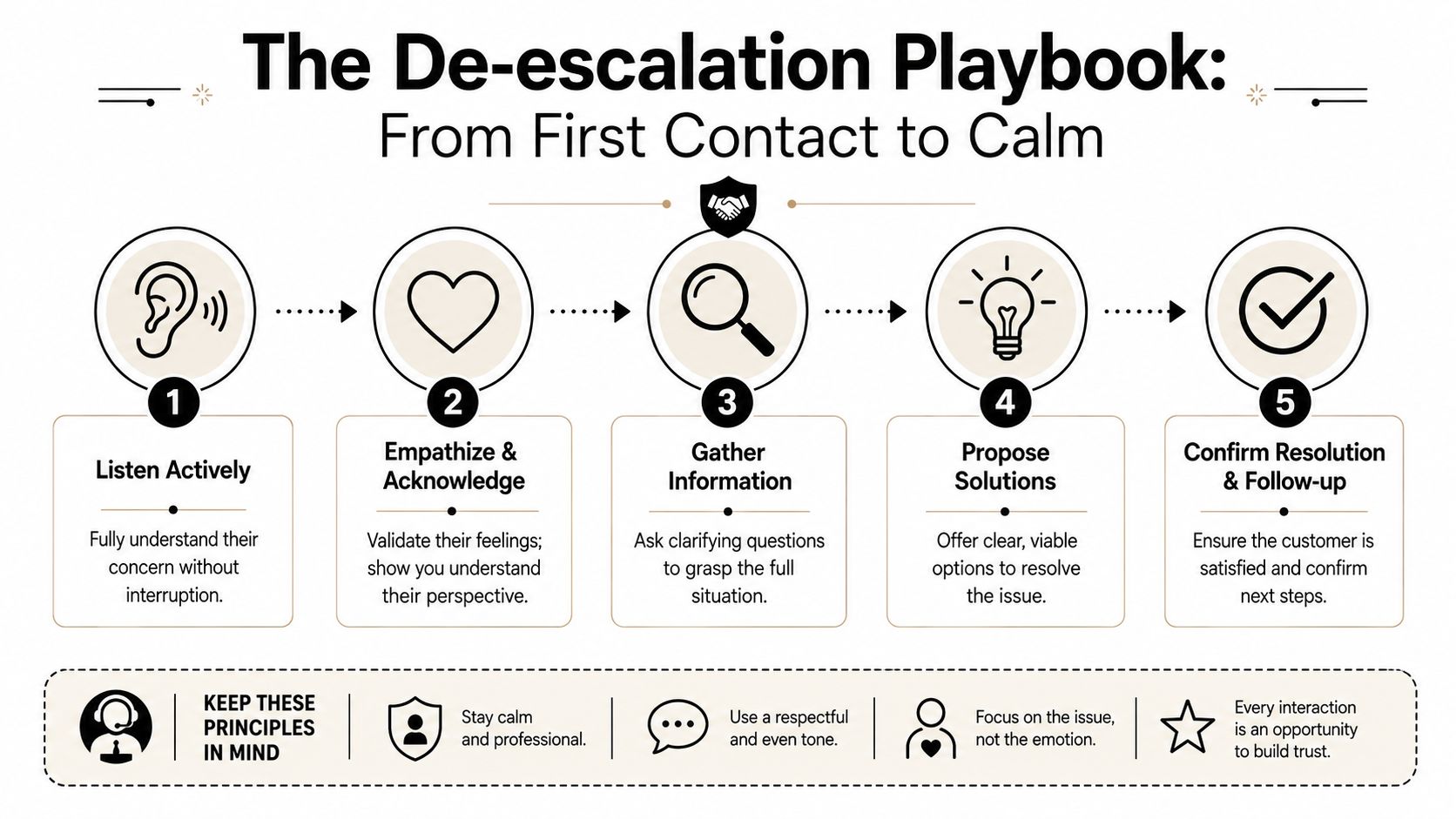
The opening move is simple. Let them talk.
Don't interrupt to fix facts. Don't start searching for policy language while they're still venting. Don't jump into “what happened was…” while the customer is still emotionally escalating. In live channels, silence can feel uncomfortable to the agent, but interruption feels disrespectful to the customer.
After they finish the first burst, acknowledge the emotion directly. Keep it plain. “I can hear how frustrating this has been.” “I understand why you're upset.” If your company caused the issue, apologize specifically. Vague apologies sound evasive. “I'm sorry your order was delayed twice” is stronger than “I'm sorry for the inconvenience.”
A useful training asset for teams handling voice interactions is below.
Then restate the issue in operational terms. That step slows the conversation down and creates alignment. “To make sure I've got this right, the integration failed after the update, your team had to do the work manually, and you still haven't received a confirmed fix.”
When the customer says, “Yes, that's exactly it,” the conversation usually changes. You're no longer opposite them. You're next to them, looking at the same problem.
Only then should the agent move into options, next steps, and timing.
Use language that lowers temperature
Agents don't need robotic scripts. They do need phrase patterns that reduce tension instead of increasing it.
| Instead of This (Problematic) | Try Saying This (Productive) |
|---|---|
| You need to calm down. | I want to help, and I'm listening. |
| That's our policy. | Here's what I can do from here. |
| There's nothing I can do. | I can offer a few options. |
| You already contacted us about this. | I can see this has taken too many steps already. |
| That's not my department. | I'm going to get this to the right person and stay clear on next steps. |
| You misunderstood. | Let me clarify what happened and where we go next. |
| We're waiting on another team. | The next step depends on another team, and I'll tell you exactly what happens next. |
| I don't know. | I don't want to guess. I'm checking that now. |
A few operational rules matter here:
- Name the issue clearly. Customers trust specificity more than polished wording.
- Give time-bound next steps. If the answer is delayed, say when the next update will come.
- Offer choices when possible. Even limited options restore a sense of control.
- Avoid defensive phrasing. “as I said,” and “per policy” often inflame the exchange.
- Keep your pace steady. On calls, fast speech sounds nervous or dismissive.
What doesn't work is over-apologizing without action. It sounds courteous, but it leaves the customer with emotion and no progress. The best agents sound calm, concrete, and unafraid of ownership.
Mastering Active Listening and Empathy
A lot of teams say they train empathy when they really train politeness. Those are not the same thing.
Politeness keeps the interaction civil. Empathy helps the customer feel understood. When people ask how to deal with angry customers, they often focus on wording. The deeper skill is showing that you grasp both the facts and the impact.
What active listening looks like in real conversations
Consider two versions of the same exchange.
The first agent says, “I'm sorry to hear that. Can you give me your account number?” That isn't rude. It's just transactional. The customer hears, correctly, that process has started before understanding has.
The second agent says, “I'm sorry you've had to chase this more than once. Let me make sure I understand what broke and what your team is dealing with today.” That sentence does two jobs at once. It acknowledges the experience and invites detail that will help solve the issue.
Good active listening usually includes three moves:
- Paraphrasing the facts. “So the shipment arrived late, and the replacement was wrong.”
- Labeling the impact. “That left your staff without what they needed for the weekend.”
- Checking alignment. “Is that the full picture, or is there another part I should know before I act on this?”
Real-time agent support can help. Tools such as agent assist software can surface prior interactions, product context, and recommended prompts so agents don't force customers to repeat themselves. That matters most when the customer is already frustrated by having to start over.
Empathy is not agreement
Some agents hesitate to acknowledge emotion because they think it means accepting blame or surrendering the argument. It doesn't.
You can validate the customer's experience without agreeing to every claim they make. “I understand why this feels unacceptable” is not the same as “You're right about every detail.” It tells the customer that their reaction makes sense given what they experienced.
A customer can accept a limit more easily after they feel understood. They rarely accept it before.
This distinction is critical in billing disputes, product misunderstandings, and policy conflicts. If the customer's request can't be granted, the path forward is still empathy first, clarity second, boundary third. Reverse that order and the conversation hardens.
Empathy also protects agents from becoming mechanical. When teams are under pressure, they start sounding efficient in the wrong way. The customer gets a technically correct answer but no sign that anyone understands the cost, embarrassment, delay, or disruption behind the complaint.
That's why the strongest support teams coach for listening behaviors, not just macros. Customers remember whether the agent seemed present. They remember whether the company sounded human.
Designing Smart Resolution and Escalation Workflows
A calm agent can still fail if the workflow behind them is weak. Angry customers expose system design problems very quickly. If the agent lacks authority, can't see prior history, or has no clear escalation path, the interaction drags on and frustration deepens.
The fix isn't telling agents to “take ownership” while giving them no room to act. The fix is operational design.
Separate service mistakes from systemic failures
Not all anger should follow the same route.
One category is the classic service failure. The order was delayed. The agent gave conflicting information. A billing correction wasn't processed. Frontline teams can often recover these quickly if they have the authority to apologize, correct, and confirm next steps.
The other category is more serious. The customer is angry because the company's product, process, or policy created ongoing business pain. In those cases, pure de-escalation is not enough. Helply's B2B guidance on angry customers argues that the primary skill is recognizing churn signals and business impact before choosing the response. That means looking at account value, contract timing, operational disruption, and the customer's broader health before deciding whether this is a standard escalation or a retention event.
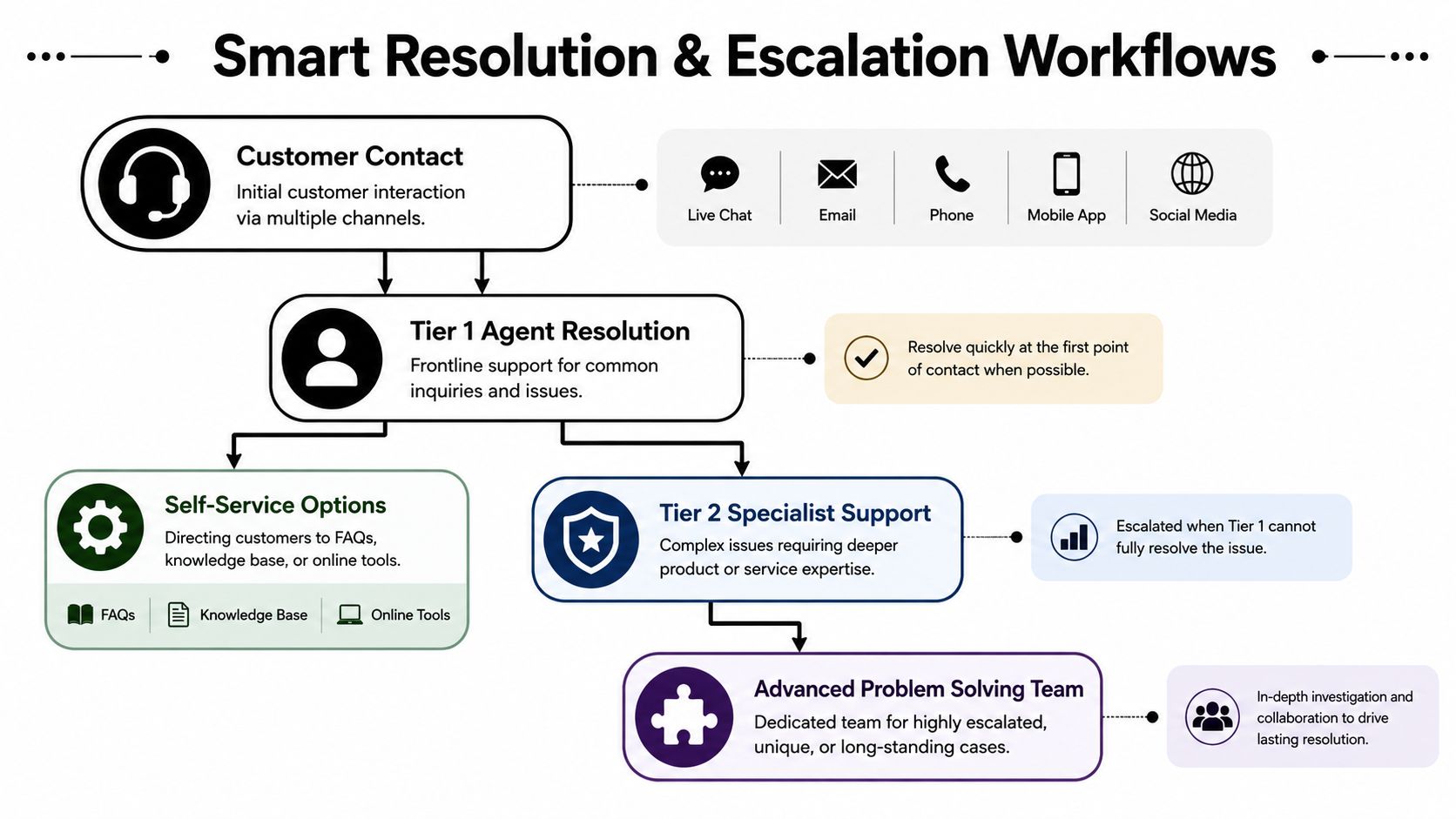
A useful internal triage model looks like this:
- Recover at Tier 1 when the issue is isolated, understood, and fixable within frontline authority.
- Escalate to a specialist when product depth or technical diagnosis is needed.
- Route to account ownership when the complaint signals renewal risk, adoption breakdown, or ongoing operational harm.
- Open a systemic review when multiple customers are hitting the same failure point.
Build a public-channel response path
Social complaints and public review responses need a different playbook from private support tickets.
The aim in public is not to litigate the entire issue in front of an audience. It is to show responsiveness, professionalism, and control. Guidance from the U.S. Chamber on handling angry customers online emphasizes moving the conversation offline, replying within about 24 hours, and keeping the public response short, factual, and non-defensive.
That means your workflow should specify:
- Who owns first response for X, Instagram, app reviews, and third-party review sites.
- What counts as a public safety, compliance, or reputation risk that needs fast escalation.
- Which channel to move the customer into, such as direct message, phone, or email.
- How to document the public thread so private teams can continue without losing context.
A solid public response often sounds like this: “We're sorry you've had this experience. We'd like to review the details and help. Please send us a direct message with your account information.” Short. Calm. Actionable.
What fails in public is defensiveness. Long explanations, subtle blame, and tone policing make the brand look fragile. The audience isn't just watching whether you solve the issue. They're judging whether your company stays composed under pressure.
Augmenting Your Team with AI and Automation
The wrong automation makes angry customers angrier. It blocks access, forces repetition, and treats emotion like a routing error. The right automation removes friction before a human ever has to repair it.
That's the opportunity. AI should make frontline teams more prepared, not more distant.
Where automation helps and where it hurts
Automation works well when the customer wants speed, clarity, and a simple path. It works badly when the customer needs judgment, reassurance, or exception handling.
Use automation for tasks like authentication, status retrieval, knowledge surfacing, intent detection, and routing. Don't use it to trap upset customers in loops or to hide escalation paths behind endless menus. If a customer is already angry, the system should shorten the path to a capable human, not lengthen it.
This is especially important in public digital channels. As noted earlier, newer guidance recommends moving those conversations offline and keeping public replies short and factual. AI can help teams detect urgency, flag reputation-sensitive language, and draft neutral responses, but a human should still review high-risk cases before posting.
Use AI as agent support, not just deflection
The strongest use case I see is AI as an in-the-moment support layer for agents. During live interactions, AI can pull customer history, summarize prior contacts, surface knowledge articles, suggest empathy phrasing, and recommend next-best actions based on issue type. That reduces agent cognitive load at the exact moment a customer needs composure and precision.
For teams evaluating tools in this category, AI copilot software for support teams is one example of how vendors are packaging this model. The value isn't replacing human judgment. The value is helping agents act faster with better context.
AI is also useful upstream. If you analyze conversations at scale, you can find the product gaps, broken handoffs, and policy friction that repeatedly trigger anger. That turns support from reactive cleanup into an early warning system for the rest of the business.
In operational environments beyond the contact center, the same logic applies. Teams managing dispatches, appointments, and on-site issues can learn from how an virtual assistant for field service supports real-time communication and workflow coordination when customers are already under stress.
Automation should absorb routine effort. Humans should handle ambiguity, trust repair, and exception decisions.
That division of labor is where AI improves outcomes without flattening the customer experience into scripts.
Closing the Loop Recovery Follow-up and Measurement
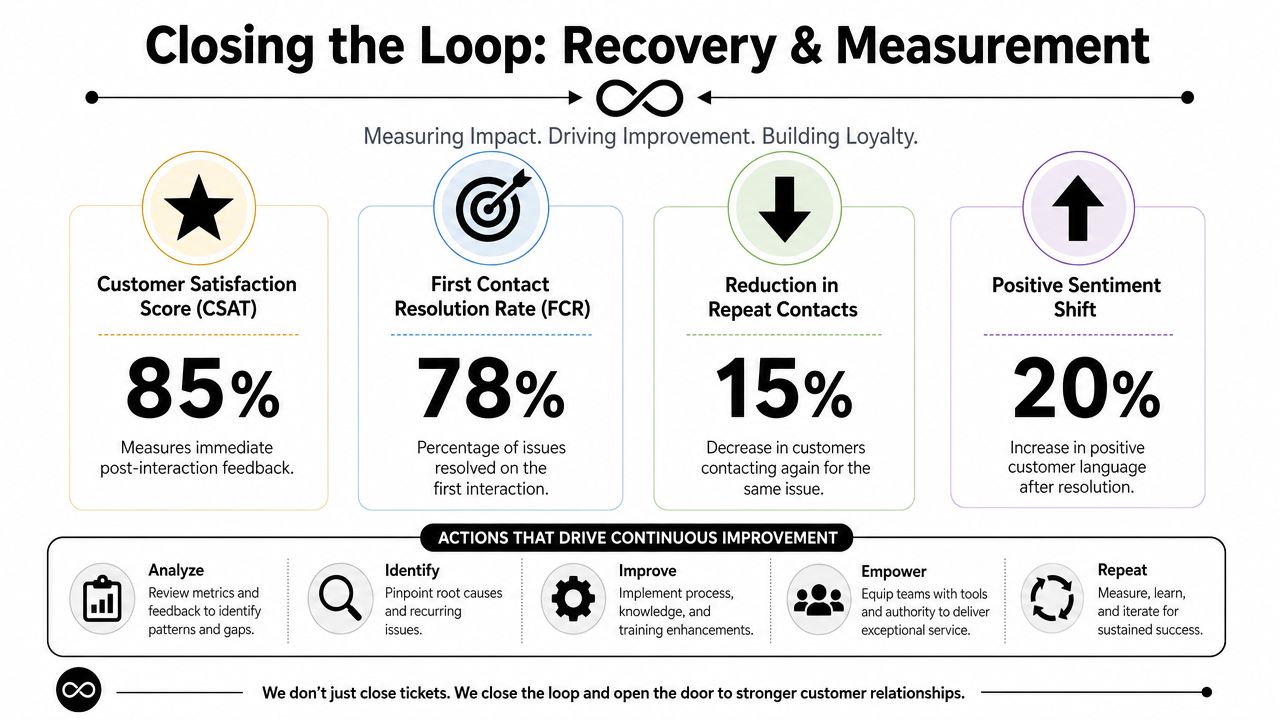
A resolved case is not always a recovered relationship. Some customers hang up calmer but still doubtful. They're waiting to see whether your company follows through, whether the fix holds, and whether anyone learned from the issue.
That's why follow-up matters. Closing the loop tells the customer that the company's concern did not end when the queue moved on.
What to do after the customer calms down
A strong recovery process is disciplined and simple.
- Send a follow-up confirmation. Restate what was resolved, what remains open, and who owns the next action.
- Check that the fix worked. This is essential after technical issues, replacements, billing corrections, and account changes.
- Document root cause clearly. “Customer angry” is not a diagnosis. Record the service or product trigger.
- Feed patterns back to the business. If the same failure keeps creating escalations, support should push that signal into product, operations, or policy owners.
One of the easiest ways to lose trust is to solve the immediate issue but miss the lingering concern. Customers want proof that the situation won't repeat.
What leaders should measure
Measure de-escalation with a wider lens than handle time.
Look closely at indicators like First Contact Resolution for escalated issues, post-interaction satisfaction signals, repeat contacts on the same issue, complaint themes by root cause, and shifts in customer tone before and after intervention. You don't need a huge metric stack. You need a review rhythm that connects angry interactions to coaching, workflow design, and systemic fixes.
A good leadership review asks:
- Which anger triggers are operationally preventable
- Where agents lacked authority or context
- Which escalations involved real revenue or renewal risk
- What changed in training, tooling, or product after the pattern became visible
Teams that do this well stop treating angry interactions as isolated fires. They use them to improve the whole service system.
If you're building a CX operation that needs stronger de-escalation, smarter routing, and better agent support at scale, Yellow.ai is one option to evaluate. Its platform supports AI-powered customer conversations, agent assistance, analytics, and automation across voice and digital channels, which can help teams reduce friction while keeping humans focused on the moments that need judgment and empathy.



