













Your first enterprise agent demo probably worked. It answered questions, called a few tools, and impressed stakeholders in a controlled session. The problems appeared later, when separate chatbots started pulling from different knowledge sources, tool permissions grew without a clear owner, and compliance teams asked who would approve an irreversible action. A workflow that looked intelligent in a prototype became expensive to operate and difficult to explain.
That's the practical challenge behind how to build AI agents for production. An enterprise agent needs more than a capable language model and a well-written prompt. It needs orchestration, controlled data access, observable execution, reliable failure handling, and a defined relationship with human operators. Market estimates put the global AI agents market at about $7.63 billion in 2025, rising to about $10.91 billion in 2026, or roughly 43% year-over-year growth according to Ringly's AI agent market estimates. That scale justifies serious engineering discipline, but it also raises the cost of getting production design wrong.
Table of Contents
- Introduction to Enterprise AI Agent Challenges
- Designing Multi-LLM Agent Architecture
- Agentic RAG Data and Knowledge Ingestion
- Dialogue Design and Multimodal Capabilities
- Integrations Deployment and Operations
- Testing Observability and Safety Compliance
- Runbook and Checklist for Go-Live Best Practices and Conclusion
Introduction to Enterprise AI Agent Challenges
A large service organization often starts with good intentions. Customer support deploys a chatbot for order questions, HR launches another for policy requests, and IT adds a third for access tickets. Each system has its own prompt, retrieval index, authentication model, and escalation logic. Employees and customers experience the fragmentation directly, while platform teams inherit duplicate integrations and unclear accountability.
The central mistake is treating an agent as a conversational surface rather than a controlled system that executes work. A prototype can succeed when the user asks a familiar question and the required data is clean. Production introduces incomplete requests, conflicting records, expired credentials, ambiguous policies, prompt injection, and actions that shouldn't happen without approval.
Practical rule: Design the failure path before you optimize the happy path.
The foundations explain why modern agents behave differently from simple chatbots. Carl Hewitt's actor model formalized message-driven concurrency in 1973, and by 1995, agents had been defined as autonomous, adaptive systems that operate in an environment and pursue goals. Those foundations underpin today's combinations of planning, memory, perception, retrieval, tool use, and action, as outlined in this history of AI agents.
A production program therefore needs explicit decisions about:
- Scope: Which workflow should the agent own, and which requests belong elsewhere?
- Authority: Which tools can it call, with what permissions and approval requirements?
- Evidence: What data must support a response or action?
- Control: When should the system pause, retry, refuse, or transfer to a person?
- Accountability: Who reviews incidents, policy changes, and model behavior?
The market's rapid expansion makes investment easier to justify, but it doesn't make autonomy automatically valuable. Enterprises should first identify workflows where unstructured information, exceptions, and context make deterministic automation difficult. For routine tasks with stable rules, conventional software may remain cheaper, faster, and easier to audit.
Designing Multi-LLM Agent Architecture
A production agent should have a clear control plane, even when several models participate. Start with a controller that receives the user goal, tracks workflow state, selects the next operation, and enforces exit conditions. The controller shouldn't let every model call every tool. It should route requests through typed capabilities with explicit permissions, schemas, timeouts, and audit events.
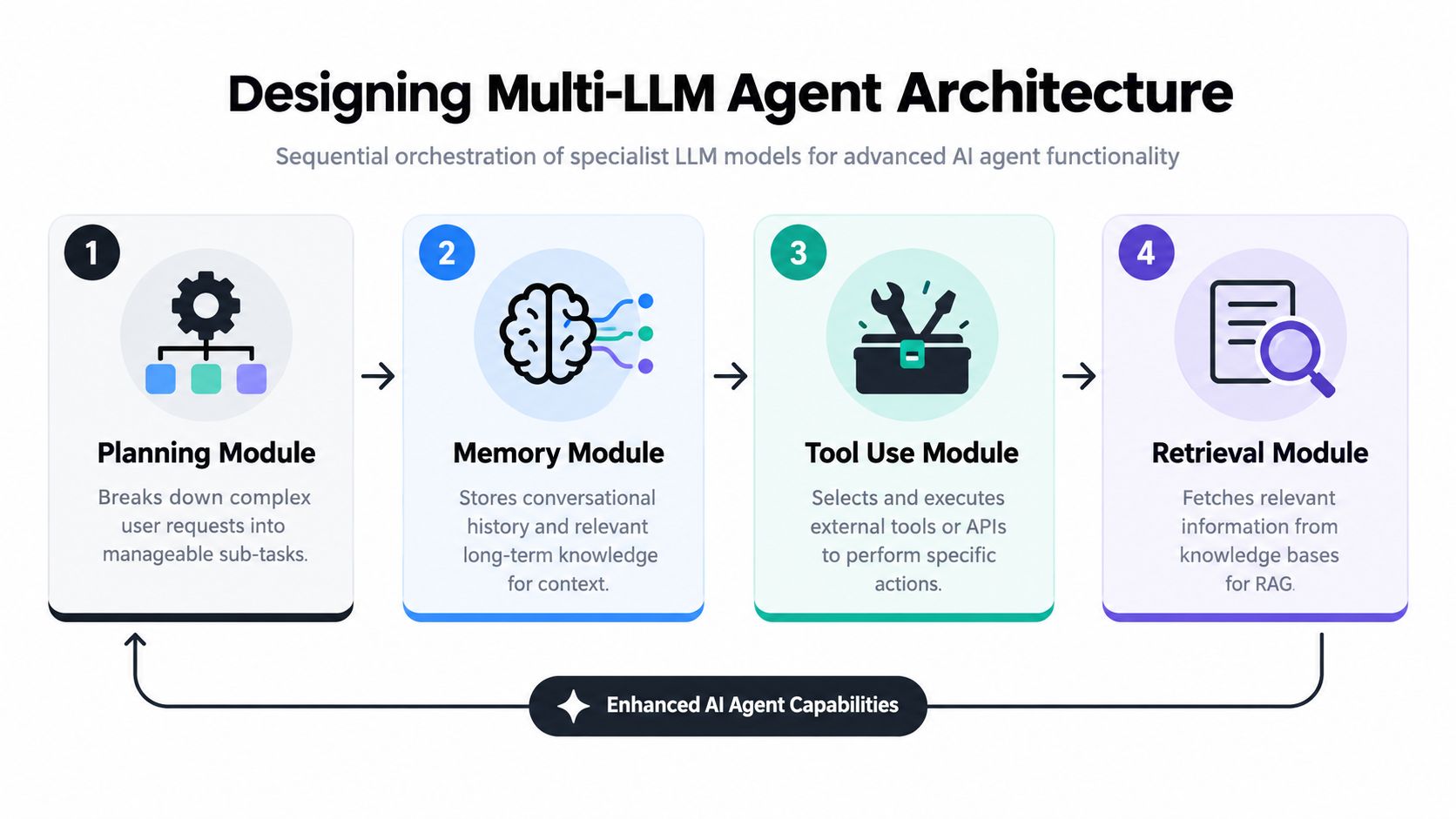
The architecture below separates four responsibilities that teams often mix together:
Give each model a bounded job
A planning model can decompose a request into tasks, while a smaller model handles classification or routing. A memory service can manage conversation state and durable user preferences, but it shouldn't decide whether a payment or account change is authorized. A retrieval component can gather supporting documents, while an action model prepares a tool call that the controller validates before execution.
This separation improves diagnosis. If an agent gives a wrong answer, the trace should reveal whether the planner misunderstood the goal, retrieval returned weak evidence, the tool produced an unexpected result, or the final response ignored a policy. Without that separation, every defect looks like a generic “LLM issue.”
The historical progression from message-driven actors to autonomous agents also supports this design. Concurrent components need clear messages and ownership boundaries, not an undifferentiated prompt. A useful implementation keeps state transitions explicit:
- Interpret: Extract the user's goal, identity, constraints, and missing information.
- Plan: Produce a structured set of permitted next steps.
- Retrieve: Fetch relevant, access-controlled context.
- Act: Call a tool through validation and authorization checks.
- Verify: Confirm the external system reflects the intended result.
- Close or escalate: Return an answer, request clarification, or transfer control.
Choose models by task, not brand loyalty
Cloud APIs usually provide broad model choice, managed infrastructure, and rapid access to new capabilities. They can also introduce variable pricing, provider dependency, data residency questions, and network latency. In-house models may offer more control over deployment and sensitive data, but they demand stronger internal expertise for serving, upgrades, evaluation, and incident response.
Build a baseline with a capable model, then test whether smaller or specialized models can handle narrower tasks without weakening outcomes. Keep model selection configurable in the controller so teams can change providers without rewriting business logic. For teams comparing external research and model options, AI research alternatives can help broaden the discovery process before architecture decisions become fixed.
A multi-LLM platform such as Yellow.ai's AI Agent Builder illustrates the kind of abstraction enterprise teams may seek, with agent construction, orchestration, and model choice managed within a broader platform. The architectural principle remains the same regardless of vendor: keep prompts, tools, policies, and state independent enough that you can test and replace them separately.
Agentic RAG Data and Knowledge Ingestion
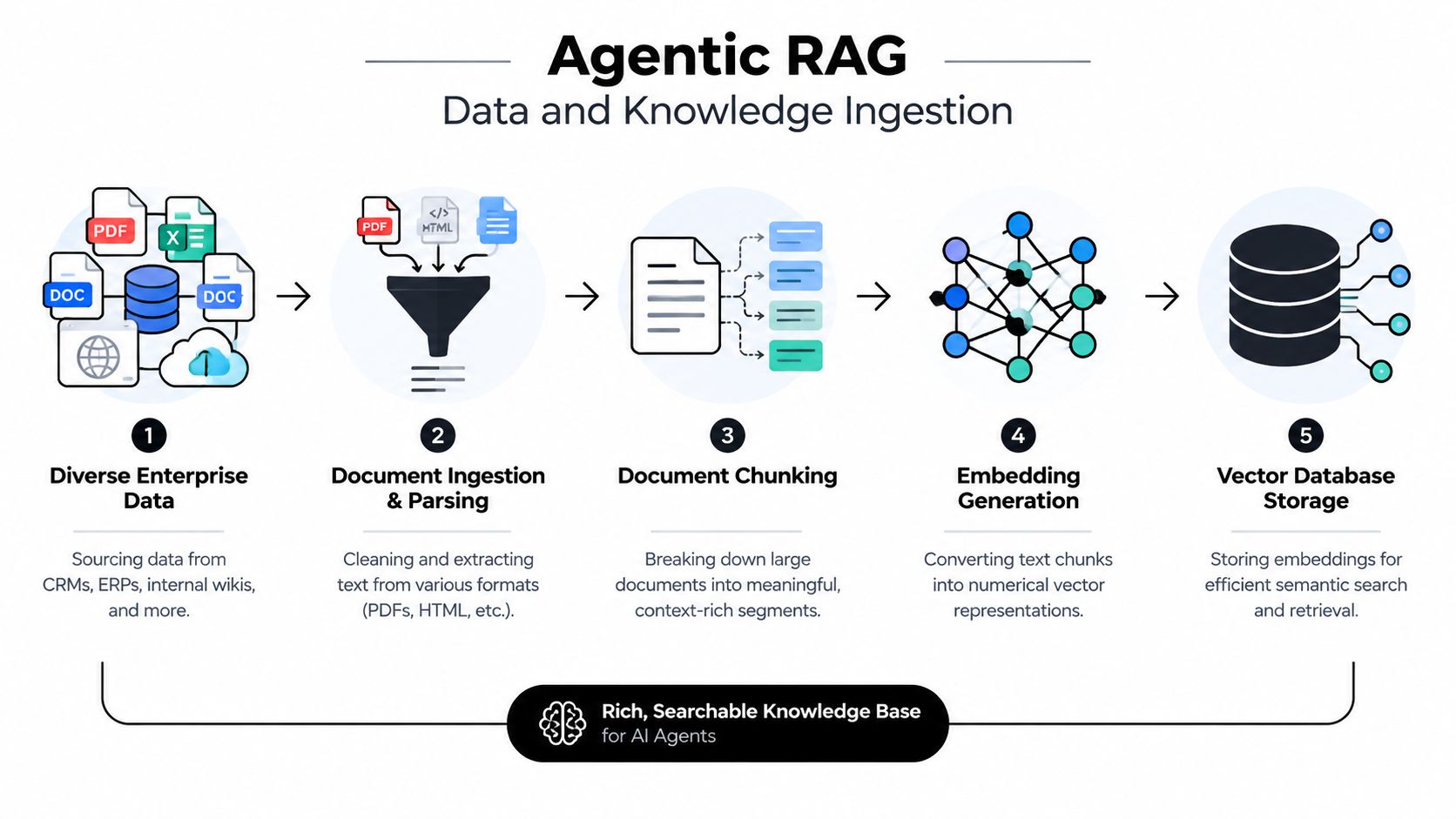
Retrieval quality begins before a vector database exists. An agent can't compensate for outdated policy documents, duplicated records, inaccessible systems, or unclear ownership. Treat ingestion as a governed data product with named sources, refresh rules, access controls, and evidence requirements.
Build the pipeline in controlled stages
Source discovery should cover the systems that contain operational truth, such as CRM records, ERP data, internal wikis, policy libraries, ticket histories, and approved external content. Create a source register that records the business owner, sensitivity, update behavior, retention requirements, and intended agent use.
Parsing and cleaning must preserve meaning rather than merely extract text. Tables, headings, footnotes, product identifiers, and document versions often carry the answer. Strip navigation noise and duplicated headers, but retain section titles and effective dates so the agent can cite the right context.
Chunking requires judgment. Split content around semantic boundaries, such as a policy rule and its exceptions, instead of cutting at arbitrary character limits. Store document identity, section, authoring team, version, language, jurisdiction, and access labels alongside each chunk.
Embedding and indexing make semantic search possible, but retrieval shouldn't be the only selection mechanism. Combine vector similarity with metadata filters, keyword search, permissions, freshness, and document authority. A useful result isn't merely semantically close. It's relevant to the user, allowed for that user, and valid for the workflow.
Incremental updates keep the index aligned with operational systems. Process changed documents, retire superseded versions, and retain lineage so an auditor can determine which source supported a response at the time. A conversational knowledge base for agentic retrieval reflects this broader requirement, where enterprise knowledge must support interaction rather than sit as an unstructured document store.
Protect proprietary data and personal information
Apply authorization before retrieval, not after generation. If a user can't access a source in the underlying system, the agent shouldn't retrieve it and hope a later filter removes sensitive content. Separate tenant, role, geography, and business-unit permissions where those boundaries affect eligibility.
Sanitize personal information when the workflow doesn't require it, and define retention rules for prompts, retrieved passages, tool results, and transcripts. Keep the original source reference attached to every retrieved item. That trace lets reviewers investigate whether a bad response came from a stale document, an incorrect permission mapping, weak ranking, or an agent that ignored valid evidence.
Dialogue Design and Multimodal Capabilities
A capable model can still produce a poor experience if the dialogue has no structure. Users need to know what the agent can do, what information it requires, and what happens when the request falls outside its authority. Design the conversation as a stateful workflow, not as an open-ended exchange with a friendly tone layered on top.
Start with the user's objective and define the minimum information required to complete it. For an HR service request, that might include the employee's identity, region, policy category, and desired action. The agent should ask only for missing information, repeat critical values before an action, and explain why a verification step is necessary.
Make branching explicit
Dialogue design should account for incomplete answers, corrections, interruptions, and conflicting records. Use clear states such as:
- Clarification: The request lacks a required detail.
- Verification: The agent confirms identity, eligibility, or destination.
- Execution: A permitted tool performs the action.
- Confirmation: The system checks the result and communicates it.
- Escalation: A person takes over with the relevant context attached.
Avoid letting the model invent a resolution when a required tool fails. A useful fallback says what couldn't be verified, preserves the conversation state, and offers a human route. The handoff packet should include the user's stated goal, collected facts, retrieved evidence, attempted actions, errors, and any policy trigger.
Research summarized by Prefactor's analysis of AI agent adoption suggests many multi-step agent systems achieve only about 30 to 35% task success, which makes explicit human checkpoints a reliability feature rather than a sign of product weakness. Put approval gates around irreversible or high-impact actions, and allow operators to override the agent without forcing the user to start again.
Add voice, images, and video with purpose
Multimodal support should solve a workflow problem. Voice can reduce friction for callers who need service while moving between tasks. Images can help with visual inspection, document interpretation, or product support. Video may support guided procedures when a text explanation isn't enough.
Each modality introduces its own controls. Audio requires consent, transcription handling, and a clear way to confirm sensitive values. Images require content filtering and access controls. Video workflows need careful treatment of recording, storage, and human review. Keep the underlying workflow state shared so a user can move from voice to chat without losing verification status or pending actions.
Integrations Deployment and Operations
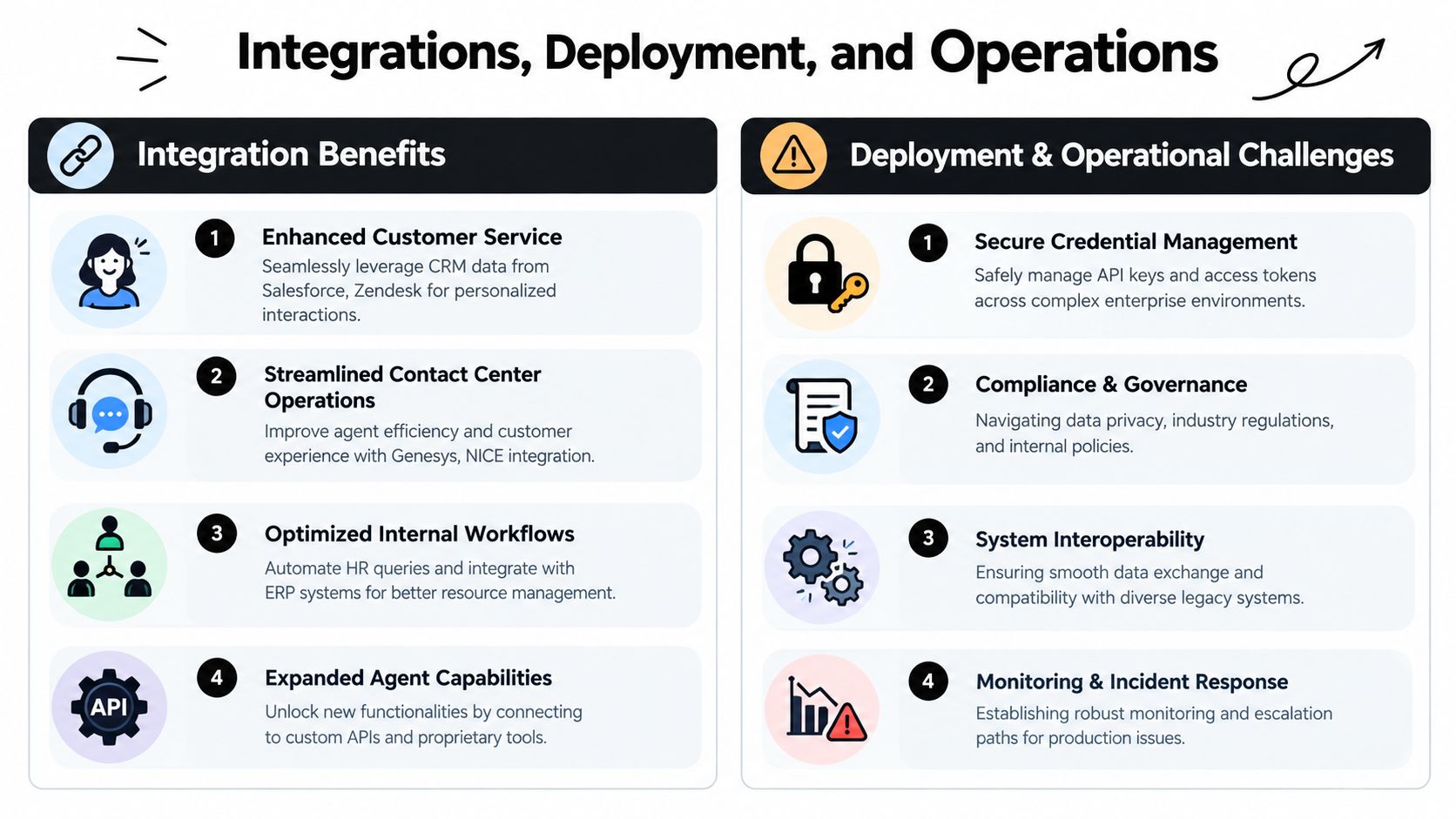
Enterprise agents create value by changing systems outside the conversation. That makes integration design more important than interface design. A polished agent that can't safely update a CRM, open a ticket, check an HR record, or trigger an approved workflow is only an expensive search box.
Use a capability layer
Expose enterprise functions through a standardized tool registry rather than connecting every agent directly to every application. Each tool should declare its purpose, required inputs, output schema, permission scope, risk level, timeout, retry behavior, and owning team.
For example, a lookup_customer capability can read approved CRM fields, while update_case can write only to defined fields and requires a case identifier. A contact-center integration with Genesys or NICE should handle transfer context and queue selection as explicit operations. An HR tool should distinguish policy retrieval from employee-record changes.
This layer gives platform teams one place to rotate credentials, version APIs, enforce authorization, and record activity. It also prevents a prompt change from expanding what an agent can do undetected.
Plan for failure at the network boundary
Retries are useful for transient failures, but unsafe for non-idempotent actions. A duplicate email, ticket update, or payment request can create a larger incident than the original timeout. Give write operations idempotency keys where the underlying system supports them, and use a status lookup before retrying an uncertain action.
Event-driven triggers need the same discipline. Validate event origin, deduplicate repeated messages, preserve ordering where it matters, and define what happens when downstream systems are unavailable. Queue work that can wait, but don't hide a stalled action from the user or operator.
Channel orchestration should share policy and state across chat, voice, email, and other interfaces. The channel can change the presentation, but the authorization decision, tool contract, audit event, and escalation policy should remain consistent. This is how teams avoid building several slightly different agents that behave unpredictably across customer touchpoints.
Testing Observability and Safety Compliance
Traditional software tests assume deterministic outputs. Agent testing must evaluate decisions, tool selection, retrieved evidence, policy adherence, and final outcomes across varied inputs. A response can sound correct while calling the wrong tool, exposing restricted information, or claiming completion without changing the external system.
GuardianAgentBench reports a best overall accuracy of only 74.8%, and its results indicate that runtime guardrails recover about 19.9% of errors at a 0.5% false-positive rate in the tested setting, as documented in the benchmark analysis. The practical lesson isn't that one benchmark predicts every deployment. It's that prompts alone aren't an adequate control layer.
Test the whole trajectory
Create evaluation sets from real intents, edge cases, policy exceptions, adversarial inputs, and tool failures. Test complete trajectories, not just final text. The evaluator should ask whether the agent:
- Identified the correct goal and missing information.
- Retrieved an authorized and current source.
- Selected an appropriate tool with valid parameters.
- Asked for approval before a sensitive action.
- Recovered safely from a timeout or malformed result.
- Verified the external state before reporting completion.
- Escalated when confidence or policy required it.
Automate regression runs whenever prompts, models, tools, retrieval indexes, or policies change. Review failures by category so teams can fix the right layer. A retrieval defect needs different remediation from a permission defect or a dialogue defect. Guidance on agentic testing practices is useful when designing this evaluation loop.
Observe behavior in production
Log every run with a correlation identifier, model and prompt versions, retrieved source identifiers, tool calls, approvals, latency, errors, and outcome verification. Redact sensitive content while preserving enough structured context to investigate incidents. Dashboards should separate user sentiment from operational correctness. A pleasant conversation isn't proof that the requested task completed.
Set alerts for rising tool failures, repeated retries, escalation changes, retrieval gaps, policy violations, unusual usage, and shifts in task outcomes. Compliance reviews should map controls to the data and actions in the workflow. HIPAA, SOC 2, and PCI-DSS may apply differently by environment, so involve security and legal owners before launch rather than treating compliance as a final checklist item.
Runbook and Checklist for Go-Live Best Practices and Conclusion
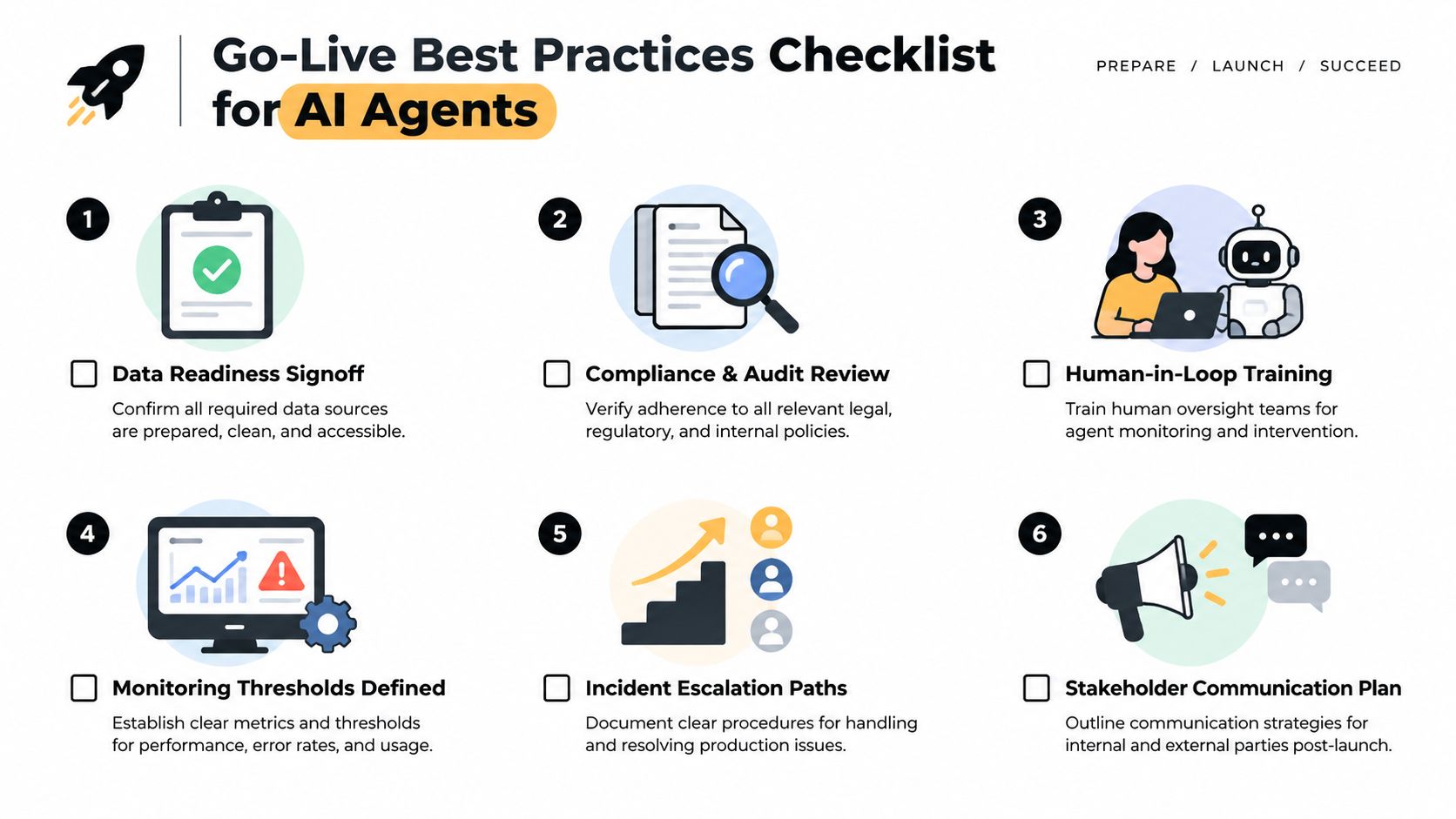
A go-live decision should be an operational signoff, not a product launch announcement. The owner needs evidence that the agent has approved data, bounded authority, tested failure behavior, trained human support, and a documented response when something goes wrong.
Use a signoff sequence
Data readiness signoff: Confirm that source owners have approved the content, permissions, freshness rules, and retirement process. Test representative questions against the sources the agent is expected to use.
Compliance and audit review: Document data flows, retention, access control, model providers, tool permissions, human approvals, and evidence capture. Record unresolved risks with an owner and a launch decision.
Human-in-the-loop training: Train reviewers on escalation criteria, override procedures, privacy handling, and the information they'll receive during handoff. Operators shouldn't have to reconstruct an agent run from scattered logs.
Monitoring thresholds: Define acceptable behavior for task completion, tool errors, escalations, latency, retrieval quality, and safety events. Every threshold needs an owner and a response, not just a dashboard tile.
Incident escalation paths: Write the sequence for disabling a tool, restricting a channel, reverting a prompt or model, notifying stakeholders, and reviewing affected transactions. Practice the path with the teams responsible for engineering, security, operations, and communications.
Stakeholder communication: Tell employees, customers, and support teams what the agent can do, how to reach a person, and how the organization handles corrections. Clear expectations reduce unsafe workarounds and help operators identify defects early.
Enterprise teams commonly struggle with data readiness at 63%, system complexity at 49%, and workforce resistance at 36%, according to reported enterprise AI pulse survey findings. Those obstacles reinforce a useful sequencing choice: fix ownership, integration boundaries, and operator training before expanding autonomy. Teams evaluating the business consequences of AI adoption can also consult investment insights for traders as a broader perspective on technology and market considerations.
The strongest rollout starts with a narrow workflow, measurable acceptance criteria, reversible actions, and a staffed escalation path. After launch, review failed trajectories, update knowledge sources, refine tool contracts, and widen scope only when the evidence supports it. More autonomy isn't the objective. Reliable completion with controlled risk is.
Yellow.ai provides an enterprise agentic AI platform for customer and employee experiences, including multi-modal agent building, agentic retrieval, omnichannel orchestration, integrations, automated testing, and governance controls. If you're moving from a successful prototype to a production workflow, visit Yellow.ai to assess how its platform can support design, deployment, monitoring, and human escalation.



