









The most popular advice about how to build a chatbot is also the least useful: choose a model, write a clever system prompt, connect a chat window, and launch. That approach produces a convincing demo. It doesn't produce a service your organization can operate, audit, improve, and trust.
The difficult work starts after the model answers its first question. You need a bounded business objective, governed knowledge, reliable retrieval, explicit refusal behavior, tested integrations, measurable handoff, and an owner who can respond when the bot is wrong. Model selection matters, but it's rarely the reason an enterprise chatbot dies. Organizational proof and operational discipline are the actual product.
Table of Contents
- Why Most Chatbot Builds Fail Before They Launch
- The Six-Phase Lifecycle of an Enterprise Chatbot
- Designing Conversations Users Actually Trust
- Choosing Text, Voice, or Multimodal for Your Use Case
- Multi-LLM Orchestration and Cost-Aware Routing
- Retrieval, Evaluation, and the Tests That Catch Real Failures
- Integrations, Governance, and the Path from Pilot to Production
Why Most Chatbot Builds Fail Before They Launch
Model selection is usually the easiest part of building a chatbot. Teams can compare hosted models, connect an API, and produce natural language quickly. The harder question is whether anyone can prove that the system resolves a defined problem without creating unacceptable risk.
A prototype has a narrow audience, forgiving testers, curated questions, and engineers nearby. Production has incomplete context, unusual phrasing, stale documents, permission boundaries, unhappy users, service outages, and employees who need a clean handoff. The chatbot that your team can demo in two weeks isn't automatically the chatbot your enterprise can run for two years.
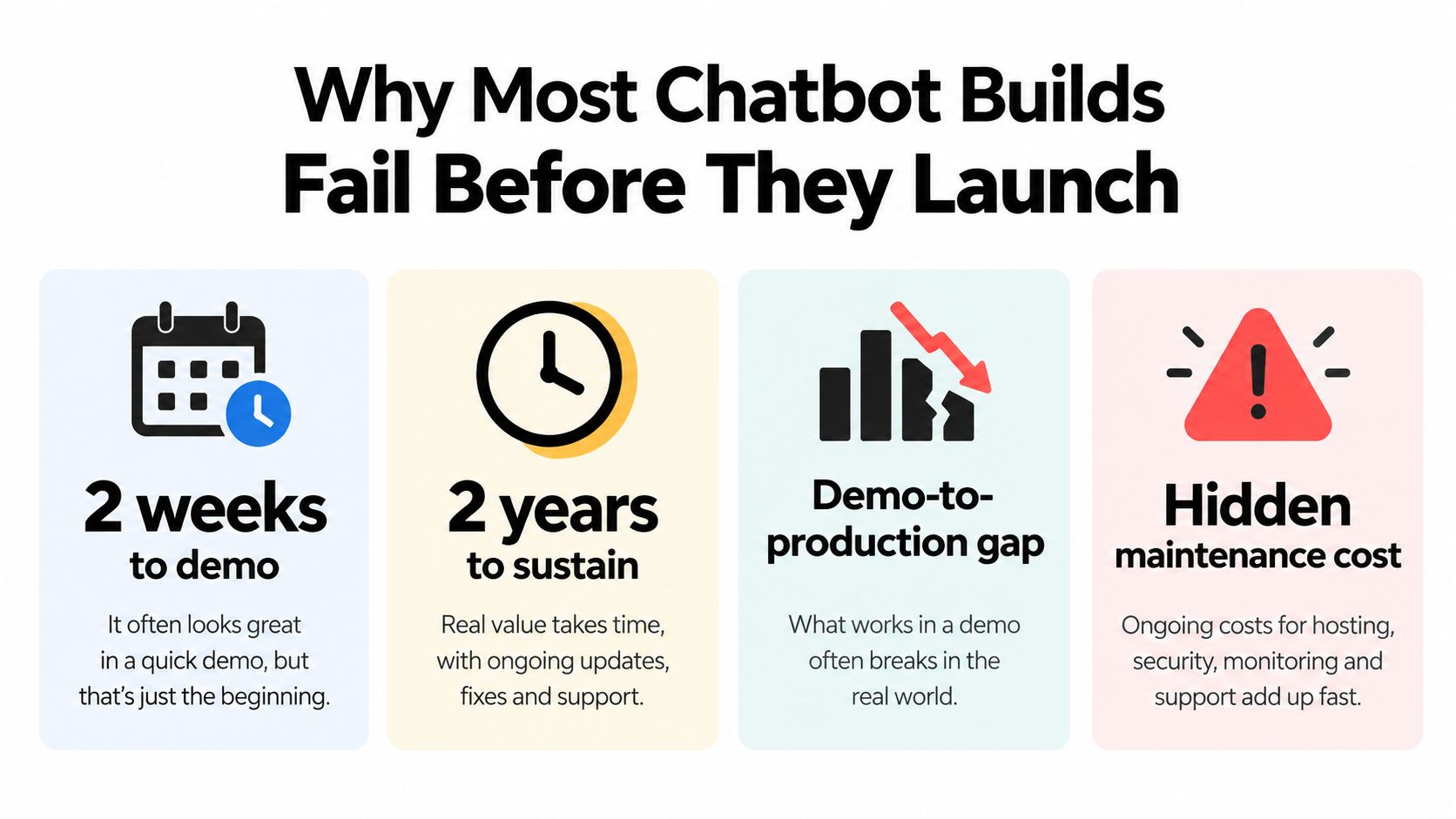
Adobe's 2025 Digital Trends research found that only 12% of organizations had working generative-AI solutions demonstrating clear ROI, while 89% of customer-service leaders see generative AI's potential yet only 21% report full deployment at scale (Adobe research summary). Those figures describe an execution gap, not a shortage of model capability.
The questions to answer before prompts
Before writing a prompt, assign owners and answer four questions:
- Business outcome: Is the bot resolving a service request, finding an employee policy, assisting an agent, or completing a transaction?
- Boundary: Which intents are supported, which are refused, and which require authentication or human review?
- Evidence: Which approved sources may support an answer, and who owns their freshness and access rules?
- Proof: What counts as resolution, and what evidence will justify expansion beyond the pilot?
Procurement and change management belong in that list. A support leader must decide how agents receive context. An information-security team must approve data handling. A product owner must review failure patterns. Finance needs a defensible connection between the bot's work and operating outcomes.
Practical rule: Treat a chatbot as a controlled lifecycle, not a model integration.
That changes the architecture immediately. Instead of optimizing only for fluent responses, you design for source provenance, evaluation, escalation, auditability, and replacement. The objective isn't maximum autonomy. It's dependable completion of the right work, with recovery when the system lacks confidence.
The Six-Phase Lifecycle of an Enterprise Chatbot
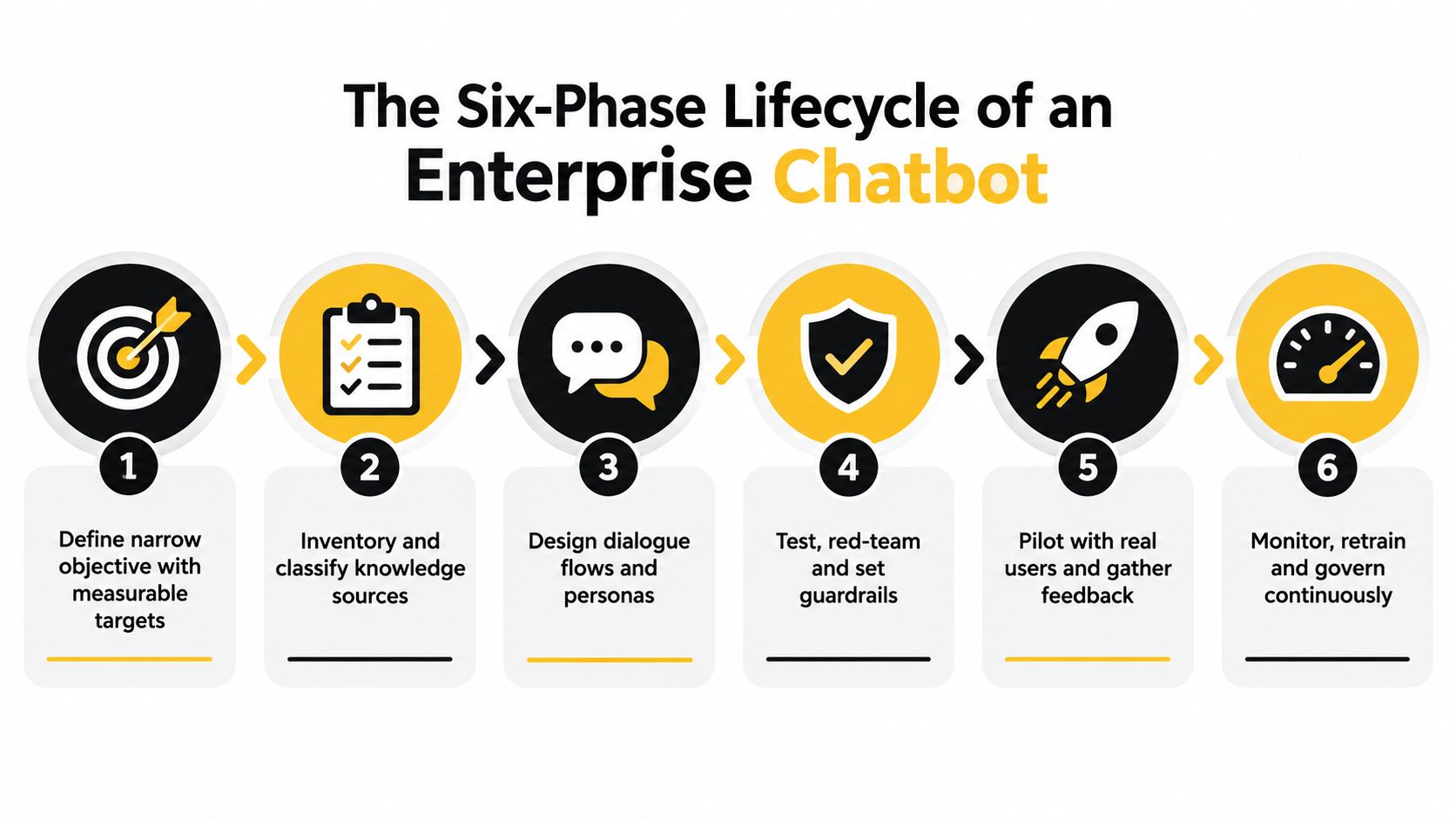
Enterprise chatbot work does not fail because teams picked the wrong model. It fails because nobody proved what the system is allowed to do, what evidence it can use, how it will be tested, or when a person takes over. A usable lifecycle forces those decisions early and keeps the build tied to operations, not demo fluency.
Define the target
Start with one narrow job, then write down the supported intents, refusal boundaries, escalation path, and success criteria. “Help authenticated employees find approved leave-policy answers and route exceptions to HR” is a workable target. “Automate HR conversations” is not. Broad goals hide failure modes and make evaluation impossible.
Govern the knowledge
List the documents, APIs, tickets, and policy repositories the bot may touch. Classify each source by sensitivity and authority, remove duplicates, preserve version history and access controls, and assign an owner. If nobody owns a source, it should not be treated as approved evidence.
Design the orchestration
The orchestration layer should manage state, retrieval, business rules, tools, safety checks, and channel behavior. In practice, retrieval-augmented generation works best when lexical and vector search are combined with metadata filters, reranking, grounded generation, and citations. Teams weighing platform and application responsibilities can review this guide to build an AI your enterprise needs. For implementation, an AI agent builder can speed up flow design, integrations, and deployment, but it does not remove the need for governance, access control, or audit trails.
Build the evaluation set
Use real conversations wherever possible. Include normal requests, ambiguous requests, adversarial inputs, multilingual queries, and out-of-scope cases. Test contradictory documents, time-sensitive questions, prompt injection hidden inside retrieved text, and permission-sensitive scenarios. Evaluate actions as well as answers.
Establish the deployment gate
Before launch, test factuality, retrieval recall, citation support, latency, cost, safety, integration behavior, and human handoff. A correct answer without support from retrieved evidence should still fail review. Low-confidence or policy-sensitive requests should route to people by design.
Operate and regress
Production is where weak governance shows up. Monitor conversations, review failures, refresh stale content, and rerun regression tests after every prompt, model, policy, or knowledge-base change. NIST's generative AI risk profile stresses governance, provenance, pre-deployment testing, incident disclosure, acceptable-use policies, refusal criteria, and representative human evaluation.
A longitudinal study of 103 deployed chatbots found that 53 of 103 examined chatbots had failed after 15 months. In customer service, 89% of failed systems lacked an additional human-support option, while 87% of still-operating systems offered one. Handoff is part of durable service design, not a fallback you bolt on later.
Designing Conversations Users Actually Trust
A chatbot earns trust by making its limits visible. ELIZA, developed by MIT computer scientist Joseph Weizenbaum between 1964 and 1966, used formal language analysis, pattern matching, and substitution to transform statements into apparently relevant questions. Its history shows that conversational fluency and actual comprehension are different things (Weizenbaum Institute on ELIZA).
That distinction should shape every dialogue. Define the persona, domain, conversation states, fallback behavior, and escalation path before polishing wording. A friendly tone can't compensate for an unclear state machine.

Use a disputed charge as a design test
Suppose a customer writes, “I don't recognize this charge.” The bot shouldn't jump directly to an explanation. It should determine whether the user is authenticated, identify the relevant transaction, explain what it can verify, and distinguish a merchant dispute from suspected fraud.
A safe flow might ask for the transaction context, retrieve only records the user is authorized to see, explain the next available route, and offer a human specialist when policy or confidence requires it. The same intent needs a different response in an authenticated banking app, an unauthenticated public website, and a voice channel where the user may need confirmation at each step.
Make failure behavior explicit
Good conversation design answers these questions:
- State: What does the bot know, and what is it still missing?
- Permission: Is the user authorized to see or change the requested information?
- Confidence: What happens when intent or evidence is uncertain?
- Recovery: Can the user correct the bot without restarting?
- Handoff: What context, summary, and next action reach the human agent?
Don't hide the handoff behind endless clarification. Tell the user why a person is needed and preserve the conversation state so they don't repeat the story.
Choosing Text, Voice, or Multimodal for Your Use Case
Channel choice is a business decision disguised as a technical one. Text usually provides strong auditability, easy citation display, and a durable transcript. Voice can reduce typing friction and support urgent or emotionally charged conversations, but it introduces speech recognition, turn-taking, interruption, and latency concerns.
Multimodal experiences combine text, voice, and interface cues. That can help users confirm a transaction visually while speaking, or switch channels when typing is difficult. Accessibility shouldn't be treated as an enhancement. A customer may need voice input, readable confirmation, keyboard navigation, or a clear visual status.
| Channel | Best Fit | Cost Per Interaction | Accessibility Strength |
|---|---|---|---|
| Text | FAQs, account guidance, documented workflows | Usually easier to control because exchanges are compact and auditable | Strong for written records, keyboard use, and visual review |
| Voice | High-empathy service, urgent support, low typing tolerance | More sensitive to speech processing, duration, and live latency | Helps users who prefer speaking or struggle with typing |
| Multimodal | Complex workflows requiring confirmation and flexibility | Combines channel costs and integration complexity | Supports switching between voice, text, and interface cues |
A billing dispute demonstrates the difference. Text can present the disputed transaction, policy citation, and next steps in one inspectable view. Voice feels more natural for a distressed caller, but the agent needs concise verbal confirmation and an easy transfer path. Multimodal support can let the customer speak while the interface displays the exact transaction and consent choice.
For teams evaluating voice-specific architecture, a voice bot platform can be compared against telephony-native builds and contact-center tooling. The right decision depends on the workflow, not on whether voice sounds impressive in a demonstration.
Instrument channel-specific outcomes. Compare successful resolution, abandonment, escalation, latency, accessibility feedback, and cost per resolved conversation. A channel that produces more conversations but fewer completed outcomes isn't necessarily expanding service capacity.
Multi-LLM Orchestration and Cost-Aware Routing
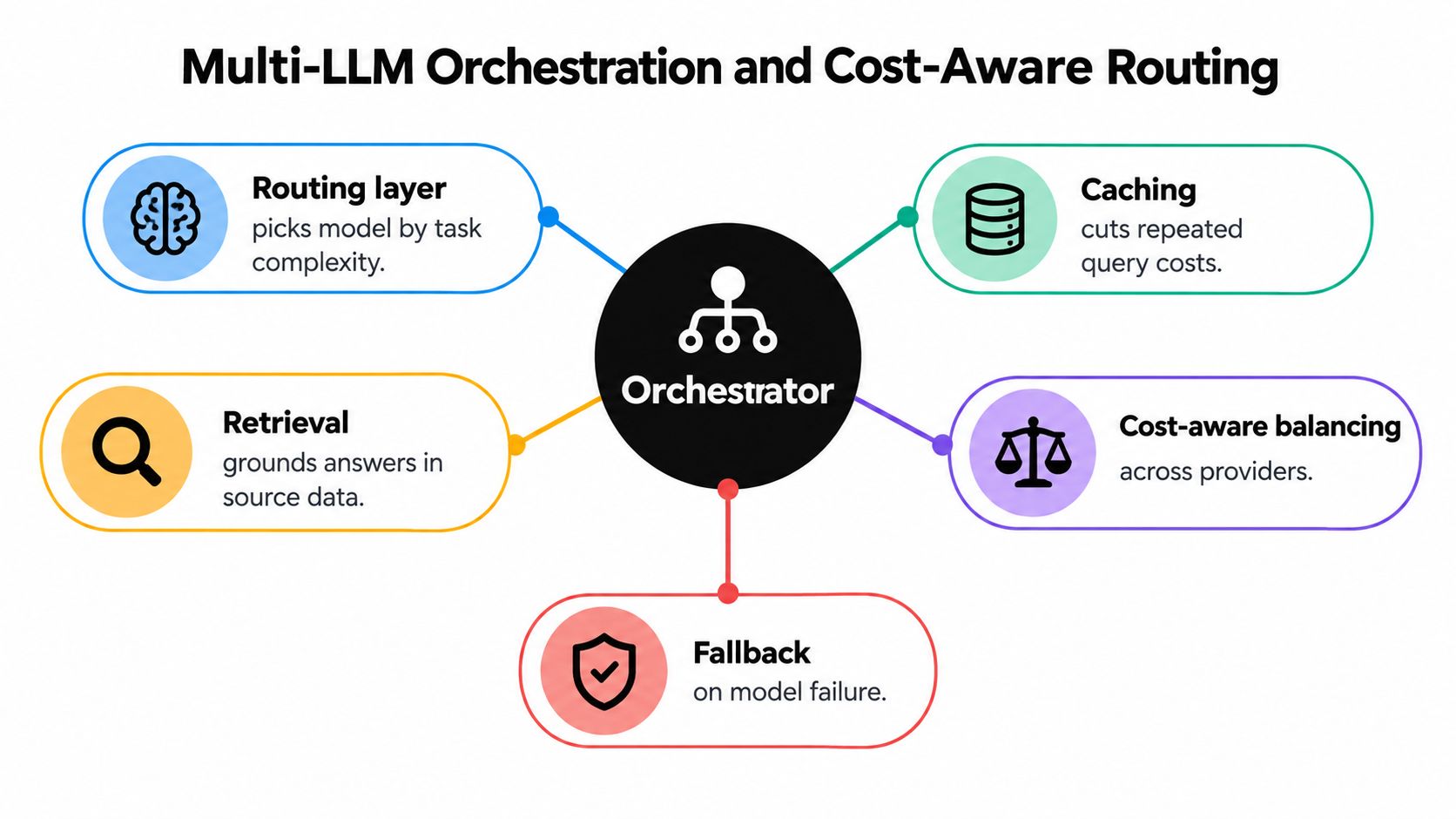
A single-model chatbot is simple to explain and difficult to operate well at scale. Every request receives the same capability, context window, latency profile, and price behavior, even when a lightweight classifier could handle the first decision.
Stanford's 2025 AI Index reported that the cost of querying a model achieving a GPT-3.5-equivalent score of 64.8 on MMLU fell from $20.00 per million tokens to $0.07 per million tokens, a reduction of more than 280 times in roughly 18 months (Stanford AI Index). Falling prices make routine turns more feasible, but they don't remove the cost of long context, retrieval, tool calls, concurrency, monitoring, or human handoffs.
Route by risk and complexity
A practical routing policy might use:
- A small model for classification: Detect language, intent, authentication state, and whether a tool is needed.
- A mid-tier model for grounded responses: Generate answers from retrieved, permission-filtered evidence.
- A stronger model for ambiguity: Handle conflicting evidence, complex reasoning, or policy-sensitive requests.
- A deterministic path for critical actions: Use explicit business rules and confirmation before changing records.
- A fallback path for outages: Retry safely, switch providers where appropriate, or hand off to an agent.
Cache reusable results, limit unnecessary history, and summarize old turns without losing policy-relevant state. Keep retrieval separate from generation so you can inspect whether a failure came from missing evidence or poor synthesis.
Measure the conversation, not the token
Track cost per resolved conversation, latency by intent, tool-call failure, escalation, and answer quality. Token price alone can encourage false savings. A cheap model that gives wrong answers or triggers avoidable handoffs may cost more operationally than a stronger model used selectively.
Build the evaluation set in layers. Start with representative transcripts, add paraphrases and multilingual variants, then add adversarial requests and policy edge cases. Expand coverage from a small pilot set to thousands of scenarios as real failures accumulate, but keep slice-level reporting so strong average performance doesn't conceal a dangerous weakness.
Review the model mix regularly. Pricing and capabilities change quickly, so architecture decisions shouldn't be permanent assumptions.
Retrieval, Evaluation, and the Tests That Catch Real Failures
Retrieval is where enterprise chatbots often fail. The response may sound polished while relying on the wrong policy, an obsolete version, or a document the user isn't permitted to see.
Start with chunking experiments. Compare structure-aware sections, overlapping windows, tables, FAQs, and metadata-rich chunks against a labeled query set. Then evaluate hybrid lexical and vector search, reranking, citations, and abstention rather than treating the vector index as a finished component.
A reported enterprise benchmark found vector-search accuracy declining from 90.7% at 5,000 documents to 50.6% at 500,000 documents. A separate RAG study found established systems answered only 44% of temporally sensitive queries successfully (reported RAG benchmark). These findings make corpus scale and freshness explicit engineering concerns.
Test the evidence chain
Your evaluation suite should measure:
- Retrieval recall@k and precision@k: Did the system find the right evidence, and did it avoid irrelevant passages?
- nDCG: Did it rank the most useful evidence first?
- Faithfulness and citation entailment: Does the response follow the retrieved content, and do citations support the claims?
- Abstention quality: Does the bot decline or escalate when evidence is missing or conflicting?
- Task completion: Did the user complete the intended workflow, not merely receive fluent text?
Add effective-date, jurisdiction, language, and permission metadata to documents. Retrieve the current authoritative version first. If two policies conflict, expose the conflict to the orchestration layer instead of asking the model to guess.
For automated regression coverage, an automated testing platform can support repeatable conversation checks, but human review remains necessary for nuanced safety, tone, and policy behavior. Log the query, retrieved passage identifiers, model version, policy decision, latency, escalation, and outcome within your governance limits.
A chatbot is ready for launch only when the evidence chain works under realistic pressure. Technical correctness without organizational ownership is still an incomplete release.
Integrations, Governance, and the Path from Pilot to Production
Production value comes from connecting the chatbot to systems of record, such as Salesforce, Zendesk, Genesys, HR platforms, and approved knowledge repositories. Start with read-only actions where possible, then add write operations behind authentication, confirmation, authorization, and audit logging.
Governance must cover PII redaction, source-level permissions, transcript access, incident response, multilingual testing, and human override. A 2025 survey of 700 CX decision-makers found that 67% were implementing AI without adequate governance structures, while 98% reported difficulty aligning CX data and feedback across departments (CallMiner survey).
A production gate should require four forms of proof:
- Resolution: Users complete the target task with acceptable escalation.
- Safety: Sensitive, ambiguous, and unauthorized requests recover safely.
- Operations: Latency, cost, integrations, monitoring, and ownership are defined.
- Learning: Transcript review and regression testing can improve the system without breaking approved behavior.
Teams working across jurisdictions may also find a practical overview of AI governance frameworks for UK businesses useful when translating principles into accountable operating controls. The pilot is not the finish line. Organizational go-live happens when people, processes, evidence, and recovery paths are ready.
Yellow.ai offers visual agent building, multimodal orchestration, retrieval-grounded knowledge workflows, automated testing, analytics, and integrations for enterprise CX and EX use cases. Visit Yellow.ai to evaluate how its platform could help your team move from a chatbot prototype to a governed, measurable production service.