














A customer starts an insurance claim in a mobile app at 8 p.m. The chat assistant collects the first details, but it can't verify a policy exception, so it transfers the customer to voice. The caller repeats the story, waits for a human, and then receives an email the next morning asking for information already provided. Each channel works in isolation. The customer experiences one broken conversation.
That pattern is why enterprise leaders shouldn't treat AI as a deflection race. The practical question is how AI can improve customer experience without removing judgment, trust, or accountability. The answer is selective autonomy, where AI completes routine, well-governed work and hands sensitive or uncertain interactions to people with the full context attached.
This playbook is for CX leaders, CIOs, and operations executives in BFSI, healthcare, retail, utilities, logistics, and other high-volume environments. It focuses on the decisions that determine whether an AI program becomes a dependable operating layer or stalls after an impressive pilot.
Table of Contents
- The Customer Journey AI Is Trying to Repair
- What Agentic AI Actually Means for Customer Experience
- The Four Levers That Move CX Metrics
- High-Impact Use Cases Across Voice, Chat, and Digital Channels
- An Implementation Roadmap for Enterprise CX Teams
- Where AI Should Step Aside and Hand the Call to a Human
- Security, Compliance, ROI, and a Vendor Question Checklist
The Customer Journey AI Is Trying to Repair
The customer in the opening scenario doesn't care which department owns the app, telephony platform, CRM, or email queue. They care that the company remembers what they've already said. A capable AI system should preserve the claim details, identify the unresolved policy question, authenticate the customer once where appropriate, and give the human agent a concise summary before the transfer.
That sounds straightforward until the journey crosses organizational boundaries. The mobile team owns the first interaction, the contact center owns voice, claims operations owns the decision, and a back-office team owns email. Without shared context and an orchestration layer, each handoff creates a new intake process. Customers pay for that fragmentation through repeated explanations, longer resolution times, and declining confidence.
The real failure is context loss
AI can make an already fragmented journey faster while still making it worse. A voice agent that answers immediately but loses the chat transcript has improved response time and damaged continuity. A chatbot that resolves routine questions but traps a distressed customer in a loop has improved containment and weakened the relationship.
The defensible objective is not fewer human conversations. It is fewer unnecessary customer efforts.
Leaders should therefore define the journey before selecting the model. Map the customer's intent, the systems that hold relevant information, the decisions AI is authorized to make, and the conditions that require human ownership. Then assign a metric to each transition, including repeat-explanation rate, transfer acceptance, resolution after transfer, and customer effort.
What enterprise leaders should decide first
Start with one interaction where the customer's desired outcome is clear, the risk is limited, and the required data is accessible. Password resets, order status, appointment changes, and straightforward policy information are usually easier to govern than disputes, complex refunds, clinical questions, or hardship cases.
The program should also make a business case beyond labor reduction. Faster resolution, more consistent service, shorter onboarding, better after-hours access, and stronger employee support can all matter, but each requires its own measurement design. The leaders who avoid stalled pilots usually make three choices early: they clean the knowledge source, design the human handoff before launch, and establish quality thresholds that can stop automation when it causes harm.
What Agentic AI Actually Means for Customer Experience
A legacy chatbot answers from a script. A copilot suggests information to an employee. Robotic process automation follows predefined instructions. Agentic AI works toward a goal, using available context to decide which steps it can take, execute authorized actions, and confirm the result.
Consider a travel concierge. A basic chatbot answers whether a flight is available. An agentic system retrieves the traveler's preferences and eligibility, reasons through the available options, books the approved itinerary, and confirms the reservation. In CX, the equivalent might be checking an account, identifying the customer's intent, applying a service policy, updating a ticket, and escalating when the request falls outside the policy.
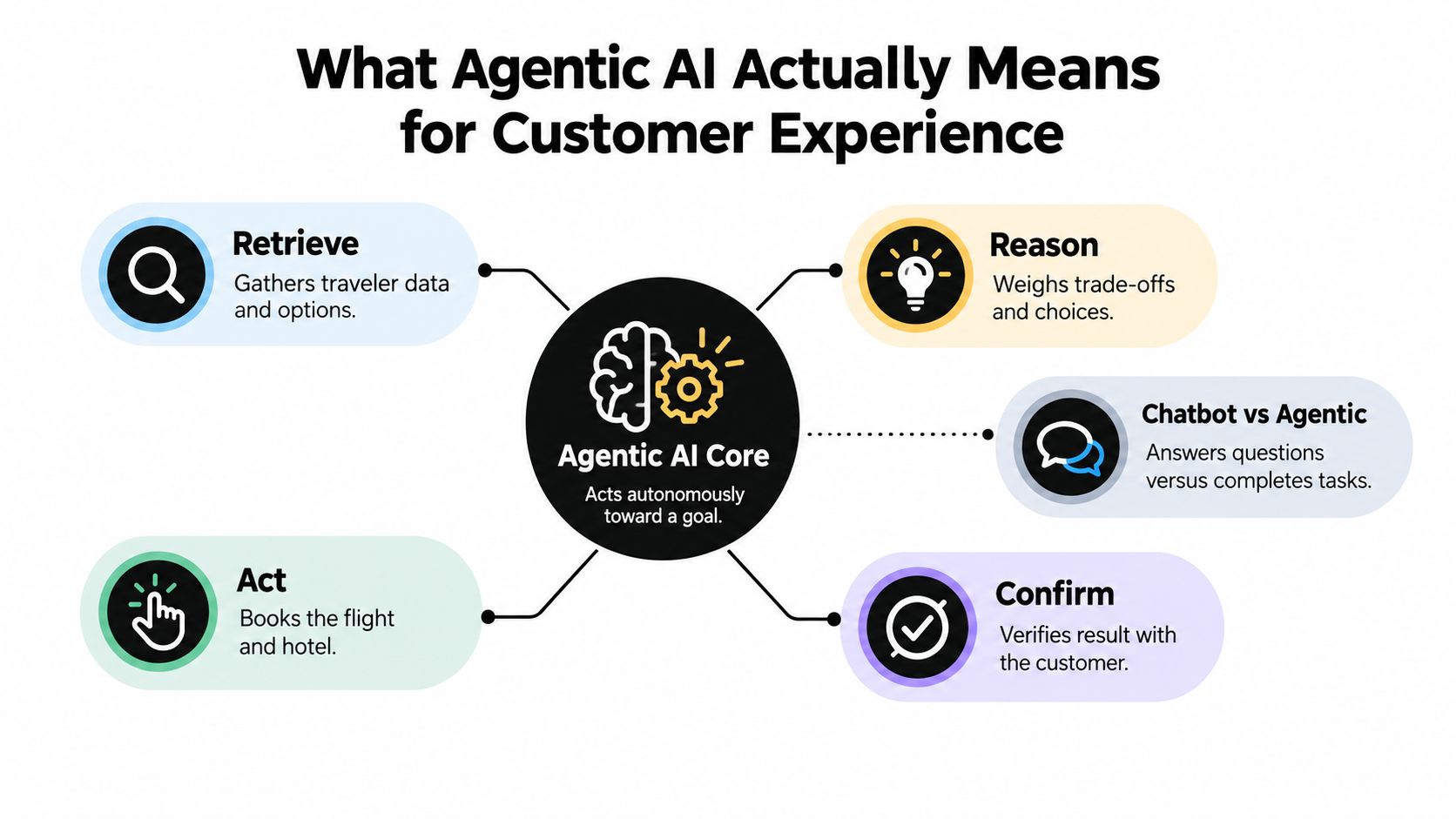
Four capabilities, four CX outcomes
Retrieve means gathering relevant information from governed sources, such as a knowledge base, CRM, order record, or ticket history. The system should retrieve only the context it is authorized to use.
Reason means matching the request to policy, intent, eligibility, and risk. At that point, the platform should detect uncertainty rather than confidently inventing an answer.
Act means completing an approved workflow, such as changing an appointment, sending a notification, or updating a case. The action needs permissions, auditability, and a defined rollback or escalation path.
Confirm means verifying that the action succeeded and explaining the outcome to the customer. A system that changes a record but doesn't communicate the result has completed an internal task, not the customer's journey.
These capabilities support four outcomes that executives can evaluate separately: personalization, automation, resolution-time reduction, and voice or multimodal interaction. Personalization uses context to make the next step relevant. Automation removes repetitive work. Faster resolution reduces customer effort. Voice and multimodal experiences let customers use the channel that fits the situation.
A practical guide to agentic AI can help teams distinguish autonomous task completion from conversational assistance. The distinction matters because a fluent answer isn't proof that the system can safely execute a workflow.
A field study of 5,179 customer-support agents at a Fortune 500 enterprise-software firm found that an LLM-based conversational assistant raised issues resolved per hour by 14% on average, while novice and lower-performing agents improved by as much as 35%. The National Bureau of Economic Research study indicates why augmentation deserves attention before full autonomy: timely recommendations can spread effective practices without removing the human from the interaction.
The Four Levers That Move CX Metrics
“AI improves CX” is too broad to guide investment. Enterprise teams should separate the mechanisms, because each lever needs different data, integrations, controls, and proof.
Personalization needs orchestration
Personalization works when the system combines identity, history, intent, eligibility, behavior, and current context to select a useful next action. A generic recommendation engine isn't enough. The customer should receive the right resolution, notification, offer, or transfer for the situation, with permission-aware access to the underlying data.
McKinsey estimates that an AI-powered next-best-experience capability can increase customer satisfaction by 15% to 20%, raise revenue by 5% to 8%, and reduce cost to serve by 20% to 30%. Those are directional ranges, not universal guarantees, and the McKinsey analysis ties outcomes to data quality, integration depth, and decision authority.
Automation should target low-risk work
Automation pays back fastest when the request is repetitive, the policy is stable, and the result is easy to verify. It can retrieve information, classify intent, update a case, or complete a straightforward transaction. The governance check is simple: define what the AI may do without approval, what requires confirmation, and what must go directly to a person.
Resolution-time reduction often begins with agent assist rather than autonomous resolution. Retrieval, suggested language, summarization, and workflow guidance help employees move faster while preserving judgment. Measure handle time alongside resolution quality, reopen rate, escalation, sentiment, and satisfaction.
Voice and multimodal interaction can remove channel friction, but only when the underlying context follows the customer. A voice agent that can't access the prior digital conversation creates a faster version of the same failure.
| Lever | Mechanism | Data Needed | Primary Metric | Common Failure |
|---|---|---|---|---|
| Personalization | Selects a relevant next action from authorized context | Identity, history, intent, eligibility, real-time signals | Satisfaction or repeat contact | Using sensitive data without a clear customer benefit |
| Automation | Completes routine workflows with controlled permissions | Policies, knowledge, transactional systems | Resolution rate | Automating exceptions and high-impact decisions |
| Resolution-time reduction | Guides agents with retrieval, summaries, and recommended actions | Knowledge base, CRM, ticketing, interaction history | Time to competent resolution | Optimizing speed while quality declines |
| Voice and multimodal interaction | Preserves intent across voice, chat, email, and digital inputs | Transcripts, authentication, channel context, telephony | Customer effort or transfer quality | Losing context during channel handoff |
Pick the lever connected to your weakest current CX score, not the feature with the loudest vendor pitch. If customers wait too long, prioritize agent guidance and routing. If they repeat information, prioritize orchestration and continuity. If they distrust personalization, prioritize permission controls before expanding recommendations.
High-Impact Use Cases Across Voice, Chat, and Digital Channels
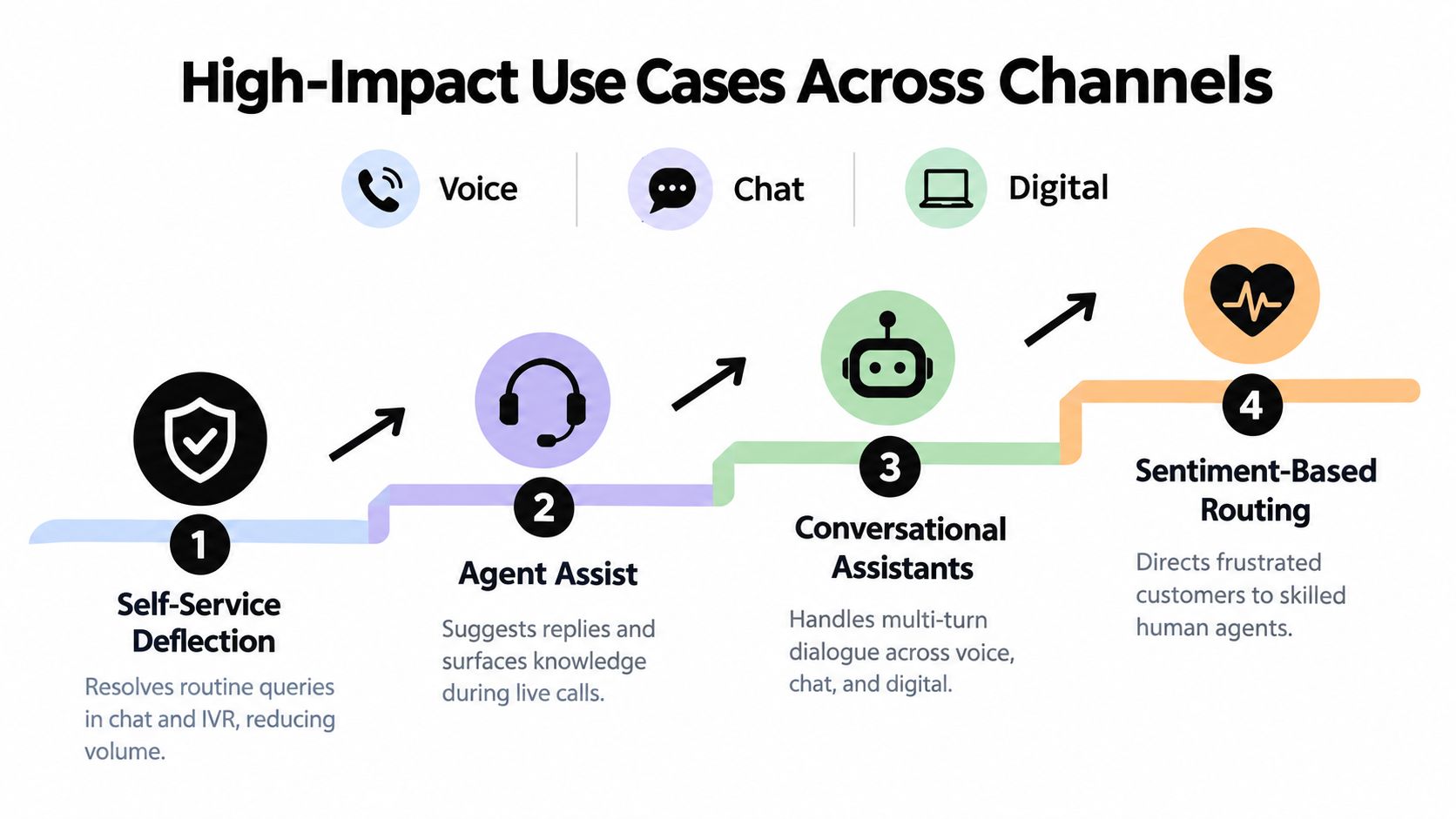
Enterprise use cases work best as a maturity ladder, not a shopping list. Start with a narrow, low-risk task, strengthen the knowledge and handoff layer, then expand autonomy only after quality holds.
Begin with visible, bounded demand
Self-service deflection is a sensible entry point for FAQs, order status, password resets, and appointment information. The handoff rule should be explicit before launch: if the system lacks an answer, detects repeated failure, or receives a request outside its permissions, it should transfer with the conversation summary intact.
Agent assist is often the better first investment for mid-size operations. It surfaces approved knowledge, drafts responses, summarizes prior exchanges, and guides newer representatives during live interactions. Evidence from the NBER research shows why this model is practical. Newly hired agents without AI moved from about 2.0 inquiries per hour initially to roughly 2.5 after eight months, while agents using the assistant from the start reached the 2.5-inquiry level after two months in the dataset analyzed by the NBER Digest.
Add autonomy after the handoff works
Conversational assistants can manage multi-turn requests across chat, voice, and digital channels once the organization has reliable retrieval and case continuity. They should authenticate appropriately, show what they intend to do, and confirm completed actions.
Sentiment-based routing belongs later than many teams expect. Emotion signals can help prioritize a frustrated customer or route a sensitive issue to a skilled representative, but sentiment is a signal, not a decision. Human review remains important because language, culture, sarcasm, and personal circumstances can defeat automated interpretation.
For teams evaluating cross-channel orchestration, omnichannel AI automation offers a useful reference point for thinking about voice, chat, email, and digital workflows as one operating model. Industry-specific teams can also compare adjacent automation patterns, such as the practical overview of AI for real estate agents, where speed and context matter across lead and service interactions.
Use a maturity scorecard rather than a launch checklist:
- Self-service: Can customers find the answer or complete the task without repeating information?
- Agent assist: Does the representative receive relevant knowledge and a reliable summary?
- Conversational autonomy: Does the system complete only authorized workflows?
- Routing: Does escalation reach the right human with enough context to act immediately?
The first pilot should prove customer outcome and operational control together. Deflection without successful resolution is just hidden failure.
An Implementation Roadmap for Enterprise CX Teams
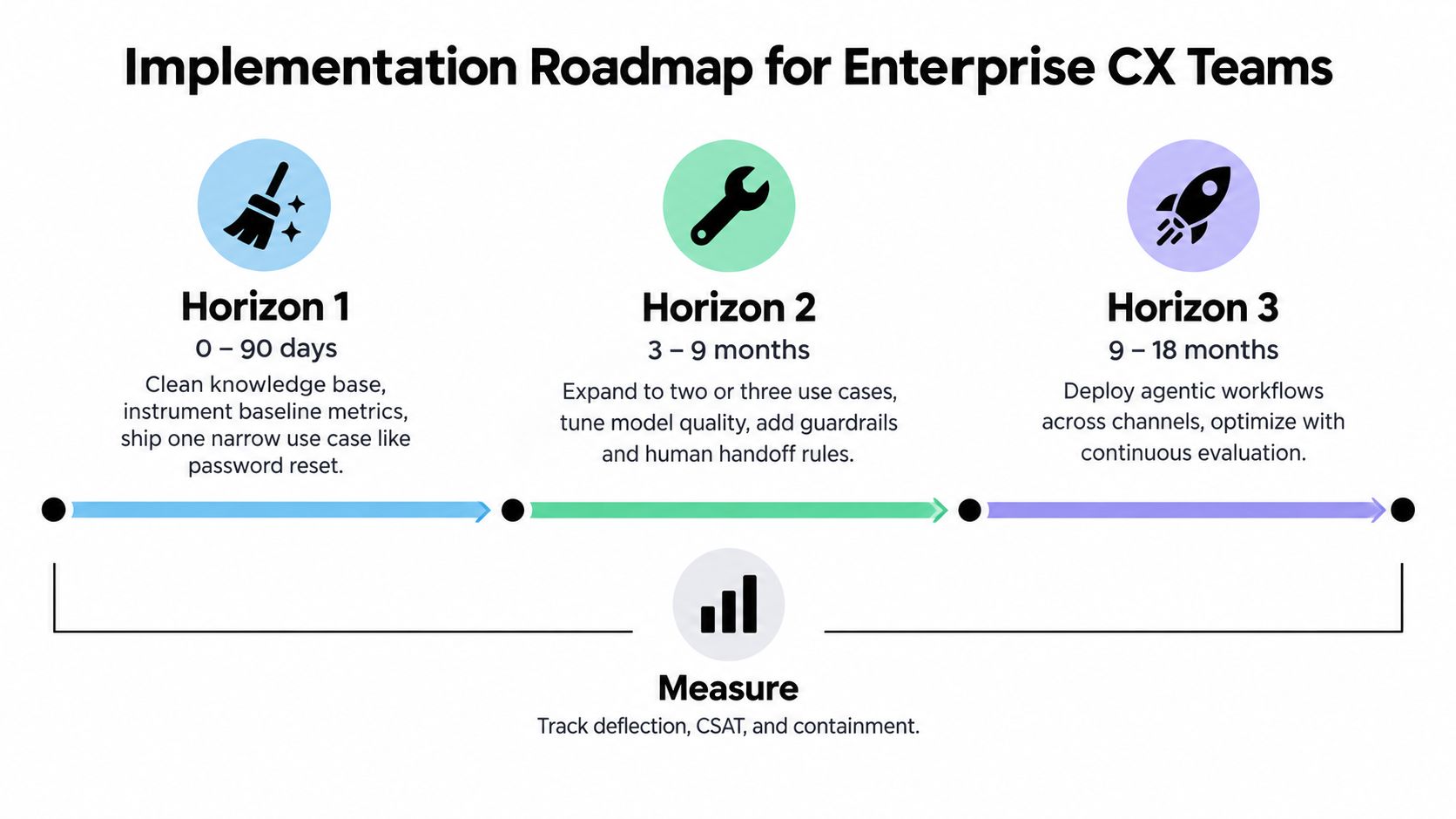
Enterprise AI programs become manageable when leaders sequence decisions instead of attempting a channel-wide transformation. The first horizon establishes trust in the data and measurement. The second expands operational usefulness. The third introduces orchestration at scale.
Horizon one focuses on evidence
During the first 90 days, clean the customer-facing knowledge base, assign content ownership, and remove conflicting policies. Instrument the baseline before enabling automation, including resolution rate, handle time, customer satisfaction, repeat contact, escalation quality, and cost per resolution.
Ship one narrow use case, such as password reset or order status. Keep the scope deliberately small enough to inspect conversations manually. A useful pilot has a clear stop condition, a named operational owner, and a human path that doesn't force customers to start again.
Horizon two connects the operation
From 3 to 9 months, add agent assist, connect CRM and ticketing, and introduce carefully bounded voice workflows. Tune retrieval, test response quality, and document handoff rules for uncertainty, emotional distress, regulatory sensitivity, and high-impact decisions.
Your architecture choices start to matter here. Favor a conversational knowledge base with retrieval, a control plane that lets non-technical teams update approved answers safely, and a multi-LLM strategy that reduces dependence on one model. Pre-built integrations can shorten delivery, but they shouldn't replace security review or process design.
Horizon three orchestrates the journey
From 9 to 18 months, connect channels so the customer's intent and history follow the interaction. Activate personalization only after consent, access controls, and data quality are working. Add automated testing, continuous evaluation, audit trails, and dashboards that distinguish successful resolution from abandoned or transferred conversations.
Measure the handoff as carefully as the autonomous action.
A first-year operating model should include CX, IT, compliance, security, operations, and frontline representatives. The technical team owns reliability, but operations owns whether the workflow makes sense and agents own whether the assistance helps them serve customers.
Where AI Should Step Aside and Hand the Call to a Human
Lower human involvement doesn't automatically produce better CX. In many journeys, the best AI behavior is a quick, well-prepared transfer.

A 2025 global consumer study reported that 54% of consumers believed AI agents rarely or never had sufficient context about them, 66% felt uneasy about an AI agent accessing their complete history, and 51% were uncomfortable sharing personal or financial information with AI agents, according to Twilio's published study. Those findings should change the success definition. The system doesn't earn trust by knowing everything. It earns trust by using only what the customer expects and needs.
Define selective autonomy
AI should handle routine, low-risk, well-instrumented work. It should step aside when it detects uncertainty, emotional distress, vulnerability, regulatory sensitivity, privacy concerns, or a decision with material consequences. The handoff should include verified intent, actions already taken, relevant records, and the unresolved question.
The human agent should receive enough context to take ownership immediately. If the customer must repeat the story, the organization has transferred the burden rather than resolved the problem.
Healthcare and other high-stakes operations can apply the same principle to adjacent choices, including choosing the right scribe model. The broader lesson is to match automation depth to risk, not to the technical ability to generate fluent language.
A practical escalation scorecard includes:
- Repeat-explanation rate: How often does the customer restate information after transfer?
- Transfer acceptance: Does the receiving team accept the case without rerouting it?
- Time to competent human ownership: How quickly does a qualified person take responsibility?
- Resolution after transfer: Does the handoff improve the final outcome?
- Privacy recovery: Can the customer revoke access or request a human path without friction?
Trust also depends on a visible value exchange. PwC's research found that customers may accept data sharing when it makes an interaction smoother, but they react strongly when companies mishandle that data. Consent, explanation, correction, revocation, and a clear human alternative should be product features, not policy documents hidden from customers.
The following video is useful for teams discussing why automation boundaries matter in real support environments:
Security, Compliance, ROI, and a Vendor Question Checklist
A vendor conversation should begin with operating risk, not a demo. Ask how the platform controls data, limits actions, records decisions, tests behavior, and preserves the customer's path to a human.
Security requirements vary by industry, but enterprise buyers should examine HIPAA, ISO 27001 and 27701, SOC 2 Type II, PCI-DSS, data residency, PII redaction, access controls, and audit trails. Ask whether sensitive context is exposed to the model, how long it is retained, who can retrieve it, and how administrators investigate a disputed interaction.
ROI also needs a balanced model. Track resolution rate, average handle time, successful containment, cost per resolution, retention or lifetime value where relevant, and supervisor escalations. A program that reduces contacts while increasing complaints or repeat explanations isn't creating value.
PwC's 2025 survey of 5,511 U.S. consumers found that 53% considered data sharing worthwhile when it made interactions smoother, while 93% said mishandling that data would cause them to lose trust. The PwC customer experience survey reinforces the commercial point: personalization must be useful, visible, and controllable.
| Category | Question to Ask | What Good Looks Like |
|---|---|---|
| Security and compliance | Which certifications, controls, and audit evidence apply to our data? | Current documentation, clear ownership, and verifiable controls |
| Data governance | Can we restrict, redact, correct, and delete customer context? | Permission-aware retrieval, retention controls, and auditable access |
| Model strategy | Can we use multiple models without rebuilding workflows? | Multi-LLM flexibility, routing controls, and no forced dependence on one provider |
| Integrations | Which systems can the platform read and update? | Governed connections to CRM, ticketing, knowledge, telephony, and identity systems |
| Handoff | What does a human receive when AI escalates? | Intent, transcript, actions, sentiment signals, and unresolved issue |
| Evaluation | How are quality, safety, and drift tested after launch? | Automated testing, human review, outcome dashboards, and rollback controls |
| ROI | Which baseline and counterfactual will prove value? | Control groups or comparable baselines across quality, cost, and effort |
Use this buyer's guide to evaluating conversational AI solutions to structure the procurement discussion. Yellow.ai is one option that supports agentic conversations across voice, chat, email, and messaging, with a conversational knowledge base, multi-LLM architecture, pre-built enterprise integrations, and human handoff workflows.
The standard for success is simple: customers should feel understood, not processed. AI should remove avoidable effort, make employees more capable, and know when a person needs to take ownership.
Start by mapping one broken journey, measuring its current resolution and handoff performance, and selecting a low-risk workflow with clear permissions. Then evaluate how Yellow.ai can connect agentic automation across channels while preserving context, governance, and human escalation.



