













When it comes to healthcare, not all chatbots are created equal. A standard chatbot is like an open-access file cabinet—useful, but not secure. A HIPAA compliant chatbot, on the other hand, is a fortified bank vault, engineered from the ground up to protect sensitive patient data.
It's not just a software feature; it’s a comprehensive security strategy.
Table of Contents
- What Truly Makes a Chatbot HIPAA Compliant
- The Technical Safeguards That Protect Patient Data
- Understanding the Business Associate Agreement
- Navigating AI Risks in Today's Healthcare Chatbots
- Maintaining Compliance with Audit Logs and Monitoring
- How to Choose the Right Chatbot Vendor
- Common Questions and Practical Answers
What Truly Makes a Chatbot HIPAA Compliant
Let's cut through the marketing noise. The stakes for getting this wrong are astronomical. Recent data breaches in healthcare have exposed the records of over 275 million patients in a single year. Using a generic chatbot for patient interactions isn't just a misstep; it's a direct route to becoming another statistic.
A compliant solution is simply non-negotiable.
The Three Pillars of Compliance
True HIPAA compliance isn't a single checkbox. It stands on three essential pillars, and if one fails, the entire structure collapses, putting patient data and your organization at risk.
You can see how we apply these principles in our healthcare industry solutions to get a better sense of how they work in the real world.
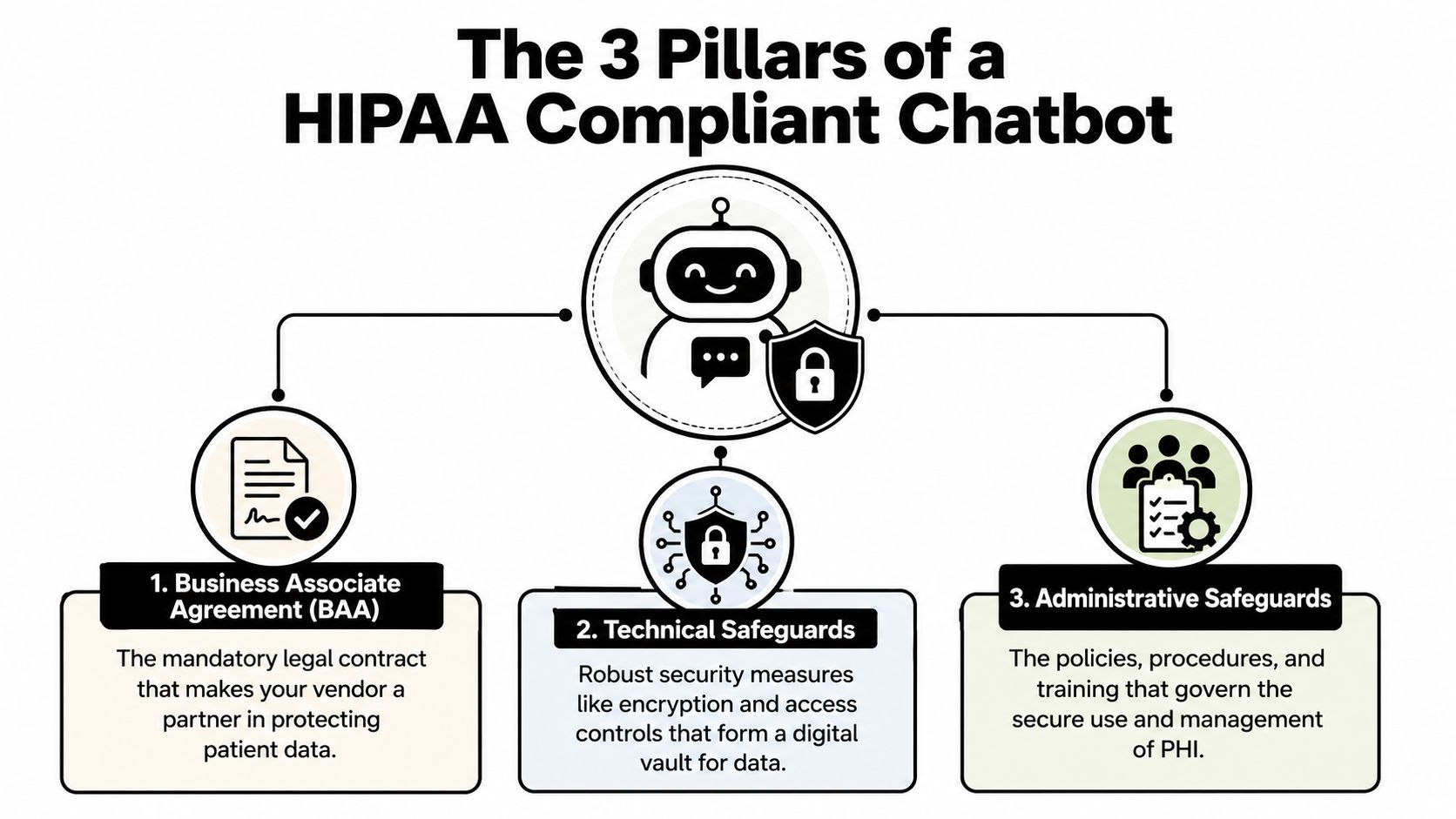
As you can see, compliance is a three-legged stool. It requires a legal agreement, technical fortifications, and human-led procedures to even stand a chance.
These three pillars work in concert to form a protective shield around Protected Health Information (PHI):
-
Business Associate Agreement (BAA): This is the legal bedrock. It's a contract that legally binds your chatbot vendor to protect PHI with the same rigor you do. Without a signed BAA in place, your chatbot is non-compliant. Period.
-
Robust Technical Safeguards: These are the digital locks, alarms, and surveillance systems. This includes end-to-end encryption for data both in transit and at rest, strict access controls to enforce the "minimum necessary" rule, and unchangeable audit logs that track every single interaction with PHI.
-
Clear Administrative Safeguards: This pillar governs the human element—the policies, procedures, and ongoing training that dictate how your team interacts with the chatbot and manages the sensitive data it handles.
The Technical Safeguards That Protect Patient Data
To protect Protected Health Information (PHI), a HIPAA-compliant chatbot needs more than just a promise of security. It requires specific, engineered technical controls that act as digital armor, protecting patient data at every turn. Think of it like a digital armored car—every door, window, and pathway has to be fortified.
This all starts with encryption. Every single piece of data, whether it’s moving across the internet (in transit) or sitting on a server (at rest), must be scrambled into an unreadable code. This ensures that even if a bad actor managed to intercept the data, it would be completely useless without the specific key to unlock it.

Enforcing the Minimum Necessary Rule
Beyond encryption, you need strict access controls. This is where Role-Based Access Control (RBAC) comes in, acting as a digital bouncer to ensure people can only access the specific information they absolutely need to do their jobs. It’s the practical, real-world application of HIPAA’s "minimum necessary" principle.
A billing specialist, for example, has no business looking at a patient's detailed clinical notes. RBAC prevents this by creating permission-based roles, which dramatically cuts down the risk of unauthorized data exposure, whether it’s accidental or malicious.
This level of granular control is a non-negotiable feature of any truly secure system. If a vendor can't clearly explain how they enforce RBAC, it's a major red flag. For a closer look at how these principles are applied in other digital healthcare settings, this guide on Blue Haven RX's telehealth data security is a great resource.
The Importance of Data Isolation
Another critical technical safeguard is tenant isolation. In a multi-tenant cloud environment where different organizations use the same platform, it is absolutely essential that one organization's data is completely walled off from another's. It's the difference between getting a private, locked hotel room versus a bed in a crowded dormitory.
This isolation must be cryptographic, meaning data isn't just separated by some flimsy software logic; it's physically and digitally sealed off. The best platforms accomplish this by creating dedicated, secure environments for each client, eliminating any chance of data "leaking" between tenants or an incident in one environment spilling over into another.
These enterprise-grade security features are the foundation of a HIPAA-compliant solution. Understanding them gives you the language and knowledge to confidently question any vendor’s security claims and ensure they can meet the rigorous standards that HIPAA demands.
Understanding the Business Associate Agreement
When you bring a chatbot vendor into your healthcare ecosystem, the Business Associate Agreement (BAA) is the single most important document you will sign. Think of it as the legal bridge that extends your HIPAA responsibilities to your technology partner. It's a formal, legally binding contract that makes your vendor just as liable for protecting patient data as you are.
This agreement is what separates a professional, healthcare-ready AI from a consumer-grade toy. It’s precisely why you can't use free, public versions of AI like ChatGPT for patient interactions. Their providers won't sign a BAA for those services, and sharing Protected Health Information (PHI) with a third party that hasn't legally agreed to protect it constitutes an immediate HIPAA violation.

Key Vendor Obligations Under a BAA
A BAA isn't just a piece of paper to be filed away; it places strict, enforceable duties on your chatbot provider. Your legal team needs to review this document with a fine-toothed comb to ensure it includes critical protections for your organization and patients. If a vendor hesitates or refuses to agree to these terms, they are not a viable partner for handling PHI.
A strong BAA is your first line of defense. It legally obligates your chatbot vendor to uphold the same security standards you do, ensuring there are no weak links in your data protection chain.
The agreement officially transfers specific responsibilities from you, the Covered Entity, to the vendor, your Business Associate. At a minimum, here's what it must clearly define:
- Implementing Safeguards: The vendor must commit to maintaining the same administrative, technical, and physical safeguards outlined in the HIPAA Security Rule.
- Mandatory Breach Reporting: The BAA has to require the vendor to report any security incident or data breach to you without unreasonable delay. There's no room for ambiguity here.
- Subcontractor Compliance: It must ensure the vendor holds its own subcontractors accountable. If they use another service that touches PHI, that subcontractor must also sign a BAA, extending the chain of liability.
- HHS Cooperation: The vendor has to agree to fully cooperate with any investigation from the Department of Health and Human Services (HHS).
Ultimately, the BAA is non-negotiable. It's the foundational document that makes a secure partnership possible, ensuring every party handling sensitive patient data is legally bound to protect it.
Navigating AI Risks in Today's Healthcare Chatbots
The leap from old, rule-based chatbots to today's AI-driven conversational agents is massive. But for healthcare, this power comes with a new set of very specific compliance risks. The engines driving the most advanced bots—Large Language Models (LLMs) like those behind ChatGPT, and Retrieval-Augmented Generation (RAG) systems—are a world away from the simple decision trees of the past. If you don't understand how they work, you can't manage the risks they introduce.
At its core, an LLM is a massive neural network trained on a staggering amount of public internet data. A RAG system then connects that powerful LLM to your own private, controlled library of information.
Think of the LLM as a brilliant but sometimes unreliable new hire who has read the entire internet. The RAG system is the official company handbook you hand them on their first day. It acts as a strict supervisor, ensuring the new hire only gives answers based on your verified documents, not from some random blog post they might remember reading. While this combination is incredibly effective, it creates two major HIPAA landmines if not managed with absolute precision.
The Risk of Data Retention and Unintended Model Training
The first and most critical risk is data retention. Many publicly available LLMs are designed to learn from every conversation they have. If a patient shares their Protected Health Information (PHI) with a chatbot built on such a model, that sensitive data could be absorbed, stored, and used by the AI provider to train their models further.
This isn't just a minor misstep; it's an immediate and serious HIPAA violation.
A truly HIPAA-compliant chatbot architecture is built to prevent this from ever happening. The foundation is a zero-retention policy with the LLM provider. This is a contractual and technical guarantee that no part of any conversation, especially PHI, is ever logged, stored, or used for model training. The data is processed in-memory to generate a response and then it's gone—leaving zero footprint on the third-party LLM's servers.
This zero-retention safeguard is absolutely non-negotiable. It creates a firewall that allows the AI to understand and respond to a patient's query without ever "keeping" their data, completely isolating your organization from the LLM provider's data practices.
Preventing AI "Hallucinations" in a Clinical Context
The second major risk is what's known as an AI "hallucination." This happens when an LLM confidently states incorrect or completely fabricated information. In a general-purpose chatbot, this might just be a strange or funny quirk. In healthcare, providing a patient with inaccurate medical advice or wrong information about their coverage can have dangerous and legally catastrophic results.
This is where a well-architected RAG system becomes your primary line of defense. By "grounding" the chatbot exclusively in your organization's approved knowledge base—your clinical protocols, billing policies, and patient FAQs—you lock down its source of truth.
This strategy gives you two crucial advantages:
- Controlled, Factual Responses: The chatbot is effectively prohibited from inventing answers or pulling information from the public web. Every response it generates is directly traceable to a source document that you have written and verified.
- Verifiable Accuracy: Because every answer comes from your internal documents, you can maintain accuracy with confidence. When a clinical guideline is updated, you only need to change that single source document, and the chatbot's knowledge is instantly and universally corrected.
Maintaining Compliance with Audit Logs and Monitoring
Getting a HIPAA-compliant chatbot up and running isn't the finish line. In fact, it's just the start of an ongoing commitment to vigilance. While essentials like encryption and access controls are your front-line defense, audit logs and continuous monitoring are the surveillance system that proves your defenses are actually working.
Think of it as a security camera for your data, recording every single interaction.
These logs aren't just a "nice-to-have" feature; they are a mandatory requirement under the HIPAA Security Rule. Any compliant system must generate a detailed, unchangeable audit trail for all access to electronic Protected Health Information (ePHI). This creates a permanent record of every time a patient's information is touched, changed, or sent by the chatbot.
For a HIPAA-compliant chatbot, these logs are your black box recorder. When a security incident happens or an auditor comes knocking, these records become your most credible evidence, showing exactly who did what, and when.
Without these detailed records, you're flying blind. You have no way to investigate a potential breach or prove that you've taken the necessary steps to secure patient data.
What Your Audit Logs Must Capture
For audit logs to be useful, they have to be comprehensive. They need to answer critical questions about data access with forensic clarity. Any vendor you consider must provide a platform that can track and export logs containing several key data points.
At a minimum, a useful audit log must include:
- User Identity: Who accessed the data? This could be a patient, a support agent, or an administrator.
- Timestamp: Exactly when did the access happen? This needs to be precise, down to the second.
- Action Type: What did the user do? This includes viewing, creating, modifying, or deleting information.
- Specific Data Involved: Which patient record or specific data field was part of the interaction?
This level of detail is non-negotiable for reconstructing events and spotting any unauthorized activity.
The Six-Year Rule and Proactive Monitoring
HIPAA dictates that all audit logs must be kept for a minimum of six years and must be completely tamper-proof. This long retention period highlights their critical role as legal and compliance records. The penalties for getting this wrong are steep, with fines reaching up to $1.5 million per incident for organizations that fail to follow HIPAA's strict rules. You can find out more about these chatbot compliance requirements and the risks you need to manage.
But just storing logs for six years isn't enough. Your team needs a solid process for reviewing them regularly. This is where proactive monitoring comes in. It helps you spot unusual patterns—like an employee accessing records far outside their normal duties or a sudden spike in data exports—before they become a full-blown data breach.
While the responsibility for providing these logs falls on your chatbot vendor, the duty to review them and act on what they show is entirely yours.
How to Choose the Right Chatbot Vendor
When you're choosing a vendor for a HIPAA-compliant chatbot, you need to cut through the slick marketing presentations and demand verifiable proof of their security posture. The right partner isn't the one with the fanciest features; it's the one with a documented, ironclad commitment to protecting patient data. This decision carries serious legal and financial weight, so treating it like a quick-scan RFP won't cut it.
Think of this process as a security audit from day one. A vendor’s willingness to offer clear, direct evidence of their compliance is the single best indicator of whether you can trust them. Vague promises of "enterprise-grade security" are red flags. You need concrete proof.

Verifying a Vendor's Security Credentials
Your evaluation must start with demanding the documents that back up their security claims. These aren't just pieces of paper; they are independent, third-party attestations that a vendor has implemented and actually follows rigorous security controls.
Kick off your review by requesting these critical documents:
- SOC 2 Type II Report: This audit confirms that a vendor’s internal controls for security, availability, and confidentiality are effective over an extended period.
- ISO 27001 Certification: This international standard maps out the requirements for a comprehensive information security management system (ISMS), proving they have a systematic approach to protecting sensitive information.
- List of Subprocessors: You must know every single third party that will touch your data, from their cloud provider to the LLM service they use. There's no room for ambiguity here.
- Incident Response Plan: Ask for their formal plan. You need to see exactly how they would respond to a data breach, step-by-step.
Critical Questions for Your Sales Calls
Once the documents are in hand, it's time to ask pointed questions. How a vendor’s team responds will tell you everything about their readiness to handle Protected Health Information (PHI). If their answers are fuzzy or they deflect, it's time to walk away.
A vendor’s BAA is the cornerstone of your partnership. If it contains loopholes or fails to cover their entire technology stack, including third-party LLMs, it leaves your organization dangerously exposed.
Go into your sales calls armed with these non-negotiable questions for any potential HIPAA-compliant chatbot vendor:
- Does your Business Associate Agreement (BAA) cover your entire technology stack, including any third-party LLM providers you use?
- How do you technically guarantee our data is cryptographically isolated from your other customers' data in your multi-tenant environment?
- Can you demonstrate your zero-retention policy with your LLM provider and prove that no PHI is ever stored or used for model training?
A vendor who not only answers these questions but welcomes the scrutiny is the kind of partner you can build a secure foundation with. To dig even deeper, our complete buyer's guide to evaluating conversational AI solutions provides a more detailed framework for these crucial conversations.
Common Questions and Practical Answers
Even with the best strategy, putting new technology into practice in a field as regulated as healthcare always brings up real-world questions. Here are the direct answers to some of the most common things we hear from organizations working to deploy a HIPAA-compliant chatbot.
Can We Use a Chatbot for Patient Appointment Scheduling?
Absolutely. This is one of the most powerful and immediate use cases for a healthcare chatbot, but it has to be done right. The non-negotiable first step is that your chatbot vendor must sign a Business Associate Agreement (BAA) before a single piece of patient data touches their system.
From there, every part of the interaction must be secured. This means:
- End-to-End Encryption: The patient's name, their requested appointment time, and the reason for their visit must be fully encrypted, both while moving across the network and when stored.
- Strict Access Controls: Your system needs to be configured so that only authorized staff can see the scheduling dashboard and the sensitive data it contains.
- The Minimum Necessary Rule: The chatbot should only ask for the bare minimum information required to book the appointment. Anything more is a compliance risk.
What Is the Difference Between HIPAA Eligible and HIPAA Compliant?
This is a critical distinction, and it’s a place where a lot of confusion—and risk—originates. "HIPAA eligible" is mostly a marketing term. It means a vendor believes its platform has the security features you need, but puts the entire burden of configuration, use, and ultimate compliance on you. It's like being handed a toolbox without the instructions.
True "HIPAA compliance" is a partnership. A compliant vendor will readily sign a BAA and has architected their service to meet HIPAA regulations from the ground up. While compliance is always a shared responsibility, it has to start with a vendor who has already done their part.
Don't just take a vendor's word for it. Always demand a signed BAA and look for independent verification of their security posture, like a SOC 2 Type II report.
Are Employee-Facing Chatbots Subject to HIPAA?
Yes, if there is any possibility that they will handle Protected Health Information (PHI). For instance, an internal chatbot designed to help your HR team manage employee health benefits or medical leave requests absolutely must be HIPAA compliant. The same rules apply, with no exceptions.
You'll need a BAA with the vendor, robust technical safeguards like encryption and audit logs, and clear internal policies for its use. The "minimum necessary" principle is especially vital here to prevent the accidental oversharing of sensitive health data within your own organization.
Ready to deploy an AI agent that is secure, compliant, and built for the enterprise? Yellow.ai offers a HIPAA-compliant platform with robust security, a multi-LLM architecture, and zero-retention policies to protect your patient data. Book a demo today to see how our agentic AI can transform your healthcare operations safely.



