













A healthcare product manager walks into a Monday review at a large hospital system and gets hit from three sides at once. A nursing leader wants faster patient messaging. The compliance team wants proof that new automation won't expose protected health information. The operations team wants AI to reduce scheduling friction and service backlog. None of those requests can be handled like a standard app feature ticket, because in healthcare, one small workflow change can affect patient safety, reimbursement, auditability, and trust.
That's the reality many enterprise teams are living in right now. They're trying to modernize access, support, and internal workflows while keeping one foot planted in regulation and the other in clinical reality. A chatbot for appointment changes sounds simple until it touches triage rules, identity verification, escalation protocols, and downstream care coordination. A better digital experience matters, but in healthcare product management, experience alone is never enough.
This guide is for the people in that tension every day: product managers, CX leaders, IT leaders, compliance teams, digital transformation owners, and healthcare operators. It treats healthcare product management as it works inside enterprises. Not as a generic backlog role, but as a discipline that sits between care delivery, systems integration, governance, and measurable value. For teams exploring AI-enabled service design, healthcare automation and patient engagement workflows are becoming part of that operating model.
Table of Contents
- Introduction to Healthcare Product Management
- Understanding the Key Concepts
- Navigating Regulatory and Privacy Considerations
- Managing the Product Development Lifecycle and Risk
- Engaging Stakeholders and Organizational Structures
- Measuring Success with KPIs and Analytics
- Tooling and Integrations for Enterprise Teams
- Conclusion and Future Outlook
Introduction to Healthcare Product Management
Healthcare product management starts where ordinary product management stops. In most industries, a PM is judged by adoption, satisfaction, or delivery speed. In healthcare, those still matter, but they sit beside a tougher standard. The product has to work safely, fit real clinical workflows, respect privacy obligations, and hold up under scrutiny from legal, compliance, and operational leaders.
Think about a hospital scheduling assistant. In retail, a scheduling bot mainly needs to answer quickly and reduce friction. In healthcare, that same bot may need to distinguish between a routine follow-up and a symptom escalation, route to the right team, preserve an audit trail, and avoid saying anything that could be interpreted as clinical advice outside approved pathways. The PM isn't just shaping usability. The PM is shaping risk boundaries.
The role in plain language
A healthcare product manager translates between groups that often speak different languages:
- Clinicians talk in terms of care quality, safety, workflow burden, and patient context.
- Engineers think about APIs, release cycles, uptime, architecture, and model behavior.
- Compliance and legal teams focus on privacy, documentation, approvals, and controls.
- Business leaders want operational efficiency, financial sustainability, and strategic fit.
The PM's job is to align those groups without flattening the complexity.
Practical rule: If a requirement can't be explained in both clinical language and system language, it probably isn't ready.
Why the role has become more central
Healthcare product management now sits inside a market with major economic weight. The global HealthTech market is projected to generate an annual value of $350 billion to $410 billion by 2023, which signals why product leadership has become so strategic in healthcare transformation, according to Koru UX's HealthTech market overview.
That scale matters because healthcare PMs aren't only working on one category of software. They may oversee telemedicine tools, patient access systems, data products, internal staff platforms, device-connected workflows, or AI-assisted service layers. In every case, the product sits close to care delivery.
What trips teams up
Many teams get confused because they assume healthcare product management is just ordinary SaaS management with extra regulation layered on top. It isn't. The shape of the work changes.
A PM in this field has to ask questions like these early, not late:
- Does this workflow create any patient safety risk if automation fails?
- Who owns the final approval for content, triage logic, or escalation rules?
- What evidence will clinical stakeholders accept as proof of value?
- If AI changes its behavior over time, how will the team monitor and govern that?
Those questions separate a useful healthcare product from a risky one.
Understanding the Key Concepts
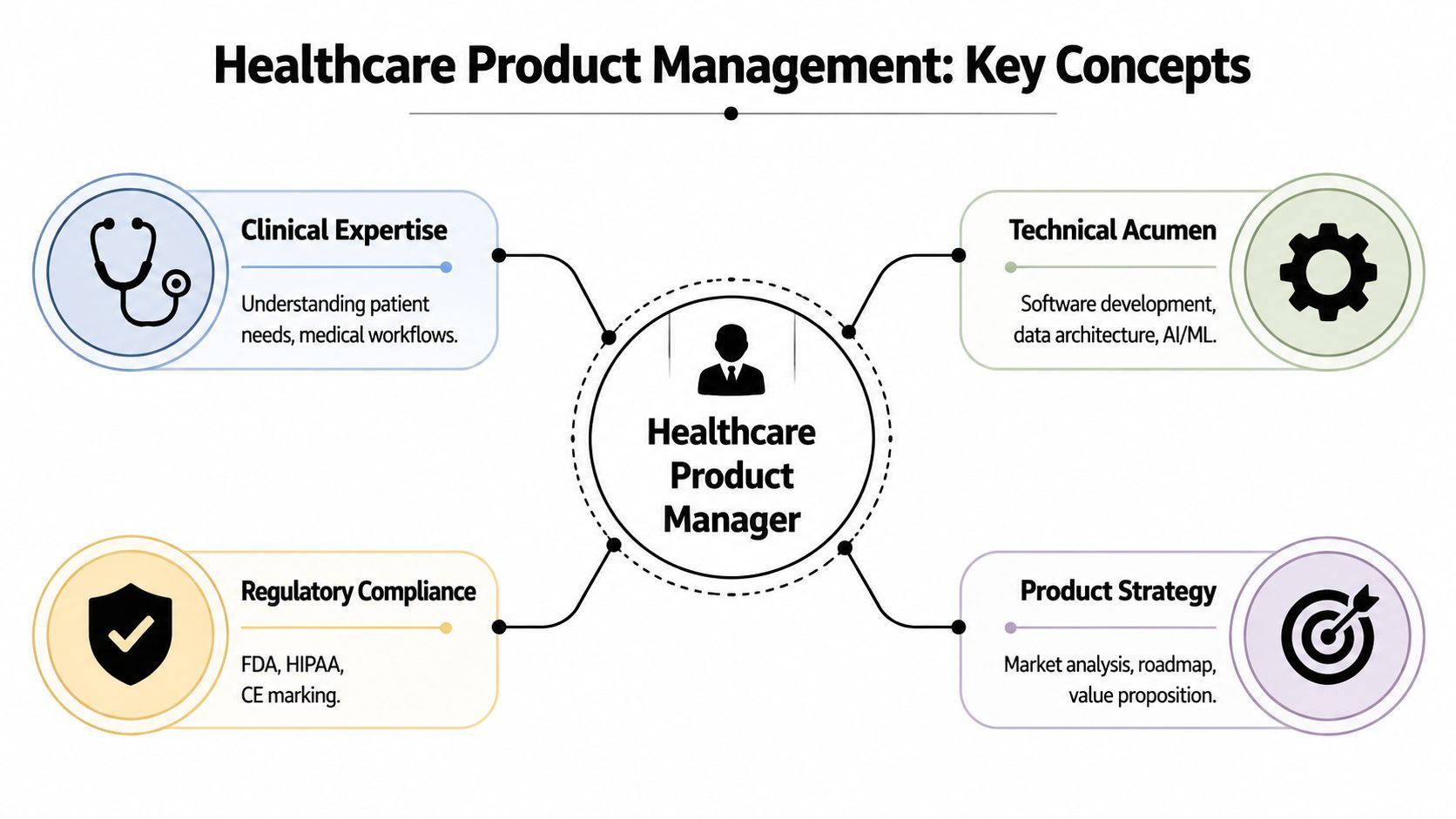
The simplest way to understand healthcare product management is to think of it as a four-part balancing act. A PM in this space isn't only shipping features. They're balancing clinical reality, technical systems, regulatory constraints, and product strategy at the same time.
Four pillars that shape the role
A helpful mental model is to picture the PM at the center of four connected pillars.
- Clinical expertise means understanding how care is delivered. That includes patient journeys, provider handoffs, documentation burden, and what creates friction at the point of service.
- Technical acumen means being able to work with engineering on integrations, data movement, architecture choices, and increasingly, AI behavior.
- Regulatory compliance means designing with privacy, safety, traceability, and approval processes in mind from the start.
- Product strategy means deciding what to build, for whom, and why it matters to the organization.
A strong PM doesn't need to be the deepest expert in all four. But they do need enough fluency to spot conflicts early.
How this differs from consumer tech
Consumer PMs often optimize for attention, conversion, or engagement. Healthcare PMs still care about adoption, but they operate in a setting where the user's preference can't be the only decision signal.
A patient may love a fast self-service workflow that bypasses intake questions. A clinician may hate it if that shortcut removes necessary context. An operations leader may like full automation. A compliance lead may reject it if the workflow lacks traceability. The PM has to reconcile all of that.
Here's the key difference. In healthcare, the best product decision isn't always the shortest path for the end user. Sometimes it's the safest path that still feels usable.
Good healthcare product management means building products people can use, clinicians can trust, and auditors can understand.
Why scale changes the expectation
This discipline is no longer a niche specialty. The market context is too large for that. As noted earlier, the HealthTech sector is measured in the hundreds of billions of dollars, which raises the bar for operational rigor and specialized leadership. Inside that environment, healthcare PMs often own products that affect not just digital convenience, but provider efficiency, workflow quality, and care delivery patterns.
That's why the role increasingly demands a mixed skill set:
| Capability | What it looks like in practice |
|---|---|
| Clinical literacy | Understanding visit types, care pathways, and escalation logic |
| Data judgment | Knowing which metrics are operational, clinical, and financial |
| Workflow design | Mapping handoffs between patient, staff, systems, and care teams |
| Governance awareness | Building products that can survive review, audit, and change control |
A plain-language example
Take an AI assistant that helps patients reschedule appointments.
On the surface, this looks like CX work. But the PM has to think through more than convenience:
- Is the patient rescheduling a routine follow-up or a time-sensitive visit?
- Does the workflow need identity checks before exposing appointment details?
- If the bot detects symptom language, should it stop self-service and escalate?
- Will call center agents, front-desk staff, and clinic managers all see the same updated status?
That one workflow touches service design, operational control, and clinical caution at once. That's healthcare product management in practice.
Navigating Regulatory and Privacy Considerations
Many teams treat healthcare compliance like a checklist you finish before launch. That mindset breaks down quickly, especially when AI enters live workflows. In healthcare product management, compliance isn't a gate at the end. It's a design constraint that shapes requirements, architecture, testing, and post-launch monitoring.
Static rules versus dynamic systems
Traditional software usually behaves in predictable ways. If the logic is fixed, reviewers can inspect the rules, test the expected outputs, and sign off with reasonable confidence. AI-powered systems complicate that pattern, especially when they route conversations, summarize records, or adapt to new inputs across changing contexts.
That's why the governance gap around agentic AI matters. While 78% of healthcare organizations prioritize AI adoption, only 24% have established specific governance protocols for autonomous, self-correcting AI agents that can modify their own behavior in live clinical workflows, according to World Health Expo's analysis of healthcare product management and AI governance.
A checklist won't catch every risk in a system that can behave differently across situations.
What privacy by design looks like in practice
Privacy by design sounds abstract until you turn it into product decisions. A healthcare PM can make it concrete by forcing a few questions into every planning session:
- What data does the workflow need?
- Who can see it, edit it, export it, or trigger an action from it?
- What should happen if confidence is low, the model is uncertain, or the input is ambiguous?
- What must be logged for review later?
Those questions lead to better controls than broad promises about being compliant.
A useful operating pattern is to define the workflow in layers:
- Data layer with minimum necessary access
- Decision layer with explicit boundaries for automation
- Escalation layer for human review
- Audit layer for traceability and change monitoring
Governance for AI-driven CX
Enterprise teams often deploy AI first in patient support because the use cases seem lower risk. Appointment reminders, FAQ handling, benefits questions, and referral navigation feel operational rather than clinical. But even these flows can become sensitive if they influence timing of care, expose personal data, or shape what a patient does next.
That's where product teams need a governance model that covers live behavior, not just pre-launch documentation.
Consider a practical example. A scheduling bot starts noticing that many users asking to reschedule also mention worsening symptoms. If the system's language handling evolves or prompts change over time, the PM has to decide who reviews those changes, how they're tested, and when the automation must hand off to a human. Static approval language won't cover that on its own.
A safe healthcare AI workflow doesn't just answer correctly. It fails safely, escalates clearly, and leaves evidence behind.
Areas teams often overlook
Compliance risk doesn't only live inside software code. It also appears in devices, endpoints, archives, and retirement processes. When healthcare organizations decommission hardware that may have held sensitive data, operational leaders often need structured disposal practices and chain-of-custody controls. For teams reviewing that side of the lifecycle, Georgia ITAD compliance solutions can be a useful reference point for thinking through secure disposition and compliance alignment.
Security architecture matters too. PMs don't own every control directly, but they do influence whether the product requires strong access management, role-based permissions, encrypted workflows, and clear separation between environments. Enterprise teams evaluating platform safeguards often compare capabilities against enterprise-grade security requirements for AI systems.
A practical governance checklist
Not every team needs a giant policy document on day one. They do need a repeatable set of operating habits.
| Governance area | What the PM should insist on |
|---|---|
| Workflow boundaries | Define what AI can do, suggest, or never do |
| Human escalation | Set conditions for mandatory handoff |
| Logging | Capture key actions, prompts, changes, and overrides |
| Review cadence | Reassess behavior after releases and policy changes |
| Content control | Approve knowledge sources and response guardrails |
The most important mindset shift
The compliance question is no longer only, “Did we follow the rules at launch?” It's also, “How will we detect and respond when the system behaves differently in production?”
That's the shift enterprise healthcare product management teams need to make. Especially with AI-driven CX integrations, governance has to stay alive after release.
Managing the Product Development Lifecycle and Risk
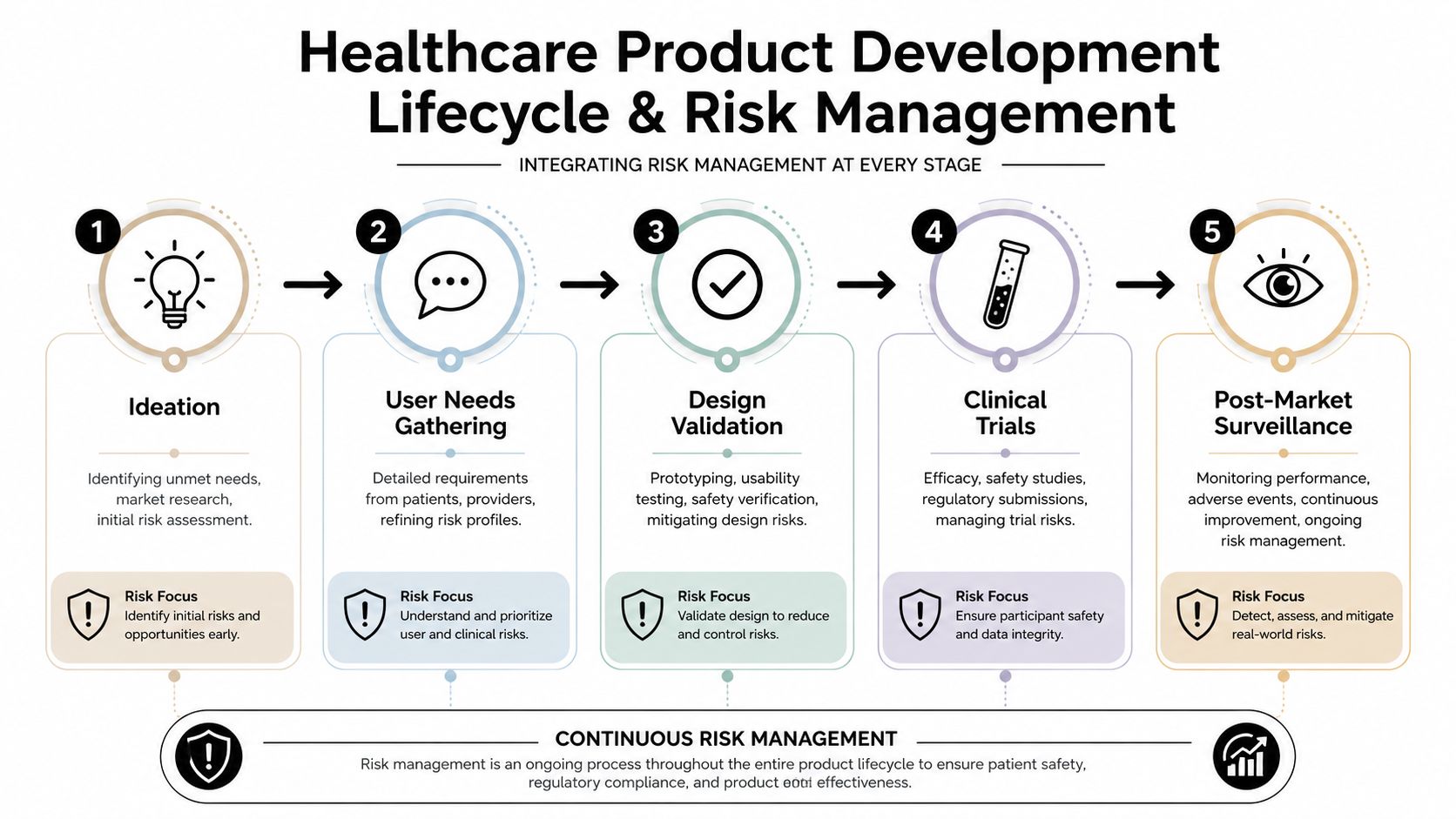
A healthcare product rarely fails because the team forgot to brainstorm features. It fails because the team moved too quickly past requirements, risk assumptions, or validation discipline. In healthcare product management, the development lifecycle has to be designed so risk review happens alongside progress, not after it.
Start with the right blueprint
For medical devices and other tightly governed healthcare products, the Product Manager Requirements Document has to do more than describe desired functionality. It needs to be specific enough that engineering, quality, and regulatory teams can all work from the same source of truth.
According to Voler Systems' guidance on medical device PRDs, a PRD for medical devices must explicitly define six components: user needs, regulatory requirements, functional requirements, design constraints, risk management, and validation and verification.
That list is useful even outside device development because it forces PMs to think beyond feature ideas.
How each lifecycle phase changes the PM's job
The work feels different at each stage.
Ideation and problem framing
At the beginning, the PM needs to separate a real healthcare problem from a general frustration. “Patients miss appointments” is too broad. “Patients can't easily confirm specialty follow-ups after referral handoff” is more useful because it points to a specific workflow and actor set.
At this stage, risk work starts with basic questions:
- Who could be harmed if this workflow fails?
- What assumptions are we making about users, timing, or clinical context?
- Where does the product intersect with regulated decisions or protected data?
User needs gathering
Healthcare teams often gather requirements from the loudest stakeholders. That's not enough. You need input from people who touch the workflow at different points: patients, nurses, clinic managers, support staff, IT teams, and compliance reviewers.
A common mistake is writing requirements that reflect only what users ask for. A stronger approach captures what users need, what the organization must control, and what the system must prove.
If a requirement says “easy to use” but doesn't say for whom, under what conditions, and with what safety limits, it's incomplete.
Design validation
Often, many enterprise teams confuse prototype approval with validation. A workflow can demo beautifully and still fail in real usage if it doesn't account for edge cases, handoffs, or ambiguous inputs.
Validation should test more than usability. It should test whether the product behaves safely when users do unexpected things, when integrations return incomplete data, or when the workflow requires escalation.
A simple stage-gate view
You don't need a rigid bureaucracy to use stage gates. You need decision points with clear evidence.
| Phase | Evidence needed before moving forward |
|---|---|
| Problem definition | Clear user need, workflow map, initial risk assumptions |
| Requirements | PRD with controlled scope and stakeholder review |
| Design | Usability feedback plus safety and edge-case review |
| Verification | Proof the build matches requirements |
| Validation | Proof the product works in intended use conditions |
Risk management shouldn't sit in one document
Hazard analysis often gets treated like a quality team artifact. PMs should resist that separation. The best teams keep risk visible in roadmap decisions, release planning, and acceptance criteria.
That can look like this in everyday delivery:
- Before sprint planning, identify which stories alter safety-sensitive logic.
- Before release, confirm that escalation paths and logs still work.
- After launch, review incidents, exceptions, and workarounds from frontline teams.
Version control matters here too. In healthcare, a changed requirement isn't just a normal product update. It may alter what was validated, approved, or promised to internal reviewers. Strong teams document why the change was made, what it affects, and whether fresh review is required.
A realistic scenario
Suppose your team is building an intake assistant for pre-visit forms. Early discovery shows patients abandon the form if it asks too many questions. Operations wants fewer questions. Compliance wants stronger identity checks. Clinicians want symptom capture before the visit.
A weak product process would split the difference casually and move on.
A strong healthcare product management process would ask:
- Which questions are mandatory for safety or compliance?
- Which can be deferred until after identity verification?
- Which responses should trigger staff review?
- What evidence will prove the new flow still works safely?
That's how lifecycle discipline reduces risk without killing momentum.
Engaging Stakeholders and Organizational Structures
Healthcare product management is often less about persuading one executive and more about aligning a small institution. A single product decision can affect call center agents, nurses, physicians, rev cycle teams, IT architects, compliance officers, and finance leaders. If the PM doesn't understand who holds real influence, the product stalls.
The stakeholder map most teams need
In enterprise healthcare, stakeholders usually fall into a few recurring groups:
- Clinical stakeholders care about safety, workflow burden, and care quality.
- Operational leaders care about throughput, staffing pressure, and service consistency.
- IT and architecture teams care about interoperability, reliability, access control, and maintainability.
- Compliance and legal teams care about policy fit, approvals, documentation, and liability.
- Executive sponsors care about organizational priorities, risk appetite, and strategic payoff.
The mistake many PMs make is treating all stakeholders as if they want the same kind of evidence. They don't.
A physician leader may trust a product more when they see a workflow diagram and escalation logic. A CIO may care more about integration dependencies and system boundaries. A compliance officer may want to review what happens in edge cases. The PM has to package the same initiative in different forms without changing the core truth.
Why technical fluency builds trust
Healthcare products don't live in isolation. They depend on claims flows, eligibility checks, prior authorization logic, provider directories, and interoperability standards. PMs who can discuss those systems plainly earn credibility faster because they reduce translation overhead across teams.
That's especially true in payer-provider and enterprise platform settings. According to Venkatesh Bellam's healthcare product management guidance, expert healthcare PMs need working knowledge of the Claims Lifecycle, Eligibility and Enrollment transactions, Prior Authorization, and Provider Data management to design products that operate effectively within real adjudication environments.
If a PM can't speak to those flows, stakeholder alignment gets shallow fast.
Choosing an operating model
Large organizations usually land in one of three structures.
Centralized model
A central product team owns standards, prioritization, and governance. This works well when the organization needs consistency across multiple business units.
The tradeoff is distance from frontline workflows. PMs may become efficient at portfolio management but slower to catch operational nuance.
Embedded squad model
PMs sit close to service lines, call centers, or digital care teams. This helps teams move with context and build trust with local stakeholders.
The risk is fragmentation. Different units may define success differently or duplicate tooling and policy interpretation.
Federated model
Many health systems end up here. Central teams set standards for architecture, security, and governance, while local product squads adapt solutions to specific workflows. It's often the most realistic model because it balances consistency and relevance.
The right structure is the one that lets teams move with local context without losing control of safety, interoperability, and governance.
Communication rhythms that actually work
Stakeholder engagement improves when cadence is predictable.
A practical pattern looks like this:
- Weekly working reviews for product, engineering, and operations
- Regular clinical advisory check-ins for workflow and safety concerns
- Governance reviews for compliance, security, and policy issues
- Executive updates focused on decisions, tradeoffs, and blockers
The PM's role isn't to create more meetings. It's to create enough rhythm that no team is surprised late in the process.
Measuring Success with KPIs and Analytics
Healthcare teams often celebrate digital adoption too early. A new assistant gets used. Satisfaction comments look positive. The dashboard shows faster response times. Then a clinical leader asks the hard question: did any of this improve care delivery or operational performance in a way the organization can trust?
That's where many products run into trouble. Data from 2025 shows that 65% of digital health products fail to demonstrate measurable improvements in clinical outcomes despite high user satisfaction, according to OSP Labs' analysis of digital health product strategy. The gap isn't always that the product has no value. Often the team never built a clean bridge from CX metrics to clinical or operational value drivers.
Start with a value chain, not a dashboard
A healthcare PM should ask three linked questions:
- What user behavior is the product trying to change?
- What operational effect should that behavior produce?
- Which clinical or business outcome could move if the operational effect is real?
For example, if a patient messaging assistant shortens time to appointment confirmation, that may improve schedule stability. Better schedule stability may reduce late cancellations and support care continuity. That's a better measurement chain than stopping at “messages answered faster.”
Sample Healthcare Product Management KPIs
| Metric | Definition | Target |
|---|---|---|
| First response time | How quickly the system or team responds to a patient or staff request | Set a target based on service expectations and escalation risk |
| Resolution rate | Share of interactions resolved without rework or unnecessary transfer | Set a target that balances efficiency with safe escalation |
| Escalation accuracy | Whether the workflow routes high-risk or complex issues to the right human team | Target consistent alignment with approved triage rules |
| Completion rate | Share of users who finish the intended workflow such as scheduling or intake | Target strong completion without skipping required safeguards |
| Clinical proxy measure | Operational metric linked to care delivery, such as follow-up completion | Target movement only after the linkage is validated |
How to make metrics meaningful
Not every product has a direct clinical endpoint. That's fine. The PM's job is to show a plausible and monitored connection between the service metric and something the health system already values.
A useful pattern is to divide metrics into three layers:
- Experience metrics such as response time, containment, and satisfaction
- Operational metrics such as rework, backlog, transfer volume, and throughput
- Clinical value proxies such as adherence to follow-up, reduced delay in care navigation, or fewer missed handoffs
That structure prevents one common mistake. Teams stop claiming that user happiness alone proves healthcare value.
Questions to ask before locking KPIs
- Is the metric actionable or is it only interesting?
- Can someone influence it through product or process changes?
- Does it hide risk by rewarding over-automation or under-escalation?
- Will a clinical stakeholder accept it as meaningful evidence?
A fast bot that never escalates can look efficient on paper and still create harm. Good KPI design protects against that.
Tooling and Integrations for Enterprise Teams
Enterprise healthcare teams don't buy tools just to add features. They buy tools to fit inside a complicated operating environment where patient communication, staff workflows, legacy systems, and governance requirements all interact. That's why tooling choices in healthcare product management should start with workflow fit and integration depth, not flashy demos.

What enterprise teams usually need
Most healthcare organizations evaluating AI-enabled CX or EX workflows need a stack that can support several functions at once:
- Conversational interfaces across chat, voice, email, or portal experiences
- Knowledge access for FAQs, policy retrieval, and guided support
- Integration with systems such as CRMs, ticketing platforms, scheduling tools, and identity systems
- Analytics for workflow monitoring, exception handling, and outcome review
- Governance controls for approval, testing, and release management
The challenge is that healthcare workflows are rarely linear. A patient may start in web chat, move to voice, then require a human transfer that updates a CRM record and alerts a clinic team. If the platform can't preserve context across those steps, the experience degrades quickly.
Evaluate integrations by workflow, not by logo count
Vendors often showcase long partner lists. That's useful, but not enough. A PM should ask a more practical question: can this tool support the exact handoff our organization needs without brittle custom work?
For example, if your team uses Salesforce for service history, Zendesk for support tickets, and an internal scheduling system for appointments, the actual measure isn't whether the platform “connects” to those tools. The ultimate measure is whether it can:
- Pull the right context at the right moment
- trigger approved actions,
- write back cleanly,
- preserve an audit trail,
- and fail gracefully when one dependency is unavailable.
That's why enterprise buyers often review AI platform integrations and pre-built connectors against real use cases rather than generic compatibility pages.
Tool categories that matter in healthcare
Conversational AI layer
This is the front door for patient and employee interactions. It handles questions, guided flows, intake prompts, and service routing. In healthcare, this layer needs strong escalation controls because not every request should remain automated.
A useful test scenario is to run the same use case through three conditions:
- routine request,
- ambiguous request,
- high-risk request.
If the platform handles only the first one well, it isn't ready for healthcare production.
Knowledge and retrieval layer
Healthcare organizations often store answers across policy libraries, call center scripts, benefit guides, and internal knowledge bases. A modern retrieval setup can help surface the right content, but PMs should check who approves source content, how updates are managed, and what happens when knowledge conflicts.
For regulated environments, stale content is not a minor issue. It can turn a helpful assistant into a compliance problem.
Analytics and monitoring layer
A mature toolset doesn't stop at conversation logs. Teams need analytics that expose where users drop off, where escalations spike, where agents override automation, and where workflows produce repeat contacts.
This is especially important for the unique angle many teams now face: linking AI-driven CX changes to measurable clinical or operational impact. If analytics stay trapped at the interaction level, the organization can't make that connection.
What to test in a proof of concept
A short proof of concept should focus on one workflow with clear operational value and manageable risk. Good candidates include appointment management, benefits navigation, referral follow-up, internal IT service requests, or staff HR support.
Use a scorecard with criteria such as:
| Evaluation area | What to look for |
|---|---|
| Workflow fit | Can the tool handle your real path, exceptions included |
| Integration depth | Does it read and write to systems cleanly |
| Governance support | Can teams review, test, approve, and monitor changes |
| Escalation quality | Does it route complex cases to the right human queue |
| Analytics quality | Can you see both interaction metrics and business signals |
A practical media example can help teams visualize how enterprise AI platforms are typically presented and reviewed in executive settings.
Common implementation mistakes
Teams usually struggle in one of four ways.
- They automate too much too early. A narrow, high-confidence workflow is safer than broad automation with unclear boundaries.
- They ignore handoff design. The human transfer experience matters as much as the automated one.
- They treat analytics as reporting only. In healthcare, analytics should drive tuning, governance, and evidence building.
- They separate CX design from clinical value. That creates adoption without defensible impact.
A grounded rollout approach
A seasoned healthcare PM usually rolls out in layers.
First, choose a use case where the organization already agrees the current process is painful. Second, map every actor and system involved in that workflow. Third, define what the AI can do and where it must stop. Fourth, test with real edge cases before broad launch. Fifth, review outcomes with operations, compliance, and clinical stakeholders together.
That sequence sounds slow to teams used to quick pilots. In practice, it speeds scale because it avoids preventable trust failures.
Strong healthcare tooling doesn't just automate conversations. It supports controlled decisions, reliable handoffs, and measurable operational learning.
Conclusion and Future Outlook
Healthcare product management is becoming harder and more important at the same time. Teams aren't only shipping portals, bots, or workflow tools anymore. They're shaping how patients access care, how staff handle complexity, and how organizations govern AI in environments where mistakes carry real consequences.
The strongest teams will treat AI-driven CX as part of a broader healthcare operating model, not as a side experiment. That means building products with clear escalation boundaries, strong auditability, and metrics that connect service performance to clinical or operational value. It also means product managers need deeper partnerships with compliance, clinical leaders, IT architects, and frontline operators.
Workforce patterns will keep influencing product design too. Organizations watching how remote care delivery evolves may find resources like remote telehealth nurse practitioner jobs useful for understanding how digitally enabled care roles are expanding and where support workflows may need to adapt.
Healthcare product management won't reward teams that chase automation alone. It will reward teams that can prove their products are safe, governable, usable, and meaningful in the daily work of care delivery.
If you're building enterprise AI for healthcare CX or EX, Yellow.ai offers a platform designed for secure, scalable automation across voice and digital channels, with the controls and integrations large organizations need to move from pilot to production.



