








Among non-federal acute care hospitals, view access to health information reached 99% in 2022–2024, and messaging held at 92% in the same period. That's the story in healthcare patient engagement now, the basic digital front door is no longer the differentiator, the hard part is whether those tools reduce friction, improve safety, and move money in the right direction. If your program still treats portals, reminders, and outreach as a patient-experience side project, you're behind how hospitals, payers, and service teams are operating in 2026.
Health systems don't need more engagement activity. They need engagement that changes outcomes, lowers avoidable work, and doesn't leave behind the patients who are already hardest to reach. The strongest programs now treat engagement as infrastructure, not marketing, and they measure it like operations, not sentiment. The question is no longer whether patients can be contacted. It's whether the contact produces a clinical action, a cleaner workflow, or both.
Table of Contents
- Why Healthcare Patient Engagement Matters in 2026
- A Working Definition of Healthcare Patient Engagement
- Business and Clinical Benefits You Can Defend
- Proven Strategies and AI Workflows That Actually Scale
- Where Engagement Quietly Backfires
- Implementation Roadmap with HIPAA and Privacy Guardrails
- Selecting an Enterprise Platform and Proving ROI
Why Healthcare Patient Engagement Matters in 2026
The digital baseline has shifted fast. In U.S. hospitals, view access rose from 98% in 2021 to 99% in 2022–2024, messaging moved from 89% to 92%, app access climbed from 70% to 84% in 2024, FHIR app support increased from 57% to 70%, and transmit capabilities rose from 78% to 84% over the same period (HealthIT.gov). That tells you two things. First, the infrastructure is already there in most major markets. Second, the bar has moved from access to usable, interoperable interaction.
Patient engagement matters in 2026 because the organizations that win won't be the ones with the most screens. They'll be the ones that convert engagement into fewer missed appointments, better adherence, safer handoffs, and less staff rework. The OECD's patient safety work treats engagement as part of safer care, and the clinical literature links engagement to quality across settings, which is why this is now a board-level issue, not a comms tactic (OECD report). The practical implication is simple, if engagement doesn't change a workflow or a care decision, it's decoration.
The new operational pressure points
Labor shortages force teams to automate low-value contact. Value-based care pushes leaders to prove that outreach changes outcomes, not just call volume. AI scrutiny raises the stakes on what gets automated, what needs human review, and where patient trust can break if the experience feels robotic or unsafe. In that environment, engagement isn't a single channel. It's the coordination layer between care delivery, patient communication, and revenue capture.
Practical rule: If an engagement program can't point to a clinical or operational outcome, cut it or redesign it.
Here's the adoption picture in a format executives can use.
| Capability | 2021 | 2022–2024 | Direction |
|---|---|---|---|
| View access | 98% | 99% | Up, then stable at near-universal adoption |
| Messaging | 89% | 92% | Up |
| App access | 70% | 84% | Up sharply |
| FHIR app support | 57% | 70% | Up sharply |
| Transmit capabilities | 78% | 84% | Up |
That table is why many teams now talk about engagement as operational plumbing. If your current stack still can't support reliable two-way interaction, you're not building a modern engagement program, you're preserving a portal from the last era. For teams evaluating where to start, the most useful benchmark is whether your current workflow behaves more like a one-way broadcast or a connected service layer, and the latter is where partners like Yellow.ai's healthcare solutions become relevant.
The rest of the work comes down to two questions. What works, and what backfires when you scale it.
A Working Definition of Healthcare Patient Engagement
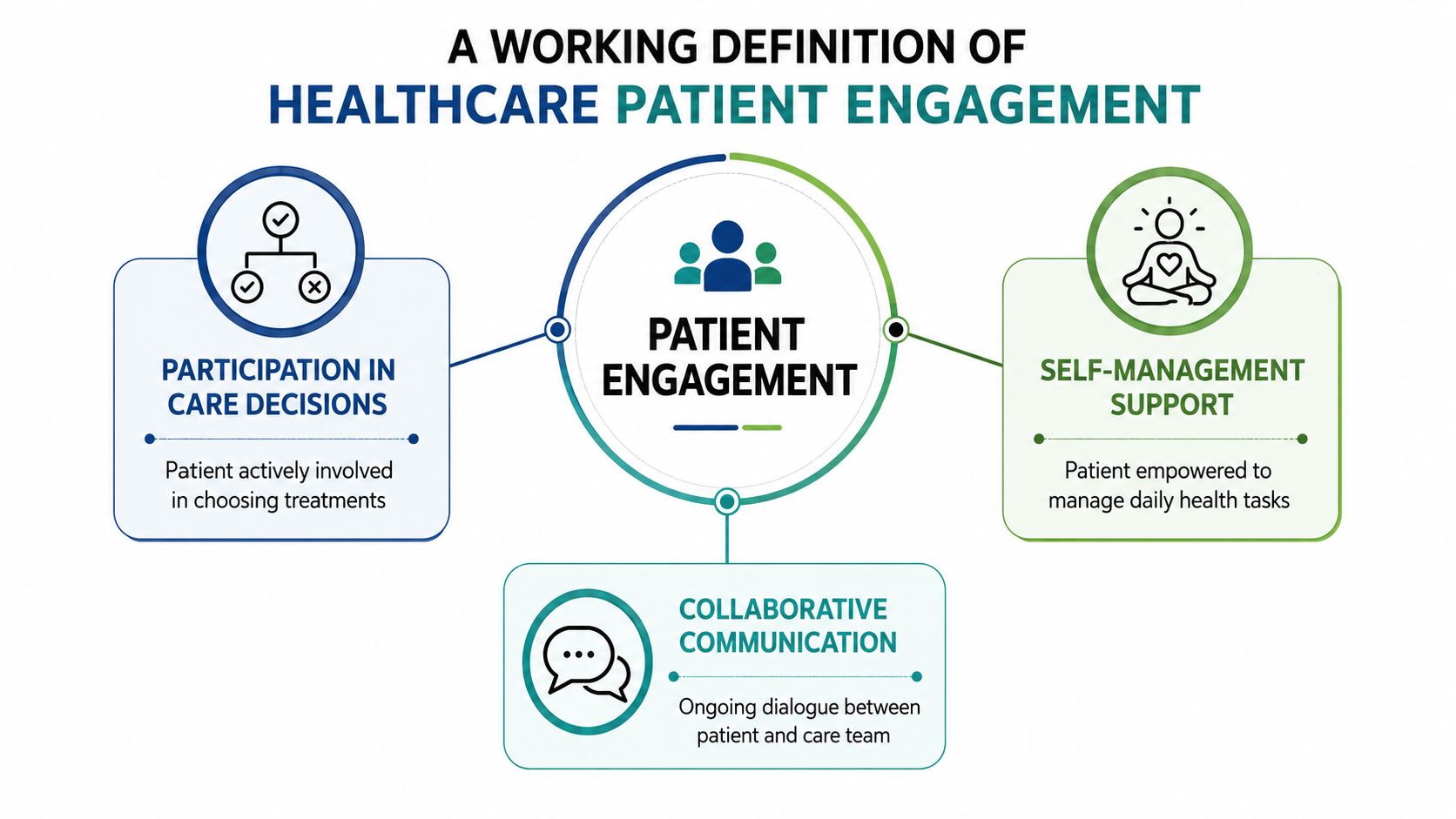
Healthcare patient engagement is not just “staying in touch.” It's the system that helps a patient participate in care decisions, manage their own health work, and exchange useful information with the care team without friction. Think of it as a hospital's nervous system. The EMR holds the record, the call center catches exceptions, and engagement routes the right signal to the right person at the right time.
Three jobs every engagement program must do
First, engagement has to support decision-making. That means a patient can understand options, ask questions, and choose a path with the care team rather than just receiving instructions. Second, it has to support self-management, which covers the repetitive work of care, medication, prep, follow-up, symptom reporting, and reminders. Third, it has to keep communication alive across the journey so patients aren't left guessing what happens next.
That definition matters because vendors often blur engagement with adjacent concepts. Patient experience is how the journey feels. Patient satisfaction is the patient's rating of that feeling. Patient activation is the patient's readiness and ability to take action. Engagement is broader and more operational. It's the mechanism that makes the other three easier to achieve.
The fastest way to confuse a buying committee is to use “engagement” as a synonym for survey scores.
A useful internal definition is this. If a workflow helps a patient make a better decision, complete a care task, or send a clinically useful signal, it counts as engagement. If it only creates more messages, more logins, or more dashboard activity, it probably doesn't. That distinction is why the strongest programs are built around action, not traffic.
What this means in practice
A patient booking a visit through a portal is engaged only if the booking reduces no-shows or speeds access. A patient replying to a reminder is engaged only if that reply changes the next step. A patient completing a symptom check-in is engaged only if the response triggers the right clinical review or reassurance. The value comes from the loop closing, not the message being sent.
Engagement is the connective tissue between care, communication, and operational response. If one of those pieces is missing, the program looks active but doesn't behave like a system.
Business and Clinical Benefits You Can Defend
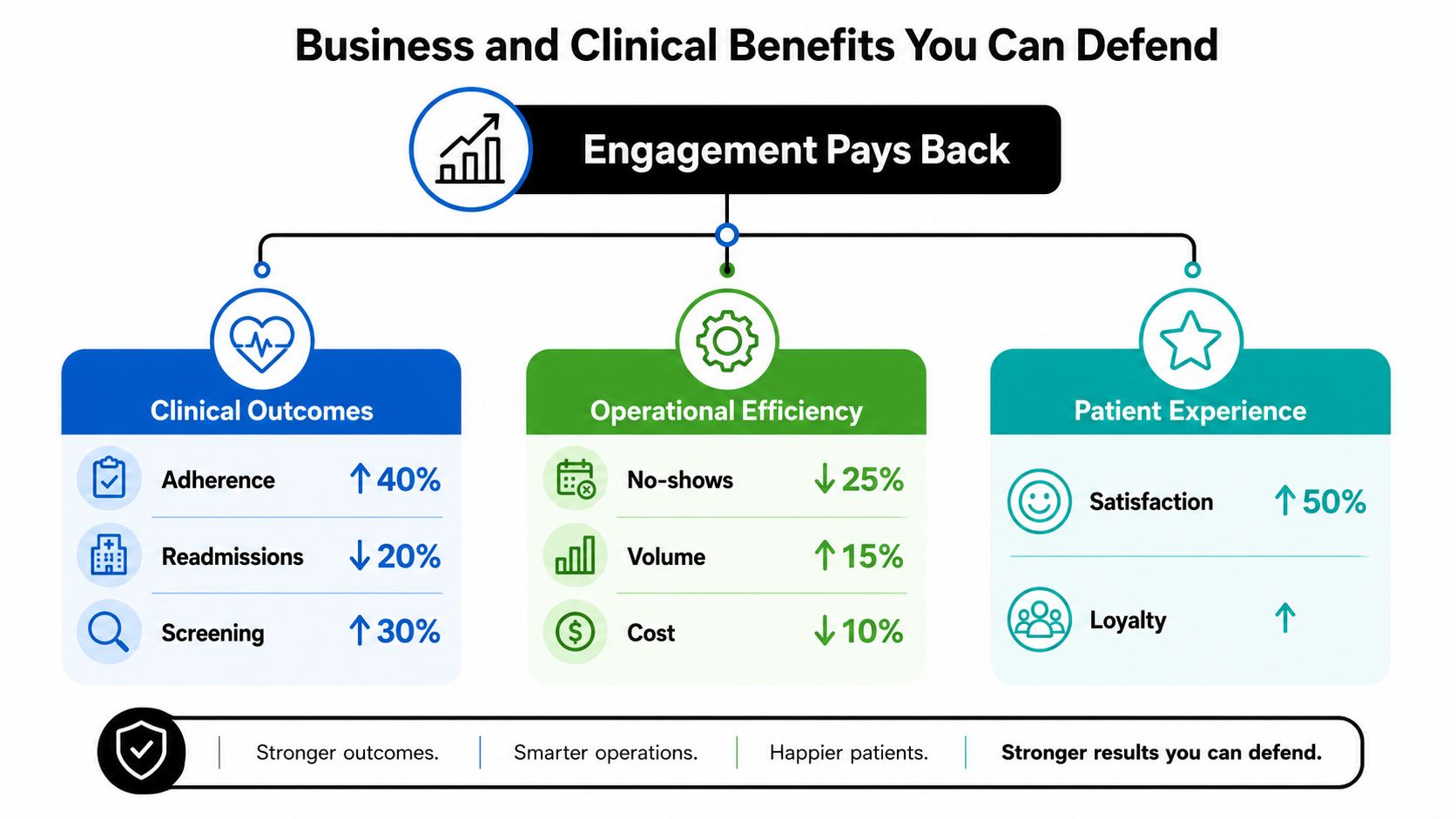
The cleanest way to justify healthcare patient engagement is to separate benefits into three buckets, clinical, operational, and financial. If a tactic doesn't fit one of those buckets, it's usually a nice-to-have. Leaders should stop approving broad “engagement” budgets and start funding specific outcomes.
Clinical benefits that matter
Clinically, engagement helps when it changes behavior or speeds detection. That includes medication adherence, prep completion, symptom reporting, and earlier escalation when something is off. The most defensible clinical gains come from workflows that make it easier for patients to do the next right thing, not from sending more educational content.
A common mistake is chasing the wrong signal. Portal logins, open rates, and message counts can look impressive, but they don't tell you whether the patient followed the plan or the care team caught a problem sooner. Measure the act that matters, not the click around it.
Operational benefits that leaders feel fast
On the operations side, engagement should reduce avoidable work. That means fewer inbound calls for simple questions, cleaner scheduling, fewer missed appointments, and less staff time spent on repetitive coordination. When engagement is working, contact centers stop acting like manual relays and start handling exceptions.
That also changes throughput. If routine tasks move into self-service and automated triage, staff can focus on the cases that need judgment. The trade-off is real, though. Poorly designed automation can create more work by sending people into dead ends or forcing them to repeat information.
Operational test: if a workflow creates extra calls, extra transfers, or extra back-and-forth, it isn't scaling, it's just moving the pain around.
Financial benefits that executives actually approve
Financially, engagement pays when it improves retention, accelerates collections, supports value-based performance, or lifts service-line capacity. Those effects don't always show up immediately, and they're rarely attributable to one message or one channel. The right way to think about return is cumulative, a better experience can lower leakage, a cleaner workflow can reduce labor, and a safer transition can avoid downstream cost.
Use the benefit-versus-metric map below to keep teams honest.
- Clinical outcome: Track follow-through, escalation, or care completion, not only message volume.
- Operational outcome: Track reduced calls, faster routing, and fewer manual touches, not only portal usage.
- Financial outcome: Track collections, retention, and capacity recovered, not only campaign reach.
The dark side is vanity KPI design. A dashboard full of opens and logins can hide a program that never improved care. If a metric can be gamed by curiosity, it's not strong enough to run a patient engagement strategy on its own.
Proven Strategies and AI Workflows That Actually Scale
The programs that scale share a simple pattern. They start with the patient's next need, not the organization's next broadcast. Then they use automation to handle repetitive steps, while a human stays available for exceptions, clinical nuance, and sensitive conversations.
Workflows that keep showing up in strong programs
Proactive outreach works best when the system anticipates a need and reaches out before the patient has to chase it. Smart scheduling matters when patients can book, reschedule, or confirm without waiting on hold. Two-way reminders help because they let people respond instead of forcing them to take a separate path.
Post-visit follow-up is where a lot of value gets lost. If the patient leaves with instructions but no easy way to ask questions, the care team inherits more confusion later. Chronic-care nudges and billing journeys matter too, because they sit in the spaces where patients most often disengage.
The practical model is conversational AI plus human escalation. Voice agents and chat agents can handle routine intake, appointment booking, refill routing, and basic status checks. Staff should only step in when the question needs judgment, a policy exception, or a high-emotion conversation. Anything else burns labor on work software can do faster.
For a useful overview of how remote monitoring fits into this broader workflow, XO's discussion of remote monitoring from XO is a solid reference point for teams thinking about patient-generated data and care continuity.
What production-grade workflows need
A demo isn't enough. A real workflow has to be context-aware, channel-flexible, EMR-connected, and measurable. If it can't read context, it asks the wrong question. If it can't move across channels, patients get stuck. If it can't write back to the record or the CRM, staff retype everything. If it can't show outcome data, nobody trusts it for long.
The most useful deployment pattern is simple:
- Route routine requests to automation. Use AI for booking, reminders, and triage where the path is standard.
- Escalate exceptions fast. Design a clean handoff to staff before the patient gets frustrated.
- Keep the knowledge base controlled. If the agent answers from your own policies and FAQs, you reduce hallucination risk.
- Measure end-to-end completion. Track whether the request was resolved, not just whether the bot replied.
A short video can help teams visualize this kind of flow, but the test is whether the workflow reduces friction in live operations.
When this is done right, the result isn't “more AI.” It's fewer dead ends, faster service, and more patients getting the next step without waiting for a callback.
Where Engagement Quietly Backfires
The biggest failure mode in healthcare patient engagement is assuming everyone can, or wants to, engage the same way. That assumption breaks in safety-net settings, in unstable households, and anywhere digital access, trust, language, or literacy create friction. The literature on marginalized populations is clear that barriers are structural, not just motivational, and implementation work keeps running into inequitable communication and trouble recruiting a patient mix that reflects real service users (PMC review).
When more touchpoints make the experience worse
More messages do not automatically mean better engagement. For a patient juggling work, caregiving, unstable housing, or low digital access, extra reminders can become noise or pressure. For a staff team, more inbound response channels can create fragmentation instead of clarity.
The other mistake is building for the average user and calling it inclusive. If your workflows assume steady internet, fluent English, or the ability to answer asynchronously during business hours, you've already excluded people. A digital-first design can widen inequities when it replaces human outreach instead of complementing it.
The red flags executives should watch
- One-size-fits-all messaging: If every patient gets the same cadence and channel mix, the program is probably too rigid.
- Engagement without access design: If patients need strong bandwidth, perfect literacy, or a modern device to participate, expect drop-off.
- No representative testing: If the pilot cohort looks nothing like the full patient population, the rollout will fail in the wild.
- Channel sprawl without ownership: If text, phone, portal, and email all exist but no one owns the handoff, patients get bounced around.
There's another uncomfortable truth. A lot of engagement programs stall because staff don't believe the effort is worth the time. Reviews of implementation barriers point to time constraints and low perceived effectiveness, which means the internal sell matters as much as the patient-facing design (NCBI Bookshelf). If clinicians and service teams don't see the work getting easier, the program dies.
Hard rule: Design for the lowest-friction path first, then add richer digital steps only where they clearly improve the outcome.
The safest strategy is layered engagement. Start with the lowest-bandwidth channel that still gets the job done, then offer digital depth where it helps and human support where it's needed. That keeps the program useful for the patients most likely to be missed by standard workflows.
Implementation Roadmap with HIPAA and Privacy Guardrails
A healthcare engagement program should launch in phases, not as a big-bang transformation. The goal is to prove one journey, harden the controls, then expand only after the workflow is reliable and the compliance story is clean. Procurement and security teams should insist on the same discipline they'd apply to any clinical system.
Phase by phase rollout
Weeks 0 to 8. Pick one journey with a clear operational pain point, such as appointment booking or post-visit follow-up. Define the success metrics, set up a sandbox, and test the AI behavior with real policy content before anything touches patients. Use this phase to find where the bot fails, where handoff breaks, and where staff need visibility.
Months 3 to 9. Add channels, integrate with EHR and CRM systems, and expand language support only after the first journey is stable. Here you decide whether the program can handle more volume without creating more work. If it can't, the architecture needs fixing before the rollout grows.
Months 9 and beyond. Put governance in place. That includes model evaluation, vendor consolidation, content ownership, exception handling, and regular review of what the AI can and cannot do. The program should now behave like a managed operating layer, not a pilot with a bigger budget.
For teams mapping the security side, Yellow.ai's enterprise-grade security overview is a useful reference point for the kinds of controls buyers should expect in an AI engagement stack.
HIPAA guardrails that should be non-negotiable
Keep the data footprint small. Use minimum necessary access, role-based controls, audit logging, and explicit consent where required for AI-generated messages. Put BAAs in place with any vendor handling protected data, and decide in advance what can flow into prompts, what must be masked, and what should never leave the source system.
Don't let legal review happen after the pilot. It's easier to design safely from day one than to retrofit guardrails after a workflow becomes popular. If a vendor can't explain data handling clearly, that's a procurement problem, not a documentation issue.
Security standard: If a team can't trace what data went where, who accessed it, and what the AI did with it, the system isn't ready.
Aligning with frameworks such as HITRUST, SOC 2, and ISO 27001 or 27701 can make procurement smoother, but alignment only matters if it supports actual operational controls. The point isn't to collect badges. The point is to reduce risk while the program scales.
Selecting an Enterprise Platform and Proving ROI
Buying the platform is the easy part. Proving value is harder, and that's where organizations either overbuy or under-instrument. A serious selection process should compare capabilities side by side, then force each vendor to explain how their system produces measurable operational change.
What to compare in a platform
Start with orchestration. Your platform should handle voice, chat, email, images, and video without forcing the patient into a single channel. Then check integrations. If the system can't connect cleanly into core systems like Epic, Cerner, Salesforce, Zendesk, Genesys, Freshdesk, HubSpot, or NICE, your staff will end up copying data by hand.
AI capability matters too, but not in the vague demo sense. Ask whether the platform supports multi-LLM routing, agentic retrieval over your own knowledge base, testing tools, and the ability to harden flows before launch. That's where operational trust comes from. Yellow.ai's AI analytics capabilities are worth reviewing if you need a sense of how performance measurement can be built into the engagement layer itself.
| Capability area | What good looks like | What usually fails |
|---|---|---|
| Omnichannel orchestration | One workflow across voice, chat, and email | Channel silos and duplicate work |
| Integration depth | Writes back to core systems | Rekeying and stale data |
| Knowledge grounding | Answers from approved content | Free-text guessing |
| Testing and governance | Preview, debug, and monitor before scale | Launch first, fix later |
How to prove ROI without hand waving
Use a simple chain. Measure baseline contact-center load, then track deflection from AI, containment quality, escalation success, appointment completion, and downstream retention or revenue effects. That sequence is more believable than a generic “efficiency gain” claim because it shows where value accumulates.
A mid-sized health system can often justify investment by showing that routine interactions move out of the queue, staff time is reclaimed, and patients complete more of the journey without a callback. The exact payback period depends on volume, configuration, and adoption, so don't let anyone sell you a universal number. Build the model from your own service mix and your own labor costs.
Ask every vendor demo the same questions.
- What happens when the bot is wrong? Show the handoff.
- Which outcomes are measured by default? Open rates aren't enough.
- How does the system handle multilingual service? Don't assume translation is good enough.
- What data is stored, and where? Security should answer without improvising.
- How fast can the workflow change after launch? If every update needs a ticket, the platform will age badly.
The right platform doesn't just answer patients. It gives your teams a way to run patient engagement like an operating function, with traceable outcomes and fewer blind spots.
If you're ready to turn patient engagement into a measurable operating layer instead of another batch of messages, Yellow.ai can help you design conversational workflows, connect them to your systems, and measure what they change. Talk to their team if you want a platform that can automate routine patient interactions without losing control of security, escalation, or outcome tracking.