














Most go to market strategy templates fail for a simple reason. They treat launch as a date, not a system.
That's backward for enterprise AI. A high-ACV platform doesn't win because marketing publishes a page, sales runs a webinar, and product declares general availability. It wins because the company builds a repeatable operating model grounded in customer evidence, tight positioning, disciplined pricing, and ongoing review. A rigorous GTM template even starts with a structured research phase, requiring teams to interview 10–15 specific customers and run win/loss analysis on 5–10 deals before they lock messaging or channel choices, according to the GTM strategy template guidance from GTM Playbook.
For enterprise AI, that difference matters more than in almost any other category. Buyers are evaluating technical risk, business risk, workflow change, compliance implications, and internal politics at the same time. If your plan is static, your launch will drift. If your plan operates like a living system, your teams can adapt without losing discipline.
Table of Contents
- Moving Beyond the Static GTM Plan
- Laying the Strategic Foundation
- Zeroing In on Your Ideal Customer
- Articulating Your Unfair Advantage
- Architecting Your Go-to-Market Engine
- Defining GTM Metrics and a Review Cadence
- Your Launch Operations Plan
Moving Beyond the Static GTM Plan
A static go to market strategy template looks neat in a board deck. It usually collapses in the first serious sales cycle.
Enterprise AI exposes every weakness in that approach. Messaging changes after security review. Pricing changes after procurement pushback. The buyer champion changes after an internal reorg. A promising use case stalls because the implementation team can't support the integration path. None of those realities fit a document built as a one-time launch artifact.
The better model is a GTM operating system. That means the template doesn't just store decisions. It defines how decisions get made, reviewed, and updated across product marketing, sales, product, customer success, and leadership.
Practical rule: If your GTM document can't tell the team what to revisit after a stalled quarter, it's not a strategy template. It's launch paperwork.
For enterprise AI, the operating system mindset is especially important because the sale is rarely just about software. Teams often need to educate the market, prove business value, address data governance concerns, and build trust with multiple stakeholders before commercial momentum appears. That changes the role of the template. It becomes the place where your company aligns on target segment, problem priority, sales motion, enablement narrative, proof assets, pricing logic, and review cadence.
A useful template also forces trade-offs. It stops teams from saying the platform is for every industry, every use case, and every buyer persona. It clarifies where you'll lead with outbound, where you'll rely on partner influence, and where you won't spend resources yet.
That's what works in practice. Not a static launch memo. A disciplined system that keeps learning while the market responds.
Laying the Strategic Foundation
Enterprise AI launches fail long before campaign execution. They fail when leadership refuses to make hard choices about market, buyer, and sales motion.
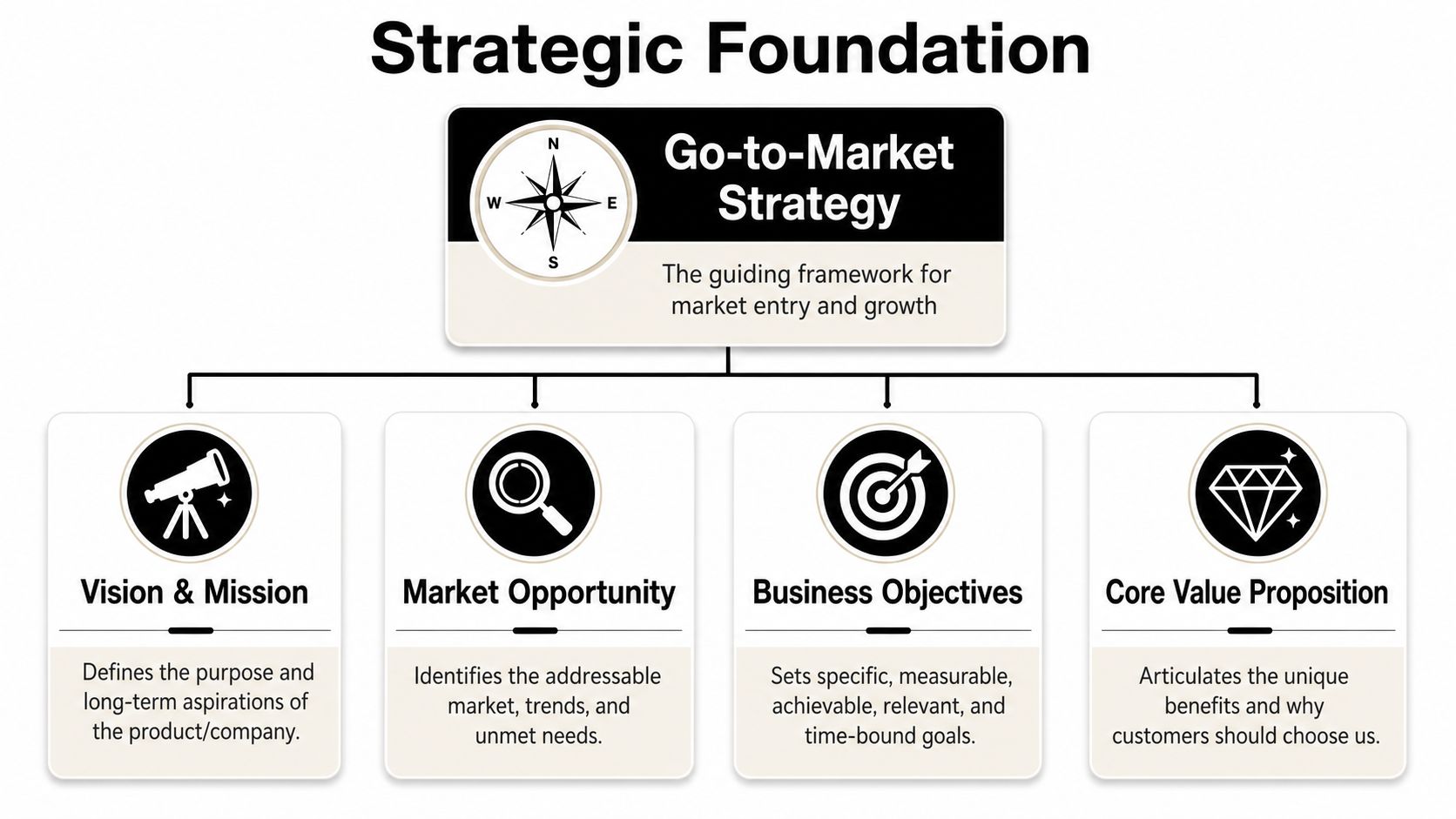
A strong go to market strategy template makes those choices explicit. It records what the company is trying to achieve, where it will compete first, and which assumptions still need proof. Without that layer of discipline, pricing, enablement, channel planning, and launch timing turn into opinion contests.
Treat the template like a decision system
For high-ACV enterprise products, the template should capture decisions in sequence. Start with the business objective. Then define the initial market, the buying problem, the economic buyer, the technical gatekeepers, and the proof required to close. That order matters because enterprise AI deals rarely move on product appeal alone. They move when the team can show business value, implementation fit, and risk control at the same time.
The foundation section should cover a clear set of operating questions: What outcome matters this year? Which segment can realistically produce it? What buying trigger creates urgency? Which objections will slow the deal? What evidence will reduce those objections? A template that answers those questions is far more useful than one filled with generic category notes.
Set goals that force trade-offs
Weak goals create expensive drift.
“Grow in financial services” is too broad to guide execution. A usable goal sounds more like this: win regional banks with high inbound service volume, long handle times, and an active CX transformation mandate, using a consultative sales motion and a six-month proof path. That level of specificity gives product marketing, sales, solutions, and customer success a shared operating target.
Goals should answer four questions:
- What business outcome matters most
- Which segment owns that outcome
- What sales motion supports it
- What constraints the team is accepting
The fourth question is where experienced teams separate themselves. Every serious GTM plan carries constraints. You may accept longer implementation cycles to win larger ACV. You may narrow the first use case to reduce security review friction. You may defer a second vertical because the sales team cannot credibly support two buying motions at once.
One practical input I use here is adjacent-market evidence. If you are shaping messaging for a legal workflow product, reviewing how buyers discuss value in categories like AI-powered legal assistant tools can sharpen the difference between “automation” claims and outcomes a buyer will defend in an internal business case.
Choose a beachhead you can actually win
A beachhead market is not the largest market. It is the one where pain is obvious, the buying committee can be mapped, and your team can produce proof fast enough to build momentum.
For enterprise AI, that usually means choosing a segment with three characteristics. The problem already has executive attention. The workflow impact can be measured in cost, revenue, or service improvement. The deployment path is demanding but still realistic for your current product and implementation team.
This is also where many launch plans become static documents instead of operating systems. Teams pick a vertical, but they never define the evidence needed to confirm that choice. A better foundation spells out what must be true in the first set of deals: repeatable discovery patterns, common integration requirements, a stable champion profile, and objection handling that does not change account by account.
A buying committee also needs evaluation material that reduces comparison friction. In conversational AI, a practical resource like this buyer's guide to evaluating conversational AI solutions can help GTM teams define selection criteria before they produce messaging, demos, and proof assets.
Narrowing the first market creates the conditions for expansion. In enterprise AI, that discipline matters more than reach.
Zeroing In on Your Ideal Customer
In enterprise AI, “mid-market and enterprise” is not an ICP. It's an admission that the work hasn't been done.
The most common GTM execution failure is misidentifying the Ideal Customer Profile. According to ZoomInfo's go-to-market strategy guidance, this shows up in 60% of failed launches, and teams are advised to define the ICP using at least 20 customer conversations. That's the right standard for enterprise AI, where surface-level segmentation almost always hides underlying buying constraints.

Why enterprise AI teams get ICP wrong
The usual mistake is overreliance on firmographics. Company size, region, and industry are useful filters, but they don't tell you whether an account is ready to adopt an advanced AI platform.
What matters more is the combination:
| Signal type | What to capture | Why it matters |
|---|---|---|
| Firmographic | Industry, company size, operating model | Helps define coverage and territory design |
| Technographic | Existing CRM, contact center stack, knowledge systems, data architecture | Shows implementation fit and integration friction |
| Behavioral | Buying triggers, executive initiatives, hiring patterns, transformation language | Reveals urgency and timing |
| Operational | Process complexity, handoff pain, service volume patterns, compliance sensitivity | Indicates whether the use case is painful enough to fund |
An enterprise AI buyer often looks attractive on paper long before they're buyable. A global brand may have budget and name recognition, but if ownership is fragmented across IT, operations, and business units, the deal may drag with no internal sponsor strong enough to pull it through.
Build an ICP that sales can use
A real ICP helps an SDR decide who to target, helps an AE qualify whether the opportunity is real, and helps product marketing build assets for the right objections.
That means your template should define:
- Primary segment with clear inclusion and exclusion criteria
- Common triggering events such as service transformation, cost pressure, channel redesign, or platform consolidation
- Required environment traits like API maturity, executive sponsorship, and internal data availability
- Expected blockers including security review depth, procurement process, and model governance concerns
For teams in regulated sectors, it can help to study how operators define target fit in adjacent analytics markets. This guide for banking leaders is useful because it shows how targeting improves when teams move beyond broad demographic assumptions and focus on practical segmentation logic.
Enterprise ICP work gets better when sales, product, and customer success all challenge the profile. Marketing alone can't see the whole picture.
A useful additional filter is “customer success viability.” Some accounts can buy, but they won't adopt. If the implementation burden is too high, the use case is too immature, or the internal team lacks ownership, the logo may close and still become a weak customer.
That's why the buyer problem matters as much as the budget. Teams wrestling with that distinction often benefit from material like this discussion on which CX problems actually need AI. It pushes a more disciplined question: where does AI meaningfully solve the issue, and where is the problem really process design, staffing, or channel hygiene?
Map the buying group, not just the buyer
Enterprise AI deals are multi-threaded. The economic buyer wants a business case. The technical evaluator wants reliability and governance. The operations lead wants workflow improvement. The frontline team wants usability. Procurement wants an advantage. Legal wants clarity.
Your go to market strategy template should reflect that by mapping the buying group against concerns and proof needs.
A simple framework looks like this:
- Economic buyer: Wants strategic fit, cost justification, and confidence that the initiative won't create political risk.
- Operational owner: Wants throughput, efficiency, and an implementation plan that won't disrupt active teams.
- Technical stakeholder: Wants architecture fit, security confidence, and a realistic integration path.
- Champion: Wants internal credibility, a compelling narrative, and support assets they can reuse internally.
When teams skip this map, they create one-size-fits-all messaging. In enterprise AI, that usually sounds impressive in a demo and falls apart in procurement, security, or executive review.
Articulating Your Unfair Advantage
Most enterprise AI companies don't lose because the product is weak. They lose because the market hears “another AI platform” and can't quickly understand why this one deserves attention.
That's a positioning failure. And it usually starts before the messaging work begins.
Validate before you amplify
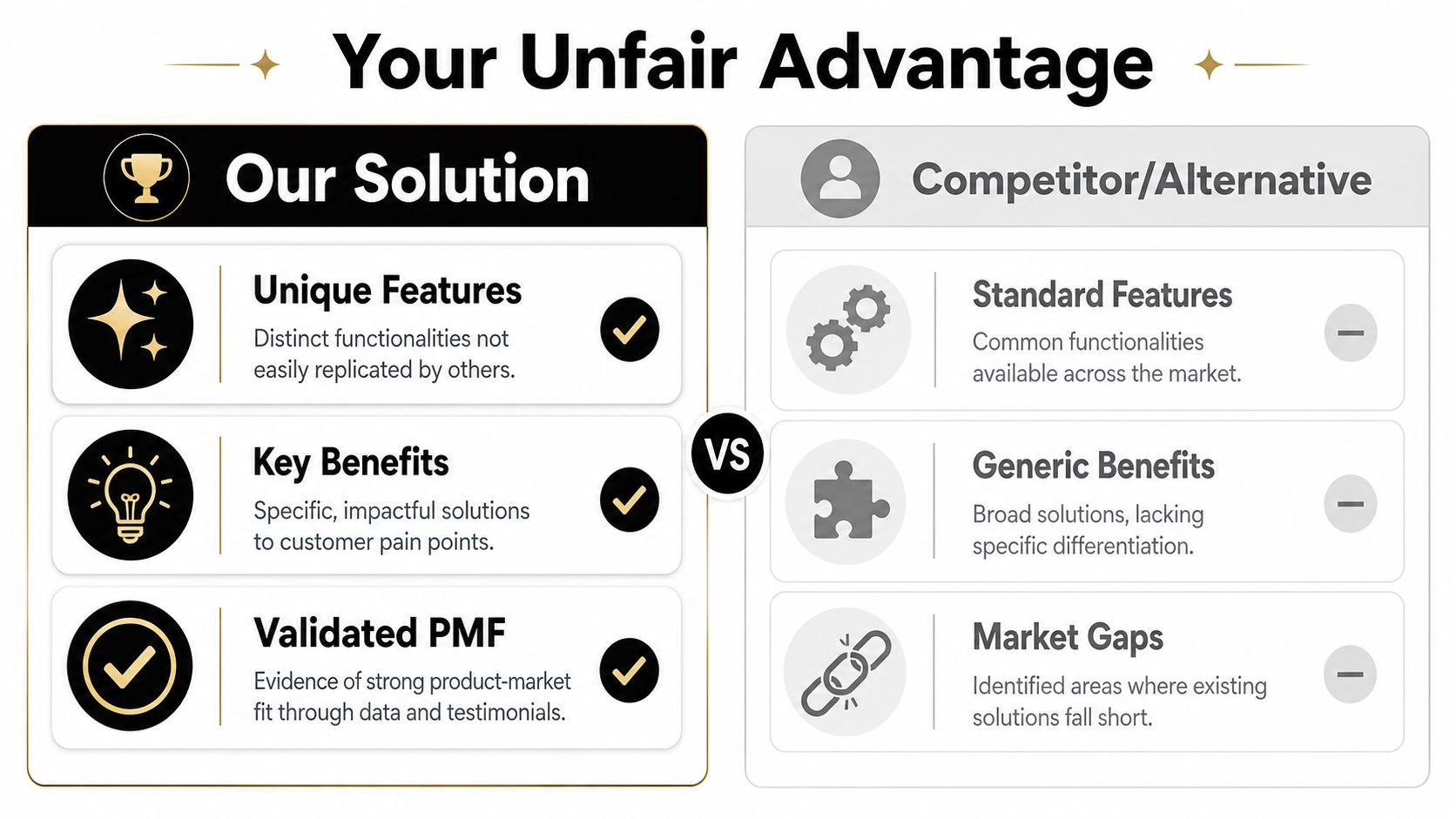
A value proposition is only credible if it rests on real proof that the problem matters and the solution fits. According to Elephant E-RevOps, validating product-market fit with 3–5 design partners is a critical step, and 95% of products that fail launch without that kind of pre-sell validation. The same guidance also notes that mapping the customer journey to select tactics for each funnel stage can reduce sales cycle length by 25%.
For enterprise AI, design partners do more than validate features. They help you answer harder questions:
- Is the use case urgent enough to get budget?
- Can the customer defend the project internally?
- Which objections appear before procurement?
- What proof does a technical evaluator need?
- Where does onboarding friction weaken value perception?
Write the value proposition for executive buyers
Weak messaging describes the product. Strong messaging describes the operational change the customer can buy.
That distinction matters because enterprise buyers don't fund AI platforms to acquire model access. They fund them to improve customer operations, compress service friction, modernize employee workflows, standardize automation, or reduce dependency on fragmented tooling.
A practical value proposition for enterprise AI should answer:
| Question | Weak answer | Strong answer |
|---|---|---|
| What is it | AI platform for automation | Enterprise AI system for orchestrating service and workflow execution |
| Who is it for | Large enterprises | Teams with complex support, compliance, and integration requirements |
| What problem does it solve | Inefficiency | Slow, inconsistent service workflows that break across channels and teams |
| Why choose you | Better features | Faster operational deployment, stronger governance, better workflow fit |
That's where many teams discover they don't have one message. They have separate narratives for economic buyers, technical evaluators, and practitioners. That's fine. The mistake is pretending one homepage headline can carry the entire sale.
Buyers don't remember feature inventories. They remember a credible explanation of why change is worth the risk.
Build a messaging matrix your team will actually use
A messaging matrix shouldn't be a brand exercise hidden in a slide deck. It should be a field tool.
The best matrices include four layers:
- Priority pain point
- Business impact
- Differentiated capability
- Proof or rebuttal against alternatives
For example, if a target account struggles with fragmented service workflows, your matrix should arm teams with:
- the operational pain in customer language
- the executive consequence of leaving it unresolved
- the platform capability that addresses it
- the reason competing approaches fall short, such as fragmented tooling, weak orchestration, or high implementation drag
“Unfair advantage” becomes useful language. Not because it sounds dramatic, but because it forces specificity. Your advantage must be something a buyer can observe in evaluation, not a slogan your team repeats internally.
If your team can't explain why a buyer should choose your platform over a legacy suite, a point solution, or building in-house, the market will decide for you.
Architecting Your Go-to-Market Engine
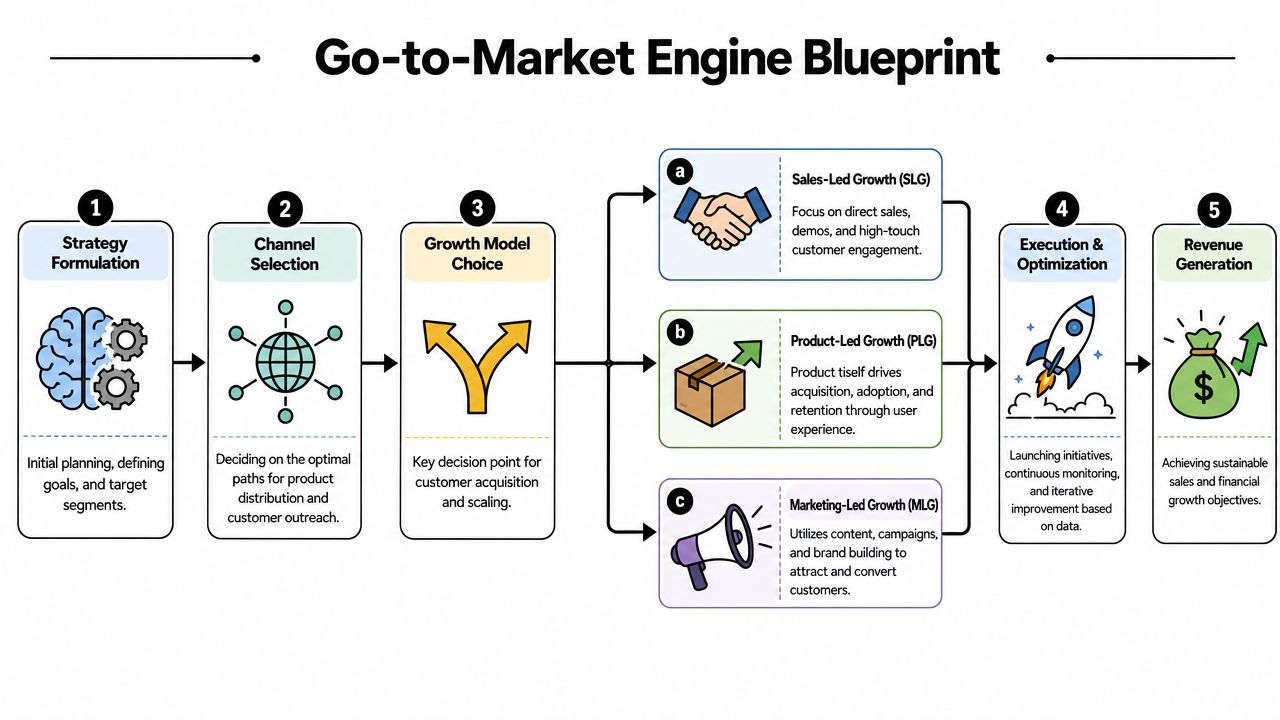
A go to market strategy template becomes operational when sales motion, channels, and packaging support the same commercial reality.
Many enterprise AI teams break this alignment. They choose a premium enterprise price point, then rely on lightweight demand capture. Or they build a complex consultative sale, then expect a product-led funnel to do the heavy lifting. Or they package around features while customers buy around use cases, governance, and rollout confidence.
The engine has to fit the product and the buyer.
Pick the sales motion your product can support
For high-ACV enterprise AI, the default motion is usually sales-led growth. That's not because product experience doesn't matter. It's because the buying process involves internal selling, technical validation, security review, and business-case justification.
Still, not every enterprise AI company should run a fully high-touch motion across every segment. A better way to think about the choice:
- Sales-led growth fits complex evaluations, large buying groups, and solutions that require change management.
- Product-led growth fits narrower use cases where users can experience value without heavy integration or executive approval.
- Hybrid motion works when product experience helps qualification, but revenue still depends on consultative selling.
The mistake is ideological attachment. Teams say they're PLG because it sounds efficient, even when the product requires workshops, integrations, and stakeholder alignment before a buyer can safely move forward.
A more useful question is simple. What must happen before a customer can say yes with confidence?
This walkthrough is worth watching because it frames GTM as a system of connected choices, not a list of tactics.
Choose channels that match enterprise buying behavior
Channel strategy for enterprise AI isn't about being everywhere. It's about creating enough trust, relevance, and proof in the places your buying group already pays attention.
For most high-ACV launches, the strongest channel mix usually combines:
- Account-based outreach: Focused targeting of named accounts with role-specific messaging.
- Thought leadership: Executive content that reframes the problem and educates the market.
- Customer proof assets: References, architecture narratives, implementation stories, and objection-handling content.
- Field and virtual events: Smaller environments where complex questions can be answered credibly.
- Partner influence: Integrators, consultants, and ecosystem partners who reduce perceived risk.
What doesn't work well is overdependence on broad top-of-funnel activity when the category still needs education. Enterprise AI buyers often need less hype and more translation. They want someone to explain how the platform fits their environment, what will change operationally, and how risk will be managed.
Package value before you debate price
Pricing and packaging are where strategic sloppiness becomes visible. If your packaging doesn't align to how value is bought, every deal turns into a custom negotiation.
The right structure depends on the category, but enterprise AI teams usually need to decide across three packaging dimensions:
| Packaging decision | What to define | Common mistake |
|---|---|---|
| Use case scope | Which workflows or business units are included | Selling “platform access” without a clear business entry point |
| Consumption logic | How usage, scale, or channel volume affects commercial terms | Mixing too many pricing signals into one offer |
| Expansion path | How customers grow after initial adoption | Leaving upsell logic to ad hoc sales negotiation |
A sound package does two jobs. It lowers entry friction for the first serious use case, and it preserves room for expansion once the customer proves value internally.
That's why pricing can't sit in its own corner of the template. It's tied to your sales motion, your proof strategy, and the kind of customer you want to retain.
Defining GTM Metrics and a Review Cadence
Enterprise AI launches rarely fail because the team lacked activity. They fail because nobody tied the numbers to operating decisions.
That is the job of the measurement section in a go to market strategy template. It should show whether the market understands the category, whether the sales motion is converting with the right accounts, and where execution is slowing down across a long, high-ACV cycle. For enterprise products, that means building a measurement system that can handle delayed revenue signals, heavy proof requirements, and multi-threaded deals.
Track revenue health and execution signals
A useful metric set separates business outcomes from in-flight execution. If those are blended into one dashboard, leaders either overreact to early noise or wait too long to fix a broken motion.
For enterprise AI, I usually group metrics into five areas:
- Pipeline creation: Are target accounts turning into qualified opportunities, or is interest staying stuck at the curiosity stage?
- Sales progression: Are deals advancing through discovery, technical validation, security review, business case approval, and procurement at the pace your model assumes?
- Deal quality: Do opportunity size, stakeholder mix, and sales effort match the segment you said you wanted to win?
- Retention and expansion: Are early customers broadening usage after the first deployment, or are they treating the product like a limited pilot?
- Operational friction: Where do deals stall repeatedly, and what pattern explains it?
That last category gets ignored too often. In enterprise AI, friction metrics often explain revenue misses before revenue metrics do. If security reviews drag, if pilots fail to convert, or if legal redlines keep expanding, the GTM issue is rarely just sales execution. It often points back to positioning, proof design, packaging, or implementation readiness.
A metric belongs on the dashboard only when a team knows what action it will take if that number moves.
Build a dashboard leadership will read
The best dashboard for a high-ACV launch is usually a one-page scorecard, not a maze of tabs. Executives need a fast read on risk. Operators need enough detail to change the weekly plan.
A practical structure uses three bands:
| Dashboard band | What belongs there | What it answers |
|---|---|---|
| Leading indicators | Meetings booked, target-account engagement, qualified pipeline, deal creation | Is the market responding? |
| Conversion indicators | Stage progression, pilot-to-paid conversion, sales cycle length, win/loss themes | Is the motion working with the right buyers? |
| Revenue indicators | NRR, average contract value, expansion rate, burn against plan | Is growth durable enough to support the investment model? |
For new-category AI products, I also recommend tracking one board-level assumption separately. Usually that is time to first production deployment, proof-of-value conversion, or expansion within the first customer cohort. Those assumptions drive the business case. If they slip, leadership should see it early and decide whether to change the offer, narrow the ICP, or put more support behind implementation and solution engineering.
Teams selling automation or service-efficiency outcomes should pressure-test ROI assumptions before they harden into pipeline targets. A practical way to do that is to use an AI automation ROI calculator during planning and again after the first few live deals.
Run reviews that lead to decisions
Review cadence matters more in enterprise AI than in lower-touch SaaS because the signal arrives unevenly. A quarter-end number can hide the fact that the underlying problem started months earlier in discovery quality, proof scoping, or stakeholder coverage.
A workable cadence looks like this:
- Weekly: pipeline quality, stage movement, top objections, blocked deals
- Monthly: conversion rates, segment performance, proof-to-production trends, channel output
- Quarterly: retention, expansion, sales efficiency, ICP fit, changes to the GTM model
Each review should answer four questions:
- What moved
- What stalled
- What changed in the market
- What decision the team is making next
The fourth question matters most. Reviews become useless when they stop at observation. A GTM operating system works when the meeting ends with a clear change. Tighten qualification. Rewrite the proof package. Add security enablement earlier. Shift outbound toward a narrower buying center. Reduce custom scoping for deals below a certain threshold.
Record those decisions in the template. The next review should start with whether the team made the change and what happened after. That discipline turns a static plan into a live operating system.
Your Launch Operations Plan
Enterprise AI launches fail in the handoff between strategy and execution. The teams that win treat launch as a managed rollout with clear gates, named owners, and fast feedback loops, especially when the deal size is high and the path to production runs through security, procurement, and multiple business stakeholders.
A useful launch plan removes ambiguity. It tells sales what is ready to sell, tells product what must hold up in live evaluations, and tells customer success what has to be in place before the first design partner becomes a production customer. For high-ACV AI platforms, that matters more than the announcement itself. A weak launch creates noisy pipeline, custom scoping chaos, and proof-of-concept work that never converts.
Run the launch as a staged rollout
Three phases usually work well, but the key discipline is in the exit criteria for each phase.
Pre-launch is about proving readiness before demand hits the system. Lock the commercial story, pressure-test the demo against real buying committee questions, prepare security and legal responses, define qualification rules, train AEs and SDRs on discovery, and confirm what customer success can support in the first wave. If the product still needs heavy founder translation to make sense in a sales call, it is not ready.
Launch is controlled activation. Release the core narrative to the market, start outbound against a defined account list, brief partner and analyst-facing teams if relevant, route inbound to the right motion, and watch early calls closely for message drift. For enterprise AI, the first live conversations usually reveal whether the market understands the category, not just whether the campaign got attention.
Post-launch is where the operating system proves itself. Review call recordings, proposal patterns, proof requests, security objections, and time-to-next-meeting by segment. Then make changes quickly. Narrow the ICP if the team is attracting curious but unqualified buyers. Rewrite the proof package if technical evaluators are asking the same questions in every deal. Adjust packaging if pricing discussions are getting stuck before business value is clear.
Assign ownership before launch week
Ownership drift kills launches. In enterprise SaaS, it usually shows up as delayed enablement, inconsistent discovery, and customer-facing teams improvising around gaps that should have been solved earlier.
A lightweight RACI is enough if it reflects how deals move.
Sample GTM Stakeholder Responsibility Matrix (RACI)
| Activity | Product Marketing | Sales/SDRs | Product Management | Customer Success |
|---|---|---|---|---|
| ICP definition | R | C | C | C |
| Messaging and positioning | R | C | C | I |
| Competitive battlecards | R | C | I | I |
| Demo and proof assets | C | C | R | C |
| Launch enablement | R | R | C | C |
| Customer onboarding readiness | I | I | C | R |
| Feedback loop after launch | R | C | C | R |
The table matters less than the operating rules behind it:
- Product Marketing owns the narrative, packaging, enablement assets, and message discipline in the field.
- Sales and SDRs own account execution, discovery quality, and structured objection capture.
- Product Management owns technical accuracy, use-case boundaries, and roadmap truth.
- Customer Success owns onboarding readiness, adoption risk, and early expansion signals.
In practice, one extra rule helps. Any asset used in a live deal needs a clear owner and a refresh date. Battlecards age fast. Demo environments break. Security answers change. If nobody is accountable for keeping those current, the launch degrades within weeks.
Use a pre-launch gate, not a loose checklist
Before release, confirm a short set of items that determine whether the team can execute without creating downstream friction:
- Targeting is fixed: account list, segment rules, buying roles, and exclusions are clear
- Messaging holds up in live conversation: reps can explain the business case without defaulting to feature tours
- Proof assets are ready: demo paths, objection handling, references, and evaluation materials match real enterprise scrutiny
- Operations are set: routing, SLA expectations, handoffs, and ownership across sales, solutions, and customer success are defined
- Review meetings are scheduled: the first weekly and monthly operating reviews are already on the calendar
If one of those gates is still open, reduce the launch scope. Start with one segment, one use case, or one motion. That is usually the better trade-off for enterprise AI platforms, where a smaller, disciplined rollout teaches the team more than a broad release that creates activity without conversion.
A strong GTM motion for enterprise AI depends on more than launch messaging. It requires the platform, orchestration, analytics, governance, and deployment depth to support complex customer journeys after the deal is signed. If you're evaluating enterprise-grade automation for CX or EX, Yellow.ai is worth a close look for teams that need agentic AI built for scale, control, and real operational use.



