














The outdated view of financial services automation is that it lives in the back office, moving data between systems while customers and employees continue to fight the same old friction. That view no longer holds. The market itself signals the shift. Financial automation was valued at USD 6.6 billion in 2023 and is projected to reach USD 20.7 billion by 2032, growing at over 14.2% CAGR, according to GM Insights on the financial automation market. That kind of growth doesn't happen because firms want more bots. It happens because automation has become part of how financial institutions operate, govern, and serve.
What's changed is the interface layer. RPA still matters. Workflow engines still matter. AI models for classification, extraction, and anomaly detection matter even more. However, the true value emerges when conversational and agentic systems sit atop that stack, transforming complex processes into something employees can act on quickly and customers can interact with naturally. In practice, that means fewer swivel-chair workflows, cleaner handoffs, and better control without making people learn yet another internal system.
Table of Contents
- The New Financial Services Automation Landscape
- Core Technologies Powering Modern Automation
- High-Value Automation Use Cases in Finance
- Designing Your Enterprise Automation Roadmap
- Measuring Automation Success With KPIs and ROI
- Common Automation Pitfalls and How to Avoid Them
- The Future Is Agentic Financial Services
The New Financial Services Automation Landscape
Siloed automation is becoming obsolete. A bank can't treat onboarding, servicing, compliance review, collections, finance close, and employee support as separate automation projects forever and expect enterprise value to emerge on its own.
The institutions achieving true advantage treat financial services automation as an integrated operating model. They connect process orchestration, core systems, controls, analytics, and experience channels into one fabric. That's what lets a customer complete a request in chat, an employee approve an exception from a workflow alert, and a compliance team review a flagged case with full context already attached.
Automation is no longer a side program
In most large firms, the first generation of automation focused on isolated tasks. A bot copied data from one screen to another. A rules engine routed claims. A script generated a report. Those projects often delivered value, but they also created fragmentation. Each team bought tools for its own bottleneck. Few redesigned the end-to-end process.
That approach breaks down at scale because the institution still pays the integration tax. Employees become the glue between systems. Customers wait while cases bounce between teams. Audit and control teams spend time reconstructing what happened after the fact.
Practical rule: If your employees are still translating between systems, you haven't automated the process. You've only automated a step.
The modern target is an autonomic enterprise
A stronger model is closer to an autonomic enterprise. Core workflows run through orchestrated systems. AI extracts and classifies information. Rules and models manage straightforward decisions. Human reviewers handle exceptions. Conversational and agentic interfaces become the access point for both CX and EX.
That matters for three reasons:
- Agility: Teams can change workflows without rebuilding every touchpoint.
- Compliance: Controls can be enforced at the workflow and data level, not patched in later.
- Experience: Employees and customers get one usable interface instead of a maze of portals, queues, and disconnected tools.
The CIO's challenge isn't choosing between efficiency and experience. Done well, the same architecture improves both. Cleaner workflows reduce manual effort. Better interfaces reduce friction. Stronger orchestration improves control.
Where leaders should focus now
The best automation programs don't start with “where can we deploy a bot?” They start with a narrower question. Where does the institution process high-volume, rules-heavy work that also creates avoidable friction for employees or customers?
That usually points to the same families of work: onboarding, servicing, claims, payments, reconciliations, close, fraud review, KYC support, and internal employee requests. The opportunity isn't just labor reduction. It's building a system where automation, people, and AI agents operate as one coordinated whole.
Core Technologies Powering Modern Automation
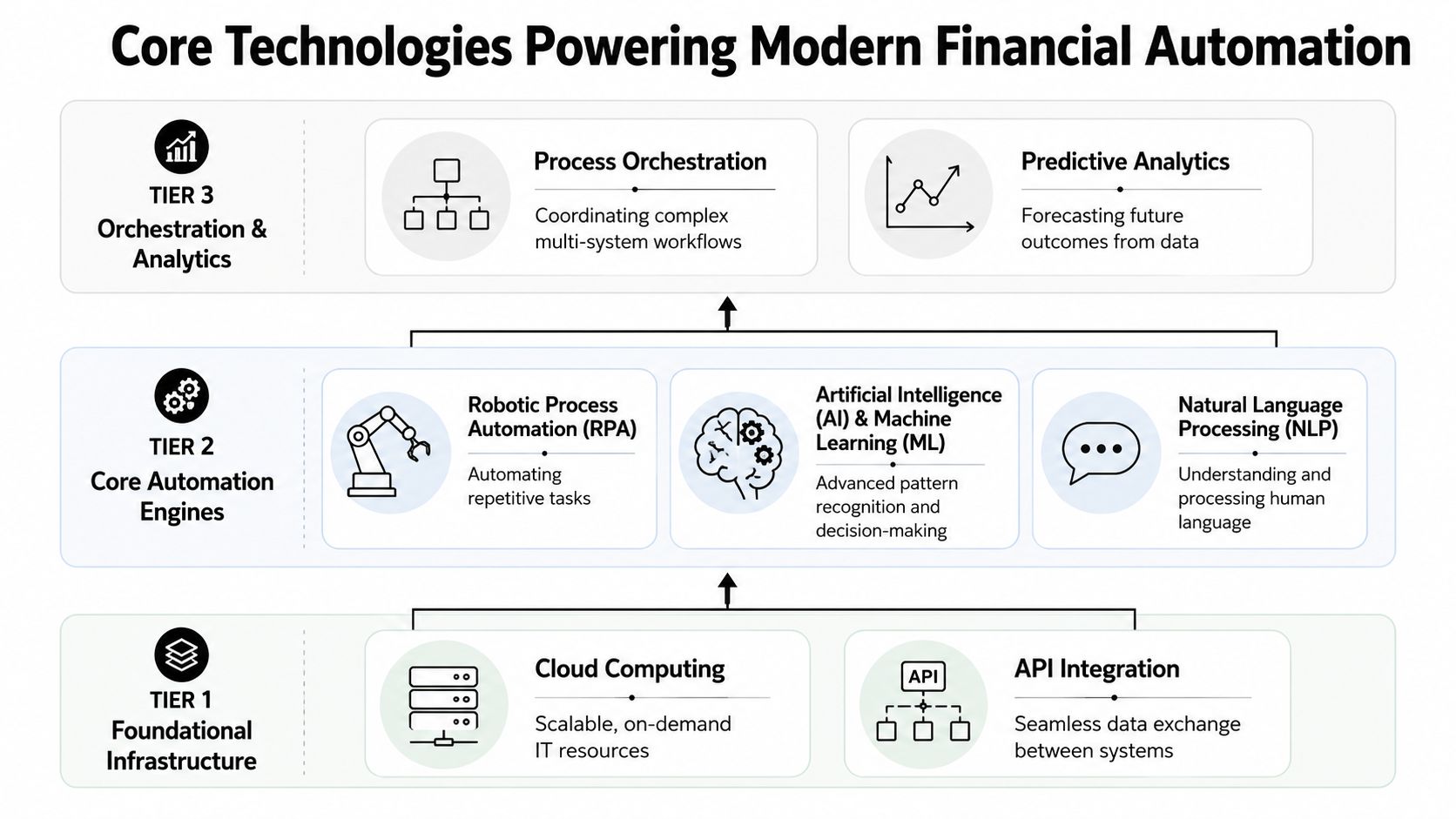
Financial services automation succeeds or fails at the architecture level. Institutions rarely need more point tools. They need a stack that can execute governed work across legacy systems, AI models, employee workflows, and customer touchpoints without creating new control gaps.
Foundational automation
The first layer is foundational. It includes RPA, workflow engines, BPM platforms, integration middleware, APIs, cloud infrastructure, and identity controls.
RPA still earns its place, particularly in environments where core systems do not expose usable APIs or replacement is years away. It handles repetitive UI interactions, batch updates, report movement, and structured handoffs across fragile systems. BPM and orchestration platforms do a different job. They define process logic, approvals, data requirements, exception paths, and audit evidence so automation runs as an operating model rather than a collection of scripts.
That distinction matters. A bank can deploy dozens of bots and still fail to reduce cost or risk if each bot mirrors a broken manual process.
A practical view of foundational automation looks like this:
| Layer element | What it does well | Where it breaks |
|---|---|---|
| RPA | Handles repetitive interactions with existing systems | Becomes fragile when screens or process steps change |
| BPM and workflow | Standardizes end-to-end processes and approvals | Adds little value if the underlying process is poorly designed |
| APIs and integration | Moves data reliably across systems | Depends on data quality and upstream system discipline |
Intelligent automation
The second layer brings judgment to structured work. Here, AI and ML, intelligent document processing, NLP, entity extraction, and anomaly detection improve how the institution interprets information before a person gets involved.
In finance operations, that usually means reading documents, extracting fields, classifying requests, flagging exceptions, identifying suspicious patterns, and routing cases based on policy. The value is operational, not cosmetic. Teams spend less time rekeying data, reviewing straightforward cases, or chasing missing information across disconnected queues.
This layer also changes the economics of compliance. Instead of applying human review to every file, institutions can direct review capacity to the cases that require it. That lowers handling cost while improving consistency, provided the models are monitored, the exception logic is explicit, and business owners accept that model drift is an operating issue, not a one-time implementation task.
Agentic orchestration
The top layer is agentic orchestration. This layer turns systems, workflows, and knowledge into an interface employees and customers can use.
A conversational or agentic system can sit at key control points and let users complete governed actions through chat or voice. An employee can approve an exception, provide missing information, request status, or pull the right policy guidance without opening five internal tools. A customer can finish a service journey without dropping from digital self-service into a branch visit or contact center transfer the moment the request becomes slightly more complex.
The most useful AI interface in finance isn't the one that generates the longest answer. It's the one that can complete the next governed action.
Platform choices become architectural choices at this stage. Some institutions assemble separate tools for voice, chat, agent assist, knowledge retrieval, testing, and analytics. Others consolidate to reduce integration overhead and governance complexity. For organizations building automation around both employee and customer experience, platforms such as conversational AI for BFSI operations can serve as the interface layer on top of existing systems, workflows, and knowledge sources.
The trade-off is straightforward. A richer interface can reduce friction and improve adoption, but it also exposes weak process design faster. If workflow ownership is unclear, data is inconsistent, or business rules conflict across channels, the agent will surface those defects immediately. The right sequence is to strengthen process controls and then place conversational and agentic AI on top as the interface layer for the broader autonomous enterprise.
High-Value Automation Use Cases in Finance
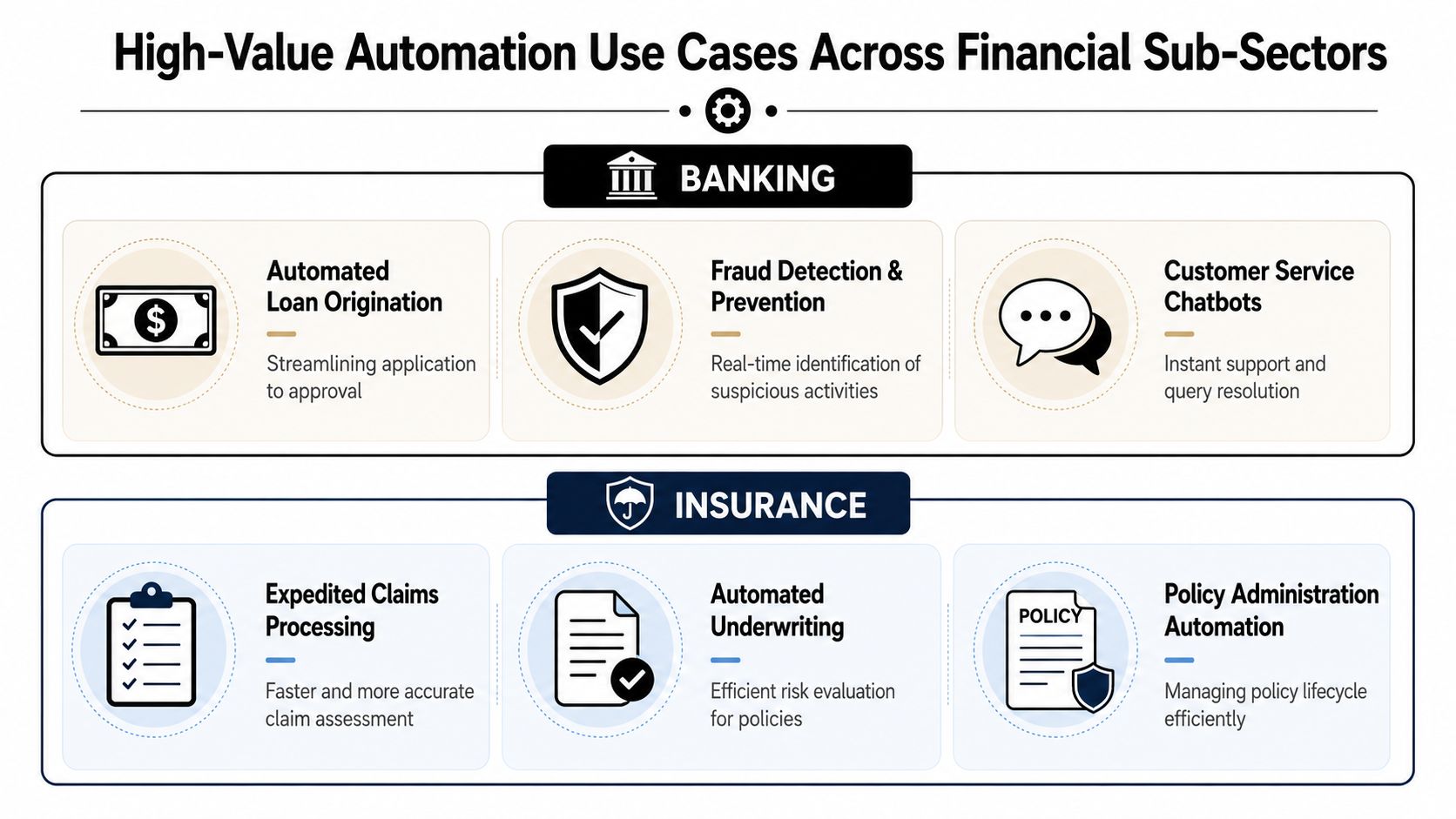
The highest-return automation programs in finance do not start with isolated bots. They start with journeys that combine transaction volume, compliance pressure, and visible customer or employee friction. The institutions getting the best results treat automation as an operating model. Conversational and agentic AI sit at the interface layer, while workflow, decisioning, and integration services carry the work through to completion.
As noted earlier, a large share of finance work is already suitable for full or partial automation. The practical takeaway is straightforward. CIOs do not need exotic AI experiments to justify investment. They need to redesign work that is already expensive, delay-prone, and difficult to govern at scale.
Banking
Banking usually exposes value quickly because the transaction base is large and the cost of delay shows up fast in both revenue and service metrics.
Loan origination remains one of the clearest targets. In many banks, applications still move across document portals, email chains, manual review queues, and core systems that do not share context well. That creates rework, longer cycle times, and weak visibility for applicants, relationship managers, and risk teams. A better design combines document capture, validation, workflow orchestration, and guided conversational follow-up so missing information is resolved in the flow of work instead of through repeated callbacks and status chasing.
Fraud and AML operations also produce strong returns, but only when leaders focus on investigator productivity rather than model novelty. Basic detection rules generate too many low-value alerts. Analysts then spend expensive time clearing noise, reconstructing case context, and documenting routine decisions. Automation improves this by enriching alerts, routing cases by risk and workload, assembling supporting evidence, and preserving a cleaner audit trail for every action taken.
Service operations are another high-value area because banks still separate self-service from fulfillment too often. Customers ask about disputes, payment status, account access, or address changes because they need an outcome, not just an answer. Employees have the same problem internally when they need policy guidance, exception approval, or case status. A conversational interface tied to governed workflows can authenticate, retrieve context, and complete the next approved action. That is where CX and EX improve together.
Insurance
Insurance operations contain more repeatable work than many teams admit. The judgment matters, but a large share of the surrounding work is data collection, validation, routing, and communication.
Claims intake and processing is a common example. Claimants submit details through digital forms, supporting evidence arrives through other channels, and adjusters often rebuild the case manually before they can make progress. Automation reduces that drag by extracting key fields, classifying documents, checking completeness, routing claims to the right queue, and sending status updates automatically. Adjusters spend more time on liability, coverage, and exception handling. Policyholders get clearer communication and fewer avoidable delays.
Underwriting support follows the same pattern. Underwriters add the most value when they assess risk and review exceptions, not when they gather standard information from scattered systems. Intelligent workflows can assemble the file, validate required inputs, and surface gaps before the case reaches an underwriter. Conversational tools can also handle broker or agent queries on submission status, requirements, and next steps without pushing every question into a service backlog.
The best insurance automation protects expert capacity for decisions that require judgment.
Policy administration often produces faster payback than headline-grabbing AI pilots. Endorsements, renewals, billing questions, beneficiary updates, and document requests are frequent, rules-based, and sensitive to turnaround time. They are well suited to automation because the controls are defined, the audit needs are clear, and customers notice every delay.
Payments and wealth management
Payments operations reward precision and punish inconsistency. Reconciliation, chargebacks, exceptions, and investigations often depend on pulling data from multiple systems, validating it, and assigning work to the right analyst with the right evidence attached. Automation cuts manual tracking, reduces avoidable handoffs, and improves traceability. Those gains matter in cost, but they matter just as much in compliance review and dispute handling.
In wealth and asset management, the opportunity is operational efficiency plus better service. Advisors and service teams still spend too much time on routine onboarding support, reporting requests, document retrieval, and account servicing tasks. Automation can prepare client context, assemble standard outputs, and handle secure service interactions before a specialist steps in. That gives advisors more time for planning and relationship work, and it gives clients faster response on routine needs.
A practical use-case filter helps keep the pipeline disciplined:
- High volume: The process occurs often enough to justify redesign and integration work.
- Rules with manageable exceptions: Standard paths can be automated, while edge cases still escalate cleanly.
- Cross-system friction: Staff or customers are currently compensating for poor handoffs between applications.
- Control sensitivity: Approvals, traceability, and audit evidence need to be built into the flow.
- Interface value: Conversational or agentic AI can remove friction for both customers and employees, not just add another channel.
For teams benchmarking employee-facing and customer-facing journeys, examples of BFSI conversational AI and automation workflows can help frame what the interface layer should do in practice. The right benchmark is not a polished demo. It is a governed journey that reduces cost to serve, shortens cycle time, strengthens compliance, and improves the experience on both sides of the enterprise.
Designing Your Enterprise Automation Roadmap
Large automation programs rarely fail because the technology is impossible. They fail because the operating model is vague. Teams pick use cases without process economics, deploy isolated tools without integration discipline, and wait too long to define control ownership.
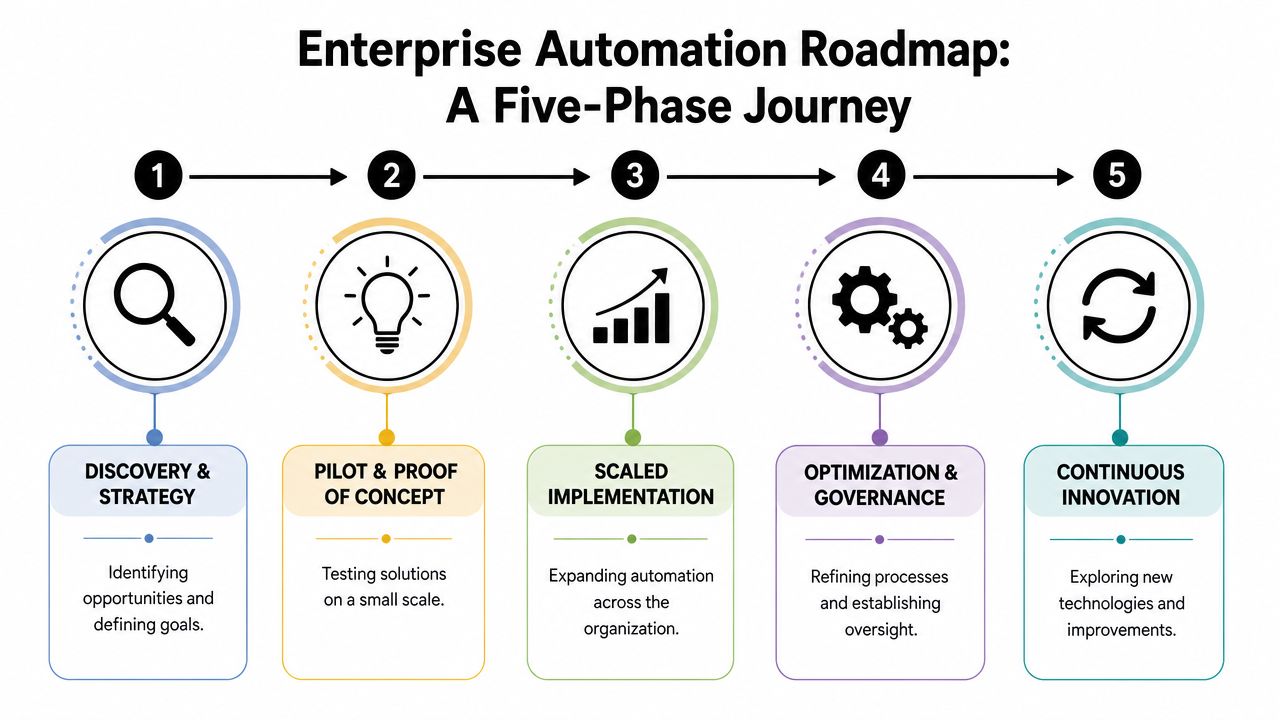
A useful roadmap has to be enterprise-safe from the start. This visual captures the sequence well.
Start with process economics
The first phase is discovery, but not the vague kind. Map work where the institution has high volume, clear rules, recurring exceptions, and measurable pain. Don't start with whichever team is most enthusiastic. Start where delay, rework, compliance exposure, or customer friction are visible.
The best candidates usually show the same symptoms:
- Manual handoffs: Work bounces across inboxes, spreadsheets, and portals.
- Exception blindness: Teams know exceptions exist, but they can't classify them cleanly.
- Channel fragmentation: Customers start in one channel and finish in another.
- Hidden control costs: Audit evidence, approvals, and validation are reconstructed manually.
At this stage, separate process steps into three buckets. Work the machine should do by default. Work the system should prepare for a human. Work a human must own directly. That boundary-setting matters more than tool selection.
Build the integration and control layer early
The second phase is data and integration. Many firms often underestimate the work involved. They assume automation is mainly a front-end effort when the main bottleneck is how the workflow reaches ERP systems, policy administration systems, claims platforms, payment rails, CRMs, case tools, and knowledge repositories.
A roadmap gets stronger when the institution makes a few design decisions early:
| Decision area | Good enterprise choice | Weak choice |
|---|---|---|
| System connectivity | API-first where possible, RPA where necessary | Heavy dependence on UI scraping |
| Workflow ownership | Clear owner for process, controls, and exceptions | Shared ownership with no one accountable |
| Data evidence | Event logs, case history, and approval trace built in | Audit reconstruction after deployment |
This is also where compliance and risk teams should be brought in, not after the pilot. If the process touches KYC, AML, lending, claims, financial close, or regulated customer communications, governance can't be an afterthought.
Scale through operating discipline
Deployment should be phased, but not timid. Pilot one meaningful workflow, prove that the institution can operate it safely, then scale through a repeatable delivery model. A center of excellence can help, but only if it does more than maintain templates. It should govern architecture, reusable integrations, testing standards, model oversight, and release discipline.
A practical example comes from the finance side itself. According to MindBridge's write-up on financial automation, large banks have reduced month-end close cycles from 10 days to as few as 2 to 4 days by integrating RPA with ERP workflows and real-time data validation. That result matters because it shows what happens when orchestration, data validation, and workflow control operate together instead of as separate initiatives.
A short walkthrough can help teams visualize that kind of program design in practice:
After pilot success, scale depends less on code and more on change discipline. Employees need clear role changes, not vague promises that automation will “help.” Operations managers need dashboards that show exception aging, handoff health, and control adherence. Business leaders need release cadences that don't create fear every time a downstream system changes.
Build the roadmap around process ownership, not tool ownership. Tools change. Operating accountability shouldn't.
Measuring Automation Success With KPIs and ROI
Automation programs get into trouble when they rely on one metric. If the only question is labor reduction, leaders miss the wider value. If the only question is experience, they understate the economics. A good measurement model balances operational performance, financial return, and experience quality.
Operational KPIs
Operations leaders should start with flow metrics. These show whether the redesigned process is healthier than the old one.
Track measures such as:
- Cycle time: How long the process takes from initiation to completion.
- Touch count: How many human interventions are still required.
- Exception rate: How often work falls out of the straight-through path.
- Rework rate: How often cases return because data was incomplete or wrong.
- Control adherence: Whether required approvals and validations happened in sequence.
These metrics matter because automation can create the illusion of speed while merely moving the queue. If touch count stays high and exception rates rise, the workflow hasn't matured.
Financial KPIs
Finance and IT budget owners need a tighter economic view. That means quantifying both direct impact and avoided cost.
Common measures include:
| KPI | What it shows |
|---|---|
| Cost per case or transaction | Whether unit economics improve as the workflow scales |
| Capacity released | Whether teams can absorb growth without proportional headcount expansion |
| Error-related cost | Whether reversals, remediation, or corrections decline |
| Time-to-value | How quickly the program starts producing measurable benefit |
For teams building a business case, a structured model helps expose assumptions early. A practical starting point is an automation ROI calculator from Yellow.ai, which can help estimate the economics of service and workflow automation before the institution commits to a broad rollout.
The important point is to distinguish between hard savings, capacity gains, and strategic benefits. They're all real, but they shouldn't be blended into one number without explanation.
Experience KPIs
CX and EX leaders need a separate lens because bad automation often shifts effort onto people. A process may look cheaper while becoming harder to use.
Measure outcomes like:
- Customer completion rate: Whether users can finish the journey without abandoning it.
- First contact resolution: Whether the interaction solves the issue in one go.
- Employee effort: Whether staff spend less time chasing information across systems.
- Escalation quality: Whether cases that do reach a human arrive with usable context.
- Satisfaction trends: Whether users report that the process feels easier and clearer.
A balanced scorecard works better than a headline ROI number because it surfaces trade-offs early. If costs decline but exception handling worsens, you'll see it. If self-service rises but escalation quality collapses, you'll see that too.
Common Automation Pitfalls and How to Avoid Them
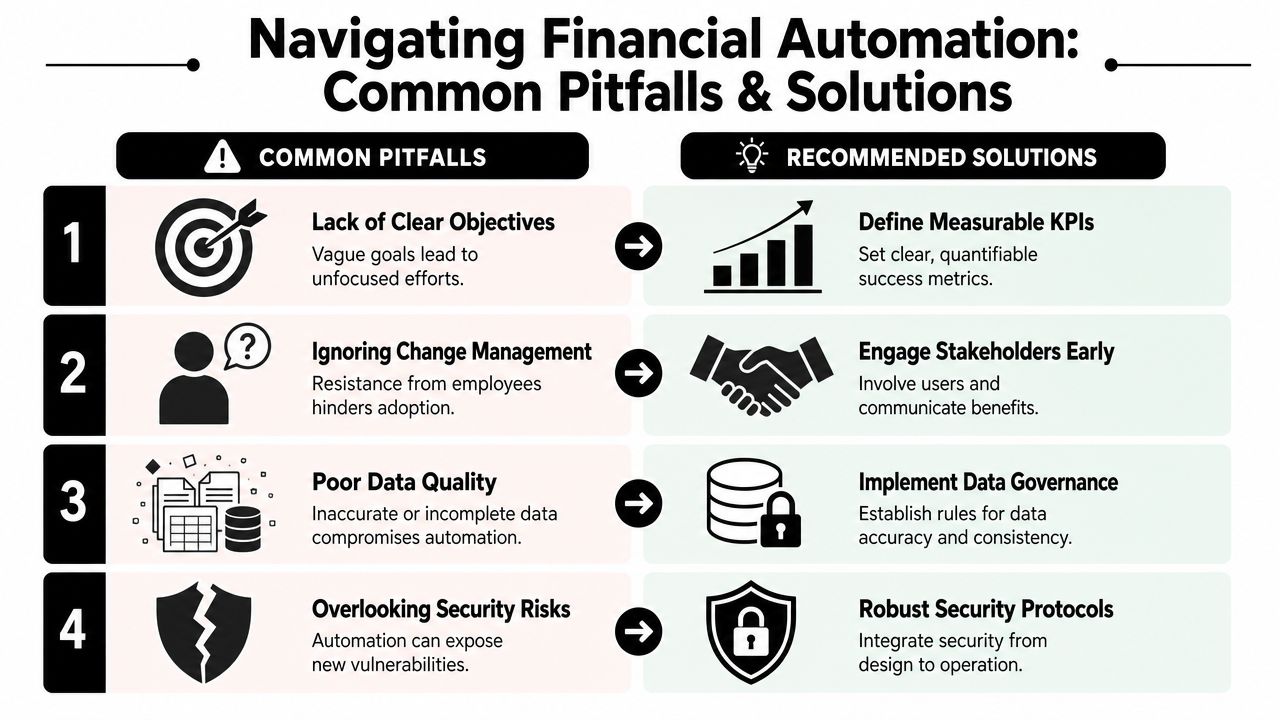
Most failed automation efforts don't fail for dramatic reasons. They fail subtly. A bot breaks after a UI change. A workflow goes live without enough exception logic. A service channel deflects requests but can't complete them. The program still exists, but trust in it disappears.
The brittle bot trap
A common mistake is assuming task automation equals process automation. It doesn't. If the design relies heavily on screen scraping, static rules, and one-off scripts, small upstream changes can cause disproportionate disruption.
The safer pattern is layered automation. Use APIs where available. Keep RPA focused on the gaps. Put orchestration above the task layer so routing, approvals, and exception handling survive even if one integration changes.
This matters in compliance-heavy workflows too. PwC notes that one large retail bank reduced false-positive alerts by 30 to 50% by integrating ML-based transaction scoring with automated workflows for AML and fraud detection, according to PwC's analysis of analytics and automation in financial services. The lesson isn't just that machine learning helps. It's that rules alone often create operational noise, and workflow design has to evolve with the detection method.
Automating bad processes
Another failure pattern is automating around legacy complexity without fixing the underlying process. Teams preserve every approval, duplicate validation, and historical workaround, then wonder why the automated version still feels slow.
The fix is blunt but effective. Redesign before you automate.
Ask three questions:
- Does this step reduce risk, or is it just inherited practice?
- Can the system validate this automatically at the source?
- Should this go to a human only when there's an actual exception?
If every case needs a human “just to be safe,” the workflow hasn't been designed with enough confidence or control.
Weak data and weak governance
Data quality issues undermine automation. Missing fields, inconsistent formats, duplicate records, and unclear ownership all create downstream failure. The institution then blames the bot, the model, or the agent, when the root problem is data discipline.
Governance problems are just as costly. If nobody owns model review, release management, access policy, prompt controls, or exception thresholds, scaling becomes risky fast.
Mitigation usually comes down to a few concrete actions:
- Assign process owners: Someone must own outcomes, controls, and exception policy.
- Instrument everything: Event logs, case traces, and approval records should be captured by design.
- Govern prompts and knowledge access: Conversational systems should only retrieve and act within approved boundaries.
- Test against real exceptions: Don't certify the happy path and call it done.
Ignoring the human side
Automation projects often get sold as technical modernization when the actual effect is role redesign. Employees lose certain tasks, gain oversight responsibilities, and have to trust new systems to do work they once handled manually.
That transition needs visible operating support. Managers should explain which tasks are changing, what good exception handling looks like, and how performance will be measured after deployment. Without that, staff create manual shadow steps to protect themselves, and the process regresses.
Financial services automation succeeds when people trust the workflow enough to stop rebuilding it outside the system.
The Future Is Agentic Financial Services
The next phase of financial services automation isn't more disconnected bots. It's a coordinated model where systems can perceive events, retrieve context, trigger actions, and involve people only where judgment or oversight is required. That's the path toward a more autonomous enterprise.
From workflow automation to operating model
Agentic AI matters because it changes how people interact with complex financial processes. Instead of searching across systems, employees can work through guided interfaces that pull the right context into the moment of action. Instead of forcing customers through rigid menus, the institution can let them move through service journeys in more natural language while still enforcing policy and controls underneath.
This doesn't remove the need for workflow engines, rules, or analytics. It makes them usable at scale. The agent becomes the interface layer across voice, chat, knowledge retrieval, and action systems. That's a meaningful shift for both EX and CX because it reduces context switching and makes automation available at the exact point where people need it.
Teams exploring that model can get a practical grounding in how these systems differ from simpler assistants through Yellow.ai's explanation of agentic AI and how it differs from AI agents.
Trust will decide what scales
There's a real constraint, though. The technology is moving faster than governance clarity. The U.S. Treasury's report on AI in financial services highlights a broader issue. A significant regulatory and trust gap exists for applying agentic AI in financial services, particularly for underserved populations, with limited guidance on governing explainability, bias, and consent, as reflected in the Treasury report on artificial intelligence in financial services.
That gap should change how CIOs deploy agentic systems.
The practical response is to design for governable autonomy:
- Scoped authority: Agents should act only within defined process and data boundaries.
- Human review for material decisions: Escalation paths should be explicit and auditable.
- Traceability: Institutions need records of what the agent retrieved, recommended, and executed.
- Role-based access: Context should be surfaced according to permissions, not convenience.
- Ongoing oversight: Models, prompts, retrieval behavior, and workflow outcomes all need review.
Agentic financial services will scale first in places where firms can combine utility with control. That usually means internal employee workflows, service interactions with clear policies, and exception handling wrapped in strong approval logic. Over time, the winners won't be the firms with the most AI features. They'll be the ones that make autonomy trustworthy enough to operationalize across the enterprise.
Yellow.ai provides an agentic AI platform for enterprise CX and EX automation across voice, chat, and workflow-driven service journeys. For financial institutions, the practical question isn't whether to add another bot. It's whether your automation stack can support governed, conversational, cross-system execution at enterprise scale.



