














A contact-center leader watches an AI agent refuse a refund. The customer asks why, the compliance team asks whether the decision followed policy, and the CEO wants to know why a loyal account was escalated. The platform shows the final answer, but not a defensible trail from customer message to intent, policy check, retrieved document, tool call, and handoff.
That gap makes explainable AI methods an operational requirement for modern agent platforms. CX and EX teams need explanations that help people investigate errors, review high-risk decisions, answer customers, and improve workflows. They also need to understand the limits of each method, especially when several models, retrieval systems, business rules, and autonomous actions work together.
Table of Contents
- Why Explainable AI Methods Matter in Modern Agent Platforms
- What Explainable AI Really Means and Where It Came From
- The Major Families of Explainable AI Methods
- Comparing the Most Widely Used Techniques
- How to Evaluate Whether an Explanation Works
- Explainable AI in CX and EX Use Cases
- Deploying XAI in Production Agent Systems
- Choosing and Operationalizing XAI for Your Stack
Why Explainable AI Methods Matter in Modern Agent Platforms
An agent platform rarely makes a decision through one isolated model. A customer's message may pass through language detection, intent classification, authentication, retrieval, policy evaluation, tool selection, response generation, and escalation logic. If the agent refuses a refund, a useful explanation must distinguish between those layers. “The AI decided the request was ineligible” isn't enough for a support supervisor who needs to identify the failing component.
The operational questions leaders need answered
A defensible explanation should help the right person answer a specific question:
- For the customer: Which policy or account condition affected the outcome?
- For the supervisor: Did the agent misunderstand intent, retrieve the wrong article, or apply the wrong workflow?
- For compliance: Which inputs, rules, model version, and approval path produced the decision?
- For engineering: Can the failure be reproduced, tested, and corrected?
- For the business owner: Should the system have acted autonomously, or should it have handed the case to a person?
These questions require different evidence. A feature attribution may help explain an intent classifier, while a policy engine needs a rule trace. A retrieval-augmented response needs document provenance, and a voice handoff needs a timestamped event trail that can be inspected without delaying the conversation.
Practical rule: Explain the decision path that matters to the stakeholder, not every internal calculation the system performed.
Explainability also supports trust calibration. The objective isn't to make users trust every answer. It's to help them understand when the agent is reliable, when it is uncertain, and when a human review is appropriate. That distinction matters in regulated environments, where a persuasive explanation can still be wrong or incomplete.
Without an explanation layer, teams often treat the transcript as the entire audit record. A transcript shows what the agent said, but it may not show which model selected the intent, which passage supported the answer, whether a tool returned stale data, or why orchestration moved the case to another agent. An auditable platform therefore needs a structured decision trace alongside the conversational record.
What Explainable AI Really Means and Where It Came From
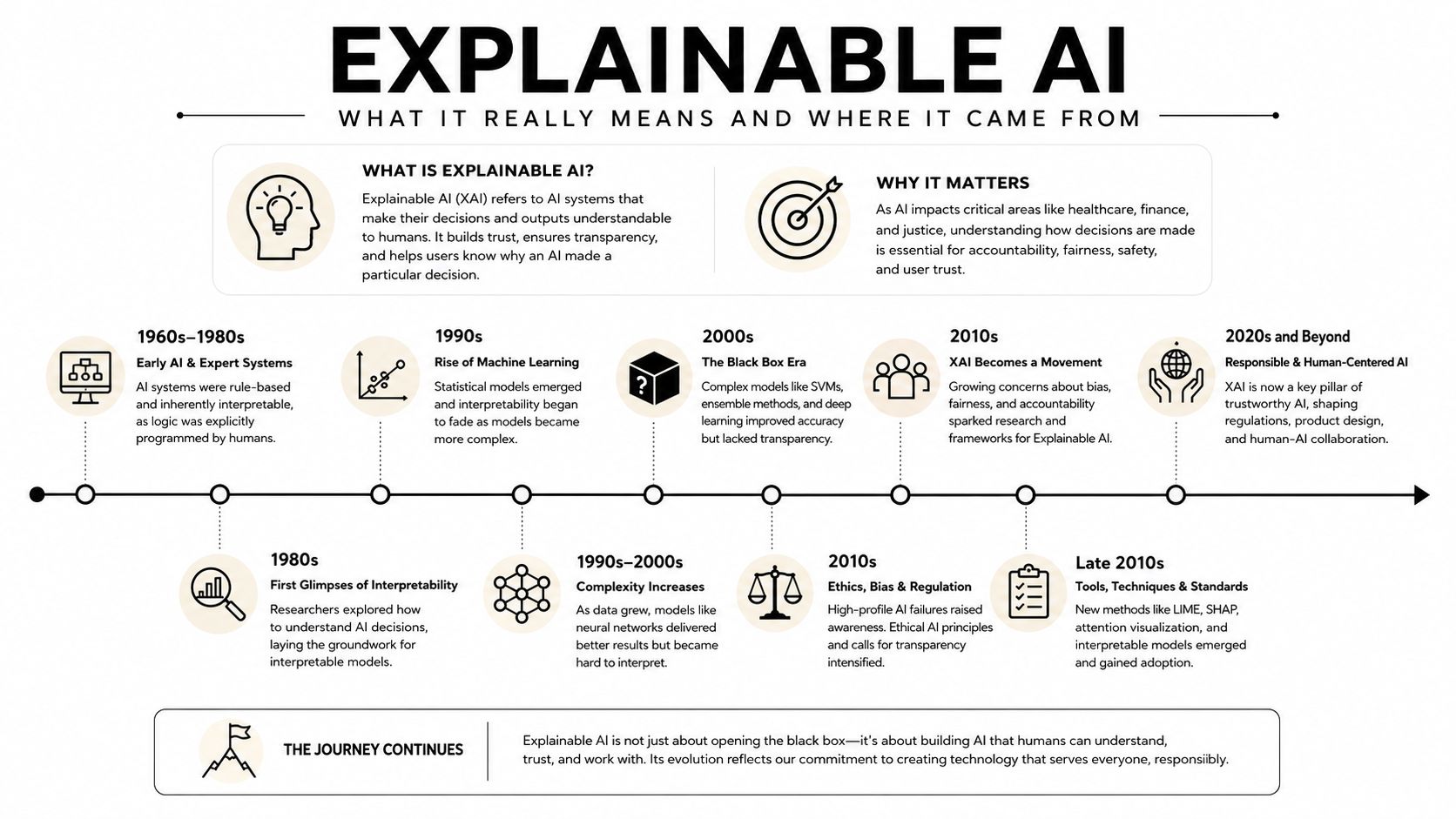
Explainable AI, or XAI, is the practice of producing human-understandable evidence about how an AI system reached an output. That evidence can describe influential inputs, alternative outcomes, retrieved sources, model behavior, or the conditions under which a decision would change. It's different from documentation, which describes how a system was built, and from interpretability, which focuses on whether the model's internal mechanics are understandable by design.
A decision tree is a glass box. Its branches can be inspected directly. A large language model is closer to a dark room: external methods act like a flashlight, illuminating selected aspects of its behavior without making every internal computation transparent. The flashlight can be useful, but it isn't the same as turning the whole system into glass.
The DARPA inflection point
Explainable AI became a formal research program in modern AI history when DARPA formulated the program in 2015 and issued Broad Agency Announcement DARPA-BAA-16-53 on August 10, 2016, as documented in the DARPA XAI retrospective. The four-year program began in 2017, with an 18-month technology demonstration phase followed by a 30-month comparative evaluation phase.
The program's goal was to create machine-learning techniques and explanation methods that would help end users understand, appropriately trust, and effectively manage AI systems. Its lasting contribution was to treat explainability as a system requirement involving both technical methods and human factors. An explanation needed to help people predict model behavior, assess strengths and weaknesses, and decide when reliance was appropriate.
That framing remains useful for agent platforms. A conversational agent isn't explainable merely because it can generate a natural-language rationale. The rationale must connect to the system's actual behavior and help a real stakeholder perform a task, such as approving an exception, correcting a routing rule, or challenging a decision.
For readers mapping XAI onto autonomous workflows, agentic AI fundamentals provide helpful context about the distinction between agents, tools, and orchestration. Explainability then adds the evidence layer that shows how those parts interacted during a particular outcome.
The Major Families of Explainable AI Methods
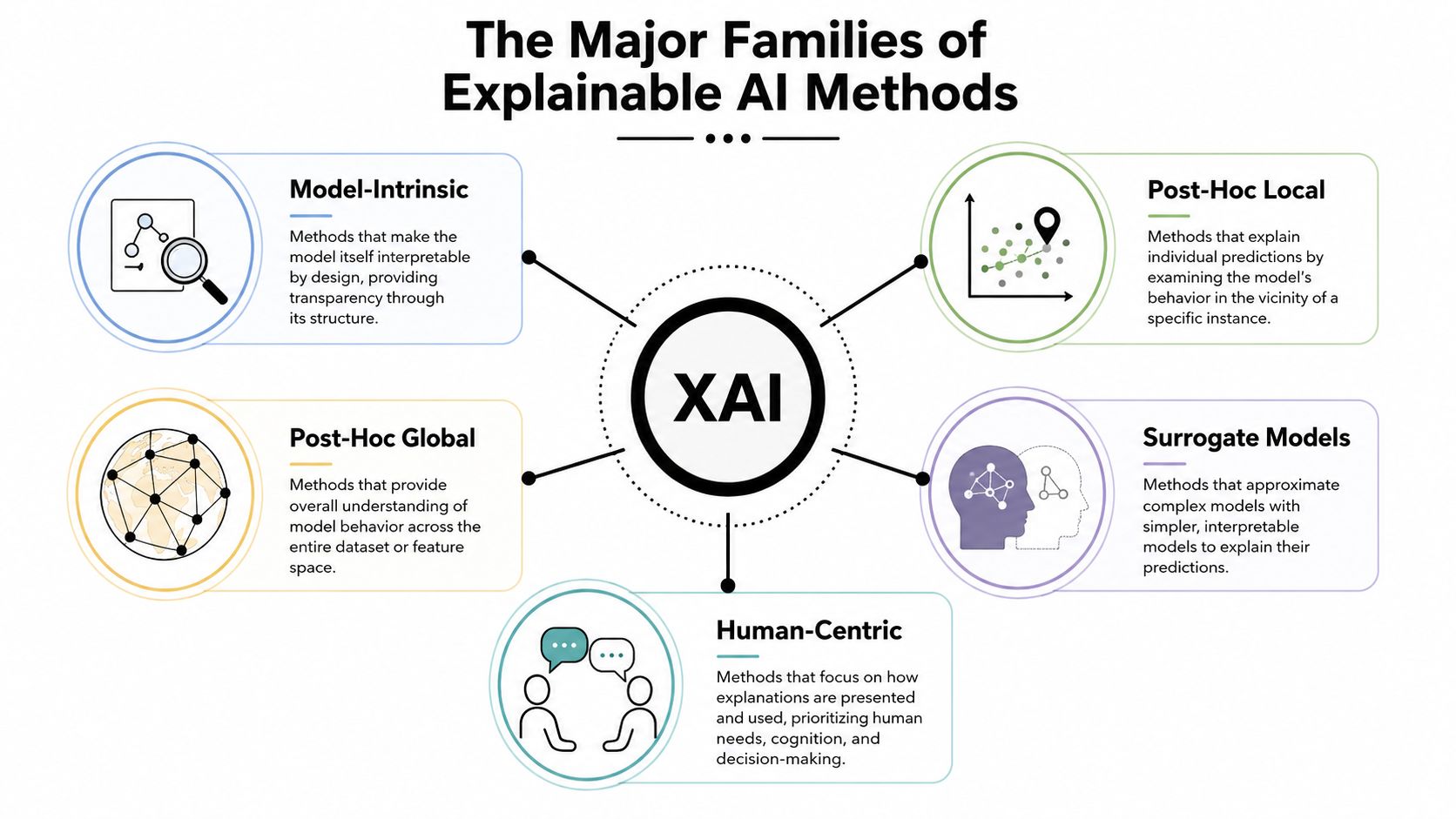
Practitioners can place most explainable AI methods into five working families. The useful distinction isn't the label alone. Each family makes a different promise about where the explanation applies, how closely it tracks the model, and what a person can understand.
Model-intrinsic methods
An intrinsic model is its own explanation. Linear and logistic models expose weighted features, decision trees expose branching logic, and rule lists express explicit conditions. Attention mechanisms are sometimes grouped with intrinsic signals because they are part of transformer architectures, but their availability doesn't guarantee that they faithfully describe causal importance.
For an agent platform, intrinsic models fit well at bounded control points. An interpretable classifier might route a known set of service intents, while a separate policy layer determines whether an action is permitted. The trade-off is that transparent models may not capture the full complexity of language, context, or multimodal inputs.
Post-hoc local methods
Post-hoc local methods explain one prediction after the underlying model has produced it. LIME creates a simple local approximation, SHAP estimates feature contributions, and counterfactuals describe what would need to change for the output to change. Anchors produce concise conditions intended to hold for a particular prediction.
These methods are useful when a supervisor asks, "Why did this conversation escalate?" They can be less useful if the explanation is unstable, too technical, or disconnected from the workflow that triggered the escalation.
Post-hoc global methods
Global methods summarize behavior across many predictions. Feature importance, partial dependence, and accumulated local effects can reveal broad patterns, such as which variables influence routing or where a model's behavior changes across an input range. They support governance reviews and model debugging, but they shouldn't be presented as the reason for one individual decision.
Surrogate and concept-based methods
A surrogate model imitates a black-box system with a simpler model. A readable decision tree may approximate an orchestration policy, but it remains a summary of the original system, not the original system itself. Its value depends on how closely it matches the black box over the domain that matters.
Concept-based methods translate low-level features into domain concepts. In CX, those concepts might include authentication failure, cancellation intent, eligibility evidence, or sentiment deterioration. Techniques such as TCAV and prototype examples can make model behavior more meaningful to business users, provided the concepts are defined and validated carefully.
An additional human-centric family is increasingly important in practice. It includes explanation interfaces, task-specific summaries, provenance views, and user studies that test whether a stakeholder can act on the explanation. A technically elegant attribution that doesn't help a supervisor resolve a case has limited operational value.
Comparing the Most Widely Used Techniques
No method should be selected because it is popular. Choose it according to the model, the decision scope, the audience, and the failure you need to investigate.
| Technique | Scope | Model Fit | Faithfulness | Compute Cost | Best Use Case |
|---|---|---|---|---|---|
| SHAP | Local and global | Broad, with model-specific variants | Strong attribution framework, but dependent on assumptions and approximation choices | Often substantial for complex models | High-stakes feature attribution and governance analysis |
| LIME | Local | Model-agnostic | Approximation can drift or become unstable | Usually lighter for individual cases | Fast exploration and stakeholder prototyping |
| Grad-CAM | Local | Primarily vision models and compatible neural architectures | Useful visual signal, not a complete causal account | Moderate, often practical for debugging | Image-region inspection |
| Integrated Gradients | Local | Differentiable neural networks, including transformer applications | Sensitive to baseline and model behavior | Usually lighter than exhaustive attribution | Fast text or image debugging |
| Surrogate decision tree | Global or local, depending on design | Any black-box model through approximation | Readable but inherently lossy | Manageable after collecting model outputs | Policy discussion and broad behavior summaries |
| Attention-based explanation | Local or sequence-level | Transformer models | Attention isn't automatically causal or faithful | Often available within the model stack | Rapid inspection of token or sequence focus |
SHAP and LIME
SHAP is attractive when a team needs consistent feature attribution that can be aggregated across cases. For a tabular intent or risk model, it can show which fields pushed a decision in a particular direction and support broader analysis of model behavior. The cost rises when the model is large, the inputs are high-dimensional, or the explanation must be generated in a live conversational path.
LIME is easier to introduce because its local approximation is intuitive. It can help a team explore why a particular prediction looks the way it does, but changes in sampling or configuration can alter the explanation. Treat it as a hypothesis generator, not as unquestionable evidence for an audit.
Gradient and attention methods
Grad-CAM is well suited to visual inputs because it maps model activity onto image regions. Integrated Gradients works across differentiable models and can provide quick input-level signals for text or multimodal pipelines. Both are useful for engineering investigation, but the team should validate whether highlighted regions affect the output.
Attention maps are readily available in transformer systems, which makes them convenient for live debugging. They can reveal that a model is focusing on formatting artifacts or unexpected tokens, yet attention weights alone don't prove that those tokens caused the answer. In an agent workload, pair attention inspection with ablation, retrieval provenance, or output perturbation.
Surrogate trees in orchestration
A surrogate decision tree can summarize how a black-box router behaves across common conditions. That summary may be excellent for a governance meeting, while still missing rare paths, interactions, and multi-turn context. If the tree says that authentication status and intent determine routing, verify that it remains accurate when the agent uses tools, carries conversation state, or receives a reformulated request.
The BEExAI benchmark reinforces this model-specific approach. Saliency achieved the best infidelity result for neural networks in 45% of cases, ranked first for sparseness in 73% of neural-network cases, and ranked first for complexity in 62% of those cases. For XGBoost, it ranked first for both sparseness and complexity in 100% of cases. These results show why a method that looks strong on one metric or architecture shouldn't be treated as a universal winner. (BEExAI benchmark evidence)
How to Evaluate Whether an Explanation Works
An explanation can sound convincing while misrepresenting a model's behavior. Start with the decision the explanation must support, then test whether it reflects the system accurately and helps a person act. For an enterprise agent, that may mean reviewing a routing choice, checking retrieved evidence, or deciding whether to override an automated response.
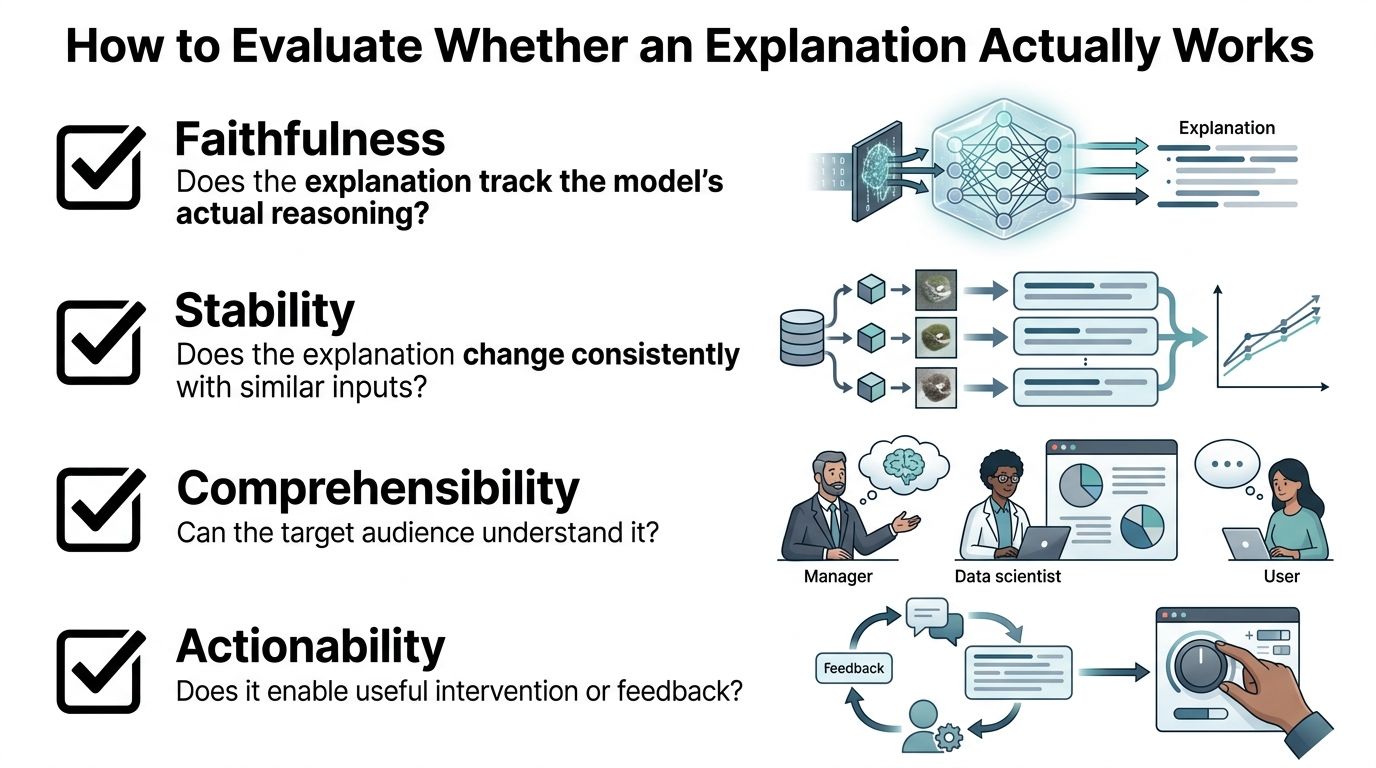
Four evaluation lenses
Faithfulness measures whether the explanation follows the model's real behavior. If an attribution says a policy phrase drove a refusal, remove or alter that phrase and check whether the output changes as predicted. Insertion, deletion, pixel flipping, sufficiency, and infidelity are examples of faithfulness-oriented metrics discussed in the NeurIPS benchmark review.
Robustness measures whether small, irrelevant input changes produce reasonable changes in the explanation. A punctuation edit or harmless paraphrase should not generate a completely different account unless the model's decision also changes materially. This test matters in CX systems, where transcription differences, reformulated requests, and multi-turn context are routine.
Complexity asks whether a person can inspect the explanation. Ten influential features may inform an engineer yet overwhelm a supervisor handling a live queue. Concision has limits, but unnecessary detail can hide the signal a reviewer needs.
Human-centered utility asks whether the explanation improves a real task. Can a reviewer correct a routing error, decide whether to override an agent, or identify missing knowledge? The 2023 benchmarking survey reported 29 automated approaches for quantitatively evaluating explanations, while human-centered evaluation also requires user experiments. (Benchmarking XAI survey)
A practical review test
Ask a vendor or internal team to examine the same decision through several probes:
- Perturb the input: Change one meaningful factor and one irrelevant factor.
- Test a counterfactual: Ask what change would have produced a different outcome.
- Compare similar cases: Check whether comparable conversations receive comparable explanations.
- Run a user task: Give supervisors the explanation and measure whether they identify the next action.
- Inspect the trace: Confirm that the explanation connects to the model, retrieval result, rule, or tool that produced the outcome.
The same discipline applies to health-data dashboards. They should separate raw measurements from interpretation. The resource raw heart readings decoded shows why readers need context around a reading, rather than a highlighted value alone.
For enterprise teams, analytics should expose what happened, why it happened, and what can be fixed. AI analytics for agent operations can be reviewed against those questions, with independent tests for faithfulness and user utility. In regulated deployments, retain the underlying trace so an explanation can be checked after a policy update, tool call, or model change.
Explainable AI in CX and EX Use Cases
The explanation must match the person making the decision. A refund escalation, an internal policy answer, and a voice handoff produce different operational questions, especially when several models and tools share one workflow.
A refund escalation
A customer requests a refund, the agent declines it, and the case is escalated. The support supervisor needs an attribution for the intent or eligibility classifier, plus a rule trace showing how the policy decision was reached. A counterfactual makes the result easier to act on by identifying the condition that could have changed the outcome, such as a missing verification step or an account state that blocked approval.
SHAP can help inspect influential classifier inputs when those inputs are structured and understandable. It cannot establish which business rule authorized or blocked the action, so the policy trace remains the stronger evidence for workflow review. In a multi-step agent platform, using the wrong method can leave a plausible model explanation in place while the actual failure sits in deterministic policy logic.
An HR policy question
An employee asks an internal copilot whether a benefit applies to their situation. Beyond why the language model generated its answer, the HR team needs to know which policy passages were retrieved, whether those passages were current, and how the response reflects them.
Retrieval attribution and document provenance should appear beside model-level signals. Integrated Gradients may help engineers examine token-level behavior in a differentiable model, while an HR reviewer usually needs the source passages, policy version, confidence indicators, and an escalation route. The explanation must connect the answer to the governed document, not merely describe the model's internal behavior. A fluent response without that evidence can create unwarranted certainty.
A voice-agent handoff
A voice agent decides whether to continue, ask another question, or transfer the caller. During the call, latency and interruption handling matter more than a long explanation. Lightweight saliency, structured event traces, detected intent, confidence state, and transfer reason can support rapid review without imposing a large per-turn computation burden.
The audience changes after the interaction. Quality analysts can inspect a deeper trace covering the relevant model, retrieval step, routing decision, and tool event, while the caller receives only the action needed at that moment. The design should separate real-time operational signals from post-interaction investigative evidence. Otherwise, internal detail can slow the live handoff, or a delayed explanation can arrive after the opportunity to correct it has passed.
Deploying XAI in Production Agent Systems
A refund agent denies a request, an HR assistant answers from policy, and a voice agent transfers a caller. Each decision needs a different explanation, audience, and response time. Production explainability therefore starts by defining what someone must understand and what action that understanding should support.
A governance group can approve a structured policy trace for refund decisions, document provenance for HR answers, and a compact transfer reason for voice workflows. Include CX operations, compliance, engineering, security, and the business owner. This stakeholder map keeps one explanation format from being imposed on every audience.
Build the operating layer
Separate algorithm libraries, observability systems, model registries, and agent platforms in the tooling matrix. SHAP, LIME, Captum, and InterpretML provide algorithmic foundations. Production systems also need transcript linkage, version tracking, latency monitoring, review workflows, and access controls.
For an agent platform, connect the trace across the full workflow:
- Input state: User message, channel, language, authentication state, and relevant conversation context.
- Decision components: Classifier, retrieval step, policy evaluation, router, tool call, and model version.
- Evidence: Feature attribution, retrieved passage, counterfactual, rule result, or structured event.
- Outcome: Response, action, escalation, transfer, and any human override.
- Review record: Who inspected the case, what they changed, and whether the explanation supported the intervention.
This structure also helps teams compare explanations across multi-LLM orchestration. A reviewer can distinguish a retrieval failure from a routing error, tool failure, or model response issue instead of treating the final answer as one opaque event.
LLM-generated explanations can make traces easier for nontechnical reviewers to read. They also introduce a risk: a fluent narrative may diverge from the model's behavior. Ground the summary in structured evidence and test whether it remains faithful to that evidence. The 2025 review of XAI limitations.pdf) identifies human-centered validation, causal reasoning, scalability, and truthful natural-language explanations as unresolved concerns.
Lifecycle controls
| Lifecycle Stage | Governance Activity | Tooling / Library | Monitoring Signal |
|---|---|---|---|
| Design | Define stakeholder questions and permitted autonomous actions | Model cards, policy specifications, architecture reviews | Explanation coverage for high-risk paths |
| Development | Select methods and establish baselines | SHAP, LIME, Captum, attribution and provenance tools | Faithfulness and stability test results |
| Pre-production | Validate with domain reviewers | Evaluation harnesses, sandbox traces, human review queues | Agreement between structured evidence and user interpretation |
| Shadow mode | Compare explanations with human decisions | Observability platform and transcript-linked traces | Override patterns, explanation stability, latency |
| Rollout | Set explanation quality SLOs | Agent platform, audit store, alerting | Drift, missing traces, regression in faithfulness |
| Operations | Review incidents and retire weak methods | Governance workflow and model registry | Explanation changes by model version and workflow |
A practical rollout proceeds from sandbox evaluation to shadow mode, then to human-in-the-loop validation and progressive production exposure. Link each explanation to the agent transcript and model version. Teams evaluating orchestration can inspect how AI Agent Builder exposes workflow behavior, then apply their own acceptance tests for explanation quality.
Choosing and Operationalizing XAI for Your Stack
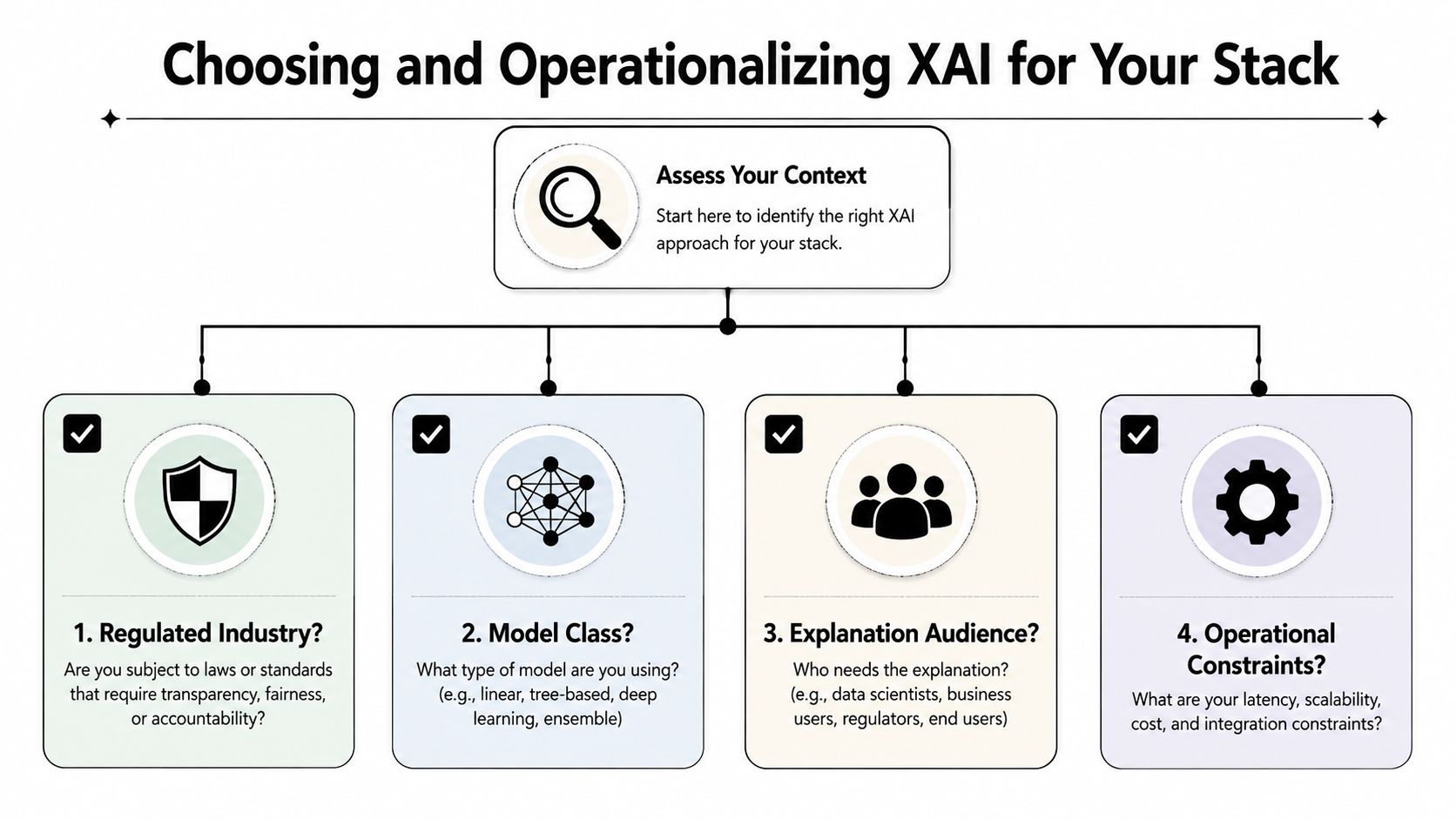
Start with four diagnostic questions: Is the use case regulated? Which model class is involved? Who needs the explanation? What latency and compute constraints apply? Those answers narrow the field faster than starting with a favorite technique.
Prefer model-intrinsic methods where the decision can remain accurate and useful with a transparent architecture. Use post-hoc local methods for opaque predictions that require case-level review, global methods for governance and drift analysis, and provenance or counterfactuals when users need evidence they can act on. Validate every method with faithfulness, stability, complexity, and human-centered utility tests before launch.
Use this checklist with your platform team:
- Choose the decision first: Define the question the explanation must answer.
- Log the evidence: Store each explanation with its input, model version, workflow state, and outcome.
- Protect the live path: Generate deeper explanations asynchronously when real-time latency makes them impractical.
- Retest after change: Re-run faithfulness and stability checks whenever a model, prompt, retrieval index, tool, or orchestration path changes.
- Retire weak methods: Remove explanations that repeatedly fail validation or mislead their intended audience.
Three useful next actions are straightforward. Pilot SHAP on one high-stakes intent, create an explanation review board with CX and compliance, and instrument faithfulness metrics before adding another model to the orchestration graph.
Yellow.ai provides agent-building, orchestration, analytics, and visibility capabilities that can support this operating model across CX and EX workflows. Visit Yellow.ai to assess how its agent platform can connect conversation traces, workflow decisions, debugging insights, and governance needs in your enterprise stack.



