









The most popular advice in escalation management is also the least useful: lower your escalation rate. That rule treats a password reset, a production incident, and an enterprise contract dispute as if they represent the same operational failure. They don't. A high escalation rate can reflect weak frontline capability, but it can also reflect honest triage in a complex environment where specialists, authority, or regulatory judgment belong in the resolution path.
Enterprise teams need a more disciplined question: Are the right cases escalating to the right owner at the right time, with enough context to reach a sound outcome? That shifts attention from volume alone to triggers, handoffs, decision latency, customer effort, and the learning that flows back into training, knowledge, product, and policy.
Table of Contents
- Why Escalation Management Is a Control System Not a Complaint Queue
- Functional vs Hierarchical Escalation Explained
- Building a Rule-Based Escalation Workflow
- What Your Escalation Rate Should Actually Be
- How AI Changes the Economics of Escalation
- RACI Roles SLAs and KPIs That Drive Accountability
- Enterprise Escalation Scenarios and Playbooks
Why Escalation Management Is a Control System Not a Complaint Queue
Escalation management is often treated as a pressure valve for angry customers. An agent runs out of options, selects “manager,” forwards an email, and hopes someone else picks it up. Under light demand, that may appear workable. Under load, it produces orphaned cases, duplicated investigation, unclear ownership, and SLA drift.
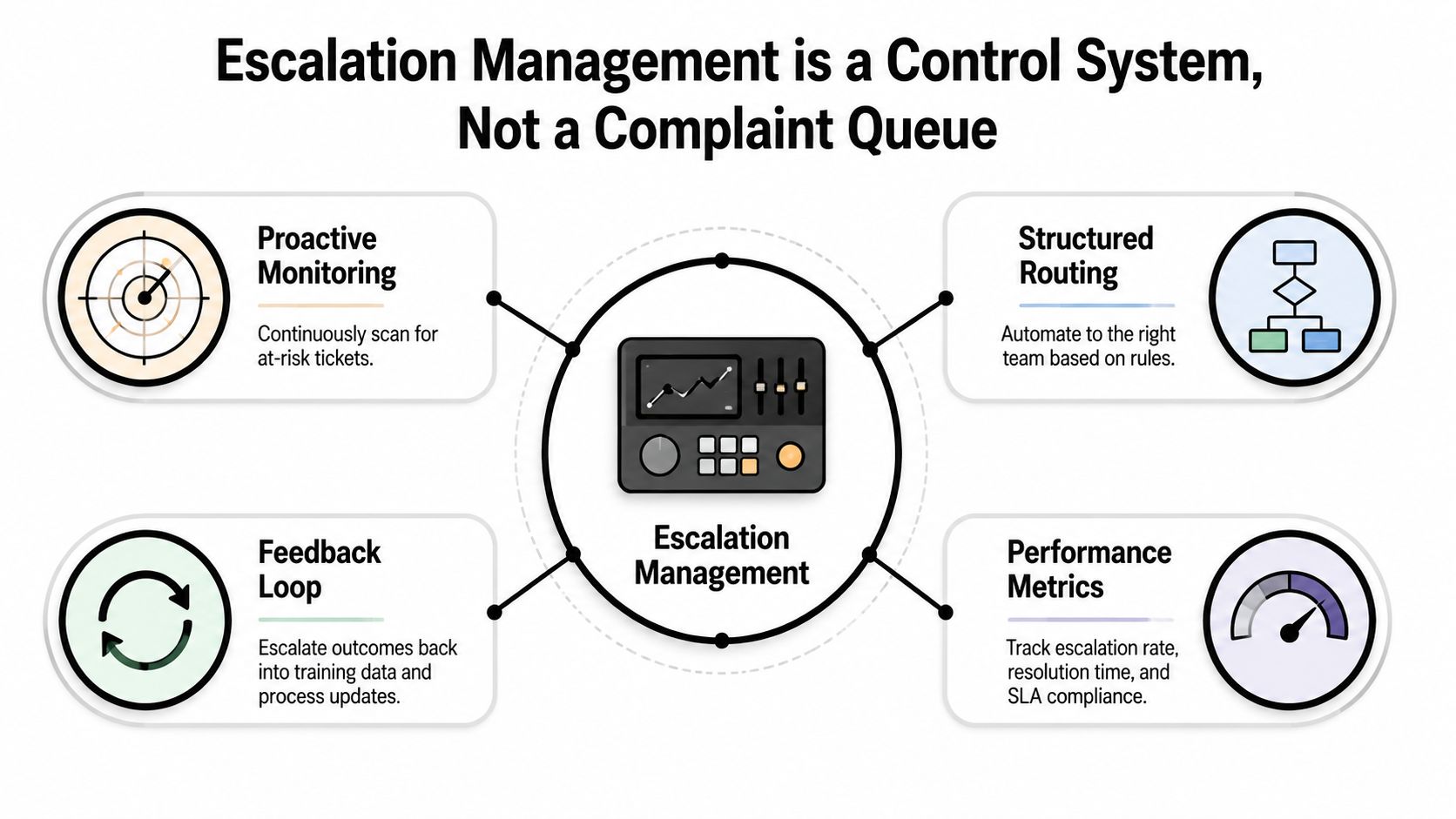
A better model treats escalation as a control loop. The input is a defined trigger, such as a capability gap, an authority limit, a severity condition, or elapsed time. Processing applies classification and routing rules. The output is containment, resolution, or another controlled escalation. Feedback then shows whether the original rule, knowledge article, access model, or staffing decision worked.
The customer support escalation rate definition and segmentation guidance makes this distinction practical. Escalation rate is calculated as escalated eligible cases divided by all eligible cases created, multiplied by 100. Transfers, reopenings, and escalations should remain separate measures, because each represents a different failure mode. Segmenting by channel, issue type, and severity also matters, since a rising rate may point to a structural frontline gap rather than poor performance by individual agents.
Escalations are diagnostic signals
An escalation isn't automatically a failure. A Tier 1 agent who routes a security-sensitive case to the right specialist may have followed the process exactly. The failure occurs when the organization can't tell why the case moved, whether the receiving team accepted it, or what should change afterward.
Use escalation data to locate system constraints:
- Capability gaps: Agents lack the product knowledge, troubleshooting skill, or system access required for a recurring issue.
- Authority gaps: Frontline staff understand the remedy but can't approve a credit, exception, cancellation, or policy decision.
- Routing gaps: Cases move to teams that can't resolve them, creating bounce-backs and repeated explanations.
- Capacity gaps: The correct resolver exists, but queue design or availability prevents timely action.
Practical rule: Treat an escalation as a controlled transfer of risk, authority, or expertise. If the handoff doesn't name what changed, it isn't operationally complete.
Review escalation volume alongside transfer rate, reopen rate, first-contact resolution, time to acceptance, time to resolution, and outcome quality. A queue with fewer escalations but more repeat contacts may be suppressing visibility rather than improving service. A queue with more escalations and faster specialist acceptance may be healthier than one that keeps complex cases trapped at the frontline.
Functional vs Hierarchical Escalation Explained
Escalation quality depends on sending the case to the right constraint, not on keeping every case at the frontline. Functional escalation moves a case laterally to a team with the required skill, system access, or technical ownership. Hierarchical escalation moves it upward to someone who can approve an exception, change priorities, or accept accountability for business risk.
A payment failure that requires payments engineering follows a functional route. A request beyond an agent's approval limit follows a hierarchical route. Mixing them creates delay: managers are asked to diagnose systems they cannot access, while specialists receive cases that require a commercial, policy, or compliance decision.
Formal incident-management practice places both routes within a sequence of logging, classification, prioritization, assignment, investigation, resolution, and closure, as described in this incident-management process guidance. Escalation protects the service target when the current resolver cannot restore service within the applicable window. It should also preserve ownership, so the receiving team knows what it has accepted and what remains unresolved.
Match the path to the constraint
Choose a functional path when the constraint is knowledge, access, ownership, or diagnostic capability. The receiving team needs the case timeline, attempted actions, relevant logs, customer impact, and the precise question still unanswered. A transfer without that context creates rework and forces the customer to repeat the same explanation.
Choose a hierarchical path when the constraint is authority, prioritization, commercial exposure, executive visibility, or imminent risk. The manager needs the decision requested, the policy boundary, the customer or business impact, and the deadline. Forwarding a long transcript is not a handoff.
Time gates should follow severity and service commitments rather than a universal clock. The examples in ITIL-style escalation workflow guidance connect escalation with SLA windows and severity thresholds. A high-severity incident may require a rapid functional route to the technical resolver, plus management notification when coordination or authority becomes necessary.
SRE escalation policy guidance identifies MTTA, MTTR, escalation success rate, and pager volume as useful measures, including under 5 minutes for P1 acknowledgment and keeping pager volume below about 50 pages per engineer per week. Treat these as design references, not universal targets. Set gates according to severity, customer commitments, resolver availability, and the consequences of delay. A lower escalation rate is not automatically healthier if complex cases remain trapped with a team that cannot resolve them.
Building a Rule-Based Escalation Workflow
Ambiguity is expensive. If agents decide intuitively when to escalate, similar cases take different paths, specialists receive incomplete information, and managers discover breaches after the customer has already lost confidence.
A durable workflow makes each decision explicit.
Start with the trigger
Define triggers in operational language. Useful categories include:
- Risk triggers: Security, privacy, regulatory, safety, legal, or material financial exposure.
- Capability triggers: Required system access, technical expertise, or product ownership sits outside the current tier.
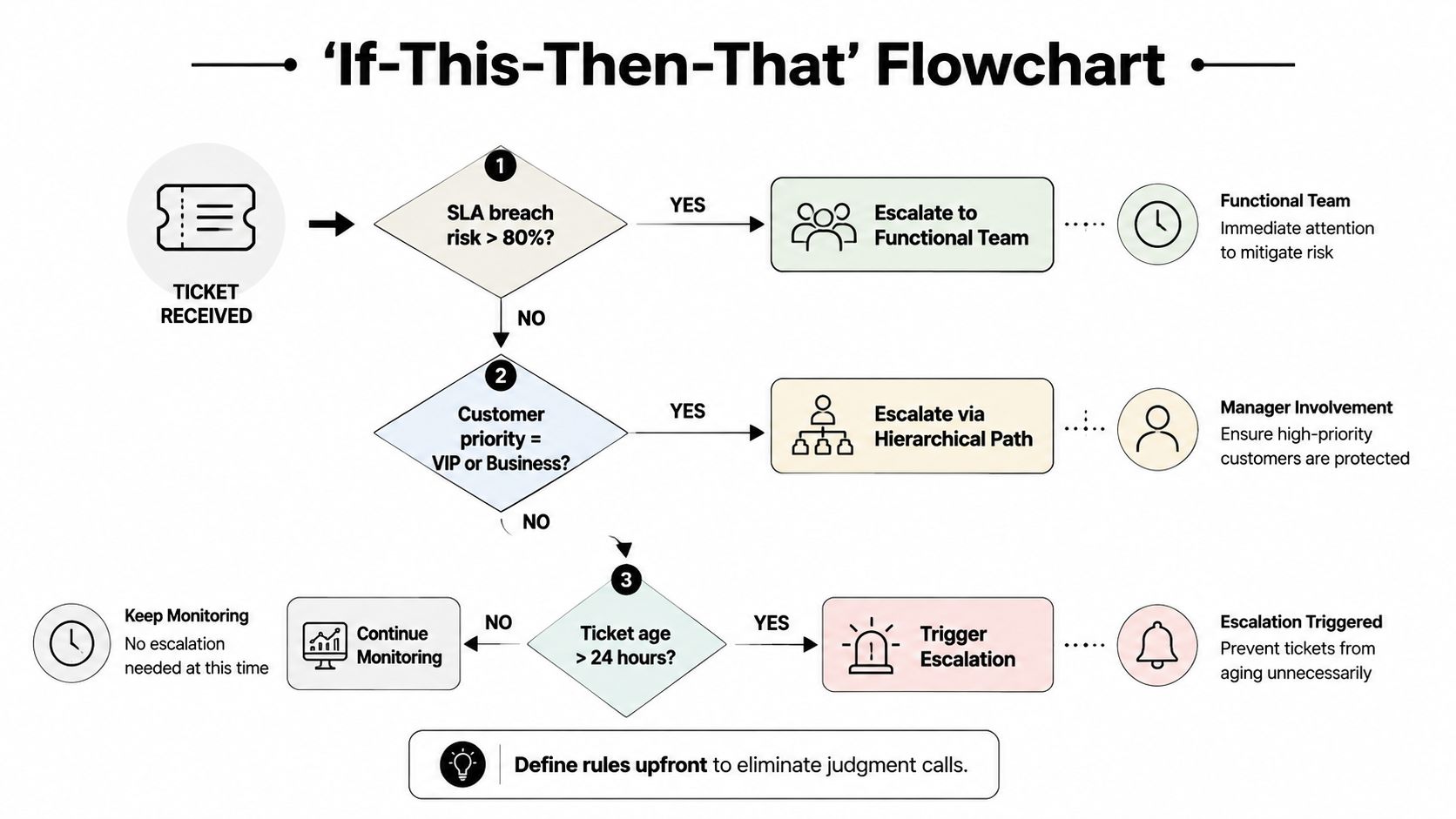
- Time triggers: The case reaches a defined share of its SLA window without progress, or remains unassigned beyond its acceptance window.
- Customer triggers: Repeated unresolved contact, a cancellation request, or a request for an authorized exception.
- Event triggers: A pattern of similar contacts indicates an emerging incident rather than isolated tickets.
A trigger should answer three questions: what happened, who receives the case, and by when must ownership be accepted? Avoid using sentiment alone. Frustration can indicate risk, but a calm customer may still have a serious outage, privacy, or contractual issue.
Classify before routing
Apply severity, issue family, customer segment, channel, and operational impact before selecting a destination. Skill-based routing is useful when the resolver must possess a defined capability. Load-balanced routing helps distribute work among qualified teams. Availability gates prevent a case from being sent to an offline queue without a fallback.
The handoff packet should be mandatory. Capture the customer's stated outcome, the issue timeline, attempted fixes, evidence gathered, relevant account context, and the decision or action requested. Require the receiving team to accept or reject the handoff with a reason. A rejected case should return through a defined correction path, not disappear into a shared queue.
Add time-bounded automation
Time-based rules outperform vague volume alarms because they protect the individual customer commitment. A case approaching its SLA limit should trigger an owner notification, then a supervisor route, then an incident or leadership route when the risk warrants it. The exact sequence depends on severity and service design.
Use automation for acknowledgment, reminders, status updates, routing, and audit timestamps. Keep human judgment for exceptions, ambiguous risk, and decisions where context matters. For safety-sensitive workflows, organizations can also study specialized patterns such as a panic button for rideshare safety, where the trigger must lead to an immediate, clearly owned response rather than a generic queue transfer.
For teams working in Zendesk, an integration for connecting conversational workflows with Zendesk can support structured transfer into an existing ticketing environment. The important design principle isn't the brand of system. It's preserving the conversation, the trigger, the priority, the owner, and the next customer update in one traceable record.
A clear sequence looks like this:
- Detect the trigger.
- Classify severity and issue family.
- Select functional, hierarchical, or incident routing.
- Attach the required handoff context.
- Start the acceptance timer.
- Notify the customer of ownership and the next update.
- Escalate again if the timer expires.
- Record the outcome and feed the cause into improvement work.
This short video offers a visual introduction to escalation workflow concepts:
What Your Escalation Rate Should Actually Be
There is no responsible universal target. The 2026 escalation benchmark compilation places the cross-industry average near 10 to 15%, while complex B2B, technical, and telecom desks run 18 to 28%, and top-quartile operations can be as low as 5 to 8%. Those ranges don't tell you what your rate should be until you segment the denominator.
A transactional L1 queue should usually resolve more cases through standard knowledge and workflow paths. An L2 diagnostic queue needs access to specialists and deeper investigation. An L3 strategic queue handles exceptions, complex relationships, and high-consequence decisions. The correct question is whether each segment's escalation pattern matches its designed role.
| Industry Vertical | L1 Transactional | L2 Diagnostic | L3 Strategic/Complex |
|---|---|---|---|
| Simple consumer support | 5 to 8% | 10 to 15% | 15 to 20% |
| B2B SaaS and technical support | 8 to 15% | 18 to 28% | 18 to 28% |
| Telecom and complex service operations | 8 to 15% | 18 to 28% | 18 to 28% |
| Enterprise strategic accounts | 10 to 15% | 18 to 28% | 18 to 28% |
The table uses the verified benchmark ranges as directional reference points, not as promises for every operation. A simple consumer queue above its expected range may have weak self-service, unclear permissions, or poor frontline training. A technical queue below its expected range may be healthy, or it may be under-escalating cases that need specialist attention.
Set a target from outcomes
Build targets from historical resolution data, issue complexity, channel, severity, and customer impact. Then test whether escalation correlates with improved resolution quality, fewer repeat contacts, and stronger SLA performance. If escalation rises but specialist acceptance and outcomes improve, the process may be exposing problems that were previously hidden.
Avoid making escalation difficult to access just to improve the headline number. That approach pushes customers into repeated contacts, social complaints, or silent churn while giving leadership a cleaner dashboard. Measure escalation accuracy, time to acceptance, re-escalation, and final outcome alongside rate.
The AI analytics platform can be evaluated as one way to inspect these patterns across interactions, but the operating decision remains yours. A target should reflect the work your tiers are designed to perform, not a benchmark selected because it looks efficient.
How AI Changes the Economics of Escalation
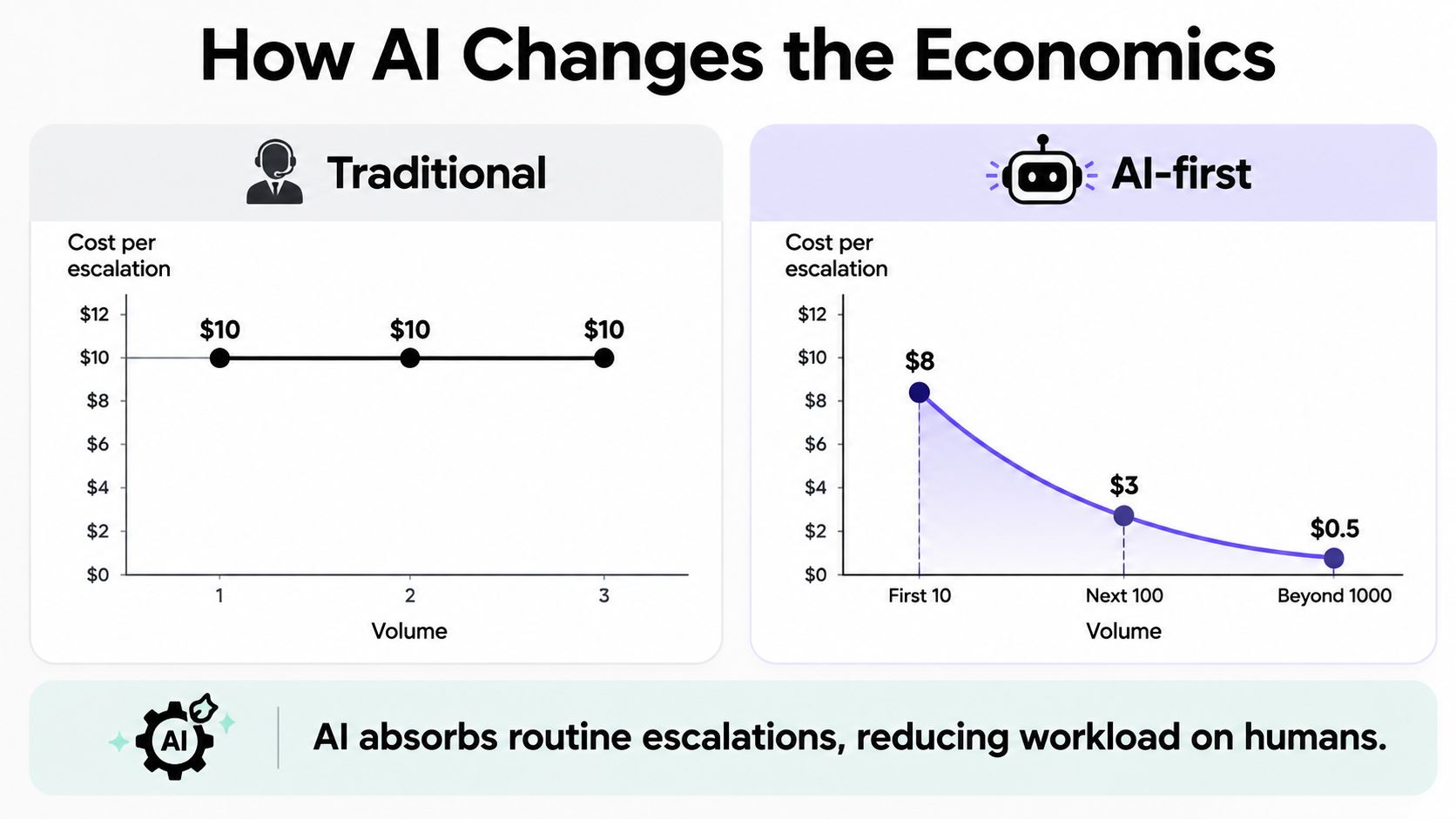
AI-first support changes the unit economics because it changes the composition of the cases that reach people. A conversational agent can collect context, identify intent, retrieve approved knowledge, guide preliminary troubleshooting, and package the interaction before a human accepts the case. The human then receives a qualified decision or investigation task instead of an unstructured complaint.
That matters because escalated contacts can cost 2.3 to 3.5 times more than standard assisted contacts, according to customer support cost-to-serve benchmarking. Prevention, deflection, and better triage therefore affect both service quality and operating economics. The same source describes contact centers prioritizing conversational GenAI, knowledge management for AI, and the return of customer insight to product and service teams.
Redesign the handoff, don't just automate it
An AI handoff should include:
- A verified summary: What the customer wants, what the system understood, and what remains unresolved.
- Evidence and actions: Relevant account facts, troubleshooting steps, tool results, and policy references.
- Risk markers: Security, legal, safety, regulatory, retention, or vulnerability signals.
- A requested decision: The exact action the human must take.
- Continuity: The human should enter the same conversation with the customer, not force a restart.
Track time to acceptance, repeated explanations, decision time, and final outcome. These measures show whether AI is reducing work or merely moving it downstream.
AI also introduces failure modes. Hallucinated instructions can create avoidable escalations or increase customer harm. Sentiment models can overreact to strong language while missing a technically severe issue. If AI absorbs every simple case, agents may lose familiarity with foundational troubleshooting, making the remaining escalations harder to resolve.
Use confidence thresholds, approved knowledge retrieval, tool-result validation, and human review for high-risk actions. AI agent-assist capabilities can be assessed in that context, especially where the human needs structured context and recommended next steps rather than a generic transfer.
AI should remove repetition from the escalation, not remove accountability for the decision.
RACI Roles SLAs and KPIs That Drive Accountability
Escalation workflows usually break at ownership before technology becomes the problem. Each case needs a named person or team responsible for the next action, an accountable owner with authority to remove blockers, consulted specialists who contribute expertise, and informed stakeholders who need visibility without taking over the work.
A practical RACI design can use this operating matrix:
| Escalation Phase | Responsible | Accountable | SLA Target | KPI to Track |
|---|---|---|---|---|
| Trigger detection | Frontline agent or automation | Support operations lead | Immediate flagging when a rule matches | Trigger accuracy |
| Triage and priority | Tier 1 or triage desk | Duty manager | Within the defined intake window | Priority accuracy |
| Functional handoff | Sending agent and receiving queue | Functional team lead | Acceptance within the severity-based window | Time to acceptance |
| Hierarchical decision | Support manager | Business or service owner | Decision before the customer commitment is at risk | Decision time |
| Customer communication | Named case owner | Accountable escalation owner | Update at each promised checkpoint | Update compliance |
| Resolution and closure | Resolving team | Case owner | Within the applicable SLA | Escalated MTTR |
| Post-resolution review | Quality or operations analyst | Operations leader | Review on the agreed cadence | Recurrence and outcome quality |
Set targets by severity, issue complexity, and customer commitment. A single response window across every queue creates poor incentives. A production outage requires rapid ownership, while a billing correction may need a different clock and a more deliberate approval path. The target should reflect the cost of delay and the authority required to resolve the case.
Measure the quality of movement
Escalation rate only shows how often cases move. It cannot show whether routing improved the outcome. Pair it with measures that expose where the workflow creates waste:
- Escalation accuracy: The share of escalations that met the documented trigger and reached the correct resolver.
- Re-escalation rate: Cases that bounce between teams or return to a lower tier because the handoff was incomplete.
- Time to acceptance: The interval between escalation creation and explicit ownership.
- Resolution quality: Whether the customer received a durable remedy without repeating the explanation.
- Root-cause recurrence: Whether the same product, policy, or process issue continues to generate escalations.
Review critical cases in a daily operational forum. Analyze trends weekly by issue, channel, tier, and trigger. Recalibrate thresholds monthly when evidence shows false positives, late routing, or specialist overload.
The right benchmark also depends on the issue mix. A lower escalation rate may indicate strong containment for simple requests, yet signal under-routing when complex, regulated, or high-impact cases remain with frontline teams. Segment the KPI by complexity and risk before judging performance. AI-first support stacks can absorb routine work, so their escalation rate may be lower by design, while the remaining cases demand clearer ownership and tighter decision controls.
Every KPI should point to an operational lever, such as better training, clearer authority, improved routing, or a product fix. Without that connection, measurement records movement without improving accountability.
Enterprise Escalation Scenarios and Playbooks
A SaaS platform experiencing a partial outage should route based on impact and evidence, not on how loudly individual customers complain. Detection identifies a shared symptom, triage confirms affected services, and the functional path moves the incident to the technical resolver. Hierarchical escalation then brings in incident command when coordination, customer communication, or business prioritization exceeds the technical team's remit. The RACI assigns the incident commander as accountable, the engineering resolver as responsible, customer communications as consulted, and account teams as informed.
A financial services dispute follows a different pattern. The case may require a specialized retention or complaints team because the decision involves policy, risk, and customer value rather than a technical fix. The handoff should include the transaction timeline, prior contacts, applicable policy, requested remedy, and approval boundary. A manager becomes accountable for the decision, while compliance or legal functions are consulted when the trigger requires them.
An e-commerce operation facing shipping exceptions should avoid flooding specialists with every delayed parcel. AI can classify single-order delays, provide approved status information, and route only multi-order, high-impact, or exception-heavy cases for human review. The human owner then sees the order history, prior actions, carrier evidence, and the precise intervention needed.
Build the playbook around decisions
A usable escalation playbook should include:
- Trigger definitions: Severity, risk, issue family, customer segment, and elapsed-time conditions.
- Routing map: Functional teams, hierarchical owners, fallback queues, and availability rules.
- Handoff packet: Required fields, evidence, customer promise, and requested decision.
- Communication cadence: Acknowledgment, interim update, resolution notice, and closure follow-up.
- Notification tree: Who is responsible, accountable, consulted, and informed for each scenario.
- Review checklist: Trigger accuracy, acceptance latency, customer effort, outcome quality, and recurrence.
- Exception authority: Which roles can approve credits, policy exceptions, emergency changes, or customer recovery actions.
Test the playbook with outage drills, emotionally difficult conversations, policy exceptions, and incomplete data. A process that works only when every field is present will fail in production. The strongest design makes the safe next action obvious, preserves context, and sends every significant outcome back into the operating system for improvement.
Yellow.ai provides enterprise teams with conversational AI, agent-assist capabilities, omnichannel orchestration, and escalation tools that can transfer chat or voice interactions to human agents while preserving workflow context. Visit Yellow.ai to evaluate how an AI-first support stack can route routine work, structure human handoffs, and make escalation outcomes measurable.