













You've probably got a security policy that looks solid on paper. Sensitive data is encrypted, employees authenticate through SSO, vendors complete questionnaires, and an AI pilot runs inside a controlled cloud environment. Yet when an auditor or incident responder asks where a particular customer transcript, employee record, or model context is stored, the answer often depends on several teams and incomplete inventories.
That gap between policy intent and operational control defines enterprise data security today. Data moves through SaaS platforms, cloud storage, collaboration tools, APIs, endpoints, and AI agents. A secure architecture must protect not only databases and networks, but also the identities, permissions, prompts, documents, conversations, and automated actions that surround them.
Table of Contents
- The Evolving Cost of Enterprise Data Security
- Mapping Threat Vectors and the Identity Gap
- Navigating Compliance Frameworks and Governance
- Architectural Controls and Encryption Strategy
- The Hidden Risks of Unstructured Data and AI
- Operational Best Practices and Implementation Roadmap
The Evolving Cost of Enterprise Data Security
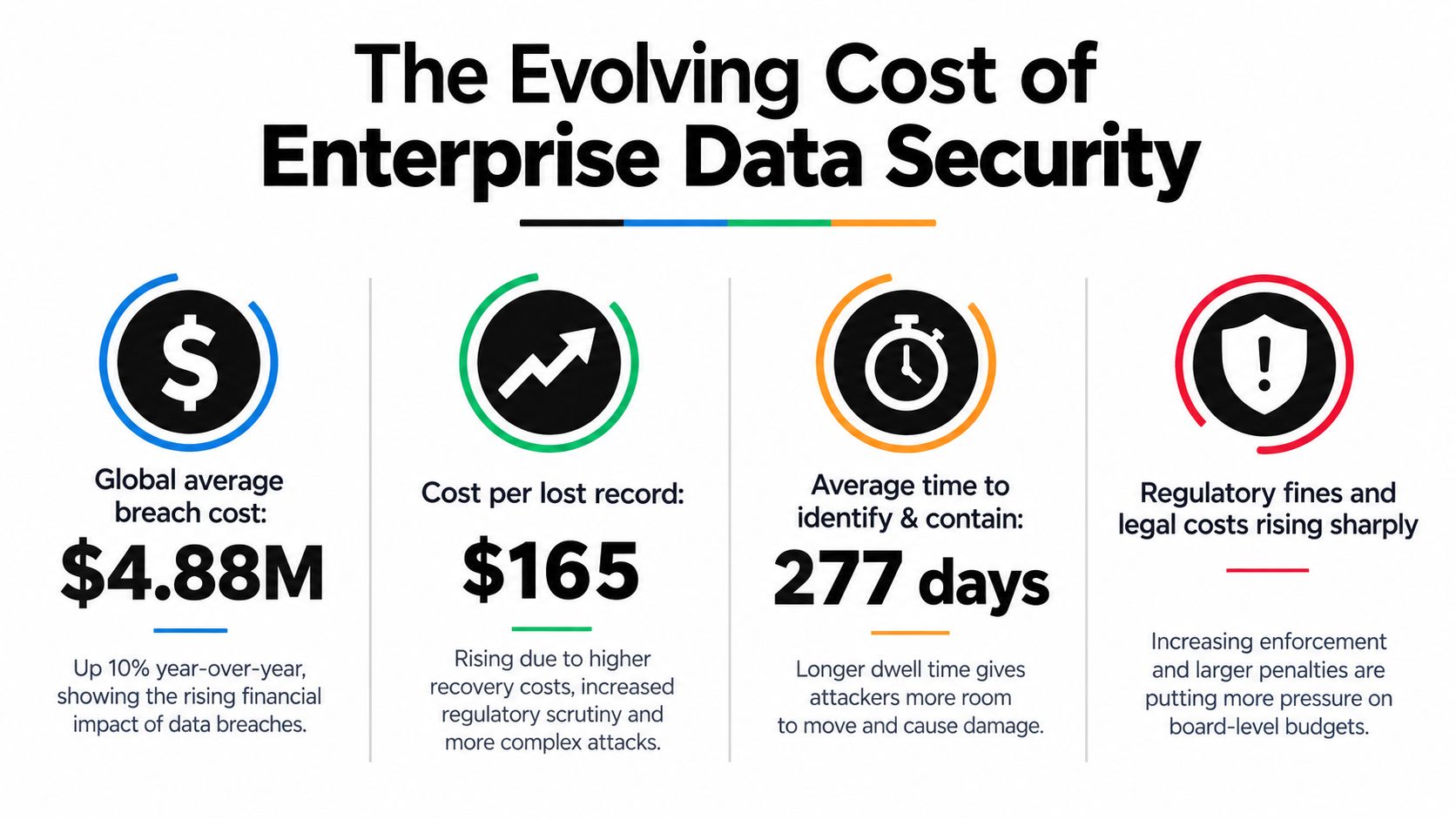
A breach rarely stays inside the security team. The incident may begin with a stolen credential or exposed service, but the bill reaches operations, legal, customer support, finance, and executive leadership. IBM's 2026 Cost of a Data Breach Report found that the global average breach cost rose 12% year over year to USD 4.99 million, based on 602 breaches across 17 industries in 16 countries between March 2025 and February 2026.
That figure matters because it changes the budget conversation. Security isn't only an insurance policy against a technical event. It protects revenue continuity, customer trust, regulatory standing, and the ability to operate while systems are being investigated or rebuilt.
Why the perimeter stopped being enough
Traditional enterprise security assumed that the main problem was keeping attackers outside the network. Firewalls, secure gateways, and segmented data centers still have value, but they can't establish trust once employees, contractors, applications, cloud workloads, and AI services operate across different environments.
A valid user session can access a sensitive document from an approved device. A SaaS integration can retain data after the original workflow ends. An agent can retrieve information through a service account without crossing the traditional perimeter at all. In each case, the decisive question is not merely whether traffic entered the network. It's which identity accessed which data, for what purpose, through which application, and with what authority.
The financial distribution of breach damage reinforces this shift. IBM found that detection and escalation plus lost business represented 63% of total breach costs, showing that disruption, customer churn, and reputational harm can outweigh the immediate technical response. A security program that focuses only on blocking intrusion may still leave the organization exposed to prolonged discovery, uncertain containment, and interrupted service.
What board-level resilience should examine
Regional and sector differences also affect risk prioritization. The same IBM report placed the average U.S. breach cost at USD 11.5 million, nearly twice the global average, while healthcare remained the costliest sector at USD 6.64 million per breach. These figures don't predict an individual incident, but they show why regulated, data-intensive enterprises need stronger continuity planning and more disciplined control ownership.
Practical rule: Fund the controls that reduce exposure and shorten uncertainty, not only the tools that generate the most alerts.
Leaders should ask whether the organization can identify its most sensitive data, revoke access quickly, restore critical services, and produce reliable evidence after an incident. Those capabilities require data classification, identity governance, tested recovery, vendor oversight, and usable logging. They also require business owners to accept responsibility for access and retention decisions instead of treating security as an isolated IT function.
Mapping Threat Vectors and the Identity Gap
Most enterprise breaches exploit a chain of ordinary weaknesses rather than a single dramatic failure. An employee receives access that exceeds their role. A SaaS application inherits a broad permission. A service account remains active after a project ends. A contractor connects through a trusted integration, and monitoring sees the session as legitimate.
Identity is therefore the control plane for modern enterprise data security. Network location offers context, but it doesn't prove that a request is appropriate. Authorization must account for the user, device, workload, data sensitivity, requested action, and business purpose.
The permissions that create unnecessary exposure
Recent zero-trust research identified employee over-privilege, cited by 56% of respondents, and SaaS or cloud misgovernance, cited by 48%, as leading sources of unauthorized access. The 2026 zero-trust findings also found that 82% viewed Universal ZTNA as essential, while only 17% had fully implemented it.
The execution gap is more important than the terminology. Many organizations have adopted least-privilege language, but permissions still accumulate through role changes, temporary exceptions, inherited group membership, and machine-to-machine connections. Static policies look orderly during design review, then drift as teams ship new integrations and workflows.
A useful review should separate four questions:
- Who can reach the data? Include human users, service accounts, APIs, connectors, and AI agents.
- What can they do? Reading, exporting, editing, deleting, and triggering downstream actions carry different consequences.
- Why do they need it? Access should map to a defined business purpose, not a broad job title.
- How quickly can access end? Revocation must work during an incident, not only during a scheduled review.
From perimeter trust to continuous authorization
Zero-trust architecture isn't a product purchase or a diagram with new labels. It's a set of enforcement decisions applied continuously across hybrid environments. Strong implementations combine phishing-resistant authentication, just-in-time privilege, device posture, session risk signals, short-lived credentials, and detailed authorization logs.
Security for internal applications deserves the same scrutiny as customer-facing systems. Teams assessing enterprise security for internal tools should examine whether internal workflows expose sensitive records through search, exports, browser sessions, or automation. An employee-service assistant, for example, may need to answer policy questions without receiving unrestricted access to payroll, health, or performance data.
What works is narrow authorization attached to a specific action. What fails is granting an agent or integration broad read access because the initial implementation is easier. The latter creates a large blast radius and makes later cleanup dependent on perfect inventory, perfect logging, and rapid human response.
Navigating Compliance Frameworks and Governance
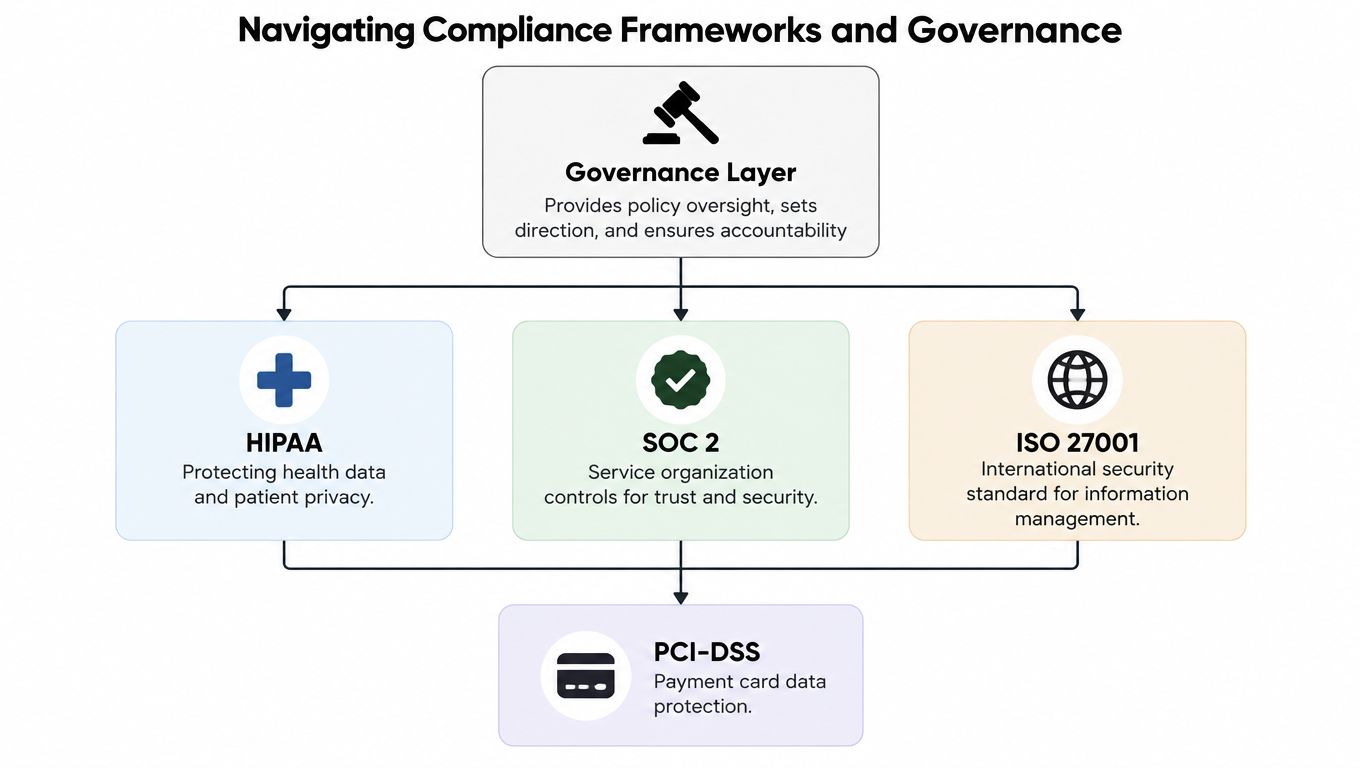
Compliance frameworks become useful when leaders translate them into operating decisions. HIPAA addresses the protection of health information, SOC 2 evaluates service organization controls, ISO 27001 provides an international information security management framework, and PCI-DSS focuses on payment card data. Their control language overlaps, but the evidence and scope differ.
The mistake is to create a separate security program for every framework. That approach produces duplicated policies, conflicting ownership, and audit preparation that consumes time without improving control effectiveness. A better model uses one governance layer, then maps each obligation to shared controls and evidence.
Build a control map that reflects operations
Start with the data and workflows, not the audit calendar. Identify where regulated data enters the organization, which systems process it, which vendors receive it, and which teams can approve or change access. Then assign an accountable owner for each control.
A practical governance register should connect:
- Data categories to classification, retention, residency, and permitted uses.
- Business processes to applications, integrations, users, and service accounts.
- Security controls to owners, implementation status, testing frequency, and exceptions.
- Evidence to logs, access reviews, incident records, configuration snapshots, and recovery tests.
- Risk decisions to an approver, expiry date, compensating control, and accepted business impact.
This structure lets one access review support several assurance objectives without pretending that all frameworks are interchangeable. It also exposes controls that exist in policy but lack a reliable operational owner.
For teams working with payment data, a focused reference on PCI-DSS v4.0.1 compliance requirements can help connect payment-specific obligations to broader identity, logging, vulnerability, and evidence practices. The framework should guide implementation, not replace threat modeling.
Treat compliance as a floor
A compliant system can still leak data through a poorly governed AI connector, an overexposed collaboration folder, or an untested recovery process. Governance must therefore include risk acceptance and resilience, not just control attestations.
Executives should receive a view that connects exceptions to business services. A report that says an access review is overdue is less useful than one showing which customer or employee workflow depends on the affected system, what data it handles, and what decision is required.
Compliance proves that selected requirements have been addressed. Governance determines whether the organization can operate safely when conditions change.
Architectural Controls and Encryption Strategy
Encryption is foundational, but security architects should be precise about what it does. It reduces exposure when storage media, databases, backups, or network traffic are accessed outside the intended trust boundary. It doesn't prevent an authorized application, user, or compromised session from reading plaintext after decryption.
That distinction changes the design. A database encrypted at rest may still be exposed through an over-privileged reporting account. A protected backup may still be deleted by an administrator whose credentials were compromised. An encrypted API connection may still deliver sensitive content to an agent that has no business reason to request it.
Design controls in layers
A durable architecture separates protection mechanisms so one failed control doesn't expose the entire dataset.
- Discover and classify. Identify structured and unstructured data, mark sensitivity, and attach handling rules to the classification. Don't apply the same policy to public content and regulated records.
- Control identity. Use least-privilege IAM, strong authentication, time-bound privilege, workload identities, and continuous authorization. Review effective permissions, not only intended role assignments.
- Protect the data. Use encryption at rest and in transit, tokenization where applications don't need raw values, and masking in interfaces, logs, prompts, and test environments.
- Govern the keys. Put ownership and administration of KMS or HSM infrastructure under controlled separation of duties. Rotate keys, restrict recovery operations, monitor privileged use, and document emergency procedures.
- Contain the workload. Segment sensitive systems, restrict outbound connections, and limit which services can retrieve or export classified content.
- Record the decision. Log access, retrieval, transformation, export, policy evaluation, and administrative changes in a form investigators can use.
For AI systems, the retrieval layer needs its own boundaries. A RAG design should filter content before retrieval, apply user and purpose authorization at query time, keep tenant and data domains separated, and prevent retrieved text from altering the agent's permissions without authorization. Prompt instructions aren't a substitute for authorization controls.
Teams evaluating platform-specific safeguards can review Pebb data protection as one example of how security capabilities may be presented alongside data handling workflows. The evaluation should focus on integration depth, administrative ownership, evidence quality, and behavior under failure, not on the feature list alone.
Architecture reviews should also test negative paths. What happens when the identity provider is unavailable? Can an agent continue operating with cached access? Can an administrator export an entire knowledge base? Does a revoked user lose access to previously indexed content? A control that works only during normal operations creates false confidence.
For a broader view of enterprise-grade security controls, compare the stated mechanisms with your own requirements for access management, encryption, key custody, network isolation, redaction, vulnerability management, and recovery. The right question is whether the control can be enforced consistently across every path the data can take.
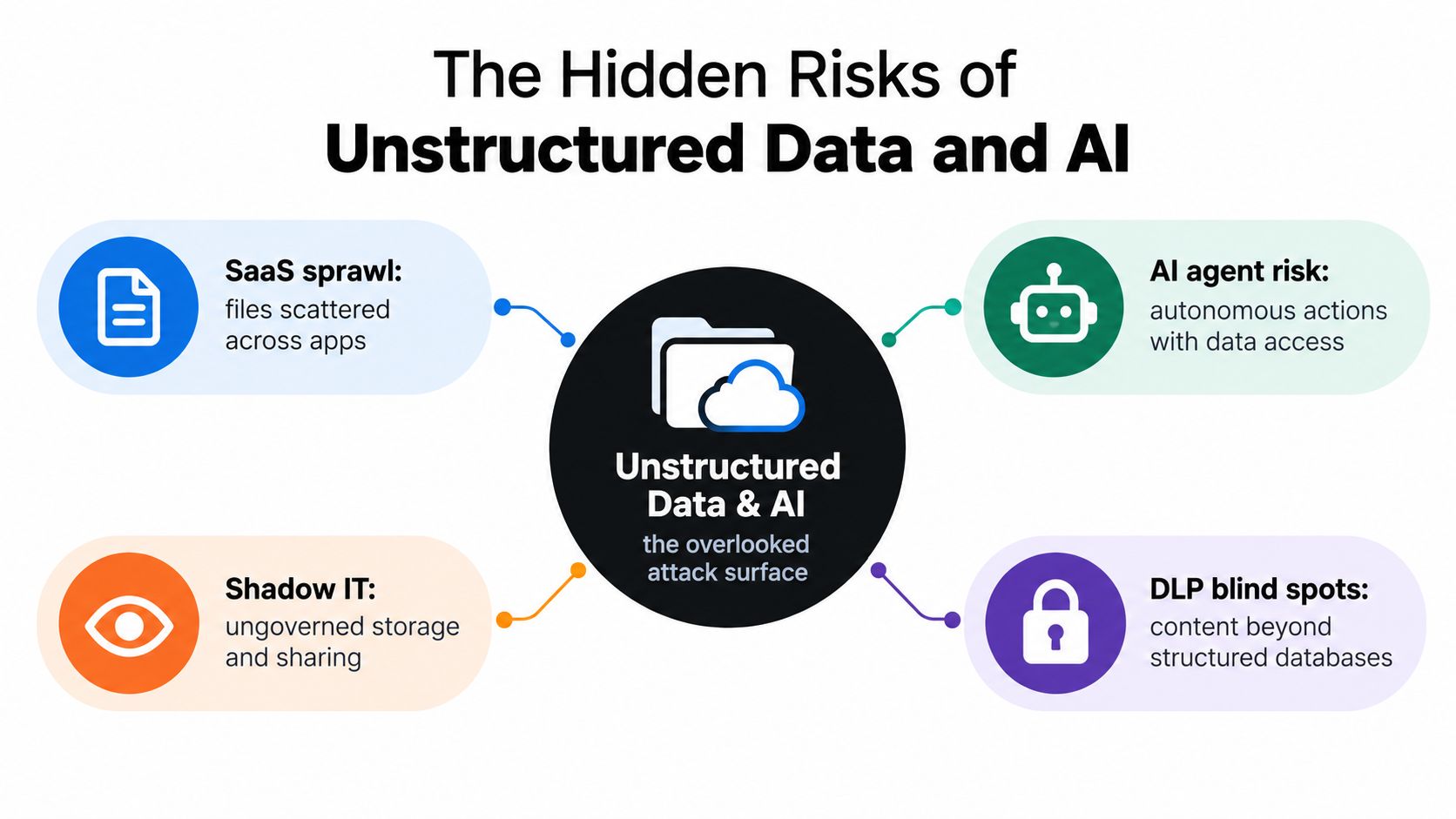
The Hidden Risks of Unstructured Data and AI
A support recording can become a transcript, a ticket attachment, an analytics export, and context for an AI agent before anyone confirms who owns each copy. Security teams may know these assets contain sensitive information, yet still lack a reliable way to locate, classify, scan, and govern them across hybrid environments. The policy may be clear. Execution often depends on which platform created the copy and which integration moved it.
A 2026 Cloud Security Alliance study found that 75% of organizations expressed confidence in securing unstructured data, while 68% said less than 80% of it was protected. The same research reported that 56% had only partial visibility into where data was stored, 9% used real-time scanning, and 23% couldn't scan unstructured data at all.
Confidence doesn't create coverage
Unstructured data exposes weaknesses in controls built around known schemas and stable locations. A customer conversation can move from a contact center platform to a transcript store, analytics workspace, ticketing system, and AI knowledge base. Each copy may have different ownership, retention rules, access controls, and deletion behavior. In a hybrid enterprise, governance intent rarely travels automatically with the content.
The same study found that only 50% of leaders had fully implemented data classification policies and 48% had fully implemented DLP across key egress channels. Meanwhile, 72% said they couldn't see how users interacted with sensitive data across endpoints, cloud services, or SaaS platforms.
That visibility gap makes enforcement unreliable. A policy may prohibit external sharing of personal information, but the organization must still identify that information in free text, assess the destination, determine which identity initiated the transfer, and stop the action without disrupting legitimate work. A control that covers databases but misses email, recordings, prompts, and exported files leaves a material policy gap.
Retrieval introduces another set of copies and decision points. Chunking, indexing, embeddings, metadata, and caches can separate content from the source system's access model. Teams building retrieval pipelines should review retrieval-aware chunking practices together with authorization, deletion, provenance, and tenant-isolation requirements. These design choices affect whether an agent receives only permitted context or a fragment that escaped its original controls.
Autonomous agents change the failure mode
An AI agent can interpret instructions, select tools, retrieve context, call APIs, and initiate actions. Its security boundary must cover both the information it can access and the actions it can take. Traditional governance often defines an approved business purpose, while the runtime must enforce that purpose across model inputs, retrieval results, tool calls, and downstream systems.
AI security research has highlighted a broad execution gap: organizations may define purpose limits, termination procedures, and network separation for agents without being able to enforce those controls consistently. A policy can authorize an agent to help resolve support cases, but implementation must restrict it to approved records, tools, fields, and outcomes. Consequential actions should require confirmation, every tool call should carry a traceable identity, and an emergency stop must work without the agent's cooperation.
A safer operating model treats agent permissions as temporary and purpose-bound. Give the agent only the context required for the task, redact unnecessary fields before inference, and remove access when the session or task ends. Test prompt injection, malicious retrieved content, tool misuse, data exfiltration, and unsafe fallback behavior before deployment, including failure cases across on-premises and cloud services.
The trade-off is real. Restricting retrieval and tool access can reduce an agent's apparent flexibility, but unrestricted autonomy can turn a small prompt or identity error into a broad data event. In enterprise environments, predictable boundaries are more valuable than impressive demonstrations that cannot be audited or stopped.
Operational Best Practices and Implementation Roadmap
A mature enterprise data security program doesn't begin with the most advanced AI control. It begins by making ownership, inventory, access, and recovery dependable. The implementation choice is usually between a broad transformation that stalls under its own complexity and a risk-led sequence that produces usable controls early.

Choose the sequence that matches maturity
If visibility is weak, start with an inventory of sensitive data stores, SaaS applications, integrations, service accounts, agents, and business owners. A smaller inventory with verified ownership is more useful than a massive catalogue nobody maintains.
If access is broad, prioritize privileged access reviews, dormant account removal, just-in-time elevation, MFA, session recording, and service-account governance. Measure whether teams can revoke access during an incident, not just whether an access policy exists.
If data movement is unclear, deploy classification and DLP around the highest-risk channels first. Tune policies with business users so the controls stop dangerous transfers without creating so many false positives that employees route around them.
If recovery is uncertain, test restoration of critical services and backups. Document dependencies, decision rights, manual workarounds, and communications responsibilities. A backup that hasn't been restored under realistic conditions is an assumption, not resilience.
Make AI controls part of delivery
Agent platforms should enter the same lifecycle as other production systems. Threat model the tools, retrieval sources, identities, prompts, models, and downstream actions before launch. Test generated code and configuration with the same review standards used for human-authored changes.
Use a staged rollout:
- Foundation: establish data owners, classifications, retention rules, asset inventories, and exception processes.
- Enforcement: apply least privilege, DLP, encryption, key governance, network controls, and centralized logging.
- Validation: run access reviews, adversarial tests, recovery exercises, vendor assessments, and agent kill-switch drills.
- Optimization: automate policy decisions, reduce false positives, measure response quality, and remove controls that create work without reducing risk.
Vendor reviews should include data handling, subcontractors, incident notification, access revocation, audit evidence, recovery commitments, and exit plans. A provider's compliance statement doesn't answer how your specific data, prompts, transcripts, or agent actions will be governed.
The best program is not the one with the most controls. It's the one that can explain where sensitive data is, why a principal can access it, what an automated system may do, and how the organization will contain and recover when an assumption fails.
Yellow.ai provides an enterprise-grade agentic AI platform for customer and employee conversations across channels, with agent building, retrieval-based enterprise knowledge, integrations, access controls, encryption, redaction, and security governance capabilities. If you're evaluating autonomous workflows against the control requirements described here, visit Yellow.ai to assess how the platform fits your data security and operational model.



