













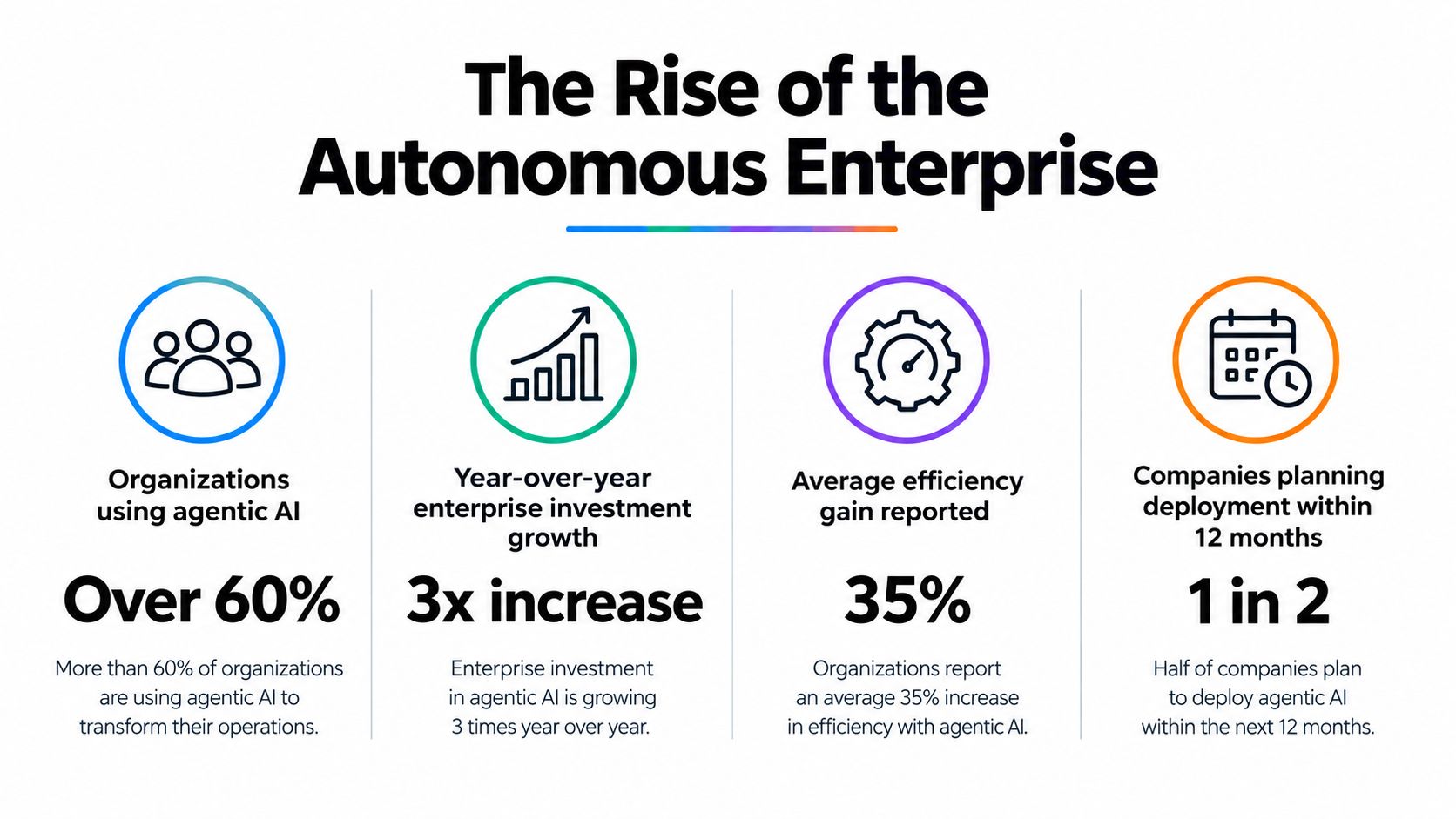
23% of organizations already use agentic AI at least moderately, and that share is expected to reach 74% within two years. An enterprise agentic AI platform is becoming essential because it turns that adoption from isolated experimentation into governed, production-scale execution.
The important shift isn't merely that companies are using more capable models. It's that leaders are evaluating AI as an operational system, one that can plan tasks, use enterprise tools, coordinate workflows, and escalate exceptions. A chatbot answers a question. An agentic platform helps complete the work behind the question.
That distinction creates a difficult executive problem. Organizations can launch an agent quickly, but production value depends on far more than model quality. Identity, permissions, data access, observability, integration reliability, human approval, and auditability determine whether an autonomous system can operate safely inside a real enterprise.
Table of Contents
- The Rise of the Autonomous Enterprise
- Core Architecture and Capabilities
- Key Capabilities for Production Scale
- Real-World Use Cases and ROI
- The Governance Gap and Control Plane
- Vendor Selection and Strategic Fit
- Future Outlook and Conclusion
- Frequently Asked Questions
The Rise of the Autonomous Enterprise
Deloitte's 2026 State of AI in the Enterprise report describes a market moving from pilots toward deployment. It says 23% of organizations already use agentic AI at least moderately, while 74% are expected to do so within two years. The same report identifies different levels of maturity, with 23% planning extensive use and 5% expecting to fully integrate agentic AI as a core operational component. These figures are summarized in Deloitte's 2026 enterprise AI analysis.
That trajectory changes the buying question. A team testing a conversational assistant can tolerate manual intervention, narrow data access, and informal monitoring. A company deploying agents across customer service, employee operations, finance, or logistics needs a platform that coordinates actions across systems and preserves control when workflows diverge from the expected path.
From conversational output to operational execution
A traditional generative AI tool usually produces text, classification, or recommendations in response to a prompt. An enterprise agentic AI platform works toward an outcome. It can interpret intent, divide a goal into steps, select tools, retrieve context, take actions, evaluate results, and request human intervention when a decision exceeds its authority.
A request such as “resolve this billing issue” might involve identifying the customer, checking account history, validating a policy, consulting a knowledge base, updating a system of record, and communicating the result. The platform's value lies in coordinating that sequence rather than generating a polished sentence.
The distinction is explained in practical terms in this guide to how agentic AI differs from conventional AI agents. For enterprise leaders, the central implication is clear:
The production unit isn't the model response. It's the governed workflow.
McKinsey's 2026 state-of-AI findings reinforce the enterprise momentum. Among respondents from organizations with more than $1 billion in annual revenue, 40% report scaling AI agents, compared with 27% the previous year. That movement indicates that large organizations aren't only exploring agent capabilities. They're starting to build the operating infrastructure needed to use them repeatedly.
The platform therefore becomes an architectural layer between models, enterprise data, applications, employees, and customers. Its success should be judged by how reliably it executes business processes, not by how impressive an isolated demonstration appears.
Core Architecture and Capabilities
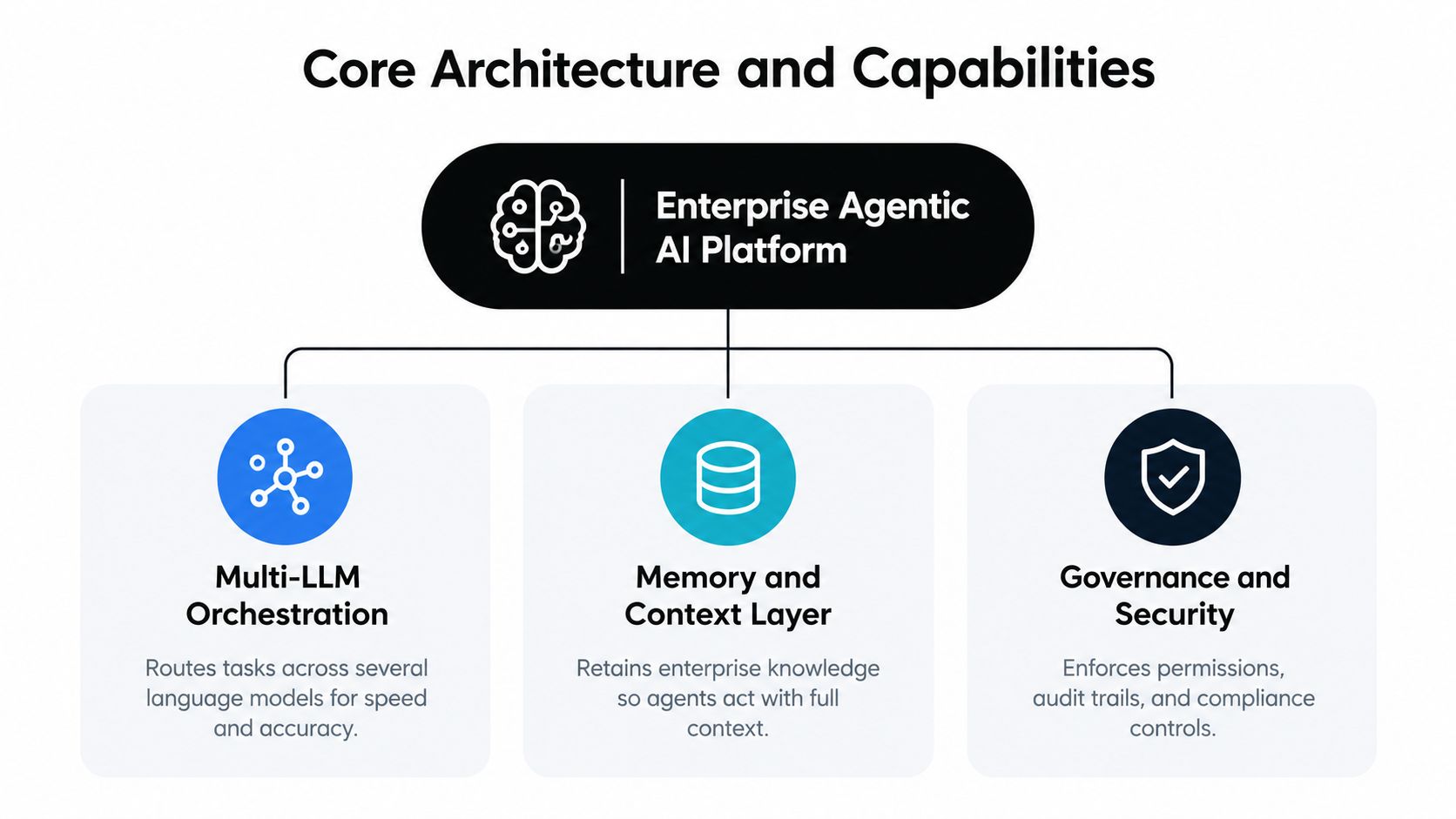
An enterprise agentic AI platform needs several architectural layers to turn a language model into a dependable digital operator. The model provides reasoning capability, but orchestration determines what the system can access, which actions it can take, and how it responds when information is incomplete.
Multi-model orchestration
A single-model architecture creates unnecessary constraints. Different tasks have different requirements for reasoning depth, response speed, cost, context length, and reliability. Multi-model orchestration routes each request to an appropriate model instead of forcing every workflow through the same endpoint.
A lightweight interaction might need a fast model, while a complex policy interpretation or multi-step planning task may justify a more capable specialist. Routing also creates fallback options when a model becomes unavailable or fails to meet a quality threshold. The underlying principle is described in this analysis of multi-model orchestration for enterprise workloads.
Agentic retrieval and contextual memory
Fixed retrieval pipelines usually perform one search and pass the returned documents to a model. Agentic RAG treats retrieval as a tool that the agent can call, assess, refine, and call again. The agent can decompose a complex question, search different sources, evaluate intermediate results, and stop when it has enough grounded context.
That approach matters when an answer depends on several policies, customer records, or operational documents. The system isn't merely finding similar text. It's adjusting the search strategy as it reasons about the task. Google describes this design in its explanation of agentic RAG for more dependable enterprise responses.
Lifecycle and control layers
The third requirement is lifecycle management. Teams need to define an agent's purpose, tools, permissions, memory, escalation rules, evaluation criteria, and release process. They also need to observe what happens after deployment, including failed tool calls, unexpected paths, and changes in source data.
A mature platform connects these layers rather than treating them as separate products:
- Reasoning layer: Interprets intent and creates a plan.
- Tool layer: Connects to APIs, knowledge repositories, CRM systems, ticketing tools, and workflow engines.
- Context layer: Supplies relevant enterprise information and preserves task state.
- Execution layer: Performs approved actions and records outcomes.
- Control layer: Enforces identity, permissions, approvals, monitoring, and audit trails.
The strategic insight is that autonomy emerges from the interaction of these layers. Better models help, but a model without reliable tools, current context, and enforceable boundaries remains an assistant rather than an enterprise operator.
Key Capabilities for Production Scale
Production deployment starts with a capability audit, not a feature checklist. Leaders should ask whether a platform can support the channels, systems, controls, and testing practices their operating environment already requires.
1. Support the interaction modes customers and employees use
A platform should handle more than text chat when the workflow depends on voice, email, images, or video. Voice systems need natural turn-taking, reliable escalation, language coverage, and a controlled way to manage voice identity. Multimodal orchestration matters because customers and employees rarely organize their requests around the capabilities of an AI product.
The practical test is continuity. Can an interaction move from voice to chat without losing context? Can an employee send a document and receive a structured response? Can a customer begin with a conversational question and complete a transaction without being transferred between disconnected systems?
2. Connect actions to enterprise systems
Agents create value only when they can work within the applications that hold operational truth. Buyers should inspect the platform's integrations for CRM, contact center, HR, ERP, ticketing, identity, and knowledge systems.
Pre-built integrations can accelerate deployment, but they aren't enough on their own. The platform also needs APIs, event handling, authentication controls, and a method for maintaining connections as enterprise applications change. A connector that reads data but can't safely write an approved update won't complete the workflow.
3. Build security into the execution path
Security can't sit in a policy document beside the agent. It must govern each action. Evaluate role-based access, least-privilege permissions, sensitive-data handling, tenant separation, approval flows, and audit logs.
For regulated operations, buyers may also require frameworks and certifications relevant to their environment, including HIPAA and SOC 2 Type II. These controls don't eliminate risk, but they help organizations establish accountable operating procedures around data and automated actions.
4. Test behavior before release
Agent behavior changes when prompts, tools, models, policies, or source documents change. Production teams need automated testing that checks intent recognition, retrieval quality, tool selection, policy adherence, escalation, and response consistency.
Testing should include normal requests and adversarial conditions. A strong release process verifies what happens when data is missing, an API fails, a customer changes the subject, or the agent reaches a decision that requires a person.
5. Measure the workflow, not just the conversation
Useful analytics connect agent activity to business outcomes. Leaders should track completion, escalation, rework, failed actions, resolution quality, and employee acceptance. A platform that reports only message volume can make an active but ineffective agent look successful.
The correct capability standard is operational: the system must make work easier to complete, easier to supervise, and easier to improve.
Real-World Use Cases and ROI
A customer contacts a service team about an order that hasn't arrived. A basic chatbot can provide a tracking link if the customer asks the right question. An agentic workflow can identify the order, inspect delivery status, apply the relevant service policy, determine whether a replacement or refund is authorized, update the case, and communicate the next step.

The human support representative still matters when the case involves an exception, emotional complexity, or a discretionary decision. The platform handles the coordination burden, gathers the relevant information, and presents a complete context package instead of forcing the representative to search across systems.
Customer experience
High-volume CX workflows often contain a predictable core and an unpredictable edge. Agents can handle the core by answering policy questions, checking account information, changing appointments, collecting details, and initiating approved actions. Escalation rules preserve human ownership when the request involves risk or ambiguity.
This model changes the economics of service in a qualitative but important way. Leaders aren't merely trying to reduce conversation time. They're reducing the number of manual handoffs required to reach a valid outcome. The value appears in resolution quality, consistency, employee workload, and the ability to serve customers across channels.
A relevant example is InteleTravel's chat and voice support use case, which illustrates how an enterprise service operation can apply conversational automation to support scaling requirements. It should be assessed as an operating example, not as a universal performance promise.
Employee experience
The same architecture applies internally. An employee might ask for help with access, payroll, benefits, travel, or a workplace policy. The agent can verify identity, consult the appropriate source, create or update a ticket, and route the request to the correct team when a human decision is required.
This reduces the friction created by fragmented internal services. HR, IT, and facilities teams can expose guided workflows without requiring employees to understand which department owns each step.
A production evaluation should connect the agent to a baseline process and compare outcomes such as completion, escalation, rework, and employee satisfaction. It shouldn't rely on message counts or demo quality alone.
The distinction between assistance and execution is demonstrated in this enterprise support video.
The Governance Gap and Control Plane
The most important enterprise AI risk may not be that an agent lacks intelligence. It may be that the organization can't see what the agent did, why it did it, which data it accessed, or who approved the result.
McKinsey found that 23% of organizations are already scaling an agentic AI system, while 39% are experimenting. Infosys reported that only 2% of enterprises have adequate responsible-AI controls, even though 86% expect new compliance risks from agentic AI. Those findings, summarized in McKinsey's state-of-AI research, reveal a dangerous sequence: deployment can move faster than accountability.
Visibility is a prerequisite for autonomy
An autonomous action is still a business action. If an agent changes a record, sends a customer communication, approves a request, or retrieves sensitive information, the organization needs a traceable record of the event.
That record should cover:
- Identity: Which user, service identity, or agent initiated the action?
- Authority: Which policy allowed the agent to proceed?
- Context: Which data and instructions informed the decision?
- Execution: Which tools did the agent call, and what did they return?
- Outcome: What changed, and did the workflow complete or escalate?
Akto's 2025 security research found that only 21% of enterprises have full visibility into agent actions, tool use, or data access, while only half have implemented action-level guardrails. The operational consequence is straightforward. An organization can't confidently scale a system it can't inspect.
Build a control plane, not a collection of safeguards
A control plane centralizes identity, permissions, policy enforcement, logging, anomaly detection, approvals, and agent lifecycle management. It gives security and operations teams a shared view of autonomous work across business units.
Practical rule: Every agent should have an owner, a defined authority boundary, an escalation path, and a durable action record.
This is especially important in BFSI, healthcare, utilities, retail, and logistics, where an incorrect action can create financial, legal, safety, or reputational exposure. The right response isn't to remove autonomy from every workflow. It's to assign autonomy according to risk, with stronger approval requirements for actions that affect money, regulated data, or external commitments.
Enterprise security guidance should be evaluated at the platform level, including Yellow.ai's enterprise-grade security approach, alongside the controls and operating model of any alternative under consideration.
Vendor Selection and Strategic Fit
Vendor selection should begin with the workflow, not the model catalogue. A platform can support impressive reasoning and still fail if it can't connect to the applications, policies, and teams that own the process.
A useful comparison separates five dimensions:
| Evaluation dimension | What to verify | Why it matters |
|---|---|---|
| Workflow execution | Planning, branching, tool use, retries, and escalation | Complex processes rarely follow a straight path |
| Model strategy | Routing, fallback, model choice, and provider flexibility | Different tasks need different quality and latency profiles |
| Enterprise integration | APIs, pre-built connectors, identity, and event support | Agents need access to operational systems |
| Governance | Permissions, auditability, approvals, testing, and monitoring | Autonomous actions need accountable control |
| Deployment fit | Channels, data boundaries, support model, and operating ownership | A technically capable platform still needs to fit the enterprise |
Compare autonomy with control
A developer framework may offer deep customization but require the enterprise to assemble governance, observability, testing, and deployment practices. An automation-first product may integrate well with existing processes but offer less flexibility for dynamic reasoning. A service platform may accelerate customer and employee workflows while placing greater emphasis on conversations, channels, and pre-built business integrations.
None of those approaches is automatically correct. The decision depends on whether the buyer is building a general AI infrastructure layer, modernizing process automation, or deploying autonomous service operations.
Test the platform against failure
A serious evaluation should include scenarios where the preferred path breaks. Remove a required data field. Return an API error. Introduce conflicting policy documents. Ask for an action outside the user's permissions. Then inspect whether the platform stops safely, explains the failure, preserves the audit trail, and routes the issue to the right person.
Yellow.ai offers an example of an enterprise service platform that combines multimodal agent creation, agentic knowledge retrieval, multi-model architecture, automated testing, analytics, and integrations with enterprise applications. Those capabilities make it one option for organizations evaluating customer and employee service orchestration, but buyers should validate the fit against their own controls, workflows, data boundaries, and support requirements.
The strongest vendor isn't the one with the most autonomous demo. It's the one that makes autonomy measurable, bounded, and operable after launch.
Future Outlook and Conclusion
Enterprise AI is moving toward a model in which software doesn't merely provide a capability. It performs a service through coordinated agents, tools, data, and human oversight. That shift makes the platform layer more important than any individual model selection.
The evidence points to a widening gap between adoption and integration. Deloitte reports that 66% of organizations have already achieved productivity and efficiency gains from enterprise AI, while 34% are beginning to use AI to deeply transform products, services, or core processes. Publicis Sapient's 2026 research adds that 73% of respondents use AI regularly or across most business processes, yet only 10% say AI is core to how the business operates. The findings are discussed in Deloitte's enterprise AI research.
That gap defines the next market phase. Enterprises don't need more disconnected pilots. They need orchestrated workflows with clear owners, controlled access, reliable integrations, observable actions, and measurable outcomes.
Leaders should treat governance as a scaling mechanism rather than a brake. A control plane lets the organization expand useful autonomy while limiting the blast radius of errors. It also gives security, operations, compliance, and business teams a shared basis for deciding which tasks agents can perform independently.
The strategic question is no longer whether agents can complete isolated tasks. It's whether the enterprise can operate them repeatedly, safely, and economically across the processes that matter most.
Frequently Asked Questions
What's the difference between a chatbot and an agentic AI platform?
A chatbot generally responds to prompts or follows a constrained conversation path. An agentic platform works toward an outcome by planning steps, using tools, retrieving information, taking approved actions, and adapting when conditions change. The important distinction is workflow execution, not conversational fluency.
How quickly should a business expect ROI?
There isn't a universal timeframe. ROI depends on process volume, integration effort, data quality, risk controls, and the clarity of the baseline. Start with a workflow where the organization can measure completion, escalation, rework, resolution quality, or employee effort. Avoid treating a successful demonstration as evidence of production value.
Will agents replace existing enterprise software?
They generally work as an orchestration layer across existing systems rather than replacing every system of record. A well-designed agent retrieves information from approved applications and performs authorized actions through controlled integrations. Existing investments remain valuable when the platform can use them without creating unmanaged access paths.
What should happen before production launch?
Assign business and technical ownership, define the agent's authority, document escalation rules, connect only necessary tools, test failure scenarios, and establish action-level monitoring. Make approval requirements explicit for sensitive decisions. Production readiness means the organization can explain and govern the agent's behavior after deployment, not just demonstrate it beforehand.
Who should own an enterprise agentic AI platform?
Ownership should be shared. A central technology or AI platform team can manage architecture, security, model strategy, and lifecycle standards, while business units own workflow outcomes and policy decisions. This prevents both extremes, uncontrolled departmental deployment and a central team disconnected from operational reality.
Yellow.ai provides an enterprise agentic AI platform for autonomous CX and EX conversations across voice, chat, email, and other channels, with integrations, agentic knowledge retrieval, testing, analytics, and enterprise controls. Evaluate your highest-value workflows and visit Yellow.ai to explore whether its orchestration approach fits your production, governance, and integration requirements.



