













Most advice on an employee self service platform is stuck in the portal era. It tells HR teams to add better menus, cleaner forms, and a more searchable intranet. That's incremental improvement to a broken model.
Employees don't want another place to click around. They want a problem solved. If someone needs a leave balance, a tax document, a benefits answer, or an address update, the ideal experience isn't “log in and find it yourself.” It's “ask once and get it handled.”
That distinction matters more than most buyers realize. Traditional employee self service was built to deflect administrative work away from HR. Modern employee support has a different standard. It should understand intent, act across systems, and finish the task with minimal effort from the employee.
Table of Contents
- Your Employee Self Service Platform Is Already Obsolete
- The Evolution from Portal to Intelligent Partner
- Core Capabilities of a Modern ESS Platform
- The Business Case ROI and Tangible Benefits
- Choosing Your Platform An Evaluation Checklist
- Implementation and Driving Employee Adoption
- Beyond Portals How Yellow.ai Delivers Autonomous Service
- The Future of Employee Experience Is Autonomous
Your Employee Self Service Platform Is Already Obsolete
If your definition of an employee self service platform is “a portal where people can view pay slips and update contact details,” you're using a definition from a different decade.
The blind spot isn't feature depth. It's the assumption that self-service still means the employee has to work through the process manually. A more useful distinction is between passive self-service and autonomous service. Passive self-service gives employees tools. Autonomous service resolves the issue.
That shift is already underway. Paylocity's analysis of employee self-service notes a critical blind spot in the market: vendors still market click-based portals even though 68% of HR leaders expect AI to automate 40% or more of tier-1 employee inquiries.
Most ESS platforms still measure success by what employees can do themselves. The better question is what the platform can do for them.
That's why the old playbook underperforms. A portal can store policies, route forms, and display account details. It can't, by itself, understand a vague question, pull context from multiple systems, ask a clarifying follow-up, complete the workflow, and confirm the result in the same conversation.
A lot of teams still buy ESS as if usability is the end goal. It isn't. Resolution is the goal. The employee doesn't care whether the answer came from a knowledge base, an HRIS integration, or a workflow engine. They care that the issue is resolved quickly and correctly.
The strongest platforms now behave less like websites and more like digital coworkers. That's the benchmark.
The Evolution from Portal to Intelligent Partner
The employee self service platform category didn't stand still. It moved through three clear stages, and most enterprises are still somewhere between the second and third.
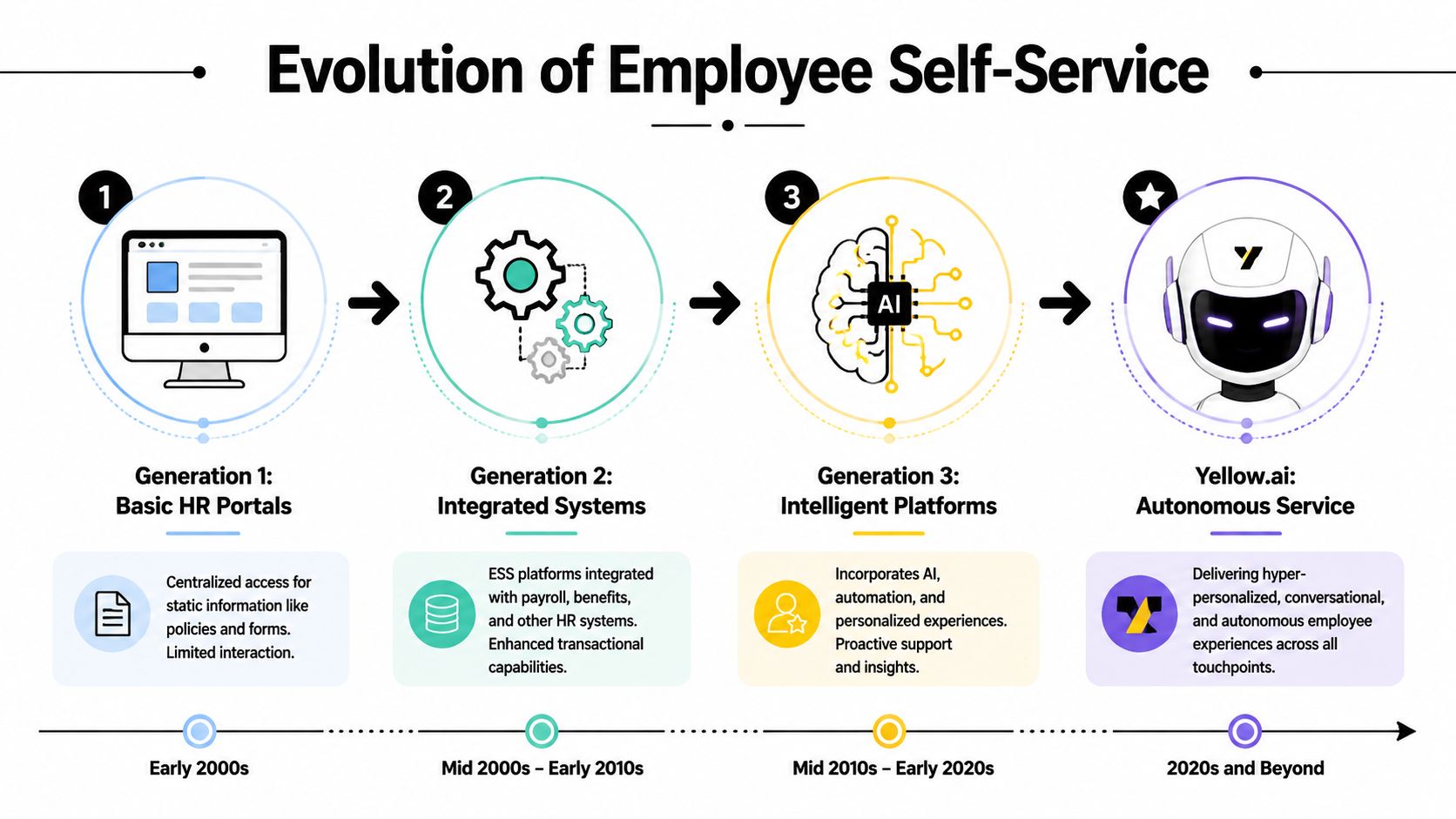
Generation 1 was digital filing
The first ESS tools were basically structured repositories. They put forms, handbooks, payroll access, and employee records in one place. That was useful because it reduced dependency on email and paper-heavy HR processes.
But the operating model was simple. Employees had to know where to go, what to search for, and which workflow to start. If they guessed wrong, they got stuck. HR still handled exceptions, clarification, and follow-up.
Generation 2 connected systems but kept the burden on employees
The second wave improved the plumbing. ESS platforms connected with payroll, scheduling, and benefits tools. Mobile access became more common. Transactions got better.
This stage helped the market expand. According to Intellective's overview of ESS adoption and market growth, the global employee self-service platform market was valued at $9.8 billion in 2025 and is projected to reach $24.6 billion by 2034, with a CAGR of 10.8%. That growth is tied to AI integration and the need for real-time data access.
Even so, the core interaction model didn't really change. Employees still had to operate the system. The software was integrated, but it wasn't intelligent enough to carry the task.
For leaders thinking beyond feature checklists, an autonomous AI systems strategy becomes more useful than another portal redesign. The strategic question isn't which interface looks cleaner. It's which system can reason across requests and orchestrate action.
Generation 3 acts more like a service layer
The modern employee self service platform sits on top of systems of record and works as a conversational layer across them. It doesn't wait for perfect input. It interprets intent.
That changes the employee experience in practical ways:
- Questions become conversations: Someone can ask for parental leave guidance in plain language instead of hunting through policy documents.
- Requests become workflows: A user can update information, request leave, or resolve a payroll query from the same interaction.
- Support becomes omnichannel: Employees can get help in Slack, Microsoft Teams, web chat, or voice, rather than visiting a dedicated HR portal.
- Service becomes proactive: The platform can surface reminders, next steps, and exceptions before an employee opens a ticket.
The breakthrough isn't that AI makes portals friendlier. It's that AI makes the portal less necessary.
That's why intelligent platforms are becoming the default direction for HR and IT leaders. The future of employee service isn't a better destination. It's a better layer between employees and the systems that run work.
Core Capabilities of a Modern ESS Platform
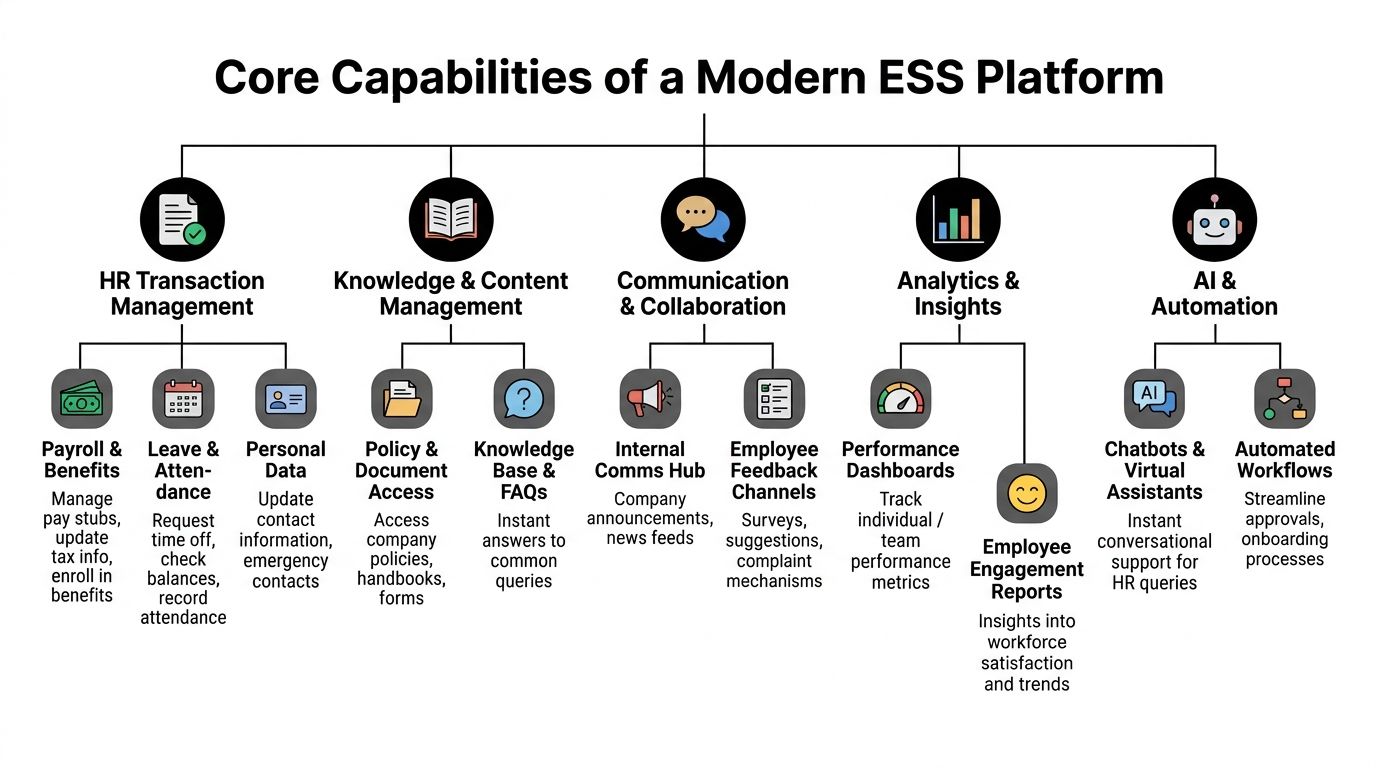
A modern employee self service platform should do more than centralize access. It should combine transaction execution, conversational support, orchestration, and governance into one operating layer.
What the platform must handle directly
Start with the basics, because many vendors still get these wrong.
- HR transaction management: Employees should be able to request leave, review pay information, update profile details, and manage benefits without opening multiple systems. If a platform still pushes users into disconnected forms, it's not reducing friction.
- Knowledge delivery: Policy answers have to be current, contextual, and easy to retrieve. A static FAQ page isn't enough. Strong platforms combine search, retrieval, access controls, and conversational explanation. A robust conversational knowledge base for enterprise support shows what this should look like in practice.
- Workflow orchestration: Good systems don't just present forms. They trigger approvals, route requests, validate data, and close the loop with confirmation.
- Omnichannel access: Employees work in Slack, Microsoft Teams, email, mobile apps, and voice environments. Support should meet them there.
- Security and compliance controls: ESS platforms handle payroll, tax, benefits, and identity data. Role-based access, auditability, and policy enforcement aren't optional.
What separates a modern platform from a dressed-up portal
There's a major difference between having AI features and being architected for autonomous service.
A dressed-up portal usually offers chat on top of old workflows. The employee still has to follow the original process. A modern platform changes the process itself.
Here's the practical difference:
| Capability | Legacy portal behavior | Modern ESS behavior |
|---|---|---|
| Employee query | Returns links or forms | Interprets intent and responds conversationally |
| Task execution | Sends user to another system | Completes steps across connected systems |
| Support channel | Mostly web login | Works across chat, voice, and workplace tools |
| Policy guidance | Static article retrieval | Context-aware answers with role relevance |
| Escalation | Human-first fallback | Automated first, human when needed |
The strongest platforms also support several modes of service at once:
A complete platform usually includes these layers
Transactional layer
The transactional layer handles payroll access, leave workflows, profile changes, and document retrieval.Conversation layer
This handles natural language questions, follow-up prompts, multilingual support, and clarification.Integration layer
This connects HRIS, payroll, identity, service management, and document systems.Automation layer
This runs approvals, applies business rules, and triggers actions.Governance layer
This enforces permissions, logging, compliance, and safe data handling.
Practical rule: If a vendor demo spends more time showing menus than showing completed tasks, you're looking at a portal with better design, not a modern employee service platform.
The best buyer mindset is simple. Don't ask whether the platform has self-service features. Ask whether it can absorb routine employee support work and resolve it reliably.
The Business Case ROI and Tangible Benefits
The business case for a modern employee self service platform isn't just convenience. It's operational discipline. When employee support runs through fragmented workflows, errors increase, tickets pile up, and HR becomes a manual coordination layer.
Where the return shows up first
Payroll is one of the clearest examples. TimeTrex's analysis of employee self-service systems states that modern ESS platforms reduce payroll errors by 5% to 7% by unifying payroll, scheduling, and personal data through automated validation instead of manual reconciliation.
That kind of improvement matters because payroll errors aren't isolated events. They generate employee frustration, rework for HR, manager escalations, and avoidable compliance risk.
The second payoff comes from labor recovery inside HR operations. When employees can update banking details, emergency contacts, tax withholding preferences, and year-end document access on their own, HR stops acting as a data-entry relay. The value isn't only lower administrative burden. It's the ability to move HR time toward onboarding quality, workforce planning, employee relations, and policy support.
If you're modeling the impact internally, a useful next step is an AI platform ROI calculator for service automation. The best business cases tie savings to current ticket categories, repetitive workflows, and error-prone handoffs.
Why the operating model matters more than the feature list
A lot of procurement teams still evaluate ESS like a software catalog. They compare mobile access, dashboard design, and workflow templates. That overlooks the key source of ROI.
Return comes from replacing this pattern:
- Employee submits request
- HR or IT interprets it
- Someone checks a policy
- Someone updates a system
- Someone sends a follow-up
- Employee asks again if there's a delay
With this pattern:
- Employee asks once
- The platform checks context
- The workflow executes
- The employee gets confirmation or a precise escalation path
That's a different operating model. It reduces manual interpretation and unnecessary touchpoints.
There are softer benefits too, and they're often the reason leaders keep investing after the first deployment. Employees trust support more when answers are easy to get. Managers spend less time chasing routine approvals. HR can behave more like a strategic function and less like a service desk for administrative repeat work.
A good ESS investment doesn't just digitize HR forms. It changes who has to do the work.
Choosing Your Platform An Evaluation Checklist
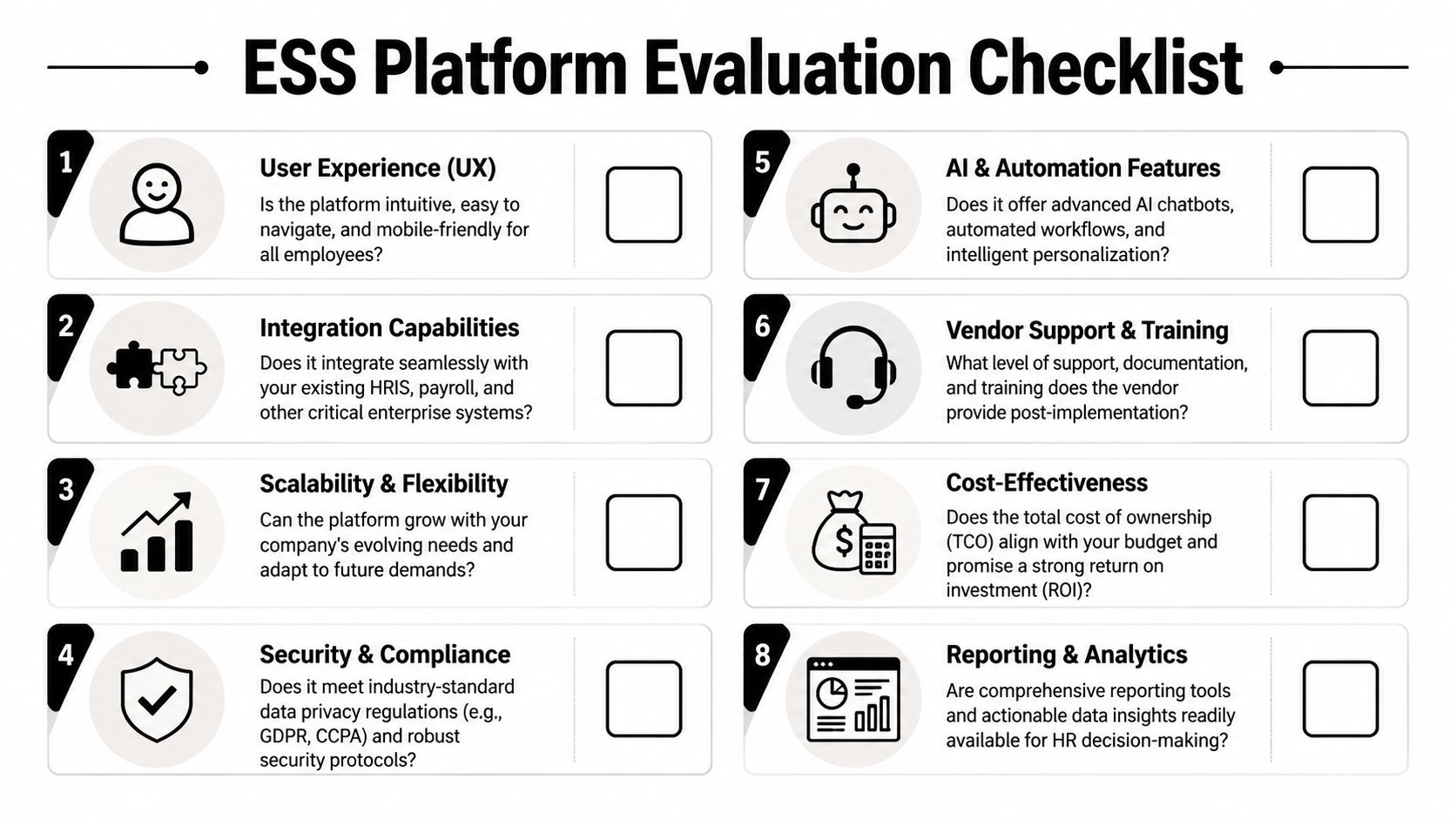
Many ESS buying processes fail before implementation starts. The team buys a portal with a chatbot instead of a platform with autonomous capability. The demo looks polished. The architecture is weak.
The shortlist questions that expose weak platforms
Use this checklist when comparing vendors.
- Can it take action, not just answer questions? Ask the vendor to complete a real workflow such as updating employee data, initiating leave approval, or retrieving a tax document. If the assistant mostly returns links, it's not autonomous.
- Does it work where employees already work? Slack, Microsoft Teams, mobile, web, and voice support all matter. A separate portal login creates friction from day one.
- How deep are the integrations? Look for pre-built connectors to HRIS, payroll, ITSM, identity, and knowledge systems. Weak integration means the AI can talk but not execute.
- Can it handle ambiguity? Employees don't phrase requests like system architects. The platform should ask clarifying questions and maintain context through several turns.
- Is security built into workflows? Sensitive HR interactions require identity-aware responses, role-based permissions, logging, and compliance controls.
- Will the architecture age well? Buyers should ask about model flexibility, governance, and how the platform adapts as enterprise AI tooling changes.
- What support does the vendor provide after launch? Enablement, workflow design guidance, analytics, and change support matter more than a slick kickoff.
Yellow.ai's buyer's guide for evaluating conversational AI solutions is a useful reference for structuring that diligence process.
What a strong buying process looks like
Advanced ESS platforms can remove significant HR administrative work because employees can independently update critical information such as banking details and tax withholding, eliminating countless email exchanges and form submissions. That's the outcome to anchor on during evaluation.
So don't ask vendors abstract questions. Use scenario-based testing instead.
Try prompts like these in a demo environment:
| Test scenario | What to watch for |
|---|---|
| “I moved last week and need everything updated” | Whether the platform can identify affected systems and guide or execute the update |
| “How much leave do I have, and can I book next Friday off?” | Whether knowledge, balance retrieval, and workflow execution happen in one flow |
| “I need my year-end tax document” | Whether retrieval is immediate and permission-aware |
| “I think my pay is wrong” | Whether the platform can collect context before escalating |
The strongest vendors won't hide behind canned scripts. They'll show orchestration, exception handling, and governance under pressure.
A good checklist protects you from buying a prettier bottleneck.
Implementation and Driving Employee Adoption
Most rollout problems aren't technical first. They're behavioral. Teams assume that because an employee self service platform is useful, employees will automatically use it. That isn't how adoption works inside a company.
Why rollouts fail
The common failure pattern is familiar. HR and IT configure workflows, launch the portal, send one announcement email, and expect traffic to move. Then employees ignore it, ask their usual contacts for help, or try it once and leave when the first interaction feels confusing.
That resistance is real. Dynamics Solution's guidance on ESS adoption notes that adoption rates can climb by 40% within three months when organizations engage stakeholders early and offer thorough training, but 39% of employees say they're reluctant to even try new workplace technology.
A platform rollout succeeds when leaders treat it like an operating change, not a software release.
What actually increases usage
The strongest implementations usually share the same moves:
- Involve managers and frontline teams early: They'll surface edge cases before launch and influence adoption after launch.
- Start with high-frequency use cases: Pay access, leave requests, policy questions, and personal data updates create immediate value.
- Train by task, not by product: Employees don't want a tour of the interface. They want to know how to solve a real problem fast.
- Create internal champions: HR partners, team leads, and IT support staff can redirect old habits and reinforce the new path.
- Refine quickly after launch: Broken flows, vague answers, and dead ends kill trust. Fix them fast.
A successful launch doesn't teach employees where every feature lives. It proves the system is the fastest route to resolution.
I've seen adoption improve most when teams position the platform around outcomes. “Use this to get your leave approved faster” works better than “Here is our new self-service portal.” Employees adopt systems that save them effort. They avoid systems that shift administrative work onto them.
That's also why conversational and autonomous experiences outperform menu-driven ones over time. They reduce the learning curve. People don't need to memorize process maps. They can ask for what they need.
Beyond Portals How Yellow.ai Delivers Autonomous Service
Yellow.ai fits the newer category of employee support platforms because it's designed around agentic execution, not just front-end interaction.
Its strength starts with agentic AI. Instead of stopping at question answering, the platform is built to manage multi-turn interactions that collect context, apply logic, and carry workflows forward. That matters for HR use cases where one request often spans policy interpretation, employee identity, system lookup, and approval routing.
Voice is another differentiator. With Nexus Vox, employee support doesn't have to stay in chat. Teams can offer natural voice interactions for situations where speaking is easier than typing, especially for distributed workforces and high-volume internal support environments.
The platform's multi-LLM architecture also matters strategically. Enterprises don't want to tie employee support to a single model provider when accuracy, latency, governance, and cost can vary by use case. Model flexibility gives IT and EX teams room to optimize over time without rebuilding the service layer.
Then there's integration depth. Autonomous employee service only works when the platform can connect to HRIS, payroll, knowledge systems, service tools, and communication channels. That's what turns conversational AI from a front door into an execution layer.
The result is a more useful definition of an employee self service platform. Not a destination. A system that can understand, decide, and act.
The Future of Employee Experience Is Autonomous
The portal-first view of employee support is fading. Employees don't need another system to learn. They need fast, reliable help inside the tools they already use.
That's why the conversation has moved from self-service to autonomous service. Basic portals gave people access. Intelligent platforms add context, conversation, and action. Agentic systems go further by resolving routine work across enterprise tools with much less effort from employees and support teams.
HR, IT, and operations leaders should redesign employee experience around that standard now. The gap between a portal and an autonomous service layer will only get harder to ignore.
Yellow.ai helps enterprises move beyond static ESS portals with agentic AI for employee and customer support. If you're rethinking your employee self service platform strategy around conversation, automation, voice, and orchestration, explore Yellow.ai to see how autonomous service can work across your existing systems.



