













Most advice on the differences between customer service and customer experience starts in the wrong place. It treats service as the “good” part and CX as the “bigger” part, then assumes that better support automatically improves the whole customer relationship. It doesn't.
A contact center can be fast, polite, and well-staffed, and still leave customers frustrated by onboarding, billing, checkout, or product usability. That's because customer service is a single, reactive interaction, while customer experience is the full relationship across every touchpoint, from discovery through renewal and advocacy, as defined in the sources on CX and service distinction from Coworker.ai and NICE. The operational question leaders keep bumping into is simpler and harder at the same time, who owns what, who funds what, and who gets to change what when the journey spans product, pricing, website, support, and post-purchase engagement.
| Dimension | Customer Service | Customer Experience |
|---|---|---|
| Scope | A single support interaction | The entire customer journey |
| Time horizon | Immediate resolution | Cumulative perception over time |
| Ownership | Support or contact center teams | Cross-functional, organization-wide |
| Main focus | Solve the issue in front of you | Shape every touchpoint in the relationship |
| Typical blind spot | Fixing the case, not the journey | Letting service metrics mask friction elsewhere |
Table of Contents
- Why Great Customer Service Does Not Guarantee Great Customer Experience
- Defining Customer Service and Customer Experience
- Operational Differences Across Ownership Metrics and Workflows
- Real-World Scenarios Where the Distinction Changes Outcomes
- Measurement Frameworks for Service and Experience
- How Conversational AI Bridges Service and Experience
- Checklist for Shifting From Service-Led to CX-Led Operations
Why Great Customer Service Does Not Guarantee Great Customer Experience
A support team can hit every target and still lose the customer. I have seen operations celebrate short handle times, clean queues, and fast closures while customers are stuck in onboarding, confused by billing, or pushed through a product that is difficult to use. The contact center looks healthy because it is doing its job, but the broader journey is still broken.
The gap is structural. Customer service is a single, reactive interaction when a customer needs help, while customer experience is the entire relationship across all touchpoints. You can deliver an excellent call and still create a poor experience if the website misleads, checkout blocks, or the product makes people contact support in the first place. Service teams can only work with the pain point in front of them, not the upstream friction that created it.
Practical rule: if support keeps solving the same issue, the root cause usually sits in product, pricing, content, or process.
That is why ownership matters so much. Service metrics usually sit with the contact center, but CX spans product, marketing, commerce, billing, and operations, which means the budget and decision rights are spread across teams that do not always share the same scorecard. A support leader can improve responsiveness and still have no authority over the checkout flow that drives avoidable contacts. A CX leader has to work across those boundaries and decide which friction points deserve investment first.
Digital channels made that divide harder to ignore. As touchpoints multiplied, the customer's impression started to depend on the full journey rather than one conversation. In that setting, service quality is necessary, but it does not carry the whole experience. Leaders who stop at the contact center end up optimizing the easiest part to measure, while the more expensive journey problems stay in place.
A simple test cuts through the noise. If customers praise your agents but still complain about buying, using, or paying for the product, the issue is not the people answering phones. The problem sits in the operating model around them, and that is where CX ownership begins. For teams trying to move beyond reactive support, the framework in Yellow.ai's CX guide is a useful reference for thinking in journeys rather than isolated cases.
Defining Customer Service and Customer Experience
What customer service controls
Customer service is an interaction-level function. It starts when a customer reaches out with a question, complaint, or request, and it ends when that specific issue is resolved, escalated, or closed. The scope is narrow by design, which is useful when the problem sits inside a queue, a script, or a ticket. The support team owns the contact, the queue, the script, the ticket, and the close.
Service is measured at the case level because that is where the work happens. Managers watch resolution quality, consistency, and responsiveness, then adjust staffing, macros, knowledge content, and escalation paths. The aim is straightforward. Handle each interaction well enough that the customer can move on without extra effort.
What customer experience controls
Customer experience is a journey-level construct. It covers every touchpoint, from first awareness through advocacy, and it reflects the customer's total perception of the brand over time. CX is not limited to support. It includes marketing, website usability, checkout, product quality, billing, onboarding, loyalty, and post-purchase communication, as reflected in NICE's overview.
That wider scope changes who owns what. CX is the connective tissue between teams, budgets, and decisions, not a handoff from one department to the next. A checkout problem may originate in commerce, a billing issue in finance, and a repeat contact spike in product or content. A contact center can absorb the pain, but it cannot fix every root cause on its own. Teams using Yellow.ai's customer service automation still have to align those operational decisions with the rest of the journey.
The customer does not see those internal boundaries. They experience one brand.
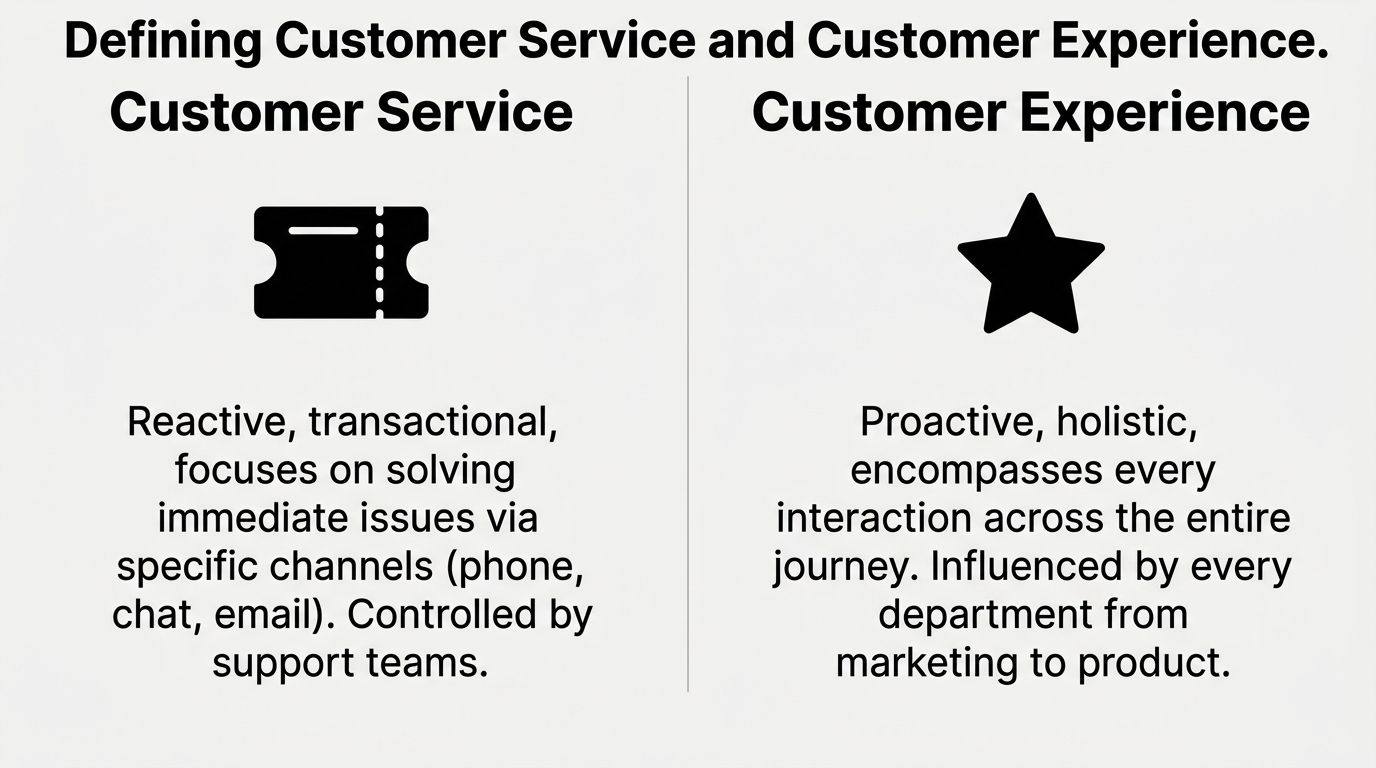
A clean way to categorize the work is to ask whether an initiative fixes a contact or shapes a journey. Password reset workflow, ticket routing, and call scripting sit close to service. Checkout clarity, onboarding design, pricing transparency, and lifecycle messaging sit closer to CX. Many initiatives overlap, but the ownership lens stays different.
That distinction matters in practice. A service leader can improve response handling and still have no authority over product friction, pricing confusion, or a website flow that creates avoidable contacts. A CX leader has to work across those boundaries, decide which problems deserve investment first, and make trade-offs across teams that do not share the same scorecard. Service is the sharp end of the experience, but the journey starts long before a customer opens a case and continues long after the case is closed.
Operational Differences Across Ownership Metrics and Workflows
Ownership is the real fault line
The hardest part of the differences between customer service and customer experience isn't theory, it's governance. Service has a clear owner, usually the support function. CX rarely has one clean owner because it spans product, pricing, marketing, digital, operations, and support, which is exactly why Talkdesk frames the ownership question as the operational gap most explainers skip. That gap shows up fast when budgets are approved team by team but customer pain is created end to end.
Service leaders usually control people, workflow, knowledge, and queue performance. CX leaders, when the role is real and not symbolic, influence journey standards, prioritization, and cross-functional decision rights. The problem is that the customer doesn't experience those boundaries. They experience one brand.
A service team can't fix what it doesn't own, and a CX team can't improve what it can't influence.
Metrics, workflows, and tools belong to different layers
Service optimization focuses on resolution performance at the individual contact level. CX optimization focuses on system-wide orchestration across channels like ads, website, checkout, support, loyalty, and post-purchase engagement, as outlined in Cast & Hue's comparison. In practice, that means service workflows are built around case intake, triage, escalation, and closure, while CX workflows are built around journey mapping, friction removal, experiment prioritization, and cross-team follow-through.
The technology stack reflects that split. Service teams lean on ticketing, chat, knowledge bases, and routing. CX teams need journey data, feedback loops, behavioral signals, and a way to connect operational changes to customer outcomes. If the dashboard only tracks contacts, the organization will keep solving yesterday's symptoms.
| Dimension | Customer Service | Customer Experience |
|---|---|---|
| Primary owner | Support or contact center | Cross-functional leadership |
| Core decision rights | Queueing, staffing, escalation, scripts | Journey priorities, channel standards, process changes |
| Main metrics | Case-level performance and response quality | Journey-level outcomes and relationship health |
| Work design | Reactive, ticket-driven, endpoint-based | Orchestrated across multiple touchpoints |
| Common tools | Ticketing, chat, knowledge base, QA | Journey analytics, feedback systems, lifecycle orchestration |
| Success looks like | Faster, cleaner resolution | Fewer points of friction across the whole brand |
The practical test is simple. If a team can improve a number without changing the customer's end-to-end experience, it's probably a service metric. If the number only moves when several teams change how they work together, it's probably a CX metric. The point of customer service automation is to remove repetitive effort from that first layer so humans can spend more time on the journey issues that need cross-functional judgment.
Real-World Scenarios Where the Distinction Changes Outcomes
In banking, the distinction shows up fast. A contact center may resolve password resets, card issues, or basic account questions quickly, yet customers can still abandon a mortgage or loan application if the forms are hard to complete, the document flow is unclear, or the handoffs between digital and branch channels feel sloppy. The support team did its job. The journey still failed.
Healthcare has the same pattern, just with more stress attached. Patients may get timely answers from a service desk, but if appointment scheduling is confusing, pre-visit instructions are scattered, or billing is opaque, the experience feels exhausting. No one says, “the call went well, so I trust the system.” They remember the friction that made the call necessary.
Retail often exposes the gap through returns. A store or contact center can deliver friendly, well-handled support, while product descriptions, size guides, or post-purchase messaging create confusion that drives avoidable returns. The service interaction gets the praise or blame, but the fix usually sits in merchandising, content, or product data.
Logistics adds another wrinkle. Customers may get a quick answer from support, but if shipment updates are inconsistent or exception handling is poorly communicated, confidence drops long before the package arrives. In those cases, the issue is not the agent on the line. It's the orchestration between systems.
Useful lens: when service feels strong but complaints keep coming from adjacent steps, the friction is probably upstream or downstream of support.
These scenarios matter because they shift the managerial question from “How do we improve the call?” to “Which team owns the root cause?” That's the moment CX becomes operational, not decorative. A strong service operation can absorb pain, but it can't create loyalty if the rest of the journey keeps handing the customer a reason to leave.
Measurement Frameworks for Service and Experience
Measure the contact, then measure the journey
Service metrics should stay close to the interaction. That means tracking the quality and speed of a single contact, the consistency of the answer, and whether the issue got resolved. The point is to know whether the support operation is doing its job without inflating the scorecard with journey outcomes it can't control.
CX metrics belong at the relationship level. They help leaders see whether customers are progressing smoothly across the journey or getting stuck in recurring friction. If service metrics are healthy but journey metrics are weak, the problem is usually outside the contact center.
Build a hierarchy instead of one blended dashboard
A useful measurement hierarchy starts with service metrics at the tactical layer and experience metrics at the strategic layer. Keep them connected, but don't collapse them into one number. The wrong blend hides the source of the problem and encourages teams to chase the easiest metric to move.
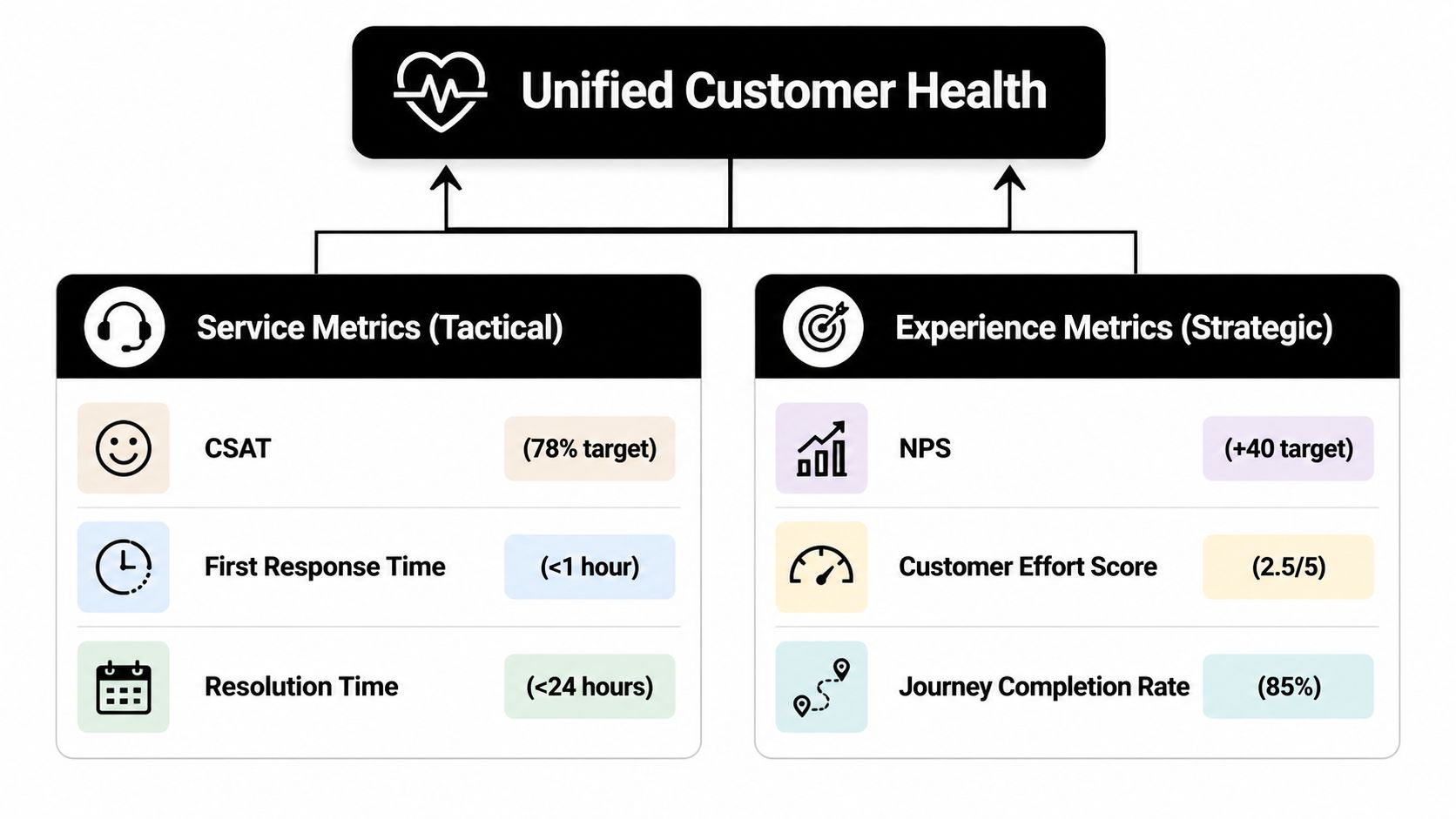
A practical dashboard usually looks like this:
- Service layer: case handling quality, response timing, resolution effectiveness, and escalation patterns.
- Experience layer: journey completion, relationship health, effort, loyalty, and churn direction.
- Connection layer: which journey steps generate the most service contacts, and which contacts point to a broken experience upstream.
The trick is attribution. If several touchpoints shape the customer's view, don't pretend one department owns the entire outcome. Use service data to locate friction, then use journey data to decide what gets fixed first. That's the difference between reporting and operating.
The strongest teams don't ask, “Which metric won?” They ask, “Which metric changed because the customer's experience improved?” That shift keeps support leaders accountable for execution and CX leaders accountable for the system around it.
How Conversational AI Bridges Service and Experience
Traditional service workflows are built around tickets, queues, and reactive handling. Conversational AI changes that by giving organizations a way to answer questions, surface context, and trigger next steps across the journey instead of only closing the case in front of them. That's where service starts to feed CX instead of sitting apart from it.
Yellow.ai is one example of this shift. Its platform combines multi-LLM architecture, omnichannel orchestration across voice, chat, email, images, and video, and 150+ pre-built integrations with systems such as Salesforce, Zendesk, and HubSpot, which lets teams connect service interactions to broader customer data and workflows. In practical terms, that means a routine support issue can be resolved in the channel where it started, while the underlying signals flow back into journey-level decision making.
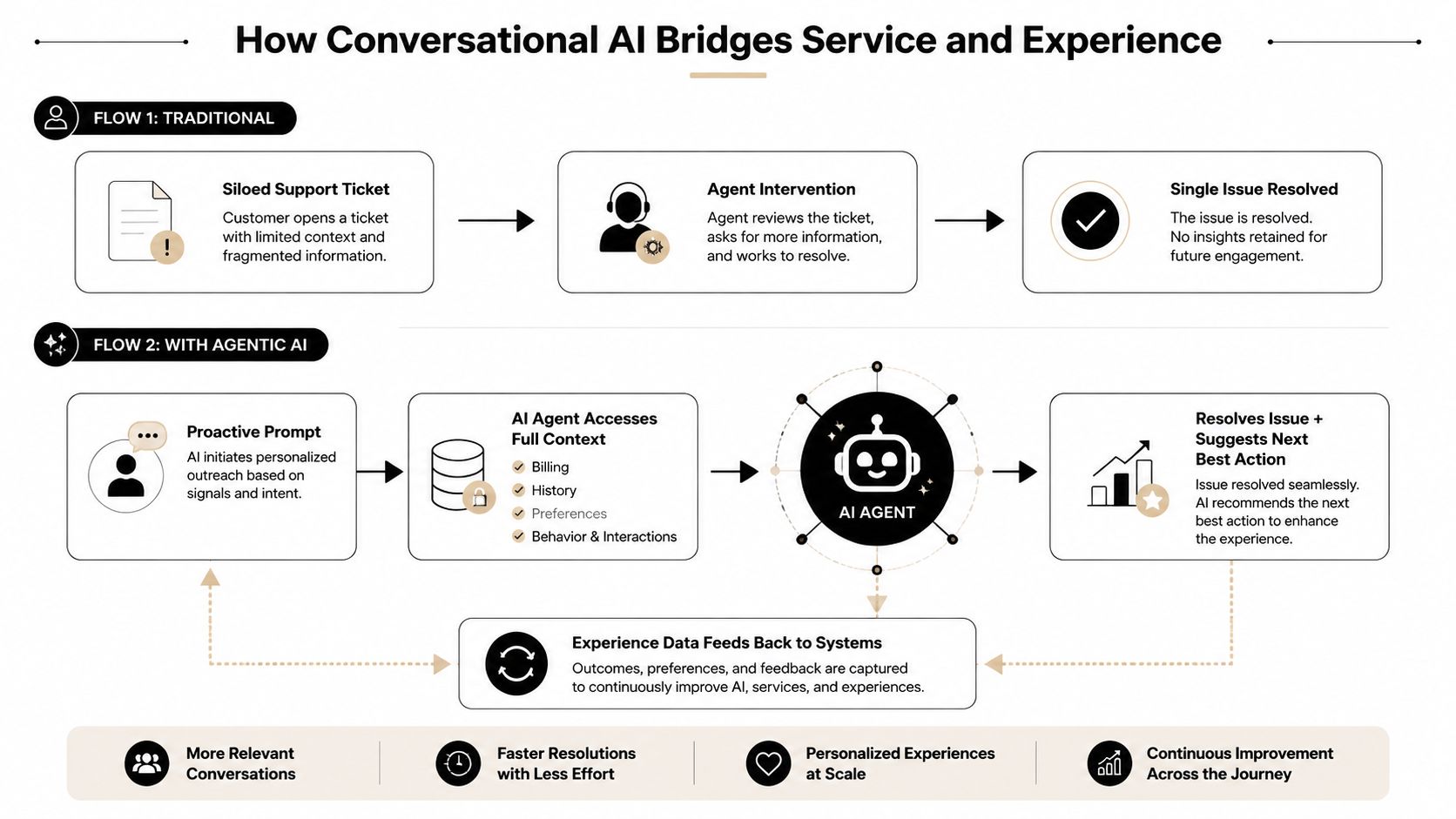
The strategic change is bigger than automation. Agentic systems can use context from billing, history, and preferences to resolve the issue and suggest the next best action, which means support stops being a dead end and starts becoming an input to experience orchestration. That's the bridge leaders have been missing when they try to separate service from CX too rigidly.
A lot of teams still treat AI as a deflection layer. That's too narrow. The better use case is to let AI absorb repetitive service work, preserve human capacity for exceptions, and feed the organization with cleaner signals about where the journey is breaking. A platform such as Yellow.ai's conversational AI stack fits that model because it sits between support execution and experience intelligence, not just inside the queue.
Checklist for Shifting From Service-Led to CX-Led Operations
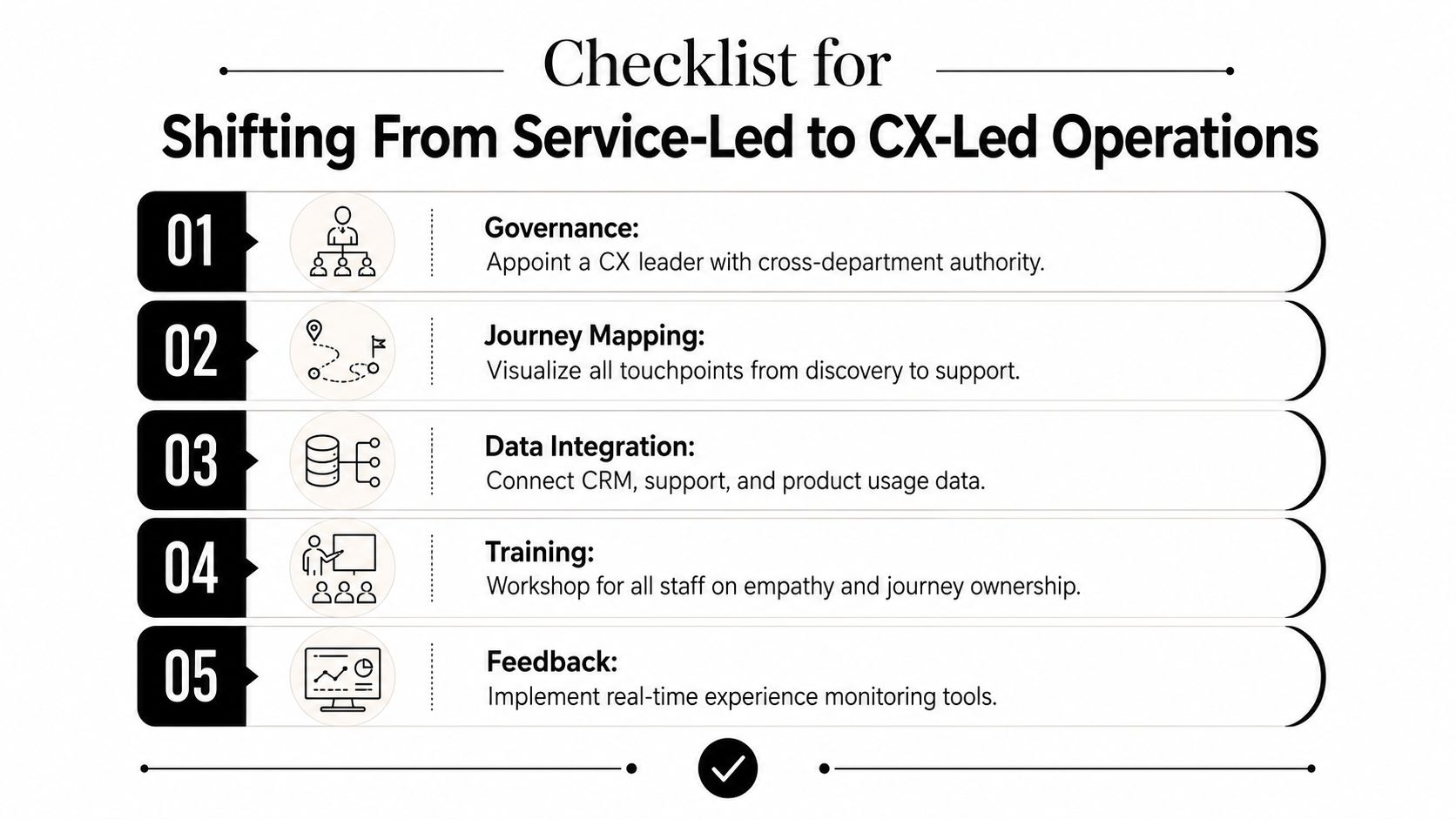
The shift starts with governance, not software. Appoint a CX owner with authority across departments, then define which decisions sit with support, which sit with product or marketing, and which require shared approval. If no one can change the journey, CX is just a label on a dashboard.
Next, map the full journey and connect the systems behind it. Teams need to see where customers discover, buy, use, ask for help, and renew, then connect CRM, support, and product data so the friction is visible in one place. Without that link, every team will keep defending its own slice of the truth.
A practical rollout usually follows three phases:
- Quick wins: standardize escalation paths, remove obvious support friction, and tie recurring cases to a root-cause owner.
- Medium-term changes: create journey teams that include support, product, marketing, and operations, then review the biggest friction points together.
- Long-term transformation: move measurement from contact outcomes to journey outcomes and make customer journey ownership part of planning, not just reporting.
Training matters at every phase. Support teams need stronger empathy and troubleshooting skills, while adjacent teams need to understand how their decisions shape the customer's perception. The success indicator is simple, recurring customer pain stops bouncing between departments and starts getting fixed at the source.
If you want a practical way to move from reactive support to coordinated customer journeys, start with the systems that can connect those two worlds. Yellow.ai helps enterprise teams automate service interactions, orchestrate omnichannel conversations, and feed customer signals back into broader CX work. Visit Yellow.ai to see how its platform supports that shift in practice.



