














A recurring subscription payment fails overnight. The billing dashboard shows decline code 51, the customer hasn't complained yet, and your support queue is about to inherit the problem. One agent may tell the customer to “use another card,” while another retries the same payment repeatedly, creating more noise without addressing the actual cause.
That response is too shallow. Code 51 usually indicates a temporary authorization problem, but the right action depends on the difference between available balance and ledger balance, the customer's card type, the payment history, and the issuer's response. A good operating playbook helps teams diagnose the event, explain it without embarrassing the cardholder, choose a sensible retry path, and automate the first conversation without losing accuracy.
Table of Contents
- When a Customer Says Their Card Was Declined
- What Decline Code 51 Actually Means
- Why Code 51 Happens Across Issuers and Merchants
- A Diagnostic Flow for Support and Payments Teams
- Support Scripts and Automated Conversational Flows
- Retry Strategy, Timing, and Alternative Payment Methods
- Monitoring, Analytics, and Prevention Playbook
- Key Takeaways and Frequently Asked Questions
When a Customer Says Their Card Was Declined
The support agent opens the account and sees a failed renewal from a few hours earlier. The payment gateway returned code 51, so the subscription is still active, but the next billing attempt needs a decision. Should the team retry now, send a payment-update message, offer another method, or wait for the customer to act?
The agent shouldn't begin with a generic script. First, they need to confirm that the decline really is code 51 and not a gateway translation of another issuer response. Then they need to understand whether the customer's account may have funds that are temporarily unavailable because of pending authorizations or holds.
A calm response matters as much as the payment logic. Customers often see a healthy posted balance in their banking app and conclude that the merchant or processor made a mistake. Telling them to “use another card” misses the reason the payment failed and can make a legitimate customer feel blamed.
Practical rule: Treat code 51 as a payment-state problem first, not as evidence that the customer has permanently lost access to the card.
This article lays out a practical operating model for payments, billing, and CX teams. It covers what the code means, how to separate issuer conditions from merchant timing, how to diagnose the raw authorization response, and how to decide between retrying, requesting another method, or escalating. It also shows how teams can turn the same logic into an automated conversational flow while keeping sensitive payment information out of the interaction.
What Decline Code 51 Actually Means
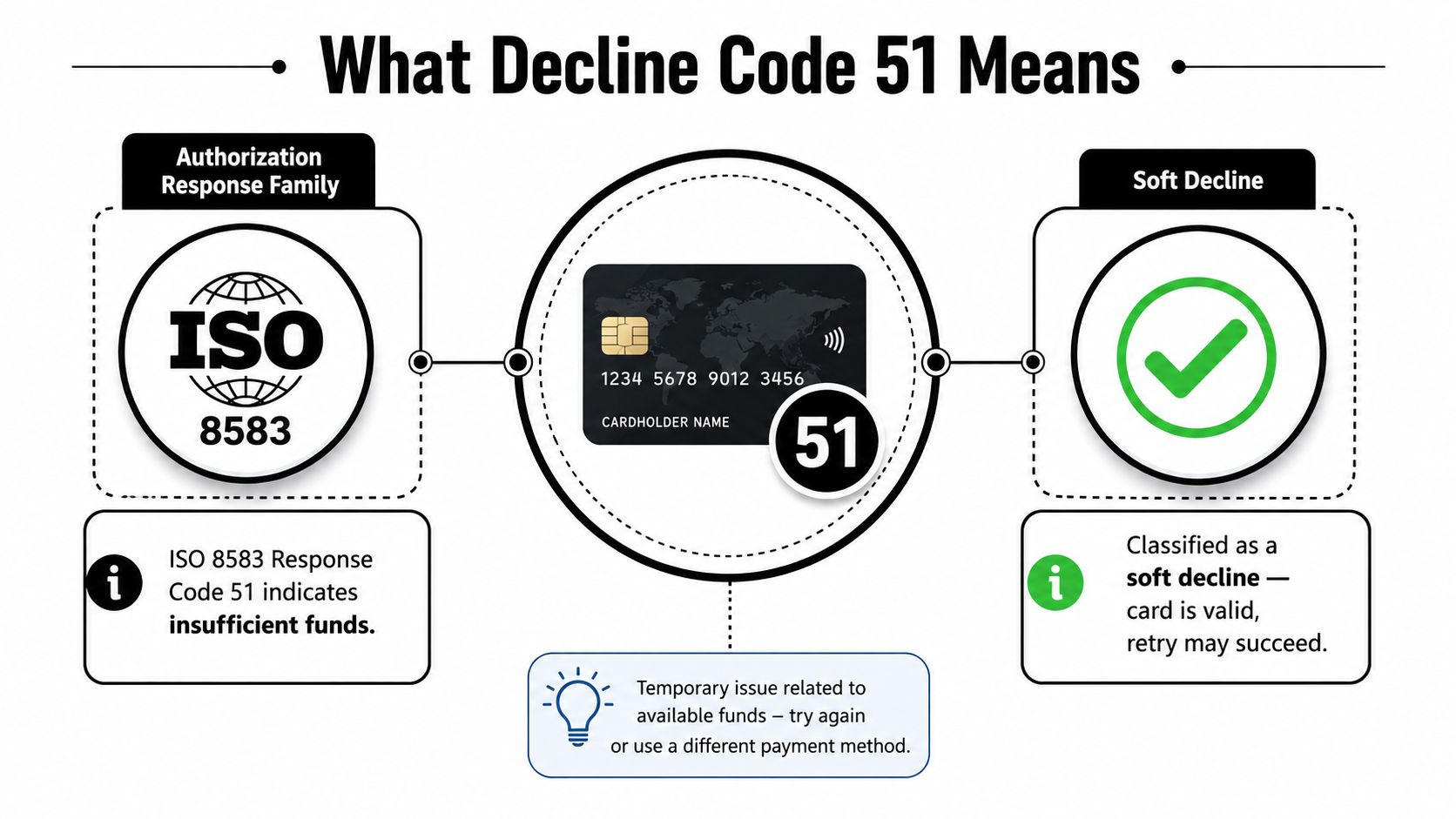
Decline code 51 is an authorization response used to indicate insufficient funds or unavailable balance. In ISO 8583-style payment messaging, the issuer returns it when the card's available funds or credit availability fall below the amount requested. Payment operations commonly classify it as a soft decline, which means the card may still be valid and a later authorization can succeed. The payment decline code reference from Chargeback Gurus describes code 51 within this card-processing context.
The important word is available. A ledger or posted balance records money that has settled into the account, but the issuer authorizes against what the cardholder can spend at that moment. Pending purchases, hotel or rental holds, previous authorization attempts, and other concurrent transactions can reduce that spendable amount. A customer can therefore see money in the account and still receive code 51 because the issuer's available-balance calculation is lower than the charge.
The card type changes the conversation
For a debit card, the issue may be a low available account balance, pending holds, or a spending restriction applied by the issuer. For a credit card, code 51 can reflect insufficient available credit because the customer is near the limit or because pending authorizations have consumed part of that line. A prepaid card can return the same response when its stored value has been depleted or its usable balance is lower than the customer expects.
That distinction gives agents better language. Instead of saying, “You don't have enough money,” say, “The card issuer couldn't approve the amount using the balance or credit available at that moment.” Customers who need more context about payment-instrument failures may also find resolving crypto card errors with NomadCards useful, especially when a specialized card has its own balance and authorization rules.
The code doesn't guarantee that the next attempt will work, and it doesn't tell the merchant exactly which balance condition caused the response. It does tell the team that the first troubleshooting path should focus on fund availability, pending activity, card limits, and timing, rather than immediately treating the card as invalid.
Why Code 51 Happens Across Issuers and Merchants
Code 51 looks simple in a gateway report, but the operating cause can sit in several places. The issuer makes the final authorization decision, yet the merchant's billing schedule and the cardholder's spending pattern often determine when the request arrives.
Issuer-side conditions
The most direct cause is an available balance below the transaction amount. On credit, the equivalent condition may be insufficient available credit. Pending authorizations can create the same result without changing the customer's visible posted balance. An account that received a deposit recently may still fail if earlier holds or authorizations have reserved the funds.
Issuer behavior also varies by product. Debit accounts can enforce available-funds rules, credit products can restrict remaining credit, and prepaid products can run out of usable value even when the customer believes the card should still work. The Stripe overview of decline codes is useful for explaining why a single response code can require different customer guidance.
Merchant-side timing
A subscription charge scheduled just before a customer's expected deposit can arrive during a low-balance window. The merchant may then retry several times before the account changes state. Currency conversion, billing adjustments, and a charge amount that differs from the customer's usual renewal can also make an authorization exceed what's available.
Cardholder-side patterns
Recent large purchases, prepaid depletion, and recurring household charges can consume funds before the renewal runs. A customer may also know that money is arriving soon and assume the issuer will authorize against it before it settles. The issuer won't make that assumption. It evaluates the account as it exists during the authorization request.
Subscription, SaaS, and utility merchants see this response repeatedly because they charge stored payment credentials on a schedule. That makes code 51 a useful operational signal, not just a one-off support label. Teams building financial-services support workflows can use BFSI customer service automation guidance from Yellow.ai as a reference point for designing conversations around account-sensitive events.
A Diagnostic Flow for Support and Payments Teams
A reliable investigation starts with the payment record, not the customer's interpretation of the error. Run the following flow in order and record the result in the case or payment event.
Confirm the raw response. Check the gateway's authorization object, response code, network response, and decline reason. Decision rule: if the raw issuer response isn't 51, stop using the code 51 playbook. Typical fields include
response_code,network_response_code, and the processor's normalized decline category.Classify the decline. Mark the event as soft or hard according to the issuer response and your processor's guidance. Decision rule: a code 51 event is generally eligible for a carefully timed recovery attempt, while a response that indicates an invalid, closed, or blocked instrument needs a different path.
Separate available from ledger balance. Don't ask the merchant dashboard to prove what the issuer sees. Decision rule: if the customer reports a healthy posted balance, ask them to check available funds and pending activity through their bank. In your system, inspect the amount requested, currency, card type, and any balance information exposed through an approved integration.
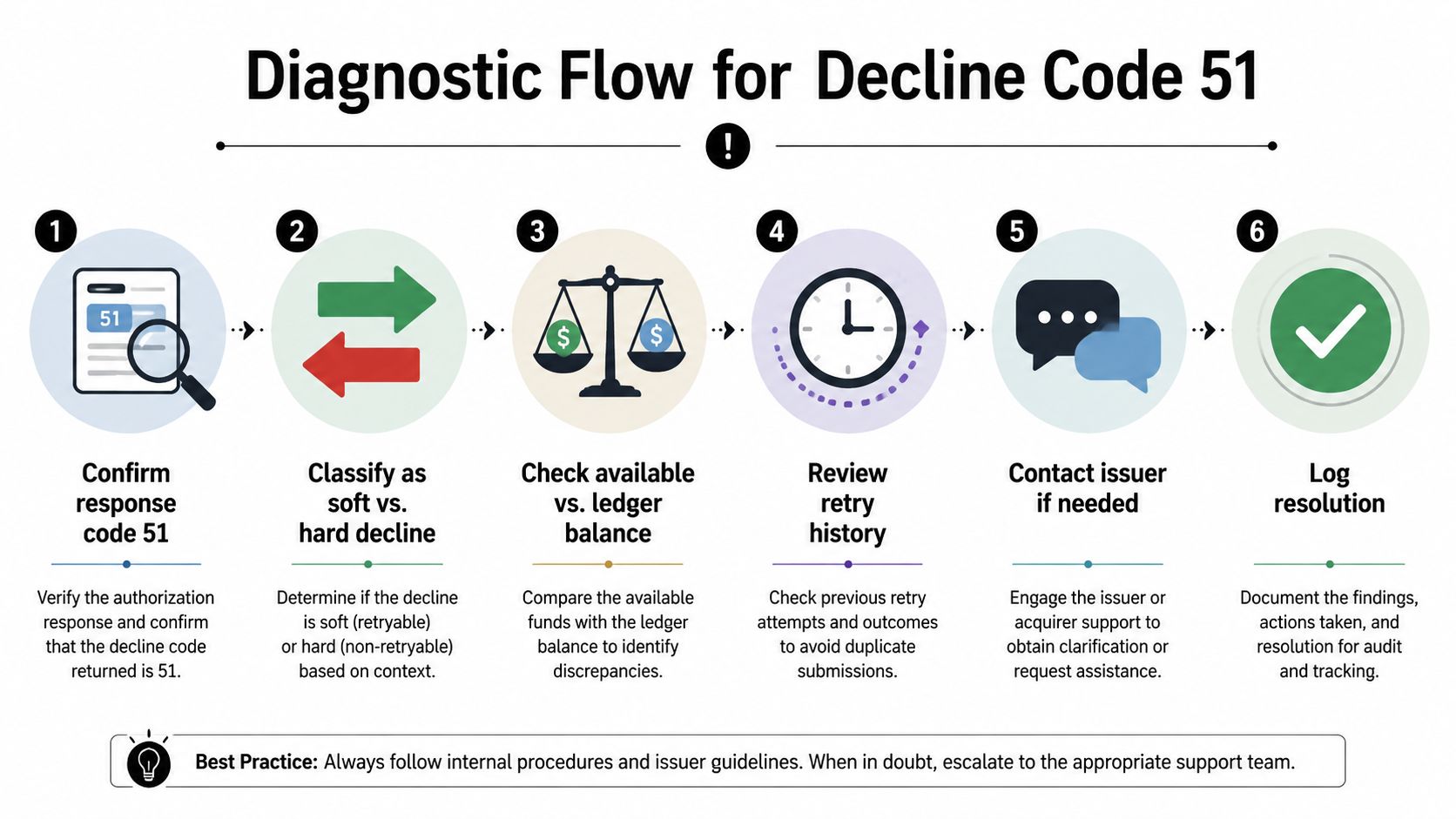
Review recent attempts and holds. Look at authorization timestamps, pending payment events, duplicate attempts, and the customer's billing history. Decision rule: don't fire another immediate attempt just because the first one failed. Confirm whether an earlier authorization or merchant hold could still be affecting availability.
Inspect issuer and card-segment behavior. Compare the event with your permitted BIN, issuer, country, card-type, and product metadata. Decision rule: use segment patterns to choose timing and messaging, but don't infer a customer's personal balance from a BIN. A repeated pattern can indicate a billing-window issue rather than a single customer problem.
Choose the next action and log it. Select a delayed retry, an alternative payment method prompt, a customer-service escalation, or a stop decision. Decision rule: every action should have a reason, an owner, and a next timestamp. Record the response code, payment token, attempt status, and resolution without storing prohibited card data.
This flow keeps agents from confusing a recoverable authorization issue with a permanent card failure. It also gives engineering and billing teams structured data for improving retry policies later.
Support Scripts and Automated Conversational Flows
The customer needs a clear explanation, not an internal code. A live agent can say:
“The card issuer couldn't approve this payment using the funds or credit available at that moment. Pending transactions or holds can affect that amount even when the account's posted balance looks higher. Please check your available balance with your bank, or choose another payment method if you'd like to complete the payment now.”
That wording avoids claiming knowledge the merchant doesn't have. The agent shouldn't say the customer's account is empty, that the card is maxed out, or that the merchant system caused the failure.
For an outbound recovery message, use a shorter version:
“We couldn't complete your scheduled payment because the card issuer reported that the available balance or credit wasn't sufficient at the time of authorization. You can check the card's available funds and pending activity, update your payment method, or wait for our next permitted attempt.”
Turning the script into automation
An automated flow should detect customer language such as “payment failed,” “my subscription didn't renew,” or “decline code 51.” It should then retrieve the payment status from the billing system using a token or account reference, never a full card number.
A practical decision tree looks like this:
- Code 51 confirmed: Explain available funds, mention pending activity, and offer a supported update-payment path.
- Different decline confirmed: Use the matching decline guidance instead of forcing a code 51 explanation.
- Customer says funds were added: Explain that the issuer may need to reflect the funds in available balance before authorization can succeed, then offer the permitted next step.
- Customer wants to retry immediately: Explain that an immediate repeat may fail again and present an alternative method or delayed retry option.
- Customer disputes the event: Route to a human agent with the raw response, attempt history, and conversation transcript attached.
- Payment data is requested: Keep sensitive card entry inside the compliant payment-hosted flow, not in free-form chat.
Agent-assist tooling can help a human follow the same policy consistently. Teams evaluating Yellow.ai Agent Assist can use this type of flow as a model for surfacing the right explanation, fields, and escalation rule without making the agent search through internal documentation.
Retry Strategy, Timing, and Alternative Payment Methods
A retry policy should reflect the fact that code 51 is often temporary, but it shouldn't treat every failed authorization as an invitation to keep submitting requests. Industry payment commentary cited by Slicker's code 51 retry guidance places recurring payment declines at about 15% of attempts, with insufficient-funds-related responses representing a disproportionate share. The same source cites code 51 and code 05 together as representing over 76% of globally declined transactions. Those benchmarks justify investment in recovery logic, but your own authorization history should determine the final policy.
| Strategy | Typical timing | Best for | Watch out for |
|---|---|---|---|
| Immediate retry | Shortly after the first failure | Rare cases where a transient gateway condition is suspected and the processor explicitly permits another attempt | Repeating the same issuer decision, frustrating customers, and consuming attempts without changing account availability |
| Fixed delay | After a defined waiting period | Simple billing systems with limited customer and payment-history data | A calendar delay may miss the customer's actual replenishment pattern |
| Context-aware retry | Around a likely funds-availability window | Subscription portfolios with useful payment history and regional or customer timing signals | Poor segmentation can create false confidence, so monitor recovery by cohort |
| Dunning plus an alternative method | After the recovery path needs customer action | Persistent failures, prepaid depletion, or customers who need to update credentials | Excessive messaging can turn a temporary issue into avoidable churn |
For subscriptions, use the least aggressive policy that gives funds time to become available, then ask for a new method when the history shows that silent recovery isn't working. Utility billing needs stronger customer communication because service continuity can matter more than convenience. High-volume recurring merchants should segment by product, geography, issuer, and billing day instead of applying one universal schedule.
An alternative payment method prompt should appear as a choice, not a threat. Customers might use another card, a bank-based method, or a wallet connected to a different funding source, depending on what the merchant supports. Teams reviewing payment economics alongside recovery workflows may also find Zaro's guide to reducing hidden card fees relevant when comparing payment methods and processing costs.
Monitoring, Analytics, and Prevention Playbook
A decline code 51 program needs a feedback loop. The dashboard should show where failures occur, what the team did next, and whether the customer ultimately paid.
Track these measures by plan, region, card type, issuer segment, billing date, and acquisition channel:
- Code 51 share of declines: Shows whether insufficient-availability responses are concentrated in a specific product or billing window.
- Retry success rate: Separates useful delayed attempts from repeated failures.
- Recovered payment value: Connects authorization decisions to recovered revenue without treating every retry as successful work.
- Churn after code 51: Identifies customers who cancel or become inactive after the failed payment.
- Alternative-payment adoption: Shows whether prompts are helping customers complete payment.
- Attempts per recovery: Reveals whether the team is spending too many authorization attempts to recover a small number of payments.
Use a weekly operating review to inspect sudden changes by issuer, plan, and billing cohort. Use a monthly review to adjust retry rules, customer messaging, and payment-method coverage. A rise in code 51 around one renewal date may point to billing timing. A rise in one card segment may require issuer or processor investigation.
Build prevention into the customer journey
Send a proactive reminder before renewal when your customer relationship and consent model support it. Give the customer a safe way to update the payment method, and keep the message focused on continuity rather than blame. For prepaid products, make the balance and reload path easy to find.
Automation should consume the same event data as the payment dashboard. A confirmed code 51 can trigger a conversational nudge, while a recovered payment can suppress further outreach. Keep payment security and compliance in the design, including the controls discussed in Yellow.ai's PCI DSS v4.0.1 compliance overview.
Operating principle: Don't optimize for the number of retries. Optimize for compliant recovery with the fewest customer interruptions.
Key Takeaways and Frequently Asked Questions
Code 51 deserves a dedicated operating path because it often represents a temporary availability problem, not a permanently unusable card. The best teams confirm the raw response, explain available balance clearly, review pending activity, and choose a retry or alternative-method path based on evidence.
Four practices keep the process reliable:
- Treat the response precisely: Don't call every payment failure code 51, and don't promise that a retry will succeed.
- Design around context: Debit, credit, prepaid, subscription, utility, and high-volume recurring scenarios need different customer guidance.
- Automate the first response carefully: Use payment status and decline type to select the conversation, while keeping sensitive card entry in a compliant flow.
- Measure the entire outcome: A successful authorization is useful, but so are reduced repeat attempts, lower post-decline churn, and faster customer resolution.
Frequently asked questions
Can code 51 mean something besides a low bank balance?
Yes. The response centers on insufficient available funds or credit, but that can include an exceeded credit limit, pending holds, prepaid depletion, or another issuer-side availability constraint. The merchant usually can't identify the exact condition from code 51 alone.
Does a recent deposit guarantee that the next retry will work?
No. The issuer authorizes against the available amount at the time of the request. A deposit may appear in a customer's account while pending activity, holds, or issuer processing rules still limit what the card can spend.
Should every code 51 event receive a customer message?
No. A carefully timed recovery attempt may resolve a temporary issue without intervention. Contact the customer when the payment needs a new method, the failure persists, the service is at risk, or the account history indicates that automated recovery is unlikely to work.
Do prepaid cards require different handling?
They do. A prepaid card may need a reload or replacement funding source rather than a delayed retry. The conversation should offer that path instead of assuming the customer's regular bank balance will change.
What should a team do when code 51 keeps recurring?
Segment the events and investigate billing timing, card type, issuer patterns, pending holds, and customer payment history. Then adjust retry and outreach rules, document the decision, and monitor recovery rather than repeatedly submitting the same authorization.
Yellow.ai helps enterprise teams automate decline-code detection, customer explanations, payment-update conversations, and human escalation across supported channels. Visit Yellow.ai to see how agentic AI can connect payment events with accurate, conversational CX workflows.



