










The most popular advice about customer data protection is to secure the database, restrict access, and encrypt everything. Those controls still matter, but they don't define the modern risk boundary. An AI agent can retrieve a permitted record, combine it with conversation history, pass selected context to a language model, call a third-party system, and produce a response that reveals more than any single source contained.
That changes the architecture problem. CX and IT leaders aren't protecting only stored records. They're governing dynamic, probabilistic data flows across prompts, retrieval systems, model providers, tools, logs, memory stores, and human handoffs. A secure warehouse can sit behind strong controls while an agent exports sensitive context through an unreviewed connector or retains it in an inference trace.
The practical question is no longer, “Where is customer data stored?” It's “Which system can see it, transform it, remember it, reuse it, and act on it?”
Table of Contents
- The New Perimeter of Agentic AI
- Financial and Regulatory Stakes
- Technical Controls and Key Management
- Privacy-Preserving AI Architectures
- Operationalizing Data Rights Workflows
- Navigating AI Transparency and Trust
- Enterprise Implementation Roadmap
The New Perimeter of Agentic AI
Traditional security models assume a fairly stable path. An application authenticates a user, queries a database, applies deterministic business logic, and returns a result. Agentic AI breaks that assumption. An agent interprets an open-ended request, selects tools, retrieves documents, reasons over context, and may ask another model or service to complete part of the task.

The warehouse may remain well protected, yet the agent can still create exposure through context assembly. A support bot might retrieve an account profile, a billing note, and an internal exception policy. Individually, each item may be authorized. Together, they can disclose identity, financial circumstances, or operational details to a model, a plugin, or a transcript archive that follows different retention and access rules.
Why deterministic boundaries fail
An LLM doesn't behave like a conventional query engine. It generates a likely response from the information placed in its context, and that context can include user text, retrieved passages, prior turns, tool results, system instructions, and hidden metadata. The model may not distinguish perfectly between trusted instructions and hostile content embedded in a document or message.
Prompt injection exploits that ambiguity. A malicious customer message, poisoned knowledge-base article, or compromised webpage can instruct an agent to ignore its original task, reveal hidden context, or invoke a tool with excessive authority. Traditional perimeter controls won't catch every such instruction because the request may be syntactically valid and authenticated.
A safer design treats each transition as a policy decision:
- Retrieval boundary: Which records may enter the agent's working context for this user and purpose?
- Model boundary: Which provider may process the content, in which region, under which retention terms?
- Tool boundary: Which actions may the agent take, and what fields must be masked before a call?
- Memory boundary: Which conversation facts may persist, for how long, and who can retrieve them?
- Output boundary: Which generated claims or fields require validation before reaching a customer or employee?
Agentic architecture guidance, including the patented approach to agentic AI, is useful only when it translates into enforceable boundaries. A diagram showing secure components isn't enough. Teams need runtime controls that inspect prompts, retrieved context, tool arguments, and outputs.
Practical rule: Treat every model call and tool invocation as a new data-sharing event, even when it occurs inside one vendor platform.
The perimeter has therefore moved from the network edge to the orchestration layer. Customer data protection must follow information as it is copied, summarized, tokenized, embedded, retrieved, and transformed. If security reviews cover only databases and APIs, they're reviewing the least surprising part of the workflow.
Financial and Regulatory Stakes
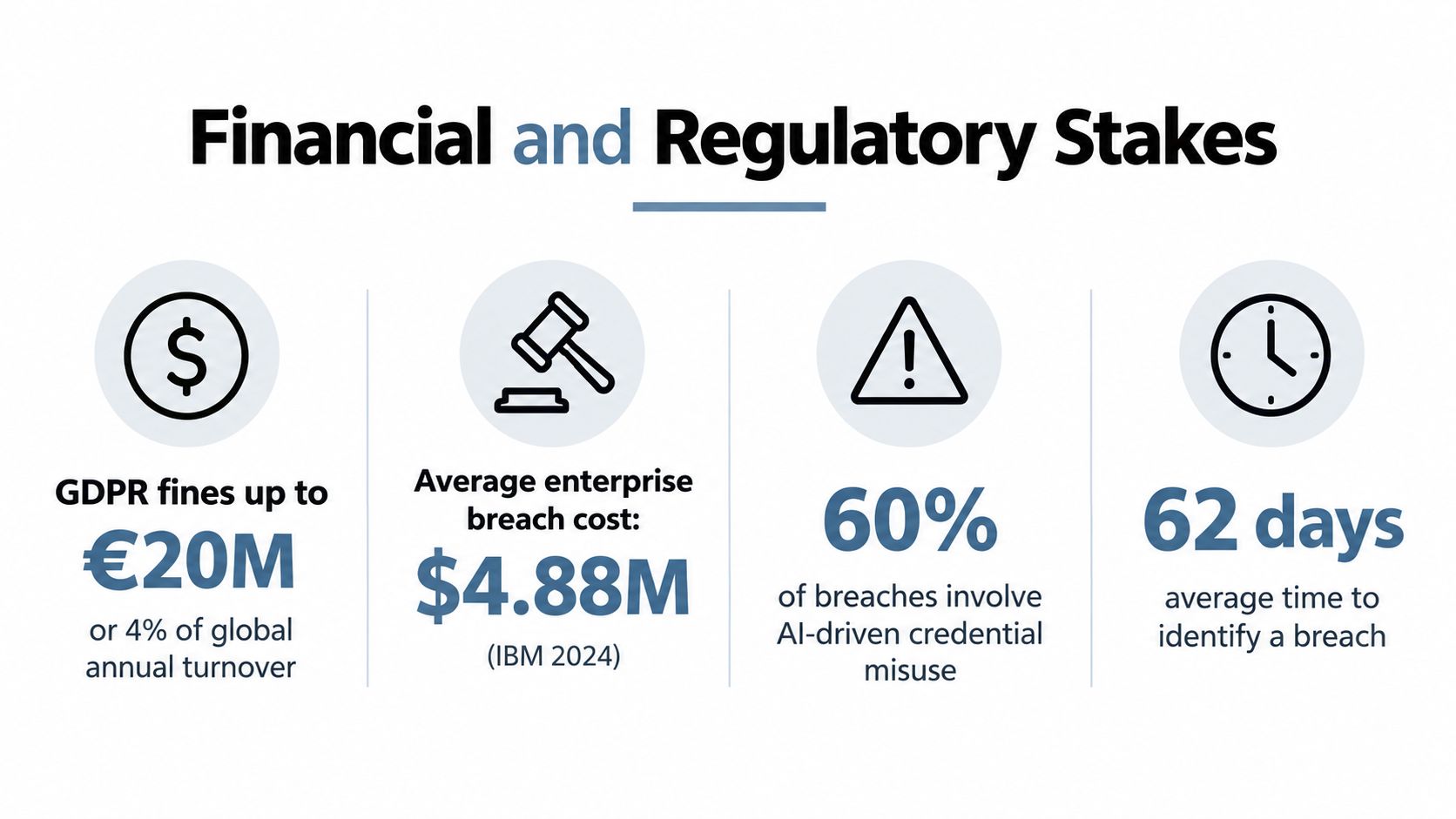
AI introduces more processing paths, but the business consequences remain familiar: unauthorized disclosure can trigger remediation, legal exposure, lost customers, and damaged trust. The scale of that exposure is visible in the IBM Cost of a Data Breach 2025 report. The global average cost of a breach fell to USD 4.44 million in 2025, the first decline in five years, while U.S. organizations still faced an average of USD 10.22 million.
The environment matters. Breaches involving multiple environments averaged USD 5.05 million, compared with USD 4.01 million for on-premises breaches, according to the same benchmark. For enterprises combining private systems, cloud CX platforms, vector stores, and external AI services, hybrid architecture isn't just an integration choice. It can increase the financial exposure attached to customer data protection.
Regulation follows the data
As of 2025, privacy or data protection legislation had been enacted in 144 countries, covering more than 79% of the global population, as reported in Termly's data privacy statistics. An enterprise agent may serve customers across several of those jurisdictions in one workflow, while its model provider, observability service, and support system operate elsewhere.
That creates several decisions that legal teams can't leave to default vendor settings:
| Decision | Architecture question |
|---|---|
| Purpose | Is the data used to resolve a request, improve a service, train a model, or support fraud controls? |
| Location | Which systems process the data, and where are those systems located? |
| Retention | Do prompts, embeddings, transcripts, and tool logs follow the same deletion policy? |
| Responsibility | Which party handles access, correction, deletion, and incident response requests? |
Revenue is directly involved. 75% of consumers are unwilling to buy from organizations they don't trust with personal data, and 47% have switched companies because of poor data practices, according to the Termly source above. A privacy failure can therefore affect conversion and retention before a regulator contacts the organization.
The right governance forum includes the board, risk, legal, CX, security, data, and procurement leaders. A PCI-focused control review can help teams understand payment-data obligations, and this PCI DSS v4.0.1 compliance guide provides relevant context for regulated CX workflows. The central issue is broader than a compliance ticket. It's whether the enterprise can explain and control every place an agent handles customer information.
Technical Controls and Key Management
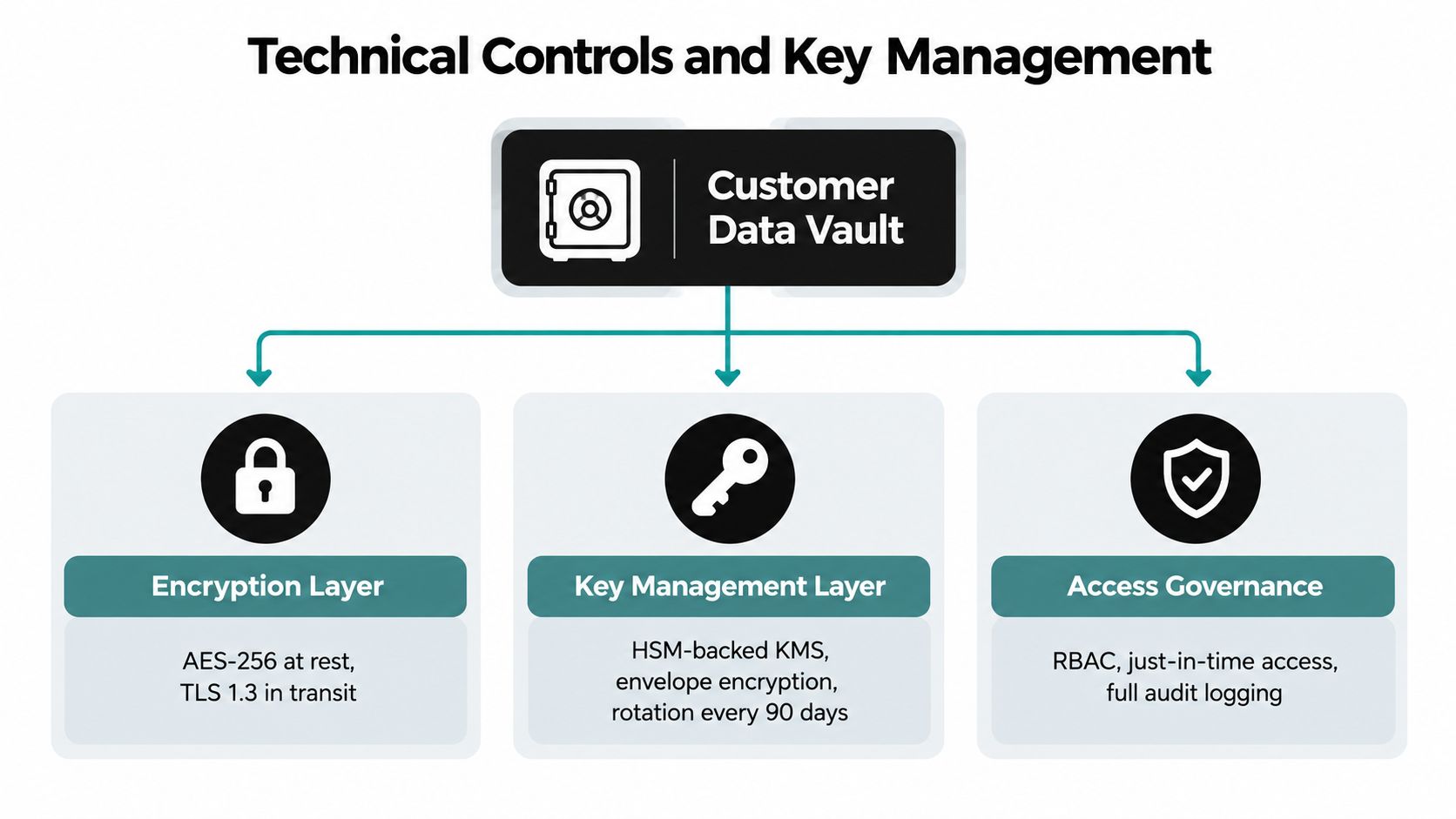
Encryption is necessary, but it isn't a complete customer data protection strategy. The decisive question is who controls the keys and how that control survives the full data lifecycle. The Thales enterprise key-management guidance makes the boundary explicit: keys must be generated, distributed, stored, rotated, revoked, and destroyed under enterprise controls.
If a third-party AI service stores ciphertext but controls the decryption path, the organization may have protected the storage layer without retaining meaningful custody. A person or system that possesses the key can restore plaintext. In an AI workflow, that plaintext may then enter a prompt, context window, cache, transcript, or model-generated summary.
Build controls around the lifecycle
Start with envelope encryption. Use a key-encryption key in a controlled key-management service to protect data-encryption keys, and separate the roles that administer keys, operate workloads, and approve access. Hardware-backed protection can reduce exposure to software compromise, but it doesn't replace authorization policy or monitoring.
A practical control set includes:
- Separate duties: The application team shouldn't be able to unilaterally retrieve keys and alter audit records.
- Automate rotation: Rotation should be policy-driven, tested, and independent of a manual request.
- Revoke decisively: Offboarding a vendor, agent, connector, or employee must terminate access without waiting for a storage migration.
- Log key use: Record which workload requested access, for what operation, and whether the request succeeded.
- Test recovery: A key policy that works only in normal conditions can become an availability risk during an incident.
Customer-controlled keys add another governance layer in cloud environments. The Microsoft Purview customer key overview notes that this pattern provides an extra layer of encryption at rest and lets organizations control root keys at the application level. It doesn't protect on-premises data or data in transit, so teams must avoid treating it as a universal control.
The cited Forrester TEI benchmark reported by Thales found a 70% reduction in encryption and key-management effort, $9 million in three-year financial benefits, and 221% ROI for the evaluated implementation. Those results describe a specific benchmark, not a guarantee. They do support a practical conclusion: automation can reduce operational friction when key ownership, access policy, and deployment boundaries are designed together.
Make the model path observable
Encryption must extend beyond databases. Inspect what enters prompts, what leaves retrieval systems, and which tools receive customer attributes. Before production, review a resource such as data breach prevention for businesses alongside your internal incident controls, then adapt the principles to AI-specific paths.
A secure enterprise platform should document its encryption, access, retention, and redaction behavior. Yellow.ai's enterprise-grade security capabilities are one example of the type of control surface procurement and security teams should examine. The key test isn't the presence of a security label. It's whether the vendor can show how controls apply to prompts, logs, connectors, and administrative access.
Privacy-Preserving AI Architectures
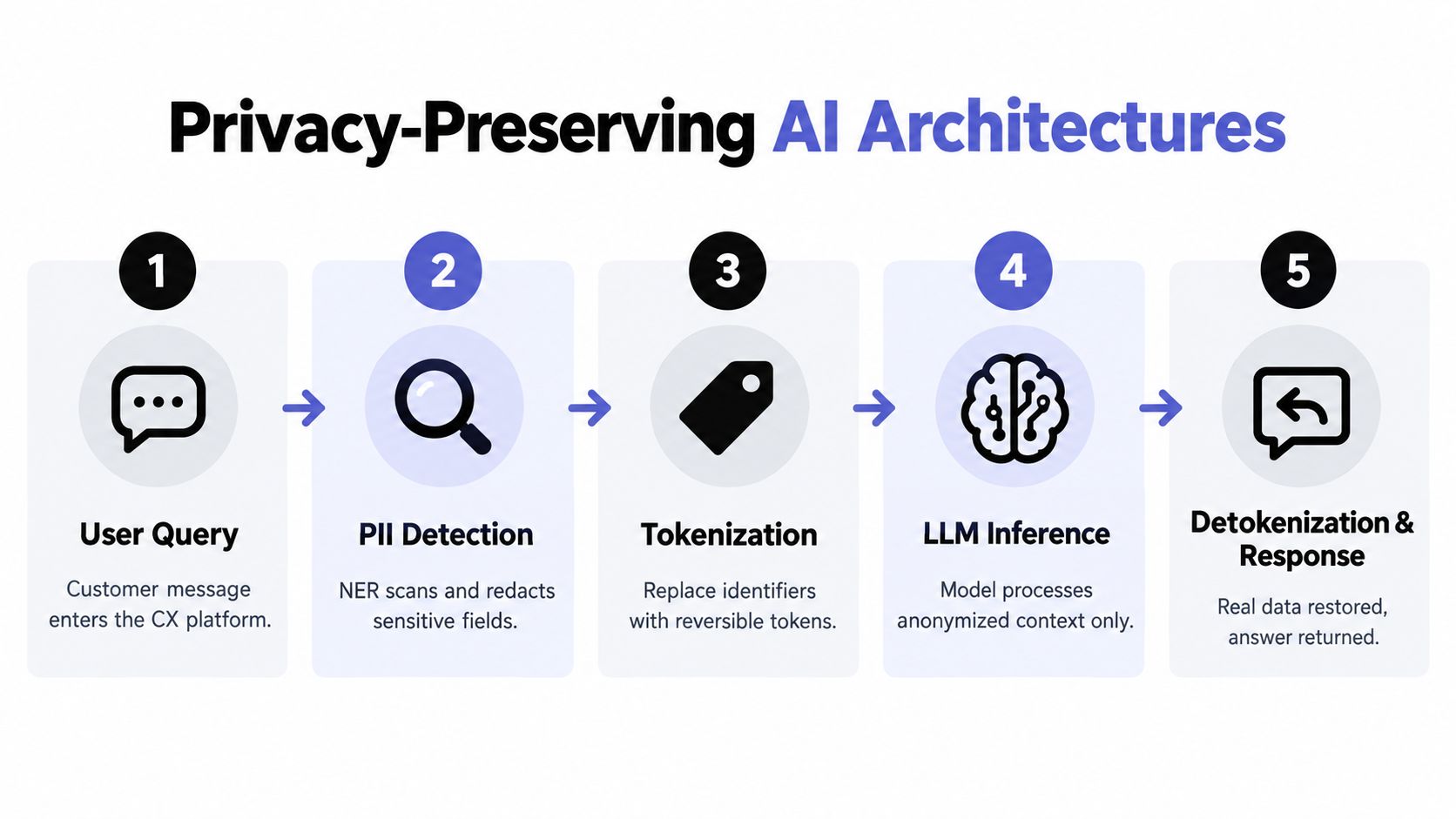
The safest prompt is often the one that never contains the original personal identifier. That principle changes how teams design conversational AI. Instead of sending a complete CRM record to a foundational model, place a controlled retrieval and transformation layer between the customer request and inference.
Retrieval-Augmented Generation, or RAG, can keep source knowledge in an approved repository while supplying the model with only the passages required for the current task. A vector database doesn't automatically make data private. It still needs tenant isolation, access-aware retrieval, retention rules, and deletion propagation. Embeddings can also preserve sensitive meaning, so treat them as governed data rather than harmless technical artifacts.
Minimize before inference
A well-designed flow begins with identity and purpose checks, not with the model. The platform detects sensitive fields, replaces them with reversible tokens, sends only the necessary context for reasoning, and restores approved values after validation.
That sequence has important limits. Redaction can fail on unusual formats, indirect identifiers, or information that becomes identifying when combined. Tokenization protects the model path only if the token vault remains separate, access-controlled, and unavailable to the reasoning model.
Use different controls for different data classes:
- Direct identifiers: Replace names, account numbers, addresses, and contact details with scoped tokens.
- Sensitive attributes: Remove or generalize information that the task doesn't require.
- Business context: Pass policy and product information without attaching unnecessary customer history.
- Actions: Require deterministic validation before an agent changes an account, issues a refund, or reveals a record.
- Logs: Store the minimum diagnostic detail needed to investigate failures, with independent retention rules.
Route models by risk
Multi-LLM routing can reduce dependence on one provider, but routing alone isn't privacy protection. The orchestrator needs a policy engine that selects a model based on data classification, residency, latency, capability, and contractual terms. A low-risk public FAQ can use a different path from a regulated account inquiry.
Compliance claims need precision. Standards such as HIPAA and SOC 2 may shape vendor evaluation, but certification doesn't authorize every use of customer data. Procurement should request a data-flow map, subprocessors, retention behavior, training commitments, regional processing options, deletion support, and incident responsibilities.
Teams should also document model and data lineage. Record which retrieval collection supplied an answer, which model processed the sanitized context, which tools were called, and which policy version governed the decision. That evidence supports investigations and helps explain an answer to a customer without exposing internal prompts.
For external policy comparison, the Ares privacy policy offers a useful reference point for reviewing how an AI-focused service describes data handling. Use it as a prompt for vendor questions, not as a substitute for your own legal assessment.
Operationalizing Data Rights Workflows
A privacy right that customers can't exercise reliably is a broken service. Many organizations publish access, correction, deletion, and portability commitments, then route requests through email, spreadsheets, and disconnected application owners. The legal policy exists, but the customer experiences delay, uncertainty, and repeated identity checks.
A yearlong Consumer Reports investigation found that roughly 25% of access requests received no response, while data brokers failed to respond to 34% of requests, according to the Consumer Reports investigation into personal-data access. Those findings show why customer data protection can't stop at notices and consent records.
Design the request as a case
CX platforms should treat a rights request as a governed case with a visible owner, not as an unstructured conversation. The workflow needs to identify the requester, determine the applicable jurisdiction and request type, search connected systems, record exceptions, and produce an auditable completion record.
A practical design includes:
- Identity verification: Use proportionate checks that prevent unauthorized disclosure without demanding unnecessary information.
- System inventory: Map CRM records, tickets, recordings, knowledge systems, vector collections, analytics stores, and vendor-held copies.
- Policy execution: Apply the correct action to each system. Deletion may mean removal, suppression, anonymization, or a legal hold.
- Exception handling: Escalate conflicting retention duties, fraud investigations, or records needed for dispute resolution.
- Customer communication: Show status, required steps, scope, and completion evidence in plain language.
- Quality assurance: Sample completed cases and test whether downstream copies were fully addressed.
The hardest part is usually propagation. An account may exist in a production CRM, a support transcript, a backup, a search index, and an embedding store. The workflow owner must know which locations are searchable, which are restorable, and which require documented compensating controls.
Privacy operations should be measured by completed, traceable outcomes, not by the existence of a privacy page.
CX leaders can turn this weakness into trust-building service design. Give customers one request channel, preserve a clear audit trail, and let authorized teams see where work stands. IT should expose system connectors and failure states, while privacy and legal teams define the decisions the workflow cannot make automatically.
Navigating AI Transparency and Trust
Enterprises often frame AI training as a binary choice. Either they use customer conversations to improve a model, or they prohibit all reuse. The better decision separates purpose, control, and evidence.
Training or fine-tuning may improve performance for a specialized service, especially when examples capture product language and recurring support issues. It also creates a durable reuse question. Once customer content influences a model or evaluation set, deleting the original record may not provide an intuitive answer about every downstream artifact.
A retrieval-first approach usually offers tighter operational boundaries. Teams can update or remove source documents, control access to collections, and record which material supported an answer. The trade-off is that the system must retrieve relevant context at runtime, and the organization must govern the retrieval layer carefully.
Consumers want understandable boundaries
The State of Digital Trust report from Usercentrics reports that 77% of global consumers don't fully understand how their data is collected and used, while 59% are uncomfortable with their data being used to train AI. The same source reports that only 44% identify transparency about data use as the main driver of trust.
Deloitte's findings in that source add a second concern. 70% of consumers were worried about privacy and security in 2025, while only 20% said technology providers were very clear about the data they collect or how they use it. Only 27% had high or very high trust that providers keep their data secure.
These results don't mean customers reject every form of data use. The cited research indicates greater comfort when a use provides a tangible benefit, such as fraud protection, and when specific guardrails are clear. That creates a more useful design standard than a long consent banner.
Explain five things at the point of collection or use:
- What is collected: Name the fields and interaction types, not just “personal information.”
- Why it is used: Separate service delivery, safety, analytics, personalization, and model improvement.
- Who processes it: Identify relevant vendors and the role each plays.
- How reuse is limited: State whether content enters training, evaluation, retrieval, or human review.
- How to change the decision: Offer practical controls for objection, deletion, correction, and future sharing.
Model cards and lineage records should support these explanations internally. Customers don't need an architectural diagram, but they do need a truthful answer to whether an agent saw their data, whether a vendor processed it, and how the organization can limit reuse.
Enterprise Implementation Roadmap
A workable roadmap starts with inventory, not model selection. Map every CX and EX journey where an agent can encounter customer or employee information, then classify the data before deciding which model, tool, memory store, or vendor may handle it.
Phase one, establish the boundary
Create a data-flow register for prompts, retrieval collections, embeddings, tool calls, transcripts, analytics, backups, and human escalations. Assign an owner to each flow and record purpose, residency, retention, access roles, subprocessors, and deletion behavior.
Phase two, enforce runtime policy
Put an authorization and transformation layer in front of model calls. Add PII detection, tokenization or redaction, purpose-based retrieval, tool allowlists, output validation, and human approval for high-impact actions. Keep credentials outside prompts and grant agents the minimum permissions needed for the task.
Phase three, test failure paths
Don't test only successful conversations. Inject malicious instructions into customer messages and knowledge documents, attempt cross-tenant retrieval, submit rights requests for records spread across systems, and inspect whether logs retain sensitive content. Test vendor outages, revoked keys, model changes, and incomplete deletion signals.
Phase four, monitor continuously
Track policy violations, blocked tool calls, sensitive data in prompts, retrieval anomalies, failed deletion jobs, access exceptions, and vendor changes. Review samples with CX, security, privacy, and legal teams. A control that isn't monitored will eventually drift from its approved design.
For enterprise deployments across Salesforce, Zendesk, Genesys, or voice channels, the release gate should require:
- Documented data paths: Every integration and model destination is known.
- Least privilege: Agents, operators, and vendors receive only necessary access.
- Traceable decisions: Retrieval, policy, tool, and response events can be reconstructed.
- Proven deletion: Rights workflows cover operational and derived stores.
- Clear customer language: Notices match actual processing behavior.
- Rollback readiness: Teams can disable an agent or connector without losing core service.
Yellow.ai offers agent building, agentic RAG, multi-LLM orchestration, automated testing, omnichannel integrations, and enterprise security controls for CX and EX deployments. Evaluate those capabilities against your own data classification, residency, retention, and audit requirements rather than treating platform functionality as a replacement for governance.
Build the data-flow register before expanding agent autonomy, then test every retrieval, tool, memory, and model boundary with realistic customer scenarios. If you need an enterprise platform for governed CX and EX agents, visit Yellow.ai to assess how its architecture and security controls fit your implementation requirements.